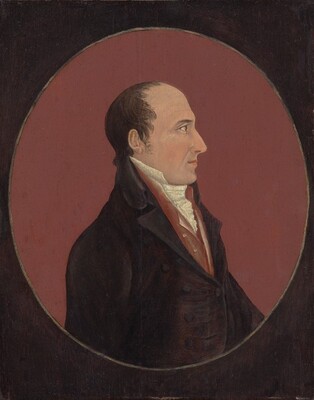
All Works

1,500 open-access works

The image shows a drawing of two ceramic jugs with a shared base and distinct necks. Both jugs feature decorative blue line illustrations including birds and geometric patterns. The jugs have a muted earthy palette with tones of brown and cream. They are positioned upright with the necks slightly flaring outwards, and display inscriptions of "New Haven" alongside the decorative imagery.

Gemel Bottle

Delasser, Yolande

The image shows a group of armored figures in front of a fortress. The figures are gathered around a large arched doorway with spiked and barred gates. Some of the figures are in dynamic poses, holding swords or staffs. The background includes a brick structure, adding to the fortress setting. The drawing is in black and white with detailed line work.

Christ Carrying the Cross

Altdorfer, Albrecht

This is an illustration of a figure drawn in ink, depicting a person standing. The person is facing slightly to the side with a gaze directed upwards. The facial features are rendered in fine lines, giving the face a serene expression, framed by hair styled in a bun with a decorative element. The figure is dressed in flowing robes and holding a shield or tablet with inscriptions with both hands. The background is plain.

Eritrean Sibyl

Spanish 17th Century

The sculpture is an oval-shaped relief featuring a dynamic scene with two figures. On the left side of the relief, a centaur is depicted. The centaur is in motion, with horse legs shown mid-step, and the human torso slightly turned with one arm raised. On the right, a human figure, possibly a warrior, is walking briskly and pulling an object with a rope. The human is depicted in a muscular form with detail given to the musculature and limbs. The relief is made from a metal material, likely bronze, with a brown color and a patina finish that adds depth to the details. The material is a dark, burnished bronze, with some areas highlighting lighter shades that accentuate the outlines and contours of the figures.

A Warrior Fighting a Horseman

Roman 15th Century

This is a photograph of a title page from a historical book. The page features the title "VOYAGE PITTORESQUE DE GENEVE A MILAN PAR LE SIMPLON." The text is printed in a classic serif font. There is an emblematic logo or monogram design beneath the main title text. The text "A PARIS" followed by "DE L’IMPRIMERIE DE P. DIDOT L’AINE" and "M. DCCCXI" indicates that the book was printed in Paris by P. Didot L'Ainé in the year 1811. The page shows some age-related spots or foxing. The overall aesthetic conveys a sense of historical documentation and elegance.

Voyage pittoresque de Genève à Milan par le Simplon

Lory, Gabriel Ludwig

The image shows the entrance of the Cathedral of Chartres with its Gothic architectural details. The horizon is at about one-third from the top, with a tree line and faint clouds in the sky. The precise rendering showcases intricate sculptures on the large stone facade. The color palette consists of various shades of gray and sepia tones. The scene includes the steps to the cathedral entrance, a row of trees, and a building with a window to the right.

Planche XII – Cathédrale de Chartres, Portique du Midi (Plate XII – Chartres Cathedral, South Entrance)

Nègre, Charles

A garden with two fountains stretches back to a manor house in the distance in this horizontal landscape painting. The horizon comes about a third of the way up the composition, and gray clouds tower in the vivid blue sky above. A pine tree closer to us to the left of center rises high against the sky. There are a few more evergreens to the right among dark-green canopied trees. A yellowed pine tree has fallen on the grassy lawn in the lower left quadrant of the composition. Just beyond this, the fountain to the left has a tall, columnar base under a dish-like basin. Water fountains sprays up and out from the center of the dish and trickles down the sides. The fountain is topped with a statue, perhaps of a child. Three people stand at the base of this fountain, which is three times their height. The fountain to the right has a blocky base about the height of a person. Water streams out from the front and two sides in this view. On the base is an urn-like form that shoots water high into the air. Five more people stand, run, or walk across the garden between the fountains. The women’s long dresses have red, white, or black skirts and pale pink or black bodices. Two wear black head coverings, and the third wears a white head covering. One man wears brown and the other black, and both have wide-brimmed hats. Near the right edge of the painting, three more people wearing black stand around an arched opening that appears to be covered in moss and/or other plants. The people all appear to have light skin but not all faces or hands are visible. A broken column lies in the bushes in the lower right corner of the composition. The final person stands entirely in shadow in the distance between two rows of trees that flank an opening to the house. The structure appears to have two tall stories with four chimneys on the dark green-gray roof and light brown walls. Angular bays of windows are outlined with white trim on the symmetrical façade.

Country House in a Park

Ruisdael, Jacob van

The image portrays a seascape with two ships. The sea appears tumultuous, with the viewpoint suggesting a slightly elevated position above the waves. The horizon is obscured, blending sea and sky. A castle-like structure is visible in the distance on a rugged cliff. The brushstrokes are detailed, depicting billowing sails and swirling waves. The color palette is predominantly greenish blues and grays, emphasizing the stormy weather.

Shipping Scene from the Collection of Lawrence Fashion

Kirkall, Elisha

The sculpture depicts a woman seated and nursing an infant who is wrapped in swaddling clothes. The woman wears a headscarf and a gown with a blue top and a grayish-blue skirt. The infant is positioned horizontally across her lap, with both hands cradling the baby securely. The sculpture is made from a material that has a glazed, smooth surface. The colors include a creamy tone for both the woman's skin and the baby's swaddling cloth, while the woman’s attire adds a touch of color with its blue and gray shades. The sculpture's life-like size and detail allow us to appreciate the realistic depiction of the maternal subject.

The Nurse

Fontainebleau Pottery

Florence Leyland

Florence Leyland

Whistler, James McNeill

The image shows a large stoneware jug with dark blue floral patterns and the words "Harrisburg PA" above them. The jug is a soft earthy brown color and is placed centrally in the image, with handles visible near the top. The floral designs are prominent on the front of the jug.

Crock

Wein, Elsie

The image is a portrait of a man with curly hair, a beard, mustache, and distinct facial features. He is wearing an ornate garment with a lace ruff, intricate patterns, and a fur shoulder guard. The portrait is framed and features engraved text and a background of fine cross-hatched lines.

Sir Anthony Shirley, Traveler and Ambassador to Persia

Custos, Dominicus

The image depicts an oval portrait of a woman from the chest upwards. She is shown in a three-quarter view, facing slightly to the right. The woman has delicate facial features and a youthful appearance, with dark hair styled in an elaborate updo typical of 18th-century fashion. She wears a gown with a low neckline and some white lace peeking out, in a muted brownish color. The background features a softly blended gradient of earthy tones. There are no visible accessories in the image.

Lady Holland (Lady Mary Fitzpatrick)

Hamilton, Hugh Douglas

The sculpture in the image is a circular, bronze-colored relief depicting a classical scene with several human figures. The figures are soldiers or warriors, with helmets and armor, some riding horses, walking in a procession. They carry long staffs adorned with symbols, such as an eagle. The sculpture appears to be made of bronze or a similar metal, giving it an antique appearance. In the foreground, a central figure stands near a column or pedestal with a decorative element that might be a flame or incense burner. Behind them, two figures observe the scene through an arcade.

Mucius Scaevola

Master IO.F.F.

Lapides Capitolini; Le Rovine dell Castello dell'Acqua Giula; Antichità di Cora

Lapides Capitolini; Le Rovine dell Castello dell'Acqua Giula; Antichità di Cora

Piranesi, Giovanni Battista

This is a photograph of the surface of the Moon. The image shows the lunar surface with numerous craters of varying sizes. Some craters are more prominent than others, casting shadows that highlight their depth. The landscape looks rugged and desolate, with a rocky texture. The top part of the image is illuminated by a light source, creating contrast and showcasing the uneven terrain. The photograph is bordered with labels and text in French, referencing a specific photographic map of the Moon and providing observation details.

Carte photographique de la lune, planche X (Photographic Chart of the Moon, plate X)

Le Morvan, Charles

Gentlemen's Still Life

Gentlemen's Still Life

Inman, John O'Brien

This is a drawing of a chaotic horsemen battle scene. The drawing depicts a tumultuous and energetic scene of horses and riders in an intense struggle. The central focus is a horse rearing on its hind legs, while others are entangled in a frenzied motion. The dynamic lines and shadows create a sense of movement and tension throughout the composition. The riders appear to be using weapons, contorted in dramatic poses that enhance the ferocity of the scene. This intricate line work reflects a classical approach to etching, highlighting both the power and chaos of the depicted battle setting.

Surprise

Chifflart, François-Nicolas

The image displays a ceramic bowl with a dragon motif. The dragon is intricately carved and painted on the bowl, showcasing scales and whiskers. The dragon's body is green, set against a yellow background. The bowl has a glossy finish, typical of glazed ceramic. The design suggests a fusion of artistry and functionality.

Bowl

Chinese Qing Dynasty

This is a photograph of an engraved metal printing plate. The image shows a metal plate with raised, inverted text meant for printing. The design also includes a dragonfly and abstract shapes. The edges of the plate show signs of use and oxidation. The text is clearly engraved into the metal, with intentional calligraphic flourishes.

Electrotype plate made from fragment of Blake's cancelled plate for "A Prophecy"

Anonymous Artist

The image shows an ornate wrought-iron gate with a cross at the top, positioned in front of a blank wall with a rectangular recessed area. The color palette consists of browns and beiges for the gate and wall, with light blue and grey shades indicating shadows. The gate is centrally placed with symmetrically arranged vertical and horizontal bars, and the wall serves as a background.

Iron Gate and Fence

Curry, Al

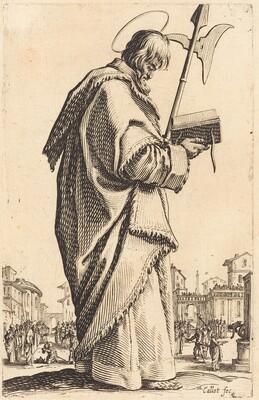
The image features a full-body illustration of a person standing in profile, facing right. The person has a halo around their head, long wavy hair covering the forehead and part of the face, a serious expression, a long nose, and a prominent brow. They wear flowing robes with intricate patterns, hold a book in their right hand, and a staff in their left. The background shows architectural structures, arches, and several smaller figures engaged in different activities, creating a busy city scene. The drawing style is detailed with emphasized texture and depth.

Saint Matthias

Callot, Jacques

The image shows a landscape with a small body of water reflecting the surrounding trees. The horizon is low, marked by trees at the water's edge. The scene includes lush green trees and shrubs with expressive brushstrokes creating depth. The color palette is earthy, with rich greens of the trees contrasting browns and yellows of the water. The sky is a pale gray with hints of warm tones. Brushstrokes suggest an impressionistic style emphasizing the serene natural setting.

Reflections in a Wooded Pool

Hills, Robert

The sculpture is an embossed circular metal medallion featuring the profile of a man in relief, facing left. The man is depicted with distinct facial features, wearing a hat with fringed edges. The medallion is bronze-like in color with the words "NICOLO" and "GANDER" engraved around the perimeter. The sculpture has a slightly weathered look, suggesting age, and exudes a sense of historical craftsmanship.

Nicolò Gander

Italian 19th Century

This is a photograph of a red textured surface. The image shows a close-up view of a material that has a consistent, even crimson color with a subtle grid-like pattern. This pattern is reminiscent of a leather-like texture, characterized by its small, interconnected lines and natural-looking grooves that give it a realistic, tactile appearance. The surface appears to be smooth and slightly glossy, reflecting the light subtly to highlight the pattern throughout. The edges of the surface are slightly rounded.

The Passion

Master S

The image shows a man from the waist up in a standing position. He is facing slightly to the right and holding a musical instrument, possibly a concertina, in both hands. His facial features include a neatly trimmed beard and mustache, round glasses, short gray hair, and a distinguished expression. He is dressed in a double-breasted coat over a high-collared shirt, with a light-colored flower pinned to his left lapel. He is wearing a tall, rounded hat that matches the tone of his coat. The background is plain with some visible texture and a simple rail or banister is visible at the bottom right, suggesting an interior space. The photo shows signs of age.

Portrait of a Man Holding an Accordion

Gay’s Gallery of Art

The head and pale face of a bearded man with a ring of interwoven branches of thorns over his chin-length, wavy, reddish-brown hair floats against a white cloth that has been hung over a wooden rod in this vertical painting. The cloth fills the composition. At its center, the man’s head faces us and he looks down with heavy-lidded, brown eyes. His lips are parted, and his cheeks are slightly sunken and shaded with pale lilac purple under high cheekbones. Blood drips down the man’s pallid forehead from the thorns. A brown spot high on his right cheek, on our left, might be a bruise or injury. A soft brown glow surrounds the head. The white cloth is frayed along its front edge, where it rests facing us on a wooden surface along the bottom edge of the painting. The cloth is bunched a little to each side where it drapes over the wooden rod above. The white cloth is painted with tones of pale coral pink, icy blue, silvery white, and dove gray. The background behind the cloth is black.

The Veil of Veronica

Fetti, Domenico

The image shows a person standing next to a donkey. The person has long hair and a beard, and is wearing a red hat and a violet tunic. They are barefoot and have one hand resting on a shovel buried in the ground. The donkey is kneeling and carrying various items on its back. The background features a rural landscape with hills, trees, and a building under a cloudy sky.

Issachar

Sadeler I, Jan

Rectangular Vase

Rectangular Vase

Chinese Qing Dynasty

The Skeleton Re-animated

The Skeleton Re-animated

Schiavonetti, Luigi

This is a drawing of a table. The image shows a perspective drawing of a slate top table with ornate design, including intricately turned legs and decorative patterns. The drawing includes annotations for scale (1 inch to 1 foot), dimensions, and construction notes. It is a precise architectural drawing with attention to detail, including perspective lines for accuracy. The line work is delicate, showcasing the table's elegance and craftsmanship.

Slate-top Table

Rosenshield-von-Paulin, M.

The image illustrates the upper three-quarters of a seated person, facing forward. The person's facial features are softly depicted, with gentle lines indicating eyes and a mouth, while their hair is short and slightly tousled. They wear a dress with visible sleeves, and their hands are placed in their lap. No jewelry or accessories are shown. The background is simplistic, featuring sketchy diagonal lines and shading.

Little Dorothy

Whistler, James McNeill

The image shows a downward perspective, appearing to be from a mountainside looking into a valley. The horizon is partly visible but mostly hidden by mountains and trees. The artwork features light and sketchy brushstrokes with graphite or pencil marks adding texture to trees and rocks, giving depth to the scene. The color palette is mostly monochromatic, using shades of gray to depict shadowed and sunlit areas. Closest to the viewer are rocks and vegetation leading down to the valley, with the scene transitioning into thick woodland and rocky slopes in the background.

Avalanche in an Alpine Landscape

Puvis de Chavannes, Pierre

The sculpture depicts a central figure representing a woman with a halo, seated and surrounded by four smaller figures which appear to be cherubs or angels. The woman is holding a child who is reclined in her lap. The composition includes three cherubic heads with wings above, creating a stacked layer effect, and another cherubic figure on each side, flanking the central figures. The surface of the sculpture is a deep reddish-brown, suggesting it could be made from carved stone or cast metal with a patinated or aged finish. The relief is detailed, with defined lines and contours offering depth and texture, while the halo around the woman's head suggests religious iconography. The sculpture has a flat appearance, with a hole at the top indicating it could be hung or displayed.

The Virgin and Child

Paduan 15th Century

The sculpture depicted on the book cover shows an owl perched on a tree branch, next to a coiled serpent. In the background, two flying birds are seen. The word "Ténèbres" at the top may suggest darkness. The color of the sculpture and book cover is predominantly brown with varying shades. The material appears to be leather, as indicated by the texture and pattern. The composition conveys a naturalistic scene with a rustic and somewhat mysterious visual impression due to the muted colors and intricate carving style.

Ténèbres (Darkness)

Redon, Odilon

This is a photograph of an industrial scene inside a large construction site. The image shows a partially constructed building supported by metal beams and scaffolding. The interior is covered in construction materials, with piles of lumber and debris scattered across the ground. Central to the image is heavy machinery, with steam rising from it. The environment is busy with intersecting lines of the scaffolding and beams, showcasing the complexity of the construction work involved. The sepia tones suggest an early 20th-century setting.

Steam Engine near the Grand Transept, Crystal Palace

Delamotte, Philip Henry
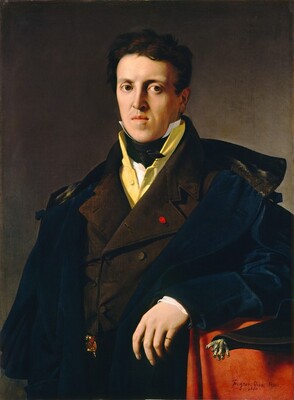
Shown from about the waist up, a man with pale, peachy skin, wearing a marine-blue greatcoat over several layers of clothing, looks out at us in this vertical portrait painting. The man’s body is angled to our left, and he looks at us from the corners of his dark brown, hooded eyes. He has an oval face with a slightly jutting chin, a long, straight nose, and his full-lipped mouth is lightly pursed. He is lit from our left, casting the right ear and side of his face in shadow. His chestnut-brown, wavy hair is short, and brushed forward over the ear we can see. Several shirts and coats are layered over his shoulders. Closest to his skin, a high-collared white shirt, with points reaching past his jawline, is tied with a wide, black neckcloth. Next is a custard-yellow garment, also with a high-neck, perhaps a vest. Over that he wears a brown coat with wide, pointed lapels. A bright, scarlet-red oval is fastened to one buttonhole on the lapel to our right, and a gold and rose-pink ornament peeks out from the bottom hem at his waist. Finally, the blue greatcoat has an elbow-length cape, and nearly falls off his shoulders. Fabric across the back of the collar is a hood lined with dark silver satin. He props his left elbow, to our right, on a table or ledge, and that wide cuff is rolled back over the white edge of this shirt. He wears a gold band on the pinky finger of that hand. The ledge is draped with a deep, marmalade-orange cloth. Gold tassels dangling from the end of a scrolled, bound document hangs off the edge of the ledge, near the man’s wrist. The background deepens from sage green along the lower left edge of the painting to fawn brown around the man’s head. The artist signed and dated the lower right corner, “Ingres. Pinx. Rom. 1810.”

Marcotte d'Argenteuil

Ingres, Jean-Auguste-Dominique

The image shows five women sitting in a semi-circle around a fireplace. They have distinct facial features and varied hairstyles, and wear formal dresses. There is a table with lit candles, and some of the women appear to be holding books or documents. In the background, there is an ornate fireplace and a window with closed shutters showing a crescent moon. The room is elegantly decorated with wood paneling and textile wall hangings.

The Wise Virgins before the Fire

Bosse, Abraham

The sculpture is a richly decorated lidded vase. It features a vibrant display of flowers and birds depicted in intricate detail on the body. The lid has a small sculpted figure of a stylized lion or mythical creature sitting on top. The color palette includes warm and soft colors - pinks, yellows, whites, and greens - against a complex pattern background. The material appears to be porcelain with a smooth, glossy finish. It presents itself as an ornate and elaborate piece of craftsmanship with decorative motifs indicative of traditional artistic techniques.

Large Covered Baluster Jar

Chinese Qing Dynasty
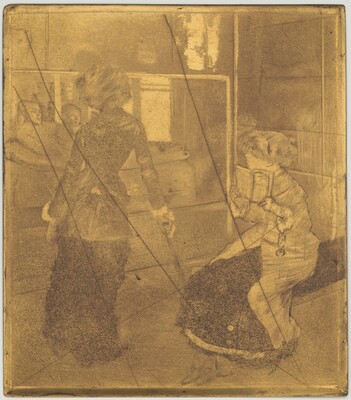
Mary Cassatt at the Louvre: The Etruscan Gallery

Mary Cassatt at the Louvre: The Etruscan Gallery

Degas, Edgar

The image shows a bold line forming a curved, angular shape with intricate patterns of crescent shapes and dots within it. The design resembles an incomplete boomerang or an abstract letter 'L'. The background is plain and neutral, highlighting the pattern's detail and color contrast.

Design from China Closet

Cartier, Ferdinand

The image shows a woman sitting on a cloud, reaching her right hand towards three shapes (a circle, a square, and a triangle) floating beside her. She has curly hair tied up, wears elegant robes, and appears serene. The background displays a landscape with hills, a river, and rocks. The scene is framed by a detailed border with the word "GEOMETRIA" and Roman numerals "XXXIIII" at the bottom.

Geometria (Geometry)

Master of the E-Series Tarocchi

In the image, two people are seated facing each other across a wooden table. On the left, an older man is seated in a black suit with a white shirt, holding a walking stick. Across from him, a woman in a dress with a bonnet tied with a blue ribbon is seated. The table holds a top hat, an open book labeled "Holy Bible," a bowl of fruit, and closed books or boxes. A small dog is at the base of the table. The floor has a patterned rug, and the wall behind them displays garlands and a framed painting depicting a pastoral scene with a house and trees.

John and Abigail Montgomery

Davis, Joseph H.

This is a photograph of a gold coin. The coin features a profile portrait of a figure wearing a hat adorned with a design or insignia. The figure has a determined, serious expression with detailed facial features including a sharp nose and distinct lips. The design on the coin also includes an elaborately patterned collar or clothing extending from the figure’s neck. An inscription in a stylized serif font wraps around the edge of the coin. The surface of the coin appears textured and worn in places, suggesting historical significance.

Lodovico II, 1438-1504, Marquess of Saluzzo 1475 [obverse]

Carmagnola 15th Century
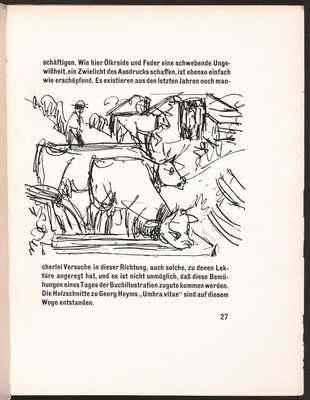
The image shows two cows and a man surrounded by rough sketch lines. There are two cows in the foreground, depicted with fluid lines suggesting movement. Above the cows are sketchy lines resembling barns or rural buildings, with a figure resembling a man nearby. The drawing is placed on a page with text above and below, creating an illustrative connection between the art and text.

In-text plate from Kirchner Zeichnungen (Kirchner Drawings)

Kirchner, Ernst Ludwig

The image shows an older woman in a half-body portrait, sitting and facing forward with her body slightly angled to the side. She has prominent cheekbones, a prominent nose, and deep-set eyes. She wears a white bonnet cap, a dark shawl or cloak, a lighter-colored garment, and a white scarf tied below her chin. Her hands are clasped, with one gloved hand visible. She wears a necklace with multiple strands of pearls around her neck. The backdrop is plain and dark. The image is bordered with a gold frame.

Barbara Frietchie

Byerly, Jacob

A mostly nude young woman with pale skin leans, half-sitting, back on one hand while she reaches for a silver vessel held by a second woman in this vertical painting. The woman who offers the vessel also has light skin, and both have auburn-brown hair bound up and interwoven with strands of pearls. The body of the woman at the center of the painting, Susanna, faces us and she turns her head to our left, to look at the vessel with shaded, dark eyes. She has a straight nose, and her ruby-red, full lips are closed. A glint on one earlobe suggests a jeweled earring behind curls that frame her face and brush her shoulders. She has small, firm breasts and wears a bronze-colored bracelet on each wrist. Crimson-red cloth hangs from the backs of her shoulders and drapes over her seat. Sheer white fabric covers her lap across her upper thighs. The toes of one foot rest on the ground while the other foot dips into the water of a pool. The other woman, holding the round vessel, faces away from us as she leans into the painting so only her head, shoulders, and arms are visible. Her dark pink sleeve wraps around the upper arm we can see, and she wears a gold-colored bracelet on that wrist. A swath of brick-red fabric hangs between the two women. A dark, shadowy bush dotted with deep pink roses fills the space behind Susanna and, in the distance to our left, two people stand under an arched trellis covered with vines. Wearing light-colored robes and hoods, the people in the distance are painted with silvery gray and cream white, and are translucent against the sky.

Susanna

Tintoretto, Domenico

The image displays a large, rectangular expanse of solid blue with a subtle texture. In the upper left corner, the word "Beich" is inscribed in a classic, cursive script style. The overall presentation resembles a minimalist book or notebook cover, with the plain blue field covering most of the image.

Landscapes in the Manner of Poussin

Beich, Joachim Franz

The sculpture depicts a figure with the upper body of a man and a fish-like lower body. The figure is adorned with decorative elements and is holding a small horn. The sculpture is intricate, combining gold metal with colored enamel and gemstones. The upper body is made of a lustrous material resembling pearl, while the lower tail-like portion is richly decorated with red and green enamel and embedded gemstones. The sculpture also features dangling pearls. Hanging from a gold chain, it resembles a luxury pendant or an ornamental piece. The elements create a visually captivating and intricate sculpture of a fantastical sea creature in a luxurious form.

Pendant with a Triton

André, Alfred

This is a print showing a man and a woman intertwined on the left edge of a long table. The people are partially clothed and pressed tightly against each other, the man holding the woman's bottom, and the woman's legs raised up under the man's arms. The woman has long, flowing hair and what looks like a tiara on her head, and the man's curling hair is tied with a strip of fabric around his head. A curling banner emerges from the edge of the table next to them and curves up the left side of the print. On the right, a creature is stepping up onto the table, using a stool. The creature appears to have the legs and tail of a lion and the body and wings of a bird, but its head and upper torso resemble a large penis. A bell appears to hang from the creature. The material that the print is on is a mottled copper color, with areas of yellow, orange, and dark blue discoloration.

Allegory on Copulation [verso]

Italian 15th Century

A large, translucent blue glass vase is shown in the center of the image. The vase has a curved shape and a slightly flared rim. The dominant colors are blue for the vase and muted beige for the background, which highlights the vibrancy of the glass. The vase is centered towards the bottom of the composition, with negative space surrounding it.

Christmas Light

Dana, John

This is a painting of a religious scene with four figures. One central figure is in a praying posture, and another figure holds a cup in the background. The style is reminiscent of medieval religious artwork, with bold outlines and flat areas of color. The figures wear ornate robes and are adorned with halos. The background features stylized trees and rocks.

Christ on the Mount of Olives

German 15th Century

The image displays a rural scene from a slightly elevated perspective. A figure sits under a large tree observing the surroundings. A road leads into the distance where two horses and a cart loaded with hay approach a rustic structure. Near the structure, there are barrels and smoke coming from a chimney. In the fields beyond, several small figures are engaged in harvesting activities. The horizon is lined with small buildings or trees. The illustration uses delicate lines with light blue washes for shadows. The color scheme is mainly sepia tones with hints of blue. The sky has wispy clouds and faint birds in the background.

Summer Harvest in an Extensive Landscape

Toeput, Lodewyk

The head and shoulders of a cleanshaven man are carved from white marble lightly streaked in gray in this freestanding sculpture. In this view, the shoulders are square to us, but he turns his head to our right. His left eyebrow, to our right, appears to cocked as he looks into the distance, and he has a sweeping nose with a rounded tip. His long upper lip overhangs the lower lip in a slight overbite. His hair is parted down the middle and ends in curls that angle from eye-level framing his forehead to ear-level at the back of his neck. He wears a high-collared breastplate over linked mail. The breastplate is ornamented with bands of flowers, dots, and other geometric designs. A strap and buckle hang from the neck area. The sculpture ends in a blunt, straight edge across the bottom, and it rests on a brown stone pedestal in front of a gray background.

Astorgio Manfredi

Mino da Fiesole

The image displays a title page with the title "RECUEIL DE DIVERSES FABLES" and the name "GEORGE FOSSATI" written in large, centered text. Below, there is a small engraved illustration featuring a wolfish creature along with plants and rocks. The color scheme is monochromatic, consisting of black and white shades. The text is centrally aligned on the top half of the page, with the illustration placed closer to the lower half. Publication information is located at the bottom center of the page.

Raccolta di Varie Favole delineate ed incise in rame (Tome 4-6)

Fossati, Giorgio

The image shows a cityscape with a prominent mosque in the distance, featuring two minarets and a central dome. The background shows a hillside with many buildings. In the foreground, there are cannons lined up along a stone quay, with people in period clothing near the water. The image is in sepia tones, giving it an antique look, with clear details captured in a photograph.

Arsenal and Mosque of Kiledeh Ali Pasha

Robertson, James

Three Pears and an Apple

Three Pears and an Apple

Johnson, David

The image features figures and shapes arranged in three horizontal bands. In the upper section, an abstract pattern of symmetrical human-like figures with raised arms is depicted. The center of the image displays a flowing abstract shape surrounding central human figures. Below, a group of seated figures is arranged in a semi-circle. The overall composition creates an abstract narrative through the arrangement of figures within distinct horizontal zones.

When the Morning Stars Sang Together

Blake, William

The sculpture is a ceramic vessel featuring a painted depiction of a cherubic, nude figure holding a vertical rod with a heart attached at the end. The background scene includes stylized mountains and grass. The vessel is painted in blue tones with yellow and hints of green. The figure has pale skin and brown, curly hair, and the material appears to be ceramic or pottery. The vessel is cylindrical with slightly curved sides, a wider base, and a narrow neck. Terracotta brown is visible at the rim and base, creating an aged and rustic appearance.

Albarello with Cupid spearing a heart

Faenza 16th Century

Three German Soldiers Armed with Halberds

Three German Soldiers Armed with Halberds

Hopfer, Daniel
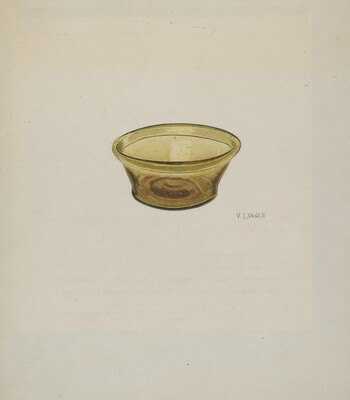
The image shows a glass bowl as the largest object in the center of the page. The color palette consists of earthy brown and yellow hues. The artist's signature "V. LIVANCE" is placed slightly below and to the right of the bowl.

Small Glass Bowl

Vance, V.L.

Three figures are depicted, a man and a woman sitting with a child. The man is standing behind a wooden surface. His facial features show wide-open eyes and a slightly agape mouth. His curly hair is slightly disheveled. He is wearing a traditional judicial robe with a cravat and there is a top hat on the table. The woman is wearing a dark cloak that covers her head. The child is crouched next to her in a dark garment. The background is plain.

Il défend l'orphelin et la veuve, a moins...

Daumier, Honoré

This image shows a group of serene figures and cherubs gathered around a grand tree. A central figure is holding a child, both with halos above their heads. The scene is filled with cherubic figures interacting around the main characters, with some hovering in the air. The tree is lush with foliage, extending upwards with cherubic figures among its branches. In the background, there are detailed architectural structures, contributing to the tranquil and natural atmosphere of the scene. The drawing is created with fine linework and subtle shading, resulting in a harmonious and intricate depiction.

Madonna and Child with Saints John and Luke

Cousin the Younger, Jean

The sculpture depicts a lion overpowering a wild boar. The lion is pressing down the boar with its paw and biting into its body. The figures of both animals are intricately detailed, showing the powerful muscles and features of the lion and the rounded shape and limbs of the boar. The sculpture is made of dark brown bronze, giving it a smooth and polished finish. The stance and expression of the lion convey a sense of dominance as it stands over the boar. The sculpture captures the moment of the lion’s conquest, emphasizing the contrast between the lion’s mane and form against the boar.

Lion Devouring a Doe

Prieur, Barthélemy

This is a photograph of a closed, old hardcover book with a brown leather cover. The image shows the front cover of the book, bound in textured brown leather. The cover has a rich hue with dark speckles, indicating wear. The edges are slightly worn, suggesting usage. A sheet of yellowed paper is peeking out from the book. The image emphasizes the material qualities of the leather.

Universae Architecturae Civilis Elementa...; Materia Tentaminis Publici...

Rieger, Christian

The image shows a landscape view from a high vantage point looking across a rocky terrain. A steep cliff rises on the right side with people standing at the top. The horizon is placed low in the image, providing a panoramic view. In the distance, another rugged formation rises from the land. The color palette is monochromatic with earth tones. The scene conveys a sense of vastness and natural beauty.

Plate 23. On the Mountains of Green River

Russell, Andrew Joseph

The image shows a landscape with three men in the foreground. One of the men is aiming a rifle, while the others are in the grass. In the background, a herd of bison is grazing in a sunlit meadow. The horizon is marked by hills with trees, and the sky has light brushstrokes suggesting a clear day. The color palette is dominated by greens and browns, with trees on the right side of the image.

Catlin and Two Companions Shooting Buffalo

Catlin, George

This is a drawing of two figures facing each other under a decorative floral vine arch. One figure is bent over, appearing to drag an object, while the other stands upright with hands in pockets, dressed in a long coat and top hat. The figures are detailed and in a classic style. The floral vine includes small creatures and floral elements as an ornamental frame.

Peter Schlemihl Sells His Shadow

Schrödter, Adolf

This is a photograph of a ceramic vase decorated with colorful patterns and motifs, predominantly in blue, yellow, and green hues. The center of the vase features a painted medallion with a profile portrait of a figure wearing headgear, and below it is a label with the inscription "dia-irrj" in a calligraphic style. The surface of the vase is covered with ornate designs including floral and geometric patterns.

Drug jar with the head of a warrior

Faenza 16th Century

This is a photograph of an etched metal plate. The image shows an intricately engraved scene on a rectangular sheet of metal, possibly copper or brass. The etching includes figures holding arrows or other tools, along with swirling patterns resembling clouds or smoke. The work displays detailed craftsmanship that is best appreciated up close, illustrating how images were historically printed.

Wrath

Aldegrever, Heinrich

The image shows three objects: tongs, a dual-pronged fork, and a shovel. The color palette is primarily gray, black, and white. The objects are displayed vertically in the center, with the tongs on the left, the fork in the center, and the shovel on the right. The background is plain with a border, and measurements are indicated below the center object. The name "HANS KORSCH" is written at the bottom left.

Fire Tongs and Shovel

Korsch, Hans

The image is a sketch of a person seated on a bed. The person is leaning on one arm in a relaxed posture. The facial features and hair are delicately sketched. They are wearing a dress with a voluminous skirt. The setting includes floral patterns, and there are suggestions of drapery or curtains in the background. The sketch is done with light pencil strokes.

Bowing to the Audience (Saluant le public)

Toulouse-Lautrec, Henri de

The image features a landscape viewed from an elevated perspective. It shows a serene expanse of land with mountains in the distance. The horizon line is in the lower third, with a range of mountains stretching across. The left side displays layers of progressively higher peaks, while the right side has a steep, rugged slope covered in dark vegetation. The brushstrokes are loose and impressionistic, with broad strokes for the sky and detailed brushwork for trees and mountains. The color palette is primarily greens and blues, with brighter greens near us transitioning to deeper hues in distant mountains and the cloudy sky. Scattered trees and patches of sunlight provide warmth amidst the cool tones of the scene.

Humphrey's Ledge

Brownell, Charles de Wolf

The sculpture depicts a round medallion featuring a central figure with a human face surrounded by serpentine hair, possibly representing the mythological Medusa. Flanking this central figure are two smaller, naked human figures, likely cherubs, each positioned to the left and right with their arms extended towards the center. The medallion is made of dark brown material, likely bronze or a similar metal, giving it an antique and textured finish. The subject's expression is neutral, looking outward towards the viewer, and the intricate details of the hair and figures add depth. The piece has a small hole at the top, which suggests it may have been intended for hanging or attachment.

The Head of Medusa

North Italian 16th Century

This image shows fifteen round cameo-style portraits of individuals in profile from the side, focusing on their heads and shoulders. Each person appears to be seated and displaying distinct facial features and hairstyles typical of the late 18th or early 19th century. Most individuals are men wearing formal attire, including high collars, cravats, and in some cases, military uniform elements such as epaulettes. One woman is depicted wearing a headwrap with curly hair. The portraits are monochromatic and presented in a grid over a cardboard backing. The backgrounds in the portraits are plain or softly shaded, emphasizing the individuals depicted. The cardboard backing contains text, presumably identifying some of the individuals by names like "Comeagues" and "Tarleton Bates."

Saint-Mémin Collection of Portraits, Group 53

Saint-Mémin, Charles B. J. Févret de

Shoshone Falls, Snake River, Idaho

Shoshone Falls, Snake River, Idaho

O'Sullivan, Timothy H.
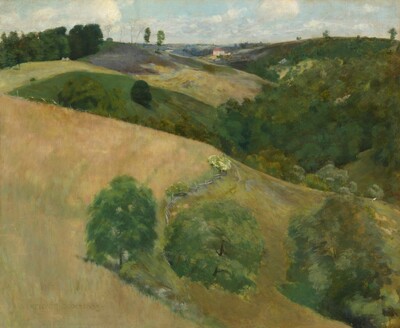
This painting depicts a landscape with rolling green hills viewed from an elevated perspective. Closest to us, the light green hills on the left are covered with yellowish grass. A dense forest of dark green trees is on the right at the bottom of the slopes. In the distance, towards the high horizon, the hills appear to flatten out, leading to a small white building with a red roof. The sky above is light blue with soft white clouds. The brushstrokes are soft.

Flying Shadows

Cox, Kenyon

The image shows a close-up view of several children's faces. The children are positioned closely together, facing in various directions with different expressions. They have youthful facial features with plump cheeks and expressive eyes. Their hair varies from curly to straight, and some wear hats or head coverings with ribbons or flowers. The children are dressed in period clothing with collars and frills, including one child wearing a necklace with a cross pendant. The background is a plain cross-hatched pattern.

Nine Children's Heads

Schenau, Johann Eleazar

Shallow bowl on low foot with the death of Laocoön and his two sons

Shallow bowl on low foot with the death of Laocoön and his two sons

Xanto Avelli, Francesco

The Soul hovering over the Body reluctantly parting with Life

The Soul hovering over the Body reluctantly parting with Life

Schiavonetti, Luigi

The image displays a metallic tankard with a lid and a handle. The tankard is the main object in the frame, with an inscription partially visible on its surface. The color palette is primarily grayscale, representing the sheen and shadows on the metallic surface. The tankard is shown in a slight profile view, with the spout on the left and the handle on the right. The drawing highlights the craftsmanship and details, including the ornamentation on the lid's knob.

Silver Tankard

American 20th Century

The image shows a man seated with his body facing slightly to the side and his head turned towards the viewer. He has short, curly hair and defined facial features. He is wearing a dark jacket with buttons, a shirt with a high collar, and a medal or insignia. In the room, there is a table with round artifacts or coins, a bookcase filled with books, relief sculptures on the wall, and classical sculptures, including a statue of a muscular male figure.

Ennio Quirino Visconti

Rados, Luigi

This is a drawing of three winged figures in a dynamic composition. The drawing depicts three angelic figures with wings, rendered in shades of brown and white. One figure kneels in the foreground with a forward-leaning posture, while another stands behind with slightly open wings, and a third is positioned horizontally in flight. The figures are executed with strong outlines and flowing lines. The background is minimal and the use of white highlights gives a sense of luminosity to their forms.

Christ in Gethsemane

Zanguidi, called Bertoia, Jacopo
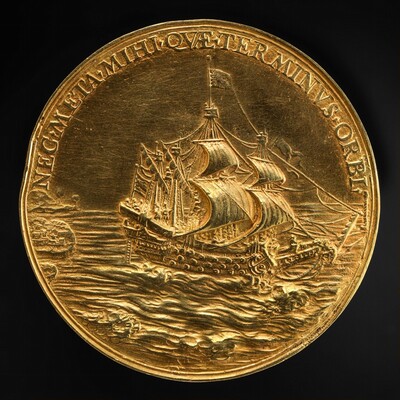
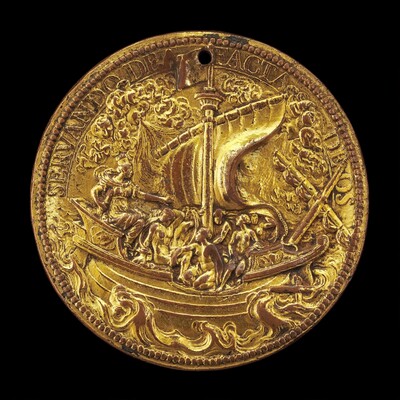
The sculpture on the circular object is a large sailing ship fully rigged with multiple sails billowing. Details of the ship, including the masts and rigging, are visible. In the foreground, there are wave-like engravings representing water. In the background, a faint coastline with structures is visible on the left side. An inscription at the top reads "NECQFETAMIFLQVETERMINVSORBI." The material is gold-colored metal, giving it a luxurious appearance. This image appears on a coin or medallion, with skilled engraving work bringing the ship to life through shadows.

The Juxon Medal: The Dominion of the Seas [reverse]

Briot, Nicolas

The image is a collage of 12 black-and-white portrait engravings arranged in four rows. Each portrait depicts a different man's side profile. The individuals are shown from the head to the upper chest, with formal clothing. The hairstyles vary slightly, and the majority have short, neat hair. The background is a plain circle behind each portrait. Below each portrait, there are handwritten names of the individuals. The collage is set against a uniform beige background.

Saint-Mémin Collection of Portraits, Group 37

Saint-Mémin, Charles B. J. Févret de
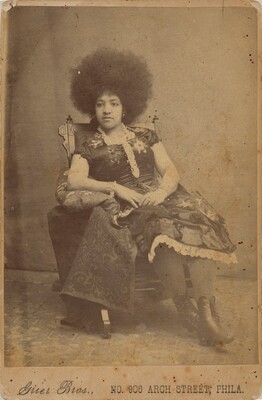
The image shows a woman seated in a three-quarter length portrait. She is sitting in a relaxed position on a decorative chair, with her right arm resting on a small cushion on the armrest. Her left arm lies across her lap. The woman has a voluminous afro hairstyle and a composed expression. She wears a dress with floral patterns, lace details, and high lace-up boots. She is adorned with a bracelet on her right wrist. The backdrop is a textured surface, with the caption "Grier Bros., No. 906 Arch Street, Phila." at the bottom of the photograph.

Portrait of a Woman

Grier, Andrew A.

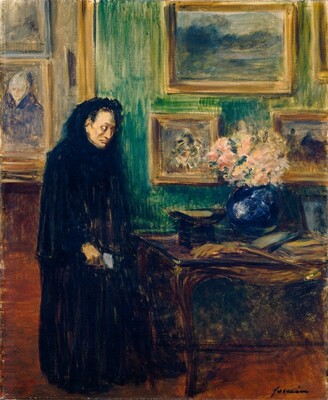
The Petitioner

The Petitioner

Forain, Jean-Louis

This is a drawing of mythological figures in a mountainous landscape. The image shows muscular figures engaging in a struggle among jagged rock formations. Clouds fill the sky above, adding a dramatic sense, while the figures carry or interact with rocks. The artwork is circular with shadows and highlights used to create depth and emphasize the figures' musculature. The detailed line work suggests a classical style, possibly inspired by mythological tales of ancient giants. Below the circular scene are inscriptions or text.

Giants Repelled by Jove

Wolfgang the Elder, Georg Andreas

This round plate features a central mustard-yellow design with a shield containing six circular shapes, five that are orange and one that is black with small yellow symbols inside it. The rim of the plate is decorated with floral and scroll patterns in the same yellow color, with thin blue outlines and small patches of white in between the large shapes. A motif of crossed keys below a crown is above the shield. The plate is set against a plain blue background.

Large dish with plant-pattern border; in the center, the arms of a Medici pope

Deruta 16th Century

The image depicts a person standing or walking. The full body is visible with arms slightly extended and facing forward. The facial features are indistinct, and the hair blends into the background. The person is wearing a long robe or gown. There are no visible jewelry or handheld objects. The background is textured and dark, creating an atmosphere of depth and obscurity.

Christ descending into the Grave

Schiavonetti, Luigi

This is a drawing of a wrought iron gate at the main entrance of a building called Cabildo. The drawing showcases a detailed depiction of a large, ornately designed wrought iron gate framed by a stone or brick archway. The gate comprises two sections, each with a grid-like pattern of vertical and horizontal bars. Near the top of the gate, there is a semicircular design with radial bars reminiscent of sunburst patterns. At the bottom of the gate, there is additional ornamental decoration. The text at the bottom annotates the subject as the "Main Entrance Cabildo Wrought Iron Gate."

Wrought Iron Gate

Curry, Al

The image shows a full-length profile of a woman standing, facing to the right. She is depicted with delicate lines, showing a composed expression. She wears a large, wide-brimmed hat with a decorative band and bow. She is dressed in a richly detailed jacket with a high, pleated ruff around her neck and long sleeves. Her voluminous skirt extends to the floor in pleats, and she wears shoes. The background is simple with no other objects, and the illustration is labeled "Mulier Augustana" at the bottom.

Mulier Augustana

Hollar, Wenceslaus

The image features a sketch of various full-body figures drawn with minimalistic lines. The figures are standing and include both men and women. The facial features are simple and not detailed, with only some outlines hinting at eyes, noses, or mouths. Various hairstyles are shown, with some women having their hair styled in buns or veils, while men are wearing hats. The clothing appears to be historical or formal, with men in coats, breeches, and wide-brimmed hats, and women in long, flowing dresses or cloaks, some with head coverings. One figure is depicted on horseback, showing more dynamic movement. The background is a plain sheet of paper with no additional details or context provided, aside from some lines indicating ground or shadow under the figures.

Historical Costumes

Paret y Alcázar, Luis
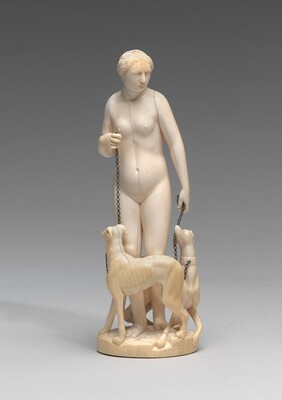
The sculpture depicts a standing nude female figure holding chains attached to two dogs. The woman is looking downwards towards one of the dogs. The sculpture is made from a smooth, ivory-colored material with a polished surface. Relative to us, the sculpture is small and detailed, capturing intricate elements such as the woman's facial features, hair, and the muscles and posture of the dogs around the woman's feet.

Diana with Her Hounds

Kern, Leonhard

The image shows a smooth surface with lines and shapes creating an abstract pattern. The surface has a mottled appearance with varying shades of brown blending together. There is a faint horizontal line across the middle.

Le Solenni Esequie di Monsignor Filippo Visconti Arcivescovo di Milano...

Cagnola, Luigi

This is a photograph of a series of motion studies. It captures a sequence of images arranged in two rows, each depicting figures engaged in dynamic movements. In the top row, a figure appears to be leaping over another, showcasing a progression of a jump with varying stages of elevation and descent. The bottom row shows a progression of a piggyback ride, highlighting the lifting and carrying movement between figures. The setting is stripped down and functional, likely focusing on the study of human motion. The background is marked with vertical lines, possibly for measuring movement. The entire composition reflects an analytic, scientific approach to capturing motion in a photographic timeline.

Plate Number 166. Jumping over a man's back (leapfrog)

Muybridge, Eadweard

A pale, nearly nude young woman perches on a rock under a tree surrounded by small animals including dogs, deer, and birds, in this horizontal landscape painting. Her body faces us as, lips parted, she looks away to our left. She is covered only by an olive-green drape over her left thigh, on our right. She cradles what appears to be a tall stone tablet in her left arm and touches the inscribed surface with her right hand. White, buttercup-yellow, and crimson-red flowers crown her long blond hair. Her smooth pink skin stands out against the brown bark of the tree trunk behind her. By her right knee, a small brown doe stands looking at her. Closer to us, a white, wading bird dips its beak into a pool of water in the lower right corner of the painting. A large book of diagrams lies open next to the woman's foot, on the slate-gray ground. A small, white dog crouches next to the book on our right in front of a sleek, brown dog and a buck with antlers, and all face the woman in profile. In the trees above, a white hawk perches near the upper right corner of the canvas, and an owl sits on a branch over the woman’s head. Beyond the woman to our left, a steep bank is topped by wispy trees and shrubs. A sandy path meanders past the bank toward a wooden building in the distance. Delicate trees with rust-red and gold canopies frame the building, while a topaz-blue haze behind it suggests a forest beyond. Full, gray clouds fill the sky overhead above a band of pale light on the horizon.

Circe and Her Lovers in a Landscape

Dossi, Dosso
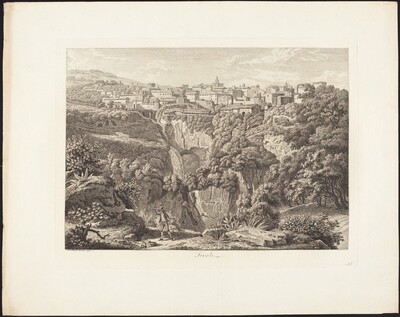
The image shows a landscape with a town in the distance. The town sits on a plateau or hill, surrounded by vegetation. Detailed line work depicts rocks, plants, and trees. A figure stands on a path near foliage and rocks. The sky has wispy clouds.

Tivoli

Dies, Albert Christoph

The sculpture is a wooden chest with intricate carvings. The chest is a rich, dark brown color and features leaf motifs on the corners and circular designs along the top edge. The carvings are detailed and symmetrical. The chest is displayed on a white plinth, elevating it off the wooden floor.

Cassone Carved and Gilded

Florentine 15th Century
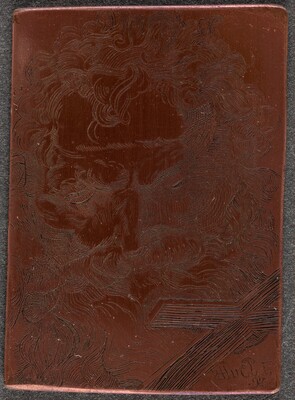
The image shows an engraving of a bearded man's face, likely from the chest up. The man's head is slightly tilted, with facial features such as the brow and nose depicted through etched lines. His hair is voluminous and curly, flowing outward in swirling patterns. There is no clothing detail visible. The engraving includes a crosshatched pattern in the bottom right corner and a signature, possibly "Ritter A.L." The background is a polished metal surface.

Head of Saint John the Baptist [verso]

Butts, Jr., Thomas

The image shows a single rifle in the center, with various shades of wood and metal. The rifle is horizontal across the frame, with the barrel extending left and the stock positioned right. The background is pale and lightly textured.

Rifle

Robinson, LeRoy

The image shows an arched stone and wooden building to the left and a large, leafless tree to the right. Characters are engaged in various activities around the structure, including standing, sitting, and one figure on horseback facing towards the right. Closest to the building's entrance, a group of people gather, while others interact with objects or animals to the left of the structure. In the distance, more people and buildings are visible, adding depth to the scene. The etching technique is detailed with precise lines, presented in monochrome shades of black and white depicting depth through shadows and textures.

The Stopping Place

Callot, Jacques

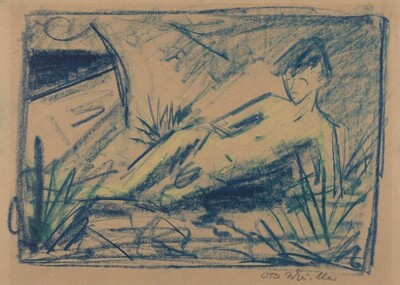
The image is a sketch of a reclining figure depicted from head to toe, lying on their side with their upper body propped up slightly. The facial features are minimally detailed, with closed eyes, a small triangular nose, and a faintly smiling mouth. The figure's hair is short and dark, depicted with simple strokes. The torso is exposed and sketched with minimal lines. The background includes abstract elements representing an outdoor setting with rough, expressive lines symbolizing plants and vegetation. The image is drawn with blue and green tones on beige paper and signed at the bottom right corner by the artist, Otto Mueller.

Bather

Mueller, Otto

The sculpture depicted in the image is a commemorative medal featuring two side portraits etched in relief. The subjects are a male and a female figure. Names and titles are inscribed around the edge. The male figure is dressed in historical attire and positioned slightly in the foreground with his profile facing left. The female figure, also in historical clothing, is positioned behind him. The medal is made of a metallic material, likely bronze or a similar alloy, with an aged patina. The inscription includes the names "FRIEDRICH WILHELM" and "KRONPRINZ VON PREUSSEN" along with other titles.

Marriage Medal of Crown Prince Frederick William of Prussia and Princess Louise Augusta of Mecklenburg-Strelitz [obverse]

Loos, Daniel Friedrich

The image shows a depiction of Christ on the cross, with his full body prominently displayed. He is nailed to the wooden cross with his arms outstretched, his head slightly tilted to one side, crowned with thorns. His facial features are solemn, with a beard and mustache, and his hair appears to be of medium length, dark in color. Christ is draped with a white cloth around his waist. Flanking him on either side are two individuals; on the left, a figure standing, clothed in a long robe with a hood, hands clasped together, and a subtle expression on her face. She has a halo around her head. On the right, another figure is wearing a green garment layered with a red cloak, holding a book, with one hand raised, gazing upwards. This person also has a halo and features long, curly hair. Both of these individuals stand on green grass, with the blue sky and the cross as the background, and there is Latin text beneath them.

Missal for Passau

Burgkmair I, Hans

The image depicts a woman from the waist up, positioned slightly angled to the right with her head turned to the left. Her facial features are delicate with a composed expression, arched eyebrows, and dark eyes. Her hair is styled in large rolls on either side, possibly with extensions, framing her face elegantly. She is dressed in a richly textured garment with an intricately designed lace shawl draped over her shoulders. Her clothing has detailed embroidery. She holds a delicate handheld fan with both hands in front of her. She wears circular earrings and a brooch at the neck of her dress. The background is plain and dark, contrasting with her clothing. The photograph is set within a vintage frame with an ornate gold border.

Portrait of a Young Woman

Southworth, Albert Sands

A tall silver vase with gold details holds a bouquet of white flowers with green leaves and red blossoms. The color palette includes metallic silver, gold, white, green, red, and teal. Positioned on the table, the vase stands centrally, with a blue box behind it to the left and a jewelry box with a pearl and flower ring design slightly to the right. There is also a piece of fabric with a tassel and small scissors lying flat behind the vase.

Still Life with Fan and Pendant

Brookes, Samuel Marsden

A drawing of a figure transforming into a tree is depicted in a circular frame. One figure on the left is transforming into a tree, with arms extending upward and morphing into branches with foliage. Another figure on the right is dynamic in posture, holding a curved object resembling a bow. The background shows a landscape with trees and hills. The detailed etching technique highlights the expressiveness of the figures and the natural setting. Latin text is included in the image.

Daphne Turning to a Laurel

Wolfgang the Elder, Georg Andreas

The sculpture depicts a wooden table with intricate designs, including human faces and scrollwork on the supports. The wood has a rich, polished brown color. The table has a rectangular tabletop, ornate balusters, and carved legs. The carvings show heads and decorative motifs, highlighting craftsmanship. The table has an opulent and elegant appearance suitable for a classic or traditional setting.

Walnut Table with Eagles on the Supports

Florentine 16th Century

This is a carved copper plate showing a busy street scene viewed from above. The street is lined with tall buildings, and people and horse-drawn carriages are visible on the street below. The street narrows as it recedes into the distance, with a line of buildings where it ends. The sky above the scene is clear, except for faint grid lines that run across the whole scene. The edges of the plate are tinged in purple, teal, and white.

St. James's Street

Whistler, James McNeill

The image shows a stoneware jug with a single curved handle on the left side and a spout at the top. The jug is grayish-brown with patches of blue. It is centered in the image, with the handle on the left and the jug slightly tilted to the right. There is a handwritten inscription on the front of the jug. The background is plain off-white.

Pitcher

Fumagalli, Frank

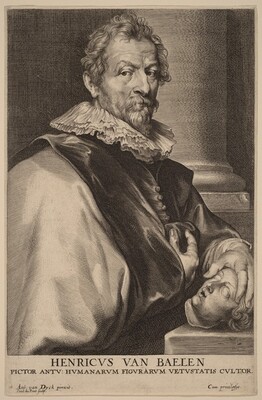
The image depicts the upper half of a man facing slightly to his right. He has a thoughtful expression, a prominent nose, close-set eyes, wavy medium-length hair, and a full beard. He wears a detailed garment with a ruffled collar under a dark velvety coat. His left hand rests on a sculpted head on a plinth table. In the background, there is a vertical element resembling a column. The artwork includes an inscription identifying the subject as Henricus van Baelen and additional text in Latin.

Hendrick van Balen

Pontius, Paulus

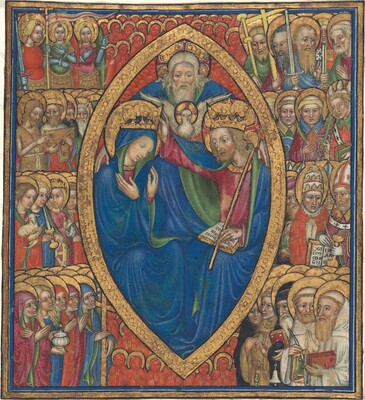
Coronation of the Virgin with the Trinity  and Saints

Coronation of the Virgin with the Trinity and Saints

Olivetan Master

The sculpture depicts a woman with a crown and detailed dress. The sculpture is in the form of a bronze medallion with embellished edges and raised lettering.

Christine de France, 1606-1663, Duchess of Savoy, Wife of Victor Amadeus I 1619, Regent 1637-1648

Dupré, Guillaume
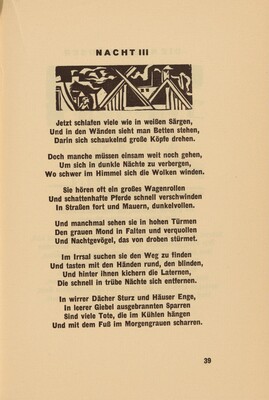
There is a rectangular abstract illustration at the top of the page. The image has bold, dark lines and shapes against a light background. The illustration depicts a cityscape with buildings and a sky filled with swirling cloud-like forms. Below the illustration, there is a block of centered text on the page. The title "NACHT III" is in bold capital letters, followed by a poem in German. The text is printed in a clear serif typeface, with the page number "39" at the bottom right corner.

Nacht III (Night III) (headpiece, page 39) from Georg Heym: Umbra Vitae (Georg Heym: The Shadow of Life)

Kirchner, Ernst Ludwig

This is a photograph of a circus performance featuring an acrobat in mid-air performing a daring feat high above the ground. The acrobat is upside down, balancing on a wire and holding various objects, such as a ring and a disc. Flowing fabrics add movement and grace to the scene. The perspective is dramatic, emphasizing the acrobat's poise and control against a light sky backdrop, giving a sense of weightlessness. The image is in sepia tones. There is a handwritten inscription in French in the lower right corner.

Acrobat

Stone, Sasha

This painting depicts a body of water surrounded by mountains and dotted with small, tree-filled islands. At the bottom of the painting is a green area with several tall trees and a small dirt path. Beyond this area, a hill slopes down to the water below. The water is painted in light blue and gray tones, and the hazy mountains beyond the water are painted in light greens and blues. The blue sky above the scene is full of puffy white clouds.

Lake George

Casilear, John William

The image shows an ornate bridge with pedestrians crossing it, surrounded by detailed urban architecture. The bridge has dramatic arches, statues, and decorative lampposts. People are walking on the bridge and in the plaza nearby. Complex gothic-style buildings with spires and turrets are visible in the background. The artwork is monochromatic with sepia and gray tones, and fine brushstrokes depict the architectural elements accurately.

Brooksbrucke

Stoltenberg, Fritz

This is a tapestry of a landscape with castles, trees, and various people and animals. It depicts an outdoor scene where people are dressed in elaborate clothing in shades of red, tan, and dark blue, including long dresses with draping sleeves, tunics with puffed sleeves, and feathered hats and caps. In the background, the landscape is dotted with green trees bearing fruit, and some people are engaging in what appears to be a harvest, using curved gray objects to slice the limbs from bare trees. To the right, a person on horseback looks on, watching them. Closer to us, near the bottom left corner, is a large table with dishes and plates, possibly signifying a feast, surrounded by more people. In the distance there are three buildings with spires and turrets typical of a castle.

The Return from the Hunt

Flemish 16th Century

This drawing portrays an ethereal scene with figures and a mythological creature. It features nude figures in classical poses with a cloaked figure beside them, interacting with a dragon-like creature. The background has stylized clouds and natural forms with fine etched lines. The scene is on a copper plate, giving it a reddish-brown hue.

The Circle of the Thieves; Buoso Donati Attacked by the Serpent

Blake, William

This is a drawing of an ornate circular emblem. The emblem features a symmetrical design with bold, stylized elements. At the center of the circular form are two fern-like shapes that create a sense of movement and organic flow, surrounded by geometric stars and crescent elements that accentuate the spatial balance. The circular border has a decorative edge that frames the internal relief, giving it a carved or embossed appearance. The background remains a plain, neutral tone, which contrasts with the detailed pattern of the emblem.

Pa. German Butter Mold

Angus, Charlotte

The image shows two men depicted from head to toe in an illustration standing side by side. The man on the left has a solemn expression and wears a dark long coat and a top hat. The man on the right appears more rotund, wears a dark suit with a white shirt underneath, and also a top hat. He holds a walking cane in his right hand. There is a partial view of a door in the background marked with the number '35', and a framed piece of paper with visible but indistinct text hanging on the wall. The background is a muted interior with subtle but textured shading suggesting walls and possibly seating in the far left.

Un Jour de représentation a bénéfice...

Daumier, Honoré

The image shows a landscape with rolling hills, mountains in the distance, foliage, and a path. The colors are earthy, with greens, yellows, and blues predominating.

Sun and Rain in the Serpentara near Olevano

Müller, Carl Wilhelm
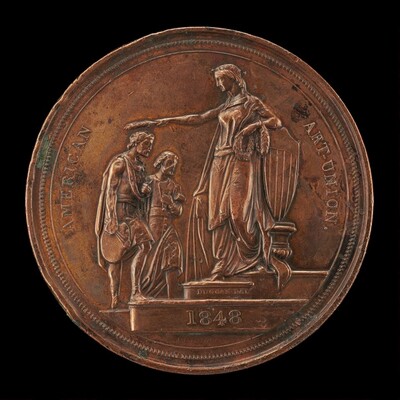
The image shows a round bronze medallion with a relief sculpture. The sculpture features a female figure standing on a platform, extending her hand towards two male figures in front of her. The female figure holds a laurel wreath and a shield. The two male figures stand in front of her, one muscular and draped in a cloth, the other smaller in stature. The medallion is inscribed with "AMERICAN ART-UNION" and "1848." The material is reddish-brown bronze with a metallic sheen and signs of aging. The scene is intricately detailed with the figures and their clothing carved in high relief.

Fame Crowning Painting and Sculpture [reverse]

Duggan, Paul Peter

This is a painting depicting a scene inside a rustic interior. The painting shows a group of individuals interacting in a lively manner within what seems to be a tavern or domestic setting. One figure is being embraced by another in colorful attire at the center, with other figures observing. The room features wooden beams, a large fireplace with pots and vessels, and a door leading to another space. Dynamic postures suggest movement and drama, with a dog sitting in the foreground. The style resembles Jean-Honoré Fragonard, showcasing baroque exuberance and detailed elements.

Histoire de Manon Lescaut (volume I)

Various Artists

This is a photograph of a building facade with three arched windows. The structure displays classical architectural elements such as prominent molding and decorative brickwork above the windows. The windows themselves are divided into multiple panes, and beneath these windows is a sign that reads "Daily News" and "Job Printing" with the name "George & Co." and the number "136." The photograph has a vintage quality, indicated by sepia tones and visible wear around the edges.

E. C. George & Co., Elmira, New York

American 19th Century

A long, rectangular dining table is surrounded by thirteen people in this horizontal painting. The skin of all the people, some of their clothing, and the tabletop are painted golden yellow. Touches of aquamarine blue, salmon pink, and rust red appear in some clothing, and the scene is set against a nearly black background. Across from us at the center of the table, a radiating, gold starburst surrounds the head and shoulders of a man, Jesus, with shoulder-length blond hair and beard. He looks at or toward us with dark eyes as he holds his hands up, palms facing out, at his chest. He wears a champagne-white robe and reclines with his legs extended to our left as he rests his opposite elbow on what could be a cushion or rolled-up blanket. To our right, a second person mirrors Jesus’s reclining position but with wrists crossed over the chest and turning to look toward Jesus. That person wears a long teal-blue garment and has smooth cheeks and long blond hair. Another bearded man to our left, near the back corner of the table, leans away from Jesus with hands held up as if in prayer. Three people lounge or sit on each of the short sides of the table to our left and right, and four recline on the side closest to us. Some have beards and others are cleanshaven, and some have short hair while others have long locks. Most of them look toward Jesus while two bend low to the table in prayer. One man, in the lower right, wears brick red and turns his back on the table as he counts or touches coins in a sack. The long table is set with goblets and plates of food. The artist signed the work with his initials in the lower left corner: “WB inv.”

The Last Supper

Blake, William

The image shows a rural landscape with a dirt road leading into the scene. The horizon is obscured by dense trees. A horse pulls a cart with a person nearby. The engraving style is detailed with fine lines. The color palette is sepia. Two haystacks are seen next to a wooden fence, with a partly cloudy sky adding depth.

A Long Island Road

Shelton, William Henry

Baluster Vase

Baluster Vase

Chinese Qing Dynasty

The image displays faint, swirling lines and shapes on a smooth, dark surface, creating an abstract pattern. The lines crisscross and curve subtly. Light and shadows interact to suggest depth, forming an intricate web that resembles a well-worn, textured slate. The abstract elements allow for interpretation, resembling distant mountains or a hazy, distant forest.

The Day of Judgment

Schiavonetti, Luigi

This is a drawing of an ornate sofa. It features a luxurious and elegant sofa with detailed woodwork and dark upholstery. The sofa has a curvaceous form with rolled arms and a matching backrest. The wood has intricate carvings, and the sofa has claw and ball feet. The drawing is displayed on a light background.

Sofa

Aloisi, Anna

This print shows an array of abstract shapes and lines on a textured background. Many forms resemble human figures, although many of their features are abstracted or exaggerated. One figure near the center has a skull-like face and is seated and with their head in their hands, looking out at us. Other shapes include a child seated on the ground on the left and a figure with long hair and wide eyes on the right, their hands clasped in prayer. In the upper half of the print, there is text in a swirling ribbon, as well as more stylized human faces, most depicted from the shoulders up. The background is filled with solid and patterned sections in shades of black, reddish-brown, and beige.

Be in Love and You will be Happy (Soyez amoureuses, vous serez heureuses)

Gauguin, Paul

The image shows a person riding a horse, leaping over a fence with dogs and buildings in the background. The horse is in mid-leap, with the rider maintaining a steady posture. Two buildings with distinct architectural elements are shown in the background, suggesting an outdoor setting near a residential area. Two dogs are also depicted in the scene, reacting to the movement of the horse. The drawing is done in a loose and expressive style, emphasizing motion over details.

Sheet of Sketches

Toulouse-Lautrec, Henri de

The sculpture is a bust of a young man with distinct facial features, including a serene expression and short curly hair. It is crafted from a brown material with gold tones, suggesting it is bronze or terracotta with a patina finish. The subject wears a pleated garment, and the bust sits on a blue and gold base with a decorative border. The sculpture is life-sized, extending from the head to just below the shoulders. It conveys a poised and dignified presence, positioned at eye-height with a viewer.

Rinaldo della Luna

Anonymous Artist

The image features a series of jagged, angular lines and geometric shapes forming a complex pattern. The arrangement resembles human figures, with bold outlines hinting at heads, limbs, and torsos. The foreground includes a central figure with exaggerated facial features and wild hair, surrounded by other figures. The composition conveys a crowded scene with a sense of motion and interaction, similar to people gathered in a limited space.

Die Irren I (The Mad I) (headpiece, page 24) from Georg Heym: Umbra Vitae (Georg Heym: The Shadow of Life)

Kirchner, Ernst Ludwig

The sculpture features intricately carved figures adorning a pair of stone columns. The figures are religious or historical in nature, with detailed garments and poses. One figure is an angel with wings, holding a trumpet. Below this angel, there are two bearded male figures with robes. The figures are crafted from stone with a beige color and aged appearance. The statues are elevated on ornately decorated pedestals attached to the columns.

Strasbourg Cathédrale, Pilier de L'Ange (Strasbourg Cathedral, Pillar of the Angel)

Winter, Charles David

The image shows a wide expanse of land with a line of trees, rolling hills, tipis, figures in canoes on a river or lake, and people gathered around the tipis. The brushstrokes are smooth and meticulous, capturing details in the landscape and structures. The color palette is warm and tranquil, with shades of light yellow, green, and brown dominating the land, transitioning into the orange and pink tones of the sky. The sky features a few wispy clouds.

Sioux Village - Lac du Cygne

Catlin, George

The image depicts a large, conical glass funnel placed on top of a cylindrical container, surrounded by various bottles and containers of different shapes and sizes. The color palette is monochromatic, with sepia and black tones. The objects are arranged on a flat surface, with a piece of fabric or paper draped over the edge of the table closest to the viewer, creating shadows and highlights.

Frontispiece

Bonvin, François

This sculpture is a large ceramic jar. It is made from brown, glazed material with a glossy finish. The jar is cylindrical with a wide opening at the top and two small, rounded handles near the rim. There are carved lines of text or markings around the upper portion of the jar near the rim.

Storage Jar

Drake, David

Mahana Atua (Day of the Gods) [recto]

Mahana Atua (Day of the Gods) [recto]

Gauguin, Paul

The image displays a small jar with a handle in the center. The jar is rounded with a wide rim and a single curved handle on the right side. The color palette includes shades of brown and darker accents for texture. The jar is on a textured wooden surface with horizontal lines. Above the jar, there is text that reads "SMALL JAR WITH HANDLE EARLY 19th CENTURY" on a beige background.

Bean Pot

Matulis, John

The image depicts two figures, a woman and a young girl, next to a spinning wheel. The woman is seated on a chair, sewing, while the girl stands beside her. A small dog rests nearby on a wooden surface. Other household items, like a teapot and a candelabra, are visible.

La Mere laborieuse

Lépicié, Bernard

The image depicts a fiery scene with a burning structure dominating the upper right section. The horizon is faint, with storm clouds above. An ethereal figure is in the clouds to the left. There are dynamic brushstrokes showing movement in the smoke and flames. The color palette includes warm and cool tones, with figures fleeing below the burning building towards the right. Vegetation adds a contrast to the burning architecture.

An Ecclesiastic Building in Flames with Demons Above

Payne, Arthur Frederick

The sculpture shows a dog lying down with its body slightly curled and its head on its front legs. The material of the sculpture appears to be bronze with a dark, greenish-brown patina. The details of the dog's muscular structure and fur texture are intricately captured. It is mounted on an oval base, with the dog's body stretched out horizontally.

Reclining Greyhound

Barye, Antoine-Louis

This is a painting of a book cover. The title "La Porte des Rêves" by "Marcel Schwob" is featured along with the year "1899" and the text "Imprimé pour les Bibliophiles-Indépendants." The background displays a pattern of flowers and leaves in teal and gold. The text is designed in artistic fonts. In the center, there's a stylized illustration of a face with flowing hair, integrated within geometric lines, reminiscent of the Art Nouveau style. The overall style is similar to Alphonse Mucha.

La Porte des Rêves

Feure, Georges de

The image shows a landscape with a tiered structure rising above barricades. The view is from a slightly elevated perspective, looking across grass towards the structure. Tall trees and the architecture, including pagoda-like spires, obscure the horizon. The sky transitions from light to dark, and the image is in black and white. Detailed textures are visible in the woodwork and masonry. Closest to the viewer is a patch of grassland, leading towards the fenced enclosure and the architecture.

Rangoon: North Entrance to the Shwe Dagon Pagoda

Tripe, Linnaeus

Three pale-skinned men wearing long, dark robes stand in and near a dense cluster of vivid, mint-green buildings with arched openings and clay-red colored roofs that nearly fill this vertical painting. Near the lower center of the composition, two bearded men stand in an open doorway looking out at the younger, cleanshaven man who stands barefoot to our right, facing them. At the door, the man in front has a long, white beard, and he holds a red book, or manuscript, in his left hand while holding up his right hand with his first two fingers raised. The man behind him has a red beard and hair. The younger man to our right bows his head, encircled with a gold halo, toward the pair in the doorway. The younger man holds one hand over his heart, and in the other holds a long, gnarled walking stick. The skin of all three men has a greenish cast. The green buildings are tall and narrow. Beyond the buildings, near the top of the panel, a row of tall, dark green trees are silhouetted against the shiny gold sky. The gold background is punched with a decorative band of small circles and arches along the top edge of the panel.

Saint Anthony Leaving His Monastery

Master of the Osservanza

The drawing depicts cherubic figures in a pastoral setting with a large tub. The figures interact joyfully around the tub in the wilderness. Winged cherubs are in trees and seated on the edges of the tub. The figures hold grapes and vines. One figure pours liquid into a bowl. Grapes and foliage are woven into garlands. The drawing is detailed and intricate, highlighting textures of hair, foliage, and wood grain. The scene conveys enjoyment and natural beauty.

Putti with Grapes and a Seated Bacchante

Dorigny, Michel

The image shows a tall vase with a smooth, rounded body that tapers towards an elongated neck, culminating in a flared rim. The vase has a soft pinkish-red color with speckles and a white accent at the rim and base. It is placed against a gray background.

Amphora Vase

Chinese Qing Dynasty

The painting shows a scene from an elevated point of view. At the bottom of the painting, a group of people walk or ride along a wide dirt path. Several of the people sit in a covered horse-drawn wagon. Two women walk next to the wagon, while a man stops to tie his shoe. To the left of the wagon, two people speak together, one of whom wears a large pack on their back. Many of the people are dressed in bright shades of blue, red, and pink. On the left side of the image, along the dirt path, are two large buildings with orange roofs. Behind the path is a body of water, on top of which float two boats with more people in them. On the other side of the water, trees and buildings line a hill that slopes upwards, continuing far off into the distance. At the bottom of the image, the colors are mostly earthy browns and greens, while the distant landscape is painted in light greens and blues, under a blue sky filled with soft, fluffy clouds.

River Landscape with Villages and Travelers [verso]

Anonymous Artist

The image shows a handbag with an intricate design featuring colorful flowers and two tassels. The primary colors are shades of green, with accents of pink, blue, and yellow. The bag is placed in the center, with a sketch of its design on the bottom left and an outline of a piece on the top right.

Silk Purse

Clarke, Hugh

This is a painting of yellow-breasted chats interacting around a nest. The painting depicts three birds with striking yellow breasts and olive-green wings positioned around a nest that is situated in a flowering tree. Two of the birds are in flight with their wings partially open, while the third bird is perched on the edge of the nest which contains a fourth bird sitting within it. The nest is nestled among branches adorned with leaves and flowers, adding a contrast to the birds. This is in the style of John James Audubon.

Yellow-breasted Chat

Havell, Jr., Robert

The image shows a pencil drawing of a townscape. The horizon features towering mountains in the distance. In the foreground, there are various buildings with flat roofs and architectural details, some obscured by foliage such as a palm tree. The structures have European architectural features like domes and stonework. The artist used fine lines and hatching for texture and depth. The drawing is rendered in grey tones for a subtle and atmospheric look.

View of Capri

Palm, Gustaf Wilhelm

The image shows a circular sculpture depicting a figure riding a horse. The subject of the sculpture is a person dressed in historical or military attire, mounted on a horse captured mid-step, with its front leg raised. The material seems to be metal with a patina, likely bronze or a similar alloy. The sculpture is detailed with relief work showing the contours of the rider and horse. Embossed text encircles the figures, possibly indicating a commemorative name. Small holes can be seen on the surface, suggesting possible mounting or display purposes.

Ercole on Horseback [reverse]

Baldassare d'Este

The image displays a black-and-white illustration on the right page of an open book. It shows a person standing in profile facing to the left. The individual's facial features are lightly sketched, and their hair is covered by a large hat. The person wears a long, dark coat and stands on a path with abstract shapes in the background resembling trees or foliage edges. The scene has stark contrasts between light and dark areas and an atmospheric quality. The left page contains German text organized into paragraphs relating to the illustration.

Akaki trägt den Mantel das erstemal auf der Straße (Akaki Wears the Coat on the Street for the First Time) (plate 6) from Der Mantel (The Coat)

Gramatté, Walter
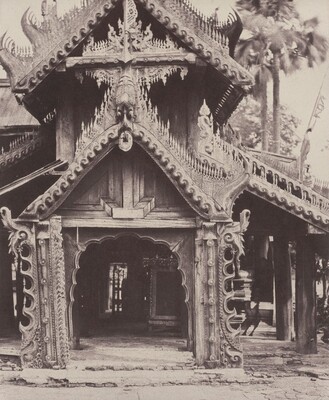
This is a photograph of a wooden building with intricate architectural details. The gable end is adorned with swirling patterns and decorative elements. The entrance has a slightly arched doorway surrounded by detailed woodwork, with a carved panel above it. The roof edges have decorative trim and flourishes. In the background are tall palm trees and foliage. The craftsmanship of the building showcases attention to detail and artistry, capturing a moment of cultural heritage in wooden architecture.

Pugahm Myo: Carved Doorway in Courtyard of Shwe Zeegong Pagoda

Tripe, Linnaeus
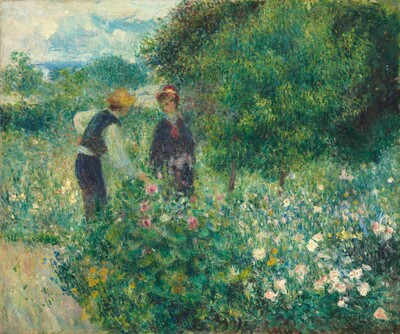
A light-skinned man and woman stand looking at each other, surrounded by blooming flowers and lush green trees in this square landscape painting. The palette is dominated by shades of vibrant green and blue, and is loosely painted with daubs and short strokes, making details indistinct. The people stand to our left of center and both are dressed in navy blue. The man stands facing our right, almost in profile, and bends forward slightly with one hand gesturing toward the flowers. He wears a vest and trousers, a white shirt, and a butterscotch-gold hat. The woman stands near him to our right, and faces us with her head turned to look at the man. She wears a long gown, a cherry-red hat, andwhat appears to be a denim-blue and cherry-red scarf around her neck. The trees fill right half of the painting, and the profusion of flowering bushes closest to us almost spans the width of the scene. Their blooms are suggested with touches of rose and petal pink, cream white, mustard yellow, and azure blue. More flowering bushes behind the man and woman are suggested by loosely painted areas of parchment white and laurel green, with scattered dots of poppy red. Pale pink clouds swirl through the topaz-blue sky in the upper left corner. The artist signed the painting in the lower right, “Renoir.”

Picking Flowers

Renoir, Auguste

The image shows the upper body of a person kneeling and leaning forward, seemingly touching a surface in front of them with their right hand. Their face is in profile with indistinct features, and they have long hair in a braid. The person appears unclothed, and there are architectural elements in the background. The artwork is minimalist with focus on line work and form, without color or shading.

Croquis (Sketch)

Helleu, Paul-César

This is a vase with a rounded body and a long, narrow neck. The vase is a vibrant green color with a crackled finish. The crackle glaze covers the entire surface of the vase except for the rim of the opening, which is white. It seems that the interior of the vase is black or dark grey.

Bottle Vase

Chinese Qing Dynasty

The meeting of a Family in Heaven

The meeting of a Family in Heaven

Schiavonetti, Luigi

The image shows a rectangular rug with a floral pattern at its center. The rug features a bouquet of vibrant flowers in shades of red, pink, orange, and purple. Surrounding the floral arrangement is an intricate swirling pattern in dark green and brown. The background of the rug is a neutral beige color.

Hooked Rug

Barnes, Ruth M.

The image shows a large dark blue eel among tall, slender, branching coral structures. The eel is dark blue and black, while the coral is golden brown against a light background. The eel's head is on the left, with its body winding through the coral branches that rise vertically in the image.

The Black Muray (Muraenae helenae varietas)

Catesby, Mark

The Children

The Children

Pissarro, Camille

The sculpture depicts a horse in profile. The body and head are clearly defined within the contours of the piece. The sculpture is predominantly dark in color, with shades of reddish-brown and black forming the body of the horse. The surface texture of the sculpture is rugged and uneven. The material appears to be a type of painted plaster or resin, providing a subdued matte finish. The horse is situated within a roughly rectangular form that frames its body. The base of the artwork is a slightly raised section that is lighter in color.

Ecorché: Relief of a Horse (Josephine)

Eakins, Thomas
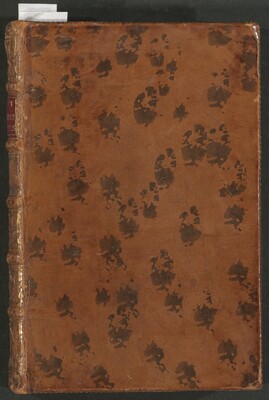
This is a photograph of a weathered leather book cover with a mottled pattern. The surface is rich, brown leather with dark, irregular spots scattered across it, giving it a worn, antique appearance. The spine of the book is visible on the left, showing faint vertical creases and a smaller section at the top with an embossed or pressed design. The book cover appears to have been well-used or designed to look aged, with distinctive leather grain and signs of wear. There is a small, white paper sticking out slightly from the top.

Les Cent Nouvelles Nouvelles

Hooghe, Romeyn de

The image shows a woman seated and facing the camera. Her upper body, including her chest and head, is in focus. She has distinct facial features, dark hair styled with waves and curls, and is wearing a dark dress with ornate details and a high collar. The background is plain.

Portrait of a Woman

Ellinwood, John G.

A young woman with light skin stands in a garden, wearing a voluminous, full-length, silvery, shimmering gown in this vertical portrait painting. Her body faces us, as she looks into the distance to our left. She has rosy cheeks, gray-green eyes under gently arched, light brown brows, and her coral-pink, thin, closed lips curve in a slight smile. Her ash-brown hair is pulled back and adorned with tiny shell-pink and azure-blue flowers along the left side top of head, to our right. A pleated lace ruffle encircles her smooth neck. Her gown is parchment white where the light glints off the stiff fabric and is silvery gray in the shadows, creating a silk-like sheen. The dress is cut low across the chest, fits tightly around her narrow waist, and has puffy sleeves tied at the elbows with topaz-blue bows. Another blue bow is tied at her chest, and the ends wrap around her back along her waist. A corsage at her left shoulder, to our right, is a profusion of white flowers around a pale pink rose. In her other hand, to our left, she holds a straw hat with a shallow crown and a wide brim, trimmed with sky-blue ribbon. The arm holding the hat is nearly engulfed in the deep folds of her full skirt. She holds a pink rose in her other hand, which rests on the lip of a shiny, copper-colored urn filled with pink flowers and delicate green leaves. On that wrist she wears a bracelet with four strands of white pearls holding a cameo. She stands on a pale, dirt ground. A teal-blue bench in the lower left corner of the painting is tucked into sage-green shrubbery. Sprigs of pink roses are strewn across the seat and on the ground. The woman is framed to either side with olive and celery-green trees and vegetation, which blend into the hazy distance beyond her head.

Madame Bergeret

Boucher, François

This is a drawing of three owls perched together amidst dark foliage. The central owl is prominent, gazing directly outwards with large eyes and pronounced tufts. Flanking the central owl, two smaller owls also perch quietly amidst detailed leaves and branches. The artwork is rendered in a monochromatic blue tone, emphasizing texture and depth. The technique used suggests precise strokes, capturing the essence of the owls with a mystical aura.

Grand-duc (Eagle Owl)

Groux, Henri de

The form of a woman standing inside an arched niche is created with vibrant painted and cut glass held in place by dark lines, probably lead, in this vertical stained-glass window. The woman’s body faces us but she turns her face to our left to look down in that direction. She wears a red dress under a blue robe lined with canary yellow. She holds a book in one hand, and her other hand, to our left, is down by her side. Her skin is a yellowish color, and she has long yellow hair with a darker yellow halo. In front of her and to our right is a lectern decorated with intricate scrollwork and floral carvings. The rounded arch behind her is filled with a coral-orange shell. A border with flowers is created with white, yellow, pale pink, red, and light blue glass.

The Virgin Annunciate

Giovanni di Domenico

The image depicts indistinct, flowing lines and shapes on a dark, possibly metallic surface. The patterns suggest depth and texture, resembling forms such as fabric folds or shadowy figures in an undefined space.

The Soul exploring the recesses of the Grave

Schiavonetti, Luigi

The image depicts a drawing with two sections: the main section shows a simple, stylized frontal view of a face and upper body down to the chest area. The person has minimalistic facial features, short curly hair, and there is a cross below the chin. Above this drawing is a smaller sketch of a similar figure enclosed in a rectangular outline. The illustration is set on a plain, lightly colored background with few specks or marks.

Jar

Fumagalli, Frank

The image features a woman seated holding a small child in her arms. She has a detailed profile, with an expression of focus directed at the child. The woman has an intricate braided updo and wears a dress with long sleeves. The child is naked and appears comfortable in her embrace. Next to them are an hourglass and a human skull. Through a window in the background, a castle and trees are visible, adding depth to the scene.

Madonna with Skull

Beham, Barthel

The image is a drawing of a person from the waist up. The person is in a pose with both arms raised above their head, showing the torso. The face is slightly tilted upward in a profile view with defined facial features and curly hair. The person is not clothed, highlighting the body's contours, musculature, and shading. There are no accessories or visible objects, and the background is minimalistic, emphasizing the central figure through shading and lines.

A Male Herm

Canuti, Domenico Maria

A photograph of a gold-colored medallion is shown. The medallion depicts a ship with a sail surrounded by waves and clouds. Figures on the ship are engaged in activities. The relief work is detailed, particularly in the figures and sail. An inscription in a classical style frames the scene on the edge of the medallion. The craftsmanship suggests a historical or commemorative purpose, highlighting fine artistry and detailed representation.

The Queen at the Helm of a Ship in Stormy Seas [reverse]

Dupré, Guillaume

This is a drawing of a title page for a book about ancient Rome. The title page showcases a collection of ancient Roman monuments, with an illustration of classical ruins, columns, and architectural fragments. The typography is elegant, with the title in uppercase letters. The page attributes the work to Monsieur Barbault, a painter, and former pensionnaire of the king in Rome, and references the publication location of Rome by Libraires François.

Les Plus Beaux Monuments de Rome Ancienne Ou Recueïl Des Plus Beaux Morceaux De L'Antiquité Romaine Qui Existent Encore: Dessinés Par Monsieur Barbault Peintre Ancien Pensionnaire Du Roy a Rome, Et Gravés en 128 Planches Avec Leur Explication.

Nolli, Carlo

The image shows a series of black and white photographs arranged in a grid pattern, depicting a human figure riding a horse. The photos capture different stages of a trot, with the rider seated upright on the horse's back. The background is plain with a grid-like pattern, and the ground appears flat. The sequence illustrates the motion of the horse and rider, focusing on the horse's legs in various stages of the trot.

Plate Number 615. "Hansel" cantering, bareback

Muybridge, Eadweard

We look out onto a sweeping, panoramic view with trees, their leaves fiery orange and red, framing a view of a distant body of water under a sun-streaked sky in this long, horizontal landscape painting. The horizon comes about halfway up the composition, and is lined with hazy mountains and clouds in the deep distance. Close examination slowly reveals minuscule birds tucked into the crimson-red, golden yellow, and deep, sage-green leaves of the trees to either side of the painting. Closest to us, vine-covered, fallen tree trunks and mossy gray boulders line the bottom edge of the canvas. Beyond a trickling waterfall and small pool near the lower left corner, and tiny within the scale of the landscape, a group of three men and their dogs sit and recline around a blanket and a picnic basket, their rifles leaning against a tree nearby. The land sweeps down to a grassy meadow crossed by a meandering stream that winds into the distance, at the center of the painting. Touches of white and gray represent a flock of grazing sheep in the meadow. A low wooden bridge spans the stream to our right, and a few cows drink from the riverbank. Smoke rises from chimneys in a town lining the riverbank and shoreline beyond, and tiny white sails and steamboats dot the waterway. Light pours onto the scene with rays like a starburst from behind a lavender-gray cloud covering the sun, low in the sky. The artist signed the painting as if he had inscribed the flat top of a rock at the lower center of the landscape with his name, the title of the painting, and date: “Autumn – on the Hudson River, J.F Cropsey, London 1860.”

Autumn - On the Hudson River

Cropsey, Jasper Francis

The image shows a landscape captured from a slightly elevated perspective. The horizon is suggested by distant hills and sky, partially obscured by clusters of lush trees. There is no distinct line for the horizon, as it blends with the tree line and distant mountains. The style of the piece features intricate engravings, capturing detail and texture of a rocky cliff and dense foliage. The scene is in monochrome, primarily black and white. In the bottom right corner, a person stands near a large rock. A river winds into the scene from the middle distance. Trees with detailed leaves dominate the image, with some clouds visible in the background.

Ponte Lupo a Tivoli

Dies, Albert Christoph

This is a photograph of a decorative ceramic bowl made of porcelain. The bowl features intricate painting on its exterior, with a design of blue vines with green leaves winding around the bowl. Red, oval-shaped fruits decorated with small dots are interspersed among the foliage. The overall design is delicate and elegant, showcasing traditional ceramic art craftsmanship. The bowl is placed against a neutral background.

Cup

Chinese Qing Dynasty

The image shows an engraved plate depicting two figures standing side by side, with their heads tilted. The figures are wearing long, flowing garments that cover their bodies. The background is intricately engraved, suggesting elements like a mountain or cliff on the left side and an implied landscape in front of the figures.

The Circle of the Traitors; Dante's Foot Striking Bocca degli Abbate

Blake, William
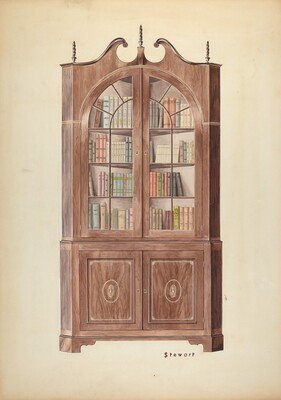
The image displays a large wooden cabinet with glass doors and a decorative arch at the top, standing on four small feet. Inside the cabinet are shelves filled with books of different colors. The color scheme consists of various shades of brown from the wood and assorted colors on the book covers like red, green, and orange. The cabinet is in the central position, showing the arrangement of books through the glass doors. A small signature, "Stewart," is located at the bottom of the cabinet.

Corner Cupboard

Stewart, Robert

This is a painting of three birds perched on a leafy tree. A blue grosbeak and two colorful birds are depicted among lush green leaves on slender branches, with one perched near a nest.

Blue Grosbeak

Havell, Jr., Robert

There is a bird with a yellow chest and blue-tinted wings lying on its side on a dark brown surface. The bird's head faces left, its legs stretch towards the right, and a small feather and a sphere-like object lie nearby at the bottom.

Dead Bird

Brandegee, Robert Bolling

The image depicts a coin with the profile of a man wearing traditional attire reminiscent of Renaissance armor. The man has a distinctive jawline and a prominent nose, with textured hair. Inscriptions surrounding the profile and the metallic material of the coin suggest historical importance. The sculpture is finely detailed, emphasizing the man's facial features and attire.

Galeazzo Maria Sforza, 1444-1476, 5th Duke of Milan 1466 [obverse]

Milanese 16th Century

This is a photograph of a book cover. The cover displays the title "ALBUM OF VIRGINIA" in gold embossing on a dark reddish-brown surface. Below the title, it reads "ILLUSTRATED BY ED. BEYER, 1858," in vertically stacked lines. At the bottom, it is marked "CORCORAN GALLERY OF ART." The cover features minimal wear with some scrapes and scuffs, with yellow-brown triangles on the right corners and a vertical yellow-brown stripe on the left edge.

Album of Virginia

Beyer, Edward

The image shows a landscape with a river flowing through it. Rocky ground lines the left riverbank where a person is sitting or crouching. A large tree is on the right, with mountains in the distance. The sky is expansive above. The color scheme is sepia, giving an antique feel. The image is a photograph capturing details like water ripples and tree foliage.

Plate 43. Weber Valley, from Willhelmina Pass

Russell, Andrew Joseph

This painting depicts two people balancing on a running horse. The horse is mid-gallop, heading to the left, with a red cloth on its back and a silver halter on its face. It is a rich brown color, with a short mane. Standing on its back is a person with short, curly blond hair and pale skin, wearing a pale-yellow tunic or dress with puffy sleeves, silver embellishments, and white tights. They are standing with one arm extended to the side and the other raised, and one of their legs is slightly bent. On their shoulder stands a much smaller person with the same skin, hair, and pale-yellow costume. This person has one leg extended outward, and they are holding a blue fabric in both hands which twists through the air. The background shows an indoor setting, with teal fabric hung below red drapes, and on the left is the front of a building with peach walls. The floor is gray, and slopes slightly downward on the left and right.

The Mounted Acrobats

American 19th Century

Three artists are depicted painting on a large canvas. Two central figures are shown holding painter’s palettes and brushes while working on the artwork. One stands upright and the other leans forward. The tallest figure has a focused expression with eyes on the canvas. In the background, framed paintings are displayed on the wall. The drawing uses strong lines and shading to create a textured composition, highlighting the artists' focused energy and expressions.

Exposition de peinture de 1868 - Le Dernier coup de pinceau

Étienne

This is a photograph of a decorative porcelain plate. The plate features a detailed and colorful design depicting a domestic scene with several figures engaged in leisurely activities. The central image is encompassed by a richly decorated border with floral patterns and ornamental motifs in colors such as greens, pinks, blues, and golds. The craftsmanship highlights traditional artistry found in fine porcelain, with an emphasis on harmony and elegance.

"Ruby-Back" Dish

Chinese Qing Dynasty

This is a photograph of a copper printing plate. The plate displays reverse-engraved text with letters indented into the metal surface. The writing is in an elegant font and is surrounded by ornamental designs. A small illustration of a bird in flight is at the top left corner. The copper's patina gives the plate a brownish tone, contrasting with the polished surface and engraved lines.

Fragment of cancelled plate for "A Prophecy" [recto]

Blake, William

The image shows a drawing of a wine glass in grayscale with a light beige background. The glass is centrally placed, slightly above the horizontal midpoint and to the right of the vertical center. Delicate shading is used to create depth and highlight the glass's contours.

Cordial Glass

Fumagalli, Frank

The figure stands behind a rectangular pedestal, extending from head to mid-thigh. The person has a bearded face, curly hair, and a serious expression. They wear loose garments, with a hand-woven lion pelt draped over one shoulder. The lion's head rests on their chest, and they hold a large club-like object with one hand. The background includes tall grass, a small stream, and a leafless tree on the right. Above the figure, ornate designs frame the scene, with leafy garlands, tassels, and ornamental faces with wings.

Hercules with His Club

Mignon, Jean

The image shows a landscape sketch featuring an ancient Egyptian scene. The point of view is slightly elevated, capturing palm trees and ruins in an expansive setting. Stone structures and temple remnants are visible against the sky, with palm trees and distant mountains in the background. The sketch uses loose brushstrokes in shades of gray and black, creating a soft, atmospheric quality. Water buffalo are depicted near a body of water, adding life to the scene. The palette is limited to grayscale tones, providing depth to the landscape.

Thebes

Lear, Edward

A woman sitting on a throne with a child on her lap and two angels are carved from white marble and decorated with a few areas of gold in this freestanding sculpture. All four people face us in this photograph, and they have round cheeks, square jawlines, and closed lips. Black dots are painted for pupils but without irises or other paint on their faces, they all look startled or intense. The woman wears a gold crown over a cloth that drapes over her head, shoulders, and across her lap. Her knees are apart, and pointed shoes peek out under the rippling hem of her dress. She braces the child’s torso with her left hand, to our right, and touches his upper leg with the other hand. The child’s adult-like face is framed by gold hair. He holds up one hand, though the fingers have been broken off, and holds an open book facing out propped on his leg with his other hand. Writing on the pages has been painted. Two child-like, wingless angels stand on the arms of the throne behind the woman’s shoulders and hold a cloth up behind her head. On all four people, their hair and the necklines, hems, and cuffs of their garments have been painted with gold geometric designs. The Latin text on the book reads, "CONTINET IN GERMIO CELV TERRA Q REGENTE VIRGO DEI GENETRIX MCCCXXI.”

Madonna and Child with Two Angels

Verona 14th Century

This print shows several people on a cobblestone street in a variety of dramatic poses, their arms outstretched in different directions. There is a woman in the center dressed in an elaborate gown, looking upward. She has pale skin and light hair, and she wears a necklace that looks like a strand of pearls. Behind her, people appear shocked, with a woman bending down and holding a cloth to her face, a man with one head on his hand and the other stretched forward, and another person kneeling on some stairs, their head on the ground. On the left, a man with medium-toned skin and a dark beard bows down towards the woman, his arms outstretched, holding a cloth. More shocked people are on the left, one of them wearing a mask over the top of their head. On the far right, someone stands on a ladder, posting a large sign on the wall. A person below looks toward them, their right arm raised up as if directing. In the bottom right corner, a child appears to carry a thin drum or similar object on a strap hung around their neck. The background includes more buildings on the cobblestone street under a light gray sky. People look out from second story windows in a building on the left, staring down at the scene on the street. Below the print are several lines of text.

L'oeuvre d'Antoine Watteau (volume II)

Various Artists

The image shows a landscape with scattered ruins and remnants of structures. The horizon is visible at the top, where land meets the sea stretching across the frame. In the distance, clusters of buildings are seen on the sloping terrain. The scene has a monochrome appearance with a vintage sepia tint. Various stone structures and debris are scattered throughout the landscape, leading to a central winding path. Close by, there are mounds of dirt and what seem to be building remains. In the background, there is the sea and a hint of a city skyline.

Sebastopol

Robertson, James

Shown from the chest up, a light-skinned man with a wrinkled face and a silvery gray beard and hair gazes into the distance in this oval portrait painting. His chest is angled to our right but he turns his head to look off over his other shoulder, to our left. His slate-blue eyes are a little sunken and lined with wrinkles. Shading marks the hollows of the temple and cheek we can see. His thin lips are closed and framed by his curly mustache and beard. A dark, mahogany-brown cap is pushed back on his head, and his brown jacket has gold-colored buttons down the front. The collar of a cream-colored shirt shows through at the neckline. The background is dark olive green. The artist signed the work near the man’s shoulder, to our right: “GDOV.”

Bust of a Bearded Man

Dou, Gerrit

This is a drawing of a historical street scene. The scene shows a bustling city street filled with a large crowd of people closely packed together. In the foreground, a wooden railing divides the crowd. The background features ornate buildings with multiple windows, some covered with drapes. Electric wires are strung across the sky. Signs are visible on the buildings, and there are street lamps at the edges of the scene.

Märztage I (March Days I)

Klinger, Max

The sculpture is a cream-colored vase with a long, slender neck that gradually flares out towards the mouth and a bulbous body that rests on a narrow base. At first glance it appears smooth, but closer inspection reveals extremely subtle swirling patterns visible on the surface.

Vase

Chinese Qing Dynasty

This is a photograph of a textured metal plate. The surface of the plate has faint, indistinct marks that may suggest a figure or abstract form. The lighting creates reflections and highlights on the surface, emphasizing its rugged and scratched quality. The overall appearance is industrial, with a sense of history. The shading and texture provide depth and complexity in a monochromatic presentation.

Death's Door

Schiavonetti, Luigi

This is a drawing of a decorative wall bracket. The image depicts a metal wall-mounted bracket with multiple views and angles. The side profile view showcases the design elements like a looped top and circular attachment point mounted on a wooden wall. Additional sketches show a top view displaying the structural framework, a simplified side view with a scale note, and various other angles highlighting the structure and elegance of the bracket. The artwork seems to serve as a technical drawing or design plan.

Wrought Iron Banister Bracket

McLellan, James

The image shows a half-length portrait of a woman depicted in the form of a bust within an oval frame. The woman is positioned centrally, facing directly forward. Her facial features include closed eyes and a calm expression, and her hair is covered with a cap adorned with lace. Around her, she wears a dark drape and under it, a dress with a high lace collar. Above the portrait, an angel with wings is positioned, looking down towards the oval frame, and a hand is resting on top of the frame. The angel's hair is curly and flows to the shoulders. The setting includes a large, decorative architectural element resembling a pedestal or monument supporting the frame. Above this, an opened book with a quill and some sort of horn rest over it. The background features a scene with clouds and appears to depict a landscape with trees and hills extending into the distance. Latin inscriptions are present around the image, providing textual context.

Anne Bill

Anonymous Artist

The image depicts six moths and a small insect arranged in a circular formation within an oval frame. The color scheme consists of earth tones such as browns, beiges, and muted yellows with soft shading. The moths vary in color and pattern, with one positioned to the upper left, a darker moth in the top center, and a cream-colored moth with spots to the upper right. In the lower section, there is a moth with pinkish-brown wings on the left, a central moth with golden wings, and a darker moth with lighter patches on the lower right. A small insect is located directly beneath the central moth, near the bottom of the image.

Plate 31: Seven Moths

Hoefnagel, Joris

The image shows a round, bronze medallion with a relief scene depicting multiple human figures and a centaur. On the left side, there is a centaur carrying a branch or staff. In the center, two human figures are embracing. To the right, two standing human figures are depicted; one is holding a staff, and the other is wrapped in a garment. A small dog and some foliage are visible on the ground. The medallion is predominantly bronze with variations in tone due to the relief work. There is a hole near the top of the medallion, possibly for hanging.

Achilles Taking Leave of Thetis and Chiron

Mantuan 16th Century

This is a drawing of a book cover for "Umbria Vitae" by Georg Heym. The cover features bold typography and a central woodcut illustration depicting two abstract figures with mountainous or cliff-like forms in the background. The lines are sharp and angular, typical of expressionist art. The illustration is attributed to Ernst Ludwig Kirchner. The drawing is bordered by simple lines and has handwritten inscriptions at the bottom, detailing information about the publication, including the publisher and year.

Titelvignette (title vignette) from mock-up of Georg Heym: Umbra Vitae (Georg Heym: Shadow of Life)

Kirchner, Ernst Ludwig

This is a photograph of the ornate entrance to a stone building. The image captures the details of a Romanesque-style archway and facade. The central feature is an arched doorway bordered by columns and adorned with carved figures. Above the door, there is a semicircular tympanum containing a relief sculpture, featuring a central figure flanked by other smaller figures. The stone facade is textured and weathered, showcasing layers of historical architecture with decorative columns and figures carved into the stone. Staircases lead up to the door, emphasizing the grandeur of the entrance. The image is monochromatic, highlighting the architectural details and shadows.

Planche VI – Portail de Saint-Trophime d'Arles (Plate VI – Entrance of Saint Trophime of Arles)

Nègre, Charles

This painting shows three people sitting together. Two individuals on the left are women, likely nuns, with light skin, wearing black habits over tan head coverings and long-sleeved white robes. One of the women holds a book. The person on the right is an older man with light skin and a white beard, wearing a light red cloak over a long white robe. He holds a book and gestures towards the women. In the background on the left, there is a tan cityscape with buildings and a cloudy sky. On the right is a dark wall with a red hat hanging behind the man. The top of the painting is curved.

Saint Jerome with Saint Paula and Saint Eustochium

Zurbarán, Francisco de
This is a photograph of a text page. The page contains printed text in French and a handwritten signature. The printed text at the top reads, "Il a été tiré cent exemplaires de ce livre." Below this, to the left, is the word "Exemplaire N°" followed by a handwritten number and a signature in light green ink.

Yvette Guilbert

Toulouse-Lautrec, Henri de

A cup carved from stone is mounted in gold fittings to create a jeweled chalice with handles that curl up each side and a tall, flaring foot below. The stone of the cup is swirled with shell pink and rust brown, and carved to create vertical ridges. The gold rim around the lip flares outward and is set with a band of alternating pairs of small, white pearls and mostly garnet-red stones, though one stone to our right is a muted blue. In this photograph, the handles curve up each side from the base of the stone cup to the gold lip, where the handle divides into two scrolling tendrils on either side of a teardrop shaped center, like curling petals. The base and foot are as tall as the stone cup and gold lip. A knob-like form just below the stone cup is set with deep red and jade green stones around its center, and rows of small pearls around the narrow top and bottom of the knob. The knob is chased to create a pattern of scrolling vines, like tracery. The flaring foot below is also chased with the same pattern, surrounding gold, oval medallions set at regular intervals in the foot. In our view, the medallion to the left shows a bunch of grapes and the center is a portrait of a bearded man with a halo, holding his right hand up with his first two fingers raised. The details on the medallion to our right are difficult to make out but it could be a sheaf of wheat. Small, round jewels are set above and below each medallion, and between each one.

Chalice of the Abbot Suger of Saint-Denis

French 12th Century

This is a photograph of an engraved metal plate. The plate has a worn and aged appearance, with scratches and areas of discoloration throughout. The design on the plate appears intricate, with various lines and textured areas. The edges of the plate are slightly beveled, and there is a visible border around the design.

The Counseller [sic], King, Warrior, Mother &Child, in the Tomb

Schiavonetti, Luigi

The image shows a wooden table with an ornate pedestal base and four curved legs. The color palette mainly consists of different shades of brown, highlighting the natural wood texture and intricate details. Positioned centrally in the image is the table, with the legs splaying outwards in a curve. Below the table, there are detailed illustrations of decorative elements, including a floral motif and two carved wooden fragments placed side by side at the bottom of the frame.

Card Table

Neal, Florence

The image shows a profile portrait of a man wearing a highly ornate historical garment. The man has prominent eyes, a straight nose, and short, curly hair styled away from his face. The portrait is surrounded by an intricately decorated oval frame with text. In the lower corners of the frame, there are decorative embellishments. The background features a finely hatched pattern, and there is an open book visible at the bottom right outside of the oval.

Christian IV, King of Denmark

Passe I, Crispijn van de
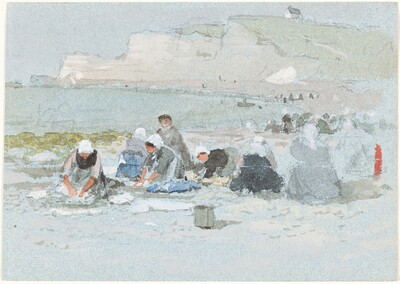
This is a painting of a group gathering near a rocky shoreline under a clear sky. In the foreground, several figures are depicted as sitting or kneeling on the pale sandy shore, engaging in a communal activity. The figures wear simple attire with muted colors, contrasting against a bright red accent seen on one of the individuals. In the background, a tall cliff overlooks the sea. The painting's treatment suggests a tranquil scene by the ocean.

Washerwomen on the Beach at Etretat

Boughton, George Henry

The sculpture is a medallion featuring a highly detailed coat of arms at its center. The circular design showcases heraldic symbols including shields and patterns enclosed by decorative drapery. Surrounding the coat of arms is a Latin inscription running along the edge of the medallion. The material of the sculpture appears to be metal, with a bronze or copper-like color. The textural details and raised relief of the symbols suggest careful craftsmanship in its creation, highlighting its historical or heraldic significance.

Shield of the Arms of Croy and Arschott [reverse]

German 17th Century

The image shows an intricately detailed stone plaque or monument off-center to the left, with inscribed text reading "Landschaften und Köpfe von LD." The scene includes dense foliage, stones, two figures near the monument, a winding path disappearing into trees, an ornate stone urn on a pedestal covered by leaves, and twisted trees on the left side. Brushstrokes are detailed, and the color palette is monochrome. Wispy clouds stretch across a clear sky in the background.

Landscapes and Heads

Hagedorn, Christian Ludwig von

The image shows the upper part of a man's body, focusing on his torso and head. He is facing forward, looking directly at the camera. The man has neatly styled dark hair, mutton-chop sideburns, a high forehead, straight nose, and a slightly open expression. He wears a dark coat and a high-collared white shirt with a dark cravat. The portrait is in an ornate frame with a gold-colored mat and a purple velvet-like lining. The background is plain and dark.

Portrait of a Man

American 19th Century

This is a painting depicting an angel crowning a seated woman in a dark landscape. The angel has white wings with hints of pink and green, pale skin, and short, golden hair. They are draped in a flowing white robe, and have one hand extended upward and the other placing a golden crown on the woman's head. The woman sits below the angel, near the bottom left corner of the painting. Her eyes are closed, and she has one hand placed on her chest. She also has pale skin and golden hair, and she wears a draping white garment that hangs loosely off of her shoulders and is tied at the waist with what looks like white rope. Over her legs there appears to be a blanket in shades of coral pink and golden yellow. The background is dark, but seems to be a rocky terrain with sparse green grass and trees, under a dark sky with dramatic purple clouds and a hint of pink light emerging behind some rocky mountains on the right. The angel and woman are brightly illuminated against the dark background.

Mercy's Dream

Huntington, Daniel

This is a drawing showing a group of individuals in elaborate attire, gathered in a room with artistic murals in the background. The figures are engaged in various activities, such as conversing or observing. The drawing uses fine lines and shading to create depth and texture in the costumes and scene.

Players Enacting the Poisoning of Hamlet's Father (Act III, Scne II)

Delacroix, Eugène

The sculpture is a small, round container with a lid. It has a red color with areas of lighter patches. The material appears to be ceramic or porcelain, with a smooth, polished surface. It is similar in size and shape to a compact or trinket box and rests on a flat surface.

Covered Box for Seal Paste

Chinese Qing Dynasty

Abraham Entertaining the Angels [recto]

Abraham Entertaining the Angels [recto]

Rembrandt van Rijn

The sculpture depicts a standing male figure in a formal attire with a dark-colored suit, green vest, white shirt, bow tie, and shiny shoes. The figure has a human-scale presence, standing in a dynamic pose, with one arm bent at the elbow and the other resting close to the body. The sculpture is made of a material that gives the skin a dark brown color and is placed on a simple, rectangular wooden base.

Hotel Porter Figure

Gully, Alvin M.

The image shows a woman from the waist up. She is positioned with her torso slightly turned to the right and her head turned to the left, looking into the distance. She has delicate facial features, a slight smile, and a softly curved jawline. Her hair is styled high with intricate twists and a decorative hairpiece. She wears an elegant gown with a low neckline, intricate detailing, a brooch at the chest, and lace cuffs. Her arms are crossed in front of her, holding a piece of fabric or a shawl. The background has dark and light tones with indistinct foliage and cloud-like forms.

Mrs. Graham

Cole, Timothy

This is a drawing of a jousting scene. It features an armored rider on horseback with a long lance, engaged in a jousting match. The rider is leaning towards the ground, indicating motion of the lance as if striking a target. Another figure lies on the ground, seemingly dislodged from their horse. The horses are adorned in decorative caparisons with green and yellow patterns. The artwork portrays the movement and drama of a jousting scene, showcasing the elaborate armor and attire characteristic of medieval tournaments, offering insight into the pageantry and competitiveness of the era.

German Joust of Peace

German 16th Century

This is a round medal depicting the profile of a man wearing a distinctive hat and robe. The sculpture is crafted in a dark brown material, likely bronze. The man faces left with a calm expression, a prominent nose, a flat-topped hat with a band, and a simple collar on his robe. The edge of the medal is inscribed with the text “VICTORINVS FELTRENSIS SVM/MVS.” The front has a small hole near the top edge.

Vittorino de' Rambaldoni da Feltre, 1379-1446, Humanist [obverse]

Pisanello

This is a drawing of a decorative book title page. The title "LES GRACES" is centered within an ornate frame embellished with floral garlands. A quote from Horace, "Simplex munditiis," is below the title. Below the decorative border are two cherubic figures draped with flowers. The text includes publishing information, stating that the book was published in Paris by Laurent Prault in 1769. The border frames and unifies the content, enhancing the elegance and classical style of the piece.

Les Graces

Various Artists

This is a photograph showing a series of sequential images of a hand in different positions and gestures. The image features a grid layout with multiple small frames, each showing a close-up of an arm and hand. The background and lighting are consistent, and the series captures various dynamic hand movements. The tones are monochromatic with strong contrast, highlighting the skin and drapery texture. The composition suggests a study of movement or a kinetic experiment, emphasizing hand gestures' fluidity and versatility.

Plate Number 535. Movement of the hand, beating time

Muybridge, Eadweard

This painting depicts a sandy beach under a vast, light blue sky. The horizon is in the center of the painting where the blue sky blends into the blue water. In the center of the painting, a group of women are on the beach, some standing and some seated. The women have light skin and wear clothing in shades of brown, dark blue, and red. They all wear headscarves covering their hair, mostly white except for one that is dark blue. Some of the women carry baskets, while others set them on the sandy ground. In the background, there are faint shapes near the shoreline created by small daubs of paint that suggest other people. The brushstrokes in the painting are thick and visible, especially those that create the shapes of the women. Small details are suggested with dashes and dots of paint instead of being shown clearly.

Women on the Beach at Berck

Boudin, Eugène

The image shows a landscape with an elevated point of view. The horizon is at the top of the image, with hills and sparse vegetation visible. The painting uses linear brushstrokes for a textured effect. In the foreground, there are rocks and shrubs, while figures are seen further back sitting or kneeling among rocks and vegetation. The color palette is monochromatic in black and white.

Paysage (Landscape)

Sérusier, Paul

This is a photograph of a ceramic vessel. The vessel is a tall, pyramid-shaped object with a narrow neck and a wide base decorated with a colorful glaze featuring intricate, ornate designs. The surface of the vessel is adorned with highly detailed and decorative motifs including mythical figures, scrollwork, and creatures, with a central humanoid figure on one side. The vessel includes handles on each side, with a snake-like design coiled around them. The color palette consists of rich blues, yellows, and greens.

Quadrilateral flask with Saint John the Baptist and grotesques

Patanazzi Workshop

This is a carved copper plate. The plate itself is dark red, and the carved lines are light gray. The plate shows five people, two on the left, two on the right, and one in the center being eaten by a demonic creature. The central man and the two people on the left are nude, while the two people on the right wear long robes and have long hair. The central man is being attacked from behind by an enormous lizard-like creature with scales, wings, and a long tail. The creature has six legs that end in claws, and they are all grabbing onto the man, its tail wrapping around his leg. His head is visible in the creature's open mouth, his features contorted. There are snakes slithering around the rocky terrain in the background, some hissing at the two people on the left.

The Circle of the Thieves; Agnolo Brunelleschi Attacked by a Six-Footed Serpent

Blake, William

The image shows a large bonnet with a smooth, rounded shape and a flowing ribbon in shades of black, grey, and white. The colors are muted and monochromatic, consisting mainly of varying shades of grey and black with light cream on the background. The bonnet is centered in the image, with the ribbon extending outward and downward in a wavy pattern from underneath.

Sunbonnet

Spicer, Roberta

The image displays a person reclining on a fabric-covered surface. The individual is lying on their side, propped up by their left arm, with their right arm resting on their side. The person has closed eyes and a serene expression, with styled hair and is unclothed. They are surrounded by soft folds of fabric, with a textured pattern in the background.

Reclining Female Nude

Bonnet, Louis-Marin

The image shows a close-up portrait of a person's upper torso and head. The person is positioned at a slight angle, with their head turned towards the viewer. They have delicate facial features, including softly arched eyebrows, large eyes, a straight nose, and slightly parted lips. The individual has light-colored, curly hair styled back with a ribbon visible at the back of the head. They are dressed in historical clothing, possibly a high-collared garment or cape. The background is plain and neutral, emphasizing the subject's facial features and expression.

Head of a Gentleman [recto]

Ducreux, Joseph

The sculpture is an oval-shaped relief depicting a central figure emerging from a rectangular structure resembling a carved box or tomb. The central figure is draped in a garment, standing with an arm raised, and holding a staff with a flag. Two smaller figures, possibly angels or followers with halos, are on each side. The entire composition is within a raised border. The sculpture appears to be metal, likely bronze, with a dark brown color and subtle lighter highlights indicating wear or patina. The sculpture has detailed engravings on its surface for texture.

The Resurrection with Two Saints

Italian 15th Century

This is a photograph of an ornate, vintage book cover. The cover is made of embossed leather, featuring a pattern of geometric shapes and floral motifs. The cover displays signs of aging and wear. A brass clasp is visible along the right edge. There is a paper label affixed to the upper part of the cover with faded writing. The cover is deep brown with hints of wear, revealing the texture typical of aged leather-bound books.

Spiegel des menschlichen Lebens

The Zamorensis Master

This is a photograph of a sequence showing a figure holding a rod in various positions. The image consists of multiple frames arranged in a grid pattern, capturing a motion study of a figure in motion. The figure is seen holding a rod and progresses through different stages of walking and posing. The background features a vertically striped surface that provides contrast to the figure's movement. The rhythmic sequence captures the dynamics of the motion.

Plate Number 355. On guard, walking and turning around

Muybridge, Eadweard

This painting shows a group of children in the woods. To the left of center, a boy plays the violin, standing on the edge of a gray path. He faces the right, where a group of children sit, looking at him. Three children sit on a pale log, while two sit on the green grass, which is dotted with small white flowers. The children mostly wear clothes in shades of tan and brown, although one child wears a pink dress and a blue jacket. All of the seated children wear straw hats. They all have pale skin. The trees fill the background with autumnal colors, including brown, orange, yellow ochre, and dark green. On the left, at the end of the path, a white cottage is visible in the distance behind a wooden gate.

His First Appearance in Public

Ward, Charles Caleb

The image depicts a scene by a body of water. The viewpoint is slightly elevated, showing a shoreline with tree-covered hills and a small sailboat on the water. The horizon divides the sky from the water. The etching uses fine lines to create textures in the water and foliage. The color palette is monochromatic, with variations of sepia or black ink on a cream-colored background. A man stands on the bank of the water, and ducks float nearby. A small boat with a person inside is on the right. Reflections of hills and trees can be seen on the water.

Cabin Boy Pulling the Rope (Le Mousse tirant le cordeau)

Daubigny, Charles-François

The sculpture depicts a figure with almond-shaped eyes and a closed mouth, adorned in a robe with colorful floral patterns. The hands are held together at the front, with a shawl draped over the shoulders. The head is topped with a dark headdress. Made from glossy ceramic material, the sculpture has a polished sheen, enhancing its design. The textures and colors create a decorative appearance, presenting the figure as elegant and traditionally crafted.

Guanyin, the Bodhisattva of Compassion

Chinese Qing Dynasty

This is a photograph of an engraved metal plate. The plate contains a depiction of several figures in a scene with a natural setting. The image shows a gathering with an arch or structure in the background. The figures are interacting with each other and the environment, which includes trees and rocky terrain. The details suggest traditional engraving techniques were used to create the image.

The descent of Man into the Vale of Death

Schiavonetti, Luigi

The image shows a clear glass goblet with a broad bowl, set upon a short, thick stem and a slightly oversized base. The color palette is transparent with reflections in light grays and whites. The goblet is centrally positioned in the image with a plain, light background.

Compote

Tarantino, John

The image shows a busy dock in the rain, with people arriving under umbrellas. Ships and flagpoles are visible in the horizon against a cloudy sky. The painting is detailed with rain-soaked planks and a crowd of people, giving a sense of movement. The color palette is monochromatic with varying shades of sepia and dark brown. Lamp posts in the distance softly glow.

Un Débarquement en Angleterre

Buhot, Félix-Hilaire

This is a drawing depicting figures in a contemplative scene. The drawing uses simple lines and shading to depict a set of figures within an undefined space. One figure stands with hands clasped, head tilted upward. The use of charcoal or pencil gives the piece a raw and expressive touch, emphasizing emotions rather than detailed realism. The surrounding figures and scenery are delineated with minimalistic lines. The strokes give the piece an open-ended narrative.

During the Armistice

Forain, Jean-Louis

The sculpture is a bas-relief medallion featuring a profile view of a man identified as "ARMANVS IOAN CARD DE RICHELIEV." The man is depicted wearing a cap and an elaborate, high-collared garment with visible details in the fabric and folds, along with ornamental chains and a pendant. The material of the medallion appears to be a warm, bronze metal. The sculpting accurately captures facial features such as the man's wavy hair, beard, and prominent nose. The round medallion includes the artist's name, "J. WARIN," engraved along the bottom edge. It is designed to have a small hole at the top.

Armand-Jean du Plessis, 1585-1642, Cardinal de Richelieu 1622 [obverse]

Warin, Jean

The image features a cover page design with a large flower-like illustration in muted green at the center. The text displays "ALEXANDRE DE RIQUER" and "CRISANTEMES" in red capital letters above the image, and "A. VERDAGUER RAMBLA DEL MIG BARCELONA" in red below. The color palette includes neutral beige with red and green accents. The illustration and text are centrally aligned on the page, with a decorative monogram at the bottom center.

Crisantemes (Chrysanthemums)

Riquer, Alexandre de

This is a photograph of a baboon in motion. The black and white image is divided into four horizontal rows, each containing frames showing the progression of the baboon walking. The setting includes a grid-lined background on the left side. Each frame captures a moment in the baboon's stride, showcasing variations in leg and arm positioning as it moves from left to right. The documentation appears detailed, potentially for studying movement mechanics or animation.

Plate Number 747. Baboon walking on all fours

Muybridge, Eadweard

A man and woman with pale, pink-colored skin hold hands and dance in this stylized, abstracted vertical painting. The woman’s breasts are exposed, and a single teal-green cloth edged in sapphire blue appears to encase both of their torsos. The man is behind the woman just to our left, and he looks down at her. Her shoulders face us, but she looks back at him, both in profile. Their faces are each painted with one or two strokes each for eyebrows, eyes, lips, and, for the man, a nose. Their hands are lifted and joined, blending into single forms, and the woman takes a wide step to our left. Their bodies are outlined with maroon red, black, or slate blue. The background is ice blue interspersed with angular, tent-like forms painted in royal blue, pale blue, and maroon. The frame is shown and reveals that the painting was done on the back of a stretched canvas. A label affixed to the top rail reads “Nachl. E.L. Kirchner TA/BH 19.”

Dancing Couple in the Snow [reverse]

Kirchner, Ernst Ludwig

Thirteen individuals are shown kneeling on the ground in a semi-circle around two central figures. The central figures appear to be a man and a woman with long hair. The individuals wear flowing robes. The central figures have hands clasped, while others have hands raised. The scene takes place under a large tree with a full canopy, with decorative motifs on the bark. The background shows hills, a moon, and a landscape suggesting nature. Sheep are in the foreground.

Job and His Family

Blake, William

This is a photograph of a vase with a dragon motif. The vase is ornately decorated with a dragon design that wraps around its body. The background has swirling cloud-like patterns in shades of green, yellow, black, and white. The dragon is detailed with scales rendered in gold and yellow. Its body weaves across the surface, and its head has a fierce expression with white protruding eyes and long tendrils. The vase has a wide mouth and a rounded base, showcasing an elegant silhouette.

Baluster Vase

Chinese Qing Dynasty

This is a drawing showing figures in dynamic postures. The image is an intricately engraved depiction on a copper plate suggesting a narrative or mythical scene. One figure is leaning forward with an assertive gesture towards another figure standing more upright. The copper background adds warmth to the artwork, with finely etched lines conveying motion and emotion within the figures. The style is highly detailed and expressive, depicting a dramatic interaction between the forms.

The Circle of the Corrupt Officials; the Devils Tormenting Ciampolo

Blake, William

The image shows a metallic container with a handle and chain against a plain, light beige background. The container is painted in shades of green, blue, and gray, giving it an aged appearance.

Fire Hydrant

Lowry, Mina

The image shows a profile view of a person facing left, from the shoulders up. Their facial features include a prominent nose with detailed shading. The person has short, combed-back hair and is wearing a high-collared garment with a jacket. The collar appears stiff and there is a dark circular background framing the head and shoulders. No jewelry or objects are visible in the image.

Morris

Saint-Mémin, Charles B. J. Févret de
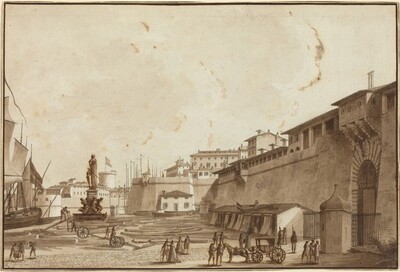
The image features a bustling port scene with a wall and buildings alongside a harbor. The perspective is slightly elevated, showing a horizon about a third of the way from the top. The artwork uses detailed brushstrokes to depict architectural features. The color palette is subdued with shades of brown and sepia. The foreground shows people, carts, and timber stacks, while in the background there are docked ships and various buildings with flags and a statue.

View of Livorno

Uggeri, Angelo

The sculpture is a bust of a mature man with a thoughtful expression and neatly combed hair. It is made from dark brown material, likely polished wood. The details of the man's face and clothing, such as buttons on his garment and folds around the neck area, are finely carved. The bust is mounted on a geometric base, evoking a sense of classical elegance.

Saint Charles Borromeo

Buonvicino, Ambrogio

Sixteen engraved portraits are arranged in a 4x4 grid. Each portrait features a bust view of a man in profile, positioned to the side within circular frames. Only the heads and shoulders of the individuals are shown. The men are of mature age and have varied hair styles. The facial features are sharp, with prominent noses and chins. Each man is dressed in period clothing, with high-collared coats over waistcoats and white cravats or neck cloths. The portraits are labeled with names beneath each circle. The background is plain, focusing attention solely on each individual.

Saint-Mémin Collection of Portraits, Group 33

Saint-Mémin, Charles B. J. Févret de

This is a photograph of a sequence showing a group of deer moving. The image is a series of black and white frames depicting the movement of deer within a natural setting. The composition is arranged in a grid format, capturing the deer at various stages of walking or running. Each frame shows slight variations in the positions of the deer's legs and antlers. The setting features a dark background, which serves to accentuate the lighter tones of the deer's bodies. The grid layout suggests an analytical approach, focusing on the precise motion of the deer.

Plate Number 687. Fallow deer, buck and group of does, galloping

Muybridge, Eadweard

A woman sits and supports a baby standing on her lap, both against a gold background in this arched, vertical painting. The woman and baby’s light skin is shaded with faint green, and they have pale pink cheeks. The woman’s body faces us. She tips her head toward the baby who stands on her knee, to our right. The woman looks at us with light brown eyes under curving brows. She has a long, straight nose, and her small pink lips are closed. Her blond hair is mostly covered by a midnight-blue robe that drapes over her shoulders, across her lap, and pools on the floor. The robe is lined with goldenrod yellow, edged with bright gold, and has gold starburst-like designs on the shoulder we can see and top of the head. The dress she wears underneath has more gold stars creating a pattern across the pearl-white fabric. A sky-blue scarf wraps over her head and loops across her shoulders. The baby holds one end of the scarf, and his other elbow rests on the woman’s shoulder. She props him up with both hands. He has a cap of blond curls and chubby cheeks with delicate features. His geranium-red garment falls over a pale blue skirt that reaches his bare feet. In the hand near the woman’s shoulder, he holds a scroll with the letters “EGO S.”  The floor beneath them is mint green and has gold writing across the front, reading, “AVE.G ANN O.D M.CCCC.XIII.” The woman and baby’s disc-like gold halos blend into the gold background, which is visibly cracked in some areas. The panel comes to a pointed arch at the top.

Madonna and Child

Lorenzo Monaco

This is a drawing of swirling lines and abstract forms. It depicts an interplay between figures and flowing elements, suggesting motion and energy. The detailed linework emphasizes the fluidity and movement of the forms within a rectangular border. The composition is precise, creating a visual impact through the use of line and form.

The Lord Answering Job out of the Whirlwind

Blake, William
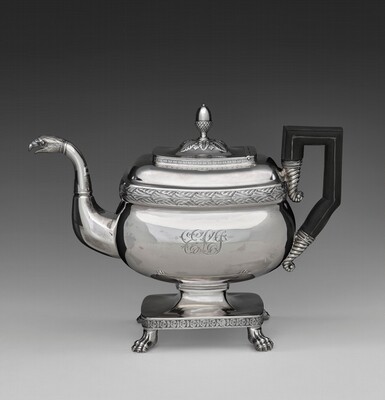
The image shows a large silver teapot with a unique spout shaped like an eagle's head, a dark handle, and intricate engravings. It has claw-footed legs, a finial on the lid, and an oval emblem on its side. The color scheme is mainly metallic silver with dark accents.

Five-Piece Tea/Coffee Service

Fletcher, Thomas

This is a photograph of an engraved metal plate. The image shows the etched surface of a metallic plate with various textures and patterns. The plate has a matte appearance with scratches and lines visible across its surface. Geometric and possibly organic shapes intertwine throughout the design.

The Reunion of the Soul & the Body

Schiavonetti, Luigi

The image displays a tall, ornate grandfather clock with a clock face showing Roman numerals and two dials. Beneath the clock face, there is a decorative panel with an intricate oval design surrounded by a floral motif. The clock case is wooden with a reddish-brown hue, highlighted by gold details at the top and side corners. The entire piece is positioned centrally within the frame, showcasing the clock face and decorative elements distinctly.

Shelf Clock

American 20th Century

The image shows a landscape with a low horizon line, featuring hills and mountains in the distance. The scene includes a winding path with travelers and donkeys, as well as additional travelers farther away. The etching technique used provides intricate detailing, giving the foliage and trees a textured appearance. The color palette is monochromatic, mainly utilizing shades of gray and black.

The Large Tree

Both, Jan

This is a drawing of two ornate fountains. The drawing depicts two intricately designed fountains. The fountain on the left features a central column with sculpted birds that act as spouts, allowing water to flow from their beaks. It is composed of multiple tiers with elaborate leafy decorations that resemble cascading water. On the right, the fountain boasts an ornamental urn at the top, surrounded by scrollwork and floral motifs. Both fountains sit on pedestals and are drawn with fine lines and shading that give them a three-dimensional appearance.

Two Fountains

Italian 17th Century

The sculpture depicts a seated older man with a flowing beard. He is surrounded by two younger figures. One of them is placing a wreath on his head, while the other holds a drapery filled with fruit beside him. A small child is reclining at the man's feet next to a large urn. The sculpture is made of light terracotta material. Its detailed craftsmanship and dynamic composition allow the observer to closely observe the expressions and posture of each figure. The sculpture sits on a rounded base.

Silenus Crowned by Nymphs

Clodion

The image shows a book cover titled "AMERICAN ARTIST LIFE." The cover is made of brown leather with embossed gold lettering that reads "AMERICAN ARTIST LIFE." It features an ornate gold decorative border design along its edges with a pattern of swirls and leaves. The spine appears slightly darker than the front cover. The design conveys elegance and historical significance, typical of older collectible books.

Book of the Artists. American Artist Life, Comprising Biographical and Critical Sketches of American Artists: Preceded by an Historical Account of the Rise and Progress of Art in America

Tuckerman, Henry Theodore

The image depicts a castle with cylindrical towers at the center and slightly left. The castle has battlements with a flag on top. Close to the castle are sailing ships with tall masts grounded due to low tide. More ships line the shore to the right. The castle is made of stone. The color scheme is sepia, giving an antique look. The sky is light and overcast, blending with distant hills. A rocky bank leads to the water where a lone figure is visible.

Scene on St. Helier, Jersey Parish

Sutton, Thomas

We look down at a cluster of three farm buildings and across grassy fields that stretch into the distance in this horizontal landscape painting. A parchment-yellow road angles from the lower center of the composition into the upper right corner, where it meets the horizon line just below the upper edge of the painting. Closest to us, the buildings flank the road, with two barns to our left and a house to our right. The buildings all have burgundy-red roofs. The barns have brown siding, and the house has paler, tan siding. The buildings are surrounded by blue or red fences. The barns to our left have large doors and two windows are visible on one of the sides facing us. A two-story, turquoise-blue bird house is affixed to the side of the barn closer to us. To our right, the house has windows piercing both levels, and a porch facing the road, to our left. Birds gather on the roof of the house, and an American flag flies beyond the back corner of the house. A black horse and two red horses, four cows and bulls, two dogs, a dozen chickens, and two pigs occupy different areas of the fenced-in spaces around the buildings. A man stands near the dogs next to the house, and a person wearing a red-edged black garment and a red cap stands on the road between the structures. In the fields beyond, people ride horses or hunt, horses graze, and a cow frolics with a dog. More buildings dot the landscape, which is farther divided into plots of land by stone walls, black fences, and more roads. Rows of stylized trees grow in straight lines in a grove to our left. Birds and deer walk or stand among the trees, and two people stand nearby, holding rifles. The slopes of indigo-blue hills rise along the horizon, at the top of the painting.  The sky to the left of blue hills is mauve pink, streaked with black clouds. The rest of the sky is pale shell pink and ivory. Many of the animals and the architectural elements are outlined in black and filled in with flat areas of color. The weave of the window shade on which this is painted is visible in many areas.

Mahantango Valley Farm

American 19th Century
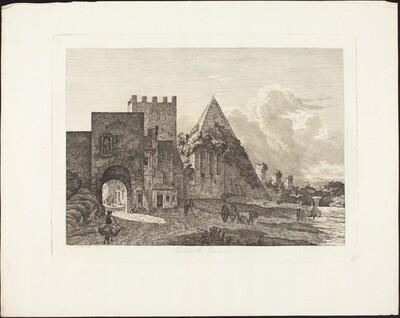
The image shows an architectural structure with a large arched gateway, a castle-like wall, and a triangular, pyramid-like structure. The perspective is slightly elevated, with the horizon high in the image, partially obscured by structures, trees, and clouds. The monochromatic artwork consists of fine, detailed brushstrokes depicting textures of stone and foliage. The color palette is limited to sepia tones. A person on horseback is close by, and the road leads through the archway to a populated area with smaller figures and buildings. A cart, animals, trees, and ruins are visible to the right.

Porta di San Paolo

Mechau, Jacob Wilhelm

This is a photograph of a decorative ceramic jar. The ceramic jar is adorned with vibrant, intricate patterns. The central image is of a figure with a turban and beard, appearing to read or write on a scroll, against a bright yellow background encircled by blue and green foliage motifs. Below this portrait are ornate scrolling and a stylized, yellow mask-like face on a dark blue background. The top and bottom edges of the jar are banded with yellow and turquoise hues. The jar's shape is slightly tapered with a subtle flared top edge.

Albarello with white-bearded physician and trophies of arms

Faenza 16th Century

The image depicts an etching plate with a faint outline of a man's head and partial bust, primarily focusing on his facial features. The figure appears to be oriented slightly to the left, as if turning slightly in profile. Facial features such as the outline of a nose, mouth, and a detailed mustache and beard can be discerned through a series of etching marks and scratches. The man's hair appears to be short with defined lines suggesting a combed back style. The clothing suggested by the more densely etched area provides the hint of a collared shirt or jacket, though details are sparse. The overall setting is a plain copper plate surface with no additional background details beyond the etched figure itself.

Alphonse Hirsch

Degas, Edgar

The sculpture features a stylized, abstract representation of a figure playing a horn or trumpet. The figure's body is shaped in a simplistic form with extended, wing-like elements suggesting motion or flight. The head is depicted as a rounded shape with a simple indication of facial features. The sculpture is made from a material that resembles wood and has a brown, natural wood color. The figure is mounted on a vertical base, contrasting with its horizontal posture. The sculpture presents a non-complex design, focusing on the essential elements of the figure, horn, and wings.

Weather Vane

Bent, Mildred E.

The image features an elevated perspective overlooking a countryside scene with a shepherd and a flock of sheep. The horizon line is suggested by a light gradient, separating the sky from the landscape. The scene is depicted in a sketch-like style with detailed lines creating textures in the grass and foliage. The color palette consists of shades of brown and sepia, giving the image a vintage quality. Closest to us are patches of earth and grass, leading to the shepherd and his flock on a rise. The landscape recedes into the distance where a lone tree stands against the pale sky.

Shepherd with Flock

Schmutzer, Ferdinand
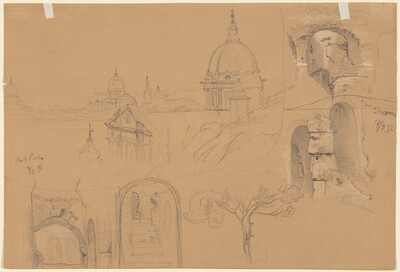
The image shows pencil sketches on tan paper portraying various architectural views and elements in a loose, informal style. The sketches include a cityscape with domed structures in the distance and architectural details like arches and stonework. The horizon is high on the paper, and there is a mix of quick lines and shading to depict depth. The warm paper tone complements the graphite and creates a muted palette. Close-up details include arches, stonework, and a tree-like shape. The focus is on form and composition rather than detailed realism.

Studies of the Colosseum and Monte Pincio (verso)

Jacob the Elder, Julius
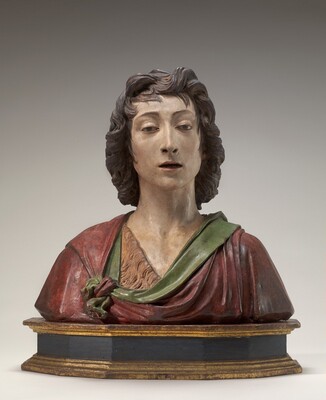
The sculpture is a detailed bust of a young man with pale skin and wavy brown hair that almost reaches to his shoulders, seen from the chest up. He has thin, arched eyebrows, a long, straight nose, and thin red lips that are partially open. A dark red and green cloth or cloak is draped over his shoulders and tied near his left arm, and it appears to cover a light brown garment with the texture of fur. The sculpture has no base.

Saint John the Baptist

Florentine 15th Century

The image shows a series of abstract, thick black lines outlining human figures. On the left side, two figures are depicted in motion, with one figure raising their hands and the other stretching out an arm. On the right, two figures are seated with angular and abstracted limbs tucked closely around their bodies. The design features bold black lines framing the figures against a pink background, with a structure resembling a linked chain of stylized squares.

Vorsatz (back endpapers) from mock-up of Georg Heym: Umbra Vitae (Georg Heym: Shadow of Life)

Kirchner, Ernst Ludwig

The image shows a man from the waist up, facing the camera with his body slightly turned to his left. His facial features include prominent eyes and slightly parted lips, with a hint of a mustache visible, and short hair under his hat. He is wearing a striped shirt beneath a light-colored jacket and a wide-brimmed hat. The background is plain and dark. The image is framed by an ornate, gold-colored border with red edges.

Portrait of a Man

American 19th Century

This is a painting of Native Americans participating in a ceremonial gathering. The painting depicts a group of people gathered outdoors on a grassy field, encircled by hills under a sky with scattered clouds. At the forefront stands a figure adorned in traditional attire, including a feathered headdress and garments with detailed patterning. The figure appears to be holding ceremonial objects and addressing or leading the assembly. Around this central figure, the people are positioned in various postures, seemingly listening or observing attentively. The scene is framed within an oval border, highlighting the central action while subtly incorporating a background structure that resembles an earthen or wooden lodge. The atmosphere is serene, with muted colors suggesting a peaceful observance. This is in the style of George Catlin, known for his portraits of Native American life.

A Mandan Medicine Man

Catlin, George

This is a drawing of three cherub-like figures in a natural setting with a tree. The scene depicts these figures engaging with their surroundings, with one cherub reaching up towards the branches of a tree. The tree has detailed bark and the ground is scattered with vessels, including an amphora. In the background, there are elements of nature such as foliage and faint hills. The style of line work and cross-hatching enhances the depth and shadow, emphasizing the contours of the figures and the natural environment.

Putti and Fauns Climbing a Grapevine

Dorigny, Michel

This is an ornate wooden table with multiple compartments and intricate gold detailing. The table is designed with a polished wood finish with decorative inlays and carvings indifferent shades of orange and reddish-brown wood. It is turned slightly to the left so that we get a view of the front and one of the sides. It features several drawers and compartments that are partially open, revealing felt-lined interiors. The central compartment has a lid that flips open, revealing a narrow compartment with a slanted bottom. The table has curved legs with decorative gold metal mounts at the joints and feet.

Combined Toilet and Writing Table (toilette à transformations)

Leleu, Jean-François

The image displays intersecting lines and faint shapes, forming an abstract design. Observers may perceive hints of a table scene and figures engaged in conversation. The forms resemble faces and limbs, blending into the abstract. The composition combines abstract artistry with suggestions of human-like interactions.

The Death of The Good Old Man

Schiavonetti, Luigi

Two silver spoons are displayed on a light beige background. The bottom spoon has engravings on its handle. The spoons are positioned horizontally, with the top spoon facing left, while the bottom spoon is slightly tilted downwards on the right side. The word "WALLACE" is inscribed at the bottom left corner of the image.

Silver Spoon

Walton, Kalamian

This is a drawing depicting three cherubs holding ornate staffs that support a circular platform, on which a bear is resting. The cherubs have wings and one of them is looking upwards. The bear is reclined with its head on its paws. Intricate foliage and decorative details surround the scene. Below the bear, there is a plaque inscribed with the date "1529." The drawing features detailed line work and fine hatching typical of the early 16th century.

Three Cupids and a Bear

Aldegrever, Heinrich

The image shows two nude figures in an open natural setting. Both individuals have short, dark hair. One figure is seated with their knees bent, while the other figure stands with one arm reaching towards their head. The figures lack detailed facial features and are surrounded by vibrant green foliage, a body of water, and a blue sky.

Two Bathers

Mueller, Otto

The image shows a round, flat medal with a relief sculpture on its front side. The sculpture features a person on horseback crossing a bridge in an outdoor setting with trees and distant landforms in the background. The scene is detailed with intricate lines depicting the scenery and is crafted from a bronze-colored material. An inscription in Latin surrounds the edge of the medal with "PROVIDENTIA PRINCIPIS" at the top and "VIAS MUNITAS MDCCXXVII" at the bottom. A small perforation near the top suggests it may have been used for display or worn on a chain.

Mounted Traveller [reverse]

Saint-Urbain, Ferdinand de

This is a photograph of a brown leather book cover. The image captures a close-up view of a textured, brown surface that appears to be a leather cover. Signs of wear are visible, including slight scuffs and darker edges. The texture of the leather is evident, showing variations in tone and color.

The Temple Builder's Most Useful Companion being Fifty Entire New Original Designs for Pleasure and Recreation; Consisting of Plans, Elevations, and Sections, in the Greek, Roman and Gothic Taste

Overton, Thomas Collins
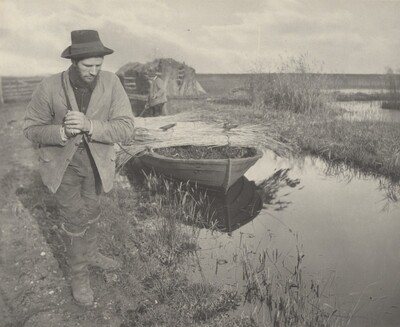
This is a photograph of a rural scene by a small waterway. The image captures an outdoor setting alongside a narrow water channel, with reflections of surrounding grass and a docked wooden boat floating in the water. The boat is laden with bundles of vegetation. In the background, a man stands near a stack of collected grasses or hay. Several elements of rural life are apparent, such as the dirt path, wooden fence sections, and the rustic nature of the landscape. The sky is partly cloudy, casting an even light across the scene.

Towing the Reed

Emerson, Peter Henry

In this painting, two clusters of dark blue-black grapes hang from a thin brown branch against a beige background. The branch stretches horizontally across the top of the painting, and olive-green vines from the top of the grapes wrap around it. The grapes reflect light and cast dark shadows on the beige wall behind them.

Grapes

Decker, Joseph

This is a drawing of several figures in a mystical scene under a starry sky. The image shows several seated figures on one side and one standing figure gesturing towards them. Behind the seated figures is a structure made of stacked blocks or stones. The scene is set against a backdrop of stark lines and contrasting shades, with a night sky filled with small stars or dots.

The Wrath of Elihu

Blake, William

This free-standing bronze sculpture shows the rounded, stylized forms of a person with long limbs riding astride a horse with noticeably short legs. The horse and rider are angled to our right in this photograph. The dark brown bronze gleams white where the light catches the smooth surfaces, and some areas are a burnished gold color. The horse looks ahead with large eyes. It has short ears, and its mouth is parted. The person riding the horse holds the reins with the right hand, closer to us. The reins wrap halfway around the horse’s neck and are then broken off. The cleanshaven rider has a heavy brow ridge and a long, straight nose. He wears a flat-topped cap and a robe that reaches to his ankles. The pointed toes of his shoe pokes through the small stirrup we can see. A rounded handle connects the rider’s upper back to the back of the horse. The background is taupe-gray behind the sculpture and darkens at the upper corners.

Aquamanile in the Form of a Horseman

English 13th Century

This appears to be a textured metal plate carved with a scene of tall tree trunks. Some of the trees curve slightly, but most are straight. The metal reflects light, making the carved lines appear white. On the left, there is an outline of what seems to be a woman standing, facing the right. She appears to have long hair and holds a lyre in one hand.  The artwork is set against a plain beige paper background with a signature in the lower right corner.

Sappho

Dumont, Maurice

The image shows three brown wooden objects resembling bowls or pedestal dishes with lids. The color palette consists of shades of brown against a muted beige background. The largest object in the center is shown from a slightly elevated perspective, displaying its ornate lid and pedestal base. A second object is displayed without the lid, revealing a smaller circular section inside. On the right side, an angled view of another lid or the underside of one is showcased, featuring its circular form and decorative top handle.

Sewing Container

Stottlemeyer, Margaret

The image depicts a person seated in profile view in a chair. Their facial features are exaggerated, with a pronounced nose and chin. They have long, curly hair and are wearing a wide-brimmed hat. The person is wearing a long coat, knee-length trousers, stockings, and shoes with buckles. They are holding a paper and smoking a pipe. Nearby is a table with a candlestick and papers. The background is plain and crosshatched.

Politician

Sherwin, John Keyse

The image is a partial sketch of a person's head and neck in a side profile, with simple outlines of facial features, hair tied back, and some curls visible. Minimal clothing details are shown around the neck. The background is plain and light-colored.

Head of a Man

Robert, Hubert

The sculpture is a detailed relief depicting two figures engaged in a handshake. Both figures are draped in classical attire. The figure on the left holds a staff topped with two entwined snakes and wings. The figure on the right holds a cornucopia filled with abundant produce. Between them, a small altar-like structure is adorned with fruit. The relief is crafted from bronze, giving it a metallic brown hue with areas of lighter patina. The rectangular plaque has two holes near its top corners. The overall appearance of the sculpture is flat, with the figures slightly raised against the background.

An Emperor and Concord

Cristoforo di Geremia

The image at the top of the page shows abstract interlocking geometric shapes and lines that resemble human faces. The shapes suggest a group of people with various expressions, arranged in a structured yet chaotic manner. The design is reminiscent of tribal masks or ancient carvings. Below the artwork, there is German text formatted in a structured layout, similar to a poem or song lyrics. The combination of the abstract image and text creates a juxtaposition of visual and literary elements.

Die Irren II (The Mad II) (headpiece, page 26) from Georg Heym: Umbra Vitae (Georg Heym: The Shadow of Life)

Kirchner, Ernst Ludwig

The image shows a woman and an infant, both visible from the waist up. The woman is seated, holding the infant in her lap, and both are looking slightly off to the side. The woman has shoulder-length dark, curly hair that is parted in the middle. She wears a dark dress with a white collar, a brooch at the center, and a watch chain pinned at her shoulder. She also wears earrings and a bracelet. The infant is dressed in a white christening gown with lace patterns and a bonnet. The child looks cozy in the woman's arms. The background is plain and dark to highlight the subjects. The image is in an ornate frame with a gold-tone inner edge and a velvet-lined border, typical of 19th-century portrait displays.

Portrait of a Woman and Baby

Eastham, Silas

A jumble of pewter plates and a pitcher, glass goblets, a gold chalice, a brass candlestick, and other vessels along with lemons, olives, and the remains of a mince pie are arranged on a cream-white tablecloth bunched on a dark green tabletop in this square still life painting. The scene is painted almost entirely in shades of cool grays, gold, brown, and white against a deep beige background. The objects span width of the canvas across its center. At the left edge of the painting, a vibrant yellow lemon has been cut so its rind curls in a spiral that hangs over the front edge of the table. Behind the lemon, a scissor-like candle snuffer is propped against the wide ledge of the tall brass candlestick, its white candle nearly burned down. A few glistening olives sit in a small pewter plate, and one olive sits on the tabletop near the lemon and candlestick. A glass goblet with a wide stem with textured knubs rests upended on an elaborately chased, gold, footed vessel that has been tipped over so its wide shallow bowl faces away from us. The tall pewter pitcher behind this is dented on its rounded body. The lidded gold chalice next to the jug is the tallest object in the painting. Next to the chalice, along the right half of the painting, is a glass oil cruet with a long, curving spout, a tall, cylindrical vessel holding a small pile of salt, and a straight-sided, low glass holding beer. In front of these objects, an untouched bread roll and knife sit on a pewter plate at the center of the composition. The remains of the mince pie with its pastry crust sit on a large pewter plate to our right. In front of it is a smaller plate holding a broken goblet and a piece of black and white paper rolled into a cone. A few empty oyster shells sit on the table to the left and right, near the lemons and mince pie. The artist signed and dated the painting along the edge of the white cloth near the lower right corner: “HEDA 1635.”

Banquet Piece with Mince Pie

Heda, Willem Claesz

This is an image of a vintage book cover. The cover is richly textured brown leather with ornate gold embellishments along the edges and corners. The gold detailing consists of delicate floral and scroll motifs. The leather shows signs of age with scuff marks and imperfections, giving it a weathered feel. The central panel is blank, creating a contrast with the border patterns.

Radirungen

Scheuren, Caspar Johann Nepomuk

The sculpture is a decorative vase with a wide flared top. The subject on the vase includes a black and yellow rooster, standing in a picturesque setting with delicate flowers and light greenery surrounding it, painted in vibrant colors such as red, blue, and green. The vase is made of a ceramic material with a glossy finish. The primary color of the vase is deep red, with an intricate design featuring alternating panels of white, where the painted images of the rooster, birds, landscape, and floral motifs are placed. The vase presents an elegant composition with traditional imagery that appears to be carefully arranged to achieve a harmonious and balanced visual effect.

Beaker Vase

Chinese Qing Dynasty

This is an engraved plate. The plate itself is dark red, and the lines on it are gray. At the bottom of the plate appears to be a river filled with people twisting and turning in the water. On the right, the river appears to float upward and loop around itself, ending in the top right corner. In the center is a stretch of ground that reaches to the left edge of the plate. On the ground, a person stands, looking down at another person that lays on the ground below them. Both people wear robes and appear to have long hair. Above the person who lays on the ground seems to be another large wave of water that carries two people upward inside it, a man and a woman with their arms outstretched towards each other. In the sky on the left is a large round sun-like shape near that emits rays of light. In the sun are the outlines of two intertwined people who appear to be kissing.

The Circle of the Lustful: Paolo and Francesca

Blake, William

The image shows a silver creamer with floral and fruit engravings. The creamer is upright with a curved handle on the right and a spout on the left. It is placed against a plain background.

Silver Creamer

Barrell, Eugene

The image shows a large, spiky-edged flower against a plain backdrop. The color palette is monochromatic, consisting of various shades of black, white, and grey. The flower is centrally positioned, with its pointed petals radiating outward, filling much of the frame and highlighting its intricate texture and detailed pattern.

Eryngium giganteum

Blossfeldt, Karl

This is a drawing of a centaur resting against a tree in a forest landscape. The drawing depicts a centaur, which is half human and half horse, positioned reclining against a tree. The backdrop features a forested area with trees and detailed foliage. The composition is rich in texture, with fine lines that convey depth and detail.

Centaur with Branches

Legros, Alphonse

The sculpture depicts multiple human figures in a dynamic interaction against a backdrop of architectural elements. The figures have distinct facial features and clothing styles, and the setting suggests a scene from classical or ancient times. The sculpture is predominantly brown and has a relief appearance, with a textured background.

Augustus and the Sibyl

Briosco, called Riccio, Andrea
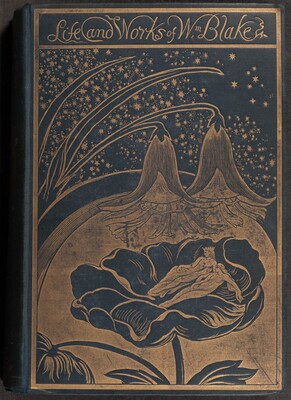
This is a drawing of a decorative book cover. It features intricate line work depicting a scene with two figures reclining within a large stylized flower, surrounded by foliage and stars. The flower has large petals that cradle the figures, who appear crowned and are lying with tranquility. Above them are two hanging bell-shaped flowers against a star-filled night sky. The title "Life and Works of Wm Blake" is inscribed at the top in flowing, ornate letters. The design uses a limited color palette.

Life of William Blake with Selections from His Poems and other Writings (volume II)

Gilchrist, Alexander

This is a photograph showing a sequence of a person swinging a bat. The sequence is displayed in a grid of small, black-and-white images, illustrating the stages of the bat swing. The backdrop features a grid pattern, and each frame captures the progression from preparing to swing the bat to the follow-through of the swing. The setting appears to be an indoor or enclosed motion capture environment. The sequential arrangement suggests the use of chronophotographic techniques for studying physical motion.

Plate Number 277. Baseball, batting

Muybridge, Eadweard

In this horizontal painting, a crowd of more than two dozen men and women gathered shoulder to shoulder at the foot of three men hanging from wooden crosses nearly fill the scene. All the people have pale or ruddy skin. To our left of center, each of the crucified men is tied and nailed to a cross. Blood pours from their hands and feet, and from a gash over the central man’s right ribs. The men’s heads slump and their bodies sag. They are nude except for a red cloth across the central man’s hips and a small white loincloth on the man to our right. Two of the men wear crowns of thorns. The spear piercing the central man’s side is held by a man riding a white horse in the crowd below. At least three additional men in the crowd are on horseback. Many of the men are armed with spears, creating a bristle of vertical and diagonal lines over the group. The men and women wear robes and uniforms in shades of golden yellow, pine green, crimson and rust red, black, and cream white. A few men wear metal helmets, and one wears armor. Near the lower left corner, a woman wearing a navy-blue robe has fainted and is supported by two kneeling women while another woman and cleanshaven man look on, their fingers interlaced and held low. The smooth ground is grass green. A spindly tree with dark green leaves grows up the right side of the composition. Off in the distance beyond the tree, two buildings hint at a city. Blue clouds billow in the blue sky above.

The Crucifixion

Signorelli, Luca

The image shows a charcoal drawing of a person from the waist up. The individual is seated, leaning slightly forward, with their head down, reading a book held open in their lap with both hands. The person has soft and tranquil facial features, dark hair pulled back, and is wearing a loose-fitting top with short sleeves. The background is shaded with no distinctive details.

Liseuse (The Reader)

Monfreid, Georges Daniel de

This is a painting of a pastoral scene with figures, animals, and a village. The tapestry depicts individuals engaged in various activities such as playing music, herding sheep, and conversing. The background features a castle with turrets and a bridge over water. Foliage and flower patches create a lush surrounding setting. A quaint hut can be seen on one side. Animals including dogs and sheep are present throughout. This is in the style of medieval European tapestries.

Hunting and Pastoral Scenes, with a shepherdess shearing

French 16th Century

Two Title Pages for "Le Sourire" (Les deux titres du Sourire) [verso]

Two Title Pages for "Le Sourire" (Les deux titres du Sourire) [verso]

Gauguin, Paul

The image shows a green glass bottle with an embossed design of an eagle and the word "LIBERTY" above it. The bottle is against a light-colored background, with the neck and cap facing upward.

"Liberty" Bottle

Holme, Maud Marie

The image depicts two full-length figures inside a room with a vaulted, wooden ceiling. The first figure, a standing woman, is depicted in profile and is elegantly dressed in a long, flowing gown with voluminous sleeves and a bodice. Her hair is styled elaborately on top of her head. Opposite her, a second figure, dressed in a cloak and elaborate head covering, is kneeling on the ground with hands clasped in front of her chest. Both figures appear to be concentrating on a distant point, with the standing woman pointing toward the horizon outside, visible through arched windows. In the background, beyond the room's arched windows, a picturesque landscape unfolds, consisting of a castle nestled amongst trees and rolling hills. The image is detailed with light and shading, adding depth and texture to the figures and the architectural details that frame them. On the right side, there is a small sculpted figure holding a snake wrapped around what appears to be a staff, standing on a pedestal.

Solomon Worshipping False Gods

Master MZ
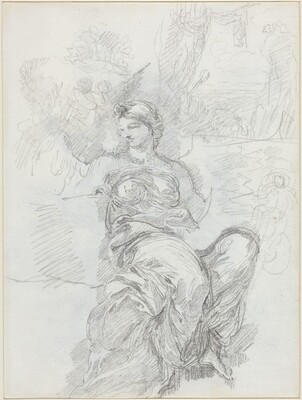
The drawing shows a full-body sketch of a person seated, with their upper body slightly turned to the side and their head tilted downward. The individual's facial features are delicately outlined, with an emphasis on closed eyes and a serene expression. The hair is styled in an updo, with a small decorative element or bow near the top. They are draped in flowing garments that fall smoothly over the contours of their body, while their right hand holds an object close to them, and their left hand rests on their lap. The background features faint sketch lines suggesting an outdoor setting, with trees and clouds. There are no visible jewelry or detailed objects held by the person.

Seated Angel in a Landscape [recto]

Lemonnier, Anicet-Charles-Gabriel

The sculpture is a rectangular bronze box with a relief carving on its front panel. The scene depicted on this panel includes several human figures dressed in long robes. The figures appear to be engaged in some form of interaction or narrative, with a central figure holding a staff and another figure kneeling before them. The bronze box has a dark brown patina, characteristic of aged metal, with areas of lighter highlights where the relief details are more pronounced. The box is set on four small feet.

Two Scenes from the Life of Saint Simeon of Polirone: The Miracle of the Stag (vignette) and The King of León (vignette)

Spani, Bartolomeo

This is a photograph of a book cover. The cover is dark with elaborate gold decorations. A central ornate gold design forms an oval frame around the words "EXCURSIONS DAGUERRIENNES." The gold embellishments include scrolling floral motifs, curving filigree patterns, and a central crown-like emblem at the top of the oval. The left side of the binding shows signs of wear.

Excursions Daguerriennes / Vues et Monuments les plus Remarquables du Globe (Vol. 2)

Lerebours, Noël Marie

This is a series of black and white photographs showing an individual interacting with a bucket outdoors. Each frame captures a different moment in the motion. The background varies between a grid-like pattern and outdoor structures. The images focus on the physical dynamics of using a bucket, including the flow of water in the middle row. The set provides insight into movement and photography.

Plate Number 401. Emptying a bucket of water

Muybridge, Eadweard

A woman with light skin sits facing us across a marble-topped table in a café in this vertical painting. Her body is angled slightly to our right, and she rests her right elbow, on our left, on the table. She leans her right cheek onto the back of her right hand as she gazes into the distance. She holds a cigarette in her other hand, which rests on the tabletop. Her pale pink dress has long sleeves with ruffles at the cuffs, and buttons down the front of the skirt can be seen under the table. A lace bow or ruffles cascade down at her neck. Straw-colored hair peeks out under a black hat encircled with a wide band of lace. A short, stemmed glass sitting on the table in front of her holds a small, round piece of fruit surrounded by caramel-colored liquid. The white marble tabletop is streaked with gray. The burgundy, patterned banquette she sits on takes up the bottom half of the composition, and wood paneling around a slate-gray metal grate fills the top half. Loose brushstrokes are visible throughout. The artist signed the work as if he had written his name on the surface of the table, near the front edge to our left, "Manet."

Plum Brandy

Manet, Edouard

The image depicts a man standing in a strong and authoritative position. He is facing slightly to the side, with one hand on his hip and the other holding a scepter. His facial features are defined, and he sports a full beard. His hair is obscured by an ornate helmet adorned with a colorful, feathered plume. He is wearing a golden chest plate and a short, decorative skirt with patches of red and gold. A blue cloak is draped over his shoulders, fastened with a decorative clasp. His sandals are strapped up to his calves, and he stands with one foot forward showcasing muscular legs. Surrounding him is a landscape of green hills leading to a distant medieval town with castles. Majestic snow-capped mountains rise in the background. At his side sits a large, imposing lion, calm but alert, with a detailed and flowing mane. The scene is bordered by text.

Juda

Sadeler I, Jan

This is a photograph of an ornate cabinet. The cabinet has a black lacquered surface with intricate gold detailing. The decorative elements include rococo-style gilded floral and scroll motifs surrounding the central panels. The central panels depict detailed and colorful scenes of traditional Asian architecture, surrounded by nature. The legs of the cabinet have intricate gold designs. The photograph showcases the fine craftsmanship and artistic details of the cabinet.

Corner-Cupboard (encoignure)

Desforges, Jean

This is a photograph of an engraved metal plate. The image shows a metal surface that has been engraved with fine lines and details depicting an individual. The surface is dark, and the engravings highlight the contours and features of the figure with intricate line work. The lines are meticulously etched, producing a ghostly visage that subtly emerges from the metal's surface.

William Blake

Schiavonetti, Luigi

The sculpture depicts a figure dressed in a short blue tunic with a red belt, adorned with a helmet featuring a crest that bulges upward. The figure appears to be holding an object aloft in their right hand and is standing on a green pedestal. The figure is also accessorized with gold or bronze armbands and leg bands. The material of the sculpture gives an impression of being made of painted metal or painted wood, displaying earthy tones for the skin and vibrant colors for the clothing and accessories. The stance is upright, with the figure slightly larger than life-sized in relation to the viewer and poised in a confident position.

Cigar Store Indian

Cero, Emile

This is a drawing of a crucifixion scene with multiple figures involved. The image shows a lifeless body being lowered from a large wooden cross by a group of individuals. The figures are clothed in flowing garments, conveying a moment of mourning and solemnity. There is a ladder leaning against the cross with individuals positioned on and around it. On the ground, a skull and bones are visible. The background includes a cloudy sky and an additional pair of crosses. The drawing evokes a sense of drama and emotion through its use of shading and composition.

Descent from the Cross

Charpentier, François-Philippe

The image shows a landscape with rolling terrain as seen from an elevated point of view. The horizon is high, showing where the land meets a pale sky. A church tower stands out at the horizon. The foreground displays muted greens and earth tones, while the background shows a blend of greens, oranges, and browns representing trees and bushes. The scene is painted using a watercolor technique with soft and fluid brushstrokes, creating a dreamy atmosphere. The color palette is delicate and pastel, enhancing the peaceful feeling of the landscape.

Landscape with Church Steeple

Bulwer, James

This is a photograph of a bronze medallion. The medallion features a sculptural relief of a female figure holding a branch with leaves. The background showcases a landscape with structures resembling a castle or city. The perimeter of the medallion bears an inscription in Latin. The surface has a warm patina, highlighting the design details against the dark background.

Daphne Transformed into a Laurel Tree [reverse]

Galeotti, Pier Paolo

The image contains fifteen circular portrait silhouettes, arranged in a three-by-five grid. Each silhouette depicts a person in profile view with detailed facial features. The individuals are dressed in period-appropriate attire, with most facing left. Some have styled hair and two are women with formal updos. The portraits have a dark background and handwritten names below each. The grid is set against a plain, light-colored background.

Saint-Mémin Collection of Portraits, Group 42

Saint-Mémin, Charles B. J. Févret de

The image shows a central lamp post surrounded by large sacks. The color scheme is grayscale. In the foreground, a tall ornate lamp post stands amid several bags. In the background, two numbered archways labeled '12' and '14' display stacks of more bags and a clock on the wall to the left. The setting includes a rounded architectural space with a balustrade above and two smaller lamp fixtures on each side of the central archway.

Halle aux Blés (Intérieur)

Marville, Charles

The image depicts four individuals against an abstract background. The first adult, on the left, is a woman with long, dark hair, wearing a shawl and holding a small unclothed child. In the center, a man stands with a raised arm holding a spear. The third adult, on the right, stands with a relaxed posture holding a bow. The background is soft-hued with a grassy ground underneath the individuals.

Four Mura Indians

Catlin, George

The image shows two people seated at a table, with only their upper bodies visible. Their positions suggest they are engaged in an activity at the table, with heads inclined towards the tabletop. One person has dark hair styled in a bun. The other person's features are illuminated, showing refined facial features and long hair tied back. Both are dressed in dark clothing with white collars. The surroundings include a window draped with sheer fabric on one side, allowing light to filter through. The room seems dimly lit, enhancing the contrast between the figures and the illuminated tabletop.

Intérieur (Les brodeuses)

Fantin-Latour, Henri

The curving X-frame design of this wood chair creates an hourglass silhouette from the front, and creates a bucket-like seat for the sitter. The front face of the wooden frame is carved with curving vines and stylized bunches of grapes and leaves, and the frame ends with clawed lions’ feet at the bottom. The seat and legs are made up of alternating slats so the chair could fold up. Imagine interlacing your fingers and then moving your palms back and forth—that is how the pivot of this chair works. The arms of the chair, which have a rounded knob at each front end, rest along the top edges of the slats. The back rail connects at the back of the arms. A crest at the center of the back rail is flanked by the capital letters “A” to the left and “G” to the right. The crest and letters are contained within a medallion-like form, and the sides of the back rail dip down to meet the arms. A worn, pale blue velvet cushion rests on the seat, and has tassels at the front corners. The chair is shown against a pale gray background.

Walnut Savonarola Chair with Letters A.G.

Italian 16th Century

This is a drawing of abstract figures and forms with a complex composition. The image shows vague outlines of figures amid a patterned texture. The surface is mainly gray and appears to be made of a metallic or subdued material. The figures are abstracted and merge into one another, lacking distinct details, suggesting movement or transformation. There are suggestions of architectural elements, possibly indicating an enclosed space. The intricate detailing of lines and shading encourages viewers to search for definition within the obscured presentation.

Death of the Strong Wicked Man

Schiavonetti, Luigi

The image shows a large, cylindrical metal object with a curved door on its side, supported by four legs. The color palette is predominantly muted with shades of gray and brown. Positioned centrally within the frame, the object has handles on the top and sides, and the door is slightly open on the right side, showing part of the interior. The image is set against a plain, light background.

Roasing Oven

Fineman, Samuel

The image depicts a full-body caricature drawing of a person standing with their hands behind their back, holding a top hat. The person is facing forward, with a slightly turned head, exuding a prominent facial expression. Their face features exaggerated large eyes, facial lines, and a bushy mustache. The hair is long and flows down to their shoulders. The person is dressed in formal attire, consisting of a long, dark coat, a shirt, and a bow tie. The clothing appears to have a tailored look typical of formal wear. In the background, there is a faint sketch of seated people.

Ferdinand Flocon

Daumier, Honoré

The image displays a cityscape view with classical architecture. The scene includes a street, buildings, Castel Sant'Angelo, a bridge over a river, and a basilica dome in the distance. The low horizon shows rooftops and structures fading into the background. The style uses pen and ink with a light wash, creating a sepia-toned look. The color palette consists of earthy browns and soft grays. The sky is left mostly blank, adding to the sense of openness.

View of Rome with the Dome of Saint Peter's and the Castel Sant' Angelo

Zocchi, Giuseppe

This is a photograph of an old coin. The image shows a circular metal coin with intricate detailing. The center of the coin features a shield divided into four quarters, with various symbols in each quarter. Above the shield is a crown and around it are decorative elements including foliage. The edge of the coin has inscribed text in an old-style font, encircling the shield and crowning design. The texture of the coin suggests it is made from a metal material.

Crowned Shield [reverse]

Milanese 15th Century

This is a black and white drawing featuring abstract figures surrounding geometric structures. The drawing is on a page with German text titled "DIE NEUEN HÄUSER." The abstract illustration on the page shows angular forms suggesting architectural elements and elongated figures interacting with each other. The drawing style uses heavy black lines and shapes to create contrast. The figures are in dynamic poses, implying movement or action in a simplified and distorted environment.

Die Neuen Häuser (The New Houses) (in-text plate) from mock-up of Georg Heym: Umbra Vitae (Georg Heym: Shadow of Life)

Kirchner, Ernst Ludwig

This is a photograph of a sequence depicting an elephant in motion. The image comprises a grid of black and white photographs arranged in four rows of four frames each, capturing the different stages of an elephant's walk. The background is plain. The photographs document the elephant's movement in a walking cycle.

Plate Number 732. Elephant walking

Muybridge, Eadweard

Three pale-skinned men wearing black garments and long, white aprons stand behind a table on which lies a nude corpse on a white sheet in this vertical painting. The corpse’s head is to our right and the face falls toward us. The eyes are sunken, and the rib cage and hip bones protrude sharply from the body. The men gathered behind the table are painted with fewer details so their faces are indistinct, though we can make out that the person to our left has gray hair, and he touches the corpse’s pelvis. The other two have dark beards and might wear black caps, and the middle person might take notes. The man to our right rests both hands on the table on either side of the corpse’s head and leans forward, looking down. The table is under the curve of a thick arched wall that separates two high, deep-set windows. Two unlit lamps hang above. The scene is painted with dabs and some visible brushstrokes, giving it a soft, shadowy, and hazy appearance. The artist signed the painting in red in the lower left, “H. Gervex.”

Study for "Autopsy at the Hôtel-Dieu"

Gervex, Henri

The image shows a central rectangular area with a repetitive pattern of small star-like shapes made of multiple lines radiating from a central point. This design overlays a darker silhouette resembling a profile of a horse or abstract human figure. The pattern and silhouette interplay create a layered effect, adding depth to the composition.

Das Mappenwerk der Insel

Rodin, Auguste

The sculpture is a shallow dish with two reclining figures at its center. The figures are human and intertwined, surrounded by small white seashell-shaped elements. The dish is made of ceramic with various colors. The material has a three-dimensional appearance and is detailed. The colors used are greens, blues, and flesh tones with a deep blue shade on the outer rim, giving it a lush and colorful look with naturalistic elements.

"Gondola" with Bacchus and Ceres

Fontainebleau Pottery

The Circle of the Corrupt Officials; the Devils Mauling Each Other

The Circle of the Corrupt Officials; the Devils Mauling Each Other

Blake, William

The image shows a large ceramic jar with a wide neck and slightly tapered body. The jar is light brown with blue-gray decorative elements on its surface and an inscription near the upper portion. The color palette consists of earthy browns with accents in blue-gray tones. The jar is placed on a light-colored background, emphasizing its detailing.

Jug

Durand, Francis Law

This is a drawing of sea creatures riding waves. The image shows two human-like figures with serpent bodies on horses, one holding a staff and the other blowing a horn. A cherubic figure floats above them. Sea creatures and cherubic forms blend with the waves below. Intricate lines detail scales, waves, and hair, emphasizing the lively and fantastical nature of the scene.

Sirens, Naiads, and Tritons

Falconetto, Angelo

The image is a sketch of a full-length figure standing. The person has one arm resting on a surface and the other hand on their hip. The facial features are basic outlines, and the hair is also sketched loosely. The clothing is a long, flowing garment, possibly a robe or cloak, with a hood. There is no visible jewelry. The background is plain with a slightly textured appearance.

Portrait of a Procurator [verso]

Longhi, Alessandro

This is an image of an ancient coin. The coin features a detailed profile relief of a figure with curly hair and a regal or militaristic outfit adorned with a row of circular embellishments. The border of the coin contains inscribed text describing the figure. The surface of the coin shows signs of age with a patina giving it a brownish and reddish tint. The craftsmanship exhibits a high level of detail, particularly in the depiction of the figure's facial features and attire, indicating the coin's historical significance.

Federigo II Gonzaga, 1500-1540, 5th Marquess of Mantua 1519 and 1st Duke of Mantua 1530 [obverse]

Pomedelli, Giovanni Maria

This is a drawing of a title page. The title is written in large, bold font across the top of the page, focusing on the city of Venice and its views in the works of Antoni Canal. Red and black inks emphasize different sections of the text, most of which is in Latin. Below the text, there is an ornamental embellishment with an elaborate illustration. The illustration includes a central figure, possibly an allegorical or classical figure, surrounded by a richly adorned frame with intricate scrollwork, shields, and symbolic elements. At the bottom, there are publication details and a red seal, indicating it is a publication from Venice dated MDCCXLII (1742).

Urbis Venetiarum Prospectus Celebriores, Ex Antonii Canal Tabulis XXXVIII. Aere Expressi ab Antonio Visentini in Partes Tres Distributi. Pars Prima [-Pars Tertia]

Visentini, Antonio

The image depicts a group of nine men and women posing for a formal photograph. Some individuals are seated, while others stand behind. The men have short, neatly styled hair and wear suits with bow ties or neckties. The women have their hair pulled back or styled elegantly and wear long dresses with high necklines and long sleeves. One woman seated holds a circular object in her lap. The background shows a plain wall and a draped curtain, creating a studio setting. Each person has a calm expression. The photograph is mounted on orange card stock.

"Jubilee Singers, Fisk University, Nashville, Tennessee"

Black, James Wallace

This is a tall, vertical painting. In the center, a woman in a pink-and-yellow gown sits on the ground, holding a limp child in her arms. She faces the left and is looking upward at a man in a brown robe who faces her and extends one arm towards the child, placing his finger on its forehead. Surrounding this group, many other people look at them with expressions of shock or amazement, leaning forward with their mouths open and hands raised. All the people in the painting have pale skin, although the child and another man in the bottom right corner have a greenish sheen to their skin. In the sky above this group, cherubs and angels fly, surrounded by clouds and looking down on the scene below. The sky is blue, with pink clouds and green trees, and a tall gray column on the left side.

A Miracle of Saint Francis of Paola

Ricci, Sebastiano

The image shows several figures gathered outdoors near the entrance of a building. The central figure is an elderly man standing at an open door, gesturing towards two approaching men. Both men are using walking sticks and wearing cloaks. Other figures are visible in the scene, with a person peeking out from the doorway. In the background, there is a large, leafy tree and a distant town or village with buildings and people moving along a path.

Lodging of the Travelers

Meyer, Conrad

The sculpture depicts a hexagonal vase with floral motifs. The vase is adorned with blossoms in pink, white and green colors set against a yellow backdrop. It is made of glazed ceramic material with a white rim on top featuring a red crisscross pattern. The floral patterns are evenly spaced around the surface, creating a harmonious and balanced look.

Hexagonal Trumpet Beaker Vase

Chinese Qing Dynasty

The image shows a group of figures engaged in a game or activity on a field. A line of trees is depicted on the left side, and a building with a steeple and cupola is on the right. The figures are distributed across a textured field, with trees beyond them. The technique used is fine line etching, evident from the detailed trees, buildings, and figures, creating a sense of movement. The color palette is primarily warm brown tones with darker etched lines for contrast. The background features additional trees and foliage.

Reward of Merit

Cheney, John

The image shows a wooden chair with a cane woven seat. The chair has intricate designs on the backrest and legs in a light reddish-brown hue. The background is plain off-white.

Side Chair

Choate, Florence

The image shows a landscape with rocky terrain leading to a body of water in the distance. The horizon line is visible midway, with sailboats on the water and hills or mountains beyond. Tree branches arch overhead and to the right, framing the scene. The rocks close to the viewer exhibit varying textures, with caves and boulders in brownish sepia tones. The color palette is earthy, emphasizing details and depth in the scene.

Veue de quelques Grottes solitaires de la Thebaide

Chedel, Quentin-Pierre

The image displays a landscape with various elements. On the left, there is a grand structure with columns, potentially a temple, partly covered with ivy. A stone bridge crosses a stream in the middle, while trees frame the right side. The top of the image shows a horizon with clouds blending into the tree line. In the scene, figures are seen engaged in various activities, such as leading a horse, reclining on the grass, and interacting near the water. The brushstrokes are loose and fluid, emphasizing movement and texture. The color scheme includes blues, greens, and earthy tones, creating a serene atmosphere.

The Seesaw

Anonymous Artist

The sculpture is a circular medal featuring a dragon-like creature breathing fire. The creature is centrally positioned and surrounded by decorative elements, including a crown above its head. The medal is crafted from a metallic material with a bronze or brass-like appearance. The surface is textured and the details of the dragon and surrounding elements are well-defined, enhancing the three-dimensional quality of the piece. The outer rim of the medal bears an inscription.

Salamander in Flames [reverse]

Neufahrer, Ludwig

Insignium Rome Templorum Prospectus Exteriores Interioresque...; Disegni di Vari Altari e Cappelle Nelle Chiese Di Roma...

Insignium Rome Templorum Prospectus Exteriores Interioresque...; Disegni di Vari Altari e Cappelle Nelle Chiese Di Roma...

Rossi, Giovanni Giacomo de

This is a photograph showing a series of sequential motion studies of a person removing a piece of fabric. The grid layout contains two parallel rows of images capturing the progression of the action. The background appears to be a studio setting with simple, possibly textured or striped walls. The scenes are in black and white.

Plate Number 430. Toilet; taking off clothes

Muybridge, Eadweard

The image shows a person standing barefoot on a tiled surface, holding an open book. The person has a solemn facial expression, short hair, and is wearing a long brown robe with a hood. In the background, there is a golden archway with intricate patterns, leading to a landscape with trees and a clear blue sky.

Saint Bernardino of Siena

Foppa, Vincenzo

The image shows a group of people sitting outdoors in a coastal setting. Several individuals are sitting along a stone wall, some smoking pipes. Sailing equipment and fishing nets can be seen in the background. The drawing uses lines and shading to create texture and depth, with a sparse background focusing on the figures. A few birds and clouds are visible in the sky.

Fishermen Seated along a Wall, Smoking

Scheuren, Caspar Johann Nepomuk

This is a photograph of an ornate chair. The chair has an intricately designed, gilded wooden frame with detailed carvings in a Rococo style. The seat and armrests are upholstered with a floral tapestry in red, green, and beige. The chair features floral motifs, scrollwork, and stands on four cabriole legs. The design reflects a blend of artistry and opulence characteristic of the period associated with this style.

Armchair

Gobelins Tapestry Factory

It is a drawing showing three individuals engaged in various activities. The left figure is focused on an object in hand with stick-like objects protruding from a round shape at their feet. A smaller form, possibly a child, is leaning against them. In the center, another figure is holding a vertical, spindle-like object and seems to be spinning or weaving. Their feet are partially visible, showing strands of material extending towards a basket filled with tools or materials. To the right, a third figure sits on a barrel holding a musical instrument resembling a bagpipe. The scene is set against a plain background with a stylized, linear engraving technique.

Various Occupations [recto]

Italian 15th Century
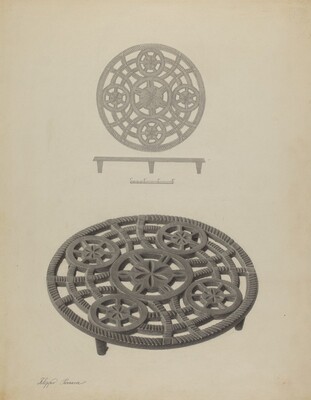
This is a drawing of a circular mechanical component. The image shows two views of a cast iron mechanical or decorative object with a round, intricate design composed of various circular patterns that interlock and overlap to create a dense, geometric motif. The design has a three-dimensional quality, showcasing depth and shadow. The upper part of the image provides a side view to demonstrate the object's structure and height, supported by three small legs. The material and design suggest it was intended for both functional and decorative purposes, likely having an industrial or domestic application.

Pa. German Trivet

Porreca, Filippo

The image depicts a man seated and facing the viewer. He has a long, pointed beard and wears a tall headpiece. His head is slightly turned to his left. The man has deep-set eyes, a prominent nose, and a calm expression. He is wearing a long robe-like garment and a mantle or wide sash. The portrait is framed within an oval with a decorative border. In the top left corner, there is a crest with a coat of arms containing three symbols. The background features diagonal hatched lines, creating texture. The image appears to be engraved.

Aluaso Semedo

Moncornet, Balthasar

The image is a sketch of several figures, likely male, seated around a central figure on a table or platform. The central figure has long hair and a beard, seated facing forward. The surrounding individuals have indistinct faces and are oriented towards the central figure. Their clothing is suggested by flowing lines indicating loose garments or robes. The sketch is on a textured, aged background.

The Last Supper

Italian 16th Century

The image depicts a bronze medallion featuring a profile of a sculpted figure. The figure wears ornate attire and a crown, showing intricate details in the hair, intricate garment patterns, and a circular necklace. The medallion has a warm, aged patina with varying brown and golden hues. An inscription encircles the edge, and a loop at the top suggests it may be used as a pendant.

Christine of France, 1606-1663, Duchess of Savoy 1619, Regent 1637-1648

Dupré, Abraham

Chad Gadya (The Tale of the Goat)

Chad Gadya (The Tale of the Goat)

Lissitzky, El

The image shows a forest with tall trees, viewed from a low angle. The horizon is hidden by the thick tree canopy. A pathway leads into the forest and a person stands among the trees. The image has a monochromatic and sepia tone, creating a warm and earthy atmosphere. The presence of shadows and glimpses of light filtering through the trees add depth to the scene.

Forest at Saint-Cloud

Robert, Louis-Rémy

This painting depicts a seated woman looking off to the left, resting her head on her right hand, our left, with her elbow on an abstract green surface. She has a fair complexion, a long nose, pale eyebrows, pale lips in a neutral expression, and reddish-brown hair styled up with a blue clip. She is wearing a pale mauve dress and shawl with a deep neckline, blue-green ribbon details, and puffed sleeves. A thin black belt is tied around her waist and there is a silver bracelet on her forearm. The background is painted in soft shades of blue and green, with a few highlights of pale yellow. An inscription in gold lettering in the top left corner identifies her as "Annetta D. of Edward Coke, wife of Lewis Cage of Milgate Kent."

Annetta Coke

Reynolds, Joshua, Sir

This is a drawing of a group of men observing artworks. The detailed line drawing depicts men in suits and top hats closely inspecting various art pieces in what seems to be an art gallery. The men are shown from different angles, some leaning in to view the artworks. On the walls are paintings, and one man is bent over, peering closely at a painting on the ground depicting a classical or mythological scene with a reclining figure. The gallery walls are decorated with framed images, each with its own level of detail captured in the sketch. The composition uses strong lines and cross-hatching to create depth and character, effectively capturing a scene of art appreciation from a bygone era.

Une Salle de l'hotel Drouot un jour d'exposition

Maurand, Charles

Round Dish with the Wedding Feast of Cupid and Psyche

Round Dish with the Wedding Feast of Cupid and Psyche

Limousin, Leonard

The image shows a landscape with two figures on a rocky surface overlooking a vast expanse. In the background, there are hills or mountains with a winding river or road. The etching technique showcases fine lines and intricate details, emphasizing texture and depth. The color palette is predominantly coppery, giving the artwork an aged and earthy feel.

The Circle of the Falsifiers: Dante and Virgil Covering their Noses because of the st

Blake, William

The image shows a rectangular box with a sliding lid painted with floral designs. The color palette includes dark green, yellow, orange, and red. The box is angled with the lid slightly opened to reveal compartments inside. The hand-painted floral design is on the sliding lid facing forward.

Spice Box

Bulone, Angelo

This image features a small etching of an urban riverscape scene. The viewpoint is from the embankment of the river, showing buildings and a bridge on the opposite side. The horizon has a row of buildings with varying rooftops, and a bridge spans the river. The lines of the etching create texture for trees and water. The color palette is monochromatic in shades of brown. The water's surface shows horizontal lines for flow and reflection. Two large leafy trees frame the central structure and the bridge in the distance.

Paysage

Dumont, Maurice

The image shows a landscape with trees, clouds, and a small structure visible in the distance. The style of the painting is loose and expressive, using a combination of washes and sharper lines. The color palette consists of earthy browns and greens, creating a sepia-toned atmosphere with varying light and shade intensities.

The Trees, Bedford, New York

Gignoux, Régis François

This is a photograph of an ancient coin. The coin is circular with a finely serrated rim and features intricate engravings on its surface. In the center, there is a seated figure surrounded by ornate patterns. The figure holds a staff or scepter in one hand. Around the figure, there is an inscribed border containing possible words or letters in a historic script. The bottom part of the coin displays a series of squares with small figures or embellishments inside each one. The coin's surface shows signs of wear and age.

Saint Petronius Enthroned above Arms of Cardinal Alidosi [reverse]

Bolognese 16th Century

The sculpture includes two women standing on rectangular bases, both dressed in classical attire. They have one arm extended toward the center, interacting with decorative elements. These elements consist of two griffins facing each other on each side of an ornamental swirl at the top of the piece. The relief is displayed on a lintel or mantlepiece. The color scheme is monochromatic in shades of gray, resembling stone such as marble. The composition is symmetrical and balanced, with the figures mirroring each other for a sense of harmony and order.

A New Collection of Chimney Pieces, Ornamented to the Style of the Etruscan, Greek and Roman Architecture; Containing Thirty Six Designs suitable to the most Elegant Range of Apartments

Richardson, George

The image shows a naked male figure in various stages of a motion sequence, likely pitching or throwing a baseball. The man's entire body is visible in different stances, each illustrating a step in the throwing process. His arms and legs are flexed or extended accordingly. The man's facial features are somewhat indistinct, and he has short hair. No clothing or jewelry is visible, and he holds a baseball in some frames. The background consists of a plain, textured wall in the upper row and a more detailed outdoor setting with a path, grass, and fence visible in the lower row.

Plate Number 281. Baseball, catching and throwing

Muybridge, Eadweard

Three tall sailing ships, each with three masts and full sails, float in calm, arctic waters, surrounded by fragments of icebergs and ice floes amid a smattering of arctic animals in this horizontal landscape painting. The horizon line comes about a quarter of the way up the composition so the sails and rigging of the ships are shown against the sky. The clouds have ivory tops and lavender-purple undersides, and they curve in a C-shaped bank to cover most of the left half of the painting and to span the horizon. The three ships closest to us are spaced evenly across the composition, with the left-most the closest, and therefore the largest. The ship to our right is set a bit farther back, and the center ship is the farthest away. A rowboat holding several men has pulled alongside the boat to our left, and more men haul massive slabs of whale blubber up the side of the ship. Others walk on an ice floe nearby. Close inspection reveals more rowboats around and beyond these ships, and several more ships fading into the hazy distance along the horizon. Jagged edged chunks of icebergs as tall as the ships float around them. Closer to us, a trio of seals sits on an ice floe near the lower center of the composition, and a polar bear stands nose to nose with a cub to our right. Two narwhal whales with long tusks break the surface of the water between us and the ships, as does a whale’s tail near the boat to our right. Two walruses with long tusks sit on a floe near the center ship. A couple dozen birds, many white with black wing tips, fly low over the surface of the water across the painting.

The Northern Whale Fishery: The "Swan" and "Isabella"

Ward of Hull, John

The image depicts a scene with various plants and foliage in the foreground, alongside an artist's easel and drawing board. The illustration style is detailed and intricate, with fine lines defining the flora. The color palette is monochrome, emphasizing the line work. The background is minimal, highlighting the botanical and artistic elements.

Sechs Landschaftstudien nach der Natur

Lebschée, Carl August

This is a ceramic vase. The vase is colored magenta red with white sections showing designs of a rooster, flowers, and abstract floral patterns. The designs use colors like gold, green, and blue. The vase has a tall, cylindrical body with a flared top and a slightly rounded base.

Beaker Vase

Chinese Qing Dynasty

This is a painting of a decorative floral pattern on a geometric background. The painting features bright red flowers with yellow centers arranged on green stems and leaves forming a circular design on the left and a linear pattern along the right and bottom edges. The background consists of a soft, neutral chevron pattern.

Quilt

Hastings, Katherine

This is a drawing of multiple figures in an architectural setting. The figures are arranged in a classical architectural environment with arches and columns. They appear to be interacting, some seated and others standing, dressed in draped garments. In the background, there is an alcove with a statue. The use of hatching and cross-hatching techniques provide texture and shading.

Confirmation

Dughet, Jean

This is a drawing of an angel and a woman in a religious scene. The drawing shows an angel with large wings and a flowing robe gesturing towards a kneeling woman. The angel holds a staff and appears to be delivering a message. The woman is near a structure that resembles an altar, and there is a potted plant or flowers nearby. Above them, there is a divine figure in the clouds and a dove emitting rays of light. The drawing uses fine lines and delicate shading, suggesting a classical or Renaissance style, with carefully detailed drapery and architecture.

The Annunciation

Anonymous Artist

The sculpture depicts a hunting scene with armed hunters on horseback, holding spears, accompanied by dogs. There are additional horses in the background. The sculpture has an oval relief presentation with intricate details, such as flowing garments and textures reminiscent of ancient Roman or Greek warriors. The color of the sculpture is bronze-like, suggesting a metallic composition. The figures are highly detailed, showing the textures of the horses' manes and the musculature of the riders and dogs, creating a dynamic visual narrative.

A Panther Hunt

Bernardi, Giovanni

This is a drawing of an ornate decorative page. Detailed illustrations with a central coat of arms featuring an eagle in a heraldic pose under a wide-brimmed clerical hat are included. Latin text is at the top in a serif typeface. The borders are decorated with intricate patterns of vine-like motifs, stylized floral designs, and baroque faces surrounding the central content. Ink annotations are visible within the illustration. The design is likely from a historical manuscript or book, showcasing craftsmanship and elegance typical of religious or formal publications from previous centuries.

Decachordum Christianum

Vigerius, Marcus

Pontoon Bridge on James River, Deep Bottom, Virginia

Pontoon Bridge on James River, Deep Bottom, Virginia

Fowx, Egbert Guy

The image shows five individuals standing in a line on a flat terrain with a soft, neutral background. Starting from the left, there is a male figure with short dark hair holding a spear, another male figure with feathers in his hair holding a paddle or club, a male with a feathered headdress and a red band across his forehead, a female in a skirt with beaded accessories holding arrows, and a small child standing beside her.

Klatsop Indians

Catlin, George

The image depicts an architectural scene from an elevated angle. The composition leads the eye towards building structures that recede into the distance. Several towers, columns, and sculptural figures are visible. The brushstroke technique is linear and precise, with an etching style. The color palette is monochromatic, focusing on black and gray shades. The painting shows columns, a statue, arches, spires, and decorative elements. Faint outlines of other structures are visible in the background.

Square with a Circular Building on the Left and an Obelisk in the Background

Doetechum, Lucas van

This is a ceramic vessel with a rounded, dome-like shape and a small, narrow opening at the top. The right half of the vessel is predominantly covered in red glaze, while the left side is a lighter cream color. The red glaze is patchy in some areas, showing the cream area underneath. The surface features an embossed design resembling swirling clouds or waves.

"Beehive" Water Pot

Chinese Qing Dynasty

This is a drawing of a decorative mirror frame. The drawing features an ornate mirror frame design with intricate detailing and a classical aesthetic. The frame has a rich wood tone with golden ornamental accents. At the top of the frame, there is a sculpted eagle with spread wings. The sides of the frame are decorated with garland-like designs, and the bottom has scrolling elements. The drawing gives a detailed depiction of a mirror frame from around 1800, as noted in the sketch, capturing the craftsmanship and artistry of that period.

Mirror Frame

De Vault, David S.

The image shows a figure with a staff and a textile, surrounded by playful dogs. In the background, there are hills, mountains, and trees. The style is linear and delicate, with fine lines detailing the figures and natural elements. The color palette is monochrome, using sepia-like tones on a light background.

The Huntress

Callot, Jacques

This is a drawing of a neoclassical building facade with columns and a clock tower. The drawing presents a symmetrical architectural design with detailed elements. The central part of the building features a prominent entrance flanked by four large columns in the Corinthian order, which support an entablature adorned with classic friezes. Above the entablature rests a clock tower with a dome. The lower portions include arched openings and niches containing sculptures or reliefs. The left side of the drawing shows additional segmentations, suggesting window placements, while the right side is faded. The meticulous linework and use of shadows enhance the depth and dimensionality, emphasizing the structure's grandeur and classical inspiration.

Architectural Study

Valeriani, Giuseppe

Amor Caritas

Amor Caritas

Saint-Gaudens, Augustus

This is a drawing of a title page for a book or poem titled "Les Saisons, Poëme". The image features an ornate layout with the title and additional text in French. Below the main title, there is a quote attributed to Wieland. It indicates that this is the seventh edition, published in Amsterdam in 1775. The central decorative element is an intricate vignette featuring a lyre surrounded by foliage and flowers. The overall aesthetic is elegant and refined, reflecting the artistic styles of the era.

Les Saisons: poëme

Saint-Lambert, Jean-François de

Étang de Corot, Ville-d'Avray (Corot's Pond, Ville-d'Avray)

Étang de Corot, Ville-d'Avray (Corot's Pond, Ville-d'Avray)

Atget, Eugène

Both dressed in white, a little boy leans onto the lap of a woman sitting in front of a smooth, sunlit boulder with a landscape to the right in this vertical portrait painting. Both people have pale skin with rosy cheeks. To our left, the woman sits with her body facing our right. Her round face also tips to our right, and she looks at us with gray eyes. She has an upturned nose and her full, pink lips are closed in a slight smile. Her long legs are crossed at the ankles, and dark gray slippers peek out from under the long hem. She wears a diaphanous, eggshell-white gown gathered under her bust. The short sleeves of the dress are puffy over sheer sleeves that extend to her wrists. A sheer veil is tied over her brown hair with a gray ribbon falls over her shoulders. She wears coral-red beaded necklace and drop earrings. Her hands rest in her lap and intertwine with the little boy’s hands. He stands behind her and leans onto her knees with both elbows. His round face is framed by a cap of honey-brown hair, and he looks at us with big, lapis-blue eyes. The boy has a small nose and bow-shaped lips. He wears a flax-yellow and mist-gray short sleeved garment with a bow in the back. Light falls on the pair from our left, and throws some of the foliage surrounding them into shadow. Burnt orange, gold, and white leaves and flowers surround the boulder behind the woman, and a view into a moss-green forest interior extends into the distance to our right.

Lady Mary Templetown and Her Eldest Son

Lawrence, Thomas, Sir

The image shows a wooded area with a clearing surrounded by trees. There is a stone column faintly visible through the branches. In the center is a large stone structure with a reclining statue among the trees. The artwork features intricate etching with fine lines conveying texture. The color palette is monochromatic using shades of gray. A winding path is visible in front of the trees with two small deer.

In villa Borghese

Reinhart, Johann Christian
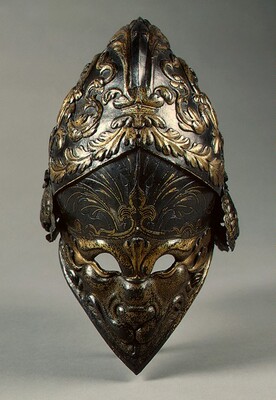
This is an ornate helmet made of dark metal with gold-colored details. It features intricate designs and patterns throughout, including symmetrical swirling and floral designs, as well as designs on the faceguard that look similar to an animal’s face, including a snarling mouth and eye holes. The lighting emphasizes the embossed and engraved elements of the helmet.

"The Morosini Helmet" (visored burgonet)

Milanese 16th Century
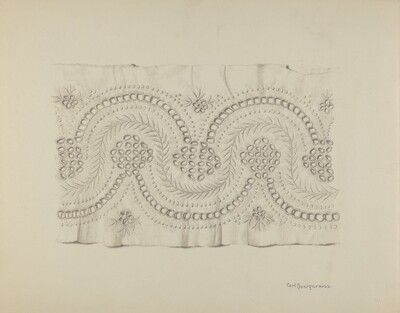
The image displays a piece of fabric with an intricate embroidery pattern featuring rounded designs and floral motifs. The color palette is primarily composed of subtle greys and whites, giving the appearance of a pencil drawing. This embroidered piece is positioned centrally on a blank background, with smaller floral details at the edges of the design. The style is symmetrical and repetitive, with duplicate patterns aligned horizontally across the fabric.

English Embroidery

Buergerniss, Carl

Two men are depicted from the waist up in the image. They are both wearing formal robes, suggesting a professional setting, possibly as legal professionals. The man on the left has a smug expression with a wide smile and eyes looking downward. He has curly hair peeking out from beneath a rectangular hat. The man on the right is angled towards the left, appearing to lean in to converse with the other man, with his mouth slightly open. He has a defined nose and curly hair under a similar hat. Both are wearing dark robes with a light-colored collar. The man on the left is holding eyeglasses and rolled papers in his right hand. The background features shaded patterns, creating a neutral backdrop for the two figures.

Eh bien, mon cher, vous avez perdu ...

Daumier, Honoré

This is a drawing of horses with mounted riders. The drawing shows several horses and riders in different poses and perspectives, depicted with delicate lines and shading. The background is plain.

Study of Four Horsemen

Callot, Jacques

The sculpture depicts a man in a dynamic pose, appearing as if caught mid-action. He is leaning back slightly and holding a long staff or spear across his shoulders. He is dressed in historical or outdoorsman clothing, including a feathered hat, a ruffled shirt, and fringed pants. The sculpture is made of dark bronze with an aged, greenish patina. The figure stands on a circular base and showcases realistic muscular definition and clothing folds. This bronze sculpture captures expressive motion and detail.

Peasant of the Middle Ages

Barye, Antoine-Louis

This is a black and white drawing of an expressionistic scene with a group of individuals and a piece of text. The illustration shows figures in a style similar to woodcut prints, with strong angular lines and sharp contrasts. The scene features abstracted figures, some with raised hands, depicted in a dramatic and stylized manner. The text "DIE TAUBEN II" is present above the image, and below the artwork, there is an excerpt of German text. The composition conveys an introspective or solemn tone typical of expressionist art, emphasizing emotion and the human condition.

Die Tauben II (The Deaf II) (headpiece, page 46) from Georg Heym: Umbra Vitae (Georg Heym: The Shadow of Life)

Kirchner, Ernst Ludwig

The image depicts a seated woman, visible from the waist up. She has dark, neatly parted hair. She wears a long-sleeved, dark dress with a high collar and white lace or frilled trim at the cuffs. She is posed with her right elbow on a table and her right hand under her chin, with her left hand resting on her lap. There is a small object in her left hand. A dark, round table nearby holds a book or box. The background is plain and the scene is framed in gold.

Portrait of a Woman

Hughes, Cornelius Jabez

The image depicts a night scene in a dense and shadowy forest. A faintly illuminated path is visible running horizontally through the scene. Dark silhouettes of trees and foliage surround the path, leading to a strip of warm light shining through the trees. The horizon is obscured by the densely packed trees, creating a continuous dark mass. The artist uses blended brushstrokes to create subtle transitions between light and shadow, adding depth. The color palette consists of deep greens and blacks with touches of muted oranges and yellows where the light breaks through, creating contrast. Softly rendered brushstrokes blur the boundaries of form, enhancing the scene's depth and contrast.

Ignis Fatuus, Rio Uruguay

Catlin, George

The image shows a landscape with a rural setting. The horizon is in the middle, with houses with red roofs and white walls. There are trees on the hills. A pathway runs through a yellow field with some greenery. The sky is blue with white clouds. The painting has deliberate brushstrokes creating a textured effect. The color palette includes earthy tones, yellows, blues, and greens.

Das Mappenwerk der Insel

Laage, Wilhelm

This is a painting on a circular plate depicting a battle scene. Warriors clad in medieval armor and helmets engage in combat. The scene includes figures in action poses with swords and shields. In the background, a fortified city with flames and smoke rising from its towers suggests a siege or invasion. Bright colors and detailed ornamentation enhance the drama of the scene. This is in the style of an Italian Renaissance artist like Francesco Xanto Avelli, known for detailed maiolica ceramics depicting historical and mythological scenes.

Charger with the Battle of Roncevaux

Xanto Avelli, Francesco

This is a painting of three stylized birds. The image depicts three brightly colored birds in an abstract, folk art style, each with unique patterns and a simplified, geometric aesthetic. The first bird is predominantly red with a green back and a dotted pattern on its wings. The second bird is leaning forward with a broad tail and features a predominantly brown and cream color palette with a checkered pattern on its wings. The third bird is colorful, featuring a vivid mix of green, red, and white stripes and dots along its plumage. The text at the bottom reads "FROM WOOD CARVING AND BIRTH CERTIFICATES."

Plate 10: From the Portfolio "Folk Art of Rural Pennsylvania"

American 20th Century

The artwork features a reclining figure, lying on their side with their head propped up on one hand and the other arm resting across their body. The facial features are stylized, with dark shading around the eyes and mouth, and short hair. The figure is draped in a cloth with floral patterns, lying on a surface with floral motifs. There are no visible jewelry or objects. The background includes abstract, cloud-like forms and floral patterns, with the initials "P.G." in the upper left corner.

Te Arii Vahine (Lady of Royal Blood)

Gauguin, Paul

The image shows a street-level perspective of a narrow alleyway between tall buildings with trees on one side. A seated figure is on the right near the viewer. A woman and a child are walking down the street. The sketch is done in pencil on blue-toned paper, creating a sense of form and depth with light, fluid lines. The color palette is minimal, highlighting the blue paper as the background with shading variations from the pencil work, emphasizing shadows and shapes.

View up a Street in Sorrento [verso]

Bertin, François-Édouard

The sculpture is a bust of a man with a strong expression, prominent eyes, and defined facial features. He wears a high-collared coat and a neatly tied cravat. The material is smooth and light-colored, possibly marble or a similar stone. The craftsmanship depicts intricate details of the man's face, hair, and clothing realistically. The bust sits on a round pedestal, elevating it and enhancing its classical appearance.

Joel Barlow

Houdon, Jean-Antoine

The image features two illustrations. The top illustration shows a detailed architectural drawing of a stone block with labeled sections and parts marked with letters. The perspective is from a slight angle, emphasizing the three-dimensional aspect and showcasing architectural elements like channels and holes. The drawing style is technical and precise, with clean, deliberate lines defining the structure. The bottom illustration depicts an ancient ruin, potentially part of a coliseum or amphitheater. The perspective is from a low vantage point, looking up towards the structure. A series of arches guide the eye towards a tall tower in the middle, with additional buildings and vegetation in the background. The brushstrokes are expressive, creating a textured, cross-hatching effect to indicate the aged and overgrown nature of the ruins. The color palette is monochromatic, using contrasts of light and dark to convey depth and detail, similar to etchings or engravings.

Le Antichità Romane (volume I)

Piranesi, Giovanni Battista

This is a photograph of a star chart. The image shows a grid layout with small black dots spread across the background, representing stars in the celestial coordinate system. The chart, titled "Photographische Sternkarten," was created by Joh. Palisa and Max Wolf and includes annotations detailing its production date, location, and contributors. The chart features references to celestial latitude and longitude, presented on an organized grid with numbered divisions running vertically and horizontally along the edges. These coordinates assist in identifying star positions within the mapped sky section. The information provided emphasizes cartographical efforts to document the night sky in 1901.

Photographische Sternkarten (October 15, 1901)

Wolf and Palisa

This is a painting of a forest scene with dancers and a tent. Figures are dancing in the foreground on green grass, with each figure positioned expressively. More figures are gathered near a tent, and in the background, dense trees fill the scene. A serene body of water is visible through the clearing, surrounded by greenery.

Tapuya Encampment

Catlin, George

The image displays a composition of faint, raised lines and shapes on a textured surface. The lines resemble the outline of a bird with outstretched wings or the imprint of leaves on a branch. These abstract outlines are visible against a uniform background.

Le vautour (The Vulture)

Rouseaud, Aristide

A free-standing, gold, enameled, rectangular box has a triangular top like the roof of a house, and the box rests on a short, square foot in each corner. In this photograph, we look onto one long side and the short side to our right is angled toward us, so we see the panel there, too. Along the long side, five people are shown from the waist up in the upper, roof-like panel and six more line up on the panel below. The skin of every person is gold, and all wear robes and garments in lapis or sky blue, spring green, yellow, and white. The area around the people is also gold, and each panel is encased by a royal-blue band dotted with stylized stars at regular intervals. Each panel is then lined with small, button-like rounded bosses around its edges. In the upper panel, all of the men except the second from the right have beards, and all have halos with wavy bands of blue, green, yellow, and white. The man to our left holds a book and his neighbor a skeleton key the length of his arm. The man at the center holds up a book with his left hand, on our right, and raises the index and middle fingers of his other hand, held up at shoulder height. The two men to our right also hold books. In the panel below, three horses’ heads peek in from the left edge, creating a vertical band, and three crowned men line up, holding gold vessels and looking toward a woman seated in a throne with a child on her lap. The woman has a halo made with a wavy pattern of blue, yellow, green, black, and white. Her throne is flanked by columns, and the area around it is edged with bands of white, light, and dark blue. The baby wears gold, has a halo, holds a book in his lap with his left hand, and raises the first two fingers of his other hand toward the three men. The final person in this panel wears a hat, holds a scepter topped with a fleur-de-lis, and gestures at the woman and baby. The head and shoulders of a haloed person is visible along the short side of the box, which is angled sharply away from us. The gold between all the people and bordering each panel is intricately carved with tiny flowing organic lines and swirls.

Reliquary Châsse

French 12th Century

The image features a small square containing abstract shapes and lines. The shapes include curved forms resembling scales or textured surfaces, with black lines outlining a path or contour. The pattern has an abstract quality akin to a patchwork quilt or mosaic, featuring earthy tones and a touch of bright blue. The textures and colors evoke the appearance of layered fabric or a natural geological formation.

Hooked Rug (Detail)

Mason, Georgine E.

This is a black and white drawing of a forest scene with a man aiming a rifle towards another figure. Above them is a celestial figure holding a child, surrounded by clouds. The style is reminiscent of woodcut illustrations with detailed lines. Text at the bottom of the image appears to be in a German-like language.

Ain Man ward mit ainer Puren ...

Master of the Miracles of Mariazell

The image shows a person standing upright. The individual has a solemn expression, delicate features, medium-length hair, and is wrapped in flowing cloth. Their hands are visible holding the fabric close to their chest. There are no visible jewelry or objects being held. The background is plain, accentuating the figure and detailing of the drapery. The artwork is presented on a light-colored mount contrasting with the sepia-toned drawing.

Study of a Standing Woman

Italian 18th Century

The sculpture is a round medallion featuring the bust of a female figure. The subject is depicted in a frontal pose with her head slightly tilted, displaying long, flowing hair. The attire appears to be loosely draped around her shoulders, accentuating the form of her upper body. The sculpture is crafted from a material resembling aged bronze, evidenced by its dark, metallic color with patches of patina, giving it a rugged texture. The medallion includes inscriptions around the perimeter. The three-dimensional relief of the bust stands out against the flat surface of the medallion, lending it a sense of depth and realism.

Elvira, Daughter of Consalvo de Córdoba [obverse]

Italian 16th Century

Antiquites de la Grande-Grece (volume I)

Antiquites de la Grande-Grece (volume I)

Piranesi, Francesco

The image shows three individuals, each dressed in traditional, rustic clothing and wearing wide-brimmed hats. The person on the left is playing a wind instrument with a determined expression. The person in the middle is also playing a wind instrument, with their face partially obscured by shadows. The person on the right, possibly a child, is playing a small wind instrument. The background is a simple wall with a deep shadow cast across it, indicating bright sunlight from the side. No additional objects or jewelry are visible in the image.

Planche III – Groupe de Trois Pifferari Debout, dans la Cour du 21 Quai Bourbon (Plate III – Group of Three Pifferari Standing, in the Court of 21 Quai Bourbon)

Nègre, Charles

A naked man with ghostly white skin sits upright in a canopied bed set in a narrow room in this tall, vertical painting. Wearing a black cap, he looks to our left in profile toward a skeleton who comes through a door along the left edge of the composition. The man gestures at the skeleton with one hand and, with the other, toward a bag of money held up by a small demon next to the bed to our left. The skeleton wears a white shroud and holds an arrow. A winged angel kneels next to the man in the bed, one hand on the man’s shoulder and the other lifted to gesture at a crucifix hanging in the window over the door. A small devil on the canopy above looks down onto the bed. At the foot of the bed, a man wearing a green robe and headdress drops coins into a sack held by another demon. Three more demons crawl about and hide under the chest. Pieces of armor and weapons lie on the ground to the right in front of a stone ledge in the foreground. Two pieces of clothing drape over the ledge to our left.

Death and the Miser

Bosch, Hieronymus

The image is an engraving showing a point of view from slightly above ground level, looking towards a cylindrical stone structure surrounded by lush trees and vegetation. The horizon is just above the middle of the image with tree tops and a distant building visible. Intricate engravings detail the stones, foliage, and clouds. The color palette is monochrome with varying shades of black and white. A path winds through the landscape with a figure on horseback traveling along it. The circular ruin is prominent, with trees framing it on both sides, leading to a distant architectural structure in the background.

Sepolcro volgarmente detto degli Orazii e Curiazii a Albano

Reinhart, Johann Christian

This is a painting of a narrative scene on a circular ceramic plate. The plate is decorated with intricate and colorful imagery depicting various figures and animals engaged in different activities. In the foreground, there is a central pedestal with an inscription, surrounded by various characters and animals, including a bovine figure on the left and a variety of other figures interacting with each other, some appearing to be sleeping or in distress. The scene is bustling with activity, with architectural elements and lush greenery in the background.

Plate with the Plague of Phrygia

Urbino 16th Century
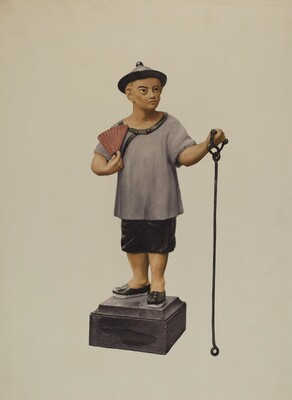
The sculpture depicts a figure resembling a young boy dressed in traditional clothing. He is holding a red fan in one hand and a long black stick or rod in the other. The figure is wearing a grey short-sleeved tunic, black shorts, and black shoes. A small round hat sits atop his head, complementing his attire. The sculpture is primarily composed of painted material with colors such as grey, black, red, and flesh tones. The sculpture stands on a rectangular base, elevating the figure slightly above the viewer's eye level, yet the size of the sculpture suggests it would be roughly the height of an average human child when considered in relation to the base.

Iron Hitching Post

Constantine, George

This is a drawing depicting an entrance to an exhibition or gallery space. The scene is framed by an architectural archway, with signage above the entrance reading "Les Salles D'Estampes" meaning "The Print Rooms." Below, there are words "En Province" and a reference to a publication "Publiées dans le Journal des Arts 1884–85" visible. 

The composition is in a monochromatic, sepia tone. Two figures stand in the foreground under the archway. Inside the building, a larger space with high ceilings and arches is visible through a doorway, suggesting classical architecture. Various details such as framed artworks and architectural elements like columns are depicted, contributing to a cultured setting.

Frontispiece for "Les Salles d'Estampes"

Buhot, Félix-Hilaire

The image shows a person in profile standing upright with one hand on the hip. The individual has an angular face, curly hair pulled back under a tall hat, and is wearing a tunic with decorative details on the sleeves and hem, paired with leggings or bare legs. The background is an aged, textured paper.

Standing Youth

Florentine 15th Century

Descent from the Cross

Descent from the Cross

Italian 16th Century

This image features classical imagery and text. The upper section shows a winged figure intertwined with a swan in a rectangular border. The name "HOMER" is displayed below, surrounded by a decorative border of repeated swan motifs. A seated figure reading or reflecting is depicted further down, integrated with a large initial "H" and accompanied by text in German praising Homer and his literary significance. The layout and decorative elements are in a neoclassical style, emphasizing symmetry and classical themes.

Homer Nach Antiken Gezeichnet

Tischbein, Johann Heinrich Wilhelm

The image displays a landscape with a house, leafless trees, wetland, shrubs, and tall grasses. The color palette is subdued and dominated by gray and earth tones.

The Fringe of the Marsh

Goodall, T.F.

A man and woman greet each other at the center of a group of about a dozen people set within a landscape in this horizontal painting. All the people have pale, peachy skin. In the middle of the crowd, a woman, Abigail, kneels to our left while a man to our right, David, reaches out to her. Abigail’s blond hair is tied back under a white veil that drapes over her shoulders, and she wears a slate-blue dress and a string of pearls around her neck. She holds her left hand, on our right, to her chest and her other hand gestures down to a basket of bread held by a man in the lower left corner of the painting. David stands and bends toward Abigail as he cups her bent elbow with his left hand. His other hand rests on a walking stick near her head, and his index finger is extended as if to brush her cheek. He has short, curly blond hair and beard, and he wears a thigh-length tunic under a breastplate. Crimson-red fabric drapes around his shoulders and over his armor, and a dagger or short sword hangs at his hip. Three women, three men, and a donkey gather to our left, behind Abigail. Two of the men hold large baskets of bread, and they all look toward Abigail and David. Six armored men, two younger people, and two horses make up the group to the right. Trees line a hill behind the people to our left and dark gray and amber-colored clouds fill the sky.

The Meeting of David and Abigail

Rubens, Peter Paul, Sir

The image shows a sketch of a street view with a building at the center. Figures are depicted near an entrance, with one figure crouching and a horse hitched to a cart on the right. The background is minimalistic, with light brush strokes creating an impressionistic feel. The color palette is monochromatic in shades of black and gray.

Gaiety Stage Door

Whistler, James McNeill
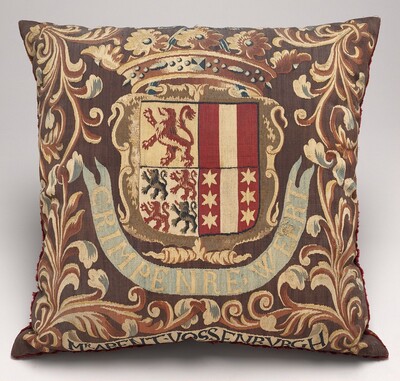
This is a photograph of a decorative embroidered cushion. The cushion features a detailed coat of arms in the center, showcasing a lion, stars, and various stripes and patterns within an ornate shield. The crest is surrounded by floral and scroll motifs in colors like gold, red, blue, and brown. The design includes a banner below the shield with text. The craftsmanship is intricate, highlighting woven patterns and textures.

Tapestry-covered Cushion

Netherlandish 17th Century
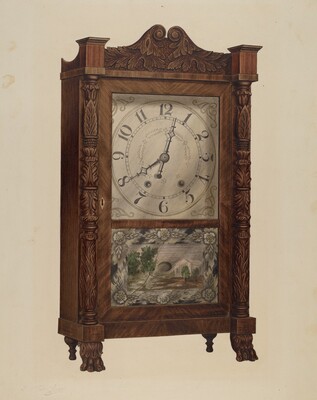
The image features a wooden antique clock with ornate carved columns and a decorative crest on top. The clock's face includes roman numerals and two hands, with a scenic landscape panel below. The color palette consists of rich browns and earthy tones in the wood, and lighter shades in the clock face and painting. The clock is positioned centrally in the frame, with intricate carvings on each side.

Shelf Clock

Wenger, Frank

This is a drawing of a scene involving a crowd. The composition features figures, some on horses, surrounding a large wooden beam with intricate textures. The figures display different postures and clothing details, showcasing interaction. The drawing conveys movement and activity with elements like leaning bodies and extended arms. In the background, there are landscape features like hills and a town. The artwork's detailing includes fabric folds, facial expressions, and spatial depth, suggesting a significant narrative or event.

Christ Carrying the Cross

Schongauer, Martin

The image shows a full-body sketch of a person in profile view facing left. The individual holds a rifle over their right shoulder with their left hand and their right hand is on their belt. They wear a wide-brimmed hat and simple attire. Surrounding the main figure are three close-up side profile sketches of the head from various angles, emphasizing the hat and facial structure. The background is plain.

Recruit; Two Studies of Heads

Huntington, Daniel

The sculpture is a bust depicting the head and shoulders of a man. His facial features are pronounced, with a prominent brow and nose, a large mustache, and a firm expression on his lips. The material appears to be bronze, exhibiting a dark, weathered patina with aging highlights. The surface is rough and rustic, adding to the impression of strength and solidity. The bust is life-sized.

Jacques-Antoine-Adrien, Baron Delort

Daumier, Honoré

This is a title page of an illustrated book or series entitled "Harvey's Scenes of the Primitive Forest of America, at the four periods of the year, Spring, Summer, Autumn & Winter, Engraved from his Original Paintings, Accompanied with Descriptive Letter-Press." The page states that the book was published according to an act of Congress in the year 1841 by G. Harvey and printed by Charles Vinten in New York. The page shows signs of aging, with visible spots and slight discoloration typical of aged paper.

Harvey's Scenes of the Primitive Forest

Bennett, William James

The image shows a group of seven people in a workplace. Five women and two men are visible, all from at least the waist up. One man is seated in the foreground, while the rest are standing. The seated man has short hair and a moustache, and is dressed in a dark suit and tie. To his left, a woman sits on the edge of a table, wearing a long dress with a high collar and an apron. The standing women wear long dresses and aprons, with their hair tied back. One woman wears a floral patterned blouse with a belt. Accessories include brooches and an object held by one man. The background features shelves with folded fabrics and bundled items, as well as a metal stove on the right side. The floor is wooden, and the setting suggests a well-organized environment.

"Anna in Union College Laundry”

Edel

People and a horse-drawn wagon move along a street lined with buildings on the left and trees on the right in this loosely painted horizontal landscape. The wide street angles from the bottom left of the composition to the middle right. The surface of the road is painted with strokes of apricot orange, light gray, rust red, and olive green, and it leads back to a slate-blue, blurred area suggesting trees in the distance. The two, three, or four-story buildings are close together or may be joined. They are painted in muted tones of parchment white, pale peach, and blue gray. Closest to us and to the left, a long brown roof and two bare trees sit beyond an ivy-covered stone wall. The people are indistinct and small in relation to the scene and are dressed in black, brown, olive-green, and slate-blue clothing. One of two carriages is across the road from us and the second one is farther back. On our side of the road, a man wearing a long black jacket and gray pants strolls away from us past a neat row of trees lining the peach-colored sidewalk. The overcast gray and pale pink sky is above. The artist signed and dated the lower left corner, “Sisley. 72.”

Boulevard Héloïse, Argenteuil

Sisley, Alfred

The image shows an elevated view of a narrow waterway flowing between rocky cliffs. The horizon is high in the composition, with distant mountains and a sky filled with clouds. The style features detailed engravings on the rocks and foliage. Near the water, a person and livestock are resting. The waterway continues between cliffs and vegetation into the distance. The color palette is monochromatic, using shades of grey.

Cascatella di Tivoli

Dies, Albert Christoph

This is a photograph of an ornate necklace made from gold, pearls, and gemstones. The necklace features an intricate chain with repeating motifs of red and white gems encased in a gold setting. The central pendant shows a figure with a sculpted face and extended wings, with three pearls hanging beneath. The background is dark, emphasizing the craftsmanship and design of the jewelry.

Necklace and Pendant with a Sphinx

André, Alfred

The image shows an open round compact with a mirrored lid facing upwards and a slightly beveled edge containing a light pink hue. The color palette is soft pastels and muted brown. The compact is centrally placed in the image on a plain background.

Epaulette Box

Frazier, Cornelius

This is a drawing of an outdoor gathering with a nature theme. It depicts a lush, wooded landscape with trees forming a canopy. In the center and towards the top, cloud-born figures float above. On the ground, various figures are gathered, dressed in flowing garments, engaging in a festive or social occasion. Some hold musical instruments and others wear floral wreaths. The scene includes decorative elements, a pedestal on the right, and peacefully integrated animals. The composition conveys a tranquil and celebratory atmosphere, capturing leisure and nature's splendor.

La simple Nature

Martinet, Francois-Nicolas
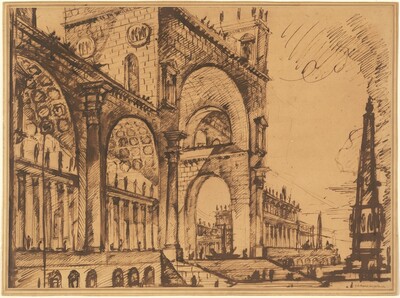
This is a drawing of an elaborate architectural structure featuring grand arches, columns, and detailed stonework. The design includes large arches, columns, circular medallions, arched windows, and a colonnade leading into the depth of the structure. In the distance, an obelisk-like structure is visible. The drawing uses cross-hatching and bold lines to define depth and form.

Fantasy on a Magnificent Triumphal Artch

Piranesi, Giovanni Battista

The sculpture depicts a male figure with his hands tied behind his back. The material appears to be a dark, metallic substance, potentially bronze. The subject's head is turned slightly to the side, showing his defined facial features and curly hair. The figure's stance suggests tension, emphasized by the tightly pulled ropes around his wrists. The relief is set against a circular disc, creating subtle shadows.

Saint Sebastian

Francesco di Giorgio Martini

The image displays eight individual engravings arranged symmetrically on a single page. The top left engraving shows a City Tavern, a large two-story building with classical architectural features. To the right is a central vignette of a landscape with intricate foliage framing an empty center and a small stone bridge below. The top right engraving depicts a market scene with several buildings and a prominent arched structure in the center. In the middle left is an engraving labeled "Court-house" featuring a grand building with a detailed cupola set in a pastoral scene. The central engraving is a circular portrait of a woman and child. The middle right displays an architectural image labeled "Church" with a neoclassical building, columns, and surrounding structures under a cloudy sky. The bottom left engraving shows a smaller building with high boundary walls. Below, a colored landscape, labeled "Vue de Ticonderoga sur le Lac Champlain," illustrates a serene scene of a lake and hills with vibrant foliage. At the bottom right is a landscape with trees on the horizon and gently sloping hills in black and white with fine linework. The engravings are primarily monochromatic, except for the colored landscape which features greens, blues, and earth tones.

Saint-Mémin Collection, Group 57

Saint-Mémin, Charles B. J. Févret de

This is an image showing a raccoon in a grid-lined background, moving from left to right. The image is composed of multiple frames depicting different stages of the raccoon's motion. Each frame shows a slight progression as the raccoon moves, highlighting its body postures, leg positioning, and tail movement. The grid serves as a reference for observing the animal's actions with accuracy. The sequence documents the nuances of the raccoon's gait in a scientific manner.

Plate Number 745. Raccoon walking and turning around

Muybridge, Eadweard
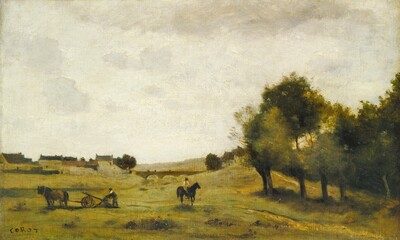
A person at the center of this loosely painted horizontal landscape rides a dark horse across a field as a man to the left works the field behind a horse-drawn plow. The field is carpeted with muted and gold-shaded green, and a grove of trees in the right third of the composition are painted in fern, olive, and dark green. A patch of darker green near us and to left of center is dotted with red and yellow to suggest flowers. The men and horses are small in relation to the composition. The people have brown skin and are painted with a few strokes in dark gray and muted green for the man behind the plow to the left and pale yellow and white and a red cap for the person on horseback. A band of houses with tan or light yellow walls and gray or terracotta red roofs line the far side of the field to the left, and an arched bridge crosses what appears to be a shallow, grassy ravine near the center. The horizon comes about a third of the way up this composition and a few smoke-gray clouds line the upper edge of the otherwise milk-white sky. The artist signed the lower left corner, “COROT.”

View near Epernon

Corot, Jean-Baptiste-Camille

The image shows a table with a funnel, bottles with stoppers, a brush, a small dish, and other objects. The color palette is primarily brown and black. The objects are arranged on the table, with the funnel and bottles in the center, and a sheet of paper hanging over the table on the left side.

Frontispiece

Bonvin, François

This is an ornate, decorative vessel resembling a large ceramic bowl or pot. Its surface features intricate floral designs painted in shades of pink, red, and orange, with hints of green leaves and a small brown fence around the flowers, all set against a white background. The main body of the vessel is a deep cobalt blue color and has a smooth, shiny surface. The vessel has small, golden-toned handles on each side.

Large Fish Bowl

Chinese Qing Dynasty

The image shows a large, brown, ribbed glass bottle on a plain background. The bottle is centered with its neck extending upwards in the middle. The name "Anna Aloisi" is signed in the bottom right corner.

Bottle

Aloisi, Anna

The image depicts a valley surrounded by cliffs and waterfalls, viewed from an elevated perspective. The cliffs, waterfalls, greenery, trees, river, and sky are detailed with fine brushstrokes using earthy tones. Figures and wooden structures are visible in the foreground.

Chute de Staubbach, dans la Vallée de Lauterbrunnen (Falls at Staubbach in the Lauterbrunnen Valley)

Janinet, Jean-François

The image is a pencil sketch showcasing a rural scene from a slightly elevated viewpoint. The landscape features several structures among lush vegetation. The horizon blends with the building roofs, while trees rise behind them. The pencil strokes show detail in foliage and buildings, with cross-hatching for shadows. The color palette is monochromatic, emphasizing gray tones. The sketch depicts a grassy hill leading to trees and buildings in the distance, creating a countryside vista.

Italian Farm Buildings by a Stream

Vien, Joseph-Marie

The image shows two central figures, one standing on a raised surface on the right with a staff and a vessel pouring water over the head of the other figure. The figure being baptized has long hair falling to their shoulders and serene facial features, with arms bent and hands clasped at the chest, wearing minimal clothing. The baptizing figure has a beard and detailed facial features, wearing a draped garment. Around them is a larger halo. On the left, a group of angels is present, with two angels kneeling, characterized by soft facial features and wings folded behind them, wearing draped robes. Above the central figure, a dove hovers with radiant lines spreading outward. The background has dark, crosshatched patterns for depth and an arched motif above, with the ground below resembling agitated waters. The image is framed, suggesting age or historical significance.

Baptism of Christ

Italian 16th Century

The image is a grid of fifteen small portrait illustrations. Each portrait features a man in profile facing left. The men have distinct features and wear formal attire typical of the late 18th to early 19th century. A handwritten name is beneath each portrait. The background is a plain neutral tone.

Saint-Mémin Collection of Portraits, Group 28

Saint-Mémin, Charles B. J. Févret de

The images depict a woman in various positions, displaying different views of her body. She starts seated, moves to standing, then bends forward while holding a fan. She has a neat bun hairstyle and wears a long dress with puffy sleeves and a high neckline. The background has vertical lines, resembling wooden paneling.

Plate Number 250. Rising from chair, stooping and lifting handkerchief

Muybridge, Eadweard

Dozens of light-skinned men and women gather around clusters of columns and sandstone-colored buildings that line a crimson-red river to our right in this horizontal painting. The center of the painting is dominated by a structure made up of three rows of three columns each, which hold up a flat-topped roof. A similar structure angles into the distance along the left edge of the painting. The columns of these two structures are carved with bands showing people separated by rings of vertical lines. The capitals are carved with stylized leaves. Just beyond the columns to our left, a blocky, rose-pink structure is carved with more people, seated or standing singly or in pairs. More rectangular, parchment-brown buildings extend into the distance along the water’s edge. The people gathered along the riverbank wear robes and tunics in deep blue or black, bright white, or saturated tones of cobalt blue, ruby red, or shell pink. Standing within the columns of the central structure, a crowned, bearded man wearing an emerald-green robe under a scarlet-red cloak gestures to our right, toward the red river. A woman nearby, wearing lapis blue and also crowned, watches with hands flung up as a person pours red liquid from a bucket. Most of the other people look or gesture toward the river, which winds in deep S-curves from the horizon line, which comes about two-thirds of the way up the composition, through sage-green fields, to the town. A single, white lightning bolt zigzags down from a white cloud in an otherwise navy-blue sky above.

"He Turned Their Waters into Blood"

Field, Erastus Salisbury
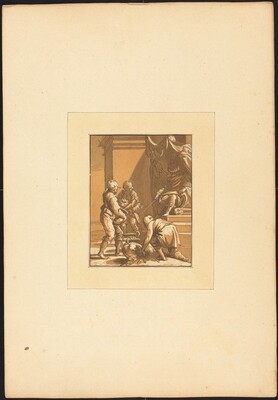
This is a drawing of a group of figures engaged in an activity in a classical setting. The scene is set within a formal interior space defined by architectural elements such as a column and a draped curtain. The composition features figures dressed in historical attire, with one seated figure elevated. The gathered figures are depicted in dynamic poses, and one seems to be attending to an overturned pot or urn on the ground. The gestures and diagonals formed by the figures and their garments lead the viewer's eye around the scene. The use of line and shading in the drawing adds depth and drama to the scene, creating a contrast between the figures and their environment.

Roman Sacrifice

Prestel, Maria Catharina

The sculpture is of a traditional ceramic vase featuring a bulging body with an elongated, narrow neck. The vase is primarily white and is adorned with an intricate pattern of blue swirling motifs covering the body and neck. The top of the vase has a band with blue calligraphic characters. Made from what appears to be porcelain, this vase displays a high level of craftsmanship typical of historical Asian pottery. Its glossy finish and classic blue-and-white color scheme give it an elegant and timeless look.

Bottle Vase

Chinese Qing Dynasty

The illustration depicts a single spoon at the center of the composition. The color scheme includes grayscale tones on a light beige background. The spoon is positioned vertically with the bowl at the top and the handle extending downwards. The handle is intricately designed with fine lines, while shading adds depth to the bowl and handle, creating a metallic appearance.

Silver Soup Spoon

Guarino, Joseph

The image depicts a man standing in a slightly turned position with his head facing forward. He has distinct facial features, including a defined nose and relaxed expression. His hair is light and combed back gently. He is dressed in ornate clerical attire with intricate patterns on his sleeves and collar, and wears a large cross around his neck. His right hand rests on a document, while his left hand holds a book or similar object, resting on a table. The background is plain, with no additional details.

Gabriel Cortois de Pressigny

Ingres, Jean-Auguste-Dominique

The image shows a large semicircular line intersecting a grid of small squares with symbols, numbers, and letters. The overall appearance is abstract, resembling a geometric diagram or blueprint. This design could be linked to engineering or architectural sketches with precision and calculation at its core.

Diagram of a Lunette [verso]

Pearce, Charles Sprague

The sculpture is a medallion featuring a central figure of a putto playing a lute, surrounded by ornate designs including floral motifs, scroll work, and small figures. The sculpture is gold-colored and round, with a relief that provides texture and depth to the designs.

Cupid Playing on the Lute

German 16th Century

The image shows the cover of a book. The cover is a dark brown fabric with distressed black spine and corner edges. Printed in gold lettering, it reads "Prang's Progressive Proofs, Collection William T. Walters, 1895." The book appears aged with signs of wear, especially along the edges and corners, indicating long term use or storage.

Prang's Progressive Proofs

Prang, Louis

This is a photograph showing a sequential motion study of a figure ascending a ladder. Multiple frames depict the progressive movements involved in climbing up a ladder. Each frame captures a slight change in position, illustrating the mechanics of motion. The ladder is positioned upright, with each step clearly visible as the sequence progresses. The background appears to be a plain setting, emphasizing the focus on the movement study. The format suggests the image is part of a motion study or an early example of sequential photography designed to analyze motion.

Plate Number 112. Ascending a ladder

Muybridge, Eadweard

The image shows three individuals standing in full length facing the viewer. On the left stands a woman with dark hair, wearing a brown fringed dress with red leggings. The middle figure, likely a man, wears a beaded garment and a headpiece with feathers. He holds a stick or staff. The figure on the right, also likely a man, wears a feathered headdress, a beaded necklace, and an arm band. He is bare-chested with a blue cloth covering his lower body, grey leggings, and holds a painted shield and a ceremonial club. The background features a softly painted horizon within an oval border.

Athapasca Chief, His Wife, and a Warrior

Catlin, George

The image is a detailed engraving viewed from an elevated vantage point. The scene features a dramatic sky dominating the upper portion with dynamic cloud formations and a mythological figure. The sun is in the top left, radiating lines. Below the sky is a landscape with rugged mountains, plains, and intricate detailing in hatching and cross-hatching lines. The image is monochromatic, creating a stark contrast and highlighting details within the scene.

God Creating Order from Chaos

Wolfgang the Elder, Georg Andreas

This is a photograph of a white ceramic plate. The plate has a smooth, glossy finish with a subtle design along its surface that blends into the overall creamy white color. Its shape is slightly scalloped or lobed. The background is a simple, neutral tone. The lighting emphasizes the plate’s texture and shape.

Small Foliated Dish

Chinese Qing Dynasty
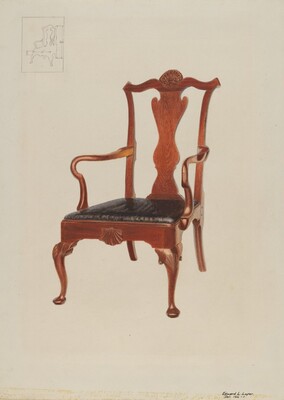
The image shows a large wooden armchair with a black cushioned seat and intricate carvings on the backrest and legs. The chair is centered in the image, with a faint sketch of its design details in the upper left corner. The color scheme includes warm brown wood tones and black for the seat, set against a light background.

Armchair

Loper, Edward L.

This is a drawing of a scene involving a tree, a snake, and human figures. The drawing depicts a scene beneath a large tree full of fruit. A cloud-like formation emerges from the tree with a figure sitting on it and pointing downward. Below, two figures interact with the environment. One figure stands with folded arms, while another sits on the ground and gestures. A serpent is seen nearby. The style of the drawing is detailed and intricate, focusing on line work and shading to convey texture and depth in the figures, tree, and forms. Text at the bottom of the artwork suggests a narrative.

God Commanding Adam and Eve

Palko, Franz Karl

The image depicts a dense forest with an old stone structure among the trees, viewed from ground level. The canopy obscures the horizon, creating an intimate and enclosed atmosphere. The foliage and branches are intricately detailed, with the ruins shaded to show age and texture. Delicate brushstrokes capture the play of light and shadow on the trunks and leaves precisely. The color palette is monochromatic, in shades of gray, creating a tranquil setting. Soft light filters through the trees, illuminating parts of the ruins and forest floor. Figures are engaged in quiet activity in the background.

Ruins by a Woodland Stream

Liender, Paulus van

The sculpture depicts a small figure of a child seated with a posture suggesting relaxation or contemplation. The child appears to be holding an object that extends upwards near the head. The sculpture is made of metal with a golden hue, and some areas show wear with the underlying darker metal visible. It is mounted on a cylindrical base made of a polished stone material with a deep maroon color and white speckles throughout.

A Triton

Italian 16th Century

This is a photograph of an antique leather-bound book. The cover features a worn brown leather exterior with an embossed rectangle and diamond pattern in lighter brown hues. The design includes delicate decorative dots and filigree at the corners of the rectangular border. The spine of the book is visible on the left, exhibiting slightly raised bands. The overall condition suggests age, with visible scratches and wear.

Kupfer-Bibel, volume I

Scheuchzer, Johann Jacob

The sequence of photographs depicts two naked men engaging in a blacksmithing task. They alternate roles, with one holding a hammer while the other holds a metal piece on the anvil. The men have short hair and their facial features are visible but not clearly distinguishable due to the black and white quality of the images. They work with a hammer and an anvil placed on a block in a simple outdoor setting with a wooden fence or wall in the background. There are no visible jewelry or additional objects in the images.

Plate Number 377. Two blacksmiths, hammering on anvil

Muybridge, Eadweard

A bird in flight with its hooked beak wide open, wings held high, holds a shimmering green and white fish in its talons in this vertical painting. The bird and fish fill the composition against a pale, hazy landscape. Both animals face our left in profile. The bird’s raised wings are dark brown, and the feathers on the underside of its left wing, closer to us, are cream white. Its tail is fanned and the feathers are striped with golden yellow against dark brown. The bird surges forward, to our left, its head low. The yellow eye we see is round and clear, and its dark beak curves to a sharp point over its protruding tongue. The head is striped with cream and brown, creating a mask-like effect. Powerful talons grip the fish, whose tail still dips in the water below. The fish’s mouth gapes and its eye, which is yellow around a black iris, is wide open in the gray and silver head. The top of the fish’s body is iridescent emerald green that fades to tan and parchment yellow along its belly. Light and dark speckles create a dotted pattern along the fish’s length. The body of water meets the horizon about a quarter of the way up the composition. The surface of the water is painted in sage green, golden tan, and pale pink. Cliffs in the distance are soft mauve purple under an aqua-blue sky filled with billowing clouds. White birds with black wingtips fly over the water in the distance.

Osprey and Weakfish

Audubon, John James

The image shows a landscape viewed from a low perspective with the horizon slightly above the center. In the distance, there is a line of trees and bushes along the horizon, with a prominent, windswept tree leaning to the right. The brushstrokes create a textured effect capturing the movement of the wind. The color palette is monochromatic with shades of sepia and dark brown. The sky has swirling clouds rendered in light strokes, with detailed lines depicting grasses and low vegetation in the foreground.

Near the Coast [small plate]

Gifford, Robert Swain

This painted plate shows three armored people and two horses in a dynamic scene set against a green and blue landscape. The people all have light skin and wear armor in shades of yellow and gold, with red fabric around their waists. They all wear different hats: one wears a yellow hat, one wears a blue hat, and one wears an orange hat with large blue feathers. Closest to us, a person jabs a spear towards a large white horse on the right. Another person is behind this horse, holding its reigns and looking over their shoulder. In the background on the left, a person riding a tan horse points a long sword down at the spear-wielder. In the background, blue water winds through light green grass and pale rock formations, with a few light blue trees. In the distance on the right is a large white castle with a golden roof under a blue sky that fades to yellow near the horizon. The rim of the plate is gold.

Flat plate with a battle scene

Italian 16th Century

The image displays a large, dark brown metallic mug with a handle, standing on three small feet. The mug is decorated with a pattern of raised dots and wavy lines. The color palette consists mainly of dark browns and blacks with subtle lighter highlights on the edges. The mug is centrally positioned in the image against a light beige background. Below the mug, there is a small signature that reads "R. Stewart."

Pa. German Cheese Strainer

Stewart, Robert

The image shows a busy port scene from an elevated viewpoint. The background features the horizon, buildings, and ship masts. The artwork conveys detailed linework and a monochromatic color palette using black and white shades. The foreground includes figures and market stalls, while ships docked at the quay and distant buildings complete the scene.

Riva Delgi Schiavoni, No. 1

Duveneck, Frank

The image shows a group of five people. Two individuals are seated or crouched on the ground. One person is wearing a hat with colorful stripes and a light short-sleeved shirt, and the other is wearing a headscarf and a purple garment. The standing person in the center wears a blue dress with a lighter blue apron and has a red scarf tied around the head. To the right is an outline sketch of a person. Faces are not detailed, with minimal depiction of facial features. The background shows a faintly sketched person in a bent over position. The setting appears to be outdoors, perhaps a field or garden. No visible jewelry or objects are being held apart from the foliage in the hands of the central figure.

Pea Harvesters [recto]

Pissarro, Camille

The sculpture is a coin depicting the profile of a man facing to the right. The figure has long hair and wears an elaborate garment with detailed collar. The coin is made of coppery material, giving it a reddish-brown hue with a slightly aged appearance. There is an inscription around the portrait in an older script, encircling the coin's border. "1471" is inscribed at the bottom. The coin is intricately detailed with raised lettering and a portrait, showing signs of wear consistent with age.

Lodovico Maria Sforza, called il Moro, 1451-1508, 7th Duke of Milan 1494-1500 [obverse]

Milanese 15th Century

This muted, celestial blue, wide book cover has gold text and a drawn illustration of marshlands and sailboats. The text is oriented at an angle between the lower left and upper right corners. It reads, “Life and Landscape on the NORFOLK BROADS BY P.H. EMERSON and T.F. GOODALL.” In dark brown, cattails rise along the left edge, near the book’s tan-colored spine, and two boats sail away from us toward a harbor town to the right. The spine and cover are worn and scuffed, and there are a few stains.

Life and Landscape on the Norfolk Broads

Goodall, T.F.

The image shows a group of children and a few adults gathered outdoors. The children, dressed in formal attire typical of the early 1900s, are positioned with their backs to the viewer. They wear long socks, dark suits, and dresses. One girl in the foreground stands out with a light-colored dress and puffed sleeves. The children are standing closely together facing forward. Among the adults is a man elevated above the children, wearing a tall top hat and dark suit. The setting is outdoors, with tall trees and sparse bushes in the background, suggesting a park or forest area. The photograph is in sepia tone.

Singing for President Roosevelt, Pinehurst Tea Farm, Summerville, South Carolina

Underwood & Underwood

The painting depicts a landscape with rocky outcrops, trees, and distant mountains. A rocky brown hill that takes up the lower third of the image, and at the top there are white buildings with brown roofs. These buildings are surrounded by green trees, and on the other side of the hill we can see more dense trees and other structures. Above the distant mountains is a blue sky filled with a few white clouds.

View of La Cava

Lanoüe, Félix-Hippolyte

The image features an etching with two head-and-shoulders portraits drawn side-by-side. On the left is a woman in a slight profile facing right, with curly hair peeking out from beneath a cap. Her facial features are softly rendered, including delicate eyes, a small nose, and a gentle expression. She appears to be wearing a garment with a visible shoulder pattern and a string of beads or pearls around her neck. On the right is a man in three-quarter profile facing left, with a more intense expression, pronounced eyebrows, deep-set eyes, a broad nose, and a tightly closed mouth. He is wearing a cloth head covering wrapped around his head, with hair cascading over his shoulders. The background is plain with some unfinished sketch lines and subtle textural details, including a faint floral motif behind the woman, contributing to the classical style of the artwork.

Young Woman, Old Woman, and Man with Long Hair

Schenau, Johann Eleazar
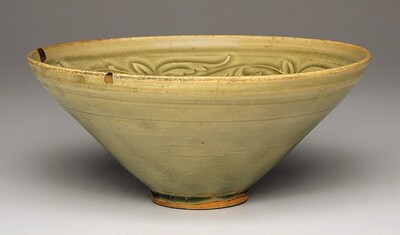
This is a photograph of a ceramic bowl. The bowl has a soft olive-green glaze with broad curving lines forming an abstract floral or vine-like pattern incised into the interior. The shape is wide at the top, tapering down to a small raised foot. The rim has small aged chips revealing a darker clay base. Subtle crackling is visible throughout the glazed surface, giving it an antiquated appearance. The lighting highlights the texture and color variations, accentuating the bowl's simple form.

Bowl

Chinese Jin Dynasty

The sculpture depicts an eagle with its wings partially spread and a raised head. It appears circular in form and is set within a round medallion or plaque. The color is consistent brown. The eagle is intricately detailed, showing its plumage and beak. The background is plain.

Plaque

Liberto, Virgil A.

This is a drawing of a hunting scene with a dog and two figures. The drawing depicts two individuals engaged in a conversation or instruction session in a natural setting. One figure is holding a large stick or pole, while the other is bending down by a small dog. The background features rolling clouds in the sky and distant trees, adding depth to the landscape. The ground is detailed with foliage and grass, indicative of a rural or wild environment with various plants depicted in the foreground. The artwork includes a caption in French.

Un violent exercice étouffe les sentimens tendres

Le Mire, Noël
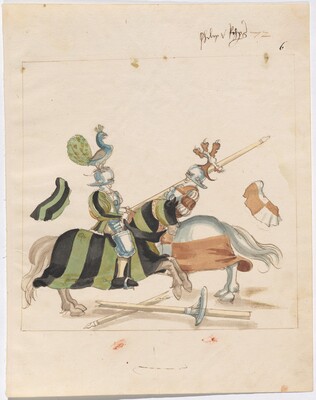
This is a drawing of two jousting knights on horseback. The drawing depicts two armored knights engaged in a joust, each riding a horse and carrying a lance. Both knights are wearing helmets adorned with elaborate crests; one with a bird-like creature and the other with antler decorations. The armor and horses are decorated with colorful patterns. The background appears plain. Below the horses, a lance is broken. The drawing skillfully combines line work with watercolor to give a sense of movement and historical context.

Mock Joust of War with Flying Shields

German 16th Century

The sculpture is a large, intricately designed urn with classical motifs. The focal point of the urn features a bas-relief depiction of a woman and a child, both seated and surrounded by a natural setting with trees and rocks. The scene is elegantly framed by ornate garland patterns and ribbon motifs. The urn has two large handles shaped like ram's heads, adding a distinctive and symmetrical feature to either side. It is crafted from white marble, giving it a smooth and pristine appearance, with finely polished surfaces that highlight the detailed artistry. The urn stands on a beautifully carved pedestal base, which is also adorned with patterns resembling leaves. Overall, this sculpture presents a harmonious blend of classical elements and exquisite craftsmanship, contributing to its aesthetic grandeur.

Monumental Urn

Clodion

This is a drawing of an architectural frontispiece with decorative elements. The image shows an intricately detailed architectural frame with columns, arches, a banner in the center with an inscription, and a coat of arms featuring an eagle's head and angelic figures. The architectural details include columns with decorative embellishments and drapery revealing the central banner. The focus is on architectural ornamentation and heraldic symbols.

Freggi Dell'Architettura

Mitelli, Agostino

The image shows the Colossi of Memnon, two massive seated statues of Pharaoh Amenhotep III, made of light-colored sandstone. The statues are eroded but retain faint details like hieroglyphs. People nearby appear small in comparison, highlighting the statues' grandiosity. The statues are in an open area with barren hills in the background.

The Statues of the Plain, Thebes

Frith, Francis

A sliver of land across the bottom of this composition gives way to a procession of puffy gray and white clouds sweeping up across a vivid blue, panoramic sky in this horizontal landscape painting. An area of darker gray beyond the brown land could be a valley, mountain, or shadows from the billowing clouds. About one-fifth of the way up the composition, the horizon glows the faintest peach. The clouds trundle from our left up and to our right. The view is loosely painted, especially in the land.

Study of Clouds over the Roman Campagna

Valenciennes, Pierre-Henri de

This is a drawing of a mythological scene with Apollo and the Python. The circular frame contains a wooded landscape. On the left, a figure with a decorated robe holds a bow, aiming towards a serpent or dragon on the right. The creature lies slain with its sinuous body and large head near a tree. In the background, a group of figures observes from a distance. The artwork is detailed, especially in the foliage and serpent's scales. The scene conveys tension, capturing a moment of triumph in a classical mythological context.

Apollo Killing the Python

Wolfgang the Elder, Georg Andreas

This is a photograph of an ornately embroidered pillow. The pillow features an intricate design with a central heraldic emblem depicting a red lion in a standing pose enclosed within a woven-like fence, topped by a crown. Surrounding this central motif are floral embellishments with leaves and flowers in various colors, including red, pink, blue, and beige, set against a dark background.

Tapestry-covered Cushion

Netherlandish 18th Century

This is a painting of a wooden table with curved legs. The image depicts a finely crafted wooden table with a rich reddish-brown color and an elegant design. The table has an elevated rectangular top with a simple trim, resting on four curved cabriole legs. Each foot gently flares outward with a slight inward curve beneath the knee. The table is set against a plain, neutral background that highlights its craftsmanship and form.

Tea Table

Goldberg, Isadore

This is a drawing of a group of horse riders in elaborate attire. The riders are mounted on horses and are dressed in detailed embellishments. The horses are depicted with precision, appearing to be trotting or standing elegantly. The background is minimal, allowing the focus to remain on the intricate portrayal of the horses and riders. Lines and shading emphasize the movement and posture of both riders and horses.

Entry of Marie de Medici into Amsterdam [plate 3 of 6]

Nolpe, Pieter
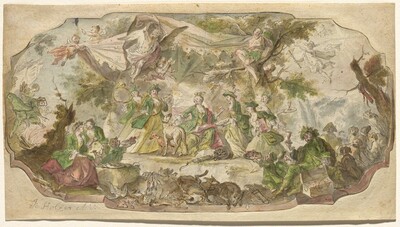
This is a drawing of various mythological figures and animals in a whimsical scene. The scene features elegantly dressed women and mythical creatures among trees and animals. Some figures appear to be floating or perched in a theatrical setting, with cherubic figures carrying a large drape. On the ground, there is a lively gathering with dogs, food, and drink, creating a sense of festivity and merriment. The image uses bright and soft colors to convey a playful and dreamlike quality. The figures are attired in green and pinks, enhancing the festive atmosphere.

Diana Resting after the Hunt

Enderle, Johann Baptist

The sculpture is a roundel featuring a figure of a bearded man holding a staff. The man is facing forward and is depicted in a carved design. The sculpture is made of a material that looks like a combination of dark wood or metal, with a golden hue accentuating the figure and rim. There are intricate carvings and crosshatching depicting the man's attire. The sculpture has a circular shape resembling a medallion or decorative plaque, giving it a historic or classical aesthetic.

Saint with Sword and Palm

Lombard 15th Century

This is a drawing of an ornate decorative page dedicated to Elisabetta Petrowna, the Empress of all Russias. The page features a sonnet beneath the title, embellished with detailed illustrations. Cherubs hold a draped fabric at the top center, with the left and right borders adorned with scrolls and floral motifs. At the bottom left, there is a depiction of an angelic figure seated with a trumpet, looking upward. Another cherub rests on ornate scrollwork at the bottom right, near an Italian inscription. The artistry of the page displays a blend of baroque ornamental elements, emphasizing luxury and grandeur in its classical design.

La Divina Commedia

Dante Alighieri

Notre-Dame

Notre-Dame

Atget, Eugène

The image shows a portrait of a person from the upper half of their body. They are facing forward but their head is turned slightly to the side, suggesting a profile view. The person has sharp facial features, light-colored hair styled in a classic manner, and is wearing a black coat with a high collar and a white cravat. The background consists of a red drapery.

William Vans Murray

Brown, Mather

The image depicts a person in a dynamic, upward movement as if emerging from the bottom of the frame. The person is portrayed with one arm bent and raised, and the other arm lower and slightly forward. The facial features and hair are outlined with expressive lines, and the long hair is flowing backward. The person is wearing a long, dark coat over a lighter inner garment, possibly a shirt. There are no visible jewelry pieces or objects being held by the individual. The background consists of dynamic, diagonal strokes, and the image is signed in the lower right corner by the artist.

Bruant?

Ibels, Henri-Gabriel

This is a painting of a scene featuring a young, winged figure reaching out to a robed woman. The round plate shows a colorful, intricate scene with a winged cherubic figure and a woman dressed in a flowing garment. The background displays a landscape with a twisted tree shape, rolling hills, and a detailed village under a sunset or dawn sky with hues of orange, blue, and pink. The style resembles the work of Renaissance artist Luca della Robbia, known for vibrant colors and intricate detailing typical of painted maiolica ware from that period.

Plate with the reconciliation of Cupid and Minerva

Italian 16th Century

The sculpture depicts a quadrupedal animal walking amidst tall grass or reeds. Birds are flying above the animal. The color of the sculpture appears to be a uniform grey, suggesting it may be made from stone or a similar material. This sculpture is a relief, meaning it is carved into a flat surface, giving it a three-dimensional effect within its rectangular frame. The figures are slightly raised from the background, allowing the details to stand out in relation to the flat surrounding surface.

Relief Panel of Dog

Merchant, Flora

The image is a portrait showing the upper half of a man's body. He is positioned facing slightly to his right, looking towards the viewer. The man's facial features include a prominent mustache and a goatee, with medium-length wavy hair that falls around his shoulders. He is wearing a dark, metallic-looking armor with a high, rounded collar adorned with lace and a sash draped over one shoulder. The background is an ornate oval frame with text inscribed around the edge, and below the oval is a decorative panel with a coat of arms and text in French.

Frederic-Maurice, Duc de Bouillon

Nanteuil, Robert

The image displays a landscape with a rolling hillside and ruins in the distance. A rocky hill with sparse vegetation and ancient stone structures sits near the upper third of the scene. The artwork features sketchy and loose pencil marks, giving a dynamic feeling. The color palette consists of muted tones on a soft grey backdrop contrasting with darker pencil lines. The land close to us has softer shapes and lightly suggested textures, while the rocky formation in the distance is sharper and more defined.

Nile Journey, Tmui of Ptolemy

Vedder, Elihu

The sculpture depicts three or four intertwined people on a rough base. The people are in a moment of interaction, with their limbs and torsos intertwined. One person appears seated in the center, while the others bend around them, their bodies contorted. None of their faces are visible. The people are smooth, while the base of the sculpture is roughly hewn. The material of the sculpture is white.

The Evil Spirits

Rodin, Auguste

The image contains bold, angular lines and shapes creating an abstract winter landscape. A fragmented face appears on the left within undulating forms resembling trees or branches. The right side displays structures with slanting rooflines, possibly representing houses or sheds adorned with snow-like textures. The abstract elements evoke a winter scene, with the face suggesting indoor observation.

Der Winter (The Winter) (headpiece, page 37) from Georg Heym: Umbra Vitae (Georg Heym: The Shadow of Life)

Kirchner, Ernst Ludwig

The image shows a man standing with a relaxed posture, leaning slightly to one side while resting one hand in his trouser pocket. His other hand is on a walking stick. He has a composed expression, neatly groomed hair, and a mustache. He is dressed in a formal outfit consisting of dark trousers, a waistcoat with a patterned design, a bow tie, and an overcoat draped over his shoulders. There is a statuette on a pedestal next to him, depicting a figure in armor. The background features patterned wallpaper, a table beside him with a top hat and fabric items.

Portrait of a Man

Silvy, Camille

This painting shows a woman standing in front of a wooden dresser with a mirror, her back to us. We can see her face reflected in the mirror. She is gazing at her reflection with both of her hands lifted towards her slightly tilted face. The woman has pale skin and dark hair neatly styled away from her face, and she is wearing a dark gown with white ruffles around the neck. On the dresser, there is a floral arrangement, a pair of blue bottles, and a wooden box holding more containers. Behind the dresser, the background includes patterned wallpaper, a blue curtain on the left, and sunlight coming through a window on the right. The floor appears to be covered by a patterned rug.

The Toilet

Johnson, Eastman

This is a drawing of an ornate emblem featuring two cherubs holding a cartouche. The image includes a shield-like structure with inscriptions "PRIMA PARS" and other text. Above the cartouche is a trumpet with ribbon-like scrolls, surrounded by decorative elements like leafy motifs and swirling patterns. The design is enclosed within a circular frame with fabric drapery at the sides.

Title Page

Wolfgang the Elder, Georg Andreas

This is a bowl with a rustic orange finish and a crackled glaze that gives it a textured pattern. The bowl is decorated with painted white designs, including a large floral motif in the center surrounded by curving lines and the outlines of birds. The rim of the bowl is undulating rather than flat, and it has some areas of black pigment. The wide bowl has a narrow, round base at the bottom.

Raku Tea Bowl

Japanese Edo Period

The image shows a large floral embroidery design on a piece of fabric. It features a central flower with curving petals and stems adorned with smaller blossoms and leaves. The color palette includes muted tones of red, blue, green, yellow, and beige. The largest flower is slightly off-center and positioned upwards, with its vine extending horizontally across the fabric. Additional smaller flowers and leaves are present on either side of the vine.

Bed Valance (Detail)

Gaylord, Marion

This is a drawing of a bear wearing a crown and holding a scepter and sword. The bear is standing upright, with its left arm raised high holding a torch and its right arm holding a sword. In the background, a group of smaller, indistinct figures appear to be bowing or kneeling. The use of shading with pencil or charcoal offers a contrast, highlighting the central figure. The drawing conveys themes of dominance and authority.

L'ours du nord, le plus désagréable de tous les ours connus

Daumier, Honoré

This is a drawing of a group of angelic figures surrounding a central figure. The drawing features angelic figures depicted in a classical style with flowing robes and feathered wings, gathered around a central, reclining figure. The scene depicts a moment of care or protection, with the figures intertwined and creating a sense of movement. The drawing is rendered with a subtle use of sepia tones, primarily browns and grays that provide a sense of depth and contour. The strokes are fluid and sketchy, with a dynamic and expressive quality that captures the emotional essence of the scene. The background is left largely unmarked, keeping the focus on the figures and their interactions.

Saint Mary Magdalene Lifted by Angels

Tiepolo, Giovanni Battista

The sculpture depicts a dragon-like creature with scales and a long, curving neck holding a set of scales. It is crafted in a round shape with a bronze color. The sculpture is a small, finely detailed relief, with the creature prominently raised against a flat background.

Winged Dragon with a Balance [reverse]

Antonio da Brescia, Fra

This is a drawing of an abstract scene along with text. The image contains a black and white illustration above a poem or text titled "Der Krieg." The drawing features an abstract arrangement of figures and forms blending into one another, with dynamic elements suggesting movement. Below the illustration, the text is laid out in stanzas and is in German. The composition likely aims to evoke themes related to conflict, upheaval, or internal struggles. The use of black and white enhances the stark nature of the themes presented.

Der Krieg (The War) (headpiece, page 3) from Georg Heym: Umbra Vitae (Georg Heym: Shadow of Life)

Kirchner, Ernst Ludwig

The image shows a woman standing gracefully. She is positioned with her head slightly tilted and eyes closed. Her right hand is held delicately near her face. She has long, dark, wavy hair falling over her shoulders and down her back. The woman is wearing a voluminous, light-colored dress that extends to the floor, with long, loose sleeves. In her right hand, she holds a candlestick with a lit candle. The background features a rustic setting with a large wooden wheel, stone architecture, and a staircase leading upwards.

Adelina Patti

Silvy, Camille

The image displays a landscape with a high horizon line, showcasing a grassy plain under a soft sky. Figures on horseback are dispersed across the scene, with fluid brushstrokes depicting movement in the grass and sky. The color palette is mainly earth tones, greens, rust, and ochre, set against a pale blue sky.

Driving the Pampas for Wild Cattle - Connibo

Catlin, George

The image features a landscape viewed from a slightly elevated angle, showcasing a wide perspective of mountainous terrain with a valley in the center. The artwork uses varying density of lines to depict texture in the mountains and swirling clouds in the sky. The color scheme is monochromatic, mostly black and gray, creating contrasts and depth. In the foreground, there are rocky landscapes with trees and a small figure walking. The mountains in the distance rise impressively, with dramatic cloud formations above.

Mountain Storm

Calame, Alexandre

The Raising of Tabitha

The Raising of Tabitha

Netherlandish 15th Century

The image shows a large rectangular box with a decorative surface on the top, featuring an intricate floral pattern in red and green hues. The box is mainly green with red accents and beige panels on the sides. It is centered in the image and tilted slightly to the right, displaying its decorated top and side details.

Pa. German Box

Brown, Ethelbert

The image shows an elderly man standing upright. He has a long beard and curly hair, with deep-set eyes and arched eyebrows. He wears a long robe and holds a book in his left hand and a staff in his right hand. The background is neutral and sparse, with initials at the bottom of the image.

Saint Paul

Schongauer, Martin

The image shows a seascape from an elevated point of view. The horizon is positioned slightly above the center line of the image, with several ships on calm waters. A detailed ship stands slightly off-center to the right. In the distance, the shore with buildings or a settlement is visible. The sky has soft pencil strokes indicating clouds. The drawing is monochromatic, using shades of grey for depth. Light shading and fine lines depict water movement and ship structures with delicacy and precision.

Coastal Landscape with Shipping

Boudin, Eugène

The sculpture is a circular medallion featuring the profile of a bearded man facing to the right. He has a detailed beard and hair texture, wearing what appears to be a tunic or armor with a visible collar and button. The medallion is crafted from a golden bronze material, giving it a rich, warm color and metallic sheen. The outer edge of the medallion is inscribed with the text "IVLIVS NOBILIVS PEO R," encircling the relief portrait.

Giulio Nobili, 1537-1612, Florentine Senator [obverse]

Poggini, Domenico

The image is a title page from a book, consisting of text at the top and bottom. In the center, there is an illustration within a rectangle, showing a scene from a slightly elevated side view. The horizon is depicted above the middle of the rectangle, featuring a cityscape with towers and domes. A tall tower stands prominently on the horizon. The illustration includes a wolf or dog-like animal facing left, with its head slightly turned towards the right. The style of the brushstrokes is reminiscent of classic etching, with fine lines detailing the animal's fur and surrounding foliage. The color palette is monochrome, with different intensities of black and white creating contrast and detail, giving the image a vintage appearance.

Bertoldo con Bertoldino e Cacasenno

Mattioli, Ludovico

The image shows a large gray fern leaf on a textured, light beige background. The color palette includes shades of gray for the leaf and off-white to beige for the background. The fern leaf is positioned with its stem from the middle of the bottom edge towards the upper left, taking up most of the image space with its detailed fronds.

Fern

Talbot, William Henry Fox

Portrait of a Man

Portrait of a Man

French 17th Century

The scene depicts a family resting on a grassy area, with a man sitting, a woman standing with a jug, and two children interacting with them. There is a group of grazing animals, likely goats, on the left. In the background, there is a forested area leading to architectural structures resembling castles. The sky above is expansive, with a calm and serene atmosphere created by a color palette of soft greys and whites. The artwork showcases fine, detailed brushstrokes, particularly in the grassy textures and foliage.

Scenery of Bristol

Danby, Francis

This is an ornate wooden side table. The table has slightly curved legs and a lower shelf for storage or display. The edges are trimmed with decorative silvery metallic elements. A small keyhole is visible at the front of the table. The legs appear to be darker wood, while the front and sides of the table are more red-toned wood. The top of the table has a floral design that uses multiple shades of wood.

Work and Writing Table (table en chiffonnière)

Vanrisamburgh II, Bernard

The image shows an iron trivet with a partial triangular shape and cut-out detailing. It is engraved with the text "COLEBROOKDALE IRON CO POTTSTOWN PA." The trivet is a dark metallic color and is placed on a light-colored background. The top edge of the trivet is inscribed with curved text, and a symmetrical design is in the center with cut-out sections.

Trivet

Hartenstein, Violet

This is a drawing of a scene featuring a rustic building with people outside. The building is weathered and wooden, with a porch where figures are seated. In the foreground, a woman in period attire walks with two children playing nearby. The people on the porch appear relaxed while the woman walks by with a confident posture. The building's facade shows signs of wear and age, with a rough texture and small windows with shutters. The drawing is in a monochromatic palette, capturing a moment of everyday life from a historical time period.

With Pride Upon Her Brow

Juengling, Frederick

This is a drawing of two separate scenes on a single sheet. On the left side, there is an abstract scene with swirling clouds or waves and indistinct figures. On the right side, there is a more structured scene with figures gathered in an architectural space, possibly a ballroom or hall. Figures are shown in a way that suggests a social or ceremonial occasion. Both sketches are outlined delicately with pencil.

Study of Moses Striking the Rock and a Procession [verso]

West, Benjamin

The sculpture is a profile portrait of a man depicted in relief, facing left. He wears traditional papal attire including a tiara or cap, and a robe with intricate details. The sculpture is dark bronze in color, giving it an aged appearance. The material appears to be metal, likely bronze. There are inscriptions in Latin encircling the figure, the top text reading "CLEM IX PONT MAX A I". The sculpture captures a detailed likeness from the profile view, with distinct facial features such as a bearded face, curls in the hair, and a serious expression.

Clement IX (Giulio Rospigliosi, 1600-1669), Pope 1667 [obverse]

Morone Mola, Gasparo

This is a photograph of a historical document titled "CARTE PHOTOGRAPHIQUE ET SYSTÉMATIQUE DE LA LUNE." The document cover is aged and has finely textured paper with a black binding on the left edge. It includes the author's name, "C. LE MORVAN," and the description "ASTRONOME ADJOINT A L'OBSERVATOIRE DE PARIS." The title describes a photographic and systematic map of the moon. Below the author's name, the document mentions "IMAGES DIRECTES" and "SIX PLANCHES EN HÉLIOGRAVURE." It also includes the year "MDCDXXVI" (1926) and the location "PARIS" at the bottom. The document shows signs of wear with paper deterioration on the edges and a tear in the bottom region.

Carte photographique et systématique de la lune (Photographic and Systematic Chart of the Moon)

Le Morvan, Charles

The image shows an elevated view of a scenic landscape with water and architecture in the distance. The horizon is high, with the water's edge and buildings lining it. A tree with large fruits and dense foliage frames the view closely, its branches extending across the upper section of the image. The photographic technique captures clear lines and textures. The color palette is monochromatic with varying shades of sepia or brown tones highlighting details like tree textures and the water's stillness. In the background, there are rolling hills covered with thick trees.

A Peep from Upper Lake Road showing Temple and Island with Park -- fruit tree in foreground

Bourne, Samuel

This painting is a portrait of a seated woman looking off to the left with a composed expression. She has light skin with rosy cheeks, brown eyes, and slightly upturned pink lips. Her curly brown hair is styled on top of her head with a small floral clip or decoration. She is wearing a white dress with short sleeves and a low neckline with a wide collar. Around her waist is a thin belt with gold and light-blue designs, and a translucent cloth with a similar pattern is draped over her right forearm. Her other arm rests over the edge of the tan chair she sits in, and she brings her hand up slightly below her chin. A thin gold band is visible on one of her fingers. The background is a plain, muted brown color, with a curved tan section at the very top.

Eleanor Parke Custis Lewis (Mrs. Lawrence Lewis)

Stuart, Gilbert

The image shows four men in side profile, positioned in a line, observing something closely. The first man leans over a surface, examining a framed object with a magnifying glass. The second man stands behind him, watching. The third man stands behind the second man, observing. The fourth man is further back, leaning forward. The background displays framed artworks or panels. The men's features are exaggerated in a cartoonish style.

L'Hotel des ventes: L'Amateur

Maurand, Charles

The image depicts a large, bulbous vase with a narrow neck and flared rim. It is turquoise blue with a crackled pattern. The vase is centered on a neutral background.

Bottle Vase

Chinese Qing Dynasty

The image shows a decorative hand fan with a primarily dark surface and pink floral designs on one side. The color scheme includes dark shades, bright pink and green from the flowers and leaves, and a brown tone from the handle. The fan is positioned diagonally across the composition, with the handle in the lower right and the open fan extending to the upper left, showcasing the floral pattern.

Fan

Buckley, Ann Gene

The image depicts two men from the waist up. The man on the left faces right, while the man on the right faces left. The man on the left wears a dark robe and has thinning hair. The man on the right holds a pastry and a feather duster. The background shows an interior setting with a suggestion of courtroom seating or barriers. The image is in a simple, sketch-like style with a French caption below.

Nous avons grande représentation aujourd'hui

Daumier, Honoré

This image shows the upper body of a person in a side profile position. The person's head and partial shoulder are visible, with their face turned slightly to the side. Their facial features are indistinct due to the art style, with a visible nose and chin. The hair is long and flows down behind the head, blending with the dark background. Clothing details are ambiguous, with shadows and textured dark markings dominating the image. There are no visible jewelry or objects held by the person. The background is a textured dark area that blends into the figure, creating a moody and abstract atmosphere.

Head of an Old Woman

Ribot, Augustin Théodule

The sculpture depicts a figure in a robe with a halo around its head. The figure is holding up a hand with two fingers raised. The sculpture is circular and made of a dark metal material. Details are engraved into the metal, giving the figure an outlined appearance. Surrounding the figure is a sun with radiating lines and a building structure to the side.

Saint Bernardino of Siena

Italian 15th/16th Century

The image depicts sixteen circular portraits of historical figures arranged in rows and columns. Each portrait shows a head-and-shoulders view of the subjects in profile, facing left or right. The subjects are depicted with detailed facial features, expressions, and hairstyles indicative of different historical periods. The men typically have styled, powdered wigs or tied back hair, while the women have coiffed hairstyles, some adorned with hats or ribbons. They are dressed in period-appropriate clothing like high-collared jackets and elaborate dresses. The portraits have plain backgrounds, and names are written underneath each image for identification. The overall presentation is organized and harmonious.

Saint-Mémin Collection of Portraits, Group 1

Saint-Mémin, Charles B. J. Févret de

The image depicts a small waterfall flowing into a pool within a forest. The viewer is at eye level with the pool, with the waterfall as the focal point. The surroundings consist of tall trees, lush foliage, and a canopy above, obscuring the sky. The monochromatic color scheme enhances textures and contrasts. Water reflects the environment, giving depth to the composition. Ivy covers rocks near the waterfall, and a pathway can be seen in the distance, lined with forest. The scene evokes a sense of serenity and timelessness.

Grotto in the Bois de Boulogne

Marville, Charles

Roiling, churning waves breaking against a patch of a sandy beach fill most of this wide, horizontal landscape painting. The water deepens from aquamarine blue to teal, slate, and midnight blue amid clouds of ivory-white crests and spray. A glassy, mirror-like sheen of water coats the sandy beach where it drops sharply from the lower left corner to the breaking waves. A few shells or other objects are suggested with touches of pumpkin orange and charcoal gray along the beach. Near the lower center, a battered wooden cage is pommeled by waves where the water meets the foot of the sloping beach. A strip of sky lightens from sable brown to our left to light tan to our right across the upper third of the composition. The artist signed and dated the work with red paint in the lower left corner, “T MORAN 1884,” with the T overlapping the M to make a monogram.

The Much Resounding Sea

Moran, Thomas

This is a drawing of two figures. One figure is standing next to large curtains with a determined expression, holding back the curtain. The other figure lies on the ground in an elaborate costume, apparently lifeless, with a sword next to them. The standing figure wears an ornate outfit. The scene conveys drama and confrontation, possibly alluding to a narrative. The composition and detailing of attire suggest tension and confrontation in an enclosed setting. The text at the bottom of the image provides a dramatic farewell.

Hamlet and the Body of Polonius (Act III, Scene IV)

Delacroix, Eugène

The sculpture depicts a large decorative jar with a lid, showcasing ornate floral designs. The jar features predominantly green and red colors, with intricate floral patterns incorporating shades of orange, yellow, and white. It stands on an elaborate base made of what appears to be a gold-colored metal with scroll and leaf motifs. The jar seems to be made of glazed ceramic or porcelain, giving it a glossy appearance. The lid is adorned with a decorative knob resembling a pine cone. The overall impression is one of elegance and luxury.

Covered Jar in Gilt-Bronze Mount

Chinese Qing Dynasty

The image shows a ceramic cup and saucer. The cup has the inscription "Mercer" and the saucer is decorated with floral patterns and the text "Greensboro Silver Comet B." The color palette is mainly brown. Both objects are centered on a neutral background, with the artist's name, Robert Stewart, written in small text towards the lower right of the saucer.

Cup and Saucer

Stewart, Robert

The image is an illustration of the Church and Hospital of the Mendicanti with a canal scene. The perspective is slightly elevated, showing the architecture and canal activity below. Various structures and buildings are visible, creating depth. The building on the right has columns and statues. The lines are detailed, capturing textures. The color palette is sepia, typical of a pen and ink drawing. Gondolas are on the canal, with human figures nearby. In the background, there are more buildings and a bridge over the canal.

Chiesa et Hospitale de Mendicanti (plate 35)

Carlevariis, Luca

The image is an ink drawing of a person standing in a relaxed posture. The figure faces forward with one arm resting on the side and the other raised, lightly touching their head. The face has classical proportions, with a straight nose and full lips, and the hair is depicted in curls. The body is mostly uncovered, with only hints of draped clothing around the shoulders. The person holds a cluster of foliage or a garland in one hand. The background includes architectural elements like a pillar and archway, with the area around the figure outlined with hatching for shadow and depth.

Allegorical Figure with a Cat and a Pig

Jacopo di Giovanni di Francesco
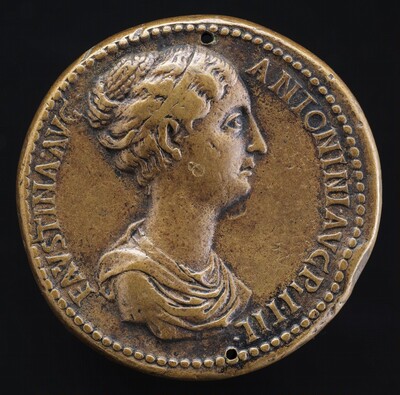
The image depicts a relief of a woman's profile facing right on an ancient Roman coin. The subject appears to be a classical figure, suggested by her attire and the style of the coin. The sculpture is made of a light brown material, possibly bronze. Text in Latin is inscribed along the border of the coin. The woman's hair is styled intricately and seems to be held up with a diadem or headband. There is a small hole near the edge of the coin, indicating it might have been used as a pendant or ornament. The texture of the coin shows signs of wear, suggesting its age and historical use.

Faustina the Younger, died A.D. 175, Wife of Marcus Aurelius [obverse]

Cavino, Giovanni da

The image shows an open book with an artwork on the right page and faint text on the left page. The artwork is a black and white print depicting a group of figures walking down a tunnel-like structure with curved walls. One figure in the foreground has large eyes and a cap. The figures are mostly in silhouette, with minimal details. The clothing is dark, blending with the scene's shadowy atmosphere. The background suggests depth with lighter tones continuing the tunnel. The signature "Kollwitz" is seen at the bottom of the artwork. The setting conveys a solemn procession.

Der Morgenweg zum Amt (The Morning Route to the Agency) (plate 1) from Der Mantel (The Coat)

Gramatté, Walter

The image shows a river winding through cultivated fields with a small boat anchored nearby. In the distance, there is a cityscape with various buildings, including a prominent domed structure to the right. The photo has a soft, sepia-tone palette, giving it an aged feel.

View of Rome

Caneva, Giacomo

This painting depicts a landscape with several haystacks in the center, arranged in a line that cuts diagonally across a green field from left to right. The five large golden-brown haystacks are shaped like tall cones and are surrounded by more golden hay on the ground beneath them. The rest of the field is mostly green, with patches of yellow, purple, and light blue. The sky above the field is light blue, with long horizontal strips of white clouds. At the horizon is a line of purple and dark blue shapes, suggesting faraway trees, or perhaps low buildings. The brushstrokes are short and textured, making the landscape appear blurred.

Haystacks

Seurat, Georges

The artwork displays a side profile of a person standing with their head turned slightly to the side. The person's upper body is depicted, and their facial features, long hair tied back, and loose-fitting garment are visible. The background consists of dark vertical lines and shading around the figure, creating a textured effect.

Madame Abdala

Toulouse-Lautrec, Henri de

This is a photograph of a green ceramic pot. The pot is spherical with a wide opening at the top. Its surface is covered in a vibrant green glaze with a network of fine crackles creating a pattern across it. The top edge of the pot is unglazed. The background is a simple gradient. The lighting emphasizes the glossy finish of the glaze and highlights the form of the pot.

Bowl

Chinese Qing Dynasty

The image displays a central decorative embroidered basket containing colorful plant-like patterns in orange, green, and blue. Surrounding the basket are small brown figures and geometric shapes, including two large brown plants or figures on each side, and multiple small human silhouettes or dolls near the top and on each side. The color palette consists of earthy tones such as brown and dark green, accented with vibrant orange and deep blue with pink embroidery around the border. The central pattern is positioned symmetrically within the artwork, with figures and additional decoration placed around it. The piece is bordered by a pink and red embroidered line, and at the bottom, there is cursive text in brown acting as a dedication.

Applique Linen Panel

Chichester, Beverly

The image depicts a scene from an elevated position, showing a figure standing on steps overlooking a busy square. The background includes architectural structures and a gathering of people, horses, and carriages. A figure in ornate attire points toward the plaza, while the buildings and a tower in the distance frame the bustling activity within the square. The brushstrokes are detailed and linear, creating a complex scene with a color palette dominated by sepia tones.

Piazza della Signoria, Florence

Callot, Jacques

This is a painting of a medieval illuminated manuscript page. The artwork depicts a central figure seated on a throne under a grand arch, holding a book and gesturing towards a group of standing figures. The background is decorated with floral patterns and roundels, showcasing colors including blue, red, yellow, and green. Surrounding the scene are architectural elements, such as arches and columns. The attire of the figures and decoration reflect the artistic style associated with illuminated manuscripts. This is in the style of an anonymous medieval illuminator.

Saint Augustine

British 19th Century

The sculpture depicts a bull standing on a rectangular base. The bull is robustly built, with detailed musculature, a slightly lowered head, and prominent horns. The sculpture is made of bronze with a dark greenish-brown patina. It is small and detailed, showing the folds of the bull's skin and facial features.

Small Bull

Barye, Antoine-Louis

This is a photograph of a book cover. The cover is designed with intricate gold embellishments on a dark brown leather background. It features a central oval design with a regal emblem of fleurs-de-lis and a crown. Surrounding the central motif are symmetrical patterns with scrollwork and floral elements in gold. The corners and borders are adorned with circular and linear motifs. The use of gold contrasts against the dark material, highlighting the detailed craftsmanship.

Album of Portraits of Queen Marie-Antoinette

Various Artists

The image shows a landscape with a river, dense foliage, tall grasses, a meandering river, trees along the riverbank, a forested hill, and a calm sky. The style is a classical sepia photograph, with a monochromatic color palette. Large trees are also visible on the left side.

The Susquehanna At Wyalusing

Rau, William H.

The image shows a portrait of a woman seated in a chair. She is facing slightly to the left and looking directly at the viewer. She has fair skin, light-colored eyes, and dark brown hair styled under a lace-edged cap. She wears a black dress with a lace collar and holds a small book titled "Sacred Songs" in one hand. She also wears a bracelet on her wrist. She is seated in a chair with a red upholstered back and an armrest draped with embroidered blue and green fabric. The background is a plain, muted brown color.

Sophia Mead

American 19th Century

The image is an etching of a classic architectural scene with an elevated perspective, offering a broad view of the structures. The horizon is visible along the distant architectural lines and beyond the archway. The etching features precise linework detailing the textures and forms of ancient stone structures. The color palette is monochromatic, using black and white for depth and detail. The grand arch of Settimio Severo is prominent in the foreground, with intricate carvings and deteriorating stones. Various ancient buildings with Roman architectural features like columns and arched windows are visible in the distance. The sky has a few clouds, creating a sense of openness, and people are scattered throughout the scene for scale.

Arco di Settimio Severo

Piranesi, Giovanni Battista

Vase

Vase

Chinese Qing Dynasty

A tall cylindrical metal shaker with a decorative handle and a domed, perforated lid is the largest object in the image. The color palette is primarily silver-gray, with subtle shadows indicating the metallic texture against the off-white background. Positioned in the center of the image, the shaker is depicted with its handle on the right side, standing upright.

Silver Caster

Duany, Hester

The image depicts an elaborate interior scene with intricate architectural details and figures. It features a vaulted ceiling adorned with arches and a carving of a dove at the center. Two figures are seated on either side, with a playful toddler-like figure reaching up between them. In the background, there is a colonnade and figures peering through windows. The drawing suggests a narrative or thematic element with symbolic references.

The Virgin and Child with Saint Anne by a Portal

Hopfer, Daniel

The image shows a full-body drawing of a person standing. The person is facing forward with their face slightly tilted upwards and their eyes looking forward. Their facial features include outlined eyes, a straight nose, and lips, with short hair. The person is wearing a long robe with draped fabric and shading for texture. They are holding a hammer-like object in their right hand and a goblet or cup in their left hand. There is no visible jewelry. The background is a plain surface.

Study for "Dogma of the Redemption: Frieze of Angels" [recto]

Sargent, John Singer

The sculpture portrays a human figure standing and draped in flowing robes, holding a serpent in one hand. It is set on a round, coin-like surface. The sculpture is made of metal with a dark patina of green and brown hues, giving it an aged appearance. The relief is low, with the figure gently raised against the background, outlining the figure's form and the serpent. The edges of the piece are slightly worn.

Wisdom Gazing at a Serpent [reverse]

Florentine 15th Century

The image shows abstract shapes and lines forming two distinct clusters against a monochromatic background. On the left, there are angular, abstract faces resembling caricature-like facial expressions. On the right, there are elongated, linear figures suggesting human forms in motion. Both clusters are enclosed within rounded edges and separated by a horizontal division. Handwritten text is present at the top and bottom of the page.

Vorsatz (front endpapers) from mock-up of Georg Heym: Umbra Vitae (Georg Heym: Shadow of Life)

Kirchner, Ernst Ludwig

The image shows a woman depicted from the waist up, sitting in a formal position. She has a composed expression with clearly defined facial features and her dark hair is styled into a smooth bun, covered partially by a white headpiece. She is wearing a dark, long-sleeved dress with a high neckline, accented by a white lace collar. The woman is holding a small sculpted bust in her right hand, which rests on a table covered with decorative fabric. The background is a simple dark backdrop. The image is framed in an ornate gold mat within a red-bordered frame, with the name "WALSH" imprinted at the bottom.

Portrait of a Phrenologist

Walsh, Thomas S.

Two large dogs approach a man lying unconscious and mostly buried in the snow in this horizontal painting. The head of the man comes toward us, at the lower center of the composition, and the dogs are close to us. In the center of the painting, a large tan and white dog has short, glossy fur and floppy ears, and its jowly mouth hangs open with the pink tongue visible. It paws at the snow partially covering most of the body of the man, who wears an olive-green coat with a fur collar and white shirt. The dog looks up to our right, and its body and white-tipped tail recede diagonally into the picture to the left. There is a red blanket with black edging over the dog’s back, and the hound wears a wide, fur-lined silver collar ornamented with metalwork lions and bells. The second dog, a dark brown brindle color, sits to the immediate left of the first dog. It gazes down at the prone person and bends its head down to lick a bare pale, pink hand that protrudes from under the snow. The brindle dog wears a small barrel around its neck on a brown buckled leather collar. The man’s dark brown hair falls over the snow. His pale gray face is upward, and his shoulders are visible while his arms splay out, and the rest of his body, extending into the picture, is covered with snow. The man’s eyes are closed. His right hand, in a tan leather glove, reaches toward us from the snow, while a green velvet cap with a red ribbon lies under the hand. The scene is enclosed by large, angular, steel and blue-gray boulders and rock formations, with two craggy pine trees above. Beyond lies a mountain landscape with a V-shaped pass at the center top framed by the steep ascent of jagged, snowy hillsides and a sliver of blue sky. A blocky stone building is nestled in among the crags to our right. On a path leading from the building, three bearded men wearing black caps and robes hurry toward the dogs. The nearest of them holds up a staff with a cross on the top and waves or signals to the men farther back along the path.

Alpine Mastiffs Reanimating a Distressed Traveler

Landseer, Edwin, Sir

This is a drawing featuring a crowd of people gazing up towards an elevated platform where a scene unfolds. The foreground shows tightly packed individuals, dressed in period attire with many men wearing top hats, staring upwards. The crowd spans the foreground. In the background, high structures can be seen, along with additional figures peering out of windows or climbing to get a better view. Lines suggest movement towards the upper right where figures appear engaged in activity. The drawing utilizes a detailed line-based technique to emphasize figures and expressions.

Les Voyageurs du dimanche

Maurand, Charles

This is a photograph of a decorative porcelain vase. The vase features intricate and colorful hand-painted designs typical of traditional East Asian craftsmanship. The central part of the vase showcases a scenic landscape with trees, rocks, and water, surrounded by Chinese characters. The top and bottom sections of the vase have decorative bands with a geometric pattern interspersed with floral motifs and circular medallions depicting mythical creatures. The color palette includes greens, blues, oranges, and earthy tones.

Lantern

Chinese Qing Dynasty

The image features a large weathervane in the shape of a cow, with a reddish-brown patina and patches of corrosion in shades of green and gray. The cow form is centered in the image, standing with its head facing to the right, and displays riveted sections. Below the cow is a rectangular greenish bar suggesting a base or support. The color palette includes earthy tones such as rusty browns, faded greens, and grays against a light beige background.

Cow Weather Vane

Johnson, Philip

The image shows flowing lines and shapes arranged in an abstract composition. There is a rounded form at the top left with elongated, undulating shapes radiating from it. Below are curved lines and irregular areas of color, suggesting hills or clouds. A bright yellow band runs through the center. A small, intricate circle with flame-like patterns is present below the yellow band. The lines also form figures seated facing left. The inscription "TE PO" is at the bottom left of the image.

Te Po (The Long Night)

Gauguin, Paul

The drawing depicts a full-length view of a person standing with their upper body slightly bent forward and looking to their left. The figure's head is turned to the side, revealing their facial features, including a prominent nose and a defined brow. The person's hair is styled back and appears to be in a loose, short ponytail. The individual is shown in an expressive pose with one arm crossing their body and the other resting near their abdomen. The background consists of plain brown paper, contrasting with the white highlights and black contours used to render the figure, emphasizing the form and musculature of the body. There are no visible details of jewelry or objects being held by the figure.

Study for "Stars and Dews and Dreams of Night"

Davies, Arthur B.

The sculpture portrays the face of a cherubic figure with rounded cheeks and a subtle smile. The face is framed by a circular design featuring a leaf and flower pattern. The sculpture is primarily golden with darker patches underneath. The surface texture is uneven, emphasizing its three-dimensional quality. The proportions of the face are slightly exaggerated, giving it a mythical appearance.

A Child's Head

Italian 17th Century

This is a drawing of an ornate title page. The image features a detailed and elaborately designed title page with a classic font, announcing the seventh book in a series about the magnificence of ancient and modern Rome, focusing on convents and the houses of clerics. The piece is dedicated to Carlo Vittorio Amadeo delle Lanze and created by Giuseppe Vasi. At the bottom of the page, there is a small illustration depicting an outdoor scene with people among architectural ruins, featuring large columns surrounded by trees and greenery. The text indicates the book was printed in Rome in 1756.

Delle Magnificenze di Roma Antica e Moderna (vol. 3)

Vasi, Giuseppe

Men's Fashions

Men's Fashions

Atget, Eugène

Shown from the waist up, the profile of a pale-skinned woman wearing an ice-blue dress is loosely painted with visible brushstrokes in this vertical portrait. The woman’s body faces our right, and she looks slightly down with her pale pink lips parted. A floppy straw hat is tied over her copper-blond hair with a plum-purple ribbon and tied in a bow beneath her chin. The bow appears to be nearly as wide as her shoulders, and the ribbons hang down almost to her belly button. Her dress has a high, ruffled neckline along the back of the neck and long sleeves. A few flecks of lapis blue suggest polka dots, and a blue belt wraps around the waist. The background is especially loosely painted with strokes of aqua blue and bright, bottle green that suggest an outdoor setting and few touches of coral red in the lower corners could be flowers.

Young Woman with a Straw Hat

Morisot, Berthe

The image shows an elevated view of three horses. The horses are depicted in a sketch-like style with loose brushstrokes. One horse is on the left, and two are on the right with harnesses. The ground line gives depth. The color palette is mainly sepia tones. There are a few additional elements in the background, like a tree trunk.

Station de fiacre (Cab Stand)

Béjot, Eugène

This sculpture is a decorative cup. The cup has a uniquely shaped form, with a scalloped rim and a yellow handle crafted in a flowing shape. The exterior is speckled mint green and decorated with various intricate patterns, including yellow flowers and stylized characters or symbols in tan and dark green. The interior is coated with a soft yellow glaze, while the rim is white.

Wine Cup

Chinese Qing Dynasty

The image is of a rectangular shape with rounded edges, featuring abstract circular patterns within. The rectangle resembles a vintage piece of leather, with a large central circle surrounded by smaller circular motifs at each corner, resembling a decorative book cover or a stamped piece of fabric. The design evokes antique or handcrafted elements.

Zoar Fireplace Tile

Bulone, Angelo

The image shows an engraved portrait of a man in elaborate armor within an ornate oval frame. He has short, curly hair, a moustache, and a pointed goatee. The background features classical elements and the frame includes inscriptions and decorative motifs. The style indicates a baroque influence.

Ernest of Holstein, Schawenburg and Sternberg, Prince of Holy Roman Empire

Kilian, Lucas

The image depicts a drawing of a male figure from the mid-torso up. His head is turned slightly down and to the left, with finely detailed facial features and slightly wavy hair falling around his head. The figure is drawn without clothing, and appears to be holding his right shoulder with his left hand. The drawing is on a light blue background, with no accessories or objects visible.

Bust of Nude Man

Legros, Alphonse

This is a photograph of a circular medallion or coin. The medallion features a raised relief depicting a robed figure with a halo holding a flower. The relief is set against a textured, diagonal crosshatch background. Surrounding the central figure are inscriptions that appear to form a name or title, including the letters "SA" and "LBERTVS." The item has a worn and weathered appearance, with a greenish patina along its rim.

Saint Albert of Trapani

Italian 15th/16th Century

This is a drawing of a village scene with houses and foliage. The artwork is executed in a bold, woodcut style and features several small, peaked-roof houses nestled among abstracted trees and foliage. There is a figure with a pointed head and intricate patterns in the surroundings. The drawing is surrounded by text in German. The monochromatic, high-contrast technique is typical of woodblock prints.

Spitzköpfig Kommt Er... (With a Pointed Head He Rises) (headpiece, page 13) from Georg Heym: Umbra Vitae (Georg Heym: The Shadow of Life)

Kirchner, Ernst Ludwig

The image shows a child sitting on a chair. The child is facing forward, with hands clasped in their lap. They have a serious expression, curly hair, and wear a dark dress with a light collar, light socks, and dark shoes. The chair has a decorative back, and the background is plain. The image is bordered by a golden frame.

Portrait of a Girl

British 19th Century

Dozens of men and women wander through a tall interior space lined with statues and columns and topped by a soaring domed roof in this vertical painting. The people are small in scale within the cavernous space. The women wear long, full dresses and the men wear knee-length waistcoats and stockings in shades of dark blue, crimson red, pine green, marigold orange, or brown. Three people wear clothing of the clergy: two of them, on our left, wear long, ginger-brown robes under white mantles, and a third person on our right wears a hip-length, diaphanous white cape over a long dark blue robe. The crowd strolls, kneels, converses, or leans back to look up at the high ceiling overhead, which has a round opening at its apex. A glimpse white of azure-blue sky with white clouds is visible through the opening. The interior is divided into three levels. The ground level has five niches lining the walls, each with a white stone statue of a man or woman standing inside. Each statue is at least three times the height of the people in the space below. The three niches closest to us on our left and right have semicircular pediments with garnet-red or moss-green columns flanking the statues. Two niches at the far end have triangular pediments and honey-gold columns. Each niche sits on a wide base, presumably an altar, and is surrounded by marbled gold and purple panels set against a sage-green background. Sets of three honey-gold columns line the wall between each niche. Oversized, copper-green double doors are swung inward at the far side of the space. More people, a sunlit obelisk, blue sky, and slivers of other buildings are visible through the doorway. The second level of the interior has windows spaced across walls otherwise covered with white, blue, and mauve-pink panels. An inscription running around the building between the first and second level reads, “DOMINVM IN SANCTIS EIVS LAVS EIVS IN ECCLE.” The third level is the domed pewter-gray ceiling with coffers, like inwardly stepped panels. The floor is patterned with alternating circles and rectangles in sage green or light brown.

Interior of the Pantheon, Rome

Panini, Giovanni Paolo

This is a photograph of a vintage book or magazine cover. The image displays the cover of an old, light brown publication with a minimalist design. The title "L'ÉPREUVE Album d'Art" is centrally aligned at the top, printed in a classic serif font. The paper shows signs of age with slight discoloration and some texture from wear. The lower-left corner of the cover is marked with the number "12," and the bottom right has another small marking, "XII."

L'Épreuve (album 1, deluxe edition)

Carrière, Eugène

This round sculpture contains several ornate designs and figures. In the center is a man with pale skin, long golden hair, and a golden beard, wearing red robes over a white garment. His hands are raised by his chest, and in them he holds a large cross with a smaller man attached to it. This man has his arms stretched out to each side, and his hands and feet have been nailed to the cross. He is shirtless, with a red cut on one side of his chest, white cloth wrapped around his waist, and a leafy crown on his head. He has pale skin with some areas of gold and long gold hair. At the top of the cross seems to be the shape of a white bird, its wings stretched to either side. Surrounding these two men are angelic figures with large brown wings, white skin, and golden hair. Circling them is a ring of thorns, and beyond that is a wreath of leaves with several large pearls in it. At the edge of the sculpture is an ornate golden frame. The piece is richly colored with gold, white, red, blue, and green tones.

Morse with the Trinity

French 15th Century

This is a drawing of a trivet. The trivet is depicted in a three-dimensional perspective and as a flat plan view. It has an elongated, teardrop shape with ornate designs, including scrolling and floral motifs. The trivet has three short legs that elevate it slightly. A scale is shown next to the trivet. The drawing emphasizes the ornamental and functional aspects of the trivet.

Flat Iron Holder

Garjian, Charles

The image displays a rural landscape from an elevated viewpoint capturing a village scene. The horizon is high in the image, focusing on the village and farmlands. There are houses with a chimney emitting smoke and a windmill in the distance. The brushstroke style is detailed and delicate, typical of engravings with fine lines depicting textures like thatched roofs and fields. The color palette is monochrome with variations of black and white showing depth and texture. Close by, there are fields with a gate and figures and animals are seen on the village road in the distance.

Fields and a Village Road with Post Mill

Doetechum, Lucas van

La Goulue and Her Sister

La Goulue and Her Sister

Toulouse-Lautrec, Henri de

The sculpture depicts a horse in a rearing position with one front leg raised and bent. It is made of dark bronze with a smooth reflective surface and darker patina in some areas. The horse's nostrils are flared, and its mane appears flowing. The sculpture rests on an oval base, providing stability. The artwork is slightly larger than life, emphasizing the presence and vitality of the horse.

Turkish Horse, Right Foreleg Raised

Barye, Antoine-Louis

The image displays abstract bold angular shapes and intersecting lines in black at the bottom of a text-filled page. The forms suggest movement and overlap, resembling silhouettes of people and flames. Within the design, figures engaged in action can be recognized, suggesting a scene of activity or commotion. The solid black and sharp contrasts lend depth and complexity to the composition.

Der Krieg (The War) (in-text plate) from mock-up of Georg Heym: Umbra Vitae (Georg Heym: Shadow of Life)

Kirchner, Ernst Ludwig
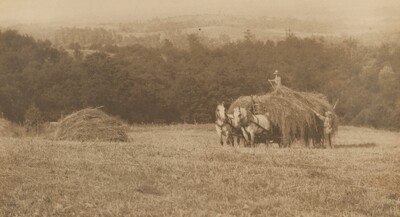
Two men pitchfork hay onto a horse-drawn carriage in a field in this horizontal black and white photograph. The platform of the carriage is wider than the two white horses harnessed to it. One man tosses hay onto the top of the pile and the other man standing there. We look slightly down a hill, which is spanned a short distance away by a band of evergreen trees. Rolling hills are hazy in the distance beyond.

Loading Hay

Bullock, John G.

This painting shows the upper body of a woman seated in a chair. She is wearing a white bonnet with ruffled edges, covering her wavy, light brown hair. Her facial features include fair skin, thin lips, a long nose, and a pointed chin. She is dressed in a deep red gown with a high white collar. The chair has a blue cushion and wooden frame with curved armrests. The background is a gradient of brown at the top and tan at the bottom.

Sarah Homes Tappan (Mrs. Benjamin Tappan)

Stuart, Gilbert
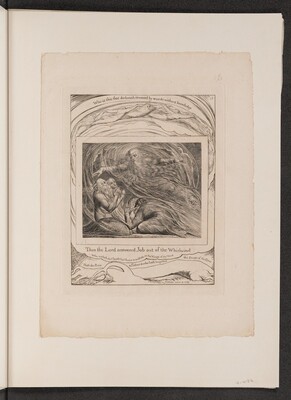
This is a drawing of a biblical scene with a swirling figure surrounded by intricate linework. It depicts a dramatic whirlwind with ethereal figures intertwined with the wind. The central figure emerges from the scene, appearing powerful and commanding. The text above and below the drawing quotes a scriptural narrative: "Then the Lord answered Job out of the Whirlwind." The intricate details and textural contrasts create a vivid portrayal of an epic moment, filled with movement and emotion.

The Lord Answering Job out of the Whirlwind

Blake, William

The sculpture is a vase with a simple form. It has a rounded body and a narrow neck that widens at the top. The vase is green with a glazed, crackled surface, giving it texture. It appears to be made of ceramic. The vase is visually appealing and likely used for holding flowers or as a decorative item.

Vase

Chinese Qing Dynasty

The sculpture depicts a figure of a man playing a pan flute. The subject is partially draped in a green garment around the lower part of his body. The material of the sculpture appears to be wood, with visible texture and grain. The color of the sculpture is a natural wood tone with areas of pale coloration, green, and beige. The man is standing upright, with one leg slightly forward, and appears to be leaning against a rough-hewn vertical structure. The overall posture and detail of the sculpture convey a relaxed yet purposeful stance.

Circus Wagon Figure: Pan

Collins, John

This is a drawing of a bird called Larvivora ruficeps. The illustration shows a bird with a red-brown head, a black mask around its eyes, and a white throat. It has a dark upper body blending into grayish tones on the underparts. The bird is standing on the ground among grasses and fallen leaves in a naturalistic habitat.

Bird (Larvivora Ruficeps)

British 19th Century

The image shows a drawing of a person from the knees up, lying on their back with their head tilted to the side and arms resting at their sides. The person's facial features are soft, with closed eyes and a relaxed mouth, and their medium length, slightly wavy hair is visible. They are wearing a buttoned shirt with a high collar in earthy tones with hints of red and shading, depicted with a focus on capturing the folds and textures. The background is a light, solid color, emphasizing the figure's form and posture without any additional elements.

Fallen Jockey (study for "Scene from the Steeplechase: The Fallen Jockey")

Degas, Edgar

The sculpture displays a relief scene of a male figure standing bound beside a column. He is adorned in a cloth around his waist, revealing a muscular build. Surrounding elements include columns and smaller figures in dynamic poses, likely embodying scenes or characters of significance. The material is a bronze-like metal with a warm brown hue and a slightly reflective surface. The overall style is classical, reminiscent of ancient or mythological themes, with the main figure in the foreground and decorative elements framing the scene.

Saint Sebastian

Moderno

This image shows a worn, textured book cover. The cover is a rich brown color with a leathery appearance, displaying signs of age and use through its worn edges and slight scuff marks. The surface has lighter spots indicating abrasions or scratches. The spine of the book is on the left side and appears more worn than the rest of the cover, indicating age and handling.

Romanae Magnitudinis Monumenta Quae Urbem Illam Orbis Dominam Velut Redivivam Exhibent Posteritati Veterum Recentiorumque Quotquat Hac de Re Scripserunt Authoritate Probata Quibus Suffragantur Numismata e Musea Principum Praesertim Fragmenta Marmorea Farnesiana Continent Restituta et Aucta

Lauri, Giacomo

This is a series of twelve frames showing a horse pulling a carriage with a rider. The sequence displays the horse's gait and movement over time, with its legs in different positions in each frame. The horse is harnessed to a two-wheeled cart and is shown in profile against a plain background. The lighting highlights the horse's muscles and form.

Plate Number 588. "Reuben" walking, harnessed to sulky

Muybridge, Eadweard

A woman with peachy skin stands facing our left in profile ironing a pale blue shirt on a white surface, possibly a table, with a line of pastel-colored shirts hanging in front of curtained windows opposite us in this vertical painting. We seem to look slightly down onto the woman’s shoulders and onto the surface of the table. The white tabletop takes up most of the bottom half of the composition, and, seen from the knees up, the woman leans in from the lower right corner. The woman’s chestnut-brown hair is pulled up into a bun, and she wears a dark earring in her left ear. Her denim-blue dress is speckled with white dots and highlighted with strokes of blush pink. Her sleeves are rolled up to the elbow, and a dusty rose-pink apron covers her brown skirt. She presses down on the iron with her right hand, farther from us, and uses her left hand to straighten the fabric of the shirt collar. The iron has a thick handle and a flat, narrow, triangular surface used to press out wrinkles. A small, empty, bronze-colored bowl and crisply starched and folded porcelain-white shirt lie on the table to her left, closer to us. A row of hanging garments in pale crepe pink, flaxen gold, teal, and lavender purple soften the light coming into the room from three vertical windows, which are covered with sheer, ivory-white curtains. The artist’s feathery brushstrokes give the painting a hazy quality. The artist signed the work with olive-green letters near the lower left corner: “Degas.”

Woman Ironing

Degas, Edgar

The image shows several figures in a group. One central male figure is standing with his arms outstretched. A female figure is near him, slightly behind and to his left. On the far right, there is a smaller figure, likely a child. The central figure has distinctive facial features, is wearing a hat, loose-fitting clothes, and boots. Other figures around him also have visible facial lines, hats, and casual or rustic attire. The figures are on a simple background, enclosed within a border, against a beige matting background.

Old Man Pointing to the Left

Prestel, Maria Catharina

The sculpture is a rounded vase or vessel with a crackle glaze. It is a vibrant green color which is slightly lighter in some areas, highlighting the thin cracks running across it. The vase has a curved shape with a narrow neck and a flared white lip.

Jar

Chinese Qing Dynasty

The image shows a clear glass jar with the embossed text "J.P. Smith" on it. The jar is on a light, neutral background.

Fruit Jar

Iams, John Howard

The image shows a landscape with a low horizon line. The area is gently rolling with vegetation, a windmill on the horizon, a large detailed tree on the right, and a building with steep roofs and chimneys partially hidden by the tree. The style is precise etching with attention to texture and contour. The color palette is black and white with strong contrast for depth and detail.

A Village on a Hill

Waterloo, Anthonie

This is a drawing of a rustic interior scene. The image depicts a room within an old structure. Inside, the space is filled with various household items and exposed wooden beams line the ceiling. An open hearth is on the left side and a cat is resting nearby. Wooden stairs are on the right. Barrels and containers are stacked against the walls. The composition features a subdued palette of browns and grays.

Interior of a Farmhouse with Figures

Robert, Hubert

The sculpture is a round medallion featuring the profile of a man, identified as "Gilbert Stuart," as inscribed on the perimeter of the piece. The medallion depicts the man in a profile view, displaying detailed features including a prominent nose, lips, and textured, wavy hair. The sculpture is crafted from a dark brown metal that appears to be bronze or copper, with a weathered surface showing some areas of discoloration or patina typical of aged metallic materials. The carefully detailed contours and craftsmanship of the man's facial features and hairstyle give the medallion a realistic appearance when viewed closely.

Gilbert Stuart, 1755-1828, Painter [obverse]

Ellis, Salathiel

An Album of Prints of the Roman Festival of the Chinea

An Album of Prints of the Roman Festival of the Chinea

Various Artists

The sculpture depicts a human figure lying on its side with one arm bent under the head. The figure is detailed with visible features such as a head shape, torso, bent knees, and a foot. The sculpture appears to be made from a light-colored material, which gives it an off-white to grayish appearance. The surface of the sculpture looks rough with visible texture, creating an impression of being aged or eroded. It is placed on a dark cloth or surface with cracked earth or stone tiles beneath. The posture suggests a realistic portrayal of human form and anatomy.

Impronte Umane, Pompei (Human Cast, Pompeii)

Sommer, Giorgio

The image shows a seated woman and a standing boy beside her. The woman is sitting on a wooden chair, with her right hand resting on a small table and her left hand holding a small book. She has dark hair styled in an updo and wears a long, dark dress with long sleeves and a pearl necklace. The boy is standing beside her, wearing a dark suit with shiny buttons and a bow tie. In front of them is a table covered with a white tablecloth, holding cakes, cups, a teapot, and a spoon. The background has a green wall with a window showing greenery and flowers outside, framed with a wooden frame. Red drapes with gold accents hang on either side of the window.

Interior Scene

American 19th Century

This is a drawing of a bull charging at a pole vaulter in a bullring. The bull is depicted mid-charge, with its head lowered and front legs stretched forward. The pole vaulter is shown using a long stick to vault over the bull. In the background, there is an audience with some holding umbrellas, watching the spectacle unfold in a traditional bullring setting.

Ligereza y atrevimiento de Juanito Apinani en la de Madrid (The Agility and Audacityof Juanito Apinani in the Ring at Madrid)

Goya, Francisco

Young Woman

Young Woman

Chinese Qing Dynasty

The image displays geometric shapes and lines. There is a vertical form resembling a totem pole with symmetrical curves at the top. Two oval loops are above it. A thin line extends horizontally from the central shape, ending in a solid circle.

Weather Vane

Gale, Harriette

The image displays bold, expressive lines and sharp contrasts in black and white, forming an abstract composition. Three figures are depicted, each suggesting a regal figure with crowns on their heads. The figures hold objects resembling gifts or containers. The background consists of swirling lines.

The Magi

Rohlfs, Christian

Six men and women stand or kneel in front of a sixth person, a man, holding the limp corpse of another, Jesus, in this vertical drawing on cream-white paper. Jesus and the man supporting him are in the lower right corner of the page, and a woman with long, loose hair bends low to kiss Jesus’s feet in the lower left corner. These three people are the mostly simply drawn of the group, sketched in with outlines and contours without shading. The other woman kneels with her hands together, facing Jesus in profile. A young, cleanshaven man stands at her far side and rests his hand on her other shoulder. A trio of three men stand closely behind this pair. All three wear elaborate hats, two may converse, and one holds a drum-like object and another a hammer. A rectangular stone tomb stretches behind Jesus at the foot of a rocky cliff face. Across the paper, three crosses rise from a hill in the top left corner of the composition. A ladder leans against the central cross, and men hang heavily from the other two. The artist signed and dated the work as if he had inscribed the top middle of the tomb cover. A capital letter D is tucked between the wide legs of a capital A, both under the date, 1504.

The Entombment

Dürer, Albrecht

A man wearing a cloak tied around his body kneels with his hands together at the foot of a crucifix, set against a rocky outcropping on this stone panel. The scene is shallowly carved in low relief from pale, apricot-peach marble. Both the kneeling man, Saint Jerome, and the man hanging on the cross have raised, disk-like halos. Slightly right of center, the kneeling man looks up at the cross from under heavy brows. He has hollow cheekbones and short hair. His robe is tied over his shoulders and falls across his hips, but his feet and slender arms are bare. The man on the cross is smaller in scale, less than half the size of Saint Jerome. He hangs heavily from his hands, which are nailed into the cross, and his head falls forward. He is nude except for a loincloth across his hips. A rocky, hut-like form fills the space behind Saint Jerome. A few details are lightly carved so are visible only on closer inspection. These include a smaller cross along the left edge of the panel and a skull at the base of the crucifix. Between the crucifix and rocky structure, a male and female lion run toward Saint Jerome, mouths open. In the space between Saint Jerome and the right edge of the panel, another person is lightly carved into the background. He runs to our right while looking back over one shoulder, perhaps at the lions. One hand is flung high, his mouth wide open, and his hair stands on end. His voluminous robe flutters around his body. Beyond him, triangular trees recede into the distance under a cloud-streaked sky.

Saint Jerome in the Desert

Desiderio da Settignano

The image shows an open book with an illustration on the right page and text in German on the left page. The left page has a block of printed text in German. The right page features a monochromatic illustration of two claw-like hands reaching out against a dark, textured background. The hands are detailed with sharp edges and exaggerated features, set against abstract forms creating a shadowy atmosphere. The book has a red spine with the page number 24 visible at the bottom of the left page.

Zwei gespenstische Hände greifen nach etwas (Two Ghostly Hands Grasp for Something) (plate 8) from Der Mantel (The Coat)

Gramatté, Walter

The image shows a framed photograph of three people from the waist up. There is a woman on the left, a child in the middle, and a man on the right. The woman wears a patterned shawl and a white bonnet, with a neutral expression. The child wears a dark collared outfit and places one hand on the man's chest. The man wears a suit with a bow tie and has neatly combed dark hair. They are against a backdrop with an ornate foliage pattern, and the photograph is in a wooden frame against a dark matte background.

Sulisse Family

French 19th Century

The image displays an upper-body portrait of a seated woman. She has fair skin, rosy cheeks, dark hair styled in tight curls, and is wearing a white lace bonnet with ribbons. She is dressed in a dark dress with white lace at the neckline and has a subtle smile on her face. The background is a plain, warm brown color with a lighter area on the left.

Portrait of a Lady

Neagle, John

The image shows a close-up view of dense foliage in a natural scene. The viewer is at a low angle, almost at ground level, surrounded by plants. The horizon is not in view, with vegetation dominating the space. The image is a detailed etching style with fine lines and textures depicting leaves and grass. It is rendered in a monochrome palette of black and white, creating contrast. There is a wooden structure partially visible to the right, adding a rustic element. The image captures natural textures and depth in intricate detail.

Water Dock

Bléry, Eugène

This is an ornately decorated plate. The rim is predominantly decorated with a light pink geometric pattern interspersed with blue, gold, and green accents along the border. At the center, within a yellow outline, is the design of a bouquet of flowers inside a decorative vase on a white background. The flowers are in shades of pink, purple, and yellow, and are inside a scalloped blue border. There is also the design of a blue platter with what appears to be a group of various fruits in yellow, green, and pink.

"Ruby-Back" Dish

Chinese Qing Dynasty

The image features a ceramic mug with a decorative pattern. The mug displays warm colors such as brown, gold, and hints of green in the detailing. Positioned centrally on a plain, neutral background, the mug stands upright with an ornate surface and a curved handle on the right side.

Cup

Durand, Francis Law

The image shows a seated woman holding a child on her lap. The woman is in a relaxed position, with her head tilted downward to the child who is standing on her lap. The woman has closed eyes and shoulder-length hair. She is wearing a long robe. The child is unclothed with curly hair and one arm around the woman's neck. Both the woman and the child have a halo around their heads, depicted by radiant lines. There are several cherubic figures with curly hair on the left and in the clouds below. The background is filled with clouds.

The Virgin and Child

Cantarini, Simone
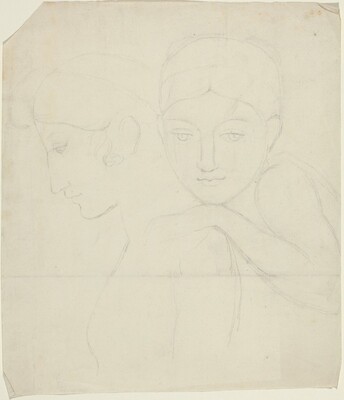
The image is a sketch showing two figures. Both figures are depicted from the shoulders up. The figure on the left is in profile, facing left, with gently arched features, a straight nose, and slightly downturned lips, with hair suggestively styled around the ear. The figure on the right is positioned slightly behind the first, with their chin resting on their crossed arms, directing their gaze to the viewer. This figure's face is more forward-facing, with almond-shaped eyes, a slender nose, and subtle lips, and their hair is suggested to be tied or styled back. There are no distinctive details of clothing, and the background is plain, with the focus solely on the pencil sketching of the two figures.

Two Women's Heads

Flaxman, John

The sculpture depicted on the metal is of a bird. The bird is perched with its wings slightly spread and head elegantly turned. Flame-like patterns are visible beneath the bird. The sculpture is made of a bronze-colored metal and is surrounded by an inscription. The worn texture of the metal suggests age and endurance.

Phoenix on a Burning Pyre [reverse]

Romano, Giancristoforo

The image shows a figure sitting in an angled chair. Their body is partially visible from the chest down to the knees, with hands on their lap. The person has abstract facial features with sharp, angular lines, and short hair. They wear a dark outfit with a collar or scarf around the neck. Around them are abstracted elements of a room, including a wall with a framed picture and three plant-like forms on a shelf. There is a table nearby with an unknown object. The background features a linear style with dark lines and shadows.

plate 1 in Alfred Döblin: Das Stiftsfräulein und der Tod (Alfred Döblin: The Canoness and Death)

Kirchner, Ernst Ludwig

The image depicts a man seated from the waist up, with his body slightly turned to the side but facing the camera. The man has deep-set eyes, a prominent nose, and a firm mouth. He has curly dark hair with some thinning at the front. He is dressed in a dark suit, including a waistcoat and bow tie, over a white shirt. A pocket watch chain is visible hanging from his waistcoat. The bottom of the photograph is inscribed with "Barnum." The background is plain.

P. T. Barnum

Fredricks, Charles D.

The painting depicts a harbor scene with several large ships and smaller boats on a wide waterway. To the left and right of center, two large ships are visible, each with multiple tall masts and several sails. The boat on the left appears to fly a flag that has white and red stripes and a section of dark blue. A small rowboat is positioned in the water by this ship, and it appears to have several indistinct people on it. To the left, a plume of gray smoke rises from low gray buildings. On the right, more people in rowboats appear to head towards a line of tall buildings in the distance. The sky is painted with soft brushstrokes in shades of light blue and grey, with hints of pale yellow at the center of the painting by the horizon. Some gray clouds drift across the sky. The water reflects these colors as well as the gray ships. Overall, the color palette is mostly light blue and shades of gray. The brushstrokes are visible, and details in the distance are suggested with minimal lines of paint.

Entrance to the Harbor, Le Havre

Boudin, Eugène

The image shows a man standing confidently, with a robust build, muscles, and a full beard. He wears an ornate helmet with a large, colorful plume and a short blue skirt-like garment. A red cape drapes over his shoulders, leaving his upper body exposed. He holds a sword, pointing downwards, with armor pieces on the ground nearby. The background shows a landscape with a winding river, greenery, and a distant castle, under a lightly cloudy sky.

Gad

Sadeler I, Jan

This is a painting of a gathering in an architectural setting. The composition features figures dressed in flowing robes around a temple or public square. One central figure is gesturing dynamically, possibly addressing the assembly or leading a discussion. The background shows classical architecture with columns, arches, and a statue of an armored figure. The scene is enclosed within a circular frame. The colors are vivid, with blues, oranges, and earth tones predominating the palette. This is in the style of Raphael, owing to the classical theme and details of the architecture and clothing.

Plate with Saint Paul preaching at Athens

Durantino of Urbino, Guido
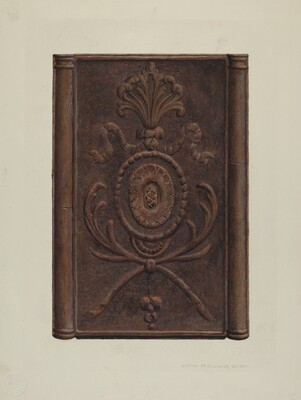
The sculpture is a rectangular relief with intricate designs. It features an ornate central oval medallion surrounded by a symmetrical arrangement of scrolls and foliage motifs. At the top of the piece is a decorative plume-like element. The sculpture is a monochromatic bronze hue, suggesting a metallic composition. It has a classical appearance, reminiscent of ancient architectural decor. The relief has a frame-like appearance with cylindrical side borders giving it a book-like or carved panel aesthetic. Overall, the piece appears meticulously crafted, showcasing detailed texture and elegant design work.

Pa. German Stove and Plate

Edwards, William H.

The drawing shows a figure resembling a satyr, with a child in one arm and holding a goat's horn in the other. A goat sits at their feet. In the background, another figure leans over a jug. The style features fine lines and detailed cross-hatching for texture and depth, with careful attention to shading and contours. The image is labeled "SATVRNVS" and has the initials "ISB" in the corner. The composition is balanced, with the figures in the foreground and minimal background elements.

Saturn

Beham, Sebald

In the image, there are two central figures. One is an older man seated, shown from the chest up with one hand resting on a rolled scroll. He has a beard and disheveled hair, and his expression is focused as he gazes upward. The man's body is muscular and mostly uncovered, with a cloth draped over his lap. An elegant woman stands beside him, gesturing towards him, with styled hair and flowing garments. The background features architectural elements like columns and arches.

Homer and Calliope

Conca, Tommaso

The sculpture depicts a horse in a dynamic pose, with one of its front legs raised. It is crafted from a dark material, likely bronze, giving it a rich, dark brown color with a slightly shiny surface. It is displayed on a rectangular base made from the same material. The surface of the horse is textured, showing details such as musculature, mane, and tail. The horse is proportionate and realistic in its depiction, evoking a sense of naturalism. The size of the sculpture is small, indicative that it is a model or a small-scale work rather than a life-sized representation.

Flayed Horse III

Gericault, Théodore

This is a photograph of a vintage book cover. The cover is titled "Union Pacific Railroad Photographical Illustrations" in gold lettering, set against a brown background. The cover shows signs of age with worn edges and faded areas. The binding is leather and there are highlights of wear. The text is centrally aligned.

The Great West Illustrated in a Series of Photographic Views Across the Continent

Russell, Andrew Joseph

This is a photograph of a grand Gothic cathedral with detailed architecture featuring towering spires. The cathedral is shown from a side angle, emphasizing the use of flying buttresses along its façade. A large rose window is prominently displayed on the side. The two large towers at the front of the cathedral exhibit ornate detailing, and the roof of the building slopes steeply, with an array of lines and textures. In the foreground, along a waterway, there are smaller structures and what appears to be building materials.

Église Notre Dame - Côté sud

Renard, François-Auguste

Man of Science

Man of Science

American 19th Century

The image shows the upper half of a person's body positioned at the foreground. The person has long, dark hair that falls over one side of their face, with a prominent eye and a mustache. The individual is wearing a dark, loose-fitting garment. In the background, there are snow-covered mountains and a body of water that extends into the distance. On the left side, small, indistinct figures can be seen following a path alongside the water.

Brand, acte V (projet de programme)

Dumont, Maurice
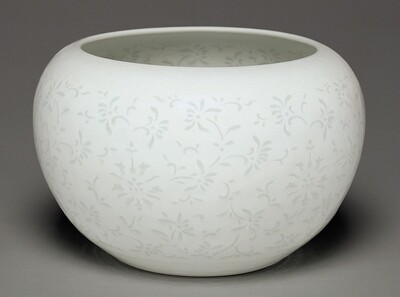
The sculpture is a large, rounded bowl with a delicate floral pattern covering its smooth surface. It is predominantly white, with the floral motifs painted in a light gray or off-white. The bowl has a wide, open top, and the same painted pattern appears to continue inside the bowl.

Bowl with "Rice Grain" Decoration

Chinese Qing Dynasty
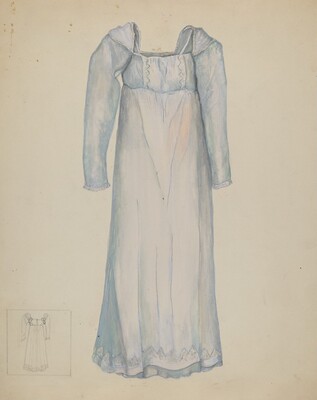
This is a drawing of a long-sleeved dress. The drawing features a light blue dress with long sleeves and a flowing, floor-length design. The gown has a high waistline with decorative details above the bustline and around the cuffs of the sleeves. The hem has a faint pattern. To the lower left of the drawing, there is a smaller sketch of the same dress. The drawing is detailed, capturing the gown's folds and the fabric's delicate nature.

Dress

Rex, Edna Crenshaw

The image shows an etching of a man from the waist up. He is facing slightly to his left and has distinct facial features: high forehead, arched eyebrows, prominent cheekbones, beard, mustache, and short, combed-back hair. He is wearing ornate armor with intricate designs, along with an elaborate ruff around his neck. The background includes text "FRIDERICVS II. D. G. DANIE. NORVEGIAE. & C. REX. OBIIT. A. 1588" encircling an oval border framing the image.

Frederick II, King of Denmark and Norway

Goltzius, Hendrick

This is a drawing of two swans on the water. The drawing depicts the swans with simple, flowing lines. One swan is shown in a resting position with its wings folded, while the other seems to be preening or stretching its wings. The water is illustrated with light strokes to suggest reflection and movement.

Swans in the Water

Sargent, John Singer
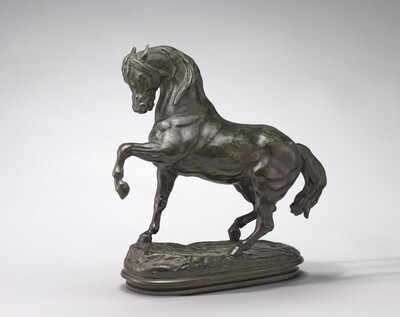
The sculpture depicts a horse in motion with its front left leg raised and its head turned to the side. It is crafted from a dark, metallic material with a green patina. The horse's muscles and contours are detailed, and it stands on a rocky base.

Turkish Horse, Left Foreleg Raised

Barye, Antoine-Louis

The image displays swirling circular patterns on the surface, intertwined with organic shapes. The design resembles a marbled effect or grainy patterns in polished wood. The spirals and shapes resemble whirlpools or eddies in water. Warm brown tones with touches of deep blue and ochre enhance the natural feel of the composition.

Atlas des Environs de Paris

Delagrive, Jean
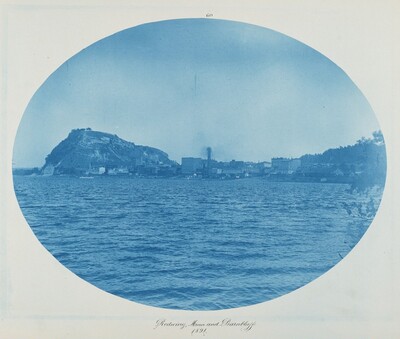
The image shows a body of water extending towards a distant shore with buildings lining the horizon. A hill rises prominently on the left side, above the structures. The style is photographic, resembling a cyanotype print in shades of blue. The foreground water is rippled, contrasting with the static buildings. The color palette is predominantly blue, creating a serene effect. The hill and buildings guide the eye across the horizon, with a soft blue sky above.

Redwing, Minn. and Barnbluff

Bosse, Henry Peter

The image shows a scene with a weeping figure near a gravestone under a willow tree, a white horse attached to a cart on a path, and a distant townscape with a church steeple. The setting sun casts warm colors over the sky, with unique cloud formations and birds flying. The color palette consists of warm and cool tones.

Eaton Family Memorial

Jordan, Samuel

The image shows a side view of a figure standing on a rocky overlook with a crescent moon in the sky. The horizon line is subtly depicted where the land meets the sky. The image has a dreamlike texture created by soft, stippled brushstrokes. The color palette consists of various shades of gray, giving a serene visual effect. The figure dominates the foreground, while the calm landscape in the distance is illuminated by the moon.

Rêverie dans la nuit (Evening Reverie)

Osbert, Alphonse

The image shows a female figure standing upright. She is facing slightly to her left with her right arm raised, holding a sword, and her left hand on a balance scale. She has curly hair tied back, delicate eyes, and a slight smile. She wears an ornate garment with gold and red hues and is surrounded by a tapestry depicting a landscape with trees and mountains, framed by architectural elements.

The Four Cardinal Virtues: Justice

Netherlandish 16th Century

The image shows a single large glass object with a bulbous top tapering down to a narrower end, resembling an elongated drop or tear shape. The object is rendered in shades of translucent greenish-blue. It is positioned diagonally across the center of a plain, off-white background.

Powder Horn

Fisk, John

The image is an architectural drawing of a grand temple-like structure viewed from the front at a slightly elevated angle. The temple has a prominent central entrance with steps and tall columns on each side. Statues decorate the top of the structure, including a figure at the peak. The horizon is low, emphasizing the building's height. Trees can be seen in the background, adding depth to the scene. The drawing is detailed with cross-hatching for shadows and textures, typical of engravings. The color scheme is mainly brown and sepia tones. Closest to the temple, figures are engaged in various activities, adding scale and human presence to the scene.

The Prima Macchina for the Chinea of 1782: The Temple of Janus Built by Numa Pompilius

Barbazza, Francesco

The image features a landscape viewed from a slightly elevated perspective. The horizon is subtly suggested by pencil outlines, with elements such as tree outlines and a distant structure visible. Loose and fluid brushwork in sepia tones creates a soft and ethereal quality. Darker strokes at the forefront indicate trees and shrubs, with a predominantly earthy brown color palette.

Hillside and Trees

Cox, David

The sculpture depicts a pair of human hands, intricately intertwined and reaching upwards. The hands are sculpted from a material resembling bronze, with a dark brown color and subtle greenish patinas. The texture is smooth but detailed, highlighting finger joints and creases. The sculpture is mounted on a glossy black base bearing the artist's signature. It represents human hands, focusing on unity and connection.

Study for "The Secret"

Rodin, Auguste

This is a richly textured reddish-brown book cover with gold embossed text. The title "DANTE" is displayed prominently in the center, with "FLAXMAN" below it. The border of the cover includes a simple gold outline. The spine of the book, visible on the left edge, has ornate ridges and shows signs of wear. The other edges appear similarly worn.

Album of Drawings for Dante's "Divine Comedy"

Flaxman, John

The image shows sequential photographs of a nude woman interacting with a hammock. The woman is seen in various positions, from standing to sitting and swinging in the hammock. Her short, likely brown, hair is visible, but not her facial features. She is not wearing any clothing or jewelry. The setting is outdoors with a cord or wire grid and a solid backdrop. The lighting indicates a bright day or well-lit area, highlighting the movement in the photos.

Plate Number 261. Getting into hammock

Muybridge, Eadweard

Four men and one woman gather around a dead man who is dressed in a bright honey-gold cape and pointed hat, his stone-gray face resting on a stump or column in this dark vertical painting. All the people have peachy skin or light skin tinged with green. Shown from the knees up, Saint Gennaro, the dead man, twists and slumps to our right. On the stump, his eyes are closed and his lips parted. His hands are crossed at his waist and bound with rope. He wears a tall hat rising to a peak in the center. His cloak drapes over a white tunic, and red seeps from around his neck. On our right, a brown-haired woman is shown from the waist up, bending down in front of Saint Gennaro’s face. The light falls across the scene from our right, so her profile is in shadow. She holds a silver chalice in one hand and squeezes something, perhaps a rag or sponge, over the chalice with her other hand. A clean-shaven man with dark curly hair stands behind the stump. That man’s body faces us as he leans to our right and tilts his head down over Saint Gennaro, his shadowed face obscured. His left hand is under the dead man’s head and his right hand clutches his own chest. Behind the dead man and to our left, a bald, gray bearded man bends over and spreads his arms wide over and across the saint’s back. His brow is furrowed, and he looks at Saint Gennaro with deep-set eyes. Along the left edge of the canvas, a bald man with a hooked nose and large ears stands and angles his body to our right, his face in profile. He leans back from the dead man, his right hand holding a knife or sword with a bird-shaped hilt. The fourth man close to Saint Gennaro looks on to our right, from behind the stooping woman. The people gathered around Saint Gennaro wear clothes in muted shades of gray, brown, and white. The edge of a building rises up along the left edge of the composition. In front of a distant mountain to our right, more people are gathered, some with swords raised and others looking on with mouths gaping. One faint head, the face painted in tones of ash gray, peeks over the shoulder of the fourth man. Yellow streaks near the horizon also illuminate the undersides of heavy, dark gray clouds above.

The Martyrdom of Saint Gennaro

Preti, Mattia

The image shows a crowd of people gathered around a large, enclosed carriage. The individuals have exaggerated facial features and are wearing top hats. Some are engaging in conversation or observations. A child is holding onto a man with a top hat. More figures in the background are wearing similar attire. The scene conveys a busy atmosphere with rich, dark lines outlining the crowd.

Exposition universelle: L'Etranger trouve toutes les facilites desirables...

Peulot, Julien Antoine

The sculpture is a detailed bust of a man’s head facing slightly to the left, with prominent, slightly furrowed brows and defined cheekbones. The man has a closely shaved hairstyle, a small beard or goatee on his chin, and large, deep-set eyes. It is crafted from a dark material, with some areas in a lighter yellow color creating highlights on the face.

Inkwell in the Form of a Grotesque Head

French 19th Century

The image displays a vintage ice skate placed in the center. The skate is made of brown leather with metal eyelets along its side, revealing the metal blade underneath. The color scheme includes warm browns and muted metallic tones against a pale beige background. The skate is positioned horizontally in the middle of the frame, with straps and buckles extending to the right.

Ice Skate

Stenzel, Erwin

This is a drawing of a group of figures in an architectural setting. The drawing depicts multiple figures in an intricate scene. The setting is indoors or within a walled enclosure, with walls and an architectural structure at the top of the image. The figures are dressed in historical clothing, including robes and hats, and are engaged in an exchange or discussion. The use of lines and shading provides texture and depth to the illustration, typical of the woodcut or engraving style used in historical illustrations.

Ecce Homo

Altdorfer, Albrecht

The image is a portrait drawing of a woman's upper body. She is turned slightly to the side with her head tilted down and eyes closed. Her facial features are delicately drawn, emphasizing her closed eyes and subtle smile. Her hair is styled elegantly with floral elements. She wears a textured garment with decorations and a bow, along with earrings and a necklace. The background is plain.

Seated Woman Looking Down

Watteau, Antoine

The sculpture displays a religious scene with a central figure seated, holding a child. Surrounding them are additional figures, including two men in robes and headgear on the left, and others on the right. The sculpture is crafted in relief on an oval plaque, with intricate details, a warm brown color with gold highlights, and ornate edge decorations.

The Madonna of the Rosary

Anonymous Artist

This print shows a person seated in a round border. They are leaning slightly forward with their arms resting on their lap, where they appear to hold a stack of paper and a long stylus. The person has pale skin and wavy hair in an updo adorned with a leafy crown. They have dark eyebrows, a small nose, and thin lips in a slight smile. They wear a flowing off-the-shoulder dress cinched at the waist with a red sash. The background features intricate patterns in rings, including illustrations of foliage and geometric shapes in blue, yellow, and green against a brown background. Surrounding the central print, text reads "ANATOLE FRANCE," "CLIO," and “ILLUSTRATIONS DE MUCHA"" against beige paper, with a few more lines of text at the bottom."

Clio

Mucha, Alphonse Marie

The image shows four women posing for a portrait. Two women are seated in front, while two are standing behind them. The women have different hairstyles and wear various dresses. They are positioned against a blank backdrop. The photograph is colored and framed with textured cardboard, labeled with "EMERSON, Lowell."

Portrait of Four Women Weavers

Emerson, Moses W.

Madonna and Child

Madonna and Child

Zoppo, Marco

This image depicts Old China Street in Canton, viewed from a slightly elevated perspective. The horizon is high, marked by the rooftops of densely packed buildings flanking the street. Decorative elements like ornate arches and lanterns are visible. The brushstrokes are precise and detailed, adding realism to the scene. The color palette consists of warm earth tones with shades of brown, beige, and red, contrasted by the blue sky. Figures are engaged in various activities, providing a sense of daily life. In the distance, the street extends into a busy thoroughfare lined with more buildings and activity.

Old China Street, Canton

Heine, William

The sculpture is a vase featuring a rounded body with a long, narrow neck. The vase is primarily made of a white material, and it is adorned with intricate designs. These designs include several black oval and leaf-shaped panels on the vase's body and neck, decorated with vibrant colors such as green, blue, yellow, and white. One of these panels on the body of the vase features a depiction of a snarling blue-and-white dragon with a yellow-and-green face set against a black background. The other visible panels have floral designs in white, yellow, blue, and green. Between these panels, the white body of the vase also appears to have been carved with white swirling floral designs. There are some small spots of brown discoloration on these designs at the bottom of the vase.

Bottle Vase

Chinese Qing Dynasty

This is a drawing of a relief plaque featuring a lighthouse, a serpent, and the letters 'F' and 'A'. The image depicts an oval plaque embossed with a lighthouse surrounded by a coiled serpent, and the letters 'F' and 'A' on either side. The composition is rendered in detailed graphite or charcoal, emphasizing the texture and dimensionality of the elements on the plaque.

Firemark

Bader, Herman

The image shows a street scene with a grand building on the right. The perspective is from street level, looking towards the building. A streetlamp is on the left. The brushstrokes show detailed architectural elements and figures. The color palette consists of earthy tones for the building and softer shades for the sky. Reds and greens are used in the clothing. The scene depicts a tranquil street from a past era.

Pavillon de Flore, Tuileries

Boys, Thomas Shotter

The image shows a cityscape in the distance across a body of water. The horizon is located towards the lower third of the image, lined by dark shapes including a tall tower and a domed structure. The artwork features soft, diffuse brushstrokes likely made with charcoal or a similar medium, creating a hazy atmosphere. The color scheme is minimalistic, using shades of sepia and gray. In the foreground, there are dark silhouettes resembling small boats with figures against the water reflecting soft lights.

Evening, San Giorgio Maggiore, Venice

Vail, Eugène

The sculpture is a circular medallion featuring the relief of a male monarch in profile, facing the right. He is depicted wearing ornate robes adorned with detailed patterns and rich embellishments. He holds a scepter in one hand and a sphere in the other. The medallion is crafted from metal with a dark bronze or gold finish that highlights the raised features and textures, while the other areas are dark brown, perhaps from a patina. The edges of the medallion are inscribed with text.

Charles V, 1500-1558, King of Spain 1516-1556, Holy Roman Emperor 1519 [obverse]

Reinhart the Elder, Hans

This is a drawing of an ornate entomological illustration centered around a flea. The central subject features a flea with a segmented body, legs, and antennae, placed within a diamond-shaped frame. Encasing this central diamond is an elaborate border of floral motifs and acanthus-like leaves, with stylized human-like faces at the corners. The artwork is in sepia tone, giving it a vintage appearance. The design is symmetrical.

Meister Floh. Ein Marchen in sieben Abentheuern zweier Freunde (Master Flea: A Fairy-Tale in Seven Adventures of Two Friends

Thiele, Karl Friedrich

The image shows a historical ruin with distinct columns and arches on the left side. A group of people is resting on the ground near the ruins. In the background, there are rooftops and a tall clock tower. Other buildings and a palm tree are also visible. The color palette is sepia, highlighting the aged textures of the structures.

Temple of the Winds

Robertson, James

This painting depicts two people, an adult man and a young boy. The man is seen from the knees up, standing with one arm on a table and the other on his hip. He has light skin, light green eyes, a brown beard and mustache, and dark hair under a black cap. He is wearing a bright red jacket with several buttons down the front, which is open to reveal a white garment with several pleats and folds. The boy, who has short brown hair and fair skin, leans against the man's leg, tying a bow on the white garment and looking over his shoulder at us. He wears a yellow outfit with subtle white stripes. On the left is a table covered with dark green fabric which the man has his hand on; there are three books on it, and a letter on white paper propped up against the books. The background is a muted green-brown color.

Alessandro Alberti with a Page

North Italian 16th Century

This is a drawing of a decorative emblem with intricate details and a central shield shape. The emblem features a shield with integrated text, surrounded by elaborate scrollwork, floral motifs, detailed illustrations, and architectural elements reminiscent of a castle. The shield reads "Radierungen von C. Scheuren 1852." Birds, small human figures, and decorative patterns are also depicted in the design.

Title Page

Scheuren, Caspar Johann Nepomuk

The sculpture depicts a figure standing on a decorated pedestal, striking a dynamic pose with one arm raised and the other bent downward. The figure is adorned in a long, flowing garment with a variety of colors and patterns, including green, blue, yellow, and white, with floral motifs in different parts of the attire. The face of the figure is white with delicate features, and the hair is styled upward in a solid black form. The sculpture appears to be crafted from a glazed ceramic material, giving it a smooth and glossy finish, and it is detailed to convey a sense of movement and elegance. The pedestal below features a crisscross yellow and green pattern that complements the colors found in the figure's attire.

Dancing Woman

Chinese Qing Dynasty

Bold black lines create a geometric composition on a light background. The central shape resembles an upside-down "V" with an additional horizontal line across its top. Curved hooks are at the ends of the diagonal lines.

Cattle Brand

Marley, J. Henry

The image is a charcoal drawing depicting the upper bodies of five individuals closely gathered together. They are positioned to form a compact group, possibly interacting. Each person has distinct facial features portrayed with expressive, bold strokes. The individuals have diverse hair and facial structures in an intense, somewhat abstract style. Their clothing details are difficult to discern, but they seem to be wearing long-sleeved garments. Some individuals are holding bowls and utensils, suggesting a possible food or dining scenario. No discernible jewelry is present, as the focus is on their interactions with the objects. The background is plain, highlighting the figures and their central activity.

Six Diners at Table

Beeh, René

This is a drawing of four figures arranged in a slightly circular composition. One figure is seated on a piece of furniture with curved legs, draped in fabric and gesturing with an upward-pointing hand. Next to this figure is a partially clothed figure seated on what appears to be fabric. To the left of these figures is a naked standing figure with a muscular build, seemingly in dialogue with the seated draped figure. On the right is another unclothed figure with wings, seated in a relaxed position. The style of the drawing is reminiscent of classical and renaissance studies, characterized by delicate and precise line work on a textured paper background.

Gods and a Goddess in Conversation

David, Jacques-Louis

This stylized, free-standing, wood sculpture shows a seated man with horns, creating a column-like shape. The statue is carved from polished, reddish-brown wood. The column is divided into three sections for the head, torso, and legs. In this photograph, the man faces us. He has gold-colored eyes under arched brows, a wide nose, thin lips, and a square jaw. The horns rise from over his temples. In the middle section, he holds his hands in front of his chest, nearly touching as if in prayer. The bottom section shows his shins, knees together. His feet, which are roughly carved, turn outward. The base along the bottom is carved with words painted in gold, reading, “PERE PAILLARO.”

Père Paillard

Gauguin, Paul

This appears to be a rectangular book with a landscape orientation. The cover is black with a textured pattern of swirling designs. In the center of the cover is the word "ALBUM" in capital letters, embossed in gold. The letters have decorative serifs. The edges of the book appear worn.

Sketchbook

Gonzalès, Eva

The image shows an ancient temple-like structure with intricate architectural details. The scene is closely cropped around the building, which features arched doorways, detailed carvings, and steps. The architecture is ornate, worn, and aged. The image is rendered in sepia tones, giving it a historical feel. The sky is relatively clear with some scattered clouds in the background.

Pugahm Myo: East Facade of Damayangyee Pagoda

Tripe, Linnaeus
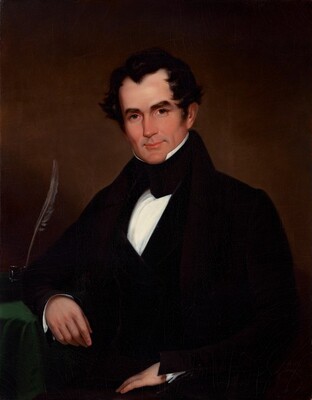
The image displays a man's upper body. He is seated at a slight angle to the left, with one arm resting on a surface covered by a green cloth. The man has a composed expression, with defined facial features, including dark arched eyebrows, a high forehead, and short, dark hair with a subtle wave. He is dressed in formal attire, consisting of a black coat, a white shirt, and a cravat. A quill is placed nearby. The background is a plain, muted brown color.

Samuel McKenney

Cooke, George

The image depicts a landscape seen from above. The horizon is positioned above the center, where the land meets a cloudy sky. Buildings are visible in the distance. The brushwork is detailed, defining trees, landforms, and water in monochrome. A river flows through the scene with figures and rocky terrain in the foreground, flanked by tall trees. The composition balances nature and human presence.

Landscape with River and Town

Prestel, Maria Catharina

This is a painting of a classical architectural scene with figures. The image depicts a woman seated in an architectural setting decorated with columns and arches, alongside a kneeling child and another figure holding a sphere. The painting is highly detailed, with the architectural setting resembling a palatial interior, complete with checkered flooring and intricate brickwork. The columns are painted in a vibrant blue hue, and the background features a view of a blue sky and distant buildings. The seated woman appears to be interacting with the kneeling child, possibly teaching or bestowing wisdom, as indicated by the open book and laurel wreath. The third figure, dressed in robes and holding the sphere, contributes to the scholarly or philosophical theme of the scene.

Plate with an allegorical scene of Calliope and a youth (from the Ladder Service)

Nicola da Urbino

The sculpture depicts the head of a lion. It is crafted from stone, giving it a grey and slightly textured appearance. The lion's head is shown in profile with pronounced features such as a detailed mane and smooth facial contours. The eyes are depicted in an abstract, almond shape. The sculpture appears to be a fragment, displaying only the head and part of the neck.

Lion's Head (one of pair)

DiGennero, Edward
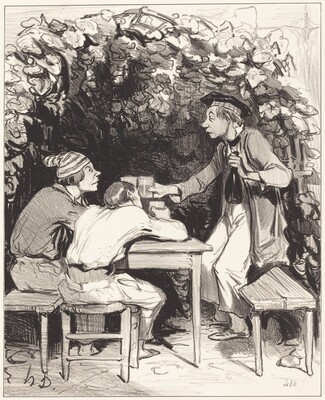
This is a drawing of three individuals gathered around a table under a leafy canopy. Two individuals are seated at a wooden table, while a third stands beside them. The seated individuals have varied poses, one leaning forward attentively and the other wearing a hat with a striped pattern. The backdrop is dense with foliage creating a textured, intricate contrast to the white space around them. The style is sketch-like with emphasis on shading and line work, displaying the figures and greenery.

Vois-tu, mon ami... il n'y a que deux élemens... du bonheur...

Daumier, Honoré

This is a drawing of an angelic figure and fallen individuals within a grand architectural setting. The drawing presents a somber scene. In the foreground, there are individuals lying on the ground, dressed in long robes, some motionless. One of these figures features a faint halo above its head. The upper portion of the drawing is dominated by an angel with outstretched wings, descending from above. The background features an architectural element reminiscent of a theater or amphitheater, with curved arches and tiered seating. The use of muted tones and careful shading highlights the ethereal quality of the angel and the solemnity of the tableau below.

Christian Martyrs

Doré, Gustave

The sculpture depicts two figures holding a bearded head. The figures are wearing draped garments with intricate folds. The sculpture is made of bronze, with realistic proportions and textures, presented in a relief form.

Judith with the Head of Holofernes

Briosco, called Riccio, Andrea

Printed in black on now-darkened paper, lines of text are above and below an illustration showing three winged, nude children gesturing toward a balding older, bearded man near the center. The older man sits on a throne to the right and leans forward, one hand braced on the sphinx-shaped arm of the chair and the other pointing toward a stick one of the children holds. One of the man’s eyes is open wide, and the other appears to be closed. The man is barefoot and wears voluminous, flowing robes. The children all have short, curly hair and muscular bodies. Drapery flits to cross the groin of the child closest to us and the back side of another. They all reach at least one hand forward toward the man. The front child holds up the stick and looks over his shoulder at us. The room behind them has a door opening into a cavernous space with arched vaults. The corner of the paneled room beyond the older man has shelves and a ledge with books and globes. The page is numbered 151 in the top right corner. Text above the image reads, in all caps: “Francisci Agvilonii e Societate Iesv Opticorvm Liber Tertivs de Commvnivm Obiectorvm Cognitione.” The block of text under the image is titled “Argvmentvm” in all caps. Text continues, in italics mixed case: “Natvræ simul ac doctrinæ ordo exposcit, vt definite visus essential, præcipua’que eius affectione, quæ ad visionis modum opticorum’que radiorum traductionem pertinent, explicate, ad communium visibilium cognitionem veniamus. Hæc enim per se quidem, at non primò, vt et quæ propria dicuntur, sub aspectum cadunt. Nam lux et color simplici obtutu; hæc verò aut collatione, aut distinction, aut antecedente notione, aut syllogism, aut alia demum ratione, quam internus sensus variam ac multiplicem administrat, cognoscuntur. Quod sane ex eo prouenire videtur, quòd hæc non propriè ad visus facultatem attineant, sed aliis quoque sensibus sese ingerant: vnde N4 non”

Opticorum Libri Sex

Galle, Theodor

This is a photograph showing a person flipping over a chair in a series of sequential frames. The top row displays the person moving from a seated position on the chair to a handstand and flipping over the chair. The second row shows a similar sequence from a different angle. Each frame captures a moment in the movement, illustrating motion progression.

Plate Number 373. Acrobat, "press up" from chair

Muybridge, Eadweard

The image depicts a half-length portrait of a person shown from the waist up. The individual is standing with a confident posture, one hand positioned at their waist. Their facial features include a prominent mustache and pointed beard, with slightly arched eyebrows and a direct gaze. The person's hair is a dark shade, styled close to the head and visible beneath their hat. They are wearing a dark blue military uniform adorned with yellow buttons and shoulder insignia, along with a yellow and red belt. The hat is also dark blue with a yellow emblem that has the letters "US," circled by a decorative design. The person also wears yellow gloves on their hand. The background of the image is a muted, textured surface in shades of gray.

The Colonel

American 19th Century

The image depicts a landscape viewed from a slightly elevated position. The horizon is above the center, showing an expansive scene dominated by rolling hills in the distance. Trees are scattered across the terrain. In the foreground, small figures are seen by boats along a curving path beside a rocky outcrop. The brushstrokes are subtle and controlled, emphasizing details without overwhelming the serene ambiance. The scene is depicted in a monochromatic palette of warm sepia tones, creating a timeless and historic atmosphere. Lighter tones are used for the sky and distant hills to suggest depth and vastness.

Landscape with Fishing Boats

Prestel, Maria Catharina

Apollo and Daphne

Apollo and Daphne

La Fosse, Charles de

The sculpture depicts a Native American figure with a headdress of large, colorful feathers in mostly yellow and green hues. The figure holds an axe in its raised right hand and a pouch or bag in its left hand. It wears a brown garment with fringes and decorative elements like leaf-like designs in green, blue, and ochre. The sculpture's color is primarily earthy brown with bursts of color in the headdress and garment accents. The figure stands confidently on a pedestal, with one foot forward. The sculpture showcases intricate details in attire and posture, with slightly exaggerated features typical of carved wooden statues.

Cigar Store Indian

Heiberg, Einar

The image shows two people in a rustic outdoor setting. The man is standing with one hand on his head, facing the woman. He has a broad smile, shoulder-length dark hair, and is dressed in an earthy red coat, light blue waistcoat, yellow breeches, blue stockings, and black shoes. The woman is seated on a chair, spinning using a wheel in front of her. She has dark hair, wears a white bonnet, and a white dress with long sleeves. Surrounding them are a barrel, a broom against the wall, a tree with green foliage, a simple wooden house with a thatched roof, and an earthy ground with grassy patches.

Rustic Courtship

Rowlandson, Thomas

The image shows two birds tied together at the feet. The birds have detailed feathers and claws. The color palette includes light beige and dark brown ink for outlining and details, creating a monochromatic look. The birds are positioned in the center, with their bodies overlapping, and their heads facing downwards in the lower half of the composition.

Two Dead Chickens

British 18th Century

The image shows a round, coin-like sculpture featuring a side profile of a human figure. The individual wears a hat, shoulder-length hair, and a garment with a visible collar. The sculpture appears to be made of metal, possibly bronze, based on its brown and gold tones. Intricate detailing is visible on both the figure's features and the surrounding text inscribed in a circular fashion around the edges, reading "BARTHOLOMEVS ZANGATIUS FLORENTI." The lettering is raised in relief against the background, showcasing precision and craftsmanship. The sculpture resembles a historical medallion or coin, providing a tangible, three-dimensional representation.

Bartolomeo Panciatichi, 1468-1533, Merchant [obverse]

Gauvain, Jacques

This is a drawing of a book cover for "La Derniere Héloïse." The cover features decorative typography and an illustrated oval scene framed with ornate detailing. The scene shows two figures in an interior space with tall columns and arched architecture. One figure is seated and the other standing, engaged in an interaction. The seated figure appears relaxed, leaning against the back of a chair or couch. The illustration reflects 18th-century style with detailed and elegant features, including clothing and architecture. Text on the cover includes the title, author, and publication details, showing it was published in Paris in 1784. The color scheme consists of sepia tones.

La Dernière Héloïse: ou, Lettres de Junie (Part I and Part II)

Dauphin, de Verdun

The image depicts a woman pouring liquid from a spoon into a glass. She is standing in a studio setting, wearing a traditional nurse's uniform and standing next to a small table with bottles and glassware. A chair with wicker detail is seen behind her.

Portrait of a Wellesley College Graduate, Class of 1897

Holden, Charles W.

A young blond person stands in the center of a dimly lit room facing dozens of men in this horizontal painting. The people all have pale skin, though many are in shadow. The central person, Joan of Arc, stands in profile facing our left. She clutches one hand at her chest and the other extends in front of her, fingers arcing up. She has chin-length hair and bangs. Her brow is furrowed and her lips parted. She wears a lapis-blue, high-necked tunic over smoke-gray stockings and pointed black shoes. A metal band encircles her waist and a chain and manacle hang from one of two rings there. The chamber is lined with two rows of seats that extend along the short side to our left and the long wall across from us. A man wearing a white robe and a burnished gold mitre hat and cloak sits in the corner, both arms resting on a high throne. The other men wear clergy’s brown or black and white robes or long garments in slate blue, olive green, tawny brown, charcoal gray, and silvery white. Most wear hats. Four more men sit around a table covered in a grass-green cloth behind Joan, to our right. One man looks down at and writes on a sheet of paper. About half a dozen soldiers wearing silvery helmets and holding spear-topped halberds cluster in the back right corner, beyond the table. A wood stepstool sits closer to us, in front of the table, in the lower right corner. The walls of the chamber are paneled in a rectangular grid of light brown planks over darker wood, and the floor is tiled with small pink rectangles. The artist has signed in the lower right, “M. Boutet de Monvel.”

The Trial of Joan of Arc (Joan of Arc series: VI)

Boutet de Monvel, Louis Maurice

The image shows a head-and-shoulders portrait of a person facing slightly to the right. Their facial features are partly visible, with eyes closed or downcast. The person has long hair framing their face and is wearing a garment with a high collar. Their hands are clasped in front of their face. The background is dark, and the image is rendered in a monochrome palette. The name "Alfred Heinrich" is written in the top left corner.

Mélancolie (Melancholy)

Martin, Alfred-Nicolas

The sculpture depicts a white vase with a traditional bottle shape. It is made of porcelain and has intricate raised patterns of leafy motifs on the neck and swirling patterns on the body. The bottom of the vase features a repeated lotus petal pattern. It is set against a dark gray background.

Vase in the Shape of an Archaic Bronze Hu

Chinese Qing Dynasty

The image features a detailed drawing of a black, cylindrical mug with a slightly flared base and an ornate handle. The color palette is monochromatic, with shades of black and gray against a light beige background. The mug is positioned centrally within a rectangular frame drawn on the paper, and there are additional smaller sketches showing different views or details of the mug in the top left and bottom right corners of the page.

Pewter Mug

Winter, Charlotte

The image features a group of people depicted in an etching style. Various figures are shown in full body view, with some standing and others seated. Two men on the left are conversing, one holding a cane. Their faces are expressive with lined features, beards, and they wear long robes and distinctive hats. Another man in the background sits on a stone ledge, also dressed in flowing garments and a turban. To the right, two men are in discussion, one wearing a tall hat. The background shows architecture with large stone columns and high arched openings that create shadow and light contrasts.

Jews in the Synagogue

Rembrandt van Rijn

The image features an illustration of a person on a horse. The person is shown in profile, holding a spear. They have facial hair, wear a hat and a long-sleeved shirt with rolled-up sleeves. A colored band is seen across their chest. The horse has a saddle and a fabric draped over its back. The background is off-white with some faint sketches and text.

Campagniolo romano

Nerly, Friedrich

The sculpture is a bust depicting the head and upper torso of a man with wavy hair and a stern expression. It is crafted from a white material and has a polished appearance. The subject of the sculpture is portrayed in a formal manner, with a high collar, a knotted scarf around his neck, and a double-breasted outer garment with visible buttons. The sculpture is placed on a pedestal inscribed with the name "A. CÉRARD" and other text including "P.J. DAVID" and "1824." The sculpture presents detailed facial features, contributing to its realistic likeness.

François-Pascal-Simon, Baron Gérard

David d'Angers, Pierre-Jean

There is an open book in the image, with text on both pages. The left page has "TABLE DES MATIERES" as a heading, with a floral illustration at the bottom. The color palette is mainly beige and cream, with the text and illustration in dark tones. The text is organized in columns on the left page, with "FIN" and a floral basket illustration at the bottom. The right page continues the text in a similar layout.

Les Quatre Livres De l'Architecture D'André Palladio. Mis en François. Dans lesquels, aprés un petit Traitté des cing Ordres, avec quelques- vues des plus necéssaires observations pour bien bastir, Il parle de la contructions des maisons particulieres, des grands chemins, des Ponts, des Places publiques, des Xystes, des Basiliques, & des Temples

Fréart, Sieur de Chambray, Roland
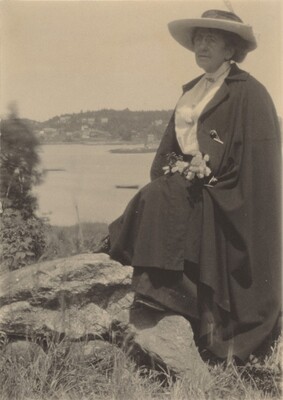
The image shows a woman sitting on a large rock outdoors. She is captured from the waist up, positioned in a three-quarters view. The woman has a mature appearance with soft facial features and short, dark hair mostly hidden under a wide-brimmed hat. She is wearing a dark cape over a light-colored blouse and holding a cluster of flowers around her midsection. The background includes a calm body of water with a distant shoreline populated with trees and sparse buildings.

Gertrude Käsebier in Maine

White, Clarence H.

The image shows a portrait of a woman in a side profile facing left. She has an elegant hairstyle, pearls in her hair, fair complexion, a delicate nose, and softly closed lips. She is dressed in a light pink gown with gathered fabric at the bodice, covered by a black lace shawl. She wears a necklace and the attire suggests an 18th-century fashion style. The background is a dark green shade, and the portrait is framed in an oval border.

Mrs. Thomas Horne

Cotes, Francis

The image depicts an engraving showing a hilly terrain leading to a town. The view is from an elevated position looking down towards the distance. The horizon is low, with architectural features such as domes and spires indicating a cityscape in the far distance. The sky is prominent, filled with textured clouds rendered in a detailed linear style typical of engravings. The color palette is monochromatic, with varying shades of gray creating contrast between the buildings, sky, and activities of the people in the foreground. Individuals are shown engaged in various activities on the hilly terrain, providing scale and human presence to the landscape.

Prisco onor pur dura...

Wagner, Joseph

The sculpture is a lidded vase with a hexagonal shape and ornate decorations. It features a design of flowers, branches, and birds. The floral patterns are in white and green, and the branches are light brown. The birds are in matching colors. The vase is predominantly yellow with a detailed finial on top of the lid. It is made of glazed ceramic and has a glossy appearance. The body of the vase has intricate patterns, adding texture.

Hexagonal Covered Jar

Chinese Qing Dynasty

This is a painting of the Great Seal of the State of California. The artwork features a circular emblem with a central design depicting mythology and symbolism associated with California. The central design shows a seated figure dressed in classical attire, holding a spear and shield, and a grizzly bear nearby. The background shows ships sailing on water, with hills or mountains in the backdrop. Above the central scene is the word "Eureka." The border features geometric patterns and spears, and the text "THE GREAT SEAL OF THE STATE OF CALIFORNIA" encircles the core image.

Mosaic Marble "Ornament"

Jackson, Gordena

The image shows a nude figure in a reclining pose. The body is oriented slightly sideways, facing left, and the head is tilted slightly downward. The facial features are soft and partially shaded, with closed eyes and a relaxed expression. The hair is long with gentle waves falling down past the shoulders. The person seems to be holding a long piece of fabric or garment draped over one shoulder and extending down the back. The background is textured with dark, sketch-like shading interspersed with lighter areas for contrast around the figure.

Eve

Besnard, Albert

The image shows a sketch of a human figure in a side-profile view from the upper thigh down, including one leg. The figure appears to be standing. Facial features, hair, clothing, or specific objects are not detailed. Surrounding the figure are additional light sketches of an animal head and abstract shapes. The background has a lightly speckled paper texture, indicating this may be from a sketchbook or similar document.

A Leg and a Pig's Head

Callot, Jacques

This is a photograph of a coin with an intricately designed classical scene in bas-relief. The coin features a standing male figure wrapped with ropes around a column or tree trunk. An inscription in Latin surrounds the central scene, while finely engraved text adorns the edge. The engraving showcases the craftsmanship involved in minting the coin.

John Huss Centenary Medal [reverse]

Austrian 16th Century

The image depicts a page with an illustration of an ancient-style profile portrait medallion, featuring the bust and head of a person with defined facial features facing left. The person has a nose, cheekbones, and chin, with hair styled in a classical Greek fashion, tied with a band. Above the portrait, the text "Le Avventure di SAFFO" is inscribed in a decorative font. Below the medallion, there are lines of smaller text in Italian. The background has an aged paper texture with scattered spots. The location is listed as "ROMA," and the date is in Roman numerals "MDCCLXXVIII," which translates to 1784.

Le Avventure di Saffo (The Adventures of Sappho)

Tresham, Henry

The image shows a sculpture of a standing female figure with long flowing hair and draped in a cloth. There is an additional smaller figure at her feet. The sculpture is white and placed on a square pedestal. The setting seems to be an exhibition hall with intricate architectural backdrop and various display items around, including other sculptures. The sculpture is centrally positioned among other exhibits in the aisle.

The International Exhibition of 1862 — "The Nave, from the Western Dome"

London Stereoscopic and Photographic Company

The image depicts six people, all facing the viewer. On the left, a woman sits on the ground. A naked child is partially visible behind her on the left, and in front of her she holds a younger child in a decorated carrier with a square handle. On the right are three men, one sitting and the other two standing. The seated man is in the center of the painting, and he holds a bow and two arrows. The next man on the right holds an axe or similar weapon, and the third man on the right also holds a bow and two arrows. All of the people have light brown skin, and the woman and children have black hair. The men have no visible hair, but instead appear to wear headdresses of long, thin red fibers or feathers that radiate outward from the backs of their heads. The seated man also has long horizontal feathers or fibers extending on either side of his head. The men and woman are all adorned with jewelry, including layers of colorful necklaces, silver bracelets, and several earrings in each ear. The woman wears a long-sleeved tan dress, while the men have fur-lined tan garments draped around their torsos and tan pants with colorful beads and fringe. Their garments are painted with scenes of people on horseback or colorful geometric patterns. The men also have tattoos on their arms and torsos. The seated man has red handprints on his upper arms, and the dark outlines of a bull's head on his chest and face. He has a hooped ring in his nose. The background shows a blue sky and grassy ground. The painting is framed in a gray oval border with tan paper beyond it and a green outer frame.

Pawnee Indians

Catlin, George

The image features a riverside pavilion overlooking a river scene. Architectural elements and nautical life are detailed. The horizon shows distant city structures and smokestacks. There are intricate buildings on the water with turrets and flags. The brushstrokes are refined and precise, emphasizing architectural details. The color palette consists of muted tones like greys. Close to the pavilion, small boats with figures are on the water. In the distance, more boats are visible along with a cityscape.

Alsterlust

Stoltenberg, Fritz

This is a painting on ornamental pottery. The artwork is on a decorative ceramic plate depicting a scene within an arched architectural setting. The detailed artwork includes elements of Renaissance-era attire and architectural forms. The background features a brick archway, buildings, and a blue sky with clouds. In the foreground, a group of figures is gathered in a dynamic arrangement. The figures are dressed in colorful period costumes, with one figure seated on an ornate chair. Rich drapery in blue and white stripes hangs on the right side. This style is reminiscent of Renaissance majolica ware, known for its vivid colors and narrative scenes.

Molded dish with Joseph's robe being presented to his father

Urbino 16th Century

This is a drawing of a wrought and cast iron balcony railing featuring intricate designs like spirals, floral motifs, and ornate scrollwork. Detailed measurements are included, showcasing the precision and craftsmanship of the design. The drawing emphasizes the elegance and sophistication of the ironwork, suitable for both functional and aesthetic purposes in architectural settings.

Cast Iron Balcony Rail

Price, Ray

The image shows a bird's-eye view of a crowded cityscape with the Collège Henri IV or Lycée Napoléon. The horizon is set high in the frame, behind the assortment of buildings. The skyline is barely visible due to the closely packed structures. The style features intricate etching techniques with finely crafted lines depicting buildings and vegetation. The color scheme is monochromatic, using varying shades of brown. Figures and architectural details are seen in the foreground, with roofs, buildings, and trees extending towards the horizon. More buildings are visible in the background, contributing to the urban landscape's complexity and density.

Collège Henri IV, Paris, ou Lycée Napoléon (Henry IV College or Napoleon School)

Meryon, Charles

Two men are depicted standing in front of a large agave plant. The man on the left is holding a cigar close to his mouth with his left hand. He has a mustache, dark, bushy eyebrows, and is wearing a bowler hat, long coat, pants, and shoes. The man on the right has his right hand on his hip and his left hand extended, pointing at the cigar of the first man. He wears a hat with a wide brim, a scarf, long-sleeve shirt, pants, and shoes. In the background, a large agave plant dominates the scene, with a building faintly visible in the distance. Birds are drawn in the sky.

Cactus from Mexico

Kemble, Edward

The sculpture is a small bust depicting the head of a person with distinctive features like deep-set eyes and textured hair. It varies in color from dark brown to a slightly lighter shade, indicating a metal material, possibly bronze. The head is proportionate, and the facial features are somewhat stylized. The sculpture appears antiquated with spots and patination typical of aged bronze artifacts. It is relatively small, standing freely on a flat base.

Head of a Faun

Briosco, called Riccio, Andrea

The image consists of monochromatic portrait engravings showing the head and shoulders of various individuals. The individuals are in profile, facing either left or right. Their faces have prominent noses, chins, and facial hair typical of the 18th or early 19th century. The portraits display distinct hairstyles or wigs common for the period, often powdered or tied into queues. The subjects wear formal attire with high-collared coats and cravats or neckties. No additional jewelry or objects are present. The portraits have a dark circle background against a plain archival paper backdrop. Some portraits have handwritten names like "Elias Boudinot" and "Aaron Burr" below them.

Saint-Mémin Collection of Portraits, Group 54

Saint-Mémin, Charles B. J. Févret de

The image displays a waterside view captured from a slightly elevated angle. A solitary house with several sailboats is seen on the horizon, alongside a calm water surface reflecting the boats and trees. The color palette is monochromatic, with various shades of gray. In the foreground, a grassy shore leads to the still water, with tree reflections adding to the scene's natural beauty.

Cantley: Wherries Waiting for the Turn of the Tide

Emerson, Peter Henry

This painting shows two halves of a pale-yellow lemon with visible seeds and a small hole in the center. Two green leaves and a short stem accompany the lemon halves. The lemon halves are placed side by side in the center of the painting, with one half slightly angled towards the right. The background is brown, and the lemon halves cast dark shadows.

Lemons

Hall, George Henry

This is a drawing of a group of figures gathered under a tree. The central focus of the drawing is a cluster of figures congregated beneath a large tree with serpentine branches. Surrounding them are more trees and landscape elements, including a crescent moon in the sky. In the foreground, there are sheep lying on the ground. The detailed lines and shading create an intricate scene, giving depth and texture to the figures and foliage. The composition and style suggest a blend of mystical and pastoral themes.

Job and His Family

Blake, William

Wine Cup

Wine Cup

Chinese Qing Dynasty

The image shows a large wooden mug with a curved handle on a plain background. The color palette is rich browns, highlighting the wood's natural grain. The mug is centered with the handle on the left side, and a subtle shadow is cast beneath it.

Tankard

Biehn, Irving L.

This is a drawing of a man climbing over a wall interacting with another man. The drawing shows one man climbing over a stone wall while another stands on the ground below holding what appears to be a rifle. The scene is outdoors, with plants and a small tree to the right side. There is a sign on the wall next to the climber with French text warning against entry. The style of the drawing is reminiscent of 19th-century satirical illustrations, with detailed line work and cross-hatching for depth and texture. The setting suggests a rural or garden-like environment.

Qu'est-ce que vous faites la...

Daumier, Honoré

The image shows a simple sketch of a person's upper body on the left side of a blank page. The individual is lying down with their head turned slightly to the side in partial profile. The facial features are depicted with minimal lines, suggesting closed or relaxed eyes and a neutral expression. The hair is drawn lightly, indicating a short style. The person's left arm is bent and raised slightly, with the hand near the face. No clothing, jewelry, or objects are included in the sketch.

Study of "The Roman Orator (Germanicus)"

Cezanne, Paul

The sculpture is a profile portrait of a person facing left. The individual has a distinct hairstyle with short, wavy hair that is detailed with fine incisions. The person is wearing detailed armor or robe with intricate patterns visible on the shoulder and neckline. The sculpture is a circular medallion or relief made from a material resembling metal with a bronze or copper hue. There is an inscription along the circular edge of the medallion. The sculpture's form is flat and round, resembling a coin or medallion, with highly defined details.

Costanzo Sforza, 1447-1483, Lord of Pesaro 1473 [obverse]

Enzola, Gianfrancesco

This is a drawing of an ornate book page. The page is the title page of a biographical work about Michelangelo Buonarroti, written by Giorgio Vasari. The page's layout is centered with the title "VITA DEL GRAN MICHELAGNOLO BUONARROTI" prominently displayed. An intricate decorative border frames the page, featuring illustrations of cherubic figures on either side, with ornate scrollwork and a coat of arms at the top. Below, there is a small depiction of a cityscape labeled "IN FIORENZA." The text and imagery are printed in a classic typographic style, typical of the Renaissance period, with additional information about the text being produced by "Nella Stamperia de' Giunti 1568."

Vita de' gran Michelagnolo Buonarroti

Vasari, Giorgio

The image consists of small photographs arranged in a grid format. The photographs show two women from multiple angles and positions, standing closely next to each other and appearing to walk together while holding fans. Their facial features are indistinct due to the small size of the frames, but their hair is tied back in a bun. They are nude except for the large fans they hold, which partially obscure their bodies in some frames. The background features a brick wall and a wooden floor, suggesting an enclosed, outdoor setting. The sequential nature of the images suggests motion or a narrative of movement as the women progress from one side of the frame to the other.

Plate Number 54. Two women walking arm in arm and turning around; one flirting a fan

Muybridge, Eadweard
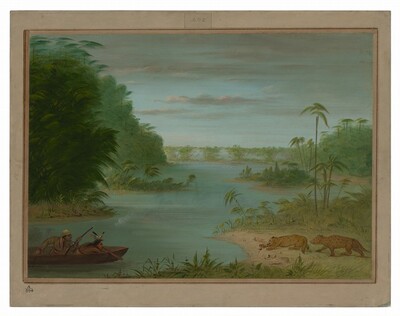
The image shows a serene river landscape from a slightly elevated angle. The horizon is near the upper third of the painting with a dense strip of forest lining the riverbanks in the distance. Two animals are scavenging for food on a sandy bank to the right, and to the left, near us, a small canoe with two figures is quietly paddling. The brushstrokes are smooth and detailed, capturing the lush foliage and gentle ripples on the water. The color palette is natural with rich greens of the vegetation contrasting with soft blues and earthy tones of the river and sky.

Pont de Palmiers and Tiger Shooting

Catlin, George

The image shows a landscape scene with a rocky terrain, cascading water forming a waterfall, and a stream. There are dense forests, distant mountains, and peaks in the background. Detailed engravings capture the trees' texture and the play of light and shadow. The color palette is monochromatic with shades of black, gray, and white. Light clouds are visible in the sky above the landscape.

Mountain Waterfall

Calame, Alexandre

The sculpture is a blue vase with a tall, slender neck that widens into a bulbous body before tapering towards the bottom. The vase is made from smooth ceramic material and stands upright with a symmetrical shape, reflecting light.

Amphora Vase

Chinese Qing Dynasty

The image features a hairpin with a detailed circular design on top, primarily in gold and brown tones. Surrounding it are two faded gray sketches of the hairpin. The color palette consists of beige, gold, brown, and gray. The background color is light beige.

Amber Hairpin

American 20th Century

The image shows a man from mid-chest upwards. He is facing forward but slightly turned to his right. The man has a round face with a prominent nose and full lips. He has thick, curly hair extending down to his shoulders. He wears a formal robe with a wide, white collar. Surrounding him is an elaborate oval frame with classical motifs and a coat of arms at the bottom, including two greyhounds and a swan. The background includes decorative engravings and text encircling the figure.

Nicolas Le Camus

Schuppen, Peter Ludwig van

The image shows a sketch of two half-body figures. One figure, on the left, is standing upright wearing a long-sleeved garment with an emblem over the chest. He has a mustache, short hair, and a stern expression, with one hand on his hip. The second figure, on the right, is less detailed, leaning forward with an obscured face and short hair. The sketch is set on a plain, light-colored background with scribbles and the phrase "En 1871" and a signature in the bottom right corner.

En 1871

Forain, Jean-Louis

The sculpture is a bas-relief image of a man's profile on a circular coin. The man has long hair flowing down his neck. The coin has inscriptions around its edge in a classical font, similar to "IOANNE STEFAN BENTIVOLVS." The coin is metallic, with a silver or gray color, and a shiny, reflective surface. The sculpture is relatively flat with detailed engravings of the man's profile and text. The craftsmanship emphasizes the contours of the man's face, including his nose, lips, and chin.

Giovanni II Bentivoglio, 1443-1509, Lord of Bologna 1462-1506 [obverse]

Bolognese 15th Century

The image displays a block of text in a serif typeface, with evenly spaced lines and justified alignment. Below the text is an abstract black and white illustration portraying a cluster of angular shapes and lines that suggest human faces and figures. The abstract forms resemble a crowd or a group of people, with some elements hinting at eyes, noses, and mouths amidst swirling lines. The figures appear intertwined, conveying a sense of movement or congregation.

Die Morgue (The Morgue) (in-text plate) from mock-up of Georg Heym: Umbra Vitae (Georg Heym: Shadow of Life)

Kirchner, Ernst Ludwig

This is a black and white photographic series capturing a sequence of movements associated with a domestic laundry chore. The series comprises multiple frames arranged in two rows. Each frame shows the progression of action, beginning with handling a laundry item and ending with laying it out. The background features a patterned backdrop and a partially visible bucket. The series depicts fluid transitions between actions, providing a time-lapse effect and highlighting physical gestures involved in the task. The photograph breaks down movement into visual elements reminiscent of early motion studies.

Plate Number 434. Hanging clothes on a line

Muybridge, Eadweard

This painting shows a man from the waist up, his body turned slightly to the right. He stands upright, looking at the viewer, holding a golf club or cane horizontally with both hands. The man has a neutral facial expression and a light complexion, a blond mustache, and neatly combed blond hair. He wears a white shirt under a pale yellow sweater and a brown coat, along with a red bow tie. He also has a long, multi-colored scarf draped over his shoulders with red and green stripes visible. The background is gray and becomes slightly lighter around the man's head and darker around the edges.

Chester Dale

Bellows, George

This is a drawing of a group of armored figures. The individuals are depicted wearing classical and elaborate armor. They appear to be focusing on something central. The scene is detailed, with intricate designs on their helms and clothes. The setting suggests a natural environment, possibly under a tree or tent. The color palette consists mainly of shades of brown.

Dying Epaminondas

Prestel, Johann Gottlieb

Roll-top Desk (Bureau à cylindre)

Roll-top Desk (Bureau à cylindre)

Riesener, Jean-Henri

The image shows two bonnets with ribbons for tying, displayed against a plain background. The bonnets have delicate lace trimmings, with the left one adorned with blue flowers and dark centers. The color palette includes beige, cream, and blue. Positioned centrally, the bonnets are laid side by side, facing slightly outward, each with long ribbons flowing downward.

Bonnet

Mosher, Stella

This is a drawing of a dragon coiled around an elaborate vase. The vase features intricate designs and scenes, including figures and symbols, with the dragon clutching a piece of paper labelled "U.S. TREATY." The setting evokes a sense of cultural diplomacy or negotiation. The illustration contains a variety of elements that seem to portray a blend of Eastern and Western motifs, with a focus on the ornate style of the vase's artwork and the powerful presence of the dragon. The drawing is detailed with an ink rendering, conveying a sense of intricate craftsmanship both in the depiction of the mythical creature and the decoratively illustrated vase.

A Diplomatic (Chinese) Design Presented to U.S.

Nast, Thomas

The image depicts a study of two male figures showing their back and waist up, focusing on the muscular anatomy. Both figures have broad shoulders and defined muscular backs, with detailed attention given to the curvature and tension of the muscles. They are in seated positions, slightly turned to the side. The drawing does not show their heads in full detail, but some facial features such as the outline of the jaw and part of the ear can be seen. The hair is suggested by flowing lines. The sketch is rendered in a reddish-brown medium on a textured, light background, possibly paper. The background is plain, and there are visible stains and marks on the paper.

Two Nudes

Italian 17th Century

The sculpture is a medallion with a portrait in profile of a bearded man facing to the right. The subject appears to be mature with detailed facial features, including a prominent nose, curly hair, and a thick beard. The medallion is circular and made of bronze with an aged, golden-brown patina. There is an inscription encircling the portrait along the edge of the medallion, partially obscured in the image. The raised relief of the portrait provides a three-dimensional quality, highlighting the subject's attire and facial features in relation to the flat background.

Pietro Lauro, born 1508, Modenese Poet and Scholar [obverse]

Master I.A.V.F.

The image depicts complex shapes and lines on a red background. The shapes resemble human figures in different poses - two standing and two sitting, enclosed in rectangular outlines. The figures appear stylized with emphasis on form. Black shapes interconnect, creating a puzzle-like composition where the figures interact within outlined spaces.

Vorsatz (back endpapers) from Georg Heym: Umbra Vitae (Georg Heym: The Shadow of Life)

Kirchner, Ernst Ludwig

This grayscale photograph is a portrait of two people, visible from the knees up. They both have pale skin and dark hair. A man is seated on the left, facing forward. He has pale skin and short, dark hair styled into a curl on top of his head. He is wearing a dark suit with a white shirt and a black collar. A woman is seated on the right. Her hair is parted in the middle and styled into bunches above her ears. She is wearing a dark dress with a checkered pattern around the collar and white cuffs. She holds a small book in her hands. The backdrop is plain and dark. The photograph is enclosed in a gold frame with some dark specks and discolorations. Around that frame is a dark wooden frame with some red trim.

Portrait of a Couple

Washington, Augustus

A young girl with dark hair and pale skin, wearing a long white dress, kneels on the ground in a hilly, tree-lined landscape in this vertical portrait painting. The girl sits close to us, her body slightly angled to our left as she looks toward and reaches for a rose bush potted in a tall, brown urn along the left edge of the painting. She has pale gray eyes under faint brows and a delicate, pointed nose. Her round cheeks are flushed, and her pink bow lips are closed. Her chestnut-brown hair curls at the neck of her clothing, and bangs cover her forehead under a lacy white bonnet. Light glistens off her lace-edged black cape, which is tied at her throat. The full skirt of her white dress pillows like a cloud on the ground around her legs, and she has a wide, teal-blue sash around her waist. With her right arm, farther from us, she reaches out to touch a pink blossom with a gloved hand. The fingers of the butter-yellow gloves have been folded back. Her other hand rests with exposed fingers in a loose fist in near her knee. Behind her, gently rolling hills are dotted with leafy green trees silhouetted against a stretch of white sky just above the low horizon. Painted in smoky gray, ivory white, and pale, blush pink, the thin clouds against the topaz-blue sky fills the upper two-thirds of the picture. The painting is inscribed with gold paint in the lower right corner: “Lady Caroline Howard” and “Lady Cawdor.”

Lady Caroline Howard

Reynolds, Joshua, Sir

The image shows a courtyard with columns, arches, a balustrade, statues, and a tower in the distance. The scene is depicted with meticulous detail using a monochromatic color palette of shades of gray to emphasize light and shadow. A fountain with intricate details sits at the center, with open walkways leading to more secluded areas.

Palace Courtyard with Fountain in a Rectangular Basin

Doetechum, Lucas van

This is a photograph of an ornate ceramic plate with intricate designs. The plate features a central circular motif with a black bird standing on stylized wheat or hay against an orange background. Surrounding the central motif are blue and gray decorations, including winged cherub-like faces and scrolls, with various words inscribed on them, such as "SPQR," "AMAS," "DIO," and "GADI." The plate has a richly detailed and symmetrical design, combining vibrant colors and classical elements.

Broad-rimmed bowl with border of urns and cherubs' heads; in the center, device of a bird standing on a bundle with the inscription VINCENZO

Urbino district 16th Century

This is a painting of an ornate altar with three statues. The painting depicts a structured architectural altar with intricate detailing and ornate embellishments. It features three niches containing statues on a marble facade. The central statue is taller, flanked by two smaller ones on either side. The altar is embellished with decorative blue and gold patterns, and there are columns and archways adding to the structural beauty. The base of the altar has a textured design with floral and geometric motifs. The floor is a warm terracotta, contrasting with the cooler tones of the altar.

Side Altar, San Luis Rey Mission

Kieckhofel, William

The image shows a portrait of a man positioned directly towards the viewer. He has a pointed mustache, a small goatee, curly hair falling around his shoulders, and sharp facial features. He is dressed in an elaborate garment with vertical stripes and a large ruffled collar typical of the period style. The background consists of a detailed oval frame enclosing the portrait, with the name "PIERRE DE MARCASSVS" inscribed below. The engraving style of the artwork adds a rich texture to both the subject and the surrounding space.

Pierre de Marcassus

Lasne, Michel

The image portrays a sketch of a rustic building complex with multiple connected structures, viewed from an elevated angle. The main building and its reflection are prominent, set against a horizon at the lower part of the image. Delicate pencil strokes and light shading capture the architecture, foliage, and surroundings, creating depth and texture. The color scheme features varying shades of gray on a beige background, evoking a timeless quality. A body of water reflects part of the building, with trees and bushes surrounding the structures, enhancing the tranquil and pastoral ambiance.

Seine et Marne

Mielatz, Charles Frederick William

The sculpture depicts two figures: a man and a creature with a human-like upper body and snake-like lower body. The man is nude, exhibiting a strong, muscular build, and is positioned in a dynamic stance, with one arm raised and holding the creature by its hair. The creature appears to be female, with intricate details in the long, serpentine curls of her hair that end in snake heads, and her tail is coiled on the ground. Both figures are crafted within a rectangular frame. The sculpture is composed of a dark, metallic material that gives it a glossy finish. The figures emerge in relief from the flat background.

Hercules and the Lernaean Hydra

Moderno

This is a print depicting various people on a stage, casting dramatic shadows on the walls. In the bottom left corner, the dark silhouettes of people watch the stage, which stretches diagonally across the scene. A thin arched pole hangs down on the stage, under which three people are gathered, two standing and one sitting, working with a hammer. On the left of the stage are three people dancing together, one person in the center with horns in mid-step, and a person on the right standing next to a goat. There are also two winged cherubs hanging from strings above the dancing figures. The shadows of these people are projected onto the wall or screen behind them, and the shadows of the three people under the arch are massive, taking up most of the print. The backdrop features faint outlines of vegetation, clouds, and a coat of arms. On the right edge, several people peek out from behind the backdrop.

Inleyding tot de Hooge Schoole der Schilderkonst (Introduction to the Noble School of Painting)

Hoogstraten, Samuel van

The image shows a group of four people. Three women and one man are present. The oldest woman, sitting in the center, wears a bonnet with lace details and a dark dress. She has a calm expression. A younger woman stands behind her. A child stands to the left, leaning on the older woman. On the right, the man is seated at a small ornate table with his hand on a book, wearing a dark formal suit with a white shirt and cravat. The background appears textured, possibly a patterned fabric or wallpaper. The photograph has a sepia tone.

Rev Ebenezer Miller and family

Hill, David Octavius

The painting depicts an elevated point of view of a broad landscape. The horizon is high in the image, showing distant mountains against a light blue sky with scattered clouds. The brushstrokes are smooth and blended, creating depth and atmosphere. The color palette includes earthy greens and browns in the landscape, and cooler blues and grays in the mountains and sky. Close to us, a group of horses stands near trees, with figures by a river and a waterfall in the background. The middle ground contains more trees and greenery leading to the distant horizon.

Falls of the Snake River

Catlin, George

The image depicts an ancient ruin surrounded by trees and vegetation. The perspective is slightly elevated, showing the ruin, greenery, and hills in the distance. The artwork features intricate details of stone, foliage, and texture, using a monochromatic color palette of various shades of gray. Closest to the viewer are remnants of classical architecture partly covered by greenery, leading to a landscape with dense clusters of trees and a cloudy sky.

Avanzi della Bibliotheca in Villa Adriana

Reinhart, Johann Christian

This is a painting of a mythological scene on a decorative plate. The scene depicted involves several figures engaged in an active, dynamic composition. The central figure is supported or carried by several other figures along a landscape filled with vibrant colors, including greens, blues, and warm earth tones. The background features an idyllic landscape with trees and rocky formations under a sky exhibiting gradations of blue and orange hues. A figure to the left appears to be playing a musical instrument. This is in the style of Renaissance majolica pottery, encompassing mythological and classical themes painted with vivid colors on ceramic ware.

Plate with the Triumph of Bacchus

Italian 16th Century

The sculpture portrays three figures in a baseball scene. Two are standing, and one is crouched on the ground. The left figure is a pitcher in mid-throw, wearing a blue and yellow uniform. In the middle, the figure is the batter, holding a bat and dressed in a blue shirt labeled "BOSTON" and yellow pants. The figure on the right is crouched and looking upwards. Each figure has dark skin, and the sculpture features vibrant colors such as yellow, blue, brown, and red. The material appears to be painted metal, and the sculpture is mounted on a base with decorative elements and the text "DARK TOWN BATTERY." The sculpture's details are prominent and stylized, capturing a dynamic moment in a baseball game.

Toy Bank: Darktown Battery

Tallman, Verna

This is a drawing of a scene in a forest featuring intertwined figures and various animals. The intricate line work depicts two central figures, one giving an apple to the other, with a snake entwined around a tree nearby. There are also depictions of a badger and a goat at their feet, and the scene is filled with dense foliage and branches. The composition is carefully balanced with detailed textures in the bark of the trees and the fur of the animals. The strong contrast created by the black and white ink work adds depth and drama to the scene.

The Fall of Man

Dürer, Albrecht

The image depicts a terraced structure with a row of arches on the left side. The top of the stone structure is adorned with small decorative sculptures. The drawing shows detailed textures, including leafy trees and stone surfaces, created through fine pencil strokes. The color palette is monochromatic with shades of grey. The trees appear to recede into the distance, while the stone steps and walls closer to us provide a sturdy appearance.

The Fishpond at Villa Madama

Vien, Joseph-Marie

The sculpture is a round object resembling an old coin or medallion. The design features a central motif with a pointed, arrow-like figure surrounded by four circular patterns encased within a lobed border. The material appears to be metal, likely silver or a similar alloy, with a silver-gray color and areas of tarnish. Around the edges, there is an inscription or series of symbols. The sculpture is relatively flat with raised designs and inscriptions.

Four-wheeled Carro, Heraldic Symbol of the Carrara Family [reverse]

Paduan 14th Century

The image features angular lines and bold black shapes forming an abstract design. On the left side, there is a block of text with a striking font amidst fluid shapes on the right. The abstract lines on the right suggest elongated figures or flowing fabric. The design merges text with fluid forms, combining the appearance of a book cover or a poster with abstract expression.

title page for Alfred Döblin: Das Stiftsfräulein und der Tod (Alfred Döblin: The Canoness and Death)

Kirchner, Ernst Ludwig

The image is captured from a ground-level point of view, looking down a winding path surrounded by dense trees and foliage. The path disappears into the distance, with no clear end in sight. The photograph is monochromatic, akin to early photography, creating a sepia-toned effect. Greenery and tall trees line the path, casting shadows, while three figures in light clothing sit at the edge of the path. The composition and color palette of the image give a serene, timeless nature scene.

At Winterdyne on the Severn

Gresley, Francis

This painting features a landscape with a winding dirt path surrounded by foliage. In the background, there are hills and mountains. On the left is row of buildings below tall brown cliffs, including a white church with a steeple. A body of water with sailboats can be seen in the distance on the right. The color palette is warm, with earthy tones including greens, browns, yellow, and oranges, with shades of pink and purple in the cloudy sky.

Lake George and the Village of Caldwell

Chambers, Thomas

The image depicts a night scene with two figures walking along a dimly lit path. The horizon line is obscured by darkness and shadow, creating a sense of depth as it fades into the dark sky. The sky is filled with textured strokes, conveying movement and a tumultuous atmosphere. The figures are close to us, one carrying a lantern that illuminates the path and their legs, contrasting against the darkness. The brushstrokes are detailed and intricate, defining the figures and path with fine lines. The color palette is monochromatic, using black and gray tones to enhance the dramatic mood. The light from the lantern illuminates the man and child, casting long shadows and creating an eerie ambiance.

The Search for an Inn (La Recherche d'une auberge)

Daubigny, Charles-François

This is a vase that features delicate white flowers with brown branches and a small gray bird. The vase is predominantly green. At the bottom of the vase there are some tall triangular shapes in lighter shades of green which may be representing the tops of mountains.

Baluster Vase

Chinese Qing Dynasty

Two figures are depicted in an upright position. The central figure is an adult with a beard and short curly hair, wearing a long brown robe with a green inner garment and a red outer garment. They are holding a child dressed in a red garment. The adult is holding a staff with a cross at the top in their left hand, while supporting the child with their right arm. The background shows a landscape with trees and a cloudy sky, indicating an outdoor setting. The scene is framed by a rectangular border with a decorative fan-like shape at the top.

Retablo

Lorenzini, Eldora P.

The image shows a man from the waist up facing forward with a slight turn to his right. He has a neatly trimmed beard and mustache. He wears a large, dark hat and formal attire with an ornate ruff around his neck, a patterned cloak, and a chain or decorative clasp. The portrait's framework includes flowing banners with Latin inscriptions and two cherubs holding scepters and a coat of arms at the top. The background features intricate patterns and engravings.

Thomas Howard, First Earl of Suffolk

Elstrack, Renold

The image displays a composition of curved lines, undefined shapes, and a partial semicircle. Within this abstract sketch are figures that could resemble two people, potentially in seated or crouching positions. Above these figures are smaller shapes that might suggest clouds or birds. Towards the bottom right, there are vertical lines and small circles that could represent plant life, hinting at a garden or natural setting.

Study for a Lunette [recto]

Pearce, Charles Sprague

The sculpture depicts a scene with a central figure laying horizontally, supported by surrounding figures. The central figure is in a semi-reclined pose with an exposed torso and draped lower body. The surrounding figures have distinct expressions and gestures. The sculpture is made of a dark bronze or bronze-like material, giving it a rich hue with subtle highlights. The figures are densely packed in high relief, creating a dynamic three-dimensional quality.

The Entombment

Briosco, called Riccio, Andrea

This is a drawing of the facade of a theater building. The image shows a detailed architectural illustration of a building with classical elements such as arches and columns, featuring two levels of evenly spaced windows with decorative pediments above each. The Italian text around the drawing indicates that this is the design or plan of a "new theater" in Bologna, dedicated to Count Girolamo Legnani by Lorenzo Capponi. The typography and style of the text reflect a formal and historical presentation, possibly indicative of an 18th-century document.

Pianta e spaccato del nuovo teatro di Bologna

Capponi

Portrait of a Scientist

Portrait of a Scientist

Unknown 19th Century
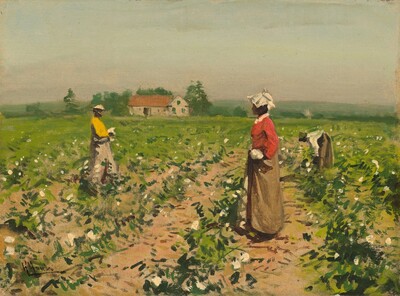
This painting depicts a green field of cotton plants with white blossoms. Three individuals are seen harvesting the cotton. They appear to be wearing skirts and bonnets and have dark skin, although their faces aren’t detailed. The background includes buildings on the left and green trees against a pale blue sky with hints of grey. The painting utilizes loose, visible brushstrokes. The color scheme is warm and natural, featuring shades of green, brown, and muted tones.

Picking Cotton

Gaul, William Gilbert

The image shows a bird's-eye view of a rural scene with ruins and distant landscape. The intricate 18th-century style with black and white color palette emphasizes textural detail and contrast. Remnants of architectural elements and figures can be seen among scattered ruins. A wall with foliage is in the foreground, while the background shows a rugged terrain with more ruins and vegetation.

Sepulcro de famiglia de' Scipioni

Piranesi, Giovanni Battista

This is a photograph of a decorative ceramic vase. The vase features intricate, colorful designs with a central motif of a mythical creature, with a human-like upper body seated atop it. The creature is set against a vibrant background of rolling hills and a sky. Surrounding the main scene are ornate leaf patterns and swirls in shades of deep blue, green, yellow, and orange. The neck of the vase is adorned with additional decorative patterns and motifs. A wide band at the base of the image contains a script in stylized lettering.

Tall drug bottle with two babies riding a griffin

Pompei, Orazio

There is a rectangular wooden box painted with intricate floral designs. The color palette consists of earthy tones like beige and brown, accented by vibrant reds, yellows, blues, and greens. The floral motifs are on the top and front of the box, set against a dotted blue background bordered by a red and white striped pattern. This box is positioned centrally in the image.

Utility Box

Scrymser, Christabel

The image depicts a low angle view across a calm body of water with boats and buildings. The horizon line is high, marked by trees and structures. The boats dominate the right side, while buildings line the left. The technique uses fine brushstrokes, giving an ethereal quality. The color palette is monochromatic with tones of brown and gray, creating a serene atmosphere. The contrast between dark sails and lighter elements adds visual impact.

Hurlingham

Whistler, James McNeill

Self-Portrait

Self-Portrait

Kirchner, Ernst Ludwig

The image shows a medallion featuring a side profile of a man's head and shoulders. The medallion is inscribed with "SIR JOSHUA REYNOLDS" around the edge and "KIRK.F" beneath the bust. The medallion is crafted from a brownish metal with distinct, sculpted features including curly hair and neck drapery. The relief work creates depth and texture.

Sir Joshua Reynolds, 1723-1792, Painter [obverse]

Kirk, John

The image shows a page from a book with text in German above a black and white illustration. The illustration is located towards the bottom of the page, just above the page number 18. It depicts a stylized landscape or scene with arched structures resembling domes or arches at the center, surrounded by foliage or trees. The bold and rough brushstrokes or carving technique create contrasts and a sense of movement. The color palette is monochromatic, with black ink on a cream-colored page. The horizon is not defined, but the composition directs the focus towards the central arch formations, emphasizing depth and structure. There are no visible elements in the distance or background, as the composition concentrates on the central elements.

Mond (Moon) (in-text plate) from mock-up of Georg Heym: Umbra Vitae (Georg Heym: Shadow of Life)

Kirchner, Ernst Ludwig

The image shows a rocky cliff photographed from a side, slightly elevated point of view, with a person standing on the large boulders near the top. The horizon is mostly obscured by the massive rock formation. The texture of the rocks is rough and weathered. The color palette is earthy and muted, with a historical or vintage feel. The sky above is a uniform light hue, contrasting with the darker tones of the rock face and soil.

The Logan Rock, South Coast of Cornwall

May, William

The image shows a rustic interior with large objects, including a collection of ceramic pots, bowls, and raw vegetables like cabbages, carrots, and onions in the foreground. The color palette is earthy and warm, with browns, beiges, and muted greens. A table is on the left side of the image where several people are seated, while in the center, a man with his arm around a woman stands in front of a stone archway, surrounded by pottery on a wooden table. In the background, another figure can be seen through a doorway.

Tavern Scene with Standing Couple

Buesem, Jan Jansz van

The image displays a side profile drawing of a woman's head and shoulders. She is looking to the side with delicate facial features, including emphasized eyes and nose. She has an updo hairstyle with soft waves and the drawing is in sepia tones. The focus is on her face and hair, with a plain background.

Tête de femme, profil à droite (Head of a Woman in Profile to the Right)

Gandara, Antonio de la

This is a photograph of an ornate wooden table. The table features curved legs with gold accents, intricate floral marquetry, and a hinged decorative panel.

Writing and Toilet Table (table mécanique)

Oeben, Jean-François

The sculpture is of a horse in mid-gallop, crafted from wood with a weathered, grayish-brown color. The horse has a simplistic design with visible grain and texture, showcasing a rustic appearance. Its legs are extended and the mane is flowing, conveying a sense of movement. One of its legs has a rod-like support underneath it. The sculpture is flat and in a folk-art style, set against a light-colored backdrop.

Weather Vane

Pohle, Robert

The image displays a landscape from an elevated point of view. The horizon shows rolling hills reaching into the distance, with faint outlines of mountains visible. A large tree is depicted on the right with detailed etching emphasizing the texture of bark and leaves. Linear brushstrokes capture the landscape and foliage. The color palette is monochromatic with a sepia tone, creating a serene atmosphere. Gentle hills and trees are visible in the distance under a calm, overcast sky.

Top of the Hill (Le haut de la colline)

Legros, Alphonse

The image shows a person in a seated position, partially turned to the side, with their upper body exposed from the waist up. The person is resting their head on their folded arms, which are propped up on a surface. The facial features are detailed with a focused expression, and the person has short, slightly wavy hair. There is no clothing visible, as the sketch includes the depiction of their torso and arms. No jewelry or objects are noticeable. The background is plain, emphasizing the figure without additional context. The page is light with faint sketch lines around the figure, and a signature is present at the bottom right corner.

Female Nude Seated

Legros, Alphonse

The image shows a medallion featuring a side profile of a man with curly hair and a short beard, wearing a buttoned-up garment with a high collar. The medallion is circular with text inscribed along the edge saying "IAC . ANT . SORRA." The material of the sculpture seems to be a reddish-brown metal, likely copper, giving it a distinct color and texture. The man's profile is presented in relief against the flat background of the medallion, providing clear visibility of his facial features and clothing details.

Jacopo Antonio Sorra [obverse]

Abondio, Antonio

De plurimis claris selectisque Mulieribus

De plurimis claris selectisque Mulieribus

Italian 15th Century

The remains of a rectangular porch-like portico are photographed in tones of ash-brown and black in this horizontal albumen print. The roof of the portico is held up by six marble columns carved into the shape of women wearing robes that fall in long, vertical folds. The women all face forward, and some of their features are weathered. All are missing their arms. The portico and structure behind it are constructed with massive, squared blocks. A man wearing a suit and a bowler hat sits drawing in the corner where the portico meets the bulk of the building, near the lower right corner of the photograph. Fragments of reliefs and other architectural ornaments are lined up behind and next to him. A few scrubby plants grow on the dirt ground, and the sky above is a washed out white. White text angled up across the lower right corner reads, “D. CONSTANTIN.”

The Caryatides

Constantine, Dimetrius

The painting depicts three adults and a child. The central adult, a woman, holds the child securely to her chest. The woman has pale skin and a white cloth covering her head, and she is wearing a dark cloak over a red robe. The child has curly light brown hair and is unclothed, looking towards the left. A bald man with a white beard, wearing a red garment and holding a key is on the left. On the right, another woman wears a white headscarf and a dark garment, holding a red cross. The background is dark, highlighting the people and their attire. All four of them have thin halos around their heads.

Madonna and Child with Saints

Anonymous Artist

The image displays a landscape from a slightly elevated viewpoint. The horizon is not distinct, with a dense cluster of trees and vegetation covering undulating terrain. An ancient stone bridge with sturdy arches and an aged appearance is in the middle ground, partially obscured by greenery. The bridge spans a small rocky stream. In the foreground, some cattle are grazing near the water. The brushstrokes are delicate and precise, capturing details like leaves, stones, and the bridge's texture. The monochromatic palette is mainly black, gray, and white, highlighting contrasts and depth in the landscape.

Ponte Acquoreo a Tivoli

Reinhart, Johann Christian

The image shows a decorative ceramic bowl with a vibrant yellow glaze as its primary color. The bowl has intricate green patterns of stylized clouds interspersed with motifs in red and blue. The design forms a continuous band around the external surface of the bowl, and the rim is adorned with a green band featuring a repeating circular pattern. The bowl has a gently flared form and fine detailing, indicating artisanal quality.

Bowl

Chinese Qing Dynasty

The image depicts a long, flowing dress in soft, muted green with intricate detailing on the sleeves and a train spreading out at the hem. The dress is shown in profile view, with the bodice at the top and the train trailing to the lower right. The bodice area shows the dress form, and the pleated skirt falls downwards elegantly.

Gown

Campbell, Douglas

The image shows a portrait of a man from the waist up, slightly angled to the right but gazing directly at the viewer. He has a high forehead with receding curly hair, a narrow chin, a sharp nose, and a small mustache. He is wearing a formal outfit with a white collar and a cloak. Behind him is a shelf with books, and there is text at the bottom identifying him as Sir Kenelme Digby, aged 62, with a description of his status.

Sir Kenelm Digby

Cross, Thomas

This is a painting of a geometric pattern with abstract and organic elements. The image features intersecting lines and shapes forming a lattice-like background in earthy tones of brown and green. Two elongated leaf-like shapes are seen over this pattern, with subtle touches of blue along the edges. The artwork is minimalist, relying on texture and pattern.

Study for a Border Design [recto]

Pearce, Charles Sprague

This is a photograph of an ancient coin. The coin features a detailed engraving of two robed figures in profile, facing each other and reaching out their hands. Surrounding the figures is an inscription that includes the year "1532" and the text "CONCORDIA." The edges of the coin are slightly worn, and there is a raised, beaded border encircling the figures and inscriptions. The overall patina is a muted, aged bronze.

Antonio Da Mula and Marcantonio Trevisan [reverse]

Spinelli, Andrea

The image depicts a detailed architectural view from an elevated position, showcasing a grand basilica and its surrounding structures. The horizon is above the clustered buildings, highlighting the facades and the sky with clouds. The architectural style is characterized by intricate line work, with classical columns and statues on the facade. The color palette includes shades of black, white, and grey. People are gathered on the left, with a path leading to the centrally positioned basilica. In the distance, there are more classical buildings or ruins.

Les Plus Beaux Edifices de Rome Moderne...

Montagu, Domenico

Portrait of Men with Telephone Equipment

Portrait of Men with Telephone Equipment

American 19th Century

The image depicts a night-time riverscape with a view from the bank of a river. The horizon is in the upper third of the painting, where the river meets a line of trees fading into the night. The brushstrokes give an impressionistic texture to the foliage and water, creating movement and depth. The color palette consists of deep blues and blacks, with a red-orange glow near a light source by the river bank illuminating nearby vegetation. A canoe with figures moves on the water near the light, heading towards the dim shorelines. Dark clouds loom in the upper portion, emphasizing the nocturnal setting.

Spearing by Torchlight

Catlin, George

The image features a man standing confidently. He has a rifle over one shoulder and one hand on his hip. His head is turned slightly to the side, showing a profile with a mustache. He wears a feathered hat, a doublet with puffed sleeves, a high collar, fitted breeches, knee-length socks, and stylish shoes. A sash or cloak drapes across his chest, and a sword hangs at his side. The background shows a landscape with hills, figures engaged in activities, tents, and clouds in the sky.

Musketeer

Gheyn II, Jacques de

Pax with a Miniature of the Nativity

Pax with a Miniature of the Nativity

European 19th Century

This is a drawing of a striped blue dress with detailed sketches. The dress has a fitted bodice with puffed sleeves and a full skirt, featuring horizontal and vertical blue and white stripes and blue detailing. Adjacent to the dress is a simple sketch of a headpiece or accessory. The drawing lacks a background.

Child's Dress

Price, Ray

The image shows a portrait of a person displayed from the mid-torso up. The individual faces slightly to the left, with their gaze forward. They have a pale complexion, delicate facial features, and powdered hair styled pulled back. The person wears a garment with a red fur-trimmed collar and a light blue bow at the neckline. No jewelry is visible. The background features an oval frame with decorative leaf motifs on a dark, textured backdrop. An inscription below the oval states the name and title of the person depicted.

Marie-Antoinette, Dauphine

Bonnet, Louis-Marin

The image shows a drawing of two people in an interior setting. On the left, a standing man wearing a long coat and hat is facing towards the other person. He is holding a bag over his shoulder. To the right, a woman is lying in a bed with pillows, wearing a nightcap and nightgown. She has wide eyes and an open mouth. The background is simple. French text is inscribed in the upper and lower portions of the image.

Elections Municipales

Forain, Jean-Louis

The image shows a sculpted relief featuring a central figure with long hair, a beard, and a crown of thorns, positioned in front of a cross. The central figure has eyes closed and hands crossed over its torso, displaying marks or wounds. Two smaller angelic figures with wings are on either side, kneeling and holding their hands together. The sculpture is made of a golden material, giving it a rich and luminous appearance. It is set within a rectangular frame, and the background features an arch pattern at the bottom.

The Dead Christ with Two Angels

Bellano, Bartolomeo

This is a drawing of a figure with an animal-like mask in a dark outfit holding objects. The image is on the right page of an open book, with German text on the left page. The drawing is done in a monochromatic style, primarily using dark shades against a lighter background, suggesting a chaotic or urban environment with rough textures and a sense of movement. The figure's stance and the composition contribute to an unsettling atmosphere.

Akaki geht ratlos auf der Straße (Akaki Walks Helplessly on the Street) (plate 4) from Der Mantel (The Coat)

Gramatté, Walter

The image shows a portrait of two young children, with their upper bodies and torsos visible. The child on the left has short, curly hair and wears a coat with light-colored fur trim, holding a hat with a wide brim and plume. The child on the right has medium-length, straight hair and wears a dress with puffed sleeves. Both children have neutral expressions. The background is plain and dark, and the portrait is framed with an ornate border with a gold and red design.

Portrait of Two Children

American 19th Century

William Henry Cavendish Bentinck, 3rd Duke of Portland

William Henry Cavendish Bentinck, 3rd Duke of Portland

Pratt, Matthew

The image displays an array of plants and foliage. The largest plants are tall, slender stems with clusters of small flowers on the right side. The color scheme is monochrome, with varying shades of black and white. Broad leaves are in the foreground, while climbers and floral tendrils rise on the left side. The detailing indicates a flourishing, natural growth in the scene.

La petite berle aux liserons (Small Water-parsnip with Bindweed)

Bléry, Eugène

This is a photograph of a hexagonal ceramic cup. The cup has a flat, hexagonal base and a wide opening at the top. The interior of the cup is yellow, contrasting with the exterior decoration. The exterior features intricate designs in muted greens, yellows, black, and white. The designs are floral and abstract patterns. The handle is curved and matches the cup's artistic theme. The style suggests a blend of traditional and artistic elements, focusing on symmetry and color harmony.

Wine Cup

Chinese Qing Dynasty

This is a painting of a statue. The image depicts a statue of a figure adorned in a red draped garment with yellow trim. The figure stands on a square base, with their back facing the viewer. The statue has long black hair and a headdress featuring multicolored feathers. The posture of the statue suggests a gesture with a raised right arm. The background is off-white, emphasizing the detailed rendering of the statue.

Cigar Store Indian

Hochstrasser, Walter

The image shows a portrait of an elderly man from the waist up, seated in a chair. He is positioned facing the viewer with his right arm resting on the armrest of his chair and his left hand holding a piece of fabric in his lap. The man has a white beard and mustache, deep-set eyes, and a high forehead. His hair is short and covered by a cap. He is wearing a dark, full-sleeved garment with buttons down the front, and a large ruffed collar. A bracelet is visible on his left wrist. On a table around him, several books, writing implements, including a quill, are laid out. The background is a textured, dark surface that contrasts with his clothing and skin, drawing attention to his presence.

Gellius de Bouma

Visscher, Cornelis

The image shows a woman in profile, standing with her left arm on a railing. She has delicate facial features, soft lines, and curly hair under a wide-brimmed hat with ribbons or feathers. She wears a long gown with puffy sleeves and a fitted waist, along with a necklace featuring a circular pendant. The background displays faint, unfinished sketches and intricate line work around the woman, possibly hinting at a setting or other figures. The artwork conveys grace and poise in pencil and watercolor.

Maria Cosway with Her Daughter Louisa

Cosway, Richard

The sculpture is a circular medallion featuring the profile of a man. He has a beard and wears what appears to be armor with detailed engravings, including a cross-like design. The material of the medallion is metal with an aged, greenish-brown patina. The medallion is inscribed with text along its border, including the name "RICARDVS SCHELLEIVS PRIOR ANGLIE" in engraved capital letters. The sculpture's subject is depicted in a raised relief format against the flat background of the medallion. There is a small hole at the upper part, suggesting it may have been intended to be hung or worn.

Sir Richard Shelley, c. 1513-c. 1589, Prior of England in Malta and Turcopolier [obverse]

Rantwyck, Bernardo
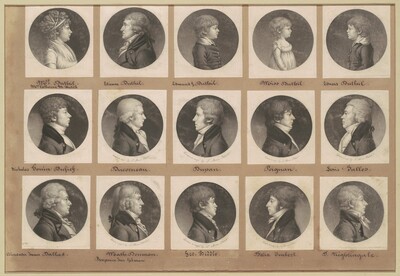
The image shows 12 engraved profiles displayed in a grid layout. Each profile depicts the upper body of a person, from head to shoulders, facing mostly to the side. The individuals wear late 18th to early 19th-century attire, with varying hairstyles and clothing styles. Men have a range of hairstyles, from short to tied back, without visible facial hair, wearing open jackets with high collars and cravats. Women have decorated hairstyles and some show their necks and upper garments, with one wearing a shoulderless dress. There is no jewelry or objects visible in the portraits. Each portrait is set in a circular vignette on a monochrome background, with handwritten names underneath. The grid layout has a historic aesthetic with sepia-toned coloration.

Saint-Mémin Collection of Portraits, Group 19

Saint-Mémin, Charles B. J. Févret de

The image shows a waterfall streaming between trees, with water flowing over rocks in the foreground. The viewpoint is from below the falls, looking upwards towards the cascading water from a distance. The scene conveys depth as the viewer's eye follows the water's path to the edge. The horizon is hidden by trees and rocks around the waterfall. The monochrome sepia palette highlights the textures of the trees and rocks, creating a timeless feel. The water appears smooth, contrasting the rough surfaces of the rocks. The image captures the power and beauty of nature, focusing on the interaction between the water and the landscape.

Pi-wy-ack (Cataract of Diamonds), Vernal Falls, Yosemite Valley, California

Muybridge, Eadweard

This painting is a portrait of a man from his chest up. He is positioned slightly angled to the left and looks directly at us. His skin is pale, and he has rosy cheeks, deep-set, dark eyes, a long, straight nose, and thin lips set in a neutral expression. His hair is light gray, combed back from his face and curled above his ears. He is wearing a black coat over a white, high-collared shirt and a white lace cravat. The background is dark brown.

George Washington

Stuart, Gilbert

The image depicts a young boy in a bust-length view. He is standing in a frontal position with his face directly towards the viewer. The boy's facial features include round cheeks and a slight pout or a neutral expression. His hair is covered by a cap. He is dressed in a dark-colored high-collared shirt with a prominent bow at the neck and a band across the chest. The background features a sketch-like drawing of an outdoor scene, possibly a garden or yard, with abstract outlines of plants and a wooden fence, along with a broom leaning against it. The scene is monochromatic, rendered in shades of brown against a light paper background.

Le petit épicier (Chandlery)

Delâtre, Eugène

The image shows a person in a dynamic stance. The individual has a serene facial expression and styled hair with a ribbon or similar ornament. They wear ornate clothing, possibly a tunic, with draped fabric. The person holds a mirror with a decorative handle in one hand and extends the other hand upward. The background includes ornate pillars, an alcove, lush greenery, mountains, trees, and a cobbled path. Floral motifs adorn the tapestry surrounding the person.

The Four Cardinal Virtues: Prudence

Netherlandish 16th Century

This is a painting of a certificate or document with intricate decoration. The design includes vibrant floral motifs and two winged figures on either side, a circular text area in the center, and ornate circular borders with colorful flowers and patterns. The angels are positioned in the upper part of the painting and are adorned with bright clothing and wings. Floral arrangements frame the composition in rich, earthy tones. The style is reminiscent of traditional Pennsylvania German Fraktur art, known for its elaborate and decorative elements incorporating calligraphy and symbolic imagery.

Pa. German Birth Certificate

Anderson, Elmer G.

The image shows a profile portrait of a man named G. W. Bedinger. He is depicted facing left, with his right side visible. He has distinct facial features, including a straight nose and a distinctive chin, with wavy hair neatly combed. He is dressed in formal attire, consisting of a dark coat with a high collar and a cravat around his neck. The portrait is set against a simple, circular frame with a textured backdrop, and the inscription below reads "G. W. Bedinger" in cursive script.

George Michael Bedinger

Saint-Mémin, Charles B. J. Févret de

This is a drawing of a person's head and upper torso. The subject's head is tilted slightly to the left, and they are looking upward. The person has a cherubic face with full cheeks, a small, slightly open mouth, a small nose, and large eyes, and they appear to have light skin. Their hair is short and wavy, with soft curls around their face. The person is unclothed, with their bare shoulders and upper chest visible. The drawing has been done in thin red lines on off-white paper.

Head of a Child

Legros, Alphonse

The sculpture depicts a relief carving of a male figure standing in an elegant pose, holding a staff entwined with a serpent. The figure is shown in profile, facing left, with a defined muscular form. The staff, known as a caduceus, is held in the left hand resting on the ground. The sculpture is crafted from a material that appears weathered and earthy brown in color, suggesting it might be made of bronze or a similar metal that has aged over time. This small, oval-shaped relief has a detailed and textured surface, reflecting light to highlight its contours and enhance the three-dimensional quality of the figure. The edges of the oval frame the figure, adding a sense of completeness to the composition.

Aesculapius

Florentine 15th Century

This is a drawing of an abstract coastal cityscape. The drawing shows stylized cityscape with contrasts in black and white, likely done through a woodcut print technique. The image depicts abstract architectural forms: domes, arches, and steps spiraling upwards. Clouds or waves fill the sky. Beneath the drawing, text in German describes poetic imagery associated with the sea and city.

Die Meerstädte (The Sea Cities) (headpiece, page 20) from Georg Heym: Umbra Vitae (Georg Heym: The Shadow of Life)

Kirchner, Ernst Ludwig

This is a photograph of a sequence of black and white frames capturing a person running. The frames show different stages of the running motion in both side and frontal views. Each frame freezes a moment in time, depicting the movement of limbs and body. The background is plain, emphasizing the motion of the subject. The style is reminiscent of early motion studies in photography.

Plate Number 68. Running

Muybridge, Eadweard

Two women and a baby, all with pale skin, sit together on a gray, stone throne with patterned fabric hanging behind them and a patterned rug below in this narrow, vertical painting. The woman sitting on the throne, Saint Anne, is the largest. A second woman, Mary, is smaller in scale, and she sits on Saint Anne’s lap. Mary, in turn, holds a nude baby boy on her lap. Both women have light brown eyes under faint, arched brows, smooth skin, long straight noses, and their shell-pink lips are closed. Saint Anne sits with her body facing us and she looks down with her head slightly tilted to our left. Her white head covering drapes over her shoulders and hangs down from her chin to cover her neck. She wears a marine-blue dress cinched at her waist with a black and gold belt, and a crimson-red robe that falls to and puddles around her feet. Her right arm, on our left, wraps around and holds Mary’s hip, and she supports a book with gold-edged pages with her other hand. Mary sits on Saint Anne’s right thigh, to our left, and leans toward the baby, who sits on her left knee, to our right. Her long, wavy, brown hair falls over her shoulders, and she wears a cobalt-blue robe over a lilac-purple dress. The baby has short, curly blond hair and reaches to turn the pages of the book. He has rounded cheeks and a pudgy torso. The stone throne is ornamented on the arms and at the top corners with ivory-white, nude children that are presumably also carved out of stone. The cloth hanging behind Saint Anne is decorated with glimmering gold, ornamental leaf designs against a pine-green background. The rug beneath her feet is a geometric pattern of red, tan, black, and white.

The Saint Anne Altarpiece: Saint Anne with the Virgin and Child [middle panel]

David, Gerard

The image is an etching of an ancient ruin, showing grand columns from a low perspective. The horizon is low, emphasizing the tall columns which break the line, with remnants of foliage or sculptural decoration on top. The lines are intricate, creating texture and depth on the stone surfaces. The color scheme is monochromatic, enhancing the classic feel. Beyond the columns, buildings and ruins fade into the distance. Small figures and livestock give a sense of scale. The sky has delicate clouds, creating a serene ambiance.

Vestigi del tempio del Giove Statore

Piranesi, Giovanni Battista

This is a photograph of a decorative ceramic plate featuring an intricate design with concentric circles. The plate has a central motif of two hands shaking, surrounded by blue, orange, and white colors and various geometric patterns. The inner border has zigzag and triangular shapes, while the outer border alternates between blue and orange segments. The plate includes an inscription "FIL FEL" on a blue ribbon-like band. The design suggests a traditional or historical style of pottery.

Plate with clasped hands

Faenza 15th Century

The image depicts a doll standing upright. The doll has a pale complexion, dark eyes, and small lips. It has a black bob hairstyle and wears a long dress with a greenish top and purple sash, along with black shoes. The background is plain and light-colored.

Walking Doll (Mechanical)

Lowry, Mina
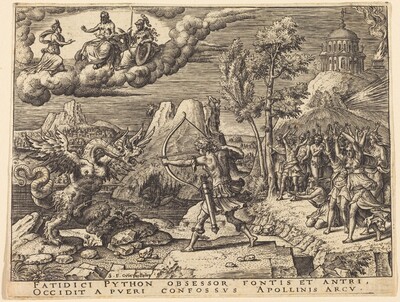
This is a painting of a battle scene. The image depicts a confrontation between a winged serpent-like creature and an archer at the center. Surrounding them are onlookers with various emotional reactions. In the sky above, three figures are seated on clouds. The background includes architectural structures and natural elements.

Apollo Killing Python

Delaune, Etienne

The Fantastic Rocks and Castle at Bomarzo [verso]

The Fantastic Rocks and Castle at Bomarzo [verso]

Breenbergh, Bartholomeus

The sculpture depicts a standing figure holding a staff in a slightly raised relief on a round medallion or disk. The figure is dressed in flowing robes and is positioned centrally on the disk. The sculpture is primarily brown with visible signs of aging, likely made of metal given its corroded surface with green patina. The figure appears to be carved in a style influenced by classical art. The word "CONSTANTIA" is inscribed below the figure. A small hole is visible at the top of the disk.

Constancy Holding a Staff and Resting on a Column [reverse]

Anonymous Artist
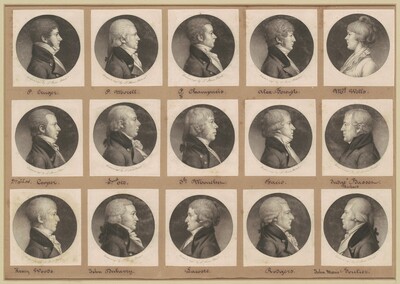
Fifteen portrait drawings are arranged in a grid, each showing the upper body of an individual in profile. The people are positioned facing either left or right within circular frames. Each portrait captures the side view of the person's face, highlighting their distinct facial features and hairstyles. The men have various hairstyles typical of an earlier era, some with short hair, some with curls, and others with powdered wigs. There is one woman portrayed in the top right with her hair styled in an updo. They all wear formal clothing; the men in high-collared coats and cravats, and the woman in a high-necked garment with a shawl. The background of each portrait is plain. The images are bordered by a brown matte, and each portrait has the individual's name handwritten beneath it.

Saint-Mémin Collection of Portraits, Group 21

Saint-Mémin, Charles B. J. Févret de

The image depicts a rugged landscape with large rock formations dominating the right side. The horizon is situated in the upper third of the image, mostly obscured by towering cliffs. The rock surfaces rise steeply from the water, with varied tones. The water is still, mirroring the cliffs and enhancing the vertical lines. The color palette is monochromatic with sepia tones. In the distance, the cliffs continue, interspersed with shadows.

Black Canyon, Colorado River, Looking Below from Big Horn Camp, #4

O'Sullivan, Timothy H.

This is a painting of a scene with a large cross at the center. The painting depicts a gathering around the cross, with angelic figures flying above amidst clouds. Some of these angels hold instruments, garlands, or tall staffs. On the ground, a group of individuals in colorful attire surround the bottom of the cross with a backdrop of a classical cityscape, including arches and stone buildings. In the bottom left, a man wearing a white cloth on his waist kneels down in front of the cross, his hands raised in prayer. To the right, two women in flowing clothes of gold and seafoam-green look at the cross, one resting her hand on it. At the very top of the painting, above the cross, is a pale-yellow arch.

The Exaltation of the True Cross

Ricci, Sebastiano
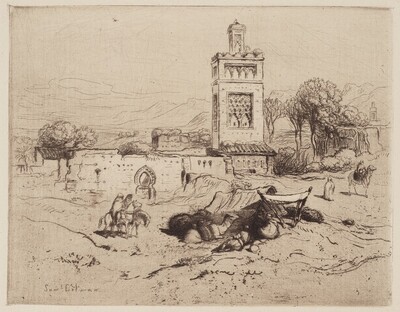
The image is depicted from a slightly elevated point of view. The horizon line is relatively low, with a series of distant mountains or hills. A tower with intricate architectural details is visible on the horizon. In the foreground, there are figures, objects like baskets or bags, and a textile structure. To the right, two figures on horses and a pedestrian are present. The brushstrokes are detailed, with a sketch-like quality emphasizing contour and texture. The palette is monochromatic, with sepia or brown tones. The background shows open skies with lightly sketched clouds.

Ruins of a Mosque, Tlemciem, Algeria

Colman, Samuel
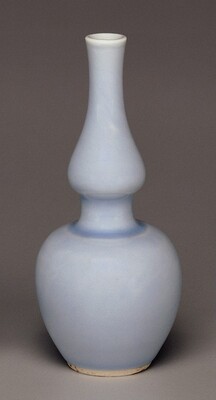
The sculpture depicts a vase with a bulbous lower body tapering into a slender neck. It is pale blue and made of ceramic. The vase has smooth curves and a glossy finish, exuding refinement and delicate craftsmanship. The neutral background accentuates its details and color.

Gourd-Shaped Vase

Chinese Qing Dynasty

The image shows a metal tool with a saw-like edge and a cylindrical handle connected by a bent arm. The color palette includes grays, silvers, and a brownish-yellow for the wooden handle. The tool is in the center of a rectangular outline on an off-white background.

Chopping Blade

Szilvasy, Mae

The black and white etching depicts a winter scene from a slightly elevated perspective. The horizon is high, showing rolling hills, trees, and a large barren tree on the left. The detailed and linear brushstrokes create textures in the snow, sky, and structures. The scene includes a dog, a horse-drawn sleigh, two figures, and a snow-covered building with icicles. The monochromatic color palette emphasizes the snowy landscape and architecture through light and shadow.

Hauling the Milk

Denison, Harold

The image depicts a portrait drawing of a man's upper body. The man is positioned in a three-quarter view, looking directly at the viewer with a composed expression. He has distinctive facial features including a wide forehead, arched eyebrows, deep-set eyes, a pointed mustache, and a slightly curly beard. His medium-length, curly hair frames his face. He is dressed in a dark garment with a wide, white lace-trimmed collar, and there is a hanging piece of string or tassel on his clothing. The background is plain with a textured appearance suggesting the medium of pencil or charcoal.

Portrait of a Man

Keyser, Thomas de

The sculpture is a round medal featuring the side profile of a man with long hair and a beard. The subject appears to be an older individual with pronounced facial features and a thoughtful expression. The sculpture is made of metal, likely bronze, as indicated by its rich brown and copper tones with hints of patina. The artwork is finely detailed, capturing the intricate lines of the man's hair and the texture of his beard. Surrounding his profile are inscriptions, including the name "Auguste Vacquerie" and other textual engravings.

Auguste Vacquerie, 1819-1895, Writer and Critic

Ringel d'Illzach, Jean Désiré
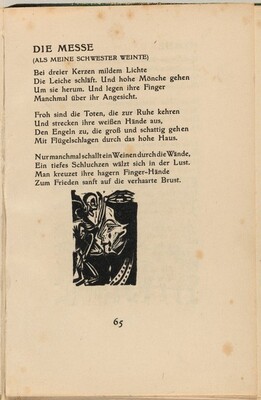
On the page, a bold abstract shape is positioned beneath a block of text. This dark, jagged shape consists of angular lines and contrasting areas of black and white, forming a pattern. The flowing, curved lines within the shape could be seen as stylized facial features or draped fabric. This form creates an organic contrast to the rectangular, orderly text above it.

Die Messe (The Mass) (in-text plate) from mock-up of Georg Heym: Umbra Vitae (Georg Heym: Shadow of Life)

Kirchner, Ernst Ludwig

This is a sepia-toned photograph of a group of people riding horses that stand on a grassy field with mountain peaks in the background. The people and horses are in a horizontal line across the photograph, all facing the left. The people have dark skin and black hair tied in two braids, many of which are adorned with long black-and-white feathers. They wear long pants, some with tassels or fringe, and many of them appear to have bare chests. The person on the far left has several strands of white beads around their neck and down their chest, and the person behind them holds a long spear. The backdrop consists of light gray mountains with snow caps against a pale sky.

The Pass Finders, Piegan, Montana

Reed, Roland W.

Shown from the thighs up, a woman holding a baby is surrounded by a man, woman, and two winged angels in this vertical painting. Mary, the central woman, the baby, Jesus, and the other woman, Saint Catherine of Alexandria, have pale, peach-toned skin. The man, Saint Jerome, and two angels have slightly darker peach-colored skin with faint gray shading. They all have gold halos, wide-set, hooded, light brown eyes, long, straight noses, delicate mouths, and pointed chins where we can see. Mary sits with her knees angled to our right, and she looks down at the baby held sitting upright near that shoulder. The crown of her head is covered by a white veil down to her forehead. A lapis-blue cloak drapes over the back of her head, her shoulders, and across her lap. There is a gold starburst on the right shoulder, to our left, and the cloak is edged in gold. The dress she wears is patterned ruby red on garnet red and decorated with shimmering, bright gold designs. She supports Jesus’s bottom with her left hand, to our right, and braces his chest with her other hand. He has small features with chubby cheeks, a high hairline with blond hair, and a chubby body. He grips the neckline of her dress with his right hand, to our left, and touches the hand that holds his chest with the other. He is nude except for a translucent white cloth around his chest and hips. To our left, Saint Jerome looks down at and writes in a book with a dark green cover using a feather quill. He is balding and has a long white beard. His forehead is lined, his cheeks hollow, and his lips parted. He wears a red robe over a white garment with a white collar. To our right, Saint Catherine looks at Jesus and holds a blue-covered book and black quill pen in one hand and a fragment of a wooden wheel lined with spikes with the other. Her blond hair is wrapped with and around a white cloth, and she wears a white-on-white patterned dress under a silver-gray cloak. One angel looks on from between Mary and the other looks up and to our right from behind Jesus. Both have their lips parted. The one to our right wears a pale pink garment and holds up one hand. The background is shiny, bright gold punched along the top and upper corners with a geometric design.

Madonna and Child with Saint Jerome, Saint Catherine of Alexandria, and Angels

Giovanni, Matteo di

The image is an etching of a ruinous arch, slightly off-center, with intricate line work to depict its structure. The horizon is above the arch, showing vegetation and rugged terrain in the distance. The etching displays textures representing flora and stone, with shadows and depth created by dense hatching. The sky is light with airy cross-hatching. The color palette is black on off-white paper. Foliage and rough ground are detailed near the arch, and ancient stonework and rocky formations extend into the landscape beyond.

Arco di Pola in Istria

Piranesi, Giovanni Battista

This is a photograph of an intricately designed rug. The rug displays a classic Persian motif with a central medallion and a complex pattern of floral designs and arabesques set against a rich red background. The design is symmetrical, featuring ornate flourishes and scrolling patterns in muted tones of blue, gold, and cream, with hints of green. The border of the rug is decorated with larger floral patterns and vines, framing the central design. The craftsmanship reveals a detailed weaving technique that highlights the artistry and cultural heritage associated with handmade carpets. The aged appearance of the rug suggests it holds historical value and has been preserved over time.

Arabesque Band Carpet

Indian 17th Century

The image shows a large, round jug with a single handle. The jug has a muted color palette with shades of brown, gray, and hints of blue on the handle. The spout faces slightly toward the right, and the handle connects to the neck. The jug casts a shadow to the right against a light background.

Cider Jug

Hoxie, Jerome

This is a drawing of a document enclosed in a decorative border. The central focus is a handwritten text enclosed within an ornamental frame, featuring towers at each side which culminate in stylized flaming torches. At the top, there are cloud-like designs with two diagonal lines converging towards the center. At the bottom, the words "Loi Sunaire" are written above a decorative element featuring a burning flame atop a small platform with three legs, surrounded by rays. The border includes decorative details such as stars and a bird-like figure at the base. The style is characterized by intricate line work and symbolic imagery.

La Loi lunaire, 1er planche ("Lunar" Law, 1st plate)

Meryon, Charles

The image shows three outlined figures in varying levels of completion. The first figure on the left has its torso sketched with an outline of a cap. The middle figure appears more detailed, in a profile view with head down, gesturing hands, possibly leaning. This figure wears a coat and a hat. The smaller figure at the bottom left is sketched in a few simple lines, suggesting an abstract form or posture. The figures are drawn in pencil strokes on a blank background, with no additional details or scenery.

Figure Studies

Linnell, John

The relief depicts a group of figures engaged in hunting. There is a central archer aiming a bow at a target, with a dog by their side. Another figure is stepping back cautiously, while a third figure stands holding a staff. The sculpture is made of bronze or bronze-toned material, set on a rectangular plaque with a textured surface and framed by a border. It appears small in scale relative to human size.

Martyrdom of Saint Sebastian

Enzola, Gianfrancesco

The image shows a drawing of a man leaning over a table, engrossed in writing. He has a furrowed brow and his hands are on a piece of paper. The setting is a simple workspace with the man in focus and a dark background behind him.

Der Titularrat Akaki Akaki-jewitsch (The Titular Council Akaki Akakiyevich) (plate 2) from Der Mantel (The Coat)

Gramatté, Walter

This grayscale photograph shows a young girl sitting on a dark wooden-framed sofa with an opened book on her lap, her head tilted downward to look at it. She has pale skin and her facial features are slightly blurred. She is wearing a light-colored dress with long sleeves, dark stockings, and black shoes. Her long hair is flowing down her shoulders. The room has a patterned carpet and a framed picture on the otherwise blank wall behind her.

Miss Grace

White, Clarence H.

Study for "Breton Women at a Pardon"

Study for "Breton Women at a Pardon"

Dagnan-Bouveret, Pascal-Adolphe-Jean

The image displays an abstract wave-like line on the left, with tendrils curving upwards. On the right, there is a figure with a round head and simple body sitting on an abstract formation. In the center, there are abstract forms implying the movement of a fish-like creature. The artwork blends organic and abstract elements, creating a dreamlike landscape with a whimsical twist.

Der Baum der Sehnsucht (The Tree of Longing)

Hoerle, Heinrich
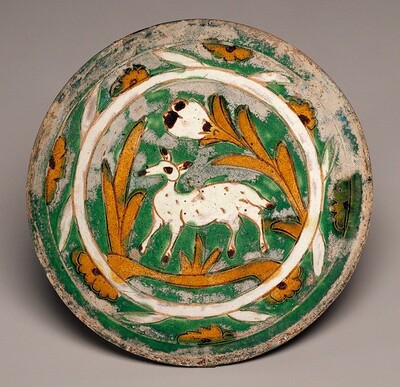
Dish

Dish

Chinese Jin Dynasty

The image shows a brown leather saddle with floral designs. The saddle has a brown color palette with varying shades. It is placed against a light background.

Saddle

Blakeley, Hal

This is a painting of three birds among tall grass. The artwork depicts three Least Bittern birds in a natural setting. The birds are shown with their long necks and extended beaks. The background consists of lush green tall grass. The intricate detailing of the feathers, the texture of the grass, and the posture of the birds capture a moment of stillness. This is in the style of John James Audubon.

Least Bittern

Havell, Jr., Robert

The image shows three figures standing together. They wear elaborate headdresses with feathers or decorations and voluminous clothing. The figures appear to be in a loosely gathered group, with two closer together on the right side and one standing slightly apart on the left. The figures have indistinct facial features and the background is plain and neutral.

Two Elegant Couples [verso]

Guardi, Francesco

The sculpture depicts a medallion featuring a side profile of a woman. She is wearing an elaborate headdress and a garment with rich folds and textures that suggest a high status. The medallion is crafted from a brown-toned material, likely bronze or a similar metal. Embedded around the edge of the medallion is a series of inscriptions in a refined, capitalized font. The woman's profile is detailed, with the headdress extending widely. The overall design and composition may suggest historical significance.

Anne of Hungary, died 1547, Wife of Ferdinand I of Austria 1521 [reverse]

German 16th Century

The image depicts an abstract black and white illustration with dynamic lines and shapes. At the top, there is a block of solid, dark lines and angular forms. In the middle, abstracted human and animal forms can be seen. The overall composition evokes a woodland scene with elements that suggest intertwined flora and fauna. Below the illustration, there is text printed in German and the numbering 35 is noted at the bottom right corner.

Der Sterbende Faun (The Dying Faun) (headpiece, page 35) from Georg Heym: Umbra Vitae (Georg Heym: The Shadow of Life)

Kirchner, Ernst Ludwig

This image shows a woman standing next to a small table. She is dressed in a dark, long-sleeved dress with a white collar. Her hair is neatly styled, and she has a composed expression on her face. She is resting her hand on the table, which has a decorative cloth draped over it. On the table, there is a black hat with a feather. The background is plain with a geometric patterned floor.

Portrait of a Civil War Widow

American 19th Century

This painting is a portrait of a man. He is seated on a red cushioned chair, turned slightly to the left, facing us. He has a pale complexion and a neutral expression, with dark eyebrows, rosy cheeks, and thin lips. His hair is gray, with curls falling to the sides around his ears. He is dressed in formal attire, wearing a dark red, double-breasted coat with large golden button and a white cravat around his neck. The man holds a pair of tan gloves in his left hand, and in front of him is a piece of red furniture covered with a red cloth. The background is a muted brown gradient.

Stephen Van Rensselaer III

Stuart, Gilbert

The image depicts a person standing with a wide stance and slightly leaning back. The person is facing away from the viewer, turned to the right side, head slightly inclined backward. The individual's facial features are obscured by a helmet. The person is wearing armor and holding a long spear or lance across their back. The background shows multiple figures in armor with spears or pikes, arranged in formation. The terrain consists of rolling hills with sparse vegetation under a sketched sky.

Pikeman

Gheyn II, Jacques de

The sculpture is a bowl-shaped piece with a small opening at the top. It is predominantly a muted reddish-pink color with areas of darker red speckles and is made from a ceramic material. The surface of the bowl features an embossed or carved design that incorporates a swirling pattern. The glossy finish gives the sculpture a refined appearance, and its compact size makes it appear similar in scale to a decorative tabletop item or pottery.

"Beehive" Water Pot

Chinese Qing Dynasty

The image shows a wooden drop-leaf table with turned legs against a plain backdrop. The color palette consists of various shades of brown, emphasizing the natural wood grain and finish. The table is positioned centrally, angled slightly to the left, displaying four visible legs with the drop-leaves down.

Dining Table

Cronk, Lon

The image shows a standing male leaning against a rectangular slab inscribed with text. He has a classical facial features, dark curly hair, and is nude with a cloth around his waist. He stands on a textured surface with a plain background. The scene is depicted in fine linework.

Title Page

Van Loo, Carle

This is a drawing of a medieval procession through a wooded landscape. The central figure is an elder riding a horse, dressed in a cloak and holding a staff. The horse is decorated, and other figures on foot accompany them, some with livestock. The figures are in medieval attire. In the background are mountains and a castle. The drawing uses black and white tones to create depth and texture.

The Count of Habsburg

Foltz, Philipp von

The sculpture is a bust depicting a person with an elaborate hairstyle characterized by voluminous curls. The figure has realistic facial features including eyes, nose, and lips, as well as a detailed representation of a draped garment over the shoulders. The sculpture is predominantly a light, weathered grey. The subject of the sculpture is positioned directly facing the viewer.

Linnaeus (Carl von Linn)

Rush, William

The image shows a design of jagged and curved lines forming abstract figures resembling human faces and bodies. The overlapping shapes create a sense of depth and complexity, with the figures appearing to emerge from one another. The composition evokes a chaotic unity, suggesting a bustling scene or crowded space.

Die Irren I (The Mad I) (in-text plate) from mock-up of Georg Heym: Umbra Vitae (Georg Heym: Shadow of Life)

Kirchner, Ernst Ludwig

The image depicts a young woman standing in a factory setting. She is positioned facing slightly toward the viewer, with her left arm outstretched near machinery. Her hair is short and styled away from her face. She wears a light-colored blouse with short sleeves and a dark ribbon tied at her neck. The background shows rows of machines with threads and spindles in an industrial building.

Portrait of a Weaving Mill Woman

Taylor

We look across a lush landscape of olive-green forests lining a glimmering, silvery-blue lake with hills in the deep distance under a pale blue sky in this horizontal landscape painting. The scene is painted with some visible and some blended brushstrokes to give it a hazy, soft appearance. A man wearing a red cap and a white shirt sits in a long, low, narrow boat with a pointed bow in the grasses along the shore, near the bottom center of the composition. Gnarled tree trunks, one to each side, frame the view beyond. Towering, leafy trees nearly fill the right half of the painting. To our left, the still surface of the lake leads back to a city painted almost in silhouette with flint blue, which is reflected in the surface of the water. Hills and mountains are painted in bands of lightening blue as they recede into the deep distance to our left. The horizon comes about a third of the way up the composition, and the pale sky above is veiled with soft white clouds. The painting is signed in orange letters in the lower left corner, “COROT,” and dated in the lower right, “JANVIER 1866.”

The Moored Boatman: Souvenir of an Italian Lake

Corot, Jean-Baptiste-Camille

The image is a bird's-eye view sketch depicting a village scene. The main structures are surrounded by human figures and animals. The sketch shows fine lines and detailed strokes capturing movement and activity. It is monochrome with shades of gray and black. Close to the viewer, various figures and animals are engaged in interactions, including villagers managing two horses. The village setting is rural with people engaging in daily activities, with visible roofs and chimneys in the distance.

Einzug

Palukst, Abraham

The sculpture is a shallow bowl with a wide, gently flaring rim, made from ceramic material with a brown glaze transitioning from dark to light. The surface is smooth with dark speckles, and the base has an unglazed textured ring.

Bowl

Japanese 19th Century

The image shows a ceramic jug with the text 'Merchant A. George 17 Milk St Boston' engraved on its surface. The color palette is simple, with shades of beige and brown. The jug is positioned centrally with a shadow below it, and no other objects are present in the image.

Pottery Jug

Godfrey, Frances

The image shows an illustration of a man standing confidently. His left hand is on his hip and his right hand holds a decorative staff. He has short, curly hair, high cheekbones, and a sharp gaze. The man wears a detailed outfit with a high collar, patterned jacket, puffed trousers, a sash, tights, ornate shoes, and a sword at his hip. The background features a detailed landscape with plowed fields, sparse vegetation, and distant hills. There is text at the bottom in a script-style font.

Gerrit de Jong

Goltzius, Hendrick

The image shows a pastoral scene with figures and a landscape. It is viewed from a slightly elevated perspective, showing the horizon towards the upper part, with a structure in the distance. A group of figures, including a seated man, woman, and child, are depicted in the foreground. The sunlight illuminates them. The brushstrokes are expressive and fluid, with a textured style. The color palette includes earthy browns and whites. A donkey is grazing in the distance, contributing to the rural atmosphere. The artwork presents a balance between figures and nature, capturing a tranquil moment.

The Rest on the Flight into Egypt

Tavella, Carlo Antonio

This is a photograph of an old coin. The coin features an engraving of a seated figure holding a branch with leaves or buds. Around the edge of the coin are inscriptions in a classical typeface, and the date "1552" is visible. The surface of the coin shows signs of age, with scratches and wear. The engraving is detailed, with emphasis on the flowing lines of the figure's draped clothing and the texture of the branch. The background is dark, highlighting the metallic sheen of the coin and drawing attention to its intricate design.

Victory [reverse]

Delaune, Etienne

This is a photograph of a closed album cover with French text. The album cover is made of a textured material with a dark green hue. It features embossed text in gold, stating "Dr Duche(enne de Boulogne)" and "MÉCANISME DE LA PHYSIONOMIE ALBUM" across the front. The text is centered, with varying sizes and styles to distinguish between titles and subtitles. Decorative horizontal lines are present above and below some of the text. The album is tied on the side with beige or light brown fabric ties. The overall appearance is formal.

Mécanisme de la Physionomie (The Mechanism of Human Facial Expression)

Duchenne (de Boulogne), Guillaume-Benjamin-Amant

The image shows black and white photographs depicting a person playing tennis in various poses. The person is captured standing, crouching, and leaning forward, with changing body orientations for a dynamic sense of motion. Their facial features show shadows, and they have short to medium-length hair. They wear a long, flowing garment resembling a toga and hold a tennis racket in some frames. The background features a grid pattern on the wall and a flat ground surface.

Plate Number 299. Playing with a ball

Muybridge, Eadweard

Apple Blossoms in a Vase

Apple Blossoms in a Vase

Heade, Martin Johnson

This is a drawing of an ornate architectural scene with lush foliage. The image features a detailed depiction of a stone balcony or terrace with classical architectural elements, including pillars and intricate carvings. To the left, abundant foliage surrounds parts of the stone structure. A large ornamental vase or urn is present, embellished with sculptural figures and patterns. The view through the railing reveals a garden or park area. At the bottom right of the image, two feet clad in shoes are visible behind a pillar. In the background, there is a dark sky with a flock of birds. The details capture a serene atmosphere with an interplay between nature and architecture.

In Flagranti

Klinger, Max

This is a painting of people and animals in a rich green landscape under a blue sky with one bright star. On the right, under an arch, there is a seated woman with an infant on her lap, one man standing behind her and another kneeling in front of her, a crown on the ground next to him. There are two more men with crowns standing near the kneeling man, both pointing towards the child. The left side shows more people standing and looking at the woman and child, with some mounted on horses. More people are walking down a tall hill on the left, coming towards us. The people are clothed in tunics and cloaks in bright shades of green, blue, and orange-yellow. Most of them have pale yellow skin, although one of the crowned men in front of the woman has brown skin.

Panel with the Adoration of the Magi

Nicola da Urbino

This is a drawing of a landscaped park or garden design. The illustration shows an area with pathways, clusters of trees, open lawns, and several buildings or structures marked in red. The landscape is bordered by rows of trees. The paths wind through different zones within the park. The presence of organized plantings and structured layouts suggests careful planning. The color palette includes green, brown, and red to highlight the vegetation and buildings. The drawing reflects a meticulous approach to landscape organization, emphasizing natural beauty and functional design.

Washington Park

Goldbaum, Meyer

The image shows a portrait of a person with a focus on the head and neck, particularly the face. The individual is facing slightly left with their gaze turned to the side. The face is detailed, showing features like a mustache, facial hair, and expressive eyes. The dark hair is slightly parted and falls around the head. The person wears a light-colored garment with a high collar close to the neck. The background is simple with subtle textures. The inscription "Rome" and the date "1917" are on the left side of the image.

Jules Destrée

Besnard, Albert

The image depicts a figure standing upright. The person is holding a scroll in each hand and is facing slightly to the left. The facial features are classical, with a serene expression. The person has long, wavy hair partially covered by draped fabric. The clothing is flowing and layered, resembling classical Greco-Roman attire. No visible jewelry is present. The background is plain and unadorned, with subtle shading.

Orante from the Villa Medici

David, Jacques-Louis

This is a photograph of an ancient coin featuring an engraved portrait. The coin displays a detailed profile of a figure with elaborate headwear adorned with floral motifs. The design includes finely engraved details on both the headdress and attire. The coin's border is inscribed with lettering. The overall craftsmanship reflects a careful attention to detail characteristic of such coinage.

Maria of Burgundy, 1457-1482, First Wife of Maximilian I 1477 [reverse]

Austrian 16th Century

The image depicts a man standing in a commanding pose. He is clothed in a tunic with decorative elements and holds a staff. The man has a beard, curly hair, and wears a crown-like headpiece. A ship with men aboard is visible in the background. Other figures and a person playing a musical instrument are present. The words "ΟYTIΣ. NEMO" are inscribed above the man.

OUTIS NEMO

Weiditz, II, Hans

The image shows a sculpture of a figure in robes on an ornate pedestal. The figure is standing upright with hands delicately positioned. The sculpture appears to be made of light-colored stone, possibly marble or limestone. It is located outdoors near leafless tree branches. In the background, there is a large, ornate building with multiple windows. The scale of the sculpture and pedestal makes it appear tall compared to the trees and the viewer's point of view.

Luxembourg, Anne of Brittany

Atget, Eugène

This painting shows a coastal scene with wooden rowboats on a sandy, rocky shore.  A white cloth and several ropes rest on the boat in the center, and two other boats are in a row behind it. On the left, brown stone structures are partially visible, with one in the background appearing to have been carved out of a rocky formation. A small figure is visible atop this structure, tending to what may be a clothesline. The rocks stretch across the painting, with some areas of bright, green-blue ocean visible around them. Small boats appear to sail on the water far in the distance. The light blue sky dominates the upper half of the painting, filled with puffy white clouds.

Marina Piccola, Capri

Haseltine, William Stanley

The image depicts three individuals in full-length view, each with distinct poses. The person on the left has curly hair, a winged helmet, and holds a torch. The central figure wears elaborate armor, a plumed helmet, and a detailed cape. The third individual on the right wears a crown of flowers and puffed clothing. The characters are dressed in historical or allegorical apparel with intricate designs. The background is plain, highlighting the detailed attire and symbolic elements.

A Blindfolded Cupid Holding a Torch Before a Couple

Dolendo, Zacharias

The image shows a pastoral landscape with fantastical creatures depicted in a colorful and vibrant style. Two half-human, half-animal figures are engaged in various activities within the scene, which features a vividly painted sky, a flowing stream, and lush greenery. The central roundel of the dish shows a smaller scene with a figure interacting with a creature inside a circular frame surrounded by a golden rim. On the right side, a rocky formation is visible with another creature climbing or reaching. The style is reminiscent of Early Italian Renaissance art, particularly maiolica ware known for intricate and colorful narrative scenes with mythological or fantastical themes.

Plate with three Satyrs

Gubbio 16th Century

The image features a wooden dresser with an ornately carved mirror on top of it. The dresser and mirror are primarily brown, with the mirror featuring some subtle blues and whites. Positioned centrally, the dresser is topped with a decorative mirror, which is framed with intricate wood carvings. The setup is against a plain, light-colored backdrop.

Bureau

Simon, Natalie

This painting features two seagulls perched on a rocky landscape against a dark background. One gull has white plumage, a yellow eye, and a yellow bill with a red spot on the lower mandible, standing on the foreground rock. The other gull has brown plumage and is lying on the rocks in the background. The painting shows detailed brushstrokes for the feathers, bill, and feet, and earthy tones for the rocks, indicating a coastal habitat. The style is reminiscent of John James Audubon.

Burgomaster Gull

Havell, Jr., Robert

The image shows two figures engaged in interaction. One figure is crouched down, reaching towards the standing figure on the right. The crouched figure has reddish-brown hair and wears a light-colored garment. The standing figure has dark hair and wears a robe-like attire. Both figures extend their hands towards each other. The background features an outdoor setting with greenery, trees, and a sky with blue and white swirls.

Study for a Lunette

Pearce, Charles Sprague

The sculpture in the image is of a bird with its wings partially spread. Surrounding the central bird are several smaller birds. The sculpture is crafted from a material that appears to be bronze, as indicated by its brownish metallic sheen. There is a circular composition. Engraved around the edge of the sculpture is a text, "LUATA PVDORE LAETA FOV CVNDITAS," and at the bottom, a small hole is present. The bird is shown in a relief style against a flat background.

Peahen with Six Chicks [reverse]

Poggini, Domenico

The image shows four black-and-white etchings of elderly men. Each etching features the upper body of a seated man, highlighting the face and shoulders. The men have long, bushy beards, deeply set eyes, and aged facial features. They wear different styles of hats: simple floppy hats in two etchings, and more embellished headgear in the others. The men wear heavy, draped clothing, possibly robes or cloaks, with fur trims on one figure. Two men hold writing instruments and parchments. The background is plain with shading for depth.

Raccolta di teste (Parts I and II)

Tiepolo, Giovanni Domenico

Plate Number 718. Cat; trotting; change to galloping

Plate Number 718. Cat; trotting; change to galloping

Muybridge, Eadweard

About two dozen men, women, children, and a baby sit in rows of wooden benches or on traveling trunks in this horizontal painting. Their skin is mostly pale with some ranging more toward pink and others toward tan. A woman nursing a baby sits in the center of the composition. Her blond hair is pulled back, and she wears a white blouse under a red vest and a long black skirt. Her shirt is pulled down to expose one breast, and the feeding baby wears a white bonnet and clothing, and is wrapped in a gray-patterned blanket. The woman sits on a wooden trunk in front of a young girl, who sits on a second chest just behind her and to our left. This girl has strawberry blond hair held back under a black headband, and she wears a blue shawl over a brick-red dress. Three silver pans, a silver jug, a glass bottle, and tin cup sit next to her trunk. She leans forward and looks intently off to our left. A man with a red beard wears glasses, a brown suit, and a flat-topped straw hat sits farther back in the room on the far side of bulging sacks and more trunks. He looks into the distance off to our right. Three men wearing black suits and two wearing black bowler hats sit facing each other just over this man’s shoulder. In the right two-thirds of the painting, more men wear fedoras, bowler hats, or brimless caps. Their clothing ranges from vests over button-down shirts to suits and ties. Some wear overcoats, and some are bearded. One man wears a military-style hat, a double-breasted black coat, and smokes a pipe with a white bowl. He looks toward the nursing woman, as does a standing man farther in the room. The men sit alone or chat in groups of two or three, and one sleeps, propped up against a fabric bag. A few more women are among the group, including one older woman who wears a yellow scarf tied over her head to the left. A sign hanging on a column behind the nursing woman begins with the text, “Emigrant Landing Depot” over columns of fine print. The walls of the room are mottled fog and cream white, and one visible window is small within the thick wall. The floor is wooden planks and there is a brown stain near the lower right corner.

In the Land of Promise, Castle Garden

Ulrich, Charles Frederic

In the image are two men within a natural setting. The man on the left has long hair wearing a military-style jacket, trousers, and boots, seated on a rock holding a spoon. The man on the right wears a tricorn hat, long coat, high socks, and shoes, standing in a leaning posture on a rock. Both men have distinct facial features. The background has a decorative border with tall plants and a clear surface.

Peter Schlemihl with the Bag of Money

Schrödter, Adolf

The sculpture is a circular gilded relief with a raised design featuring a profile portrait of a human head at its center. This central image is illustrated in vibrant shades of blue and green, depicting a person's head in profile with short hair, within a quatrefoil-shaped frame. The overall sculpture appears to be made of a metal that has been gilded, giving it a rich gold color. The background intricate pattern consists of geometric shapes, including crosses and lozenge forms, all embossed or engraved into the surface, creating a textured, three-dimensional appearance. The outer edge of the sculpture is bordered by a beaded pattern. It appears mounted on a dark background which enhances the golden hue of the metal.

Costume Ornament with Profile Portrait

North Italian 14th Century

The sculpture depicts a figure resembling a Native American man with a feathered headdress, dressed in a tunic-like garment with yellow and black detailing, red leggings, holding a bundle of cigars or a sheaf of tobacco in one hand and a small wooden barrel in the other. The sculpture is carved from wood and painted realistically, standing on a rectangular pedestal.

Cigar Store Indian

Hochstrasser, Walter
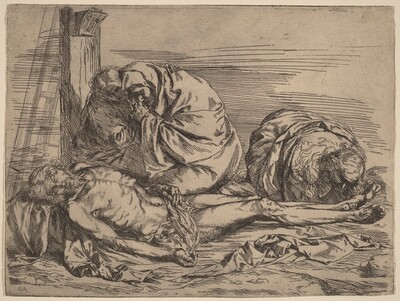
This is a drawing of three figures. In the center, one figure is reclining, supported by two robed figures who appear to be mourning. The background is depicted with simple, fine lines, and the use of shading and line work adds depth to the scene.

The Lamentation

Spanish 17th Century

The image displays the upper body of a person in a seated position, drawn in profile. The individual appears relaxed with their head slightly tilted forward, closed eyes, and a hint of a mustache. The neatly styled hair is combed to the side, and the person is wearing a high-collared garment, potentially a suit or coat. They are depicted holding a violin against their shoulder, with the bow held in their hand. The background is plain, focusing on the subject of the drawing.

The Violinist

Puvis de Chavannes, Pierre

This is a photograph of an ancient coin. The coin features designs with heraldic symbols, such as a shield with crosses and a crest above it. The surrounding text is carved in a serif font following the contour of the coin's edge. The surface of the coin displays a patina, suggesting age and handling.

Shield of Savoy [reverse]

Turin 16th Century

The image is an illustration of a figure on the right page of an open book. The person is leaning forward slightly, appearing focused on a task. The facial features are not distinct, and the hair seems dark and possibly short. The individual is dressed in dark clothing blending into the shadows. There are no visible accessories or objects. The background is minimalistic and dark, with a highlighted area indicating a window at the upper right casting light into the room. The page is filled with German text and contains a handwritten marking at the bottom of the illustration.

Akaki zeigt dem Schneider die auszubessernden Stellen (Akaki Shows the Tailor the Areas to be Mended) (plate 3) from Der Mantel (The Coat)

Gramatté, Walter

The image shows a vintage, framed sepia-toned photograph of a grand manor in an elevated landscape. The viewpoint is head-on, displaying the architectural features clearly. The horizon is marked by the manor's roofline and surrounding trees. The manor's structure is symmetrical with windows and a central entrance, flanked by trees. Below the manor is a greenhouse with a glass roof divided into sections. The photograph is framed in gold, giving it a formal, vintage look. The color scheme is warm and aged, adding a nostalgic feel to the image.

House with Greenhouse, Virginia

American 19th Century

Self-Portrait

Self-Portrait

Thayer, Abbott Handerson

The image shows a rocky cliffside with vegetation, a path along the edge, trees, people resting on ledges, a horizon over water, and low clouds. The etching technique uses fine, textured lines, creating depth and dimensionality. The color palette is monochromatic with dark ink and light paper.

Couple Resting on a Cliff

Calame, Alexandre

The image shows a sculpture designed to resemble a teapot. The sculpture depicts a traditional teapot structure, complete with a spout, lid, and handle. The teapot is circular in shape, featuring a cylindrical body on a small, rounded base, and a circular lid with a knob at the top. The knob is intricately detailed, resembling a small sculpted rose or floral element. The sculpture is off-white or ivory in color, with a glossy sheen and smooth finish. Vertical inscriptions are embossed on the teapot's side, adding intricate detail to its design.

Teapot

Chinese Qing Dynasty

This is a photograph of a piece of decorative fabric. The fabric features an intricate floral pattern in shades of red and beige, with detailed representations of leaves and flowers. The design is woven into the fabric, giving it a textured appearance. The red floral motifs are prominent against the neutral background. The fabric is displayed on a neutral background, which highlights the intricate detailing and craftsmanship of the fabric design.

Ingrain Carpet

Lefevere, Jules

The Prima Macchina for the Chinea of 1738: Allegory of Regal Providence

The Prima Macchina for the Chinea of 1738: Allegory of Regal Providence

Parrocel, Pierre

The sketch displays a full-length figure of a person standing in a gentle, fluid pose. The individual is shown in a classical draped stance, with one arm extended forward and the other near the chest. The facial features are softly sketched, with a slightly tilted head. The person's hair is styled in a swept-back manner. They are dressed in traditional draped garments with no visible jewelry or objects held. In the background, a lightly sketched architectural element or column is visible. The image is drawn in soft pencil on a plain background, highlighting the lines and folds of the clothing.

Woman in Toga [verso]

Robert, Hubert

The image is a bronze medallion with a side profile of a person's head and shoulders. The person appears to be wearing a headdress or cloak, with draped fabric covering the head and neck. The bronze material gives it a rich brown color with varied shades. The profile has a strong nose and a somewhat solemn expression, facing left. Inscriptions or lettering surround the profile, providing context to the subject. The medallion has a round shape and relief sculpting typical of historical art.

Possibly Diamante de' Medici, Wife of Giovanni Capponi [obverse]

Anonymous Artist

Bluemner Sketchbook

Bluemner Sketchbook

Bluemner, Oscar F.

The image shows four women seated on the floor with musical instruments partially visible. Two women on the left are playing instruments. The second from the left holds a string instrument resembling a biwa, and the woman furthest left appears to hold a shamisen. The women have traditional Japanese hairstyles with hairpins. Their faces are adorned with subtle makeup. They are dressed in traditional Japanese kimonos with serene colors. A small table in front of them holds what appears to be tea kettles and cups. The background features a painted screen with depictions of nature, showing foliage and possibly birds.

Musical Party

Beato, Felice

The painting depicts a rocky coastline dotted with color. The horizon is high in the scene, and a strip of pale-yellow sky is visible at the very top of the painting. Along the rocky coast in the distance, the colorful land meets vivid turquoise and green ocean waters, with white lines indicating small waves. A red-striped umbrella in the top left corner appears to shelter a person in a long white dress; the umbrella obscures their face. The rocks have been painted with thick dots of black, white, yellow, orange, red, and green. The brushstrokes are expressive and the paint has been thickly applied in dots and dashes.

Flecks of Foam

Dearth, Henry Golden

The image is a sketch of the upper body of a person in profile view. The figure is facing left, with their face turned towards another obscured figure in the background. The person has distinct facial features with a beard and short hair. The drawing is abstract with heavy lines and shading. There are no detailed clothing patterns. The background has bold, dark strokes, implying depth and complexity. The composition suggests an interaction between the foreground figure and the obscured figure in the background.

Death Visits the Strucks (Death and the Couple) (Tod bei Strucks [Tod und Paar]) from Dance of Death (Totentanz)

Corinth, Lovis

Square Vase

Square Vase

Chinese Qing Dynasty

The image shows a wooden chair with an elongated backrest and a cushion with a muted pattern. The chair is positioned centrally in profile against a creamy off-white background.

Chair

Thomas, Grace

The image depicts a portrait of an individual from the waist up, seated in a dignified posture and looking directly at the viewer with a composed expression. The person has detailed facial features, including eyes, a nose, and lips, along with short, styled hair. They wear an elaborate hat with a feather, a richly decorated garment with patterns and embellishments, a fur collar, a chain necklace with a pendant, and hold a fan in their right hand. Their left hand is resting against the clothing. The individual is framed by circles with text and scrolls, with a textured background and heraldic symbols on the sides.

Henry Stuart, Lord Darnley

Elstrack, Renold
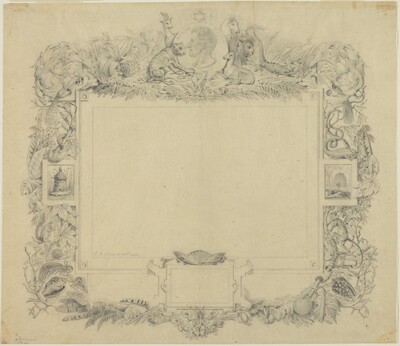
This is a drawing of an ornate decorative border featuring a variety of natural elements. The rectangular blank space is framed with intricate pencil drawings depicting flora and fauna. The border includes tropical plants, a leopard, a fox, a snake, various birds, a person, an animal, plants, flowers, animals such as frogs, fish, and reptiles, insects like butterflies and dragonflies, fruits, foliage, and additional natural elements. Two small drawings are included within the vertical borders, and the bottom center features a prominent butterfly image.

Design for a Border with a Portrait of Baron Cuvier

Arnout, Jean-Baptiste

This is a photograph of a metallic plate. The image shows a rectangular copper or brass plate with a slightly aged and tarnished surface. The plate has engraved text, with the name "EMILE VERNIER" prominently displayed in the center. Towards the bottom, partially visible, is the word "SOCIETAIRE". The plate's surface is marked by scratches and blemishes, and the edges are softly rounded.

Inscription [reverse]

Charpentier, Alexandre

The image shows swirling lines and shapes creating an intricate pattern on the surface, resembling marbling. This pattern can be associated with natural forms, like water movement or cloud swirls. It features colors such as green, gray, and yellow, enhancing its organic appearance. The design conveys dynamic movement within the still image, echoing familiar elements.

Scelta di XXIV Vedute delle principali Contrade, Piazze, Chiese, e Palazzi della Città di Firenze

Zocchi, Giuseppe

The image shows a man seated in a formal posture with his left arm resting on an upholstered armrest. He gazes directly at the camera with a calm yet attentive expression. His facial features include deep-set eyes, a broad nose, and lips that are closed in a neutral line. His hair is short, slightly curled, and neatly styled. He is dressed in a suit comprising a dark jacket over a plaid vest and a white shirt underneath, complemented by a light-colored bow tie. He wears a ring on his left hand's pinky finger. The backdrop is plain, focusing attention on the subject within a case featuring a maroon and gold border.

Portrait of a Man

Plumbe, John Jr.

This is a painting of a group of people gathered around a cave-like structure in a hilly landscape. The people have light skin and wear ornate and flowing robes in shades of pink, teal, and gold, and they are gathered closely together, some gesturing towards the cave. At the mouth of the cave, a man wrapped in strips of off-white cloth stands, looking out at the crowd. Two other men stand next to him, appearing to remove his cloth wrappings. To the right, in the center of the image, a man with long golden hair faces the cave and raises one arm. He wears blue and gold robes over a white garment, and his other hand holds a golden book. There is a halo behind his head. Behind him are ten other men of varying ages wearing colorful robes who also have halos. In the background are hills, greenery, and a sprawling city of white buildings with red roofs that extend towards the horizon. Tall palm trees punctuate the landscape, and the sky above is light blue with pink clouds.

The Raising of Lazarus

Gozzoli, Benozzo

The image depicts a landscape with a rural setting. The view is from a slightly elevated point, with an obstructed horizon due to tall trees and foliage. Buildings, likely cottages, line both sides of a narrow path, flanked by dense trees. The illustration is in a monochrome palette, with brown hues and shades of sepia. The composition leads the eye through the path and deeper into the cottages and surrounding nature.

Le chemin de Garens (The Road to Garens)

Bléry, Eugène

The image shows a decorative vase adorned with intricate designs of birds, cherry blossoms, branches, leaves, and rocks. The vase is primarily black with colorful details including blue and white blossoms, white and light blue birds, green leaves, and rocks. The material seems to be ceramic with a glossy finish, and the vase has a wide mouth and a curved form. The contrast between the vibrant colors and the black background makes the design visually striking.

Baluster Vase

Chinese Qing Dynasty

The image shows a large, rounded terracotta pot with a slightly flared rim, drawn within a squared border. The surface of the pot has a smooth texture, and the color palette includes earthy tones like brown and reddish-brown. In the bottom right corner, there is a smaller sketch of the same pot detailing its dimensions. The pot is centrally placed on a plain background while the smaller sketch is positioned in the bottom right corner.

Earthenware Pot

Aloisi, Anna

This is a drawing of a garden scene. The image shows elegantly dressed individuals dancing and socializing outdoors. The setting includes lush foliage, architecture, and a house with classic European design features. The figures are joyful, engaging in dancing and socializing near a table. There is musical accompaniment in the background, creating a celebratory mood in the garden party setting.

The Tavern

Basan, Pierre-François

The sketch shows multiple figures' upper bodies, centered around a standing person and two cherubic children. The central figure is an adult standing and presented in profile, gazing downward, with a serene expression. This figure has curly hair falling to the shoulders, classical features, a prominent nose, and a gentle smile. The clothing suggests classical drapery covering the torso loosely. Next to the central figure are two cherubic figures, mostly nude, with playful, rounded features and small wings. One cherub leans against the standing figure, while another lies across the lap of a seated figure. The background consists of simple, curved lines creating an arched frame, matching the page's shape, with no distinct setting depicted.

Charity

West, Benjamin

The sculpture is a round medallion depicting a profile portrait of a man inscribed with "NICOLAUS MALREGRESSIS VICECENSIS." The subject of the sculpture has distinct facial features, including a prominent nose and slightly open mouth, and is wearing a robe with a high collar. The figure has short hair that seems carefully styled. The color of the sculpture is predominantly a dark metallic brown with a hint of reddish patina.

Nicolas Maugras, Bishop of Uzes 1483-1503 [obverse]

Candida, Giovanni

Palazzi di Genova (vol. 2)

Palazzi di Genova (vol. 2)

Rubens, Peter Paul, Sir

The image shows a large, multi-story historical building on the right side of the frame. The building has ornate architectural detailing and reaches towards the sky. The horizon is low in the image, with manicured grass sloping up to the building. In the distance to the left, another structure with a spire is partially visible through trees. The image has a sepia-toned color palette. A gravel path runs along the front of the image, bordered by a lawn, trees, and shrubs. There are light and shadow variations indicating a bright day. The photograph conveys a sense of tranquility and historic significance.

Untitled

Rau, William H.

The image shows three full-body figures of Native American individuals. To the left stands a woman wrapped in a light-colored shawl, holding a small child on her back. The woman's hair is parted down the middle, and she wears a long turquoise dress and red shoes. In the center stands a man wearing a headdress with feathers, earrings, and several necklaces. He is dressed in a dark green outfit with decorative trim and red accents, and he holds a long rifle in his right hand. This man's face is adorned with red paint around his eyes. To the right, another man sits cross-legged on the ground, wearing a feathered headdress similar to the standing man. His attire is grey with decorative elements, and he holds a tomahawk in his hands. The background is an open landscape with a predominantly light blue sky and clouds. The image is framed by an oval border set within a larger rectangular frame.

Three Micmac Indians

Catlin, George

The image features a faint line drawing of a full-bodied person standing in a serene manner. The person has long hair, flowing robes, and is holding a small branch with leaves. No distinct facial features are visible in the light sketch. The background includes lightly sketched trees and a pathway. The overall appearance is soft and monochromatic, set within a neutral, lightly speckled beige or off-white paper background.

Léger relief pour une reliure (Light Relief for a Binding)

Dumont, Maurice

The image depicts a decorative ceramic plate with an artistic portrayal of a woman in profile. The woman is facing left, showcasing her upper body. She has delicate and idealized facial features with a serene expression. Her hair is styled with an intricate headdress adorned with ornamental elements. She wears a garment with detailed embellishments, likely representing period clothing, in warm earth tones with lacing details. A necklace is depicted around her neck. The plate's surroundings feature elaborate designs with patterned motifs, contrasting blue and orange tones, and plant-like elements. The background is filled with intricate geometric and floral patterns, adding texture to the image.

Large dish with segmental border of plant sprays and scale pattern; in the center, a profile bust of a woman in a winged headdress

Deruta 16th Century

The image shows a transparent drinking glass, slightly tilted to the side. The color palette includes soft neutral tones with light blue and turquoise hues visible through the glass. Positioned centrally on a plain, off-white background, the glass displays reflections and shading that suggest depth and curvature.

Tumbler

Nemtzoff, Anne

This is a drawing of a group of men with oversized heads walking together while holding branches with leaves. In the background, there are more figures carrying similar branches, with text at the top of the image reading "Souvenirs du Congres de la Paix." The style is akin to the work of an artist like Honoré Daumier, known for his caricatures. The composition uses body language and facial expressions to provide a humorous commentary on the scene.

Ayant terminé leurs travaux ...

Daumier, Honoré

This is a drawing of two armored knights jousting on horseback. The drawing depicts a scene where two knights clad in armor and feathered helmets are jousting. They are seated on horses decorated in red and green trappings. Each knight holds a lance and their armor includes chainmail and steel plates. The illustration captures the moment of impact, with fragments of a lance visible at the center of the composition. The style of the drawing is reminiscent of historical illustrations, with delicate lines and intricate designs on the armor and horses' coverings. There is a handwritten note on the bottom of the page.

Mock Joust of War with Flying Shields

German 16th Century

The sculpture is a bust depicting an adult male with a mustache and wavy hair swept to the sides. The subject's expression is calm, with closed lips and slightly downcast eyes. He is draped in a robe that is intricately carved to capture the folds of the fabric. The sculpture is made of white marble, giving it a pristine appearance. It is set against a plain background.

William Wilson Corcoran

Rinehart, William Henry

The image is an architectural engraving divided into two sections. At the top, there is a frontal view of a temple with a classical façade, columns, and a domed roof. The bottom section shows ruins of a historical structure with a diagonal composition. The image features decorative elements and a small coin illustration of a Roman emperor. The engraving style emphasizes line work and shading for texture and dimension, with a monochromatic color palette of black, gray, and white.

Beschryuing van Oud en Niew Rome Verdeelt in Drie Deelen: In't Fransch beschreven door den heere Francois Desseine

Deseine, François

This is a photograph of a parade marching through a city street lined with spectators. It captures a group of uniformed individuals marching in rows through an urban environment, flanked by an audience along the sidewalk. The background features tall buildings with American flags. Street lamps and architecture contribute to the historical feel of the image, suggesting an early 20th-century setting. The perspective and sepia tone enhance the historical atmosphere, capturing a moment of order, attention, and public interest.

"Colored Veterans of the 15th Regiment, 369th Infantry, Marching up Fifth Avenue, New York City"

Keystone View Company

The image depicts the upper body of a person seated upright. Their face is turned towards the viewer, showing fair skin, rounded facial features, light-colored eyes, fine eyebrows, full lips, and brown, curly hair styled back. The person is wearing a dark jacket, waistcoat, white shirt, and a black cravat. The background is a plain, muted brown color.

Husband

Prior-Hamblin School

The image shows a black and white etching of a landscape. The horizon is high in the composition, with a sky filled with soft clouds. In the middle, a small house is partially hidden by trees, with a bridge over a stream. Trees, rocks, and a person sitting on a rock by the water flank the stream. The intricate line work captures textures of foliage and rocks, creating depth and contrast in varying shades of grey.

The Lochmühle in the Liebethal, in "Saxon Switzerland"

Veith, Philipp

The sculpture depicts a tall black vase with a flared neck. The vase is decorated with the design of blooming flowers and small black birds perched among brown branches. The flowers are in shades of white and blue with pale yellow centers. The bottom of the vase features angular green and blue patterns resembling mossy rocks.

Baluster Vase

Chinese Qing Dynasty

This is a painting of a floral and geometric pattern on a wooden surface. The composition features stylized flowers in yellow, blue, and pink tones, interspersed with green leaves on a dark wood grain background. White dots and wavy lines divide the design, and chevron borders adorn the edges. The floral arrangements are organized to create a harmonious interaction between nature and geometry, resulting in a decorative and intricate pattern. This is in the style of an artisan skilled in traditional folk or decorative arts, focusing on botanical and linear elements.

Stencilled Floor

Hoxie, Jerome

The image is an artistic etching showing an abstract representation of a person with a full torso. The individual's head is tilted back and turned slightly to the side, with one hand raised to their forehead. The detail is focused on the torso and arms, with facial features being indistinct. The person's hair appears dark and loosely rendered. The figure is nude, and there are no visible accessories or objects. The background consists of dark, textured shading that contrasts with the light-colored paper.

Der Kuss (The Kiss)

Corinth, Lovis

The image shows a young person on a small wooden raft in the lower right corner. The viewpoint is at water level, facing the child. Foliage blocks the horizon, and water extends into the distance. The brushstrokes are delicate and watercolor-like. The color palette is muted with shades of green, brown, and light blue. A fish is on the raft, and a faint bird outline is in the trees. The sky has a light blue tint.

Boy on a Raft

Homer, Winslow

The sculpture on this coin-like medallion is a profile portrait of a woman facing right. She has intricate, curly hair with a headpiece, a necklace, and detailed drapery over her shoulders. The metal medallion, likely bronze, has a dark, aged patina with a reddish-brown color, areas of oxidization, and wear. It features inscriptions around its perimeter, a small hole near the top, and is flat in relief with fine details.

Violante Brasavola, Wife of Giambattista Pigna

Cambio, called Bombarda, Giovanni Battista

This is a drawing of abstract forms resembling rooftops and trees. Bold black lines and sharp angles create a dramatic and chaotic vision. There is German text above the drawing, and the page shows signs of aging with discolorations and light stains on the edges.

Spitzköpfig kommt er... (With a Pointed Head He Rises...) (in-text plate) from mock-up of Georg Heym: Umbra Vitae (Georg Heym: Shadow of Life)

Kirchner, Ernst Ludwig

The image shows a landscape from a slightly elevated viewpoint. On the left, a rocky slope with sparse vegetation runs diagonally upwards. A dirt path meanders along this slope, leading towards trees on the right with branches hanging over it. Beyond the trees is a calm body of water, followed by a forested area. In the distance, rolling hills rise against the horizon, placed high in the frame. The scene has a monochromatic color scheme with sepia tones enhancing natural details and contours of the landscape.

F.W. 4 (Old Chain Battery Walk), West Point, New York

Warren, George K.
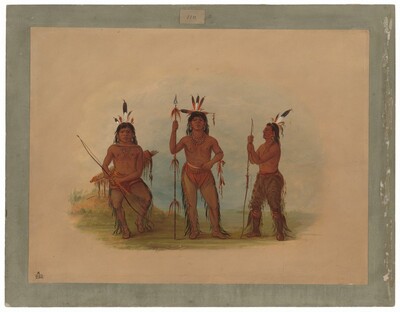
The image shows three individuals depicted from head to toe. The central figure stands upright, with the figure on the left seated, and the figure on the right standing in a relaxed pose with a bent leg. Each individual has distinct facial features, black hair adorned with feathers, and dressed in traditional attire including decorative elements made of feathers, animal hide, or fur. The seated individual holds a bow, while the central figure holds a feather-decorated spear. All three individuals wear necklaces and have feathers in their hairstyles. The background features a subtle pastoral landscape of grass and open sky.

Alaeutian Chief and Two Warriors

Catlin, George

Three full-body figures are depicted. On the left, a man is stepping forward with his left foot, holding a sword at his waist and an instrument resembling a small xylophone. He wears a mask with sharp facial features, a mustache, and a feathered hat. In the center stands another man holding a lute-like instrument, with an elongated nose and chin, wearing a cap with a feather, a collared shirt, and trousers. To the right, a woman stands holding the folds of an elaborate gown with floral designs. She wears a veil covering her head and shoulders. The background is minimal.

A Veiled Woman with Two Musicians Playing a Gridiron and a Bellows

Dolendo, Zacharias

The sculpture depicts a centaur, a mythical creature with the upper body of a human and the lower body of a horse. The human part is holding a bow. The sculpture is colorful and detailed. It has gold and enamel detailing. The centaur features a combination of enamel in rich hues, possibly including reds, blacks, and whites, while the horse body has a fur-like texture, with gilded highlights. The body is adorned with decorative jewels or stones. There are tear-shaped pearls dangling from the sculpture.

Pendant with a Centaur

André, Alfred

This is a drawing of a decorative sampler. It features various motifs such as a house, trees, flowers, baskets, and birds within distinct sections. The upper section displays an embroidered alphabet. Below the alphabet, there is a yellow house with a staircase, surrounded by small red flowers and trees with detailed leaves and flowers. The middle part contains intricate floral and animal designs in vibrant colors on a light fabric background. The bottom features ornate floral elements and geometric patterns. The work is rendered with care and precision, showcasing a classic needlework style typical in 19th-century samplers.

Sampler

Dingman, Byron

The image shows an engraved portrait of a man in an oval frame. He is facing towards the left with his head slightly turned towards the viewer. The man has curly hair, arched eyebrows, and wears a robe with a crucifix around his neck. The background features a lined pattern within the oval frame and a plain border. Below the portrait is a coat of arms with a shield and a hat with tassels, all in an engraved style.

Nicolas Grillet

Mellan, Claude

There is a sepia-toned drawing of a group of individuals in a natural setting. The scene features people interacting joyously, some playing musical instruments or holding festive objects. Trees frame the gathering, with a figure overlooking the scene from a raised platform. The drawing is detailed, with flowing garments and foliage creating a lively atmosphere. The precise lines and shading add depth and motion to the image, capturing a moment in what could be a narrative or celebratory event.

Children Parodying a Triumph of Bacchus

Watteau, Antoine
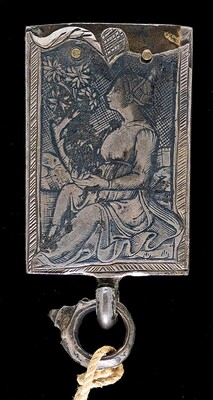
This is a photograph of an engraved metal object. The engraved image depicts a figure wearing a dress sitting on a chair, holding a bird, surrounded by floral elements. The figure is set against a patterned background with detailed engraving that enhances the texture of the garment and the foliage. The object's borders are adorned with a simple, repeating pattern, and there are metallic rivets visible at the top. This piece features an attachment component at the bottom. The photograph captures the intricate details and craftsmanship of the engraving, highlighting the contrast between the polished metal and the darkened etched lines.

Seated Woman Facing Left, Holding a Flowering Branch

Bolognese 15th Century

The image displays curved and swirling lines in a bold, reddish hue against a yellowish background, creating an abstract pattern. The shapes resemble flowing water or the intricate design of tree roots. The repetition and fluidity of the lines suggest natural forms found in a landscape or organic growth.

Der Mantel (The Coat)

Gramatté, Walter

The image shows a woman standing upright, holding a fan in each hand. She is wearing a traditional Japanese kimono with a checkered pattern and a colorful belt. The woman's hair is styled in an updo. She has a calm and focused expression. There is a bowl on the floor and a small section of a mat underneath her feet. In the background, there is a decorated box with a teapot-like object.

At Her Toilet

Beato, Felice

This painting depicts a long, horizontal landscape viewed from an elevated angle. On the left, by a group of green trees and bushes, several people stand around one person who is on the back of a white horse. They wear garments in shades of light red, dark green, and pale yellow. In the distance behind them, a gray castle is visible, and farther away boats sail across green water near tree-covered hills. In the center of the painting is a collection of massive gray rocks. A small yellow tent is at the bottom of the rocks, with a group of small people sitting or standing around it. To the right of them, two deer drink from a small blue pool while a person in a gray shirt rests nearby, wrapped in a green cloth. On the right side of the painting, people walk down a long path that ends in a large gray castle or city in the top right corner. Some of the people hold long poles or weapons. The color palette is mostly earthy browns and greens, with dark green trees filling much of the background. The sky is visible in the left and right sections of the painting; it is a greenish blue near the top that fades into a light pink when it meets the distant green hills.

Scenes from a Legend

Larciani (Master of the Kress Landscapes), Giovanni

The image displays a seascape with crashing waves seen from a slightly elevated angle. The horizon is near the upper third, with a small sailboat visible. The brushstrokes are dynamic, depicting the sea's energy. The color palette is mainly monochromatic, with shades of black and brown on a light tan background, creating contrast between the waves and the sky. The waves appear chaotic, leading towards distant storm clouds.

The Resounding Sea

Moran, Thomas

This is a photograph of a decorative ceramic bowl. The bowl has a floral design with yellow, blue, and white flowers on a red background. The interior is white. The design has flowers, stems, and leaves. The bowl is placed on a red circular foot.

Cup

Chinese Qing Dynasty

The image shows a wooden bucket with a lid and a handle. The color palette includes warm earthy tones such as brown and tan. The bucket is placed against a plain light background.

Sap Pail

Spangenberg, G.A.

The image shows a man with both arms raised at shoulder height, facing slightly off to his right. He appears to be interacting with a skeletal figure. The man has a full face with a mustache and short beard, and his hair is medium length. He is wearing elaborate clothing typical of a nobleman including a large cloak with detailed trimming. An hourglass sits on a table beside him. The skeletal figure beside him is partially draped in fabric. The background features mountains and clouds and the composition is framed with the title "Der Edelmann" at the top.

Der Edelmann (The Nobleman)

Lützelburger, Hans

The image shows a landscape view from an elevated position. There are mountains meeting the sky at the horizon. Soft, rolling hills blend into mountain ranges in the distance, creating depth. The brushstrokes are delicate, giving a watercolor texture. The color palette consists of pastel shades - light blues, greens, and earthy browns dominate. Closest to us are gentle slopes with vegetation and pathways.

The Sabine Hills and Rocca Santo Stefano Seen from Civitella

Deurer, Ludwig

The sculpture depicts a woman riding side-saddle on a horse. The woman is adorned with a flowing dress, and a bonnet or headpiece covers her head. The horse is depicted in a dynamic pose, with one front leg raised. The sculpture is crafted from a dark material, likely bronze, giving it a deep, dark brown or black color with a slightly reflective surface. This dark finish accentuates the detailed textures of the clothing and the anatomy of the horse. The sculpture stands on a rectangular base.

Equestrienne in 1830 Dress

Barye, Antoine-Louis

The image depicts a portrait of a person with only the upper body visible. The person is shown in a three-quarter view, with the head slightly tilted forward and to the side, eyes looking down. The facial features are stylized with angular lines and patterns, creating a sense of sharp cheekbones, a defined nose, and closed lips. The hair is portrayed as a solid, dark mass. The individual is wearing a simple garment with linear patterns on the neck and shoulder area. The background has abstract, irregular shapes.

Die Graphik Ernst Ludwig Kirchners bis 1924, von Gustav Schiefler Band I bis 1916 (The Graphic Art of Ernst Ludwig Kirchner to 1924 by Gustav Schiefler Volume 1 to 1916)

Kirchner, Ernst Ludwig

This is a photograph of a deer in motion. The image shows a series of frames depicting a deer walking or trotting in front of a grid-lined backdrop. The frames capture different moments in the deer's gait. The background features a cage or fence with vertical lines. The lighting highlights the shadow and form of the deer's body as it moves, showcasing the fluidity and grace of its movement. The image appears to be an early motion study focused on capturing the anatomy and motion of the deer in a scientific manner.

Plate Number 683. Virginia deer, buck, galloping

Muybridge, Eadweard
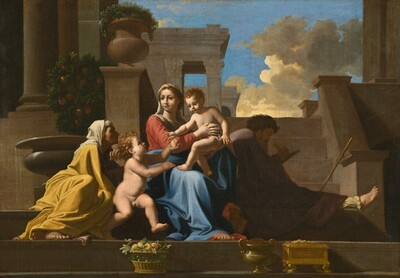
We look up at two women, two young boys, and a man, all with pale skin, sitting together on a wide landing, with stairs leading up to stone buildings behind the group and a patch of vivid blue sky in the upper right corner of this horizontal painting. At the center, a woman, Mary, sits holding a nearly nude child propped on one knee. Her body is angled to our right but she turns her head to look off into the distance to our left with large, dark eyes under faint brows. Her strawberry-blond hair is pulled back under a white veil that falls down the back of her neck and across her chest. Her smooth cheeks are lightly flushed in her round face. She has a straight nose and her pink, bow lips are closed. She wears a coral-red dress under a long, azure-blue robe that wraps around her waist and covers her legs. The sandaled toes of one foot peek from under the hems, and her other foot rests up on a gold-colored, rounded urn. Mary holds one child on her lap, and the second child sits by her right side, to our left. Both toddlers have blond, curly hair, dark eyes, rounded faces, and slightly pudgy bodies. Swaths of pale gray drapery mostly cover the genitals of both. The child on her lap half-sits, half-stands on the knee propped up on the urn. She supports his belly with one hand, the other wraps around his bottom. He leans forward, toward the second child, who faces him and holds up a yellow and blush-red fruit. Behind him, to our left, an older woman sits leaning forward and facing Mary in profile. Her wrinkled face is mostly lost in shadow, and she has a hooked nose and her forehead is lined, as if her eyebrows are raised. A white veil is wrapped around her head and drapes over the shoulders of her long, canary-yellow dress. One foot is crossed behind the other ankle, and the toes of both peep out from under her dress. To our right of Mary, a bearded man, Joseph, wears an eggplant-purple robe and sits almost entirely in shadow, facing our right in profile. The leg closer to us is extended and his foot stretches out of the shadow. He has short, curly brown hair and a long gray beard. He holds a carpenter’s compass to a panel in front of him. Closest to us, a step down runs along the bottom edge of the painting. On that step, a basket with leaves and yellow and peach-colored fruit sits in front of the standing child. Near Mary’s feet is a bronze-colored urn and a shiny gold box on raised feet. Behind the older woman to our left, water trickles from a round-bellied fountain on a pedestal in front of an orange tree. One building with round columns rises behind the tree. Behind Joseph, a long stick rests against the post of a short flight of four steps, which leads to another landing. The portico of a second temple-like building with squared columns and leafy capitals rises over Mary, presumably from the upper landing. A bright, topaz-blue sky with cream-white and steel-gray clouds fills the upper right corner of the composition.

The Holy Family on the Steps

Anonymous Artist

The image shows a person seated and holding a spindle in their hands. The person's head is facing downward, with facial features partially covered by a bonnet. They are wearing a long dress with visible sleeves. A spinning wheel is also depicted, and the background is plain with no details.

Breton Spinner (Fileuse Bretonne)

Bonvin, François

The sculpture is a rounded, bowl-like object with smooth, curved surfaces. It is a uniform, matte white color and looks like it is made of ceramic. Its form is slightly wider than its height, with a softly rounded body that tapers towards a narrow base. The top edge opens smoothly into a circular rim. The sculpture has a simple, minimalist design with gentle curves and a monochromatic finish.

Cup

Chinese Qing Dynasty

This is a drawing of a paper cut-out with various designs and handwritten text. The artwork showcases a pattern of heart shapes, floral motifs, and abstract forms meticulously cut into the paper, similar to traditional paper lacework. The hearts contain handwritten text. A name and date are inscribed in the central part of the design. The paper borders are scalloped, framing the artwork, while the empty corners contrast with the filled central circle.

Valentine

Bush, Rex F.

The image portrays an engraved portrait of a man with distinct facial features. He is posed in a slightly turned angle to the right, with curly hair flowing down to his shoulders. He wears a richly detailed garment with a large ruffled collar. The portrait's ornate frame features classical motifs and French text.

Charles I

Unknown 19th Century

The image depicts a woman seated, facing forward. She has a relaxed expression with soft features, dark hair, a red headscarf with white patterns, a blouse with wide sleeves, a corset-like garment, and a subtle necklace. The background has earthy tones, greens, light, and shadow creating a textured effect.

Young Girl with a Red Bandana

Mas y Fondevila, Arcadio

The image shows a coin featuring the profile of a man with a beard and a laurel wreath on his head. The coin is made of bronze, with a dark brown color and green patina. The man's detailed face is facing right, wearing ornate attire with intricate patterns. An inscription on the edge reads "HENRICVS.II.GALLIARVM.REX.INVICTISS.PR."

Henri II, 1519-1559, King of France 1547 [obverse]

Delaune, Etienne

The image shows irregular and interconnected lines forming abstract human figures. Some figures are standing, some are sitting, and they appear to be interacting with each other. It resembles a group of people gathered together in a simple and sketchy style.

In-text plate from Kirchner Zeichnungen (Kirchner Drawings)

Kirchner, Ernst Ludwig

The image shows a rocky formation from a low angle. The rocks are unevenly stacked, with a person standing on the tallest point. The background is dominated by the rocks, with a hint of a horizon. The color scheme is sepia-toned, giving the image an aged look. In the foreground, there is grass with some smaller rocks, and in the distance, there are shrubs and a slightly overcast sky. Multiple people are seen around the rocks.

Plate 6. Skull Rock

Russell, Andrew Joseph

A woman and child sit on an ornate gold, curving throne in front of a shimmering gold background in this vertical painting. Two winged angels in roundels at the upper corners and the woman and child all have peach-colored skin with a gray cast. The woman tips her head toward the child, to our right. She has almond-shaped eyes, a long, straight nose, and her small lips are closed. She looks into the distance over the child’s head. She wears a scarlet-red mantle that covers her head and drapes over her shoulders and body. The azure-blue of her dress beneath is visible at her throat and over one knee. The child sitting on her knee is as tall as a toddler but has adult proportions in his face and body. He holds up his right hand, on our left, and raises the first two fingers. He holds a red scroll in his other hand. He wears a forest-green robe over a salmon-pink garment. The clothing of both the woman and child have geometric gold lines indicating folds in the drapery, and both have gold halos. The child’s halo is marked with three red arms to create a cross above and to the sides of his head. The woman rests her feet on a low stool in front of the opening of the elaborately carved, two-tier throne that nearly encircles the pair. The winged angels in the upper corners have gold halos, brown hair, jeweled, gold garments, and each holds an orb and scepter.

Madonna and Child on a Curved Throne

Byzantine 13th Century

The image displays a river landscape with a busy waterfront. A bridge with multiple archways and towers is visible in the distance, marking the urban setting. Factories with smokestacks can be seen beyond the bridge, enhancing the industrial feel of the cityscape. The precise yet fluid brushstrokes capture architectural details and the vast sky with light washes of ink. The color palette is dominated by sepia and gray tones, creating a monochromatic look. Buildings and pathways are depicted along the riverbanks, leading into the bustling city.

Freihafen mit den Elbbrucken

Stoltenberg, Fritz

This horizontal tapestry is divided into three vertical sections by architectural columns and arches. The center column is a little wider than those to either side, but all three sections are packed with people, all with ivory-white skin. In the center column, a crowned Jesus is seated on a throne at the top center. His elaborately patterned robe falls in folds down past his feet. He hovers above a landscape view, which is flanked in the foreground by groups of men and women. About a dozen people are clustered on each side, many of them looking up at Jesus, and most of them wearing religious garments that range from monks and nuns to cardinals and bishops. Two crowned men kneel to our right in the center panel, their hands pressed together in prayer. Each column on either side of the central panel is divided so there is a smaller vignette above taller vignettes below. Large groups of people gather in each scene. Much of the tapestry’s surface is now brown, but it is punctuated throughout with patches of rust red, sky blue, and pale yellow.

The Triumph of Christ ("The Mazarin Tapestry")

Netherlandish 16th Century

The image displays an intricate design with geometric and organic shapes. In the center, there is a star-like shape made of red leaf-shaped elements radiating outward, surrounded by shapes resembling ferns or feathers. The design is enclosed within a square bordered in red, with a smaller square in the top left corner showing an abstract pattern of intersecting circles and lines. The overall design evokes a textile or wallpaper with a blend of floral and geometric elements.

Quilt

Anderson, Therkel

This is a painting of a purple bird perched on a rock. The image depicts a bird with dark plumage standing on a small, rocky mound scattered with patches of greenery. The bird's beak is open, and its eye is highlighted. The brushstrokes illustrate the texture of its feathers, while the rock beneath is shaded in warm earth tones, accentuated by small areas of plant life sprouting around it. The background is a plain, light color, allowing focus on the detailed rendering of the bird itself.

The Purple Jack Daw (Gracula Quiscula)

Catesby, Mark

This drawing is a sketch of several people facing the left, depicted from the chest up. The individuals are standing together in a group. Their hair is in a variety of styles, and they are dressed in draped garments. The person at the front of the group has their hands clasped together in front of their chest. The background is plain beige paper, and the lines of the drawing have been done in red.

Eight Apostles

Raphael

The sculpture is a circular relief medallion depicting a scene with multiple human figures and a chariot at the top. The figures are engaged in various activities, with some sitting and others standing. The sculpture is brown and likely made of bronze or a similar metal, giving it an aged patina. The figures are intricately carved, providing depth and movement, with attention to detail. The chariot at the top adds to the action-oriented narrative. The medallion has a small hole at the upper edge.

Mars and Venus

Master of the Orpheus Legend
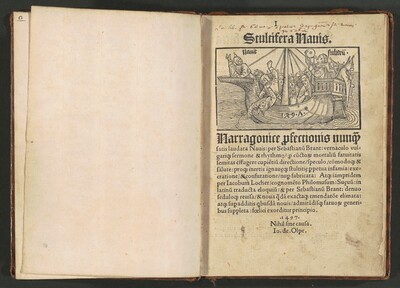
Stultifera navis (Ship of Fools)

Stultifera navis (Ship of Fools)

Dürer, Albrecht

The image depicts a bust portrait of an elderly man facing forward. He has deep-set eyes, a broad nose, a full, curly white beard, and curly white hair. He is seated upright, dressed in a dark jacket with buttons over a vest and shirt. There are no visible objects in his hands. The background is a plain surface. Below the image, text identifies him as "The Original 'UNCLE TOM.' [Rev. Josiah Henson.]"

Reverend Josiah Henson

Hart, Edward H.

Shown from the waist up behind a forest-green ledge or tabletop, a bearded man with a ruddy complexion strums a six-stringed lute between two, light-skinned people in this horizontal painting. The green ledge runs close to the bottom edge of the canvas, and the people nearly fill the composition. The musician’s body faces us but he looks up and off to our left with gray eyes under arched brows, with lips parted. His long brown hair is covered with a red hat wrapped with a pale, pink band. The ribbon meets in a bow-like form near the front center, and tassels hang to each side. His voluminous coat has wide, burnt-orange fur lapels and is lined with fur where it splits open over his shoulders. The garment below has dark sleeves. He lifts his right shoulder high over the lute as the instrument rests on the tabletop, with the neck to our right. The soundhole at the center is covered with rosette-like tracery. The man to our left has long, straight, dark brown hair and a cleft in his chin, which is darkened with a five o’clock shadow. He looks down and toward the musician with brown eyes over a long nose, and his lips are closed. He wears a black cloak with a fur collar over a white shirt, and holds a red book. To our right, a young person, possibly a man with delicate features, stands with his body angled toward the musician but he turns his face to look at us with gray eyes. He has flushed cheeks, a long, straight nose, and a rounded chin. He has shoulder-length, wavy brown hair parted down the middle, and he wears a red cloak also with a fur lapel, over a cream-white undershirt. A crumpled white cloth and a small, oval-shaped box with its lid askew sits on the green surface near the lute. The background behind the trio is elephant gray.

A Concert

Cariani

This is a drawing featuring a central figure seated in an elevated position, surrounded by an ethereal halo or orb of light. Flanking the central figure are two elongated forms. Below, there is a group of figures gathered around a symbolic or abstract natural element that resembles a mountainous or tree-like structure. The composition includes intricate line work conveying movement and texture.

The Fall of Satan

Blake, William

The sculpture depicts a vase with an elongated neck opening into a flared rim, a smooth, rounded body, and a small base. It is made of ceramic material with a red and cream glaze and hints of green and blue. The surface has a glossy finish, and the vase stands upright with balanced proportions.

Petal-Decorated Vase

Chinese Qing Dynasty

"Age of Chivalry" Circus Wagon

"Age of Chivalry" Circus Wagon

Weld, Howard

The image depicts an upper-body portrait of a man facing forward. He has a long beard and wears a hat. His expression is neutral. He is dressed in a robe with a fur collar. The background has horizontal lines. At the bottom, there is text and a Latin inscription.

Thomas Cranmer, Archbishop of Canterbury

Hondius I, Hendrik

The image features a sketch of three faces shown in close-up from the neck upwards. The leftmost face is oriented slightly towards the viewer with a direct gaze, the central face looks downward with closed eyes, and the rightmost face is in profile with an upward tilt. All three faces have sculptural, classical features with prominent eyelids, smooth contours, and slightly parted lips. The hair is styled with soft curls. The medium used is red chalk on paper, giving the artwork a warm, monochromatic tone. There are no visible clothing or jewelry. The background of the sketch is simple and unadorned.

Three Feminine Heads

Parmigianino

The relief panel depicts various scenes, including a centaur in the center, surrounded by smaller panels of cherubic figures and circular scenes. The sculpture is made of a bronze-like material with detailed musculature and flowing lines, capturing a sense of movement and vitality. Craftsmanship is intricate, showcasing classical themes and storytelling elements.

Nessus and Deianira

Moderno

This is a photograph of a page from a book. The page displays the title "ARABESQUES MYTHOLOGIQUES" in capital letters. The background is a creamy off-white color. There are no illustrations or additional text present. The edges of the page are slightly worn. Stains or marks are visible, particularly towards the bottom left and right corners.

Arabesques Mythologiques

Genlis, Stéphanie Félicité de Comtesse

The image depicts a seated woman in an ornate chair, visible from the knees up. She is seated with her arms resting on a table and a book, facing the camera. Her facial features include a long, oval face with a calm expression, and she has dark hair styled in tight ringlets on either side. She wears a floor-length, long-sleeved dress with a high collar and a white lace-edged chemisette peeking out at the neck and cuffs. Additionally, she is holding a newspaper in her lap, and a long chain is draped around her neck, falling onto her dress. The background is a plain, light-colored wall without any distinct features.

Portrait of a Woman

Hart, Henrietta M.

This painting shows a man facing the right. He has pale skin, a prominent nose, deep-set eyes, high cheekbones, a wrinkled brow, dark eyebrows, and a small mole near his mouth, which is set in a neutral expression. There is a hint of purple under his eye. The man has a thick beard and short, dark brown hair. He is dressed in formal attire, with a dark suit over a white collared shirt, and black bow tie. The background is black.

Abraham Lincoln

Volk, Douglas

The image shows a narrow street with rustic buildings on both sides. The viewpoint is slightly elevated, giving a downward angle to the scene. The horizon is obscured by the buildings, with chimneys emitting smoke. The drawing style is etching with fine lines defining textures. The color palette is monochromatic in varying shades of sepia and black. A lamppost is visible in the foreground, and two figures walk down the street. In the background, more architectural elements and fences are visible.

Rue de Champ de l'Alouette

Bonvin, François

This painting depicts a mythological scene with three central figures. One figure in a blue robe holds a sword, another figure in an orange garment appears distressed, and a third angelic figure with wings stands beside a tree. The background shows a lush landscape with architectural elements against a serene sky. The use of vibrant colors and intricate detailing creates a lively scene. This artwork is in the style of Renaissance majolica pottery.

Plate with Pyramus and Thisbe

Xanto Avelli, Francesco

The image shows a full-body portrait of a family group on a wooden-paneled floor against a brown backdrop. The man on the left, sitting on a chair with crossed legs, has short light brown hair and is wearing a dark suit with a white shirt and black tie, holding a newspaper titled "The Citizen." Seated beside him is a woman with dark brown hair, wearing a dark dress with a white collar, and next to her is another woman wearing a black dress with a lace collar and bonnet. There are children wearing various colored dresses, with one girl sitting on the elderly woman's lap. A dog is lying on the floor beneath the man's chair. The background is plain brown.

John J. Wagner Family Portrait

Thompson, Archie

The image shows a male figure seated in a contemplative pose. He is leaning forward with his hand resting on a globe and the other holding a compass. The man has long, curly hair, a mustache, and a goatee. He is wearing a hat with a feather, a dark doublet with embroidery, puffed sleeves, and a white ruffled collar. He has a decorative collar or sash with a medallion hanging from his neck. He is seated on an ornate chair. Behind him, there are two angelic figures holding up a banner with the inscription "FIDEI DEFENSOR" surrounded by sun rays and drapery. Latin text is featured on banners around the scene. The room is richly decorated.

Charles I

Marshall, William

The portrait shows the upper part of the subject's body, focusing on her head and a hint of her shoulders. The individual is in a three-quarter profile position, gazing slightly to the side. She has delicate facial features with a softly defined jawline, straight eyebrows, and a serene expression. Her hair is neatly arranged, pulled back and away from her face, revealing a smooth and tidy hairstyle. The clothing is only faintly visible, with minimal detail. There is no visible jewelry or objects being held. The background is plain and unadorned, consisting of a smooth, light-colored surface.

Head of a Young Woman

Cheney, Seth Wells

This is a round medallion or coin-shaped object made of reddish-brown material, which depicts the profile of an elephant walking towards the right, carved in relief. The elephant has large ears, a long trunk, and tusks that point upwards. The ground beneath the elephant is covered in faint vegetation, and beneath that is the inscription "M.CCCC.XLVI" in Roman numerals at the bottom. There is a hole near the top, possibly for hanging.

The Malatesta Elephant in a Meadow [reverse]

Pasti, Matteo de'
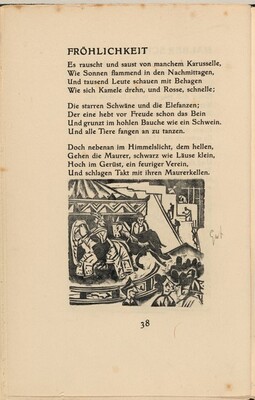
This is a drawing of a scene in a fairground or carousel setting. The image features an abstract, woodcut-style illustration, depicting figures riding on carousel animals. The animals appear to be elaborately designed, possibly elephants or similar creatures, with geometric patterns. The figures atop the animals seem to be engaged in various activities, with some positioned as if they are playing musical instruments. The composition includes dynamic lines that suggest movement and festivity. The text above the image contains a poem in German, titled "Fröhlichkeit," which translates to "Joy." The overall style and content indicate a lively and celebratory atmosphere, typical of a fairground scene.

Fröhlichkeit (Joyfulness) (in-text plate) from mock-up of Georg Heym: Umbra Vitae (Georg Heym: Shadow of Life)

Kirchner, Ernst Ludwig

The image shows two men standing in shallow water next to a small wooden boat, handling fishing nets. The background features distant trees, a cloudy sky, and two small structures or boats on the horizon. The overall color scheme is muted in sepia tones, giving the image a vintage appearance. The contrast between the dark clothing of the men and the lighter tones of the water and sky, with soft lighting, creates a serene and industrious atmosphere.

Taking Up the Eel-Net

Goodall, T.F.

The image includes two seated figures, both shown from the knees up. Each person is seated with their legs bent and feet resting on the ground. The individual on the left has dark hair with feathers and wears a long garment with a pattern across the chest and over the shoulders. Their garment reaches the knees, revealing moccasin-style footwear. This person holds an object in their hand, which appears to be a feather fan or similar item. The figure on the right also has dark hair with feathers and wears a long-sleeve top with a decorative sash, knee-length leggings, and moccasins. The background shows an open landscape with green plains, rocks, and a cloudy sky, suggesting an outdoor setting. The image is enclosed within an oval frame.

Two Choctaw Indians

Catlin, George

The image shows a person standing sideways, facing a workbench or table. The individual is wearing a cap and appears to have short hair, or their hair is concealed by the cap. Their facial features are indistinct due to the shading of the sketch. They are dressed in a long-sleeve shirt with rolled-up sleeves and pants secured with a belt. There are objects on the table in front of them, suggesting manual work or crafting. The background includes a window above the person's head, casting light onto the scene.

Auguste Delâtre au travail (Auguste Delâtre at Work)

Luce, Maximilien

Vase

Vase

Chinese Qing Dynasty

The sculptures depict two decorative elements, each showcasing a cluster of grapes and leaves. The sculptures are dark-colored and have intricate detailing in the leaves and grape clusters. They appear to hang down naturally and have a loop at the top for hanging. The sculptures are shown on a neutral background.

Paper Clip

Murphy, Vincent

This is a drawing of a small dog resting on a cushioned surface. The image captures a small dog lying down with its head resting on its paws. The texture of the dog's fur is illustrated with detail, emphasizing the curls and volume. The surrounding environment appears simple, with hints of texture above the dog's back and behind it. The drawing uses a monochromatic palette and shading to create depth and define the form of the dog.

Lying Dog

Ploos van Amstel, Cornelis

The image shows a sketch of a camp viewed from a slightly elevated perspective. The horizon line is high in the composition, with distant clusters of soldiers and encampments depicted with minimalist lines. Closer to the viewer are rough pencil sketches of figures, possibly soldiers, in various poses. Beyond them, the landscape slopes upwards towards tents and military structures, with faint indications of foliage. The artist uses a loose, casual technique with light pencil strokes, creating a sense of immediacy. The color palette is neutral and monochrome, with the paper's light brown tone complementing the graphite pencil marks.

Line-ups and Trenches [recto]

Homer, Winslow

The sculpture on the coin features a figure riding a horse. The figure is clad in armor, holding a sword aloft. The horse is rearing up on its hind legs. The coin material appears to be bronze, with a warm, tarnished brown color. An inscription in raised letters surrounds the perimeter. The sculpture has intricate details in the armor and the horse's musculature.

Sigismund II Augustus on Horseback [reverse]

Herwijck, Steven van

The image shows a large rectangular shape in a green color. The surface has a texture resembling a rough fabric or canvas, with a subtle grid pattern.

Essais de gravure a l'eau-forte (Essays in Etching)

Calame, Alexandre

The image depicts a man seated in an ornate wooden chair. He is facing forward with his legs crossed, one hand resting on the chair's arm. The man has a composed expression with a neatly groomed beard and mustache, and his hair is combed back. He is wearing a dark double-breasted suit with a white shirt and a tie. To his left is a richly carved table with books on top, and a portion of draped fabric is visible behind it. The background is plain, emphasizing the man and the furniture elements around him.

Giuseppe Verdi

Disdéri, André Adolphe-Eugène

This is a painting of a group of people clustered together and facing different directions. Many of them have their knees bent. The group stands on light green grass under a blue sky, and the composition is framed in an oval. Almost all of the people are bare chested, their tan skin decorated with horizontal lines of bright red paint. They wear orange and yellow belts and long, white-and-black feathers around their waist. Some wear pants that appear to have tassels or string attached to the sides, while others have bare legs decorated with more red paint. They wear long strands of necklaces and multiple earrings featuring bright turquoise beads, and their hair is tied back in long, thin braids with more feathers and red spikes sticking up from headdresses they wear. Some of the people hold objects like spears, bows, and instruments. One person on the right is dressed differently, wearing a plain brown dress. This person has long black hair, and their body is turned to the left while their face is turned over their shoulder toward us, their eyes closed. In front of the group of people is a semi-circle of gray stones, within which are three large pots or vessels.

Dance to the Berdache - Saukie

Catlin, George

The image shows the upper body of a person leaning on one arm, with their head resting on their hand. The person has delicate features and long dark hair. They are dressed in a light-toned garment with darker patterns. The background is a textured wash of gray.

Etude d'enfant (Study of a Child)

Bourget, Camille

The sculpture is a globular-shaped ceramic jar with a narrow, slightly elevated neck. It has a smooth surface with an even, light blue color. The jar's shape is symmetrical, with a rounded lower body that tapers up to a smaller, circular opening. The material appears to be a glazed porcelain or similar ceramic, evident from its glossy finish that reflects light subtly across its surface. The overall look of the jar is simple and elegant, with a harmonious form that complements its monochromatic color.

Water Pot

Chinese Qing Dynasty

The image shows a person standing upright. They have a round face with simple facial features, wearing a hat with a red flower and dark ribbon. Their outfit includes a belted dress or coat, pleated texture, a cape, and arm coverings. The person is holding a matching umbrella in their right hand. The background is plain and light tan.

Corn Husk Doll

Lowry, Mina

The image presents an upper-body illustration of a man seated in a formal portrait pose. His face has a rounded shape with prominent cheeks, a full mustache, and a short beard, and he looks straight ahead. He wears a large, ornate hat and a cloak with a fur-lined collar. In his hands, he holds a sword diagonally across his torso. The background features a plain light-colored surface with three heraldic shields and a decorative serif font Latin text below the illustration.

John Frederic the Magnanimous, in Electoral Robes [left]

German 16th Century
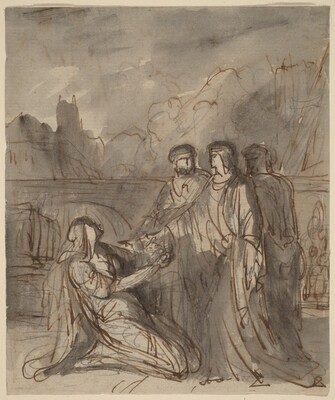
This is a drawing depicting a scene with a group of individuals and a figure kneeling. The image is rendered in a loose style using washes of dark brown ink, creating a monochromatic effect. The composition includes a kneeling figure making a supplicating gesture towards a group of standing individuals. The background shows hills and a bridge, adding depth to the scene. The outlines of the figures are sketchy yet decisive, suggesting movement and interaction within a possibly historical or allegorical setting. The medium and style give the scene spontaneity and emotive power, encouraging contemplation of the narrative content.

Composition with Four Figures [recto and verso]

Allston, Washington

The sculpture is a circular relief featuring four Roman soldiers engaged in an interaction around a pedestal with a flame. Two soldiers stand in the background, one holding a large spear or standard, while another soldier is seated in the foreground to the left. All soldiers are depicted wearing typical Roman military attire, including helmets and armor. The material of the sculpture has an aged bronze appearance, characterized by a dark brown color with some green patina in places. The sculpture is intricately detailed, capturing the scene as if preserved from a moment in ancient Roman military life.

Mucius Scaevola

Pseudo Melioli

The image shows swirling lines and rounded shapes blending together in an abstract design. The lines and shapes overlap in a pattern with various colors including pale pink, muted green, soft yellow, and dark accents. The design resembles fluid movements found in nature, such as water currents or wind flow, portrayed in pastel tones.

One hundred and fifty new designs by Thos. Johnson carver, consisting of Ceilings, Chimmney Pieces, Slab, Glass and Picture Frames (etc.)...the Whole well Adapted for Decorating all kinds of Ornamental Furniture, in the Present Taste

Johnson, Thomas

This is a photograph of the surface of the moon. The image captures an area densely covered with craters of various sizes. A particularly prominent crater near the center stands out. The surrounding surface displays radiating streaks of lighter color. The photograph's detailed texture offers a sense of depth and structure, revealing both large and small craters, as well as subtle variations in the lunar surface. The text around the image adds a scientific and cartographic context, indicating it is part of a lunar map by C. Le Morvan, with specific longitudinal and latitudinal coordinates noted.

Carte photographique de la lune, planche XIV (Photographic Chart of the Moon, plate XIV)

Le Morvan, Charles

Two women with pale skin look out at us from the other side of a rectangular window opening with a shadowy interior behind them in this vertical painting. On our right, in the lower third of the composition, one young woman leans toward us over her left arm, which rests along the window ledge. She bends her right arm and props her chin on her fist. She looks at us with dark brown eyes under dark brows. She has shiny chestnut-brown hair with a strawberry-red bow on the right side of her head, to our left. She has a straight nose, and her full pink lips curve up in a smile. She wears a gossamer-white dress with a wide neckline trimmed in dark gray, with another red bow on the front of her chest. Her voluminous sleeves are pushed back to her elbows. To our left, a second woman peeks around a partially opened shutter. She is slightly older, and she stands next to the first woman with her body facing us. She tilts her head and also gazes at us with dark eyes under dark brown brows. She has dark brown hair covered by an oyster-white shawl. She holds the shawl up with her right hand to cover the bottom half of her face. Her mouth is hidden but her eyes crinkle as if in a smile. Her left arm bends at the elbow as she grasps the open shutter. She also wears a white shirt pushed back to her elbows, and a rose-pink skirt. The frame of the window runs parallel to the sides and bottom of the canvas. The room behind them is black in shadow.

Two Women at a Window

Murillo, Bartolomé Esteban
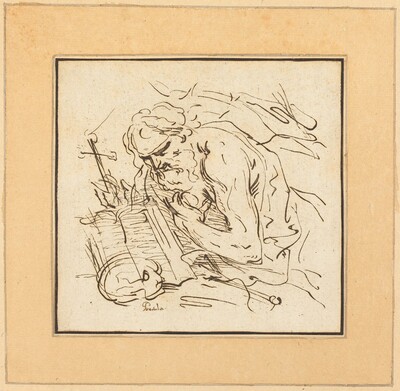
The image shows a sketch of a seated person reading a book. The person is depicted from head to waist, with detailed facial features and a beard. He has curly hair and is wearing simple drapery. There is a large open book with visible text and a wooden object nearby. A cross is shown on the side of the book. The background consists of simple sketched lines framing the figure.

Saint Jerome

Prestel, Johann Gottlieb

This is a colorful, decorative plate. The center of the plate features a coat of arms in vibrant tones of gold and deep blue, with the outline of a black bird. The shield is against a green and blue landscape, circled by a thick mustard-yellow border. The wide rim of the plate is adorned with green leaves, floral patterns, and curling scrollwork in blue, red, and yellow hues. There is the repeating image of the head of a creature with curled lips and fangs that tapers into a thin, intertwining body.

Plate with border of foliate scrollwork with dolphin heads and cornucopias; in the center, shield of arms of Vigerio of Savona

Italian 16th Century

This is a drawing of an intricately carved ornamental leaf. The drawing features a single botanical element that appears to be a carved representation of a leaf, with detailed ridges and curves giving it a three-dimensional effect. The leaf tapers to a stem at the bottom, with the upper sections fanning out in a pattern. The lighting and shading techniques used convey depth and texture. The background is plain, highlighting the focus on the ornament.

Trivet

Roberts, Sydney

The image displays the interior of an ancient stone structure. Arched openings with heavy stone blocks frame the scene, leading to more arches and columns in the distance. The horizon is obscured by the architecture. The work features detailed line work, with cross-hatching and parallel lines providing shading and texture for the stone. The color palette is monochromatic, using shades of black and white to emphasize contrast and detail. The ground is rocky and uneven, leading towards a brighter area in the distance.

The Ruins of the Colosseum

Mercati, Giovanni Battista

This is a drawing of a group of figures gathered around an object. The drawing features several individuals wearing hats and flowing garments. The figures appear to be focused on a central action or object that involves a long, staff-like item being handled. The background includes a simple architectural structure. The lines and use of shading add depth and texture to the composition, and the monochromatic palette suggests it may be a preparatory sketch or study for a more detailed work in another medium.

The Founding of Santa Maria Maggiore

Ricci, Giovanni Battista

The image contains a circular medallic sculpture with a relief featuring two cherubic figures with wings on opposite sides of an arch. One cherub is blowing a trumpet. Below them is a decorative arch framing a central rectangular section with the engraved text "PRINCE DE CONDÉ. M. 1637." Ornate foliage and scroll patterns decorate the sides, above two meticulously carved human faces in profile. The sculpture has a bronze hue, and the signature "I. DASSIER F." is at the bottom edge of the circle.

Memorial Tablet, with Geniuses of Death and Fame [reverse]

Dassier, Jean

The image shows sepia-toned portrait profiles encased in circular frames. The portraits depict individuals at various angles, focusing on their faces and upper shoulders without showing their full bodies. The subjects include men and women with different hairstyles and clothing styles typical of a historical period. Men have short, wavy, or curled hair, and some wear neckties or cravats. Women have voluminous hairstyles with ribbons or hats, and wear elaborate lace and ruffle collars or shawls. The facial features are detailed in a classical nineteenth-century style. Each portrait has a plain dark circle background and handwritten text below indicating the person's name. The image appears to document and commemorate the individuals in a formal and traditional portrait style.

Saint-Mémin Collection of Portraits, Group 2

Saint-Mémin, Charles B. J. Févret de

This is a stereoscopic card featuring two identical images of the full moon, showcasing its craters and surface texture in detail. The card is on a beige background with inscriptions mentioning the photographer, Prof. H. Draper, and the publisher, C. Bierstadt, in Niagara Falls, N.Y. It notes that the negatives were taken with a silvered glass telescope, capturing the selenographic features of the moon.

"Full Moon"

Draper, Henry

The image shows a wide expanse of land with a horizon featuring rolling hills or small mountains and sparse trees. In the foreground, a person in traditional indigenous attire is pulling on a rope tethered to a resisting horse. Several horses gallop energetically in the distance, while another horse stands alone to the right. The brushstrokes are detailed, capturing textures, and the color palette consists of earthy tones. The sky is light blue with occasional white clouds.

Catching Wild Horses - Pawnee

Catlin, George

The Fall of Phaeton

The Fall of Phaeton

Baudous, Robert de

This is a photograph of a decorative ceramic plate with intricate designs. The plate features a central emblem with a shield design, displaying five red roundels on a golden field, topped by a papal tiara and crossed keys. Surrounding the emblem is an ornate pattern with a blue background and white swirling motifs. The outer border of the plate is adorned with alternating green and yellow geometric designs. The craftsmanship suggests a detailed and meticulous approach to decoration, likely intended for ornamental use.

Footed dish with the arms of the Medici, reverse decorated "alla porcellana"

Tuscan 16th Century

The sculpture depicts a female figure known as "Muse with a Scroll." The subject is standing upright with her body slightly leaned to one side. She is holding a scroll in her left hand while her right hand supports her chin. The figure is adorned in flowing drapery that clings to her form, giving a sense of movement. The sculpture is primarily in shades of gray and has a texture that suggests it is made from stone. The figure's expression and posture are solemn and contemplative, with her gaze directed outward.

Circus Wagon Figure: Muse

Matulis, John

The image is an etching depicting a view from the bank of a river, looking toward Notre Dame Cathedral. Two towers of Notre Dame stand out, dominating the scene. The horizon is near the middle of the image, lined with buildings. The etching shows detailed buildings, natural elements, and clouds in the sky. Closest to us, figures are seen on a sandy riverbank next to a horse-drawn cart, with boats in the water nearby. The color palette is monochromatic in brown and black.

L'abside de Notre-Dame de Paris (The Apse of the Cathedral of Notre-Dame, Paris)

Meryon, Charles

Plate 77: Dotted Bee Fly with a White Flower, a Mayfly,  a Blue Weevil, and Other Insects

Plate 77: Dotted Bee Fly with a White Flower, a Mayfly, a Blue Weevil, and Other Insects

Hoefnagel, Joris

Isabella di Capua, 1509-1559, Princess of Molfetta, Wife of Ferrante Gonzaga 1534 [obverse]

Isabella di Capua, 1509-1559, Princess of Molfetta, Wife of Ferrante Gonzaga 1534 [obverse]

Nizzola da Trezzo, Jacopo

This is a drawing of an elephant with a column and statue on its back. The elephant carries a decorative cloth on its back with intricate patterns. A tall column rises from the elephant's back, supporting a statue of a standing figure. Next to the elephant is a torch-like structure emitting smoke. The ground has a pattern resembling cobblestones. The image is labeled "SCHEMA ELEPHANTI."

Descriptio publicae gratulationis...Ernesti Archiducis Austriae

Borcht, Peter van der

This is a photograph of a dog jumping over a fence. The image is a sequence of black and white frames arranged in two rows, capturing a large dog in motion as it approaches, leaps over, and lands on the other side of a fence. The dog is shown from various angles, providing a detailed study of its movements. The environment appears to be an enclosed area, likely with metal fencing visible in the background, under a natural or ambient source of light. The set-up suggests an early form of motion study or animal locomotion photography, focusing on capturing the precise mechanics of the animal's leap.

Plate Number 712. Dog; jumping hurdle; mastiff, Dread

Muybridge, Eadweard

Lady Wearing Spectacles

Lady Wearing Spectacles

American 19th Century

The image displays various types of vegetation, primarily broad-leafed plants, with intricate details. The color palette is monochromatic, ranging from black to light gray. Large leaves are in the foreground, with tall flowering stalks and vines to the left. In the background, there are grassy textures and smaller shrubs.

Study of a Burdock

Bléry, Eugène

The image shows a decorative table with a dark green rectangular top framed by a wooden border. The table is made of dark brown wood with intricate carvings of acanthus leaves and classical motifs. It has a single ornate pedestal support that leads to a four-footed base with matching carvings. The table is at a standard coffee table height.

Walnut Pedestal Table with Inlaid Marble Top

Italian 16th Century

The image shows a wooden rocking chair with a floral-patterned upholstery on the seat and backrest. The color palette includes warm brown tones for the wood and vibrant reds and blues with hints of green and gray in the floral design. The rocking chair is positioned centrally, facing slightly to the left, with distinct curved rockers at the bottom. The chair is set against a plain, light-colored background.

Toy Chair

Humes, Mary Elizabeth

The image shows multiple individuals in a scene. In the foreground, a man and a woman are on a bed. The woman is uncovered, reclining on her back with her arms raised. The man is leaning over her, wearing rich clothing and a headpiece with a plume. Another person with similar attire stands behind them. The background features heavy curtains, a luxurious bed, and ornate furniture.

Le roi d'Ethiopie

Vidal, Gérard

The image shows a central large black insect surrounded by several smaller insects of different types and colors. The color palette includes earth tones with the black insect standing out amidst softer hues like browns, yellows, reddish tones, and green on the smaller insects. The main insect is positioned towards the middle of the image, while the smaller insects encircle it within an oval frame. To the left of the main insect, there is a mix of small, winged and crawling insects. Towards the right, there are additional insects, including one with visible red wings and green body. The insects are spread across the page, mostly within a light brown oval shape.

Plate 65: A Cricket Surrounded by Insects, Including a Ruby-Tailed Wasp

Hoefnagel, Joris

The sculpture depicts a small child sitting with one knee raised and the other folded beneath, engaging with a bird perched nearby. The child is looking upwards with a serene expression, with styled short hair. The sculpture is made of bronze, with a shiny, smooth surface and dark brown color with hints of green patina. It has a rich, textured surface, particularly noticeable on the body and base. The sculpture is small enough to be a tabletop decorative piece, similar in size to a small figurine.

Child Clasping a Bird

North Italian 16th Century

This is a photograph of the cover of a red leather-bound book. The image captures a close-up view of the book's exterior, showcasing its red leather cover. The cover appears worn and slightly scuffed, with visible creases and imperfections. The spine of the book, visible on the left, shows wear at the edges where it meets the cover's surface. The texture of the leather is noticeable, and the stitching around the edges is subtly highlighted.

Album of Engravings after Sir Peter Paul Rubens

Various Artists

The image depicts a large house surrounded by trees with a waterfall in the foreground. The house is built of light stone and partially obscured by trees. The waterfall flows over rocks with a soft blur effect. The image has a grainy texture and warm sepia tones, giving it a nostalgic feel.

Colinton Manse and weir, with part of the old mill on the right

Hill, David Octavius

This painting shows a man in a yellow jacket standing on a small brown rowboat on a wide, pale green river. Behind him is a large mint-green sailboat, its tall mast bare, the sails folded on the deck. Behind that is a coastline covered in tan paths that cut through green grass. Another person stands on the shore, looking towards the boats. A yellow house with a weathered roof and two smaller, red-toned buildings can be seen on the shoreline. Behind them is more blue water, a grassy field, and dark green trees. The sky above is light gray with hints of blue. The brushstrokes of the painting are loose and visible, layering different colors on top of one another. The paint has been applied in thick, short strokes all facing the same direction, giving the impression of motion.

Oyster Sloop, Cos Cob

Hassam, Childe

The image shows a curving, elongated shape forming the outline of a chair. On it sits a figure with exaggerated, distorted features. Several arms and hands rise from small pots on the left of the seated figure, resembling plants growing from soil.

Hällucinationen (Hallucinations)

Hoerle, Heinrich

The sculpture is a vase with intricate nature designs. It is predominantly black, with vibrant white, green, and yellow decorations. The vase features a pattern of blossoming flowers and yellow birds, with elements of nature such as rocks and trees at the base. It has a flared top, and is made of a smooth, glossy material. The craftsmanship is detailed, especially the floral and avian elements. The layering of imagery creates depth in the depiction.

Baluster Vase

Chinese Qing Dynasty

The image shows two large metal tools with curved blades attached to handles. The tool on the left has a more exaggerated curve than the one on the right. The color palette is muted with shades of gray against a light beige background. The tools are centrally positioned, with the left tool higher and rotated counterclockwise, and the right tool more upright but tilted to the left.

Amana Dough Trough Scrapers

Kempter, Harley

The image is a portrait showing the upper half of a person's body. The individual is positioned facing slightly to the left, with their head turned to look directly at the viewer. The person's facial features include a solemn expression with deep-set eyes and a beard. They have a hood over their head, with their hair not visible beneath it. The person is wearing a robe, typical of monastic attire, which covers their shoulders and chest. In their right hand, they hold a closed book, and their left hand is raised, fingers extended in a gesture. The background is filled with radiating lines, and ornate decorative scrolling borders surround the image. The text below reads "Vera SS. Francisci Effigies."

The True Effigy of Saint Francis

Callot, Jacques

This is a minimalist drawing of a cloaked figure standing on a rocky cliff. The scene is rendered in soft black and gray tones on paper. The figure, draped in flowing garments, appears to gaze out into a vast landscape dominated by the sky. The drawing uses brushstrokes to convey texture and an atmospheric effect suggesting contemplation or solitude. The surroundings are sketch-like with few details, emphasizing the silhouette and mood. Light and shadow create depth and a sense of vastness beyond the figure's sight.

France Watching

Forain, Jean-Louis

The circular medallion depicts a Roman soldier riding a horse in a dynamic pose. The rider holds reins and the horse is mid-stride. The medallion is bronze with inscriptions reading “VICTORIAE AUGUSTE.” Fine details are captured in the armor and horse. There is a small hole near the top. The imagery is in relief against the flat surface.

Equestrian Figure of Marcus Croto [reverse]

Belferdino, Varrone

This appears to be the front cover of an old leather-bound book. The book is covered with red leather with the word "IGNIS" embossed in gold in the center. The cover shows signs of wear and aging, with visible scuffs, scratches, and discoloration. There are four brass clasps on the edges of the book: one on the top and bottom edges, and two on the right side.

Animalia Rationalia et Insecta (Ignis)

Hoefnagel, Joris

The image shows an up-close view of a person's hand. The hand is positioned with the back facing the viewer and fingers slightly bent, relaxed, against a flat surface. The skin appears smooth. There are no specific facial features or hair visible. The image does not display any clothing. The background is plain and likely composed of a neutral, slightly textured surface behind the hand.

Study of a Hand

European 19th Century

This painting shows a rocky stream flowing through a green wooded area. Trees and rocky brown-and-gray terrain dominate the top of the composition, with the stream winding below around small gray rocks and boulders. A small white waterfall is depicted on the left side, leading into a flat pool of brown and gray water. The color palette is rich and earthy, with deep greens, golden yellows, and reddish-browns coloring almost all of the scene, as well as some lighter patches of white and beige in the water.

Woodland Stream

Huet, Paul

This is a drawing of a bull in an arena. The drawing portrays a scene where a bull is centrally positioned, having trapped a figure under its neck. Another figure is positioned in the foreground raising an object, while two indistinct figures stand in the background. The scene takes place within an enclosed space, indicated by the textured background and ground. The artwork employs a limited palette.

Cogida de un moro estando en la plaza (A Moor Caught by the Bull in the Ring)

Goya, Francisco

The image displays a wooden chair with an engraved backrest and a cushioned seat. The backrest has gold rivets and carved details, and the seat has a golden fringe. The chair is centered, with arms slightly extended, and ornate carvings are visible on the backrest and lower bar.

Leather-covered Walnut Armchair

Italian 16th Century
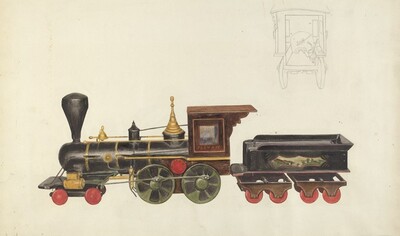
This is a painting of a toy steam locomotive and tender. The painting includes a detailed representation of a black and gold steam locomotive with red wheels, a large smokestack, and a cab labeled "Fayram." There is a small tender behind the locomotive with a decorative panel depicting a landscape scene. Above the main image and to the right, there is a pencil sketch of a small carriage-like vehicle. The artwork showcases a meticulous depiction of a toy train with attention to colors and proportions, in the style of early 19th-century toy illustrations.

Toy Locomotive

Stearns, Alice

This is a drawing of an old printing press in action. It shows a detailed interior view of a print workshop with three individuals working with a large press. One person operates the press by turning a handle, another applies ink to a plate, and the third oversees or prepares paper. The workshop has a timber ceiling with exposed beams, shelves with bottles and containers, and framed artworks hanging on the walls. The caption at the bottom describes the printing process. The scene reflects the craftsmanship and labor of traditional printmaking.

The Intaglio Printers

Bosse, Abraham

The image shows intricate lines and shapes creating elaborate arches and architectural structures. The drawing has a swirling and overlapping design that suggests chaotic motion within a grand structure. The abstract assembly resembles a grand cathedral or a palatial hall, with arches and columns akin to classical architecture. Figures and decorative flourishes are interspersed throughout, resembling statues or ornate carvings typical of an embellished building.

A Magnificent Palatial Interior

Piranesi, Giovanni Battista

The image shows a profile portrait of a man on a circular medallion or coin. The man has a beard and curly hair, with facial features visible in profile view. The medallion is bronze with a rich, golden-brown color. There is an inscription in raised letters surrounding the profile. The sculpture resembles a classical portrait coin, similar to ancient or Renaissance medallions.

Marcantonio Flaminio, 1498-1550, poet [obverse]

Torre, Giulio della

This is a drawing of an abstract landscape and figure with accompanying text. The image features a stylized black and white depiction of a mountainous landscape with a central seated figure set within angular and sharp lines. Above the image is the title "PILATUS" in bold text. Below the drawing, there is German text. The artwork is rendered with a woodcut-like style that emphasizes contrast and texture, characteristic of expressionist prints. At the bottom of the page, the number 57 is printed.

Pilatus (Pilate) (headpiece, page 57) from Georg Heym: Umbra Vitae (Georg Heym: The Shadow of Life)

Kirchner, Ernst Ludwig

The image shows a scene with a low angle perspective, focusing on a ridge where two figures are holding up a flag. The terrain below is rough and dotted with stones, graves marked by crosses and headstones. The scene has a muted and monochromatic color palette, reminiscent of an old photograph. A solitary figure stands below the ridge facing the flag, while the background shows a horizon merging into a blank sky. The composition is clear and detailed, capturing the elements in the frame with precision.

Cemetery, Cathcart's Hill

Fenton, Roger
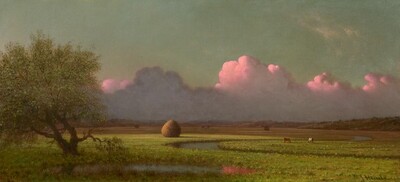
Tall, billowing, lavender-purple and shell-pink clouds line the distant horizon over a vast plain of flat grassy land in this horizontal landscape painting. Closest to us to the lower left, a tree with a gnarled trunk and round, sage-green canopy sits mostly in shadow. A river curves from near the tree to cut across most of the landscape in a tight S-shape. One plump haystack, shaped like a giant teardrop, sits near a curve of the river in the vivid, lemon-lime field, to our left of center. One brown and one white cow graze across the river, to our right. Above tawny-brown hills lining the horizon, sunlight from our left turns the tops of the band of clouds pale pink, and the undersides are grayish-purple. The sky above is turquoise. The artist signed the lower right corner, “M J Heade.”

Sunlight and Shadow: The Newbury Marshes

Heade, Martin Johnson

This is a drawing of a pastoral scene with mythical figures and a bountiful harvest. The image is filled with intricate details, highlighting a lush natural landscape framed by elegant trees. In the foreground, fruits and grains are abundant, symbolizing fertility and nature's richness. The center of the image features figures, including a being carrying a bounty of fruits over his shoulders, and a seated figure engaging with another. An urn is placed prominently on the right, while to the left, a ram's head is also present. Above and to the right, a cherub-like figure peeks from behind a tree. The overall composition is ornate, showcasing the pastoral abundance intertwined with mythological elements.

Faun Embracing a Bacchante

Dorigny, Michel
This is a tapestry of people in flowing garments in a pastoral landscape. At the center of the tapestry, a man in a red garment reclines, his eyes closed. He holds a plumed golden helmet on his knee and wears golden sandals. Around him, a crowd of people sitting or lounging on the ground turn to look at him, some pointing. All of the people have light skin and pale-yellow hair. The scene includes musical instruments, white sculptures, vessels spilling water, and many pink flowers among green leaves. Some sections of the tapestry, especially around the center, are bright white. The scene is surrounded by a golden border.

Dream of Rinaldo

Besnier, Nicolas

This is a painting of a rooster figure positioned atop a sphere. The image depicts a sculpted or carved rooster standing on a metallic or wooden sphere. The rooster is rendered in warm, earthy tones with attention to the texture and curves of the feathers. The background is plain, focusing all attention on the rooster and sphere.

Weather Vane - Cock

Lowry, Mina

This is a drawing of caricatured figures arranging flowers in front of a statue. The drawing features exaggerated figures, some wearing garlands or holding out flowers. They seem engaged in a ceremonial activity involving a covered table laden with flowers. In the background, there is a statue on a pedestal, partially obscured by the foreground figures. The setting appears festive yet satirical, evoking a critical or humorous observation of the scene. The caricature style highlights the absurdity or pomp of the scene depicted.

Fête du 4 Mai

Daumier, Honoré

This is a charcoal drawing showing a side profile view of a man's head and upper torso. The man is positioned with his back slightly turned towards the viewer, looking to the right. He has a prominent nose, a thick beard, and wavy hair falling around his head. The man is wearing a shirt with loose fabric. There are no visible accessories or objects. The background is plain, and there is a faint signature in the lower right corner.

Head of a Bearded Gentleman

Müller, Charles-Louis-Lucien

The sculpture displays four human figures around a barrel. To the left, a child looks into the barrel. Next to them, a man in a uniform stands with one hand on his cap, engaged with two other figures. A woman stands to his right, wearing a long dress and looking down at a child clinging to her dress. The sculpture features detailed clothing and expressions, suggesting an activity related to taking an oath and drawing rations. The artwork is crafted from dark bronze with a polished finish, highlighting textures and creating a realistic appearance. The figures are detailed and lifelike, placed on a flat base with an inscription.

Taking the Oath and Drawing Rations

Rogers, John

The image depicts architectural diagrams and cross-sections of wooden structures. The drawing displays detailed illustrations and cross-sections of roof construction, including various aspects, sections, and elements. Technical information about structural components like beams, columns, and trusses are provided through labels and measurements. The sections are neatly organized within boxes, potentially representing different perspectives or construction stages. The style is technical and precise, typical for architectural drawings used for educational or construction purposes.

Della Magnificenza ed Archittetura; Osservazioni; E Parere su l'Architettura

Piranesi, Giovanni Battista

This is a photograph of a sequence showing two figures engaged in a combative or dance-like interaction. The image is presented in a grid layout featuring twelve black and white frames, capturing the intricate motions and dynamics between the figures. Each frame depicts a slightly different position, illustrating the fluidity and continuity of their movements. The figures are positioned against a backdrop with a grid pattern. The photograph exhibits a high level of detail, allowing the viewer to observe the musculature and the choreography of the sequence.

Plate Number 340. Boxing, open hand

Muybridge, Eadweard

The image shows a landscape view of vast plains with small mounds of earth, a high horizon, greenish-yellow grassy land, light blue mountains, a sky with pale blue and soft gray clouds, meticulous brushwork with fine details illustrating texture, an earthy color palette with greens, yellows, and browns, and figures including a hunter and two riders on horseback.

Prairie Dog Village

Catlin, George

The image depicts a landscape with an eye-level perspective. The horizon is positioned in the upper half of the image, showing trees and distant elements. The technique appears to be a form of etching or lithography, with textured brushstrokes creating a soft effect. In the foreground, a figure and a dog walk along a path, accompanied by elongated shadows. Vertical trees line the right side, extending into the distance. The palette is monochromatic with various shades of grey, creating a somber atmosphere. The background shows a slightly lighter sky for contrast with the darker elements below.

Matinée d'automne (Le petit chasseur)

Buhot, Félix-Hilaire

This is an ornate crucifix, with a man hanging from it in a traditional crucifixion pose, his arms outstretched and nailed to the crossbeam. The man has long hair and a cloth tied around his waist, and he is colored entirely in bright gold. Behind his head is a golden circle with gems in blue, red, and green. The cross itself is adorned with intricate designs in dark blue, red, teal, and green shapes, bordered by a gold-colored outline. The top of the cross features an inscription in gold lettering on a blue background. The sculpture stands upright against a neutral gray backdrop.

Crucifix

Rhenish 12th Century

This is a drawing of a blue coat paired with tan breeches. The image depicts an 18th to 19th-century ensemble, featuring a deep blue coat, a white waistcoat with ornate lace cuffs, and tan breeches fastened with buttons at the knee. On the right side, there is a pencil sketch showing the back of the coat with long tails. The drawing is detailed, showcasing the texture and style of historical fashion.

Man's Suit

Crimi, Nancy

The image shows a caricature of a man sitting with his legs crossed. He is leaning back slightly against a bench, with his arms folded across his chest. The caricature emphasizes his exaggerated features, such as a large, elongated head with pronounced cheekbones and a slightly pointed chin, wide and expressive eyes, and dark, disheveled hair combed back. He is wearing a dark coat with a high collar, a white shirt, light-colored pants, and dark shoes. The background includes faint outlines of other figures engaging in conversation.

Charles Dupin

Daumier, Honoré

The image shows a landscape with buildings, trees, and a small bridge in the distance. The viewpoint is slightly elevated, with a rustic setting. The horizon has hills and clouds in the sky. Birds are seen flying above the horizon. There are buildings made of stone or brick with intricate details, surrounded by lush trees. In the foreground, there is a shaded area with a small, thatched structure near water. The artwork features light pencil sketching, varied brushstrokes, and a monochromatic color palette.

The Ponte Sant'Angelo and Houses on the East Bank of the Tiber

Vien, Joseph-Marie
The sculpture portrays a satyr, a mythological creature with a human upper body and a goat-like lower body. The satyr is depicted seated with its arms bound behind its back, legs crossed, and head slightly tilted. The bronze sculpture showcases detailed musculature, facial features, and textured hair. It is placed on a black stone pedestal.

Bound Satyr

Anonymous Artist

The image displays swirling lines and circular shapes merging into a complex pattern, creating an abstract design reminiscent of marbled paper. The red and earthy tones combined with intricate patterns evoke the appearance of a swirling garden full of petals and leaves, mingling with bubbles or droplets.

Huit Études et compositions de fleurs (Eight Studies and Compositions of Flowers)

Jacquemart, Jules-Ferdinand

The image shows two girls from the waist up, sitting closely together. The older girl is positioned directly next to the younger girl, and both are facing slightly towards the camera. The older girl has long, dark hair styled in braids, framing her face with a middle part, and her facial expression is neutral. She wears a dark dress with a high collar and plaid decoration near the neck. The younger girl wears her hair parted in the middle and down to her ears, and she also has a neutral expression. Her dress is dark with short sleeves and a white lace or embroidered collar. Their hands are folded in their laps, and they appear to be sitting on a piece of furniture like a chair. They are framed within an ornate, oval-shaped gilded frame with floral and leaf patterns. The background is plain and dark.

Portrait of Two Girls

British 19th Century

This painting shows four people standing by the edge of a body of water, with two of the people close to us and two farther away. They are all facing the left, towards the pale blue water that is framed by large gray rocks. In the pair closest to us, a person is standing with one leg forward, holding a large fish in both hands. They have long, dark hair, and they are wearing several earrings in their visible ear and a skirt made of thin strips of brown fringe or fibers with a colorful yellow-and-red belt. Hanging on their back is a child in cradle, swaddled in tan cloth decorated with colorful yellow bands. Behind them stands another adult who is wrapped in a light-colored blanket with a red stripe along the edges. Below the blanket, they wear tan pants and tan shoes with small dots of yellow, blue, and red. Beside these people, on the grassy ground, is a basket of gray fish. The pair that is farther away is painted with less detail, but one person appears to stand and fire an arrow into the water, while the other sits next to a basket of fish, holding one of the fish up. All of the people have light brown skin and long, dark hair. The setting appears to be outdoors, with a blurred background in shades of green and blue. The painting is surrounded by a border of off-white paper.

Flathead Indians

Catlin, George

The image shows three individuals indoors. The central figure has one hand extended towards the person on the right, while the left figure stands slightly behind. The central individual wears a dark, ornate doublet with a white collar and a chain necklace, while the person on the right wears a lighter outfit with puffy sleeves and carries an instrument resembling a trumpet. The person on the left, older with facial hair, wears a heavy, buttoned cloak and holds a hat. In the background, there is a richly patterned curtain to the left.

Hamlet and Guildenstern (Act III, Scene II)

Delacroix, Eugène

This is a decorative ceramic vase. The vase features intricate designs that include large green lotus leaves, white lotus flowers, and a scene of a marsh or pond at the lower part of the vase. A white crane or heron is depicted standing in the water amongst the reeds. The background and top of the vase are dark gray, contrasting with the vibrant greens and whites of the vegetation and wildlife. The top of the vase is rounded, with a short, narrow neck.

Vase, Meiping Shape

Chinese Qing Dynasty

This is a photograph of a piece of fabric. The fabric has a checkered pattern with alternating brown and blue squares. It has a woven texture and some loose threads. The fabric sample is placed on a plain, light-colored background. There is a signature and date beneath the fabric sample.

Fragment of Comforter

Williams, Donald

The image shows a group of people. Most individuals are in a seated or crouched position, with the focus being on an older man with a cap holding a child in his lap. There is an older woman beside him and a young girl holding a baby on the other side. Another child is crouched in front, holding flowers. They are all dressed in simple clothing, and there are scattered items in the background. The backdrop is minimal, with sketched lines indicating space. There is no visible jewelry, and the image is monochromatic.

Poor People (Les pauvres gens)

Steinlen, Théophile Alexandre

The image depicts a cityscape view from an elevated position, showing various rooftops and chimneys in the foreground. The Capitol building stands out in the upper third of the image. The sketch is done in pencil on off-white paper, with detailed line work and shading. There is a monochrome color palette used throughout. In the background, the outline of the Capitol and other buildings can be seen, adding depth to the composition.

Capitol, Washington

Strickland, George
The image depicts a round bronze medallion with a relief sculpture of a man's profile looking to the right. The subject is a male figure with curly, short hair and a full beard. He is depicted wearing a garment with a collar visible at the neckline. The sculpture is rendered in bronze, giving it a warm, golden-brown color with some darker patina. Surrounding the profile is a border with an inscription that reads, "IAN.ELVSJ.VIRIAN.CREMON.HOROLOG.ARCHITECT." A small hole is present at the top of the medallion. The craftsmanship is detailed, providing a realistic portrayal of the subject.

Giannello della Torre of Cremona, 1500-1585, Engineer in the Service of Charles V (obverse)

Nizzola da Trezzo, Jacopo
This is a photograph of a book cover. The cover features a textured fabric material in a neutral brownish tone, with reinforced corners and spine made of a smooth, slightly darker brown material resembling leather. The stitching pattern on the fabric gives it a subtle crosshatch design. The book cover does not contain any visible text, illustrations, or embellishments.

Album with engravings from John Leslie's "De Origine Scotorum"

British 17th Century

This is a photograph of the surface of the Moon. The image shows a detailed view of the Moon’s surface, capturing craters and variations in terrain. The craters vary in size and depth, some appearing as small indentations while others are large and prominent. The lighting creates shadows across the surface, emphasizing the rugged and uneven texture of the lunar landscape. The photograph is marked with various labels and coordinates, indicating details about the location and orientation of this lunar capture.

Carte photographique de la lune, planche XVIII (Photographic Chart of the Moon, plate XVIII)

Le Morvan, Charles

A young girl stands next to and holds the hand of an elegantly dressed woman sitting in a wooden armchair near stone columns, in front of a crimson-red curtain pulled up to reveal a distant landscape view in this vertical portrait painting. The child and woman have smooth, light skin, and the fabric of their dresses has a silken sheen. To our right, the woman sits with her knees angled slightly to our left, and she looks at us with dark blue eyes under faint brows. Her brown hair is pulled back from her high forehead under a hair covering set with pearls. Her pointed chin is slightly pulled back, and her pale pink lips are closed. A teardrop-shaped pearl hangs from the ear we can see, and she wears two strands of pearls like a choker, above a thick, pleated lace ruff. The fabric of the long-sleeved bodice has a gold-on-gold pattern, and is lined with a row of buttons down the front. Filmy lace cuffs extend back over her forearms from her wrists. Her full, floor-length skirt is scarlet red with a gold, brocade-like pattern, and has silvery-gray stripes down the front and around the lower hem. The cloak she wears over the dress has a black-on-black floral pattern. Three thick gold chains hang across her bodice, and she wears a square-cut, gray stone set in a gold ring on the third finger of her left hand. To our left, the young girl stands next to the wooden arm of the chair and holds the woman’s hands with both of hers. The child looks at us with gray eyes, and her pale pink lips are parted in a slight smile. Her light brown hair is pulled back under a gray band, perhaps of fur, around her head, over an apricot-colored head covering that matches her dress. The tight-fitting, long-sleeved bodice is striped with bands of alternating gold and pink geometric designs against the apricot-peach background. A lace-edged collar lies across her shoulders. A red, oval pendant hangs from her three-standed pearl necklace, and she wears three pearl bracelets on one wrist. A thick gold chain falls across her chest and around one hip. The floor-length, full skirt has buttercup-yellow and shell-pink highlights on the coral-colored background. Behind the pair, the red curtain has been pulled up so it seems to flutter behind the woman’s head, in front of stone columns that frame a distant landscape view with trees. A blocky structure, presumably a building, sits on the far distant, hazy horizon. Light pours down in streaks from steel-gray clouds against a pale blue sky.

Susanna Fourment and Her Daughter

Dyck, Anthony van, Sir

The image is an illustration of a forest scene with trees of varying heights. A gnarled tree is slightly off-center to the right. Human figures and a dog are seen on a path winding through the trees, providing scale. The detailed brushstrokes show the foliage and tree textures accurately. The color palette is grayscale, resembling an etching. The sky is partly cloudy with soft cloud formations in the distance.

Entrata nel bosco di Marino

Mechau, Jacob Wilhelm
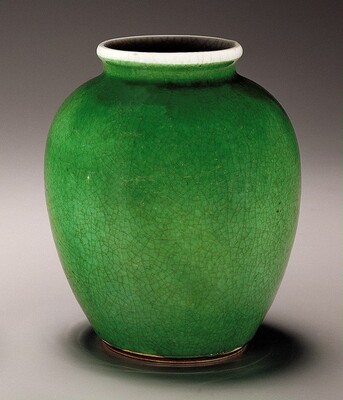
This is a vase with a rounded shape, a slightly narrowing neck, and a wide opening at the top. The vase is a vibrant green color, with crackle patterns and fine lines crisscrossing across its surface. The rim of the opening is white, and the base is a thin line of dark brown.

Jar

Chinese Qing Dynasty

This is a drawing of an abstract architectural structure. The form includes geometric shapes with rounded and angular elements, creating a 3D effect. The structure is shaded to show texture and depth, with darker tones for shadows and lighter areas for surfaces catching more light. It has a stylized embellishment on the front with symmetrical patterns. The background is blank, focusing the viewer's attention on the structure.

Patch Box

Meyer, George B.

The image shows human figures in various poses, with diverse facial expressions and hairstyles. The figures are layered and overlapping, with some in distress and others reacting to an external stimulus. Several characters are partially draped in clothing while others appear nude. In the center, a serpent is held aloft on a staff. The background is simple, emphasizing the figures and their interactions.

Brazen Serpent, from Michael Angelo

Sharp, William

This is a drawing of two sketchy figures on horseback. The drawing features two simplistic, linear sketches depicting figures on horseback. The left side displays a horse and rider seen from behind, positioned near some roughly indicated foliage. The right side shows another horse and rider, depicted in profile with the rider raising an arm. The horses are outlined with minimal lines. The bottom right section contains a hand-written note.

Mounted Horsemen [verso]

Seymour, James

This is a photograph of an old coin with a detailed profile embossment. The coin features a profile of a distinguished male figure with a beard and a hat, adorned in period clothing with detailed sleeves. The outer edge of the coin contains an inscription in a circular arrangement. The patina on the coin suggests age, giving it a rusted, brown coloration with smooth and worn areas highlighting the raised details. There are two small holes at the top and bottom of the coin.

Jean de Lorraine, 1498-1550, Cardinal 1518 [obverse]

Milanese 16th Century

The image features fifteen oval framed bust portraits arranged in a grid of three rows and five columns. Each person is depicted in profile, showing the upper part of their bodies including their heads, shoulders, and upper chest. The individuals are primarily positioned facing either left or right, seated in an upright posture. 

The portraits mainly depict individuals with European facial features, short hairstyles consistent with the late 18th century, and some with powdered wigs or tied-back hair in short ponytails. One woman in the portraits has curly hair adorned with ribbons and flowers, wearing a high-collared dress with lace embellishments. 

The individuals are dressed in formal attire typical of the period, including high-collared coats with tall collars and cravats or neck scarves. There is no visible jewelry or objects being held by any of the figures. 

The background for each portrait is plain with a simple oval shape outlining each individual, contrasting with the textured clothing and hair details. The portraits are labeled with names written beneath each person. The entire collection is set on a light brown background serving as the mount for the grid of portraits.

Saint-Mémin Collection of Portraits, Group 6

Saint-Mémin, Charles B. J. Févret de
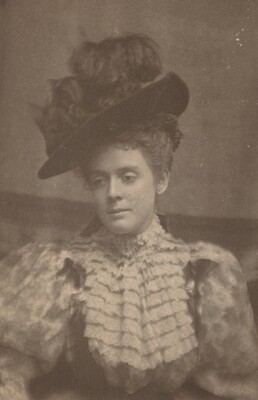
The image depicts a woman seated or slightly leaning, captured from the waist up. Her head is tilted to one side, with her gaze averted from the camera. She has delicate facial features and a serene expression. Her hair is styled in an intricate updo under a large, dark, slightly tilted hat. She wears a high-necked dress with ruffled fabric around the chest and shoulders. The background is plain with a soft-focus texture.

Woman

Keiley, Joseph T.

Rose and coral pink, vivid white, delphinium blue, and buttercup yellow flowers with deep green leaves are arranged in a blue and white vase in front of a pale sea-green background in this vertical still life painting. The vase has a white cup on a flaring foot. The vase is encircled with a twisting, decorative blue vine and scrolls. It sits on a band of peanut brown, suggesting a wooden tabletop. The still life is painted with blended strokes, giving the composition a soft, almost mottled appearance. The artist signed the painting in the lower left corner, “Cezanne.”

Flowers in a Rococo Vase

Cezanne, Paul
This is a photograph of a cover page. The page is a plain beige color with minimal text. The text is located in the upper right quadrant, printed in a serif font, and reads '"l'Epreuve" Album d'Art'. The cover exhibits a simple, minimalist design with no other text, images, or graphic elements present. The texture of the paper suggests it might be of a vintage or aged quality. The edges of the page are slightly worn.

L'Épreuve (album 6, deluxe edition)

Dumont, Maurice

The sculpture is a bowl-shaped vessel with a wide, slightly rounded body and a narrow opening. It is light blue with a smooth, glossy surface. The form is robust yet elegant. The sculpture is positioned on a flat surface. The light blue color and smooth texture give it a calm and understated appearance.

Brush Washer

Chinese Qing Dynasty

The sculpture depicts a horse in mid-stride, with one front leg raised and the tail flowing gracefully behind. The horse is designed in a stylized manner with smooth, flowing contours defining its body and mane, which is ridged and detailed. The color of the sculpture is a dark, metallic shade, suggesting it might be made of metal. The sculpture is positioned on a stable horizontal base. The sculpture’s flat, profile view shows it as a decorative piece likely intended for display, emphasizing form and silhouette rather than three-dimensional detail.

Weather Vane - Horse

Bader, Herman

The image depicts a portrait of a person from the waist up. The person is slightly facing left, with their head tilted downwards, eyes looking down, and lips closed. They have delicate facial features, including softly arched brows, long eyelashes, and a faint blush on the cheeks. Their hair is styled in loose curls with small flower adornments. The person is wearing a light-colored garment with a draped neckline and a darker overcoat with a rose flower pinned to it on the left side. The background is a simple, textured gray pattern, framed with a decorative border.

Bust of a Young Woman Looking Down

Bonnet, Louis-Marin

The image shows three figures seated. In the center, a woman sits with a baby in her arms. To the left, a child is seated on an elevated surface, holding a hat. In the background, there is a decorative pulpit or architectural structure.

Figures at a Church Service

Bellangé, Hippolyte

The image shows a circular bronze medal featuring a scene with a dead tree, branches, a pelican feeding chicks on a mound, and an inscription in Latin "FIRME ET PERPETUE CARMST*" and the Roman numerals "M D XXIII" for the year 1523. The medal appears weathered and aged, with natural patina.

Pelican in Her Piety on a Tree Stump [reverse]

Olivieri, Maffeo

L'oeuvre d'Antoine Watteau (volume I)

L'oeuvre d'Antoine Watteau (volume I)

Various Artists
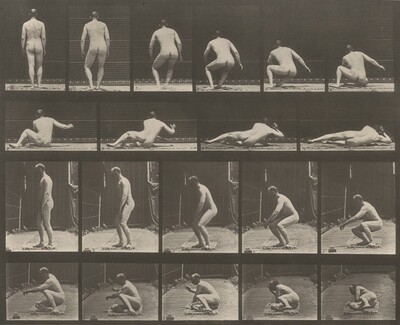
The image displays a series of photographs showing a nude male figure transitioning from standing to crouching and eventually lying on the ground. The man's body is visible entirely in each frame, showcasing different angles and stages of movement. He is bald and his facial features are not distinctly visible in all frames. There are no clothes or accessories visible on the person. The background includes what seems to be a wire mesh and solid vertical surfaces, possibly a part of a fenced or enclosed area, with light filtering through and casting shadows on the ground.

Plate Number 257. Lying on the ground

Muybridge, Eadweard

The image presents a landscape viewed from an elevated perspective, looking over a wide river winding into the distance. The horizon is positioned quite low, and the sky dominates the upper half of the scene, displaying a blend of blue with hints of pink and gray clouds. Distant trees frame the river on the horizon. Close to us, the left side features dense clusters of tall trees with green foliage, while the opposite riverbank to the right has a line of trees along the water's edge. The color palette is earthy, with shades of green for the vegetation and muted tones of brown and gray for the riverbanks and driftwood. The brushstrokes vary in intensity, softer in the sky and river, and more defined on the trees, contributing to an impressionistic effect.

Scene from the Lower Mississippi

Catlin, George

Boite à thé porcelaine

Boite à thé porcelaine

Buhot, Félix-Hilaire
The sculpture is of a jug or pitcher made of a metallic material, likely silver. It has a curved handle embellished with leaf and scroll motifs. The body is polished, with a decorative band near the neck featuring floral designs and an ornamental base with foliage patterns. The jug is tall, standing on a sturdy, decorated pedestal base. The metallic sculpture is sophisticated and luxurious, appearing functional and artistic.

Monumental Ewer

Fletcher, Thomas

The image features a rectangular wooden tray with raised edges on its longer sides. The tray has a brown color palette with dark and light wood grain patterns visible. It is positioned centrally with its longer sides running horizontally.

Butter Tub

Geuppert, Albert

The image shows a cottage on fire, with a group of figures trying to fetch water nearby. The brushstrokes are dynamic, emphasizing the fire's movement. The color palette contrasts dark blues and blacks with vibrant oranges and reds. Other structures in the distance hint at a perilous situation.

A Cottage on Fire

Turner, Charles

This is a drawing of a person next to a large wooden pole in abstract surroundings. The drawing features minimalistic and expressive linework. The person is crouched next to a tall, jagged structure that appears to be a pole or beam. Abstract lines suggest a rocky terrain or rubble around the figure. The background is mostly empty, highlighting the central interaction between the figure and the structure.

a) La fête nationale (The National Holiday) (recto); b) Woman Holding Child (verso)

Forain, Jean-Louis

The sculpture features a profile of a man's head on a round object, potentially a medal or medallion. The man depicted has historical significance, shown in a classical style with inscriptions "IOANNES" and "FASTOLVUS." The material seems to be bronze based on its color and sheen. The sculpture represents the man's face in profile facing left, with detailed features like a nose, lips, and an eye. He wears headwear and clothing with a visible folded collar. The craftsmanship reveals intricate detailing common in historical portraiture in medal forms.

Giovanni Fasiol [obverse]

Venetian 16th Century

The image shows a landscape with a rocky river winding through trees. A castle or fort sits on a hill to the right of the river, above the tree line. Fluffy clouds are in the sky above. Fine lines and cross-hatching create texture in a monochromatic style, giving a detailed and structured feel to the scene.

Sammlung Radierter Blaetter von Nathe

Nathe, Christoph

The image shows a landscape with a body of water, distant cliffs, and rocky formations on the right. There are two small boats near a sandy shore, with one person seated inside. The scene has a sepia tone, and the details of the cliffs, water, and textures are captured clearly in a photographic style.

Cape Horn, Columbia River

Watkins, Carleton E.

This painting shows a partial view of a dark wooden mantle. The mantle itself takes up the bottom right corner of the painting, and we see one side of it, but not the other. On its left corner, there is a vase of pink flowers, which stands at the center of the painting. Behind the vase, on top of the mantle, is a large silvery mirror in a golden frame. The mirror reflects gray walls and indistinct rectangles of black, gray, and brown.  In the bottom left corner, there is a patterned brown and white object, perhaps furniture or draped fabric. The wall on the left of the mantle and the mirror is a cream color. In some areas of the painting, the reddish-brown material beneath the paint is visible.

Vase of Flowers on a Mantelpiece

Vuillard, Edouard

The image depicts a woman standing outdoors. She is shown from the top of her head to just below her waist, slightly turned to her right with her eyes closed and a calm expression. Her hair is long and cascades over her shoulders. She is dressed in a long garment with dark tones and a light-colored underlayer. Leafy plants surround her, and tall trees are in the background, giving the scene a dreamlike quality. Below her, there is a faint sketch of a person in profile reading.

Invocation mémoriale

Dumont, Maurice

The sculpture is a vase with a long, slender neck and a rounded body that tapers towards the base. The vase is predominantly rose pink in color, with some slight variation on the neck, where there are patches of a peachy shade. There are also small dots of a light greenish color. The rim and base are both white.

Amphora Vase

Chinese Qing Dynasty

The image shows a large oval water cask made of small cypress staves and wrought iron hoops. The color palette includes shades of gray and brown, with the wood in gray and the iron hoops in a darker brown. Positioned centrally on the page, the cask occupies most of the image, with text describing its historical use to the right. A top view of the cask is shown slightly below the main depiction, and there is a red handwritten note in the bottom right corner.

Oval Water Cask

American 20th Century

In this image, two people are depicted from the waist up, sitting next to each other. The man on the left is seated on a chair, leaning slightly forward, and holding a dog in his arms. He has short, dark hair and appears to be smiling while looking directly at the dog. He is wearing a dark suit and a white shirt. The woman on the right is also seated on a chair, leaning slightly back. She has her hair pulled back and is wearing a bonnet, a dress with a high collar, and a patterned shawl. Her hands are resting in her lap. Both individuals are in a domestic setting, with lined wallpaper or paneling in the background.

Vous voila maintenant passe citoyen

Daumier, Honoré

This is a drawing of an architectural column capital. The drawing shows the top view of the capital with a round, circular top featuring six radial lines. The capital displays intricate carvings including volutes and vertical grooves suggesting fluting. The shading and line work emphasize the three-dimensional form of the object.

Study for "The Fall of Gog and Magog"

Sargent, John Singer

The sculpture is a circular relief depicting two male figures engaged in a handshake over an altar-like structure. One figure is dressed in classical attire, wearing a tunic and a cloak, while the other is similarly robed. In the background, there is a smaller figure or statue on a pedestal. The sculpture is crafted from a material that appears to be silver or a silver-like metal, giving it a shiny and reflective surface. The details are intricately carved, showing the folds in their garments and the expressions on their faces. The sculpture is designed to be viewed from the front, and the deeply carved elements create shadows that highlight the figures' outlines against the circular background.

Antique Sacrifice

Tommaso di Calisto

The image shows a stylized artwork of a profile view of a person, with their head and part of the upper body visible. The person is facing to the left, with their hand touching their head. The facial features are abstract and angular, rendered in bold black lines. The hair is simplified and dark. The person appears to be wearing a garment, with contours extending from the neck downward. The background is textured with dark green and off-white tones, with text at the top reading "Georg Heym" and "UMBRAVITÆ."

Bucheinband (cover) from mock-up of Georg Heym: Umbra Vitae (Georg Heym: Shadow of Life)

Kirchner, Ernst Ludwig

This is a photograph of sequential movements captured in multiple frames. The image shows a progression of movements demonstrating various body positions. There are twelve distinct positions arranged in a grid of four rows and four columns with a backdrop of a grid pattern. The photography captures the fluidity and flexibility of the subject matter as it advances through each frame.

Plate Number 510. Contortions on the ground

Muybridge, Eadweard

Twelve people and one child stand, sit, or kneel along a riverbank in this horizontal painting. All the people have pale or tanned skin, and are muscular. They are in various stages of undress, wearing robes of golden yellow, ruby red, petal pink, azure blue, or cream white. To our right of center, a man, Jesus, stands facing us with his arms crossed over his chest. He wears a blue robe wrapped loosely across his shoulders and across his hips. He looks down, his blond hair falling alongside his face, as another man, wearing red, pours water from a shallow dish onto his head. A white dove flies with wings spread overhead. To our right of Jesus, one kneeling person wearing white holds up Jesus’s blue robes and another looks on, wearing a sage green robe and holding a voluminous rose-pink cloth. To our left, a group of five men react by throwing up hands, pointing upward, or looking up. One man with a gray beard and hair stands and bows his head over praying hands. A young boy wraps the arm we can see across the praying man's hips. Three more men to the left of this group pause as they undress to look toward Jesus. All the men stand or sit among puddles as a river spans the width of the painting behind the group and winds into the distance to our right. At the center of the composition, three men stand or recline on a grassy mound on the far side of the river. Tucked under trees at the peak of the mound, a smudge of white could be another kneeling person. Two more people walk along a path that crests the mound to our left. Mountains in the distance are slate blue beneath a vivid blue sky streaked with white clouds.

The Baptism of Christ

Poussin, Nicolas

This is a drawing of an interior scene depicting a group of individuals interacting in a structured environment. The image displays an interior with large block stones forming walls and arches, along with a hanging chain. In the center, a group of figures is gathered. Among them, three figures are seated; two are draped in cloth and appear to be barefoot. Another figure stands, gesturing towards one of the seated individuals. Additionally, there is a figure leaning over a wall observing the interaction. The scene extends into the background with more figures. The detailed lines and shading techniques emphasize the depth and texture of the architectural elements and figures.

Consolation of the Imprisoned

Meyer, Conrad

This is a painting of a circular plate with a central cherubic figure surrounded by various ornamental and mythological elements. The plate depicts a cherub-like figure carrying a shield, set within a pastoral scene with trees. Surrounding this central image, the plate is decorated with smaller cherubic figures and designs including scrolls, floral motifs, and musical instruments against a deep blue background. The design features a color palette of blues, yellows, and oranges, with a strong emphasis on symmetry and elaborate detail. This is in the style of Italian Renaissance Majolica pottery.

Plate with border of putti and trophies amid grotesques; in the center, a winged putto standing, armed, in a landscape

Urbino district 16th Century

The image depicts a large wooden armchair with ornate carvings, a high backrest, and detailed designs. The chair is a warm, light brown color with intricate carvings, facing forward on four turned legs. The armrests show curves and scroll motifs, enhancing the chair's decorative appearance. The background is a plain, neutral off-white color.

Wainscot Armchair

Drozdoff, Leo

The image shows a sketch of several people situated around a table indoors. Two individuals are visible sitting at the table, with one person's back slightly turned. Both individuals have simple hair styles, and their facial features are minimally detailed. The clothing is suggested with basic lines, and one person appears to be wearing a hat. There is no clear depiction of jewelry or objects being held. The background is roughly sketched with shading hinting at a window or architectural detail. The focus is on the figures, with surrounding lines giving context.

Late Picquet

Whistler, James McNeill

The image shows an aerial view of an arched bridge and surrounding architectural structures. The horizon is not clearly defined, with the bridge spanning the middle of the composition. Buildings with slanted roofs reach upwards towards the top of the scene. The sketch features expressive pencil strokes with heavy shading to denote texture and depth in the stonework and surrounding terrain. The artwork is in shades of grey, emphasizing shadow and light. The cliffs are detailed, emphasizing the central archway against the sky above.

A High Bridge in Tivoli

Vien, Joseph-Marie

At first glance, this bronze sculpture resembles a lump of clay loosely formed into the head and shoulders of a man. In this photograph, his shoulders are squared toward us as he looks to our right. His hair is pushed forward in rope-like spikes over deep-set eye sockets. He has a sharp, thin nose, and his lips purse in an exaggerated scowl. He seems to wear a cravat nestled into the high lapels of his coat. The surface of the bronze is mostly brown except where the edges and ridges are gold, as if having been burnished through handling.

Dr. Clément-François-Victor-Gabriel Prunelle

Daumier, Honoré

This is a photograph of a decorative book cover. The cover is black with a gold border and lettering. The title of the book is "The Shakespeare Ballads Illuminated." In the center of the cover, there is a crest with a shield, a bird on top, and a ribbon with the motto "Hon Sanz Droict." Metal clasps are on the corners for closure.

The Songs and Ballads of Shakespeare

Mapleson, Thomas W. Gwilt

The image shows an older man seated, captured from the waist up. The man's facial features are characterized by a broad face, prominent nose, and a neutral expression. He has short, slightly wavy hair with sideburns. He is dressed in a formal dark suit, with a visible white shirt and cravat or bow tie. Marks or damage are present on the suit's shoulder area. The photograph is framed in an ornate gold case with a decorative edge. The background is plain and dark, centering the focus on the man's portrait.

Captain Gideon Lane

Campbell, Hamilton

A leafless, ash-white tree trunk has fallen from a broken stump into the wide V of a neighboring tree at the edge of a body of water near a verdant forest in this horizontal landscape painting. The fallen trunk creates a diagonal from near the lower left corner to the upper right. As it fell, it sheared off a substantial branch from a neighboring tree with a dark trunk. The bark where the damaged branch has pulled away is honey-orange, the same color as the leaves at the canopy, which has been pinned under the fallen trunk. Trees, vines, and other vegetation fill the space around and beyond this pair. In the lower right corner of the painting, vines grow over a broken stump, which deep in shadow. Between the stump and fallen tree, the peanut-brown surface of the water is smooth. Tiny in scale beneath the fallen tree and easily overlooked, there are two men and a dog in a boat. One man stands at the back of the boat and pushes it along with a long pole. He wears a tall, brown, cloth hat, a white shirt rolled up to the elbows under a blue vest, and loose-fitting pants. A second man wears a flat-topped, white hat with a black brim, a long, forest-green jacket, and tight-fitting slate-blue pants. He braces a rifle against one shoulder and shoots into the forest. The dog is white with brown spots, and it stands with its front paws on the edge of the boat, presumably ready to spring after the target. A patch of blue sky with puffy white clouds is seen above the trees in the upper left corner. The artist signed and dated the work in the lower right corner: “H. Vernet Rome 1833.”

Hunting in the Pontine Marshes

Vernet, Horace

The image features two figures shown from the waist up. The individual on the left is an older, balding man with deep-set eyes, pronounced cheekbones, and a frown line above pursed lips. He is wearing a collared shirt and is holding a small child facing him. The child has curled hair and is shown in profile. The older individual's hands are supporting the child. The background is a plain, light-colored surface.

Der Vater (The Father)

Hoerle, Heinrich
This is a photograph of an ornate wooden chair. The chair has intricate carvings and design elements throughout its structure. The backrest is detailed with scrollwork and central shields or cartouches framed by foliage designs. The seat is simple and flat, resting upon a similarly detailed base that continues the decorative motifs of scrolls and acanthus leaves. The chair appears to be made of dark wood, possibly enhanced with gold or gilded accents. The craftsmanship suggests it is an ornamental piece, possibly intended for decorative purposes as much as for utility.

Walnut Stool (Sgabello), Carved and Gilded

Italian 16th Century

This is a drawing featuring detailed technical sketches of an elongated rectangular object with curved ends, presented from multiple angles. The object is supported by two cylindrical legs underneath in the side view. The top view shows its shape, while the end view displays the profile with its curve. The line work is precise and clear, typical of a schematic or design blueprint.

Cradle

Bernhardt, Gerald

The image shows a figure standing on a sphere. The person is in a poised position with one arm extended to the side. Their facial features are classical, with a calm expression and short, wavy hair. The person's body is partially draped in light fabric and they hold a small open bag from which coins are spilling. A winged cherub-like child is closely positioned beside them. The background consists of stylized clouds.

Fortune

Cantarini, Simone

This is a drawing of an interior scene featuring two figures. One figure is elaborately dressed and standing, holding a container, while the other is reclining beneath a canopy. The setting includes columns, drapery, and another figure in the background. The drawing is detailed with fine lines and contrasting elements.

Second Day, Seventh Story: The Duke of Athens Contemplating the Sleeping Princess Alatiel

Gravelot, Hubert François

The image shows a bronze medallion with a detailed design. The central subject is a shield-like motif with an emblem, possibly a cross, inside a circular crest. Surrounding the central motif are Latin inscriptions referencing the year 1517 and other design elements. The bronze material gives the sculpture a brown color with a weathered patina. The medallion features a three-dimensional relief with intricate craftsmanship.

Arms of Panciatichi [reverse]

Gauvain, Jacques

Excursions Daguerriennes / Vues et Monuments les plus Remarquables du Globe (Vol. 1)

Excursions Daguerriennes / Vues et Monuments les plus Remarquables du Globe (Vol. 1)

Lerebours, Noël Marie

This is a photograph of a pronghorn antelope in motion captured through a sequence of frames. The image is in the style of Eadweard Muybridge. A series of twelve separate, sequential images in a grid show the antelope moving progressively. Each frame depicts a change in the position of the animal's legs and body, illustrating the fluid motion of its gait. The background is simple, likely a plain dark surface with vertical and horizontal lines.

Plate Number 697. Antelope trotting

Muybridge, Eadweard

The image displays two people from the waist up. The person on the left is seated in a green chair, facing slightly towards the viewer. They have short, light brown hair neatly combed to the side, a stern expression, noticeable cheeks, and a defined nose. They wear a tan coat with gold buttons over a black waistcoat and a white cravat. The person next to them, potentially a child, is slightly in front, facing the viewer, with hands clasped together or touching the object held by the other person. The child has very short light hair, a similar facial structure with bright eyes, and wears a dark garment with a white ruffled collar. The background features rich red drapery and a hint of a scenic landscape.

Father and Son

Budington, Jonathan

The image shows a group of people sitting in an enclosed train compartment. Six individuals are visible from the waist up. From left to right, there is a standing figure holding onto a support handle, a woman holding a baby, a stout man, a woman with a bonnet, and a man in a top hat. The background shows vertical lines suggesting window frames and part of the carriage's ceiling.

Interieur d'un omnibus

Maurand, Charles

This is a photograph of a decorative ceramic vase. The vase has painted scenes and motifs across its surface. The upper portion features a seated figure, peacock-like designs, foliage, and an orange color amidst green leaves. The middle section has an inscription reading "FILIONIO." The bottom section depicts cherubs or putti, one riding on a dolphin-like creature over waves. The composition suggests an ornate, historical style, possibly reminiscent of Italian Renaissance ceramics known for vivid colors and detailed storytelling in art.

Albarello with woman spinning and putti on sea monsters

Deruta 16th Century
This is a drawing of a wrought iron object with a handle. The drawing features a detailed depiction of a decorative flat iron or metalwork tool with a handle, showcasing scrollwork and symmetrical patterns within its iron frame. The drawing highlights the object's ornate structure with intricate curling shapes. A schematic view of the iron is included in the upper left corner illustrating its shape and structural dimensions with measurements indicated. The artist's name, H. Baber, is visible on the bottom right.

Flat Iron Holder

Bader, Herman

This is an image of an ornate title page from an old book. The central part shows an intricate, framed frontispiece with the title "Ancient Funerall Monuments within the United Monarchie of Great Britaine, Ireland, and the Ilands adjacent." The frame features classic columns, a pediment with sculptural busts and finials. On the left side is a skeletal figure, possibly representing death, and on the right, a draped human figure representing life or resurrection. Below the text block is an illustrated vignette of a church and cemetery, with the phrase "Hic jacet" (Here lies) written in Latin. Latin inscriptions surround the visual elements, adding to the scholarly atmosphere of the book.

Title Page to John Weever, Ancient Funeral Monuments

Cecil, Thomas

The image shows a group of figures, both human and a cow, in a rural setting. One person is seated, holding a child, with most of their body shown. Another figure is leaning on a staff, facing downward, with short wavy hair and simple clothing. A third figure stands behind them. A cow with horns is on the left. The scene is sketched in brown ink wash, depicting a barn-like environment with few details.

The Adoration of the Shepherds

Tiepolo, Giovanni Battista

The round bronze medallion features a raised relief sculpture depicting a scene with human figures and horses in motion. There are three figures depicted - one central figure standing elevated with an outstretched arm, and two figures on horseback flanking the central figure. The surface has a textured appearance. Around the edge, there is a border of dots, and the word "TENEBRARVM" is inscribed across the top. The medallion has a rich, earthy brown color due to the bronze material. The overall appearance suggests age and intricacy in craftsmanship.

Aurora Stepping from a Car [reverse]

Italian 16th Century

This is a drawing of a cover page. The cover features a title in bold red and black text, promoting a collection of images of Rome. It names Giambattista Piranesi as the architect, with Giovanni Bouchard as the collector. Below the text, there is an illustration of an ancient Roman architectural ruin set amidst trees and natural surroundings, with detailed textures and grand columns. The drawing is detailed with a sense of depth, capturing the ambiance of Roman architecture.

Le Magnificenze di Roma Le Più Remarcabili Consistenti In Gran Numero di Stampe Nelle quali vengano rappresentate le più cospicue Fabbriche Di Roma Moderna, E Le Rimaste Dell' Antica, Anche Quelle, Che Sparse Sono Per L'Italia Con L'Aggiunta Ancora Di Molte Invenzioni Si Prospettiva Sulla Maniera Degl' Antichi Romani, Come Anche Di Molti Capricci Di Carceri Sotterranee. Il Tutto Com Singolar Gusto, E Studio Diligentemente Delineate, Inventate, Ed Incise Da Giambattista Piranesi Architetto Veneziano, E Raccolte Da Giovanni Bouchard Mercante Librajo Al Corso

Polanzani, Francesco

The image shows a canal lock system near a body of water. The horizon line is high, with a treeline visible across the water. A grassy slope with a wooden fence is in the foreground, leading to buildings and a canal lock with a guardhouse. The cyanotype style gives a blue-tinted color palette, ranging from deep blues to lighter shades. The water reflects light, adding to the serene atmosphere.

Guard Rock, Des Moines Rapids Canal L.W.

Bosse, Henry Peter

The image depicts a man and a woman indoors. The man is seated on a red-covered piece of furniture and holding a letter. He has curly blonde hair and is dressed in a yellow vest, white shirt, cravat, and gray breeches. The woman is kneeling beside him, holding a piece of paper. The scene also includes a stool with letters, a musical instrument, a chair with a cloak, a sword, a hat with plumes, and a decorated cabinet with a globe and vase on paneled walls.

I Reread Them with Pleasure

Gérard, Marguerite

The image shows a group of five women in a richly decorated interior. Each woman wears historical clothing with lace collars, voluminous skirts, and tight bodices. One standing woman holds a book, gesturing, while another sitting woman holds an open book. A third woman looks at a reflection or portrait. The hairstyles are styled in curls with ribbons or flowers. Some women wear earrings. The room has intricate woodwork, paintings, wallpaper or tapestries, a fireplace, and a small dog. Large windows reveal a landscape.

The Foolish Virgins Wasting Time

Bosse, Abraham

Rectangular Vase

Rectangular Vase

Chinese Qing Dynasty

The image shows a large brown bonnet with a puffed structure and a ruffled edge around the face opening. The bonnet has two long brown ribbons attached for tying under the chin. The color palette is earthy, dominated by various shades of brown, giving the bonnet an appearance of being made from a textured fabric. The bonnet is centered and positioned slightly turned, so one side of the bonnet is more visible. The ribbons hang downward and to the left side of the bonnet, maintaining a relaxed shape.

Bonnet

Garfinkel, Sara

The image displays a portrait of a person from the chest up, facing forward with a slight turn to the right. The individual has distinct facial features and long, curly, white hair. They wear a dark coat with a vest, a white neck scarf, and the clothing has visible buttons. The background is a shaded oval shape. Below the portrait, there is text in a decorative script that includes the name "Edmundus Halley."

Edmund Halley

White, George

The drawing depicts various sketches of people in different poses and positions. The top left sketch shows an individual looking to the side, with a hat and distinct facial features, including a prominent nose and an open mouth. The person is shown with a hand raised. Adjacent sketches show heads and shoulders of other individuals in various positions. One person appears to have curly hair, while another has straight hair pulled back. The expressions are neutral, with detailed eyes and subtle mouths. Some figures exhibit facial profiles or angled views, emphasizing cheek and jaw contours. One person in the lower section appears to be leaning forward with a headband holding back curly hair, observing something below, possibly a woven basket. The attire suggests loose-fitting garments. The scene is sketched in sepia tones, with minimal background detailing, focusing more on the figures and their facial expressions and interactions. The background is plain and unadorned, accentuating the pencil or ink sketch work on the pale surface.

Sheet of Studies

Stothard, Thomas

The sculpture depicts a standing female figure with her arms behind her back and head slightly tilted downwards. The figure is leaning against a textured form, possibly representing drapery or a natural object. It is crafted from light brown or terracotta-colored material, likely clay, giving it an earthy appearance. The sculpture has a rough texture with visible marks and surface variations, suggesting a hand-modeled quality. The base is dark and polished, contrasting with the natural color of the sculpture. The proportions of the figure are naturalistic, emphasizing form and posture, conveying a sense of timelessness and human presence.

Statuette of a Woman

Rodin, Auguste

The image shows a large rectangular shape with two diagonal lines running from corner to corner, creating a triangular pattern. The overall composition resembles an abstract design resembling the cover of a book, with a textured surface and black borders.

Williamina Blackett's Album

Murray, Georgina

The image shows a young boy standing upright, with one hand resting on a wooden chair. His posture is formal, and he is facing the camera with a slightly tilted head. The boy has short, curly hair and his facial expression is neutral. He is dressed in a dark three-piece suit with a white shirt and a tie. The background consists of a simple draped curtain, and the floor is covered with a patterned rug. The environment portrayed is typical of a traditional photographic studio setup.

Duc d'Alençon

French 19th Century

Martha Tennent Rogers (Mrs. David Rogers) and Her Son, probably Samuel Henry Rogers

Martha Tennent Rogers (Mrs. David Rogers) and Her Son, probably Samuel Henry Rogers

Earl, Ralph

The image shows four figures standing and interacting with each other. The person on the left is standing upright on a mound. This figure has wavy hair and is dressed in a cloak with a visible garment underneath. The figure in the center faces the viewer and is covered in a similar cloak, with tousled hair. To the right, a kneeling figure offers a skull to the standing figures, wearing a shirt with rolled-up sleeves and a vest. Another figure, seated at the base of the mound, appears to be looking up towards the central character while holding his head with one hand and a shovel or spade with the other. The background depicts a shore with distant structures on a hillside under a cloudy sky.

Hamlet and Horatio before the Gravediggers (Act V, Scene I)

Delacroix, Eugène

This is a photograph of a decorative ceramic jar with a mythological scene. The jar features a winged cherub, who is blindfolded and seated on a golden blanket. The background shows a natural scene, with green possibly representing grass or water, and distant hills or mountains. The rim of the jar has alternating color patterns with geometric designs. The artwork on the jar suggests a traditional aesthetic typical of European ceramics.

Albarello with blindfolded, bound Cupid

Faenza 16th Century

This is a drawing of a silhouette signage depicting a mounted figure. The image shows a silhouette of a sign with a horse and rider, accompanied by a hanging sign with text. The rider is holding an object that could be perceived as a weapon or a tool. The silhouetted figures are rendered in a simple, solid black against a plain background, emphasizing the contour and shape of the graphic elements. The background features faint, swirling lines. The overall effect is a stark and impactful visual that focuses on the interplay of positive and negative space.

Two Weather Vanes

Anderson, Elmer G.

The image shows a landscape from a high vantage point, revealing a vast, rugged terrain. The horizon is high, emphasizing the depth of the view. In the distance, rocky mountain formations rise, with a castle-like structure on a hill. The artwork features detailed line work, emphasizing textures of rocky surfaces, trees, and streams. The color palette is monochromatic, using varying shades of gray for contrast and depth. Near the viewer on the right, a figure on horseback overlooks the valley. A winding path or stream guides the eye through the scene, highlighting small clusters of trees and buildings.

Large Alpine Landscape

Doetechum the Elder, Johannes van
The image depicts two individuals standing side by side. The person on the left has short curly hair and is wearing a loose, flowing garment. The person on the right has longer curly hair pulled back and is dressed in a draped garment with one shoulder exposed. Both individuals are shown from head to toe. The background is a simple, monochromatic surface primarily in shades of brown.

Two Women in Classical Dress

Lorrain, Claude

The image shows a round, flat sculpture resembling a medallion or coin with a raised Latin inscription. The sculpture appears to be made of a metal material with a warm, brownish coloration and hints of darker areas suggesting oxidation or patina. The surface is worn with blemishes and a small hole near the top. The letters are engraved into the metal, standing out by casting shadows, enhancing the visibility of the inscribed words. The texture suggests it is an antique piece, contributing to its historical appearance.

Inscription [reverse]

Hagenauer, Friedrich

This tan-colored, fabric-covered sketchbook cover is marked with a few smudges of dark gray and white paint. The binding is to the left in this photograph. The cover is wide and has a cream-colored rope wrapped around the narrower end to our right. The weave of the fabric is visible. A few swipes of gray paint are spaced along the binding, to our left, and there are tiny touches of white, lavender purple, and brick red marking the cover.

Cezanne Sketchbook

Cezanne, Paul

The image is a portrait of a man shown from the waist up, sitting in a formal pose. He is facing slightly to his left, with his right arm resting on a surface draped with a green fabric that has a paisley pattern. His left elbow appears to be resting on his knee. The man has a full beard and mustache, and styled hair with a side part. He is wearing a dark coat with a matching vest, white shirt, and a black bow tie. A gold chain is attached to his vest. The background features a curtain with a tassel, indicating an indoor setting. The portrait is surrounded by an oval frame with floral motifs in gold.

Portrait of a Man

American 19th Century

General Washington at Princeton

General Washington at Princeton

Polk, Charles Peale

There are four individuals in the image: a woman and three children. The woman is slightly bent over, holding a baby close to her chest. One child is seen with a ball, another has curly hair and a doll-like expression, and the baby is swaddled. The background shows a tree, a wooden fence, and a structure resembling a house.

Springtime

Myers, Jerome

This large ceramic vase has a deep red glaze that fades to white at the top rim. The vase has a smooth, slightly elongated shape with a narrow neck and a round base. Around the middle section of the vase there is a lighter red section, and towards the bottom the red transitions into a dark, almost black shade.

Vase, called "The Flame"

Chinese Qing Dynasty

The sculpture depicts a figure of a Native American man in a standing position. He is wearing a headdress adorned with large feathers, a necklace with a circular pendant, a belt with an ornate design, and a tasseled loincloth. The sculpture is predominantly reddish-brown in color. The man's right arm is bent at the elbow, his hand held up in a gesture, while his left arm is extended forward. The sculpture is set on a rectangular pedestal that elevates the figure.

Cigar Store Indian

Pohle, Robert

The image depicts swirling lines and circular shapes in an abstract composition. The top portion of the artwork contains curved formations blending into the background. In the center, there are detailed circular patterns. Below, a softly rendered face of a young person emerges. The lower section features distinct linear elements resembling a celestial object or mechanical device.

Tete d'Enfant (Head of a Child)

Redon, Odilon
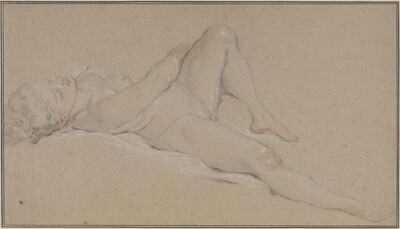
The image shows a full-body sketch of a reclining person on their back, with the head turned slightly to the side. The person is lying with one leg bent at the knee and the other leg extended, while their arms are positioned across the torso. The facial features are softly defined, with closed eyes and the hair appears curly and styled up, though details are subtle. The individual is depicted without clothing, drawn with gentle lines and shading that capture the contours of the body. The surrounding area features a simple, textured background without any additional objects or decorations.

Venus

Boucher, François

The sculpture is of a human hand and wrist, depicted in a relaxed, natural position with fingers slightly bent. The sculpture's material appears to be a pale, white plaster, with a matte surface that shows subtle texture. The hand is life-sized, comparable to the size of an average human hand, and is oriented upright. The sculpture focuses on anatomical accuracy, with detailed contours and proportions that mimic the appearance of real human skin and bones. The material and color give the sculpture a minimalist and classical appearance.

Right Hand

Rodin, Auguste

This is a drawing of an elaborate baroque-style title page. The image features a highly ornate decorative border with swirling acanthus leaves and floral motifs around a central block of text. At the top, an opened book with Latin text is supported by a cherubic figure, with rays of light emanating from it. Additional cherubs on clouds enhance the composition. The text is inscribed in both Latin and German. This design showcases the detailed printmaking techniques of the period, emphasizing grandeur and formality.

Picturae Chalcographicae Historiam Veteris et Novi Testamenti

Kilian, Philipp Andreas

The image was captured from an elevated point of view. The horizon line is low in the composition. A series of ancient columns stand above the horizon. A sprawling urban area extends to the left. A large building is visible behind the columns. A mountain rises in the background. The color palette is sepia-toned, giving a vintage feel. The image has gentle tonal variations and soft contrasts, creating a sense of calm and timelessness.

View of Athens with the Temple of the Olympian Zeus

Robertson, James

In the center of this painting, a large animal carcass is hanging upside down from a wooden frame, with several people attending to it. The carcass is light pink and has been cut open to reveal white ribs, red muscles, and purple organs. On the far left, a young boy stands next to a barrel and a basket, holding several small knives. To the right, a man in a red cap and white apron observes the carcass while holding a drink. An older man in a furred cap and dark clothing looks towards him and holds one edge of the carcass. On the other side of the animal, a young boy blows up a round object. Two women peer out from the doorway of a wooden building in the background, one holding a basket full of what looks like meat. Behind this group of people are several brown structures and a bare tree against a light pink sky.

The Slaughtered Hog

Victors, Jan

The image is a sketch of a person's bust, focusing on the head and shoulders. The person is facing slightly to the side with their gaze directed upward. Their facial features, including large eyes and a prominent nose, are depicted with strong shadowing and lines. The dark, textured hair appears almost unruly. Light sketching suggests loose clothing draped over the shoulders. In the background, there is a skull rendered in a similar sketch style above and behind the person's head. Heavy shading and cross-hatching blend the background into the person's form, creating depth and intensity in the artwork.

Death and the Old Man (Tod und Greis) from Dance of Death (Totentanz)

Corinth, Lovis

This is a photograph of an ornamental cushion with a heraldic emblem. The cushion features a richly embroidered coat of arms with two golden lions rampant on either side of a red shield adorned with three six-pointed stars arranged vertically. Above the shield is a crown-like adornment surrounded by circular patterns. The backdrop is a deep blue fabric draped to mimic curtains or banners. The top of the image reads "GOVDA" within an ornate scroll-like design, and the bottom bears the name "MR. REYER VANDER BVRCX."

Tapestry-covered Cushion

Netherlandish 18th Century

The image displays an embroidered design featuring a large flowering plant with red flowers and various other floral and leaf elements. The color palette includes vibrant reds, greens, blues, yellows, and pinks against a light, neutral background. Central to the fabric, the large red flowers are the focus, with stems and leaves extending in different directions. Additional small flowers and a bird are embroidered around the main plant.

Bed Canopy Detail

Bent, Mildred E.

The Witch of Malleghem

The Witch of Malleghem

Heyden, Pieter van der

The image shows a full-body illustration of a person depicted in a sketchy, fluid style. The person is in an active pose, appearing to be in motion with one leg forward and one leg back, arms extended outward. Their facial features are outlined with prominent eyes and an open mouth. The person's hair is short, curly, and flowing backward. They are dressed in loose, flowing garments detailed with shadows. The background is minimalistic with a lightly sketched ground and empty space around the figure. There is no visible jewelry, and the focus is on the motion and form of the individual.

The Young Courier

Daumier, Honoré

This is a photograph of a coin. The coin features a central image of an eagle with its wings spread, standing atop a central emblem surrounded by detailed engravings. At the eagle's chest, there appears to be a shield or emblem. Beneath the eagle, there are additional sculpted figures or symbols flanked by columns and ribbon-like elements. The coin's edge is adorned with inscribed text and a textured, beaded border that encapsulates the design. The surface of the coin shows signs of wear.

Double-headed Crowned Eagle on the Pillars of Hercules [reverse]

Neufahrer, Ludwig

The image shows swirling patterns and spots on a textured surface. The abstract design consists of lines and shapes that resemble the branching of a tree or the veins of a leaf, with clusters resembling islands or clouds scattered across the surface. The pattern gives the impression of a natural landscape viewed from above, with organic formations.

Vida y Hechos del Ingenioso Hidalgo Don Quixote de la Mancha (volume 1)

Cervantes Saavedra, Miguel de

This is a photograph of a city street with a large crowd, horse-drawn carriages, rising smoke, multi-story buildings, signs, and lamps. The architecture suggests a historical setting, and the sepia tone adds to the aged appearance. The presence of carriages and building style indicate it was taken before automobiles were common. The scene conveys a sense of vibrant city life with movement in the crowd and street activity.

Fire in Oxford Street

Davison, George

Two pale-skinned women sit together surrounded by five sheep and a dog in a lush forest in this vertical painting. The woman to our right sits slightly above the other, with her arm draped around the shoulders of her companion. The woman to our right wears a low-cut, rose-pink dress with a full skirt and voluminous, gossamer sleeves. Blond curls are pulled back behind a headband, which is adorned over one ear with three large, pink flowers and smaller yellow and blue flowers. She tips her head to our right as she gazes down to her left at her friend. She has blue eyes, flushed cheeks, a delicate nose, and her grapefruit-pink lips curl in a gentle smile. She crosses one knee over the other and leans toward the other woman. Tucked into her side, the second woman looks up at the first in profile facing our right. Her low-cut, lavender-purple dress has a gold shimmer that suggests silk. Her ash-brown curls are pulled back and decorated with small sea-blue flowers. One toe peeks out from her long skirt, and both women are barefoot. The woman in purple holds a white dove on her friend’s lap, and the woman in pink holds a small envelope closed with a shell-pink seal next to the bird. The dove’s wings are slightly outspread, and a blue ribbon is tied around its neck. Just behind the pair, a towering tree with a silvery-gray trunk grows up and off the top edge of the painting. It angles to our left, and green branches hang down into the picture. To our right of the tree, a rectangular sand-brown stone structure is topped with a male lion carved from the same stone, near the upper right corner. The ground beneath the women is covered with moss-green growth and the space around them filled with verdant bushes and plants. A single, cream-colored sheep stands to our right, facing the women, next to a basket of flowers near the lower right corner. Four more sheep stand and lie together beyond the women to our left, while a black-bodied hound with a white muzzle sits watching the women. A pile of broken branches, perhaps forming a fence, lies behind the sheep. Grassy hills and trees become hazy in the distance beyond, and the sky above is slate blue with a few white and pale pink clouds. The upper and lower right corners and the lower left corner are deep in shade. The artist signed and dated the painting as if he had inscribed the stone in the shadow just below the lion, “f. Boucher 1750.”

The Love Letter

Boucher, François

The image shows an elevated viewpoint of a landscape with trees, a rocky structure resembling a tomb or ruin, and a clear sky with dramatic clouds. A figure on horseback leads a herd of goats across a rocky path. The grayscale color palette creates a serene atmosphere, highlighting details in vegetation and stone. The etching technique captures natural textures and forms, conveying an atmosphere of antiquity.

Sepolcro a Falerium città Etrusca ditrutta

Reinhart, Johann Christian

This is a vase with a bulbous body tapering towards a slightly flared rim. It is coated in a vivid green glaze with a crackle pattern. In some areas, the green is lighter, accentuating the fine lines on the surface of the vase. The rim of the vase is white.

Vase

Chinese Qing Dynasty

The image shows a large wooden chest with intricate carvings. The chest is colored in shades of turquoise and placed centrally in the image against a plain background. The front panel and part of the right side of the chest are visible, with shadows suggesting a slightly off-center view from the front and right.

Chest for Clothing or Blankets

Claflin, Majel G.

This is a drawing featuring abstract forms that suggest human caricatures with exaggerated features and dynamic poses. On the left is a whimsical face with a mischievous expression, crafted with bold, angular lines. In the center, a figure appears to be in motion, with limbs extended in a dance-like posture. To the right, two more ambiguous figures are depicted. One has a rounder form and robe-like garment, while the other has an oversized head and large eyes, seemingly observing from the background. The drawing style is loose and expressive, with quick, gestural marks giving a sense of lively interaction among the figures.

Das Gastmahl des Trimalchio: pl. XI (The Banquet of Trimalchio: pl. XI)

Corinth, Lovis

This is a painting of birds perched on and around a gnarled tree. The painting features a collection of six birds, each distinct in its coloration and form, situated on a barren landscape where the earth appears rugged and eroded. The birds are distributed across the scene, with some perched on the twisted branches of a leafless tree, while others are stationed on the ground or near a body of water below a cliff. The artwork is rendered with fine detail, capturing the feathers and postures of the birds intricately. Latin text is inscribed at the top of the image.

Plate 63: Six Small Birds, Including a Bluethroat and a Cuckoo(?)

Hoefnagel, Joris

The sculpture is a medallion featuring the profile of a man looking to the left. The name "ANTONIVSDANDTEDECASITLION" is inscribed around the edge of the disc. The medallion is crafted from metal, likely bronze, with a brownish color and areas of lighter hue. The surface shows texture, suggesting age and wear, with a small hole at the top. The image is a detailed relief against a flat background.

Antonio di Dante Castiglione

Anonymous Artist

This is a drawing of a title page for an Italian text on the gates and walls of Rome. The page contains Italian text in various sizes and styles detailing the dedication and authorship of the text. The main dedication reads "Delle Magnificenze di Roma Antica e Moderna" and is dedicated to Carlo, Infante of Spain and King of the Two Sicilies. Below the text, there is a small engraved illustration of a classical figure surrounded by architectural elements, likely referencing ancient Roman structures. The page is dated MDCCXLVII (1747) and printed in Rome.

Delle Magnificenze di Roma Antica e Moderna (vol. 1)

Vasi, Giuseppe
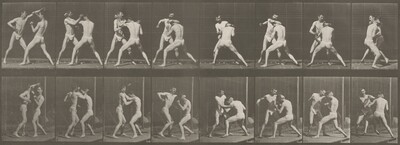
This is a photograph of a sequential depiction of an athletic activity. The photograph shows a series of frames with two rows, each capturing moments in a motion sequence. The images present two figures in motion, engaged in a form of sparring or wrestling. The background has a plain, grid-like pattern. The series captures different stages of the interaction between the figures, highlighting their dynamic movements and positions.

Plate Number 342. Boxing, open hand

Muybridge, Eadweard

Shown from the knees up, a pale-skinned woman in a voluminous rust-orange dress stands facing us in this vertical portrait painting. She looks toward us but slightly down with dark brown eyes under curved brows. She has a wide face, rounded cheeks, a broad nose, and closed, coral-pink lips over a deeply dimpled chin. Her chestnut-brown hair is pulled up and back. The orange dress has a band of charcoal gray across the shoulders and at the flaring cuffs. Wide, vertical pleats fall from under the band across her chest. White trim, perhaps lace or fur, is suggested by loosely painted cream white at the high neck. The poofy sleeves and cinched cuffs of her white shirt extend beyond the dress sleeves. Her right arm, to our left, hangs by her side and the other holds an indistinct, loosely painted light-colored object down in front of her. She seems to be in a corner with the wall behind thinly washed in muted brown and green and a sienna-brown wood panel wall to our right.

Girl in Red

Degas, Edgar

The image shows ancient ruins in a lush, vegetated landscape. Stone columns and arches are arranged in a semi-circle towards the right. Two figures converse near a large stone slab in the foreground. Other architectural remnants are visible behind them. The scene is captured in detailed black and white engraving, showcasing textures in the stone and foliage.

Nel Colosseo

Reinhart, Johann Christian

The sculpture is a cylindrical jar with an illustrated profile of a human head. The depiction includes stylized black hair and a finely detailed facial profile painted in a light blue or gray tone. The jar is made from ceramic material, predominantly gray with decorative elements and the head in shades of blue and rust-orange. The word "MITRIANO" is inscribed vertically beside the profile in dark blue letters. The form of the jar is slightly waisted, with a flared rim and base, suggesting it is designed as an apothecary or storage container. Decorative bands at the top and bottom emphasize its design, combining functionality with artistry.

Albarello with a portrait of a youth (Mitriano)

Neapolitan 15th Century

The image shows an antique musket with a long barrel and wooden stock. The color palette is primarily deep browns and shades of tan, giving the weapon an aged appearance. The musket is centrally positioned against a light beige background. The text "Eugène Bartz 1938" is displayed below the musket, slightly to the right of center.

Gun

Bartz, Eugene

This image shows a landscape scene. The viewpoint is at eye level, showing gently sloping terrain with a low horizon. A line of trees marks the horizon, blending into dense foliage that extends from left to right. The etching technique uses fine, linear brushstrokes to create texture and depth. The color palette is monochromatic in varying shades of sepia. An indistinct figure is visible near some trees in the foreground. Hills and more trees can be seen in the background.

The House of the Well (La maison du puits)

Legros, Alphonse

This is a drawing featuring a complex scene with elements of the divine and mortal realms. The image is filled with various figures and actions across celestial beings above and human figures below, depicted in a linear style suggestive of a narrative composition. In the upper section, angelic figures and ethereal beings are seen amidst clouds. They appear poised in postures that convey communication, exaltation, or proclamation. Below, there is a dynamic portrayal of human figures engaged in interactions or expressive gestures. The architecture suggests a grand temple or cityscape with archways and a bridge. Detailed figures in dramatic poses are also visible in the lower part of the image. Intricate lines and shading create movement and depth, and the monochrome palette emphasizes contrast and detail.

The Last Judgment

Rovere, Giovanni Mauro della

The sculpture is a round relief featuring two young girls facing each other. The girls are engaged in a gentle interaction, with one girl looking at the other girl as she points towards her chest area. Both girls are wearing long-sleeved attire, detailed with folds and textures. The medium of the sculpture is a dark bronze material. Surrounding the girls are engraved flowers. There are inscriptions around the sculpture's border stating "Daughters of Frederick and Elizabeth Shattuck" and the artist's initial "S. L. Pratt 1887."

Clara and Lizzie, Daughters of Frederick and Elizabeth Shattuck

Pratt, Bela Lyon
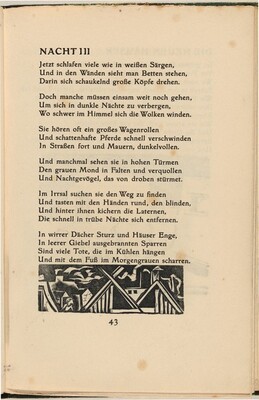
This is a photograph of a page from a book. The page contains a German text titled "NACHT III" with a small illustration of rooftops against a dark sky below. The text is neatly printed with occasional indents for new stanzas. The illustration uses high contrast black and white tones, resembling a woodcut style. The page has sepia tones and spots of discoloration, giving it an aged appearance. The page number "43" is centered at the bottom.

Nacht III (Night III) (in-text plate) from mock-up of Georg Heym: Umbra Vitae (Georg Heym: Shadow of Life)

Kirchner, Ernst Ludwig

This is a photograph of an industrial construction scene. The image shows a structure of scaffolding and iron beams at a construction site. Details like beams, metal rails, and columns are visible, along with wooden scaffolding. The presence of light and shadows creates contrasts and textures on the metal surfaces.

Workers on Girders of Auditorium, New Paris Opera

Delmaet, Hyacinthe César

From a point of view over the water, we look across a bustling canal at a bridge, which is flanked by rows of buildings to each side in this horizontal painting. At the center of the composition, the pink stone bridge spanning the canal is edged with white stone along its three arches and the top of its stepped deck. At least fifteen people standing or walking along the bridge are painted with touches of dark red, brown, pale yellow, ice blue, white, and black. The canal is busy with gondolas and other small boats, each rowed by standing people with oars. Some boats have covered compartments while others are open with seated passengers. On either side of the canal, tightly packed buildings rise two to five stories high. The architecture includes arched windows, small balconies, and laundry hanging from lines. The colors of the buildings range from pale tan and ochre to darker reds and browns. The street-level areas are active with people walking, talking, or boarding boats. The horizon comes just under halfway up the composition. The sky above is blue with soft, streaked clouds, and sunlight illuminates parts of the scene, casting shadows along the buildings and water.

View on the Cannaregio Canal, Venice

Guardi, Francesco
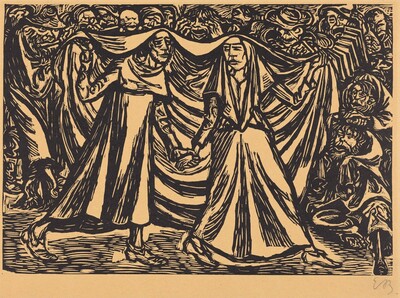
The artwork features figures holding hands. Rendered in a bold, graphic style with stark black lines against a plain background. Two central figures are draped in flowing robes, creating a dramatic effect with dynamic lines. They appear to be moving in synchrony, possibly a dance or ritual. The expressions are solemn and elongated, emphasizing a sense of gravity or mysticism. Surrounding them are abstract forms or faces crowding in from all sides, mainly from above and behind. The area is densely packed with swirling shapes, adding depth and tension. This is in the style of Ernst Barlach.

The Dance of Death II

Barlach, Ernst

The image shows a tall, elegant vase with a wide, flaring mouth and a narrow neck, which expands into a rounded bulbous body with a slightly ribbed pattern at the base. The vase has a soft, pale green color. Positioned centrally within the image, the vase stands upright and occupies the majority of the frame, set against a neutral gray background.

Petal-Decorated Vase

Chinese Qing Dynasty

The image shows a rectangle made up of intersecting horizontal and vertical lines forming a checkered pattern in red, green, and blue colors. The pattern resembles plaid fabric, uncluttered against a plain background.

Textile Sample

Kelly, Paul

This is a painting of wood ducks. The image features a group of wood ducks among leafy branches. Two ducks are perched on a branch, facing each other. Their plumage displays colors such as blues, greens, browns, and whites. Below, another duck is shown with wings spread. To the right, another duck is nestled in what seems to be a nest or hollow, looking outward. Detailed leaves frame the group, creating a naturalistic setting for the birds.

Summer or Wood Duck

Havell, Jr., Robert

The image shows a sketch from an elevated point of view. Various elements suggest depth, including faint outlines of structures, a small human figure with a staff in the distance, and a prominent tree closest to the viewer. The artwork uses dynamic pencil strokes to depict foliage with varying textures and contrasts. The color palette is primarily gray, capturing forms and details in a natural setting. Details become lighter towards the sky, showcasing open spaces with minimal distant sketches.

A Towering Tree with Travelers

Vien, Joseph-Marie

The sculpture is a round, medallion-like piece featuring a scene with two animals: a bull and a lion. The bull is facing left with its head lowered, standing on flat ground. The lion is on the right, shown in profile on a rocky incline, gazing at the bull. Above the animals, there is a panel with the inscription "CONSTANTIA" flanked by ribbon-like designs. The piece is made of a material resembling bronze, with a hole at the top for hanging. The intricate engravings and relief give a lifelike appearance to the animals and decorations.

Constantia

North Italian 16th Century

This is a drawing of architectural designs for a building. The image showcases two elevations and two floor plans of a structure. One elevation depicts a building with columns supporting a triangular pediment. The other elevation shows an entrance with an arched doorway flanked by windows, topped with a pediment. The floor plans reveal the spatial arrangement and construction details. The drawing suggests an emphasis on balance, symmetry, and classical proportions.

A Book of Architecture containing Designs for Buildings and Ornaments

Gibbs, James

This is a photograph of two wooden walking staffs or canes. The image features two elongated objects with bulbous, rounded tops that resemble natural wooden staffs. Each staff is mounted on a simple wooden base against a dark, neutral background. The wooden surfaces display an intricate pattern of natural wood grain and knots, with visible cracks and irregularities. The photograph emphasizes the tactile and organic qualities of the wooden objects, showcasing their simplicity and rustic beauty. The stands at the bottom have numbered tags.

Specimens of Gunshot Fractures of the Femur

American 19th Century

A pale turquoise footbridge arching over a pond lined with tall grasses and filled with petal-pink and butter-yellow waterlilies spans this horizontal landscape painting. The scene is loosely painted with touches of vibrant color. In the top third of the composition, the shallowly arched bridge nearly touches the top edge of the canvas, and it extends off each side. The shadows on the bridge are painted with eggplant purple. Bands of waterlilies gently zigzag into the distance on the surface of the water. The spring and emerald-green grasses growing along the banks fill the space around and over the pond, and they blend into a screen of trees beyond that enclose the scene. The green of the grasses and trees is reflected in the surface of the water, as is the underside of the bridge. The artist signed and dated the work with dark paint in the lower right corner: “Claude Monet 99.”

The Japanese Footbridge

Monet, Claude

The image shows an expansive scene of ancient ruins and natural surroundings, viewed from a slightly elevated perspective. The horizon is in the upper third of the image, featuring distant structures and a line of trees outlining the skyline. The etching style is defined by intricate lines and hatching that detail the architecture and foliage. The color palette consists of shades of black and gray to create contrast and depth. Closest to us are ancient ruins and a landscape leading to a winding path, with more ruins and vegetation extending into the distance. In the background, more ruins are partially obscured by trees, blending into the sky.

Parte dell'antica Via Appia fuori de Porta S. Sebastiano

Piranesi, Giovanni Battista

The sculpture is a decorative pitcher or ewer with an ornate handle. The handle resembles a flowing figure integrated into the design. The body of the pitcher is smooth pale green with subtle white floral designs. The pitcher features intricate gold details on its neck, base, and handle, combining porcelain and gold-toned metal elements. The gold sections include leaf motifs and decorative elements contrasting with the soft green porcelain, giving the sculpture a detailed and luxurious appearance.

Vase Mounted as an Ewer

Chinese Qing Dynasty

The image shows a circular object with a central design of five leaf-like shapes surrounding a star. The color palette consists of browns, red, and faded white with etched text near the edges. The circular object is centrally positioned against a light, parchment-colored background, with a signature or inscription in red ink on the lower right.

Pa. German Dish

Antrim, William L.

The image shows a man standing with his hands on his hips. He has a strong expression with thick, slightly curled hair under a decorated cap. He wears a quilted garment with a thorn-like pattern, patterned pants, and a belt holding a sword or dagger. The background features an engraved cloudy sky.

Kunz von der Rosen

Hopfer, Daniel

The image features marine creatures inside an oval frame, arranged horizontally. The color palette includes soft blues, greens, pink, and brown. There is an octopus on the left, a large fish in the center, and smaller fish extending to the right. Two seashells and a plant with green leaves and yellow flowers are depicted on the seafloor at the bottom right.

Plate 39: Squid, Gurnard, Pike, and Other Fish

Hoefnagel, Joris

The sculpture is a round relief featuring several figures. In the foreground, there is a seated figure on the left holding an instrument while resting on a structure. To the right stands a female figure holding a torch in her right hand, with long hair falling over her shoulders. Between them stands a smaller figure, possibly a child. In the background, there is a tree and various textured and architectural elements. The sculpture appears to be made of bronze, exhibiting a dark, aged metallic color with highlights. The composition is intricate, with detailed figures and a textured background.

Vulcan, Cupid and Venus

Briosco, called Riccio, Andrea
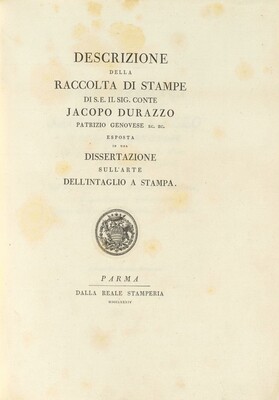
This is a photograph of a historical document's cover page. The document describes a collection of prints belonging to Jacopo Durazzo, a Genoese patrician, with a dissertation on the art of engraving. The cover is text-focused with Italian typography. It includes an engraved emblem or crest below the main text, and the bottom of the page indicates it was published in Parma by the Royal Printing House in 1784. The paper shows signs of aging with spots and discoloration.

Descrizione della raccolta di stampe di S.E. il sig. conte Jacopo Durazzo, patrizio genovese, ec. ec., esposta in una dissertazione sull'arte dell'intagio a stampa

Benincasa, Bartolommeo
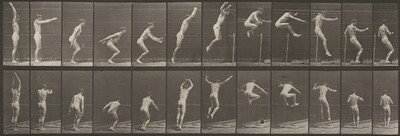
This is a photograph of a sequence showing a person in motion. The image captures a series of photographic frames depicting the detailed motion of a figure engaged in a physical action, set against the backdrop of a gridded wall. Each frame in the sequence highlights different stages of the leap, documenting the bodily dynamics and postures from various angles.

Plate Number 161. Jumping, standing high jump

Muybridge, Eadweard

The image shows a tipi in a grassy field, with Native American figures nearby engaging in daily activities. The scene includes horses grazing in the background and a serene sky with wispy clouds. The color palette consists of earthy tones and gentle blues.

A Crow Chief at His Toilette

Catlin, George

This drawing features several horses in harness pulling a cart. The image shows a horse facing the viewer in the foreground, with a team of horses pulling a cart in the background. The drawing is monochromatic in tones of brown and beige, created with loose and expressive lines.

Station de fiacre (Cab Stand)

Béjot, Eugène

This is a round plate with colorful designs. In the center of the plate is a portrait of a person in profile. They have white skin and long, yellow hair, and they wear orange armor and an orange-and-green helmet. The figure is surrounded by yellow plants against a blue and white sky. The central image is bordered by a geometric and floral pattern in earth tones of terracotta, cream, and green. The rim is adorned with a repeated floral design, red diamonds, and green dots.

Plate with running plant border and geometric panels on well; in the center, profile bust of a man in armor

Deruta 16th Century

The sculpture features a stylized bird with an abstract form, a pronounced beak, and a tail extending vertically upwards. The sculpture is teal with a texture resembling ceramic or stone, adorned with circular impressions. It has a compact, balanced design with symmetrical wings and a flat base. The sculpture stands out against a plain background with its unique shape and vibrant color.

Whittled Bowl with Lid: "Hen on Nest"

Budash, Frank
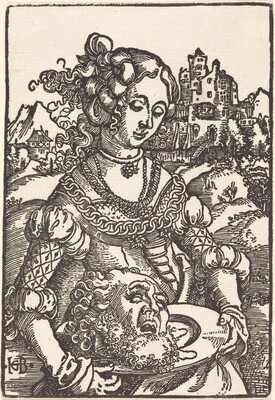
The image features a woman holding a platter with a man's head on it, set in a landscape with trees, architectural structures, and mountains.

Salome

Baldung Grien, Hans

The image shows a large and gnarled tree with a man standing beside it on a small incline. There is no clear horizon line visible. The tree's trunk is captured with textured bark and dramatic curves using broad brushstrokes, conveying age and grandeur. The color palette consists of earthy browns, muted greens, and soft grays. The man is dressed in simple attire and blends into the scene, adding to the rustic atmosphere. The background is kept minimal, focusing on the tree and the figure.

Ancient Trees in the Roman Campagna

Costa, Giovanni

The sculpture depicts a small group of cherubic figures. There are three child-like figures intertwined, all with distinctive curly hair. One figure is positioned centrally and slightly reclined, while the other two seem to be leaning over or supporting the central one. The sculpture is crafted from a dark material, likely bronze, giving it a rich, dark brown color with a shiny, polished surface that reveals the details of the figures’ hair, faces, and limbs. The texture of the material reflects light, highlighting the contours of the figures. The small size of the sculpture suggests it could easily fit within the palm of a hand, making it appear intimate and detailed when viewed up close.

Three Cupids

Flemish 16th Century

The image features 15 circular portrait sketches of individuals from the shoulders up, facing towards the right or left. Each portrait is labeled with the respective person's name underneath. Men have various hairstyles and high collars or cravats, while women have styled hair with ribbons or caps, and wear dresses with ruffles or lace. The sketches are organized in five rows and three columns against a plain background, highlighting each profile.

Saint-Mémin Collection of Portraits, Group 36

Saint-Mémin, Charles B. J. Févret de

This is a series of time-lapse images capturing the motion of a person walking. The grid displays sequential images highlighting nuances in movement. The focus is on the biomechanics of walking, with each frame showing different phases of the stride from various angles. The controlled setting suggests a study in motion photography, with vertical lines in the backdrop adding structure to the composition.

Plate Number 119. Descending an incline with right hand on breast

Muybridge, Eadweard

In this painting, several people dressed in classical attire are gathered around a man on the right, who is wearing a laurel wreath. He appears to sit on an ornately carved throne or chair, and a small brown-and-white dog sits by his feet. His brow is furrowed, and he rests his head on his hand. He is wrapped in a rich yellow cloak lined with white fur. Several people are gathered around him, some in silver armor. Behind the group are two large white columns on the left, and on the right is a draped purple curtain. Behind the columns, blue sky and distant hills are visible.

Alexander Condemning False Praise

Mura, Francesco de

The image shows an aerial view of an old village on rocky terrain with a waterfall flowing into a pool below. Stone buildings and ruins are visible in the distance. The scene includes intricate linework and cross-hatching techniques, creating a textured look. The color scheme is monochromatic, emphasizing the contrast between the water and rocks. Vegetation adds to the dynamic feel of the scene.

Situatione del Tempio di Vesta a Tivoli, dirimpetto la Cascata

Dies, Albert Christoph

The sculpture is an ornate goblet with a lid. The goblet is made primarily of clear glass, although the top, the base, and a line down the side are adorned with gold-colored metal bands featuring enamel work in green, yellow, brown, and blue. The designs on the metal include flowers, fruit, weapons, and musical instruments. There is a section of text at the top of the goblet, below the lid. At the top of the lid is a white knob.

Covered Cup with Shield of Arms of the Countess of Gleichen

Freiburg-im-Breisgau 16th Century

The image shows two wooden objects with a curved and intricate design. The objects are various shades of brown, suggesting a natural wooden texture. Positioned on a light-colored background, the object on the left is lying horizontally, while the object on the right is tilted with its handle upright on the right side of the image.

Snuff Box

DiGennero, Edward

The image depicts a group of people engaged in a processional activity. The figures are shown from the shoulders down, walking from left to right. They are dressed in heavy clothing with bonnets or headscarves covering their hair. Some are holding candles or objects. The background shows a gate on the left and a religious icon in the middle. The inscription at the bottom reads "CAVEAU ST MEDARD PROCESSION."

Procession in the Sepulchre of Saint Medard(Procession dans le caveaux de St.-Medard)

Legros, Alphonse

The image shows a pastoral scene with a building featuring distinct architecture as the central focus. The style is impressionistic with soft, sketch-like brushstrokes and a color palette of muted earthy tones. A tree with budding greenery leans slightly in the foreground, and other rooftops and shrubbery are visible in the distance.

In a French Village

Griffin, Walter

This is a golden medallion depicting a scene with armored people on the left and a columned structure on the right. The group on the left includes several armored individuals, three mounted on horseback, with some carrying tall flags or standards. The people are depicted in profile, walking towards a columned structure where two men are seated, looking towards the approaching group. The sculpture is a relief, and it shows intricate detailing on both the people and the architectural elements. However, some areas of the medallion have dark brown discoloration, obscuring these details. The medallion has a hole at the top.

Mucius Scaevola

Master IO.F.F.

This is a drawing of a decorative title page featuring text surrounded by ornate borders. The page displays a central panel of text in Latin stating, "ICONES ILLVSTRIVM FEMINARVM VETERIS TESTAMENTI," by Philippo Gallaeo. The typography is set within an intricate border design of floral and geometric patterns. Additional Latin text at the bottom is dedicated to a notable figure. The words are neatly inscribed, combining both printed and handwritten elements, with further handwriting visible at the bottom of the page beyond the ornate border.

Icones Illustrium Feminarum Veteris Testamenti (The Celebrated Women of the Old Testament)

Collaert, Hans the Younger

This is a photograph depicting a sequence of movements involving the handling of a large log. The image is divided into smaller frames arranged systematically to show a series of actions. It shows lifting, carrying, and positioning the log against a backdrop with horizontal lines. The sequence emphasizes the observation of movement dynamics and could be reminiscent of motion studies for analyzing actions in detail.

Plate Number 383. Lifting a log on shoulder

Muybridge, Eadweard

Shown from the waist up, a light-skinned woman sits angled slightly to our right in this vertical portrait painting. The woman has blue eyes, faint brows, and a sloping nose ending in a small bulb. Her upper lip is thin and her lower lip full over a slight double chin. Her blond hair is pulled back under a gold, cap-like headdress and a black, wide-brimmed hat with a shallow crown. She wears a high-necked white, black, and gold dress with intricate detailing, a gold chain necklace that falls to her waist, and a black belt with a gold clasp and medallions. She wears two gold rings set with gems on the pointer finger of her left hand, which is folded across her belly over the other hand. A scarlet-red wallcovering with pink floral designs fills two-thirds of the space behind her. The rightmost third of the background opens onto a landscape with a tall, spindly tree, a leaping animal, presumably a dog, and a bridge across a body of water leading to a town. Across another body of water, perhaps a lake, mountains are marine blue in the distance under a clear, celestial-blue sky.

Margarethe Vöhlin [obverse]

Strigel, Bernhard

The image shows a man standing upright. He is posing with one hand on his hip and the other holding a staff or spear with a decorative blade. The man has a mustache, a trimmed full beard, styled hair, and a feathered cap. He is wearing textured clothing with armor-like stripes, a ruffled collar, and detailed sleeves. The background features soldiers, cylindrical towers, buildings, and mountains.

Lieutenant-Colonel

Gheyn II, Jacques de

The sculpture depicts a bottle or vase with a rounded, bulbous body that tapers into a narrow neck and small opening at the top. It has a predominantly white surface with deep red patches blending into the white. The material seems to be ceramic or porcelain with a crackle texture on the surface. The sculpture is displayed on a neutral gray background.

Vase, Meiping Shape

Chinese Qing Dynasty

The image shows a rectangular wooden box with an open top and a lighter wooden interior. The color palette consists of warm brown tones with a natural wood grain visible on a soft beige background. The box is centrally positioned in the image with two slender metal rods or tools hanging on the side.

Wood Box

Foster, Lawrence

The image displays a village landscape from a high viewpoint. Hills with buildings, including towers, are visible on the horizon. The village is nestled among the hills, with rooftops and stone structures spread out. The detailed line work shows trees on the right and a church with a steeple near rustic buildings. The monochromatic palette focuses on line and texture, highlighting detailed composition.

View of a Town near a River with a Church on the Right

Lautensack, Hanns

The image shows a landscape with a dirt path curving in the foreground. A wooden cart is being pulled by a horse on the left, and a person walks near a small bridge on the right. Large trees with dense foliage line the background, framing the scene. The horizon is in the middle distance, with a vague hint of a castle or large structure. Clouds and light mist soften the distant view. The painting is done in watercolor with smooth brushstrokes capturing a tranquil countryside. Earthy tones dominate the color palette, with soft greens for trees and muted blues for the sky.

Landscape

De Wint, Peter

The sculpture depicts a figure in a dynamic pose. One leg is lifted high with the foot pointed forward, the arms are bent at the elbows, and both hands are positioned differently - one pointed downwards and the other upwards. It portrays a dancer caught in mid-motion. The figure is sculpted in a dark brown color, and the material appears to be bronze, giving the subject a polished, metallic sheen. The sculpture is mounted on a simple rectangular base, providing a foundation to keep it upright. A metal rod provides additional support to the figure, attaching from the base to the torso. The detail in the sculpture captures the muscularity and movement of the dancer, highlighting the contours and tensions of the body's form.

Fourth Position Front, on the Left Leg

Degas, Edgar

The image displays jagged, angular lines and shapes forming an abstract composition. Some shapes resemble trees and rugged mountainous landscapes, suggesting a forested scene with light and shadow interplay. Bold black and white contrast enhances the abstract quality, and the dense, overlapping forms evoke a thicket or dense woods, with towering trees and uneven terrain.

In-text plate from Kirchner Zeichnungen (Kirchner Drawings)

Kirchner, Ernst Ludwig

The image shows a sequence of photographs displaying a nude individual in motion. The top row shows the person crouching down and standing up, while the bottom row captures similar movements from different angles. The individual has short hair tied closely to the head and is holding a small cloth or towel in some frames. The background consists of a tiled wall with horizontal lines, and the ground appears flat, resembling a paved or sports court.

Plate Number 220. Stooping, and lifting handkerchief and turning

Muybridge, Eadweard

The image shows a wide view over a grassy plain, with a high horizon line and groups of figures and horses in the distance. Close by, numerous people, most on horseback, engage in coordinated activities. They wear traditional clothing and appear to be involved in a hunt. The painting features fine, detailed brushstrokes and a color palette of green, brown, red, and earth tones, under a sky of soft blues and grays with scattered clouds.

Camanchees Moving

Catlin, George

In this illustration, two figures are present. The foreground shows a kneeling individual with their upper body covered by a voluminous garment, presenting the back of their head towards the viewer with a hat sitting atop their head. Their posture suggests they are leaning against a tall architectural element, such as a pillar, while their hands are placed at their knees. Their face is mostly obscured, revealing only a partial profile. Adjacent to this person stands another figure, who is positioned slightly behind and to the side, partially concealed by the door frame. This person holds a sword and appears to be alert, with legs bent as if ready to move quickly. Their hair is short, and they wear clothing reflective of a historical or theatrical context, including elaborate sleeves and garments typical of a gentleman from the Elizabethan era. The background is intricately detailed with architectural elements featuring a door ajar and stone engravings of human figures, suggesting the setting of a grand hall or chamber.

Hamlet is Tempted to Kill the King (Act III, Scene III)

Delacroix, Eugène

The sculpture is a vase with a long, narrow neck that gradually widens towards the base. It is a vibrant green color with a crackled glaze which creates small lines across the surface. The rim of the vase is white. The vase is standing upright and casting a slight shadow below it.

Vase

Chinese Qing Dynasty

This is a drawing of a decorative wooden railing section. The image shows a segment of a railing comprised of five balusters with ornate, floral designs in their centers. The balusters have an elegantly carved shape. The railing has top and bottom horizontal beams. The top beam is darker, and the bottom beam appears to be greenish. The drawing's background is plain.

Choir Rail

Kieckhofel, William

This image shows a grand castle on a rocky landscape. The view is from a slightly lower elevation, looking up at the structure. The horizon is not clearly visible as the castle and surrounding rocks dominate the scene. The drawing style features detailed line work depicting the architecture and foliage, with a monochromatic color palette of black ink. The castle is surrounded by dense trees and shrubs, with other structures visible in the distance.

Landscape with a Fortress and Big Stairway

Lautensack, Hanns

The image features elongated, pointed shapes that converge at a central axis, forming an abstract arrangement. Interspersed among these shapes are small circular forms. The composition is framed on the right by a vertical, wavy border pattern. The background color is earthy.

Study for a Border Design [recto]

Pearce, Charles Sprague

The sculpture depicts a lion attacking a horse. The lion is positioned atop the horse, with its mane flowing around its face and its paws pressing down on the horse's body. The horse's legs are bent and its head is turned to the side. The sculpture is crafted from a dark material, likely bronze, with detailed textures on both animals. The composition conveys a dramatic interaction between the two animals.

Lion Attacking a Stallion

Susini, Antonio

The image shows a close-up of a worn and aged surface, possibly from an old book or manuscript. The surface is textured, with signs of wear, discoloration, and brownish stains resembling foxing. There are frayed edges and slightly bumped corners, indicating long-term handling. The photograph conveys historical value and age through the weathered material.

Ragguaglio della solenne comparsa, fatta in Roma gli otto di Gennaio MDCLXXXVII dall'Ill. Conte di Castelmaine ambasciadore straordinario della Sagra Real Maestà di Giacomo II, all'udienza di Papa Innocenzo XI

Westerhout, Arnold von

The image shows a woman standing in a formal pose with her body slightly angled to the side. She has a neutral expression and neat hair, wearing a long-sleeved dress with decorative details. She holds a rolled piece of paper in her right hand. The background depicts an artistic studio setting with painted elements including foliage, rocks, and an architectural balustrade, suggesting an outdoor scene.

Portrait of a Woman

Wright & Cornwell

The painting shows a woman and a man in a wood-paneled room. The woman is on the left, seated on a blue chaise lounge with carved wooden details. She is wearing a white blouse and a pink skirt, with one foot hovering above a basin of water. Her head is turned to the right. A small gray-and-brown dog is on the end of the chaise longue next to her. On the right, the man is entering the room, the pushing the wooden door open. He is holding a hat and is dressed in a blue tunic with white details, gray gloves, a red belt and red tights, and black shoes. They both have pale skin with rosy cheeks and red lips, and the woman has brown hair pulled back at the nape of her neck while the man has long gray curls. They are in a room with wood paneled walls and what looks like a heater on the far-left emitting steam.

Lady Undressing for a Bath

Duyckinck, Gerardus
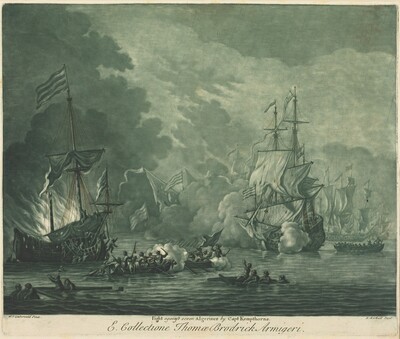
The image shows a maritime battle scene with ships on fire and engaged in conflict. The point of view is from the water level. Small boats filled with figures row away from larger ships. The style is that of a classical painting with billowing smoke and churning water created using soft, flowing brushstrokes. The color palette consists of muted sea greens and grays, creating an overcast atmosphere. A large ship with sails unfurled is on the right, with smoke trailing from various spots. Close to us, a smaller boat is filled with individuals involved in the fight. The background includes large clouds adding to the scene's drama.

Fight against Seven Algerines

Kirkall, Elisha

The sculpture is an oval platter featuring detailed elements of creatures and foliage from a natural environment. At its center, there is a coiled snake made of a shiny material, possibly ceramic or glazed pottery. The color palette includes greens, browns, and yellows with accents of blue and white. The snake is surrounded by animals like a frog and fish, as well as plants and leaves. The textures and raised elements create a rich and three-dimensional effect.

Rustic Plate with Snakes, Lizards, and Frog

Palissy, Bernard

The image displays a metal stand with three curved legs and a circular frame, along with a long-handled fork tool. The color scheme includes dark grays and blacks for the metal objects and a brown handle on the fork tool against a beige backdrop. The circular metal stand is placed on its three legs in the center, while the fork tool is positioned horizontally behind it. The fork tool extends to the right, with its wooden handle pointing towards the frame's edge.

Trivet Toaster

Porreca, Filippo

This is an image of a group of people in an architectural setting with a small dog at the foot of the scene. The composition features individuals surrounding a central figure in an archway. The central figure is draped in flowing garments. The surrounding figures exhibit emotional expressions and gestures. One person gestures towards the central figure in a possible moment of confrontation or proclamation. In the background, architectural elements with detailed stonework and archways are visible. A small dog is at the bottom of the scene, looking upwards. The hatching and line work create texture and depth, typical of traditional engraving techniques. The absence of color emphasizes the details in the figures' clothing and architecture.

Ecce Homo

Schongauer, Martin

This is a drawing of a prone figure among foliage and a directional marker. The image features a figure lying face down, partially obscured by dense vegetation. Beside the figure is a column-like object with the words "VERDUN 11 K" inscribed on it. The drawing is rendered in black and white, using expressive lines to create texture and movement. The composition contrasts the solid form of the milestone with the softer, flowing lines of the natural elements around it. The title "La Borne" is handwritten at the bottom of the drawing.

a) La Borne, Verdun (recto); b) Wounded Soldier and First-Aid Man (verso)

Forain, Jean-Louis
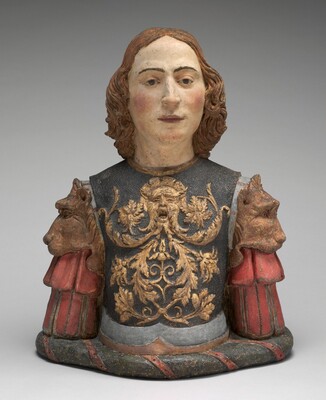
The sculpture depicts a bust of a person with a serene expression and shoulder-length wavy hair. The character is adorned with intricately detailed armor, which features a central motif of a grotesque face surrounded by floral patterns in gold. The armor is primarily a dark, muted hue, accented with red sleeves that resemble fabric folds, and two horse-like figures on the shoulders. The sculpture is created from what appears to be a painted, textured material, providing a realistic yet stylized representation of a historical or mythological figure. The face contrasts with the darker tones of the armor, enhancing the lifelike appearance of the sculpture.

A Man in Armor

Onofri, Vincenzo

The image features a sculpture of three figures wearing crowns, standing on a pedestal. They wear flowing garments resembling Roman togas and hold a garland. The figures are large and grand, surrounded by architectural elements like columns with ornate designs. Above them is a medallion flanked by cherubs. The monochromatic sculpture appears to be made of stone, exuding a sense of classical elegance.

Descrizione delle feste celebrate in Parma l'anno MDCCLXIX per le auguste nozze di Sua Altezza Reale L'Infante Don Ferdinando colla Reale l'Archiduchessa Maria Amalia.

Various Artists

Three children with different hairstyles and clothing styles are depicted against a natural background. The left child has long, wavy hair and a contemplative expression. The center child wears a wide-brimmed hat and a dress with puffed sleeves, with a distant gaze. The right child, with a flat top hat and a sailor-style shirt, is holding a basket and a stick. Foliage fills the background, suggesting an outdoors setting.

Elizabeth Keown, Kate Keown, and Freddy Gould

Cameron, Julia Margaret

The Despair of Cephalus

The Despair of Cephalus

Luini, Bernardino

This is a drawing of figures in dynamic poses. Two winged female figures are flying over a group of reclining figures. The flying figures have flowing garments. The ground below is filled with contorted figures. The background is sparse with minimal indication of a mountainous landscape. The lines create a sense of tension and turmoil.

Justice, Vengeance, and Truth

Chifflart, François-Nicolas

An armored knight and the rectangular trough he lies next to are both on a slightly larger pedestal base in this freestanding, vibrantly colored maiolica inkstand.  The earthenware object was covered with tin-oxide glaze, which, when fired, results in royal blue, grass green, pale orange, and brown hues. The knight’s skin is the white of the earthenware, and his armor is blue and orange. He lies down, using his helmet as a pillow to our left. Both knees are bent, and his hands are by his sides. A staff or lance lies at his feet to our right.  The base has a coat of arms on the center front, and two animals, perhaps deer, lie to either side. The base is outlined in green or blue, and it rests on four brown, paw-shaped feet.

Inkstand with sleeping knight

Faenza 15th Century

The image shows a square piece of woven textile with fringes at the bottom edge. The textile features a checkerboard pattern with zigzag and straight horizontal lines. It is blue with lighter diamond and horizontal rectangular details, creating a contrasting pattern. The textile is on a light background, with the fringes extending downward.

Coverlet

Christoffels, Cornelius

There is a drawing of an interior scene. The scene features a group of chairs and a framed image. The room is dimly lit, with tall-backed chairs on a tiled floor and framed pictures on the walls. There is a rectangular table or pedestal in the center. Light from an unseen source illuminates part of the room, possibly from a window. Fine lines and crosshatching are used for shading and texture, creating depth and perspective in the drawing.

The Voyage to Paris

Chodowiecki, Daniel Nikolaus

The image shows a landscape with a high horizon line. Sparse foliage and scattered trees are depicted with loose charcoal strokes. Sweeping horizontal lines indicate the vast expanse of the terrain. The color palette is monochromatic, ranging from deep black to light gray.

A View across the Park, Chatsworth, Derbyshire

Burgess, John

The image is of a circular bronze medallion with a relief sculpture of a man showing a side profile. The sculpture depicts a mature man with distinct facial features, short hair, and draped cloth over his shoulders. The medallion features inscriptions reading "BENJAMIN WEST PRESIDENT OF THE ROYAL ACADEMY MDCCCXX". The surface of the medallion is smooth with signs of aging.

Benjamin West Medal Commemorating Those Who Subscribed to Purchase the Painting "Christ Healing the Sick in the Temple" [obverse]

Mills, George

This is rectangular object that is predominantly brown, with some areas of slightly darker brown and mottled textures. There are thin, slightly recessed golden lines bordering the corners and edges of the rectangle.

Prints for "Collection complete des oeuvres de J.J. Rousseau"

Various Artists

This is a photograph of a series of images capturing the movement of a horned animal. The image is divided into frames that document the progression of the animal running or leaping, captured in mid-motion. The setting appears to be an enclosed area with a fenced boundary visible in the background. The ground is earthy, and the movement is presented in a way that displays the dynamics of the animal’s motion across the frames, showing different phases of its stride.

Plate Number 702. Gnu bucking and galloping

Muybridge, Eadweard

Shown from the knees up, a young girl with pale skin, wearing a coral-peach dress, sits facing and looking at us in this loosely painted, vertical portrait. Her knees are angled slightly to our left, and her hands rest in her lap. She has a round face and smooth, lightly flushed cheeks. She has brown eyes under arched brows, a delicate, snub nose, and her rose-pink lips are closed. Her hair, which is painted with broad strokes of caramel brown and moss green, is parted on one side and pulled smoothly back, presumably tied behind her head. Tendrils fall over her shoulders. Her dress is gathered around her neck and tied with a bow at the back. The loose sleeves fall to just below her elbows, and the dress is belted around the waist. A curving swipe of canary-yellow paint could be a buckle at the front. The fabric of the dress is painted with long, visible strokes of shell and rose pink, butter yellow, and ivory white, and a few touches of sage green and periwinkle blue for shadows. She wears a ring on the middle finger of her right hand. The space around her is loosely painted with strokes of electric and cobalt blue, with unpainted canvas visible at some of the edges. To our left, over the girl's shoulder, a wooden bird cage holds an emerald-green parakeet. The bird is streaked with royal blue along its back, and the area around its hooked beak is apple red. The cage has a mint-green bow and ribbon along the top. The artist signed the painting in green on the lower right corner: “Berthe Morisot.”

The Artist's Daughter with a Parakeet

Morisot, Berthe

The image shows a drawing of an elderly woman from the upper half of her body. She faces forward with a neutral expression. The woman has prominent facial features including deep-set eyes, a defined nose, and a firm mouth. She has styled hair in an updo with a headpiece resembling ruffled lace or a floral accessory. She wears a high-collared garment, likely a dress or blouse, with buttons down the front. A scarf tied into a bow is around her neck, and she wears small hoop earrings on both ears. The background is a plain, light surface.

La vieille (Old Woman)

Martel, Eugène

The sculpture is a chair-like piece with a tall, ornate backrest and intricately carved details. It features swirling patterns and symmetrical floral motifs in dark brown and golden hues. The material seems to be wood, with visible natural grain. The chair appears more like an artistic or ceremonial object rather than a practical piece of furniture, with a historical or ornate decorative style.

Walnut Stool (Sgabello), Carved and Gilded

Italian 16th Century

The image shows a mechanical element with a spherical object inside a metal framework attached to a piece of wood by a curved wire. The central sphere is white, surrounded by a metal casing with brown, red, and blue sections. The object is positioned off-center to the left, with the wooden handle extending to the right of the frame.

Parade Torch

Edwards, William H.

The image is an artistic engraving of a woman's bust in profile view, facing right. She is posed upright, with her shoulders slightly angled and her head turned to the side. The engraving shows her from the upper chest up, featuring delicate facial features and intricate hair styled with braids or curls cascading down the back. She wears attire with a ruffled collar. The ornate circular frame surrounding her is adorned with floral details and swirls, seemingly resting on a bed of clouds. The background is plain and light-toned, with no additional elements outside the frame. Small amounts of text beneath the image indicate the authorship and date.

Marie-Antoinette

Gaucher, Charles-Etienne
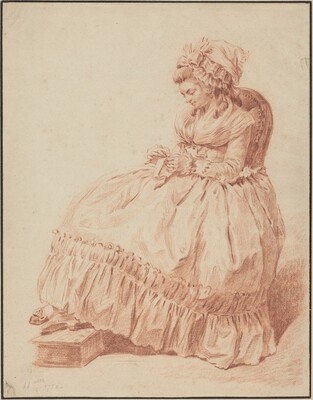
The image shows a woman sitting in a chair, holding a small piece of fabric or paper. She has a serene expression and curly hair. She wears an elegant dress and a decorative headpiece. In the background are a book and a piece of cloth.

Seated Woman Sewing

Trinquesse, Louis Rolland

The sculpture is a profile relief of a man with wavy hair, portrayed on a circular medallion. The man faces right with detailed facial features and prominent neck and hair contours. The bronze-colored medallion likely made of metal, possibly bronze, bears the name "WASHINGTON ALLSTON" around the upper half, with inscriptions crediting "F. Dougan Del. C. C. Wright Sc." The medallion is smooth and polished, contrasting with the intricate details of the profile.

Washington Allston, 1779-1843, Painter [obverse]

Duggan, Paul Peter
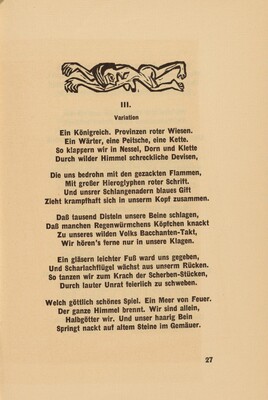
The image features an abstract drawing at the top with fluid, intertwining lines forming shapes. The shapes resemble a pair of symmetrical figures. Below the drawing, centered text in German is presented. The visual layout suggests a page from a book or collection of writings.

Liegende (Die Irren III) (Reclining Figure [The Mad III]) (headpiece, page 27) from Georg Heym: Umbra Vitae (Georg Heym: The Shadow of Life)

Kirchner, Ernst Ludwig
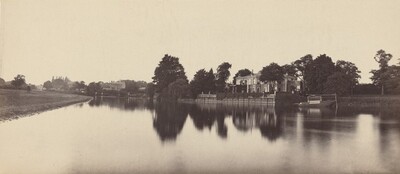
The image shows a riverside view with an estate surrounded by greenery on the other side. The horizon is high, emphasizing the reflective water surface. Trees and a house are visible on the horizon. The water reflects the surroundings. The color palette is sepia, highlighting textures and shapes in the scene.

Halliford

Prout, Victor Albert

Singerie: The Painter

Singerie: The Painter

Huet, Christophe

The image depicts abstract lines and shapes, with a prominent triangular form in the center. The shapes create an otherworldly landscape with emerging faces resembling floating masks or ghostly visages. A large circular shape with spiky lines radiating from it and scattered faces floating within the textured space can be seen.

Sur le fond de nos nuits dieu de son doigt savant dessine un cauchemar multiforme et sans treve (On backdrop of our nights God with His knowing finger traces a multiform implacable nightmare)

Redon, Odilon

This is a photograph of a decorative ceramic bowl. The bowl features intricate floral patterns with large blue and yellow flowers and green leaves set against a vibrant red background. The designs showcase a variety of flower types interspersed with smaller floral accents and stems. The color palette is bold and vibrant. The interior of the bowl is stark white, creating a contrast with the detailed exterior.

Cup

Chinese Qing Dynasty

This image displays a composition of curved lines and symmetrical shapes arranged within an arch-like frame. The design is abstract, featuring a central tulip-like figure with floral shapes resembling stylized lilies on each side. Below these forms, an ornate, symmetrical vessel similar to a decorative vase or urn is depicted. The repeated motifs and stylized interpretation of floral elements create a decorative pattern.

Study for Proposed Portfolio "Decorated Chests of Rural Pennsylvania"

American 20th Century

This is a drawing of a skeletal figure in a sarcophagus with the inscription "VANITAS ET STRVA." The image contains a skeleton lying within a sarcophagus or open coffin, along with symbols of vanity and mortality like a skull and a broken urn. To the right, a goat is next to scattered book pages. In the background are a stone wall and trees. This scene is common in vanitas art, reflecting on the fleeting nature of life and possessions.

Democritus Meditating

Schönfeld, Johann Heinrich
This is a drawing of preliminary sketches of figures. The drawing captures rough, pencil-sketched outlines of several figures in various poses. In the upper left part, multiple figures are depicted bending and huddling together, shown through simple, rounded shapes suggesting heads and outlines of limbs. Below, there is a sketch of another figure, head resting on arms. To the right, a larger figure is drawn standing, draped in loose garment representation, and appears more faint and less detailed than the other sketches. These sketches may serve as preparatory studies for a larger composition or artwork.

Sheet of Studies

Flaxman, John

This is a photograph of an ancient coin. The coin displays intricate engravings featuring a detailed depiction of a tree with branching limbs and small buds or flowers against a textured background. The perimeter of the coin features a beaded edge and an inscription that wraps around the edge. The surface shows signs of aging, with a patina that suggests it has been handled or exposed to elements over time. The craftsmanship of the coin's details, particularly in the naturalistic representation of the tree, reflects a high level of skill in metalwork.

Flowering Shrub Growing through Thorns [reverse]

Galeotti, Pier Paolo

The image displays bold, angular lines and contrasting shapes, forming an abstract depiction of a face. The facial features, such as the eyes and mouth, have been exaggerated with sharp lines, which blend into rectangular forms resembling crosses. The elements combine to create a visually intricate and abstract style.

Judas (headpiece, page 59) from Georg Heym: Umbra Vitae (Georg Heym: The Shadow of Life)

Kirchner, Ernst Ludwig

This photograph shows the interior of a large industrial building filled with piles of raw cotton and large machinery. Wooden support beams stretch up to a tall, planked ceiling, all covered in fluffy white cotton. There are several large machines with cotton accumulating around them, including one close to us at the bottom left. A burlap sack is clamped into a mechanical press in the large machine, appearing full of white cotton. Around and on top of this machine are five men, all working on different areas. One turns a wheel, one holds a hammer, two push a large wooden beam, and one stands behind a long plank. All of these men have dark brown skin and wear shirts and trousers with suspenders. They are all covered in white cotton. In the background are more men, standing in different areas of the building and looking towards the machine in the bottom left. These men wear jackets and wide-brimmed hats. Two appear to have dark skin, and two appear to have light skin, although the photograph is faded and details are indistinct.

Mississippi Cotton Gin at Dahomey

American 19th Century

Towering, pale, celery-green trees frame a view of a lush park with about a dozen elegantly dressed, light-skinned men and women in this vertical landscape painting. The color palette is dominated by moss and lemon-lime green, golden yellow, and spruce blue. The men all wear jackets with long tails over knee-breeches, and their long hair is pulled back at the napes of their necks. The women wear long dresses with full skirts and hints of lace at the sleeves and bust, and their brown or white hair is pulled up. Nine of the men and women gather to our right on a stone terrace along the bottom edge of the painting. A man in butter yellow kneels in front of a woman wearing rose pink. Around this pair, people stand, kneel, sit, or recline wearing aquamarine blue, light turquoise, or ivory white. A man and woman sit on a bench to our left, a little removed from the larger group. This woman wears ruby red and the man leaning toward her wears topaz blue. Two people in the park beyond these groups are painted with only a few strokes of pale blue and white paint, and they look over a low hedge row lining the walking path. Beds of red flowers fill the lower corners of the composition in front of a statue of a woman to our left and a person, perhaps on a fountain, to our right. The grassy walking path and trees become more blue as they fade into the hazy distance between the tall tress to either side. The sky fades from pale blue along the horizon to a silvery blue, almost white, at the top.

A Game of Hot Cockles

Fragonard, Jean Honoré

The image shows three figures in an alleyway. On the right, a woman in a light-colored dress leans against the wall, her head tilted back. In the center, a person in dark clothing leans forward towards her. On the left, another figure stands upright in shadow. The alleyway is narrow, with tall buildings on each side and a cloudy sky in the background.

Ein Schritt (A Step)

Klinger, Max

This is a cushion with a coat of arms that includes a crowned shield displaying a lion. The shield is red with a golden lion, and it is topped by a golden crown. The lion is raised up on its back paws, holding a group of arrows in one front paw and a sword in the other. There appear to be two crossing anchors behind the shield, and a brown fence circling the bottom of the shield, inside of which is a patch of green grass. The background is deep green. The letter "A" is embroidered in the top corners of the cushion.

Tapestry-covered Cushion

Netherlandish 18th Century

The image shows a rectangular pattern of interlocking horizontal lines with red, blue, and green colors. The design has a woven textile-like appearance, resembling a tightly knitted fabric or close-up of a rug. The alternating stripes and hues create a traditional handwoven mat look. The composition gives a sense of tactile texture, like a segment of a colorful tapestry.

Shaker Rug Strip

Chabot, Lucille

The image shows a man walking down a street, leaning slightly forward with one hand tucked into his coat as he takes a stride. The man has a wrinkled face with a broad nose and is wearing a top hat. He has short and somewhat unkempt hair peeking out from under the hat. He is dressed in an overcoat, a waistcoat, a shirt, a cravat or scarf, tight-fitting trousers, and pointed shoes. In his right hand, partially hidden within his coat, he clutches some unseen objects. Behind him, there is another individual leaning on a cane or stick. The background features a loosely sketched street scene with buildings, and the foreground includes a published text and printed signatures. The image is framed in a decorative border.

En voila un de jobard! ...

Daumier, Honoré

The image depicts two sketches of a man playing the violin. In both sketches, the man is shown in a slightly bent posture, focusing on the violin. The man's facial features are rough but expressive, with prominent cheekbones and a subtle smile in one of the images. He wears a wide-brimmed hat and a loose-fitting jacket. The man holds a violin and bow, with the violin under his chin. The background is plain with the texture of the paper visible.

Two Studies of a Violinist Tuning His Instrument

Watteau, Antoine

This is a photograph of an ancient coin. The image shows a coin with a detailed profile of a person's head in the center, surrounded by a circle of inscribed text along the circumference. The profile is intricately engraved, showcasing medium-length, wavy hair and the outline of a garment with a discernible collar. The text on the coin appears to be in a classical style, possibly Latin. The detailed craftsmanship suggests the coin is from a historical period when coins often featured prominent leaders or significant figures of the time. The lighting emphasizes the embossed features of the coin, highlighting the relief work against a darker background.

Giangaleazzo Maria Sforza, 1469-1494, 6th Duke of Milan 1476 [obverse]

Milanese 16th Century

The image showcases a contents list in German on the top portion, with various titles and page numbers. Below the text is a black and white illustration of a reclining figure surrounded by drapery, with the initials "EK" in the bottom right corner of the image.

Liegender Rückenakt (Reclining Nude) (tailpiece, table of contents) from Georg Heym: Umbra Vitae (Georg Heym: Shadow of Life)

Kirchner, Ernst Ludwig

The image is a composite of sequential photographs showing a man performing a gymnastic routine. In each frame, the man's full body is depicted, highlighting different stages of a handstand routine performed on gymnastic equipment. The man is balancing and maneuvering with precision, transitioning between various positions. His facial features are not clearly visible. He is not wearing clothes and there is no jewelry. The background has a grid pattern on the wall, and the floor is clear, allowing space for the gymnastic apparatus and highlighting the man's movements.

Plate Number 368. Acrobat descending stairs on hands

Muybridge, Eadweard

This vertical portrait painting shows the head and shoulders of a person with pale peach skin and an auburn, cheek-length bob hairstyle. The person has high cheek bones, deep pink lips, and an angular, pointed chin. The head is cocked to our left, and almond-shaped eyes are nearly blacked out. The black jacket has lapels over a white, collared, buttoned-up shirt with a crimson-red necktie. Shown against brick-red and black background, the portrait is painted with areas of relatively flat color but with loose brushstrokes that create a textured, mottled effect. The artist signed the work with black paint in the lower right corner: “modigliani.” 

Madame Kisling

Modigliani, Amedeo

This is a black and white line drawing of an older woman shown from the chest up. She is facing forward, showcasing her face and upper torso. Her facial features are outlined, with visible lines indicating age, and she is smiling. Her hair appears styled and is voluminous, possibly held up or adorned with a headpiece. She is dressed in a high-neck garment fastened with buttons down the front, and has a scarf or bow tied around her neck. The drawing is on a plain paper background with no additional elements.

La vieille (Old Woman)

Martel, Eugène

The sculpture is a ceramic pot decorated with floral motifs. The pot is blue with gold detailing and features an oval panel displaying colorful flowers against a white background. Surrounding the panel is a geometric pattern in gold. Animal head-shaped handles are on either side of the pot. The rim is white with a pink and orange pattern, and smaller floral motifs are repeated around the upper part of the pot.

Large Fish Bowl

Chinese Qing Dynasty

The image shows a tall wooden grandfather clock with a decorative clock face in rich shades of brown, yellow, and gold. The clock is positioned centrally against a light-colored background. On the right side, a vertical ruler-like scale is subtly marked.

Grandfather Clock

Koehn, Alfred

This is a drawing of a stone statue in a forested area. The statue resembles a figure emerging from rocky formations with water cascading down like a waterfall from its body. The image captures the detailing of the stone structure and the dense forest surrounding it, with tall, narrow trees framing the scene. To the right, a stone balustrade runs alongside a pool of water, leading the eye into the background, which includes architectural elements like a pathway and smaller sculptural features. The atmosphere is serene and timeless, blending nature with human artistry.

Colossal Statue of the Apennines

Della Bella, Stefano

The image shows a silhouette of a person standing in profile facing left. The silhouette captures the full-body of the person, with one foot slightly forward and hands placed behind their back. Facial features are not visible, but the profile includes a prominent nose and sloped chin, with medium-length hair styled back. The person is wearing a long coat, trousers, and likely depicts a 19th-century style. The background is beige with a small base below the silhouette bearing cursive writing indicating a date and name. No visible jewelry or objects are held in the person's hands.

Silhouette of Lieutenant Philip Kearney, Jr.

Edouart, Auguste

Pax with the Crucifixion with Six Angels

Pax with the Crucifixion with Six Angels

Venetian 18th/19th Century

This is a drawing of a group of people in motion. The image shows stylized line drawings of figures in a woodcut style, emphasizing outlines and forms without detailed facial features. Below the drawing, there is German text with the title "Die Blinden Frauen" followed by poetry. The page number 38 is present, suggesting this is a page from a book.

Die Blinden Frauen (The Blind Women) (headpiece, page 38) from Georg Heym: Umbra Vitae (Georg Heym: The Shadow of Life)

Kirchner, Ernst Ludwig

This is a photograph of a sequence showing a person swinging a hammer. The image is divided into multiple frames capturing the dynamics of an action with meticulous detail. Each frame captures a slight progression in the motion, demonstrating the body's transitions and positioning during the hammer swing. The background has a grid pattern, indicative of a scientific or anatomical study purpose. This series resembles early motion study photography aimed at capturing and analyzing the different phases of an action.

Plate Number 376. Blacksmith, hammering on anvil with two hands

Muybridge, Eadweard

In a landscape with chiseled, rocky mountains beyond a grassy meadow and stream, two men wearing dove-gray robes react to a flame-red cross in the sky in this nearly square painting. Both men have pale skin and their hair has been cut into a ring around each head. Their loose robes are cinched at the waist, and both have bare feet. The man to our left, with hands raised, kneels with his body angled to our right, facing the red cross in the sky, in the upper right corner of the painting. He has gray or blond hair and a flat gold halo edged with red. Five thin gold lines emanate from the red cross to touch the man’s hands, feet, and the right side of his chest. There is a red spot where one gold ray touches the palm of his right hand, closer to us. The second man, to our right, sits and leans back on one hand and holds his other hand to his brow as he looks up at the cross. He has dark hair. A small book with yellow pages and a red cover sits on the grass nearby. In the background, each of the three tall, pointed mountains nearly touch the top edge of the composition, and each is a different color, with icy, pale blue to our left, shell pink at the center, and light laurel green to our right. A stream running in front of the mountains turns a corner and comes our way in the lower right corner of the panel. The green meadow has a line of dark pine green trees and bushes behind the kneeling man and along the bottom left edge of the panel, near us. Wisps of white clouds float in the violet-purple sky above.

Saint Francis Receiving the Stigmata

Domenico Veneziano

The image features performers and an audience in an outdoor setting. One performer showcases an act with an animal jumping through a hoop, while a crowd watches. The scene includes various figures engaged in different activities such as playing instruments or observing. The setting is outdoors with a cloudy sky in the background, capturing a lively moment of entertainment and public gathering.

Les Chiens savants

Vierge, Daniel

The image shows a round decorative plate with a mythological scene. It features an aerial view of a landscape with a fort-like structure, greenery, water, and ships with one flag reading "SELEUCO." The style is reminiscent of Renaissance painting, with intricate brushstrokes capturing figures and scenery. The color palette includes blues, greens, and earth tones with accents of orange and yellow. Muscular figures are engaged in activity, and an emblem or coat of arms is displayed above against a richly toned sky with clouds.

Plate with the sinking of the fleet of Seleucus (from the Pucci Service)

Xanto Avelli, Francesco

A wooden chair with a woven straw seat and a high ladder back is the focal point of the image. The color palette is warm with natural wood tones against a beige background. The chair is centered slightly to the right, facing at a three-quarter angle. The back of the chair extends higher than the seat, adding vertical emphasis against the backdrop. In the lower right corner, there is a small number "3" drawn in pencil.

Shaker Tilting Chair

Kelleher, John W.

The image depicts an engraving of a man from the chest up. He is positioned facing slightly to the right with his head turned toward the viewer. He has long, curly hair that reaches his shoulders and frames his face. His facial features include a strong jawline, a straight nose, and direct gaze. He is wearing an elaborately patterned necktie and a garment typical of the late-17th century, with visible layers and intricate designs. The scene is framed within an ornate border with scrollwork and cherubic figures. The background is dark, highlighting the details of the man's attire and the frame. There are no visible jewelry or objects being held by the man.

Dr. John Browne, Surgeon

White, Robert

The image shows the interior of a grand cathedral or similar structure from an observational perspective. The arches rise above with gothic vaults, while massive pillars define the open central area. Figures in long garments can be seen in the distance, adding scale to the space. The image is in a monochromatic sepia tone, likely ink or wash, giving an antique feel. The shadows and light detail the structure, enhancing its depth and grandeur. The color palette is warm and earthy.

Monks in a Cathedral

Le Brun, Jean-Baptiste-Pierre

The sculpture is a rectangular relief panel with a detailed scene. Two Triton-like figures are on each side of the central part. They have human torsos and serpentine tails, facing the center and gesturing outward. At the top-center, there is a stylized frontal mask or head surrounded by floral or scroll-like elements. Flanking the central figures are ornate vases with floral designs, birds, and elaborate scrollwork. The material appears gilded, giving it a golden color. The composition shows harmony and balance, with fantastical figures and decorative elements arranged symmetrically.

One of Two Ornamental Friezes

Florentine 16th Century

Palazzi di Genova (vol. 1)

Palazzi di Genova (vol. 1)

Rubens, Peter Paul, Sir

The image shows a kitten inside a circular metal structure. The kitten is positioned near the edge of the opening, looking upwards. Its fur is primarily white with some darker patches, particularly on one ear and part of its face. The metal structure is cylindrical with a smooth finish. The background is blurred, emphasizing the kitten. The photograph is mounted on a decorative backing and labeled "Yung Fong, Shanghai."

Portrait of a Kitten

Fong, Yung

Shown from the lap up and shaded entirely in tones of golden yellow, laurel green, and black, a pale-skinned woman cradles a small, furry dog in her arms in this vertical portrait. The woman’s body is squared toward us, and she looks directly out with slate-blue eyes. She has an oval face with a delicate nose, long chin, and her pale pink lips are closed in a slight smile. Her brown hair is pulled back under a tan-colored hat lined on the underside with translucent cloth and on the top with sage-green ribbons or ruffles. A choker of thumbnail-sized pearls encircles her neck. Her dress has a deep V in the front and the elbow-length sleeves end with layers of lacy ruffles. Curving black lines suggest a pattern on sheer black fabric that covers pale yellow and frosty green stripes of the bodice. The dog has long, light-colored fur and a dark, bead-like nose and eyes. Vines grow up and from the top of a stone column in the background to the right, and the rest of the shallow space is filled with shrubs and plants. A bright yellow spot near the top left corner suggests a strong light source coming from that area, which casts her face in a diffuse shadow under the hat’s brim.

Miss Nelly O'Brien

Anonymous Artist

The image shows four individuals in different positions. The individual on the right is holding a rabbit or similar animal by its front paws, lifting it high. They wear a dark, striped suit with a white shirt and a cravat, with wide eyes and an elongated face framed by curly hair. To the left, two more individuals stand closely together, observing the animal. The central figure wears a dark cloak and headscarf, with a round face, while the other wears a tall hat, coat, and shirt. The fourth person, standing slightly behind them, is shorter and also wearing a hat. The background consists of abstract, circular patterns and sketches of hands and a crucifix.

Exposition universelle: La Fabricant de chapeaux de feutre

Maurand, Charles

Shou Lao, the God of Longevity

Shou Lao, the God of Longevity

Chinese Qing Dynasty

The image shows a wooden cradle with vertical slats on the sides and ends, equipped with rockers at the base. The cradle is made of reddish-brown wood with green accents on the spindles. The cradle is seen from an angled view, showing both its side and one end with the rockers visible beneath it.

Cradle

Bush, Rex F.

This image shows a sketch of a person from the chest upwards, positioned in a three-quarter view facing slightly to the left. The person has a well-defined jawline and large eyes, with high cheekbones and a straight nose. Their hair is short and combed back, with a slight receding hairline. The person is depicted wearing a robe with a high, wide collar that covers part of their neck. The robe appears to be plain, with no visible patterns or accessories. There are no visible jewelry or objects being held. The background is simple and unadorned, providing a neutral setting for the figure. Below the portrait, there is an inscription in Latin, which accompanies the drawing and includes the date "M.D.XX" (1520).

Luther as an Augustinian Friar

Cranach the Elder, Lucas

The image is viewed from an elevated perspective, overlooking a landscape scene. The horizon is partially hidden by hills or mountains in the distance. Stylized pencil strokes depict clouds in the sky and a radiant sun emits streaks of light. Trees in the foreground are drawn with dense, swirling pencil marks for texture and depth. The style is sketch-like, with visible lines adding dynamism. The color scheme is monochrome with shades of gray and black, creating subtle contrast in the landscape.

Sunset above a Mountain Lake

Linck, Jean Antoine

The sculpture depicts a scene of crucifixion, with a central figure on a cross flanked by two other figures, also crucified in varying postures. Surrounding these central figures are numerous human figures, some soldiers with spears and shields, while others appear distressed or mourning. The figures are intricately detailed, with attention given to their expressions and the texture of their garments. The sculpture is crafted from bronze, lending it a dark, metallic brown color with a natural patina that highlights the relief work. All figures are positioned in high relief against the relatively flat background.

The Crucifixion

Moderno

The image consists of fifteen individual portraits arranged in a grid of five rows and three columns. Each portrait shows a side profile of a man's head and shoulders within circular frames. The men vary in facial features, hairstyles, and clothing. Names are inscribed below each portrait, and the arrangement is on a flat, subtly varied background.

Saint-Mémin Collection of Portraits, Group 18

Saint-Mémin, Charles B. J. Févret de

The image shows a large castle with detailed architecture. The horizon is blurry, highlighting the castle's stone structure. The castle features a tower with battlements, turrets, and conical roofs with cross-like spires. Nearby are trees and a stone balustrade. The monochrome palette accentuates the stonework's texture and details.

Segovia, Façade of the Alcazar and Moorish Tower

Clifford, Charles
This tall, vertical fresco depicts a person in a red garment extending their arm towards a white unicorn that is bowing down on grass. The person is on the left side of the image, and only partially visible. The unicorn's long horn almost touches the person’s outstretched hand. The unicorn's back legs are extended, but its front legs are kneeling. The person and unicorn are on a light green field with red flowers and small green ferns. Behind them are thin trees in front of distant, rocky mountains. The sky above is beige, blending into the earthy tones of the landscape.

Procris and the Unicorn

Luini, Bernardino

The image shows a landscape with a building surrounded by greenery. The viewpoint is elevated, showing a wide perspective. The sky is lightly clouded with pastel colors. Two figures near us are engaged in activities. The brushwork is detailed, capturing leaves and architectural elements clearly. The color palette is dominated by greens and browns, complemented by subtle sky hues. A fence and more trees are visible in the background.

Kung-kwa at On-na, Lew Chew

Heine, William

The image shows a large, round porcelain vase with a long, narrow neck. The vase is predominantly a pale green color with a crackle glaze effect. It is centered in the frame, positioned upright on a plain surface, with a neutral grey background.

Bottle Vase

Chinese Qing Dynasty

The image shows a building with a cross-topped cupola framed by rows of tall trees. The building has a classical architectural style with symmetrical windows and an arched entrance gate. The horizon is defined by the top edge of the building, as the trees rise above it. The brushstrokes are fluid with a loose, watercolor technique, giving movement to the foliage and shadows. The color palette includes greens, yellows, browns, blues, and grays, creating a naturalistic scene. The soft, sun-dappled light suggests a serene day.

New York City Hospital

Sackerman, Gilbert

The image shows a drawing of a person standing with their hands on a book on a table. The person seems to be speaking or addressing a group. They have a bald head, a mustache, and a serious expression, wearing a dark-colored garment. On the table in front of them is a helmet with a spike. In the background, there is a crowd of people. The setting appears formal, possibly a public event. The image includes the text "Versailles, 28 Juin."

Versailles, 28 Juin

Forain, Jean-Louis

This is a sketch of a person from head to toe. The body is facing forward and is partly obscured by lines. The facial features, eyes, and a beard are visible, with long hair. The person appears to be wearing a flowing robe, with bold shading on the lower portion. There are no visible accessories or objects. The background is a textured surface, emphasizing the person in the sketch.

Study for Moses - Trinity Church, Boston

La Farge, John

The sculpture features a profile relief of a female figure on an oval medallion. Her hair is styled and adorned with a ribbon or headdress. The medallion is made of bronze with a green patina. The figure has classical features and looks to the left. The sculpture is small with a small hole at the top.

Diana

Italian 16th Century

The image displays swirling organic shapes with flowing lines resembling marbled patterns. Circular and oval forms akin to stones or bubbles move across the surface. The left side and corners have dark brown areas similar to aged leather. Vibrant colors like teal, green, and maroon blend in the central area to create a painterly wave or rippling water surface.

Fables (volume II)

Blake, William

This is a photograph of a series of black and white images capturing the movement of a figure in period clothing performing different actions with a broom and a bucket. The full description depicts a motion study consisting of sequential frames arranged in a grid. Each frame captures a slight advancement in movement, illustrating the act of walking and handling objects in a choreographed manner. The background features a grid pattern. The attire includes a bonnet, long dress, apron, and patterned stockings. The composition serves an educational or analytical purpose, emphasizing the fluidity of motion through still imagery.

Plate Number 107. Turning to ascend stairs with a bucket of water and a broom in hands

Muybridge, Eadweard

A woman cradling a baby boy sits on an arched throne, which is surrounded by twenty men, women, and winged angels against a glimmering gold background in this vertical painting. The panel on which it is painted comes to a pointed arch at the top, and a gold, carved, twisting column frames the scene to each side. Most the people have pale skin faintly tinged with green and all have bright gold, plate-like halos. The woman, Mary, wears a forest-green, gold-edged robe covering her head, shoulders, and body over a peach-colored dress, which is decorated with gold, geometric designs. She has wavy, strawberry-blond hair, a straight nose, wide, narrowed eyes, and her pink lips are closed. Her body faces us but she looks down and to our right, toward a pair of women on that side of the throne. The baby looks in the same direction, and has short, blond, curly hair, pudgy cheeks, a wide, bare chest, and scrawny arms. The fabric wrapped around his waist and legs shimmers from canary yellow to sky blue, and is crimson red on the underside. He reaches one arm across his body to our right, toward a small gray bird held by one of two women standing next to the throne. Those women and the others around the throne are smaller in scale than Mary. Their bodies face the throne, and most look up toward it. They all wear gold-trimmed robes in ultramarine blue, ruby red, emerald green, pale pink, fawn brown, ivory white, or golden yellow. Each person holds one object, including a palm frond, flute, ring, ointment jar, wooden cross, sword, lamb, or a book. One man, to our lower left, wears a furry garment under his robe and holds a red cross and a scroll. Another man, to our right, holds a book and a large, gold skeleton key. Even smaller in scale, two winged angels play instruments in the lower center, at the base of the throne. Finally, to each side of the throne, over the saints surrounding it, there are two pairs of two angels. In each of that final pair of angels, one is painted entirely in cobalt blue and the other entirely in scarlet red. Crimson-red fabric embellished with gold, stylized leaf patterns hangs behind Mary, on the throne.

Madonna and Child with Saints and Angels

Daddi, Bernardo

The image shows a man depicted from head to knee, leaning forward with one leg slightly forward. He has a bushy beard, moustache, curly hair under a round-brimmed hat, and wears a suit with a checkered pattern. He holds a walking stick in his left hand, positioned near his chest. The background is minimalistic with a shadowy figure holding a small object to the left of the man, set against a plain, light-colored backdrop.

American Singer (Chanteur américain)

Toulouse-Lautrec, Henri de

The sculpture is a large ceramic vessel with a green surface featuring intricate designs, dense foliage, and patterns. Throughout the green background, there are stylized representations of objects and symbols in vibrant colors like red, blue, and yellow. The upper rim has an ornate border pattern in red and gold designs, and the opening is white with subtle traces of age. The sculpture likely is made of porcelain or glazed ceramic. The overall shape is broad and rounded, conveying a sense of stability and elegance.

Large Fish Bowl

Chinese Qing Dynasty

The image shows two wooden containers. The larger container is circular with a wooden lid and a handle, colored dark green. The smaller container is positioned above it, with an open lid revealing a lighter interior. The color palette consists of earthy greens and browns. The larger container is placed centrally towards the bottom, while the smaller container is positioned above it to the upper left.

Pa. German Bride's Hat Box

File, George
The image shows two men in early Renaissance attire. One man is seated, leaning back against a chair, while the other man stands behind him, performing an action over his head. The standing man appears elderly with a beard, hat, and glasses, wearing a fur-collared garment. The seated man looks disheveled with tousled hair, wearing a lined shirt and loose-fitting trousers. The background is textured, with a dark arching top, and a bowl or basin is nearby. The engraving is dated "1524" and features intricate hatching details.

The Surgeon

Lucas van Leyden

Multiple sketches of human figures are depicted in the artwork. On the left, a full-body sketch shows a figure in loose-fitting clothing with a hood, detailed facial features, and short hair. Below, another sketch shows a figure from the thighs up, with minimal facial features and hair pulled back. To the right, more lightly sketched figures are shown, with one reclining figure and another standing figure in the background. The background is plain with aging marks, emphasizing the human form and posture through a mix of complete and partial contour lines.

Studies for Christopher Columbus

Delacroix, Eugène

The sculpture depicts a scene on a circular surface, featuring a figure at the top amidst clouds. Below, several people are shown in various poses, some holding objects or wearing distinct costumes. The color of the sculpture is a metallic gray, with rich textural details through incision and relief work. The surface includes intricate lines and etchings that create depth and pattern, capturing the scene compactly.

Possibly Martyrdom of Saint Stephen

Lombard 16th Century
This is a drawing of a book cover or page. The central text is a dedication on the magnificence of ancient and modern Rome, particularly its notable palaces and streets, addressed to Queen Elisabeth Farnese of Spain. The title indicates that this is the fourth book in a series. Below the text, there is a small illustration depicting a rustic hut with a banner bearing the word "DOMUS ROMULI." The scene suggests a portrayal of early Rome with a simple dwelling surrounded by natural elements including trees and vegetation. The entire piece is rendered in black and white with a detailed engraving underneath the main text.

Delle Magnificenze di Roma Antica e Moderna (vol. 2)

Vasi, Giuseppe

The image shows a young girl's seated upper body with her hands resting in her lap. Her face is turned slightly towards the camera, revealing straight hair parted in the middle that falls past her shoulders. She is wearing a dark, striped dress with short sleeves, secured with a sash around her waist. A ribbon or string is tied in her hair on both sides. The portrait is encased in an ornate gold-colored frame with a textured border. The background is a plain, neutral tone.

Portrait of a Girl

American 19th Century

The painting depicts a rural landscape from a distance, showing a hill, houses, and trees. At the bottom of the painting is a body of water with two green banks on either side. The water reflects the green surroundings. On the right, a grassy path with rocks cuts across the landscape. Behind the water is a hill in the distance, with several small buildings on its top. At the base of the hill are several small figures on a grassy field, perhaps a mixture of humans and animals. The colors are predominately shades of green and brown, with some hints of rusty orange. The sky takes up the top half of the image and is a light blue color. Light brushstrokes are visible in the sky.

Landscape in Auvergne

Harpignies, Henri-Joseph
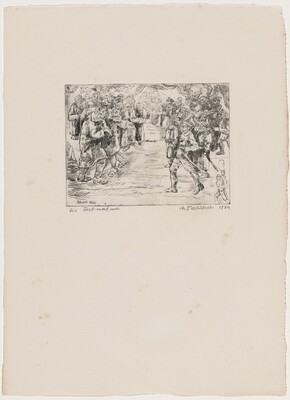
This is a drawing of a group of people gathered in a festive or ceremonial setting. It shows detailed line work of individuals in traditional clothing in an outdoor area. The figures are closely packed, suggesting unity. The scene portrays movement and interaction, with two figures in the foreground. Trees in the background indicate an outdoor setting. Various figures show different expressions and postures, creating a dynamic scene. The drawing captures a group celebration or procession with intricate line work and shading.

Die Festnahme

Palukst, Abraham

This is a photograph of a decorative lidded porcelain vase with blue and white patterns. The vase has an intricate floral design painted in shades of blue against a white background. The body of the vase tapers down to a narrow base and is topped with a fitted lid that has a small finial at the top. The patterns consist of floral motifs interspersed with small dotted designs. The blue used is a deep cobalt shade commonly associated with traditional Chinese porcelain.

Blue and White Jar with Cover

Chinese Qing Dynasty
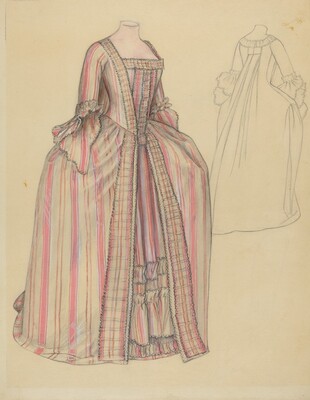
This is a drawing of an elaborate dress design. The full-length gown is depicted with vertical pink and blue stripes, featuring a wide skirt that billows out from the fitted bodice. The bodice has a square neckline, adorned with intricate lace or ruffle detailing. The sleeves are decorated with ruffles and hang loosely to the elbow. The dress appears to be an 18th-century style garment, with its extravagant use of fabric and embellishments. To the right of the colored illustration, there is a sketch of the back of the dress, highlighting the fullness of the skirt and the detailed drapery at the back. The drawing provides a detailed visualization of a historical garment, capturing the elegance and intricacy of its design.

Dress

Peszel, Jean

This is an engraving of a man sitting with a calm expression, deep-set eyes, and a beard. He wears a cap and a long-sleeved gown, holding a quill pen and book in one hand. There is an inkwell nearby. Text is placed above and below the image.

Johann Aventinus (Johann Turmair)

Lautensack, Hanns

This is a painting of a religious scene featuring numerous figures. The central panel of the artwork is filled with a group of figures wearing halos and vibrant robes. At the top of the painting, two figures are seated on thrones with symbols surrounding them. The image is framed with a border of circular portraits and decorative elements, including angels and celestial motifs. Gold is used to highlight areas, enhancing its theme. The style is reminiscent of an illuminated manuscript, common in medieval religious art.

Christ and the Virgin Enthroned with Forty Saints

Master of the Dominican Effigies

The sculpture is a relief depicting a central figure standing on what seems to be an elevated platform, holding a staff or pole. Surrounding this central figure are smaller figures, including two seated or kneeling figures holding shields and staffs, and others in different poses that suggest motion. The sculpture, made of a material resembling bronze, has a dark metallic color with worn or polished areas highlighted. The relief features intricate detailing with figures in varying poses etched into a rectangular plaque, adding depth and movement. The top part includes cloud or smoke-like formations with smaller figures, possibly depicted in mid-air or within the clouds.

The Resurrection

Master I.F.P.

Officia M.T.C.

Officia M.T.C.

Cicero, Marcus Tullius

The image displays a ground-level view of a large and classical building with prominent columns and ornate capitals on the left side. The horizon is not visible, as the focus is on the tall architecture and adjacent structures. The photo is in sepia tones, giving it an antique feel. Besides the columns, there is a tower structure with arched windows and detailed stonework. On the right, a high wall leads to another building with balconies and window grids against a smooth stone exterior. The scene lacks people and emphasizes architectural elements under soft lighting, creating a serene and slightly timeless impression.

St. Paul's Cathedral, Valetta, Malta, with Bell Tower

Jones, Calvert Richard, Reverend

A dozen men and women approach or gather around a stone tomb in a church in this square painting. The people all have pale skin and wear robes in muted blue, sage green, apricot, dark pink, or vivid red. The rectangular tomb is supported on four columns, which are just taller than the people standing next to and under it. It sits in a curved apse, which is decorated with gold paintings or mosaics. In the quarter dome above, a person sits in an almond-shaped halo flanked by two people wearing royal blue and dark pink. Some of the scenes below and to the sides of the dome are hard to make out but one, to our left, shows a person wearing blue holding a baby, and another to our right is of a nearly nude person on a cross. Two people in front of the tomb raise hands to touch its bottom edge. Underneath the casket, one person supports another, who has swooned or fainted. A fifth person there peeks around the front, right column. Two women are on the six steps leading up to the tomb, and a man using a cane approaches from our right. His robes are pulled up over a red gash on his shin. At the bottom center of the picture, three men wearing knee-length tunics support each other, arms slung across each other’s shoulders. Another man carrying a crutch across one shoulder walks away from the tomb, to our left of this trio. Rows of tan stone columns topped by leafy capitals supporting vaulted arches comes toward us to either side of the tomb. One more person wearing monk’s robes is visible through the columns, near the right edge of the painting. The floor at the foot of the steps is petal pink.

The Crippled and Sick Cured at the Tomb of Saint Nicholas

Gentile da Fabriano

The image shows the front cover of an old publication. It prominently features text in a formal typeface on a light blue background framed by concentric rectangular lines. The text is in black, creating a minimal color palette. The design conveys a sense of order and formality.

Malerische Ansichten aus den Umgebungen von Rom

Richter, Ludwig

The spout of this silver teapot faces our left and the black handle our right in this photograph. The body of the teapot would be oval shaped if viewed from above. The sides of the teapot are straight and fluted to create vertical columns that curve inward. The shallowly domed lid has a flat, black, disk-like knob. The long, straight, narrow spout tapers from the base of the teapot to the opening, which is level with the top of the teapot. The handle to the right curves like the right half of a heart and flares upward where the thumb would rest at the top of the curve. The handle is affixed to the body of the teapot with short silver sleeves. The body is engraved along the top and bottom with decorative bands of garlands and vegetal scrolls. A rose-like flower and leaves are incised near the base on the side facing us.

Teapot

Revere, Paul

There are two wooden objects with intricate details. The color scheme includes natural wood tones, warm earth shades, and subtle touches of red. The larger object is supported by four posts and features a painted image of two people. The smaller object has a side view with a winding handle.

Music Box

Makrenos, Chris

The image depicts a scene of the Crucifixion. Figures are shown crucifying a central figure, who is laid out horizontally on a cross. The painting is stylized with vibrant colors such as reds, greens, and yellows, and bold outlines to delineate forms. The background includes decorative foliage and dot-like patterns. The figures wear medieval-style garments. This artwork may be influenced by European religious iconography.

Christ Nailed to the Cross

German 15th Century

The image shows an upper body portrait of a woman positioned in profile, facing to the left. She has delicate facial features with a soft complexion and slightly pink cheeks. Her hair is light-colored, curly, voluminous, and styled elegantly. The woman is dressed in a white garment with ruffled detailing and a light pink sash around her waist. The background is a muted dark color.

Mary Wood

Russell, John

The sculpture features a relief depicting a woman seated and holding a child on her lap. Another small child stands slightly to the side, reaching up towards the woman. The figures are set within an ornate frame filled with intricate designs and patterns, including floral motifs and architectural elements in the background. The sculpture displays a rich, dark bronze color. The surface shows intricate detailing, highlighting the features of the figures' clothing and the ornate frame. The sculpture appears to be a small, decorative piece designed to be displayed flat against a surface.

Madonna and Child with Saint John

Venetian 16th Century

This is an image of mountainous landscapes with buildings and pathways. The image contains text printed in German, discussing artistic themes. In the lower right section, there is an illustration in black ink depicting a stylized mountain landscape with a winding path or road leading up the mountain, surrounded by trees. Small, simple figures are shown traversing the path, with simple buildings at the base amongst trees, creating a rustic, outdoor scene typical of mountainous or rural regions. The imagery is minimalist and stylistic, focusing on basic outlines and shapes to convey the scene.

In-text plate from Kirchner Zeichnungen (Kirchner Drawings)

Kirchner, Ernst Ludwig
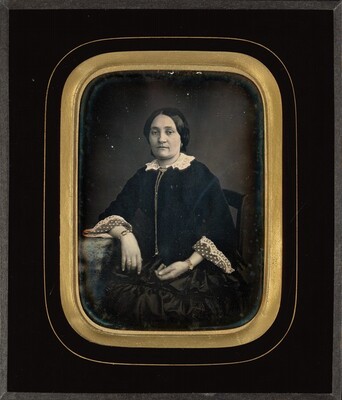
The image depicts a woman from the waist upward seated in a portrait style, facing slightly to the right. She has dark hair and is wearing a dark dress with lace collar and cuffs, accessorized with a brooch, lace detailing on the sleeves, and bracelets. The background is a dark hue, typical of daguerreotype portraits, and the photograph is framed with a gold-colored border.

Portrait of a Woman

Verdier Mlle.

The painting shows a landscape including distant hills under a pale blue sky with clouds. Below the hills is a body of water with some small red rowboats on it. Closer to us, to the right of center, is an American flag on a flagpole. A child in a black suit and a woman in a red dress stand facing the flagpole, and a man stands in front of them, facing us. He is in a blue uniform with long buttons down the front and a red belt. The man is holding broken pieces of a chain in either hand and appears to be standing in a light gray puddle. All three of these people have blue-gray skin and black hair, and there is a small black-and-white dog by them near the bottom right corner. To the left of center, a man riding a horse holds up another American flag. This man is wearing a similar blue uniform and has slightly paler gray skin. He also holds another flag in his other hand, which he allows to drag on the ground, and this flag is red with a wide white stripe in the center and a blue and gold section in the top left. Behind him is another rider on horseback who is mostly in shadow, and behind that a man stands by a tree near two horses that appear to be hitched to a wagon. In the background on the left, there is a tall white monument, and on the right is an arched structure made of light brown stone with a large gray bird sitting on top of it and more horses standing below it.

Allegory of Freedom

American 19th Century
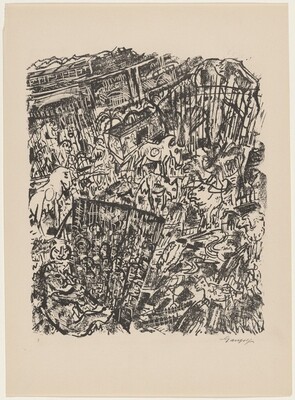
The image contains a variety of jagged and swirling lines, creating an abstract composition. Amongst these lines, there are patterns that resemble shapes such as animals and structures. The overlapping figures and lines create a sense of complexity within the image, challenging viewers to identify recognizable forms.

Zoo

Gangolf, Paul

The sculpture is a round, lidded box with a smooth surface. It has a muted red and beige color palette. The top is primarily red, blending into a creamier beige near the edges. The lid fits snugly over the base, which has red patterning along the upper edge. The sculpture is made of ceramic material. The form is simple and streamlined, without intricate details, emphasizing the color gradient on its surface.

Covered Box for Seal Paste

Chinese Qing Dynasty

The image shows a three-tiered wooden chest of drawers with golden accents. Each tier is smaller than the one below it. The drawers have round black knobs. A blue vase or ornament is placed on the top tier. The colors in the image are rich brown, gold, black, and a touch of blue. The chest is centrally positioned, with each tier aligned above the one below it.

Sewing Box

Simpson, Columbus

The image features a pastoral landscape viewed from an elevated vantage point. The terrain is rugged, with hills, clay cliffs, trees, and small architectural ruins. A group of figures is seen on a rocky path leading towards a circular structure surrounded by trees in the distance. The etching style employs fine lines for details and textures. The palette is monochromatic, with black ink on a light background creating depth. The sky has cloud patterns, adding to the sense of depth in the image.

Landscape with Two Ruined Towers

Dietzsch, Johann Christoph

This painting shows a tiger lying on the ground. The tiger's body is stretched out, facing the left. Its eyes are closed, and its head is resting on its paws. Its fur is painted in a rich orange with black stripes and areas of white on its face, chest, and legs. In the background, there are soft, gray-blue mountain ranges under a light blue sky. The ground the tiger lies on is an olive-green color, with sections of tan earth. The painting has fluid and loose brushstrokes.

Tiger

Delacroix, Eugène

The sculpture is a circular medallion featuring a profile relief of a man wearing a traditional doge cap. The subject is an older man with prominent facial features including a pointed nose and a pronounced chin. The medallion is made of a metallic material with a bronze-like color and a slightly weathered texture. Surrounding the man's profile are embossed inscriptions, likely in Latin. There is a small hole near the top edge. The size of the medallion suggests it could be held in one's hand.

Marco Barbarigo, c. 1413-1486, Doge of Venice 1485 [obverse]

Anonymous Artist

Descrizione del Sacro Monte della Vernia

Descrizione del Sacro Monte della Vernia

Ligozzi, Jacopo
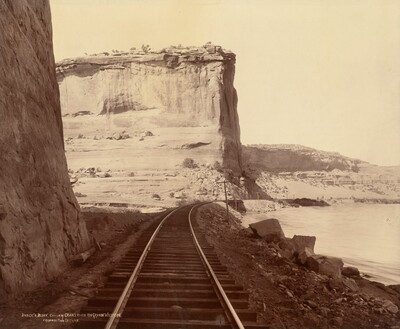
The image shows a scene of railway tracks curving to the right beside a river. The tracks are flanked by rocky terrain, with a large rock face on the left. In the distance, rugged cliffs and rock formations are visible against a clear sky. The perspective is slightly angled, giving a sense of standing at the edge of the tracks. The color palette is composed of sepia tones, creating a warm and nostalgic atmosphere. Light and shadow highlight the texture of the rocks. The image has a classical aesthetic.

Dodge’s Bluff, Canyon of Grand River

Savage, Charles R.

Seen through a wide, shallow, ornamental, stone arch, seventeen light-skinned people and a dog gather around or near a long banquet table set with plates of food in this horizontal painting. The table angles away from us so the short, right side is closest to us in the darkened room, which is lined along the far wall with shallow columns and capitals. To our left, an arched doorway in the room opens to a view of a stone structure and a sliver of blue sky. A gleaming, gold candelabra with curving arms hangs over the table from a coffered, possibly wooden ceiling. The table is covered with a white cloth. Men crowd around the short ends and the long side of the table opposite us. In pairs and trios, the men converse or look toward a man with light radiating from the top and sides of his head, at the center of the far side of the table. That bearded man, Jesus, has long brown hair and points his index finger upward with his right hand, on our left. The other men at the table wear robes and tunics in sage green, tan, brown, or slate blue. A portly man behind Jesus stands with a cloth draped over one forearm and his other hand on his hip, looking down at the table. Another cleanshaven man stands holding a large platter at the far corner of the table, and two people, perhaps a man and woman, appear to be walking away from the table but look back over their shoulders to our left. On the long side of the table, closer to us, a man to our left, balding with a long gray beard, sits on a narrow, bench-like seat and twists to pick up a jug from a large basin on the floor. The final man stands near an overturned seat as he turns his back on the table. He gestures forward, to our left, with one hand as he looks back over his other shoulder. A white dog with brown spots chews on a bone near the overturned seat. The highly decorated wide archway through which we see the scene seems to be carved from pale, fog-gray stone with scrolling moldings and capitals. The arch has a shield-like decoration at the top center, and is flanked by sculpted people in the upper corners. Two larger golden statues of robed women stand on floating plinths to either side of the arch. The woman to our left holds flaming orbs and the other holds a yoke across her shoulders. Though the painting seems rather illusionistic from afar, closer examination shows that it is sketchily painted throughout.

The Last Supper

Ricci, Sebastiano

The image shows a street view at Shimoda, with a bridge as the focal point. The scene is captured from a slightly elevated POV, offering a comprehensive view of the street activities and structures. Tall trees and traditional buildings fill the backdrop behind the bridge. The artwork features detailed brushstrokes depicting architecture and figures. The color palette includes earthy tones with contrasting bright colors in the clothing of people. Buildings and trees in the distance have more subdued colors, adding depth to the image.

Street and Bridge at Simoda

Heine, William

This is an image of a decorative ceramic plate with a heraldic design. The plate is circular and adorned with a central coat of arms or shield. The shield is divided diagonally by a gold band with two heraldic animals, likely greyhounds, depicted in a running posture with gold stripes. The upper part of the shield contains three gold fleur-de-lis symbols on a blue field. Surrounding the shield is an intricate design of green laurel branches with acorns and yellow floral elements on a blue background. The date "1532" is inscribed on the plate. The ceramic plate combines craftsmanship with rich symbolic imagery, indicative of heraldry. The design reflects a family or regional coat of arms and emphasizes tradition and artistry common in European decorative arts.

Circular plaque with fruited wreath enclosing a shield of arms

Faenza 16th Century

The image shows a large, gray, metallic bowl in a meticulous drawing style with various shades of gray against a light beige background. The bowl is centrally placed slightly above the center of the paper, with its circular opening visible from a slightly elevated angle.

Silver Dish

Braun, Clayton

The image shows a woodland scene with tall trees and a dense canopy. The perspective is at eye level, emphasizing the trees. The intricate etched lines create texture and depth in a monochromatic color palette. The focus is on the detailed natural forms of the trees and leaves.

In the Forest of Fontainebleau (Dans le foret de Fontainebleau)

Legros, Alphonse

The image is a portrait drawing of an older man. He is depicted in a frontal position, showcasing his facial features such as deep-set eyes, furrowed brows, a straight nose, long beard, mustache, and wavy hair that falls past his ears. The drawing is in pencil with hatching and cross-hatching for shading and texture. The background is plain, emphasizing the subject's features and expression.

Self-Portrait

Legros, Alphonse

The sculpture depicts a bas-relief scene with multiple figures forming a procession or gathering. On the left, a line of individuals face towards a seated figure on the right. The prominent figure is elevated with one hand extended. The figures are draped in classical robes, giving it an ancient or historical setting. The sculpture is made of bronze, with a dark brown appearance and highlights where light catches on raised surfaces. The background features arches or columns, adding to the classical architectural context. The scene appears to be a formal or ceremonial gathering with a focus on the seated figure.

Christ Brought Before Pontius Pilate

Belli, Valerio

This is a photograph of a decorative book cover. The book cover has a golden-yellow background with a repeating pattern of floral motifs, resembling chrysanthemums. The text "BADAUDERIES PARISIENNES" is printed in a dark bold font in the upper portion, and "Les Rassemblements" is displayed centrally beneath it. The design suggests elegance and artistic flair with the patterned florals and typography contributing to a refined aesthetic.

Les Rassemblements

Vallotton, Félix

The image shows a person standing upright. They are facing slightly to the left, with their left hand on their hip and their right hand holding a coiled rope. The person has short hair and is wearing a brimmed hat, long sleeves, a high-collared shirt, suspenders, and a strap across the body, suggestive of a utility belt. They have a small satchel over their shoulder and there is another rope present. The background features classic architectural elements and the floor is covered in what appears to be hay or straw. The photograph is mounted on a card from a photography studio in Kewanee, Ill.

Portrait of a Telephone Lineman

McWilliam, Peter
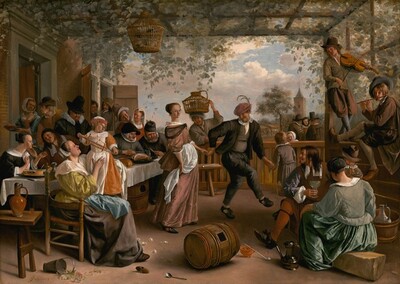
More than a dozen light-skinned men, women, and children eat, drink, talk, and make music around a dancing couple under an arbor in this horizontal painting. Most of the people are dressed in muted tones of green, gray, and black. The patio-like space is enclosed by a railing along the back and a half wall to our right. Sage-green vines and leaves covering the roof-like trellis hang down. Ten men and women sit or stand closely around a long table along the left, next to the exterior wall of a red brick building. A woman sitting in a wooden chair at the end of the table closest to us wears a flax-yellow gown with a wide white collar and a starched white cap. She smiles up at the child she braces in her lap. The child stands and holds a toy in both hands and looks over one shoulder to our right. The child wears a carrot-orange gown with a white pinafore. Two men lean out of open windows at the far end of the brick building, and the people along the table drink, smile, or look on as a man in the center leads a woman by the hand to an open spot under the arbor. He wears a charcoal-gray suit, and a muted pink cap is pulled low over his eyes. He has a long, hooked nose, and light glints off teeth in his smiling mouth. The woman is pulled behind the man, so she stands flat-footed to our left of him. She faces our right but turns to looks at us from the corners of her dark eyes. Her light brown hair is gathered at the back of her head under a pearl-lined covering. She wears a dusty rose-pink gown with a sheer black shawl around her shoulders and white apron at her waist. Beyond the back rail, a man smiles widely as he balances a covered basket containing a gray chicken with one hand on his head. Nearby, a boy on our side of the rail talks with a little girl across the railing, who smiles back. Two men and a woman wearing a black head covering talk a short distance away. Close to us, a man, woman, and child in the lower right corner sit near two young men perched on the half wall, one playing a violin and the other a flute. A gleaming pewter ewer, a wooden barrel with a square opening, a white pipe, a terracotta bowl, broken eggs, a spoon, and an overturned pail of flowers lie scattered across the foreground of the patio. The artist signed and dated the lower left, “JSteen. 1663,” with the J and S overlapping.

The Dancing Couple

Steen, Jan

The image shows a person in a crouched position with knees bent, arms extended forward as if bracing for a fall. The individual has short hair and is wearing a long coat, pants, and shoes. A stick or cane is on the ground next to them. The background includes trees, ground details, and a decorative frame.

Peter Schlemihl Chasing His Shadow

Schrödter, Adolf

Oval dish with Allegory of Autumn

Oval dish with Allegory of Autumn

Palissy, Bernard

The image shows a brown boot against a light beige background. The boot is textured with creases and folds, and is positioned upright in the center of the frame with the sole facing leftward.

Boot

Miller, Eugene C.

This is a drawing featuring four circular panels depicting different religious scenes. The top-left panel shows a standing figure with an aura above a seated figure and two others nearby. The top-right panel shows a central figure in clerical garments with two others. The lower-left panel shows monks and a cleric in a church-like setting. The lower-right panel shows a reclining figure in a natural setting with beams of light from the sky. The style is reminiscent of classic religious iconography with detailed line work.

St. Remigius; St. Leodegarius; St. Gerard, Abbot; St. Francis of Assisi

Callot, Jacques

The image depicts a rural village scene with houses, a church spire, a road running alongside a stream, and people engaging in various activities. Additionally, there is a boat near the water. The painting features precise brushstrokes and uses a color palette of sepia tones, browns, and grays. The sky is clear with a few birds in the distance.

The Village Street

Velde, Esaias van de, I

This is an image of an ancient coin featuring a central design of an ornate urn or vase with two handles, surrounded by partially visible inscriptions around the edge. The surface of the coin is worn with visible patina and signs of aging, giving it a rich, earthy color with hints of green. The inscriptions are in a classical style, possibly Latin, suggesting historical significance. The overall appearance of the coin suggests it has been buried or exposed to the elements for a significant period.

Vase in a Landscape [reverse]

Master IAC. URB.

This is a photograph of an old book cover. The cover features a dark, textured spine on the left, with two thin gold vertical lines running along the edge. The spine is mostly black. The rest of the cover is a light brown fabric, which shows signs of wear and possible water or age stains, resulting in a mottled and discolored appearance. The overall feel of the image conveys a sense of antiquity and use.

On English Lagoons

Emerson, Peter Henry

The image shows two large buildings set against a sloping landscape. The horizon is obscured by the elevated ground behind the buildings. The buildings have multiple stories, rows of windows with awnings, chimneys, and decorative cornices. The railroad tracks run horizontally at the bottom of the image. The color tone is sepia, giving an antique quality. The color palette is predominantly brown. The sky is clear with no visible clouds. Trees on the left provide a touch of greenery.

South Bethlehem General Office Buildings

Rau, William H.

Against a distant, hazy, verdant forest, a petal-pink and amethyst-purple orchid grows from a mossy branch close to us, to our left, while three jewel-toned hummingbirds gather around a nest to our right in this horizontal painting. Two pale pink, ruffled petals of the orchid flare up and out from the hot-pink, furled center. The lip-like petal below is amethyst purple brushed with pale yellow along its top. Three narrow, pink petals create a triangle behind the center of the bloom. Some of the pale honeydew-green pods and leaves growing from the base of the plant are speckled with brown spots. The orchid grows on a gnarled brown branch painted with daubs of white, burnt orange, goldenrod yellow, and scarlet red along its length, which spans the width of the painting. Three hummingbirds with narrow, pointed beaks tend a nest built further along the branch to the right of the orchid. The largest is perched with its back to us. It has a vibrant green body and a two-pronged, crimson-red tail. Its head is turned up and to our left, looking at the second bird fluttering on a branch across the nest. The second bird’s avocado-green and dusty rose-pink body curves downward from outstretched wings. The third bird is perched on a nearby branch to our left, its head turned to the right to look at the others. Two white eggs are partially visible in the nest, which is shaped like an upside-down cone. The nest is woven with wavy, dangling strands of burnt-orange plant material. The orchid, birds, and nest fill the center of the composition. The scene is brightly lit from upper left. More leafy branches covered with hanging vines rise on either side of the painting. The background is filled with a dense growth of plants and trees, painted with blended shades of muted greens and pinks creating a diffuse, watery haze. The sky takes up the upper third of the composition and is filled with smoke-gray clouds except for a small circle of blue sky peeking through the branches of the tree in the upper right.

Cattleya Orchid and Three Hummingbirds

Heade, Martin Johnson

The image shows three owls against a dark, leafy background. The central owl is larger and has focused eyes. The two smaller owls on either side mimic the central owl's pose and expression. The drawing evokes a mysterious, nocturnal atmosphere with detailed shading and cross-hatching.

Grand-duc (Eagle Owl)

Groux, Henri de

This is an image of a wooden armchair with leather upholstery. The chair has a high back, dark-stained wood, embossed leather with decorative patterns, metallic studs, a leather-upholstered seat with studs, simple arms, and intricately carved stretchers connecting the legs. The stretchers have a looped design.

Leather-covered Walnut Armchair

Italian 16th Century

This is a painting of an embroidered book cover. The painting showcases a book cover with an intricate design. The central focus is on the cover itself which is predominantly blue with delicate embroidery featuring symmetrical patterns of curved lines and floral motifs in shades of gold and green. This is in the style of an anonymous artist who focuses on precise and detailed ornamental work. The cover also has a fold showing an edge in pink, giving depth to the image, while the rest of the space is left blank.

Needle Case

Buker, Ruth

This is a painting of a Noddy Tern perched on a branch by the water. The illustration features a detailed depiction of the bird with its sleek plumage in various shades of brown and a distinctive white cap on its head. The bird stands on a rugged, textured branch that extends diagonally. The background showcases a coastal landscape with calm waters and distant landforms, likely cliffs or hills, under a soft, muted sky. Detail is also given to the texture and feather patterns of the tern. This is in the style of John James Audubon.

Noddy Tern

Havell, Jr., Robert

The image shows a valley surrounded by mountains, with cliffs blocking the horizon. The painting has loose brushstrokes in an impressionistic style, using a muted color palette. Vegetation is depicted in various greens, while rocks are shown in browns and grays. The sky is a pale color. A figure in dark clothing is seated on a slope, looking at the landscape, with trees and shrubs around them. Further away, there are cliffs with greenery, creating a dramatic backdrop.

A Seated Man Contemplating a Sunlit Mountain Valley

Alt, Jakob

The sculpture is a rectangular relief depicting a warrior in armor on top of a rearing horse. The warrior holds a weapon above their head while the horse opens its mouth and lifts its front legs off the ground. Below the horse, another armored figure is shown lying on the ground, partially hidden under the horse's hooves. The relief is carved from bronze-colored material. There are four small holes in the corners of the sculpture.

Horseman and Foot-Soldier

Briosco, called Riccio, Andrea
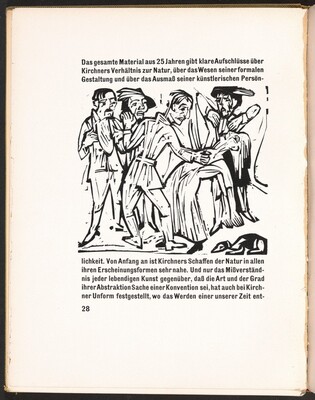
The image is a black and white illustration showing three people in a dynamic pose, with a partial view of their bodies from the waist up. The figures are leaning and reaching towards each other. Their features are stylized, with angular lines defining their faces and hair. They are wearing loose-fitting garments, with one figure in the center wearing a hat. The clothing is simple, focusing on shapes and lines. There is no visible jewelry or objects being held. The background is white. The image is surrounded by a block of text in German above and below and the page number "28" is visible at the bottom.

In-text plate from Kirchner Zeichnungen (Kirchner Drawings)

Kirchner, Ernst Ludwig

This is a photograph of a sequence showing the movement of a figure running. The image is divided into a series of frames capturing progressive moments in the motion of the figure. The background consists of a grid. Each frame captures a static moment, detailing changes in the position and posture. The figure's movement is fluid, with hair and limbs depicted in various stages of running.

Plate Number 469. Child running

Muybridge, Eadweard

A rocky shoreline juts into a vivid, aquamarine-blue body of water in this loosely painted, nearly square landscape. The rocky beach and a few pieces of driftwood stretch in front of us in shades of ivory white, sand brown, gold, and mustard yellow to fill the bottom half of the painting. A few touches of shamrock green suggest plants growing in the near distance. A higher, almost flat-topped promontory reaches into the water beyond, nearly spanning the width of the composition. Areas of pine green suggest more growth in the distance near the left edge. A line of pale brown reaches across much of the horizon, which comes four-fifths of the way up the painting. The sky above is muted turquoise blue. The artist signed and dated the painting in the lower right corner, “Childe Hassam 1901.”

A North East Headland

Hassam, Childe

The image depicts a gathering of people near a structural building with a thatched roof. A line of trees defines the horizon, suggesting an open area. More individuals are scattered across what seems to be fields or meadows. The style is characterized by fine, hatched lines typical of an etching or engraving. The color palette is monochrome, with shades of black and gray on a cream background. Shadows and object outlines are created through dense cross-hatching. Trees with dense foliage are to the right of the building, with birds scattered in the sky.

Harvesters at Rest

Scheuren, Caspar Johann Nepomuk
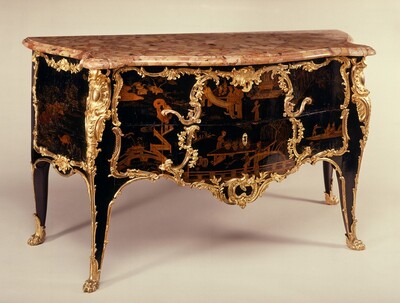
Chest of Drawers (commode)

Chest of Drawers (commode)

Desforges, Jean
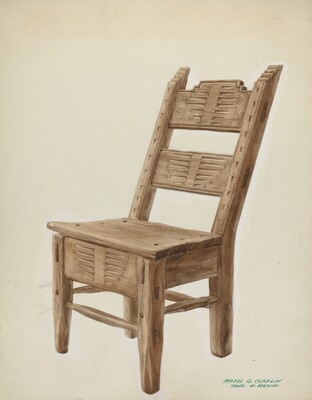
The image shows a wooden chair with intricate carved patterns on the backrest. The chair is positioned to the left in the image with the front legs slightly facing to the right, set against a light neutral background.

Wooden Chair

Claflin, Majel G.

This is a drawing of intricate decorative motifs with mythical creatures and floral designs. The drawing features a symmetrical arrangement with an oval shape in the center, containing letters "CR" above "F.A." and the date "1616" underneath. Surrounding the central medallion are elegant, swirling floral designs and fantastical creatures reminiscent of satyrs, adorned with leaves and flowers. Above the central oval is a drum with arms and flags protruding, while in the corners, there are two birds in motion. Below the medallion is a skull design, adding a macabre element to the composition, which is balanced by the ornamental extravagance of the whole artwork.

Ornament with Grotesque

Master CR

The image shows a sketch of a serene landscape. The horizon is depicted higher in the sketch with outlines of structures, potentially a bridge and buildings. The sketch is done in pencil with soft strokes, creating an impressionistic sense. Different shades of grey define the objects, while the paper is left bare for the sky and lighter areas. Close to us, there are indistinct shapes, potentially rocks or foliage. In the distance, there is a suggestion of trees or dense vegetation, framing the buildings in the sketch.

Landscape Sketch with Bridge and Castle

Cotman, John Sell

The sculpture is a relief profile of a man with long, wavy hair cascading down his shoulders. The material of the sculpture appears to be a metallic alloy, giving it a silvery or bronze patina. The artwork is a bas-relief with intricate detailing in the facial features, hair, and gown attire.

Louis II de Bourbon, 1621-1687, Prince de Condé [obverse]

Dassier, Jean

The image displays a brown leather-bound book cover. The cover shows signs of wear, including scuffs and discoloration, giving it a rustic and vintage appearance. The edges are stitched with a golden thread pattern. The leather's texture and markings contribute to the antique look of the book.

The Powers of the Pen

Mortimer, John Hamilton

Omar Pacha

Omar Pacha

Fenton, Roger

We look through shadowed trees at a river winding into the distance in this horizontal landscape painting. Close to us, a cluster of three thin trees and a larger central tree are deep in shadow, which contrasts with the light-filled scene beyond. The topaz-blue river curves from the lower right corner, across the canvas, and into the distance at the center. A few spindly trees grow along the riverbank in front of a hut with a thatched roof to our right. The bank to our left is lined with reeds and tall grasses. Behind the central shadowed tree, a long, low, narrow boat is occupied by four people with pale skin. To our left, a person with a dark garment and white collar reclines near a seated man wearing yellow and a feathered cap. To our right, another person reclines near the boatman who pushes the boat through the water using a long pole. The harvest yellow and sage green of the riverbanks and vegetation beyond the boats fades to hazy, pale blue mountains along the horizon line, which comes just over halfway up the composition. White clouds float across a blue sky above.

River Landscape

Carracci, Annibale

This is an embossing of abstract shapes. The artwork features raised patterns on paper that create an intricate abstract design. The embossing reflects curves and lines that suggest natural or organic forms. The limited color palette emphasizes the play of light and shadow over the embossed areas, adding depth and dimension to the piece.

Le vautour (The Vulture)

Rouseaud, Aristide

This is a tapestry showing a crucifixion scene. At the top of the tapestry are three men hanging from large wooden crosses, one in the center and the other two near the upper right and left corners. The men on the sides have agonized expressions, and their bodies are contorted, limbs bent and curved. The central man is still, his arms stretched outward, hands and feet nailed to the wood. He has a bleeding cut on his side and wears a tanged thorny circlet on his reddish-brown hair. The men all have cloths of various shades of gray and blue tied around their waists. Below, numerous other men and women are gathered, wearing colorful dresses and robes in shades of blue, red, orange, green, and purple. Near the bottom left corner, a woman in a blue dress and a white head covering appears to have fainted, and two other women grab her arms. Another woman stands at the base of the central cross, looking down at the fainted woman. All four of these women have halos, as does a man on the left who looks upward, his folded hands raised. In the bottom right corner, another man kneels down next to several tools, reaching for a loop of rope. The background features a pale green landscape with hills, trees, and gray buildings under a sky swirling with blue and white clouds. A red sun and a pale moon appear in the sky on either side of the central crucified man. The central scene of the tapestry is contained in an intricately decorated red border which features designs of flowers, fruit, and curling vines.

The Crucifixion

Pannemaker I, Pieter

The image shows a black jug or pitcher with a rounded body, curved spout, and a single arched handle. It is situated against a light, neutral background. The jug is positioned centrally with the spout pointing slightly to the left, and the handle is on the right side.

Moravian Pitcher

Ludwig, William

The image shows three individuals in a garden setting. They are positioned close together, with one man on the left leaning in towards a woman in the center, while another woman stands to the right holding the central woman's arm. The central woman has a delicate facial expression and both women's hair is styled up. The man has his hair styled back and wears formal attire with a coat and breeches. The women are dressed in elaborate gowns, featuring layers and detailed fabric designs. The background reveals lush garden foliage, a stone balustrade, and a decorative column.

Sans rien comprendre à ce mystere

Le Mire, Noël

This is a painting of a group of figures and sheep under a tree in the style of William Blake. The image features a collection of figures arranged in an arc, each holding musical instruments like harps, lyres, and trumpets. The figures are painted in flowing robes, suggesting a harmonious gathering. The scene includes sleeping sheep in the foreground, and the night sky above with a crescent moon and a single star. The painting uses muted, watercolor-like tones.

Job and His Family Restored to Prosperity

Blake, William

This is a painting of a nativity scene. The image features a baby lying on the ground with rays emanating from it, surrounded by figures dressed in robes. A cow and an ass are beside a wooden structure, possibly a stable. One of the figures is in a kneeling position with hands clasped. An angel hovers above with a banner, and there are multiple haloed figures. The style is reminiscent of an early Renaissance religious woodcut, known for biblical and Christian iconography.

The Nativity

Bolognese 15th Century

This is a drawing of a page featuring a poem titled "DIE SEEFARHER" in German printed in a serif font. The text occupies most of the upper portion of the page. Below the text is a small black and white abstract drawing of geometric shapes. The drawing contains a complex and slightly chaotic arrangement of figures or forms. The page number "14" is centered below the image.

Die Seefahrer (The Seafarer) (in-text plate) from mock-up of Georg Heym: Umbra Vitae (Georg Heym: Shadow of Life)

Kirchner, Ernst Ludwig
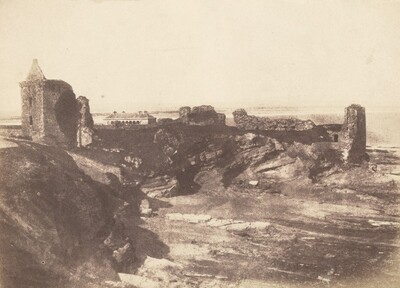
The image shows a rugged coastal landscape with a stone structure resembling a tower or fortification on the left. The stone appears weathered and aged. Rocky formations and ruins stretch along the coastline to the right, leading to the sea on the horizon. The sea forms a wide separation between the land and the sky. The image is in a sepia tone, giving it an aged appearance. The scene is barren and detailed, with warm brown and cream colors emphasizing its historical feel.

The Castle, St Andrews

Hill, David Octavius

Shown from about the knees up, a young girl with pale skin and flushed cheeks stands in front of a landscape, looking at us in this vertical portrait painting. She stands with her body angled to our left, and she turns her face to us. Her chestnut-brown hair curls down the nape of her neck, and her bangs sweep across her forehead over slate-blue eyes. Her turned-up nose and pink bow mouth are set within in her round face. The girl’s smooth skin, her white dress, and her ivory-colored, wide-brimmed straw hat are brightly and evenly lit. Her flushed cheeks are echoed by the broad, petal-pink sash tied around her waist into a bow at her back and the matching ribbon of her hat, tied in a bow under her chin. A few streaks of pink also appear in the aquamarine-blue sky behind her. A hillside painted with tones of harvest gold and tawny brown slopes up from the lower left corner to the right edge of the canvas. The landscape is more loosely painted with lively brushstrokes.

Miss Juliana Willoughby

Romney, George

The image shows a rustic rural scene with a cottage, trees, and a well. The perspective is slightly elevated, capturing the landscape. In the center, a cottage with a thatched roof is visible, partially hidden by foliage. The style appears to be etching, with fine lines defining texture. The color scheme is primarily sepia and grey. On the right, a well with stonework and timber can be seen. The overall composition invites exploration of the pastoral setting.

La chaumière au puits (Cottage with Well)

Bléry, Eugène

The sculpture depicts a wooden chair with an intricate design. It features a rich brown hue and carved circular designs on the backrest. The arms extend horizontally with rounded edges. The base forms an X shape to support the seat, and the legs have detailed carvings along the edges.

Walnut Savonarola Chair with Incised Ornament

Italian 16th Century

This is a painting of a wooden chest of drawers. The chest features intricate carvings and decorative elements, including panels and sculptural details in darker wood tone. The chest is divided into sections, with panel doors at the top and rows of drawers at the bottom. Each drawer has dark wooden knobs and is separated by carved horizontal elements. This painting is in the style of 18th-century antique furniture design. The background is plain and neutral in color.

Two Drawer Sunflower Chest - front view

Partyka, Martin

This is a drawing of a heraldic coat of arms with two angels and a large bishop's mitre. The coat of arms is quartered, featuring lions in red sections and frog-like creatures in black sections, with a smaller inescutcheon in the center showing a lion. Two angels support the coat of arms and hold a bishop's mitre above it. The colors include reds, greens, black, and gold. The composition is framed with intricate black linework.

The Coat of Arms of Wigeleus von Fröschel, Bishop of Passau

Burgkmair I, Hans

The image displays a full-body drawing of a person in a sitting position. The individual is reclining slightly backward, with the head tilted upwards and the gaze directed above. The facial features suggest a firm expression with a slightly open mouth, while the hairstyle is short and close to the scalp. The person is wearing a draped garment, possibly resembling a toga or a robe, loosely covering the body and falling in soft folds. They hold a large round shield with a floral or medallion-like pattern in one hand, and the other hand is partially obscured but appears to grasp a long stick or weapon, potentially a spear. The background is plain, lacking any discernable environmental elements, which emphasizes the subject.

Seated Warrior Holding a Sword and Shield [recto]

Cavedone, Giacomo

The image depicts a person standing upright, holding a staff in their right hand. Their facial features are distinct, with downward glancing eyes and a defined jawline. The person's hair is medium length and slightly wavy, framing their face. They are dressed in a classical or medieval-style tunic with a cloak draped over their shoulders. The tunic has a skirt-like bottom with textured horizontal lines, and they are wearing tall boots. The background shows bold lines and patterns indicating rocks or cliffs, with a structure resembling a church or castle tower partially visible to the right.

Saint Roche

Italian 16th Century

This is a book cover for "Narrative of a Five Years Expedition." The cover features the title and details of the book written in a decorative serif typeface. Below the main title, captioned "By CAPT. J. G. STEDMAN," there is an oval frame illustration depicting several ships at sea, surrounded by a bald eagle. The text provides context about the book's contents, promising descriptions of natural features and inhabitants of the depicted regions, including the Indians of Guiana and Negroes of Guinea. The book, published in London in 1796, claims to be illustrated with engravings made by the author. The text is accompanied by a Latin quote attributed to Valerius Flaccus.

Narrative, of a Five Years' Expedition, against the Revolted Negroes of Surinam, in Guiana, on the Wild Coast of South America (volume I)

Stedman, John Gabriel
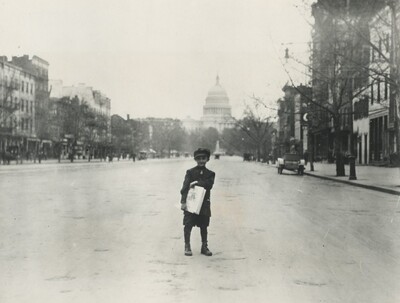
Title from caption on object: "Read All About It!"

Title from caption on object: "Read All About It!"

Hine, Lewis Wickes

The image shows a Native American camp from an elevated viewpoint. The scene includes tipis with symbols and people engaged in various activities. The setting features distant hills under a cloudy sky, with soft transitions between land and sky. The brushstrokes are delicate and precise, creating a realistic landscape. The color palette is dominated by earthy tones, with greens for hills and browns for tipis and earth, while the sky is a blend of grays and blues. Figures on horseback in the distance add movement to the scene. The painting is bordered by an oval frame.

An Ojibbeway Village of Skin Tents

Catlin, George

This is a drawing of an interior scene. The image shows a sketched interior with two figures. One figure on the right is leaning on a surface, while a second figure stands slightly to the left, seemingly engaged in a domestic task. The surrounding area includes faintly drawn elements, suggesting a room with a chair and other indistinct items. The style of the drawing is loose and suggestive rather than detailed or highly realistic.

La friction au gant de crin (Massage with Coarse Hair Glove)

Forain, Jean-Louis

This is a painting of a group of figures gathered around a long table with various dishes and food items. The figures are depicted in intricate detail, with the central figures showing emotional expressions. The setting is a richly decorated interior with ornate architectural elements, including columns, arches, and a large window. The clothing of the figures is rendered with rich colors and patterns, emphasizing the formal and historical significance of the scene. The artwork exhibits rich texture and vibrant colors, consistent with the style associated with the artist, reflecting a scene of historical or religious importance.

Plaque with the Last Supper

Penicaud, Jean I

The image shows a patchwork quilt with embroidered squares in various designs. The quilt features a variety of embroidered panels with colorful borders. Each panel showcases unique motifs such as birds, flowers, nature scenes, a girl with a red cloak alongside a wolf or large dog, and a deer and rabbit in a forest setting. Other panels display floral patterns, exotic birds, farm animals, and nature-inspired elements. The quilt presents a rich tapestry of color and texture, with each square offering a glimpse into different themes or narratives through its detailed embroidery.

Appliqued Quilt

Bates, Dorothee L.

The image features an ancient temple captured from a low vantage point, highlighting its towering columns. The temple dominates the composition, obscuring most of the horizon. The artwork utilizes sketch-like brushstrokes with dark shading and lighter textured areas. The color scheme is monochrome, with various shades of black and grey. A path leading to the temple is illuminated, contrasting with the darker surroundings. Subtly shaded foliage in the background adds depth to the scene without excessive detail.

Sunrise Behind Temple of Concord, Girgenti

Pennell, Joseph

The image is a landscape seen from a slightly elevated perspective, showing a valley with a distant mountain range under a pale sky. To the right, a rocky cliff face is depicted with soft brushstrokes. The color palette is subdued, with light grays, beiges, and browns. Mountains in the distance are outlined with minimal detailing. A river winds through the valley, indicated by simple lines that merge into the background.

Swiss Landscape with a Village in the Distance

Lushington, Sarah Grace

The sculpture is a bell-shaped mortarium made of dark bronze. It features intricate designs including reliefs of horses and chariots in motion, as well as ornate garlands and classical motifs. The sculpture is a small, open-topped vessel with a slightly outward sloping rim, resting on a narrow base. The craftsmanship is highly detailed, making it both functional and artistic.

Mortar with Putti and Griffins

Italian 16th Century

This print features swirling lines and large, petal-like shapes that radiate outward. The petals seem to end in pointed, jagged edges. Those at the center are a pale-pink color with vibrant red shadows, while the leafy shapes in the background are blue-green and brownish-yellow. In the center there is also a cluster of black-and-white dots amid the petals.

The Golden Legend: the Golden Legend of Master William Caxton done anew (volume 1)

Morris, William

The image shows a wooded area with a riverbank in the foreground. A large tree with visible roots and sparse leaves is on the right third of the frame. In the middle ground, a group of leafless trees extends diagonally, leading to a man standing among them. The horizon is high in the composition with barren hill slopes rising up to an overcast sky. The color palette is sepia, giving a vintage feel. The textures and details in the landscape are highlighted against the subdued background. The image is a photograph.

Rebel Rifle Pits, Bull Run

Russell, Andrew Joseph

Little Girl with Flower Basket

Little Girl with Flower Basket

American 19th Century

The image shows a young child facing away from the viewer. The child is walking with their left foot slightly forward and is wearing a long checkered dress and a wide-brimmed bonnet. They are holding a small bucket in their right hand. The background depicts a shoreline with sand meeting greenish water or grass.

Das Mappenwerk der Insel

Delâtre, Eugène
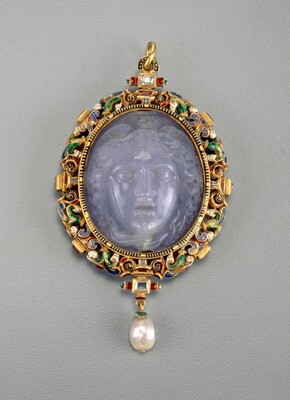
This is an ornate pendant with a carved face. The pendant features a central cameo with a face carved from a semi-transparent, milky blue stone. The face is of a woman, with an open mouth, wide eyes, and curling hair surrounding her face. The carved face is encased in a golden frame with colorful enamel work in blue, green, red, and gold. The pendant has a loop for hanging at the top and a pearl drop hanging from the bottom.

Pendant with the Head of Medusa

André, Alfred

The image shows a large woven horse collar or padded harness with a red textile adorned with patterns, beige leather straps, and a handle. The color palette includes red, beige, and hints of gold within the pattern. The harness is positioned in the center, with the red textile framing the top and sides, and the leather handle arching across the top edge, balanced by the straps and loops hanging down.

Shawl Strap

Halpin, Grace

The image shows a detailed drawing of a fish skeleton in a monochromatic color palette. The fish skeleton extends from the head to the tail, positioned diagonally across the image. Below the fish, there is text in Latin, and the artist's inscription "Pesce Cappone" is near the lower right of the fish's head.

Skeleton of a Gurnard

Liagno, Teodoro Filippo di

The painting depicts a mountainous landscape with a waterfall cascading down rugged rock formations. The horizon is obscured by towering trees and rocks. The brushstrokes are loose and expressive, with a watercolor technique merging colors. The color palette includes deep greens, browns, and hints of blues and ochres. A stream reflects the surroundings, with a small figure near the water. In the distance, trees blend into a hazy background.

Waterfall in the Dingle at Badger Hall

De Wint, Peter
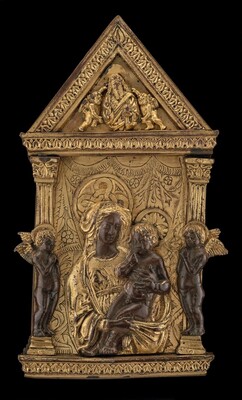
The sculpture shows a seated figure holding a child, surrounded by two smaller winged figures. The subject is central with a prominent position in the composition, flanked by columns. The sculpture is crafted in a gold color, possibly a metal like brass or gilded. The figure at the top of the triangular pediment appears to be holding a scroll, flanked by two small figures. The sculpture features detailed patterns etched into the background and framework, including repeated geometric designs and motifs. The expression and posture of the figures suggest a calm and composed arrangement.

Madonna and Child with Two Angels

Florentine 15th Century

The image displays a series of head and shoulder profile portraits of 12 different individuals. Each portrait is presented within a circular frame, with the person facing to the viewer's left. The individuals have distinct facial features and hairstyles typical of the late 18th to early 19th century. They wear formal clothing and no visible accessories. Below each portrait are handwritten labels likely indicating their names. The background has a simple design, with each portrait contained within its own section against a tan or sepia-toned backdrop, giving a historical or vintage appearance to the series of portrait illustrations.

Saint-Mémin Collection of Portraits, Group 32

Saint-Mémin, Charles B. J. Févret de

The image shows a man seated facing the camera. An apparatus holds his mouth open. His facial features include a pronounced brow, deep lines across his forehead, and a visible frown emphasized by the device. His hair is thinning and combed back, revealing more of his scalp. He wears a loosely fitted shirt with an open collar. Two other individuals are partially visible, wearing suits suggestive of a formal setting. One on either side of the man holds the device in place. The background is plain and slightly blurred with no noticeable details or objects.

Pain and despair

Duchenne (de Boulogne), Guillaume-Benjamin-Amant

Shown from the chest up, a light-skinned, cleanshaven man looks down and to our left in this vertical portrait painting. His shoulders angle slightly to the right, but he turns to look in the other direction with dark eyes under gathered brows. He has a prominent nose, a pointed chin, and his full lips are parted. His dark blond hair is parted down the middle and falls to both shoulders. His right arm, to our left, crosses his chest, and he holds a staff with that hand along the right side of the painting. He wears a tawny-brown coat with buttons down the front over a high white collar. The background is painted with shades of fawn and peanut brown. The artist signed and dated the painting along the center of the left edge in faint brown paint: “P. Soutman F.A. 1640.”

A Young Man Holding a Staff

Soutman, Pieter Claesz

The Triumph of Truth Over Envy

The Triumph of Truth Over Envy

Prestel, Maria Catharina

This is a photograph of a circular metallic object. The object features a golden circular medallion with a textured pattern of raised geometric and floral motifs. In the center, there is a small, circular inset with a stylized profile in shades of blue and turquoise against a deep blue background. The object's design suggests a blend of historical and artistic elements. The gold sections have an embossed look reminiscent of decorative craftsmanship, hinting at a ceremonial or symbolic purpose. The medallion's edge is finely scalloped and the background of the photograph is a deep, velvety shade of maroon.

Costume Ornament with Profile Portrait

North Italian 14th Century

The image features a rectangular arrangement of vertical lines in various colors, including red, brown, green, and yellow. The design resembles a woven textile or traditional rug with a vibrant and multicolored appearance.

Stair Carpet

Merkley, Arthur G.

The image shows two figures in full view. The person on the left is standing upright, holding a child in their arms. The person on the right is bent over slightly, facing the person on the left. Both individuals have halos around their heads. The figure on the left has a covered head, with mature facial features, a beard, and the child they are holding has curly hair. The figure on the right is wearing a hat, and their facial features are less discernible due to the position. The person on the left is draped in robes, and the child is also wrapped in cloth, while the person on the right appears to be wearing a garment with a checkered texture and decorative elements. The object next to the leaning figure resembles a crib or type of container with a radiating design above it. The background consists of a simple lined texture, implying an interior setting with no distinct features beyond the figures.

The Virgin and Child and Saint Anne

Altdorfer, Albrecht

This is a drawing of seated figures in an abstract scene. The central figure is seated, surrounded by other figures. The drawing uses pencil and light washes of red and brown. The main figure in the center is detailed, with a muscular torso and wearing a draped garment. There are at least four other figures with varying degrees of detail around the central figure. The drawing is enclosed in a roughly sketched oval boundary and contains swirling lines and shading.

Study of Jove and Three Goddesses

Bartolini, Lorenzo

The image shows a round bronze coin featuring a sculptural relief of a woman in profile, facing left. The woman is adorned with an intricately styled hairdo and wears a necklace with multiple strands. Her attire appears to be draped in classical fashion, with visible folds and texture depicted on the coin's surface. The sculpture is crafted from a material that gives a metallic sheen, typical of bronze, and the coin's surface shows variations in texture and patina. Around the edge of the coin, there is an inscription. The overall appearance of the coin reflects historical craftsmanship and artistry.

Faustina Romana [obverse]

Italian 16th Century

This is a drawing of a mythological scene with figures and cherubs. It features a central figure surrounded by several cherubs and mythological creatures within a dynamic composition. The cherubs are depicted with wings, bows, and arrows, floating in the sky amidst clouds. Below, a central figure stands poised amidst a turbulent group of mythological beings that include mermen and sea creatures. The style of the drawing is reminiscent of classical or Renaissance art, with detailed line work and a sense of movement captured in the figures' poses and drapery.

Psyches et Amoris ...; Galeriae Farnesianae ...; Barberinae avlae fornix

Various Artists

The image shows ancient stone columns in a clear, orderly line. The horizon is low, emphasizing the columns against the sky. In the distance, low buildings and a mountain range are visible. The image likely depicts a photograph of the stone columns, showing their texture and weathering. The color palette is monochromatic, giving an aged look. A person stands close to a column, providing scale, with others sitting on the grass nearby.

Temple of Minerva

Robertson, James

The image shows the upper half of a man's body in profile from the waist up. He has a prominent nose and slightly receding hairline, and his dark hair is combed back. He wears formal attire, including a dark coat, reddish-brown waistcoat, and white high-collared shirt. The background is a plain, muted reddish-brown color with an oval frame around the man, giving the image a classical portrait appearance with a simple, dark-colored border.

Wellington Van Reid

American 19th Century

The image shows a muscular figure preparing to shoot an arrow from a large bow. The landscape features trees and other figures or animals on what seems to be clouds in the top right corner. The style is precise with fine lines and detailed textures, resembling an engraving. The color palette consists of shades of black, gray, and the paper color for contrast. Cross-hatching is used for detail in trees and the figure's muscles.

Arcas Preparing to Kill His Mother

Baudous, Robert de

The sculpture is a ceramic dish featuring raised figures from the animal kingdom. At the center is a brown crocodile. Other figures include a coiled snake on the left and a moth on the right. Smaller figures like snails, shells, and leaves are scattered around the dish. The dish is predominantly blue with various colored figures that contrast against the blue background. The piece appears three-dimensional with vividly carved and colored creatures.

Rustic Plate with Crocodile, Snake, and Lizard

Palissy, Bernard

The image shows a detailed sketch of a metal object resembling a container with two protruding spouts, resting on a plate-like base with a handle. The color palette is monochromatic, using various shades of gray for highlights and shadows. The primary object is centered in the composition, with a smaller sketch of the same object in the top left corner.

Lamp

Riza, Janet

The image is an engraving. It features a portrait of a person viewed from the torso upwards, set within an ornate oval frame. The individual is positioned slightly angled to the left while facing the viewer. They have facial features including a mustache and wavy hair that reaches just below the ears. The person wears a dark garment with a high collar and may be draped with a robe or cloak. Surrounding the oval frame are elaborate carved embellishments, and a cherubic figure sits at the bottom right, looking upwards and holding decorative foliage. Beneath this figure, sailing ships are etched into the lower section of the carved frame. In the background, detailed engraving work embellishes the image with intricate patterns and shapes.

Algernon Percy, Earl of Northumberland

Houbraken, Jacobus

The image shows a drawing of a cylindrical stone structure from a slightly elevated angle. A stone plaque with inscriptions is placed against the side of the structure. The horizon is not visible, and the structure fills the frame significantly. The drawing features loose and expressive brushstrokes, creating texture on the stone and a sketch-like quality. The color palette is primarily monochromatic with shades of brown, giving an aged or antique look to the piece.

Tomb of Plautius

Breenbergh, Bartholomeus
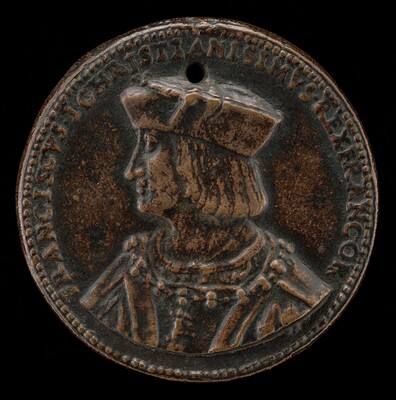
This is an image of an ancient coin or medallion. The object features a detailed profile relief of a regal figure facing left, wearing an elaborate crown or hat and a lavishly decorated robe adorned with patterns and possibly gemstones. Surrounding the figure is a border of text engraved along the edge of the coin. The surface of the medallion shows a patina, indicating age, and there is a small hole near the top. The craftsmanship and detail hint at its historical significance, likely commemorating a person of importance or serving as currency or a medallion during a specific period.

François I, 1494-1547, King of France 1515 [obverse]

Pomedelli, Giovanni Maria

This is a drawing of a dark, abstract composition with German text. The image features a woodcut-style illustration at the top with intricate shapes. Below the illustration, there is German text with the title "DIE MESSE" and a subtitle "(ALS MEINE SCHWESTER WEINTE)". The text consists of a poem or prose that evokes a somber and reflective mood. The text describes a scene involving candles, monks, and a sense of peace or tranquility amidst death or mourning.

Die Messe (The Mass) (headpiece, page 61) from Georg Heym: Umbra Vitae (Georg Heym: The Shadow of Life)

Kirchner, Ernst Ludwig

The image shows three men standing closely together in military uniforms. Each man holds a sword in their right hand, resting against their left shoulder. The man on the left has his left arm resting on the shoulder of the center figure. They all have mustaches and wear caps. The background is plain, with a curved arch at the top framing the photo.

M. Edward Rogers, Robert E. Randall, and Charles F. Lennig, First Troop Philadelphia City Cavalry

Broadbent, Samuel

An older woman wearing a long black dress sits reading a book in front of a younger woman wearing cream white, who sits on a couch just beyond, in this vertical portrait painting. The scene is loosely painted with some visible brushstrokes, especially in the furniture, clothing, and room. Both women have pale skin and wear dresses with long sleeves and skirts. To our right, the older woman sits in a chair with a curved back, which runs parallel to the right edge of the canvas. The full skirt of her black dress angles down across the picture, almost spanning the bottom edge of the composition. Her gray hair is pulled back and covered by a black cloth or veil, which falls to her shoulder and blends with her dress. The collar is lined with a white ruffle, and white lace cuffs encircle her wrists. Her face is painted with rosy tones. She looks down at her book with dark eyes, and her rose-pink lips are closed. She wears a gold ring with a light stone on her left ring finger, and the book she holds has a moss-green cover. Her skirt overlaps the younger woman sitting nearby on the couch, which runs along the back wall of the room. The young woman’s knees are angled to our left but she looks slightly back to our right, to gaze down and into the distance with brown eyes. Her skin is paler, but she has lightly flushed cheeks and her petal-pink lips are also closed. An azure-blue bow is tied in her chestnut-brown hair. A few tendrils fall down her back and over one shoulder. Her dress falls loosely over her torso and legs. She wears a gold ring on her left hand and a gold bracelet on that wrist. She fingers a piece of lapis-blue fabric in one hand. The couch behind her has a pattern with stylized flowers or leaves floating within rose-pink ribbons that hang in swags, against a white background. Pillows patterned with ruby red, sky blue, and fawn brown peek out from behind the young woman. A round or oval wooden table with curving legs to our left holds a glass vase with a violet-purple flower, perhaps a hydrangea. A slip of paper or envelope sits on the table next to the vase. The wall behind the couch is fog gray, and the bottom edge of a gold frame hangs behind the young woman.

The Mother and Sister of the Artist

Morisot, Berthe

The image shows an ornate building labeled "KUNSTHALLE." The structure has intricate architecture with columns, arches, and statues integrated into the facade. The brushstrokes are detailed, creating a precise depiction. The color palette is sepia. A cobblestone path leads to the entrance, with figures walking towards it. Trees with sparse foliage frame the sides. The background lacks detail, focusing on the building and its surroundings.

Kunsthalle

Stoltenberg, Fritz

This is a painting of a decorative ceramic plate. The plate features intricate designs with a central scene depicting three figures in traditional attire surrounded by floral and cloud motifs. The figures are colors such as blue, red, and green, set against a background of pine trees and swirling cloud patterns. The rim of the plate has a pattern of floral and scroll designs in red, green, and blue. The artwork blends traditional elements and decorative motifs.

Dish

Japanese 19th Century

The image displays a series of woven patterns with a complex arrangement of lines and rectangles in a symmetrical layout. The design consists of a lattice of squares and rectangles interspersed with small, repeating dots and dashes. These patterns create a sense of rhythm and movement across the surface, with densely filled areas resembling woven textiles or basket weaving. The overlapping frames present the patterns in a layered fashion, resembling the shifting panels of a quilt or patchwork blanket.

Woven Coverlet

Runyan, Manuel G.

The image displays multiple curving and interwoven lines, depicting an abstract composition reminiscent of human figures in motion. The central figures are elongated and posed dynamically, suggesting movement and fluidity. The lines create a scene that could evoke a group performing a coordinated dance or ritual. The figures emerge from a textured background, adding depth and complexity. Overlapping dark and light areas could be perceived as trees or a forest setting, providing context for the activity depicted.

By the Caliban

Davies, Arthur B.

The image depicts a person's upper body in a reclined position. The individual's face is in a side profile with closed eyes and a relaxed expression. The hair is loosely drawn to show texture and volume. The clothing is sketchily indicated with lines resembling textured fabric. The artwork has minimal details and a plain background of the same color as the paper, with no other objects present.

Mrs or Miss McNay

Whistler, James McNeill

The sculpture is a relief portrait on a medallion featuring a woman in profile facing left. She wears an elaborate headdress and the medallion appears to be made of a bronze or brass alloy. Surrounding the medallion is an inscription, “DIANA . DVX . VALENTINORVM . CLARISSIMA.” The craftsmanship shows intricate details in the headdress and the woman's facial features. The medallion appears slightly aged, with wear and patina consistent with its metallic composition.

Diane de Poitiers, 1499-1566, Wife of Louis de Breze, Duchess of Valentinois 1548 [obverse]

French 16th Century

This is a drawing of a printed page consisting of text and an illustration. The page features a decorative title detailing an event relating to Henry II, King of France, in the year 1549. Below the title and main text, there is a small woodcut illustration depicting a figure carrying a staff or spear, navigating through a landscape with trees in the background, and water possibly flowing at their feet. The text beneath this illustration mentions Paris and a bookseller named Jehan Dallier. The overall composition of the page reflects the style of 16th-century printed documents, characterized by its typography and engravings.

[Entrée d'Henri II] C'est l'ordre qui a este tenu a la nouvelle et ioyeuse entrée que tres hault, tresexcellent et trespuissant Prince le Roy treschrestien Henry deuzieme de ce nom à faicte en sa bonne ville et cité de Paris...

Goujon, Jean