← All styles

Volume

163 works

This is a photograph of a title page from a historical book. The page features the title "VOYAGE PITTORESQUE DE GENEVE A MILAN PAR LE SIMPLON." The text is printed in a classic serif font. There is an emblematic logo or monogram design beneath the main title text. The text "A PARIS" followed by "DE L’IMPRIMERIE DE P. DIDOT L’AINE" and "M. DCCCXI" indicates that the book was printed in Paris by P. Didot L'Ainé in the year 1811. The page shows some age-related spots or foxing. The overall aesthetic conveys a sense of historical documentation and elegance.

Voyage pittoresque de Genève à Milan par le Simplon

Lory, Gabriel Ludwig

Lapides Capitolini; Le Rovine dell Castello dell'Acqua Giula; Antichità di Cora

Lapides Capitolini; Le Rovine dell Castello dell'Acqua Giula; Antichità di Cora

Piranesi, Giovanni Battista

This is a photograph of a red textured surface. The image shows a close-up view of a material that has a consistent, even crimson color with a subtle grid-like pattern. This pattern is reminiscent of a leather-like texture, characterized by its small, interconnected lines and natural-looking grooves that give it a realistic, tactile appearance. The surface appears to be smooth and slightly glossy, reflecting the light subtly to highlight the pattern throughout. The edges of the surface are slightly rounded.

The Passion

Master S

The sculpture depicted on the book cover shows an owl perched on a tree branch, next to a coiled serpent. In the background, two flying birds are seen. The word "Ténèbres" at the top may suggest darkness. The color of the sculpture and book cover is predominantly brown with varying shades. The material appears to be leather, as indicated by the texture and pattern. The composition conveys a naturalistic scene with a rustic and somewhat mysterious visual impression due to the muted colors and intricate carving style.

Ténèbres (Darkness)

Redon, Odilon

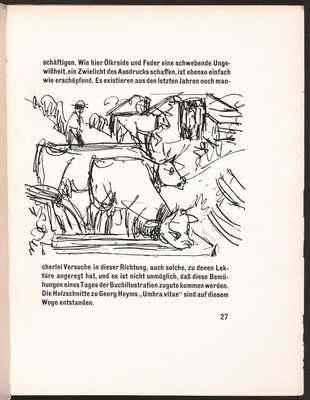
The image shows two cows and a man surrounded by rough sketch lines. There are two cows in the foreground, depicted with fluid lines suggesting movement. Above the cows are sketchy lines resembling barns or rural buildings, with a figure resembling a man nearby. The drawing is placed on a page with text above and below, creating an illustrative connection between the art and text.

In-text plate from Kirchner Zeichnungen (Kirchner Drawings)

Kirchner, Ernst Ludwig

The image displays a title page with the title "RECUEIL DE DIVERSES FABLES" and the name "GEORGE FOSSATI" written in large, centered text. Below, there is a small engraved illustration featuring a wolfish creature along with plants and rocks. The color scheme is monochromatic, consisting of black and white shades. The text is centrally aligned on the top half of the page, with the illustration placed closer to the lower half. Publication information is located at the bottom center of the page.

Raccolta di Varie Favole delineate ed incise in rame (Tome 4-6)

Fossati, Giorgio

This is a photograph of a closed, old hardcover book with a brown leather cover. The image shows the front cover of the book, bound in textured brown leather. The cover has a rich hue with dark speckles, indicating wear. The edges are slightly worn, suggesting usage. A sheet of yellowed paper is peeking out from the book. The image emphasizes the material qualities of the leather.

Universae Architecturae Civilis Elementa...; Materia Tentaminis Publici...

Rieger, Christian

This image shows fifteen round cameo-style portraits of individuals in profile from the side, focusing on their heads and shoulders. Each person appears to be seated and displaying distinct facial features and hairstyles typical of the late 18th or early 19th century. Most individuals are men wearing formal attire, including high collars, cravats, and in some cases, military uniform elements such as epaulettes. One woman is depicted wearing a headwrap with curly hair. The portraits are monochromatic and presented in a grid over a cardboard backing. The backgrounds in the portraits are plain or softly shaded, emphasizing the individuals depicted. The cardboard backing contains text, presumably identifying some of the individuals by names like "Comeagues" and "Tarleton Bates."

Saint-Mémin Collection of Portraits, Group 53

Saint-Mémin, Charles B. J. Févret de

The image is a collage of 12 black-and-white portrait engravings arranged in four rows. Each portrait depicts a different man's side profile. The individuals are shown from the head to the upper chest, with formal clothing. The hairstyles vary slightly, and the majority have short, neat hair. The background is a plain circle behind each portrait. Below each portrait, there are handwritten names of the individuals. The collage is set against a uniform beige background.

Saint-Mémin Collection of Portraits, Group 37

Saint-Mémin, Charles B. J. Févret de

The image shows a smooth surface with lines and shapes creating an abstract pattern. The surface has a mottled appearance with varying shades of brown blending together. There is a faint horizontal line across the middle.

Le Solenni Esequie di Monsignor Filippo Visconti Arcivescovo di Milano...

Cagnola, Luigi

The image shows a depiction of Christ on the cross, with his full body prominently displayed. He is nailed to the wooden cross with his arms outstretched, his head slightly tilted to one side, crowned with thorns. His facial features are solemn, with a beard and mustache, and his hair appears to be of medium length, dark in color. Christ is draped with a white cloth around his waist. Flanking him on either side are two individuals; on the left, a figure standing, clothed in a long robe with a hood, hands clasped together, and a subtle expression on her face. She has a halo around her head. On the right, another figure is wearing a green garment layered with a red cloak, holding a book, with one hand raised, gazing upwards. This person also has a halo and features long, curly hair. Both of these individuals stand on green grass, with the blue sky and the cross as the background, and there is Latin text beneath them.

Missal for Passau

Burgkmair I, Hans

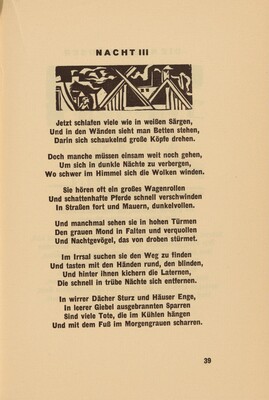
There is a rectangular abstract illustration at the top of the page. The image has bold, dark lines and shapes against a light background. The illustration depicts a cityscape with buildings and a sky filled with swirling cloud-like forms. Below the illustration, there is a block of centered text on the page. The title "NACHT III" is in bold capital letters, followed by a poem in German. The text is printed in a clear serif typeface, with the page number "39" at the bottom right corner.

Nacht III (Night III) (headpiece, page 39) from Georg Heym: Umbra Vitae (Georg Heym: The Shadow of Life)

Kirchner, Ernst Ludwig

This is a painting depicting a scene inside a rustic interior. The painting shows a group of individuals interacting in a lively manner within what seems to be a tavern or domestic setting. One figure is being embraced by another in colorful attire at the center, with other figures observing. The room features wooden beams, a large fireplace with pots and vessels, and a door leading to another space. Dynamic postures suggest movement and drama, with a dog sitting in the foreground. The style resembles Jean-Honoré Fragonard, showcasing baroque exuberance and detailed elements.

Histoire de Manon Lescaut (volume I)

Various Artists

The image features a series of jagged, angular lines and geometric shapes forming a complex pattern. The arrangement resembles human figures, with bold outlines hinting at heads, limbs, and torsos. The foreground includes a central figure with exaggerated facial features and wild hair, surrounded by other figures. The composition conveys a crowded scene with a sense of motion and interaction, similar to people gathered in a limited space.

Die Irren I (The Mad I) (headpiece, page 24) from Georg Heym: Umbra Vitae (Georg Heym: The Shadow of Life)

Kirchner, Ernst Ludwig

This is a painting of a book cover. The title "La Porte des Rêves" by "Marcel Schwob" is featured along with the year "1899" and the text "Imprimé pour les Bibliophiles-Indépendants." The background displays a pattern of flowers and leaves in teal and gold. The text is designed in artistic fonts. In the center, there's a stylized illustration of a face with flowing hair, integrated within geometric lines, reminiscent of the Art Nouveau style. The overall style is similar to Alphonse Mucha.

La Porte des Rêves

Feure, Georges de

The image displays a black-and-white illustration on the right page of an open book. It shows a person standing in profile facing to the left. The individual's facial features are lightly sketched, and their hair is covered by a large hat. The person wears a long, dark coat and stands on a path with abstract shapes in the background resembling trees or foliage edges. The scene has stark contrasts between light and dark areas and an atmospheric quality. The left page contains German text organized into paragraphs relating to the illustration.

Akaki trägt den Mantel das erstemal auf der Straße (Akaki Wears the Coat on the Street for the First Time) (plate 6) from Der Mantel (The Coat)

Gramatté, Walter
This is a photograph of a weathered leather book cover with a mottled pattern. The surface is rich, brown leather with dark, irregular spots scattered across it, giving it a worn, antique appearance. The spine of the book is visible on the left, showing faint vertical creases and a smaller section at the top with an embossed or pressed design. The book cover appears to have been well-used or designed to look aged, with distinctive leather grain and signs of wear. There is a small, white paper sticking out slightly from the top.

Les Cent Nouvelles Nouvelles

Hooghe, Romeyn de

This is a drawing of a title page for a book about ancient Rome. The title page showcases a collection of ancient Roman monuments, with an illustration of classical ruins, columns, and architectural fragments. The typography is elegant, with the title in uppercase letters. The page attributes the work to Monsieur Barbault, a painter, and former pensionnaire of the king in Rome, and references the publication location of Rome by Libraires François.

Les Plus Beaux Monuments de Rome Ancienne Ou Recueïl Des Plus Beaux Morceaux De L'Antiquité Romaine Qui Existent Encore: Dessinés Par Monsieur Barbault Peintre Ancien Pensionnaire Du Roy a Rome, Et Gravés en 128 Planches Avec Leur Explication.

Nolli, Carlo

This is a photograph of a book cover. The cover displays the title "ALBUM OF VIRGINIA" in gold embossing on a dark reddish-brown surface. Below the title, it reads "ILLUSTRATED BY ED. BEYER, 1858," in vertically stacked lines. At the bottom, it is marked "CORCORAN GALLERY OF ART." The cover features minimal wear with some scrapes and scuffs, with yellow-brown triangles on the right corners and a vertical yellow-brown stripe on the left edge.

Album of Virginia

Beyer, Edward

This print shows several people on a cobblestone street in a variety of dramatic poses, their arms outstretched in different directions. There is a woman in the center dressed in an elaborate gown, looking upward. She has pale skin and light hair, and she wears a necklace that looks like a strand of pearls. Behind her, people appear shocked, with a woman bending down and holding a cloth to her face, a man with one head on his hand and the other stretched forward, and another person kneeling on some stairs, their head on the ground. On the left, a man with medium-toned skin and a dark beard bows down towards the woman, his arms outstretched, holding a cloth. More shocked people are on the left, one of them wearing a mask over the top of their head. On the far right, someone stands on a ladder, posting a large sign on the wall. A person below looks toward them, their right arm raised up as if directing. In the bottom right corner, a child appears to carry a thin drum or similar object on a strap hung around their neck. The background includes more buildings on the cobblestone street under a light gray sky. People look out from second story windows in a building on the left, staring down at the scene on the street. Below the print are several lines of text.

L'oeuvre d'Antoine Watteau (volume II)

Various Artists

This is a drawing of a book cover for "Umbria Vitae" by Georg Heym. The cover features bold typography and a central woodcut illustration depicting two abstract figures with mountainous or cliff-like forms in the background. The lines are sharp and angular, typical of expressionist art. The illustration is attributed to Ernst Ludwig Kirchner. The drawing is bordered by simple lines and has handwritten inscriptions at the bottom, detailing information about the publication, including the publisher and year.

Titelvignette (title vignette) from mock-up of Georg Heym: Umbra Vitae (Georg Heym: Shadow of Life)

Kirchner, Ernst Ludwig

The image shows an intricately detailed stone plaque or monument off-center to the left, with inscribed text reading "Landschaften und Köpfe von LD." The scene includes dense foliage, stones, two figures near the monument, a winding path disappearing into trees, an ornate stone urn on a pedestal covered by leaves, and twisted trees on the left side. Brushstrokes are detailed, and the color palette is monochrome. Wispy clouds stretch across a clear sky in the background.

Landscapes and Heads

Hagedorn, Christian Ludwig von

This is a drawing of a decorative book title page. The title "LES GRACES" is centered within an ornate frame embellished with floral garlands. A quote from Horace, "Simplex munditiis," is below the title. Below the decorative border are two cherubic figures draped with flowers. The text includes publishing information, stating that the book was published in Paris by Laurent Prault in 1769. The border frames and unifies the content, enhancing the elegance and classical style of the piece.

Les Graces

Various Artists

This is a photograph of an ornate, vintage book cover. The cover is made of embossed leather, featuring a pattern of geometric shapes and floral motifs. The cover displays signs of aging and wear. A brass clasp is visible along the right edge. There is a paper label affixed to the upper part of the cover with faded writing. The cover is deep brown with hints of wear, revealing the texture typical of aged leather-bound books.

Spiegel des menschlichen Lebens

The Zamorensis Master

The image features a cover page design with a large flower-like illustration in muted green at the center. The text displays "ALEXANDRE DE RIQUER" and "CRISANTEMES" in red capital letters above the image, and "A. VERDAGUER RAMBLA DEL MIG BARCELONA" in red below. The color palette includes neutral beige with red and green accents. The illustration and text are centrally aligned on the page, with a decorative monogram at the bottom center.

Crisantemes (Chrysanthemums)

Riquer, Alexandre de

Sixteen engraved portraits are arranged in a 4x4 grid. Each portrait features a bust view of a man in profile, positioned to the side within circular frames. Only the heads and shoulders of the individuals are shown. The men are of mature age and have varied hair styles. The facial features are sharp, with prominent noses and chins. Each man is dressed in period clothing, with high-collared coats over waistcoats and white cravats or neck cloths. The portraits are labeled with names beneath each circle. The background is plain, focusing attention solely on each individual.

Saint-Mémin Collection of Portraits, Group 33

Saint-Mémin, Charles B. J. Févret de

The image shows a book cover titled "AMERICAN ARTIST LIFE." The cover is made of brown leather with embossed gold lettering that reads "AMERICAN ARTIST LIFE." It features an ornate gold decorative border design along its edges with a pattern of swirls and leaves. The spine appears slightly darker than the front cover. The design conveys elegance and historical significance, typical of older collectible books.

Book of the Artists. American Artist Life, Comprising Biographical and Critical Sketches of American Artists: Preceded by an Historical Account of the Rise and Progress of Art in America

Tuckerman, Henry Theodore

The image shows a series of abstract, thick black lines outlining human figures. On the left side, two figures are depicted in motion, with one figure raising their hands and the other stretching out an arm. On the right, two figures are seated with angular and abstracted limbs tucked closely around their bodies. The design features bold black lines framing the figures against a pink background, with a structure resembling a linked chain of stylized squares.

Vorsatz (back endpapers) from mock-up of Georg Heym: Umbra Vitae (Georg Heym: Shadow of Life)

Kirchner, Ernst Ludwig

This is a photograph of a brown leather book cover. The image captures a close-up view of a textured, brown surface that appears to be a leather cover. Signs of wear are visible, including slight scuffs and darker edges. The texture of the leather is evident, showing variations in tone and color.

The Temple Builder's Most Useful Companion being Fifty Entire New Original Designs for Pleasure and Recreation; Consisting of Plans, Elevations, and Sections, in the Greek, Roman and Gothic Taste

Overton, Thomas Collins

The image at the top of the page shows abstract interlocking geometric shapes and lines that resemble human faces. The shapes suggest a group of people with various expressions, arranged in a structured yet chaotic manner. The design is reminiscent of tribal masks or ancient carvings. Below the artwork, there is German text formatted in a structured layout, similar to a poem or song lyrics. The combination of the abstract image and text creates a juxtaposition of visual and literary elements.

Die Irren II (The Mad II) (headpiece, page 26) from Georg Heym: Umbra Vitae (Georg Heym: The Shadow of Life)

Kirchner, Ernst Ludwig
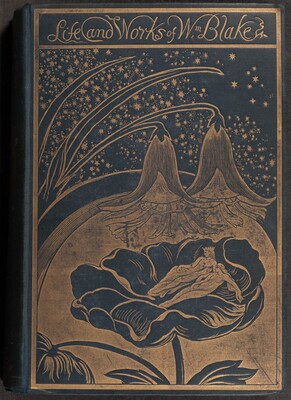
This is a drawing of a decorative book cover. It features intricate line work depicting a scene with two figures reclining within a large stylized flower, surrounded by foliage and stars. The flower has large petals that cradle the figures, who appear crowned and are lying with tranquility. Above them are two hanging bell-shaped flowers against a star-filled night sky. The title "Life and Works of Wm Blake" is inscribed at the top in flowing, ornate letters. The design uses a limited color palette.

Life of William Blake with Selections from His Poems and other Writings (volume II)

Gilchrist, Alexander

This is a photograph of a book cover. The cover is dark with elaborate gold decorations. A central ornate gold design forms an oval frame around the words "EXCURSIONS DAGUERRIENNES." The gold embellishments include scrolling floral motifs, curving filigree patterns, and a central crown-like emblem at the top of the oval. The left side of the binding shows signs of wear.

Excursions Daguerriennes / Vues et Monuments les plus Remarquables du Globe (Vol. 2)

Lerebours, Noël Marie

The image contains fifteen circular portrait silhouettes, arranged in a three-by-five grid. Each silhouette depicts a person in profile view with detailed facial features. The individuals are dressed in period-appropriate attire, with most facing left. Some have styled hair and two are women with formal updos. The portraits have a dark background and handwritten names below each. The grid is set against a plain, light-colored background.

Saint-Mémin Collection of Portraits, Group 42

Saint-Mémin, Charles B. J. Févret de

This is a black and white drawing featuring abstract figures surrounding geometric structures. The drawing is on a page with German text titled "DIE NEUEN HÄUSER." The abstract illustration on the page shows angular forms suggesting architectural elements and elongated figures interacting with each other. The drawing style uses heavy black lines and shapes to create contrast. The figures are in dynamic poses, implying movement or action in a simplified and distorted environment.

Die Neuen Häuser (The New Houses) (in-text plate) from mock-up of Georg Heym: Umbra Vitae (Georg Heym: Shadow of Life)

Kirchner, Ernst Ludwig

This is a drawing of a title page. The title is written in large, bold font across the top of the page, focusing on the city of Venice and its views in the works of Antoni Canal. Red and black inks emphasize different sections of the text, most of which is in Latin. Below the text, there is an ornamental embellishment with an elaborate illustration. The illustration includes a central figure, possibly an allegorical or classical figure, surrounded by a richly adorned frame with intricate scrollwork, shields, and symbolic elements. At the bottom, there are publication details and a red seal, indicating it is a publication from Venice dated MDCCXLII (1742).

Urbis Venetiarum Prospectus Celebriores, Ex Antonii Canal Tabulis XXXVIII. Aere Expressi ab Antonio Visentini in Partes Tres Distributi. Pars Prima [-Pars Tertia]

Visentini, Antonio

Insignium Rome Templorum Prospectus Exteriores Interioresque...; Disegni di Vari Altari e Cappelle Nelle Chiese Di Roma...

Insignium Rome Templorum Prospectus Exteriores Interioresque...; Disegni di Vari Altari e Cappelle Nelle Chiese Di Roma...

Rossi, Giovanni Giacomo de

Chad Gadya (The Tale of the Goat)

Chad Gadya (The Tale of the Goat)

Lissitzky, El

The sculpture includes two women standing on rectangular bases, both dressed in classical attire. They have one arm extended toward the center, interacting with decorative elements. These elements consist of two griffins facing each other on each side of an ornamental swirl at the top of the piece. The relief is displayed on a lintel or mantlepiece. The color scheme is monochromatic in shades of gray, resembling stone such as marble. The composition is symmetrical and balanced, with the figures mirroring each other for a sense of harmony and order.

A New Collection of Chimney Pieces, Ornamented to the Style of the Etruscan, Greek and Roman Architecture; Containing Thirty Six Designs suitable to the most Elegant Range of Apartments

Richardson, George

This is a drawing of an ornate decorative page. Detailed illustrations with a central coat of arms featuring an eagle in a heraldic pose under a wide-brimmed clerical hat are included. Latin text is at the top in a serif typeface. The borders are decorated with intricate patterns of vine-like motifs, stylized floral designs, and baroque faces surrounding the central content. Ink annotations are visible within the illustration. The design is likely from a historical manuscript or book, showcasing craftsmanship and elegance typical of religious or formal publications from previous centuries.

Decachordum Christianum

Vigerius, Marcus

This is a drawing of a title page for a book or poem titled "Les Saisons, Poëme". The image features an ornate layout with the title and additional text in French. Below the main title, there is a quote attributed to Wieland. It indicates that this is the seventh edition, published in Amsterdam in 1775. The central decorative element is an intricate vignette featuring a lyre surrounded by foliage and flowers. The overall aesthetic is elegant and refined, reflecting the artistic styles of the era.

Les Saisons: poëme

Saint-Lambert, Jean-François de

This is a black and white drawing of an expressionistic scene with a group of individuals and a piece of text. The illustration shows figures in a style similar to woodcut prints, with strong angular lines and sharp contrasts. The scene features abstracted figures, some with raised hands, depicted in a dramatic and stylized manner. The text "DIE TAUBEN II" is present above the image, and below the artwork, there is an excerpt of German text. The composition conveys an introspective or solemn tone typical of expressionist art, emphasizing emotion and the human condition.

Die Tauben II (The Deaf II) (headpiece, page 46) from Georg Heym: Umbra Vitae (Georg Heym: The Shadow of Life)

Kirchner, Ernst Ludwig

The image features two illustrations. The top illustration shows a detailed architectural drawing of a stone block with labeled sections and parts marked with letters. The perspective is from a slight angle, emphasizing the three-dimensional aspect and showcasing architectural elements like channels and holes. The drawing style is technical and precise, with clean, deliberate lines defining the structure. The bottom illustration depicts an ancient ruin, potentially part of a coliseum or amphitheater. The perspective is from a low vantage point, looking up towards the structure. A series of arches guide the eye towards a tall tower in the middle, with additional buildings and vegetation in the background. The brushstrokes are expressive, creating a textured, cross-hatching effect to indicate the aged and overgrown nature of the ruins. The color palette is monochromatic, using contrasts of light and dark to convey depth and detail, similar to etchings or engravings.

Le Antichità Romane (volume I)

Piranesi, Giovanni Battista

Antiquites de la Grande-Grece (volume I)

Antiquites de la Grande-Grece (volume I)

Piranesi, Francesco

This image features classical imagery and text. The upper section shows a winged figure intertwined with a swan in a rectangular border. The name "HOMER" is displayed below, surrounded by a decorative border of repeated swan motifs. A seated figure reading or reflecting is depicted further down, integrated with a large initial "H" and accompanied by text in German praising Homer and his literary significance. The layout and decorative elements are in a neoclassical style, emphasizing symmetry and classical themes.

Homer Nach Antiken Gezeichnet

Tischbein, Johann Heinrich Wilhelm

This is a title page of an illustrated book or series entitled "Harvey's Scenes of the Primitive Forest of America, at the four periods of the year, Spring, Summer, Autumn & Winter, Engraved from his Original Paintings, Accompanied with Descriptive Letter-Press." The page states that the book was published according to an act of Congress in the year 1841 by G. Harvey and printed by Charles Vinten in New York. The page shows signs of aging, with visible spots and slight discoloration typical of aged paper.

Harvey's Scenes of the Primitive Forest

Bennett, William James

The image displays eight individual engravings arranged symmetrically on a single page. The top left engraving shows a City Tavern, a large two-story building with classical architectural features. To the right is a central vignette of a landscape with intricate foliage framing an empty center and a small stone bridge below. The top right engraving depicts a market scene with several buildings and a prominent arched structure in the center. In the middle left is an engraving labeled "Court-house" featuring a grand building with a detailed cupola set in a pastoral scene. The central engraving is a circular portrait of a woman and child. The middle right displays an architectural image labeled "Church" with a neoclassical building, columns, and surrounding structures under a cloudy sky. The bottom left engraving shows a smaller building with high boundary walls. Below, a colored landscape, labeled "Vue de Ticonderoga sur le Lac Champlain," illustrates a serene scene of a lake and hills with vibrant foliage. At the bottom right is a landscape with trees on the horizon and gently sloping hills in black and white with fine linework. The engravings are primarily monochromatic, except for the colored landscape which features greens, blues, and earth tones.

Saint-Mémin Collection, Group 57

Saint-Mémin, Charles B. J. Févret de

The image is a grid of fifteen small portrait illustrations. Each portrait features a man in profile facing left. The men have distinct features and wear formal attire typical of the late 18th to early 19th century. A handwritten name is beneath each portrait. The background is a plain neutral tone.

Saint-Mémin Collection of Portraits, Group 28

Saint-Mémin, Charles B. J. Févret de

The image shows the cover of a book. The cover is a dark brown fabric with distressed black spine and corner edges. Printed in gold lettering, it reads "Prang's Progressive Proofs, Collection William T. Walters, 1895." The book appears aged with signs of wear, especially along the edges and corners, indicating long term use or storage.

Prang's Progressive Proofs

Prang, Louis

This is a photograph of an antique leather-bound book. The cover features a worn brown leather exterior with an embossed rectangle and diamond pattern in lighter brown hues. The design includes delicate decorative dots and filigree at the corners of the rectangular border. The spine of the book is visible on the left, exhibiting slightly raised bands. The overall condition suggests age, with visible scratches and wear.

Kupfer-Bibel, volume I

Scheuchzer, Johann Jacob

This muted, celestial blue, wide book cover has gold text and a drawn illustration of marshlands and sailboats. The text is oriented at an angle between the lower left and upper right corners. It reads, “Life and Landscape on the NORFOLK BROADS BY P.H. EMERSON and T.F. GOODALL.” In dark brown, cattails rise along the left edge, near the book’s tan-colored spine, and two boats sail away from us toward a harbor town to the right. The spine and cover are worn and scuffed, and there are a few stains.

Life and Landscape on the Norfolk Broads

Goodall, T.F.

This is a drawing of an architectural frontispiece with decorative elements. The image shows an intricately detailed architectural frame with columns, arches, a banner in the center with an inscription, and a coat of arms featuring an eagle's head and angelic figures. The architectural details include columns with decorative embellishments and drapery revealing the central banner. The focus is on architectural ornamentation and heraldic symbols.

Freggi Dell'Architettura

Mitelli, Agostino

This is a drawing of an ornate decorative page dedicated to Elisabetta Petrowna, the Empress of all Russias. The page features a sonnet beneath the title, embellished with detailed illustrations. Cherubs hold a draped fabric at the top center, with the left and right borders adorned with scrolls and floral motifs. At the bottom left, there is a depiction of an angelic figure seated with a trumpet, looking upward. Another cherub rests on ornate scrollwork at the bottom right, near an Italian inscription. The artistry of the page displays a blend of baroque ornamental elements, emphasizing luxury and grandeur in its classical design.

La Divina Commedia

Dante Alighieri

The image contains bold, angular lines and shapes creating an abstract winter landscape. A fragmented face appears on the left within undulating forms resembling trees or branches. The right side displays structures with slanting rooflines, possibly representing houses or sheds adorned with snow-like textures. The abstract elements evoke a winter scene, with the face suggesting indoor observation.

Der Winter (The Winter) (headpiece, page 37) from Georg Heym: Umbra Vitae (Georg Heym: The Shadow of Life)

Kirchner, Ernst Ludwig

This is a drawing of an abstract scene along with text. The image contains a black and white illustration above a poem or text titled "Der Krieg." The drawing features an abstract arrangement of figures and forms blending into one another, with dynamic elements suggesting movement. Below the illustration, the text is laid out in stanzas and is in German. The composition likely aims to evoke themes related to conflict, upheaval, or internal struggles. The use of black and white enhances the stark nature of the themes presented.

Der Krieg (The War) (headpiece, page 3) from Georg Heym: Umbra Vitae (Georg Heym: Shadow of Life)

Kirchner, Ernst Ludwig

The image is a title page from a book, consisting of text at the top and bottom. In the center, there is an illustration within a rectangle, showing a scene from a slightly elevated side view. The horizon is depicted above the middle of the rectangle, featuring a cityscape with towers and domes. A tall tower stands prominently on the horizon. The illustration includes a wolf or dog-like animal facing left, with its head slightly turned towards the right. The style of the brushstrokes is reminiscent of classic etching, with fine lines detailing the animal's fur and surrounding foliage. The color palette is monochrome, with different intensities of black and white creating contrast and detail, giving the image a vintage appearance.

Bertoldo con Bertoldino e Cacasenno

Mattioli, Ludovico

This is a photograph of a historical document titled "CARTE PHOTOGRAPHIQUE ET SYSTÉMATIQUE DE LA LUNE." The document cover is aged and has finely textured paper with a black binding on the left edge. It includes the author's name, "C. LE MORVAN," and the description "ASTRONOME ADJOINT A L'OBSERVATOIRE DE PARIS." The title describes a photographic and systematic map of the moon. Below the author's name, the document mentions "IMAGES DIRECTES" and "SIX PLANCHES EN HÉLIOGRAVURE." It also includes the year "MDCDXXVI" (1926) and the location "PARIS" at the bottom. The document shows signs of wear with paper deterioration on the edges and a tear in the bottom region.

Carte photographique et systématique de la lune (Photographic and Systematic Chart of the Moon)

Le Morvan, Charles

The image depicts sixteen circular portraits of historical figures arranged in rows and columns. Each portrait shows a head-and-shoulders view of the subjects in profile, facing left or right. The subjects are depicted with detailed facial features, expressions, and hairstyles indicative of different historical periods. The men typically have styled, powdered wigs or tied back hair, while the women have coiffed hairstyles, some adorned with hats or ribbons. They are dressed in period-appropriate clothing like high-collared jackets and elaborate dresses. The portraits have plain backgrounds, and names are written underneath each image for identification. The overall presentation is organized and harmonious.

Saint-Mémin Collection of Portraits, Group 1

Saint-Mémin, Charles B. J. Févret de

The image shows an open book with an artwork on the right page and faint text on the left page. The artwork is a black and white print depicting a group of figures walking down a tunnel-like structure with curved walls. One figure in the foreground has large eyes and a cap. The figures are mostly in silhouette, with minimal details. The clothing is dark, blending with the scene's shadowy atmosphere. The background suggests depth with lighter tones continuing the tunnel. The signature "Kollwitz" is seen at the bottom of the artwork. The setting conveys a solemn procession.

Der Morgenweg zum Amt (The Morning Route to the Agency) (plate 1) from Der Mantel (The Coat)

Gramatté, Walter

This is a photograph of a book cover. The cover is designed with intricate gold embellishments on a dark brown leather background. It features a central oval design with a regal emblem of fleurs-de-lis and a crown. Surrounding the central motif are symmetrical patterns with scrollwork and floral elements in gold. The corners and borders are adorned with circular and linear motifs. The use of gold contrasts against the dark material, highlighting the detailed craftsmanship.

Album of Portraits of Queen Marie-Antoinette

Various Artists

The image shows abstract shapes and lines forming two distinct clusters against a monochromatic background. On the left, there are angular, abstract faces resembling caricature-like facial expressions. On the right, there are elongated, linear figures suggesting human forms in motion. Both clusters are enclosed within rounded edges and separated by a horizontal division. Handwritten text is present at the top and bottom of the page.

Vorsatz (front endpapers) from mock-up of Georg Heym: Umbra Vitae (Georg Heym: Shadow of Life)

Kirchner, Ernst Ludwig

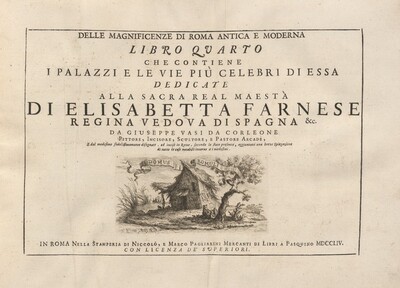
This is a drawing of an ornate title page. The image features a detailed and elaborately designed title page with a classic font, announcing the seventh book in a series about the magnificence of ancient and modern Rome, focusing on convents and the houses of clerics. The piece is dedicated to Carlo Vittorio Amadeo delle Lanze and created by Giuseppe Vasi. At the bottom of the page, there is a small illustration depicting an outdoor scene with people among architectural ruins, featuring large columns surrounded by trees and greenery. The text indicates the book was printed in Rome in 1756.

Delle Magnificenze di Roma Antica e Moderna (vol. 3)

Vasi, Giuseppe

This is a drawing of a village scene with houses and foliage. The artwork is executed in a bold, woodcut style and features several small, peaked-roof houses nestled among abstracted trees and foliage. There is a figure with a pointed head and intricate patterns in the surroundings. The drawing is surrounded by text in German. The monochromatic, high-contrast technique is typical of woodblock prints.

Spitzköpfig Kommt Er... (With a Pointed Head He Rises) (headpiece, page 13) from Georg Heym: Umbra Vitae (Georg Heym: The Shadow of Life)

Kirchner, Ernst Ludwig

The image displays abstract bold angular shapes and intersecting lines in black at the bottom of a text-filled page. The forms suggest movement and overlap, resembling silhouettes of people and flames. Within the design, figures engaged in action can be recognized, suggesting a scene of activity or commotion. The solid black and sharp contrasts lend depth and complexity to the composition.

Der Krieg (The War) (in-text plate) from mock-up of Georg Heym: Umbra Vitae (Georg Heym: Shadow of Life)

Kirchner, Ernst Ludwig

This image shows a worn, textured book cover. The cover is a rich brown color with a leathery appearance, displaying signs of age and use through its worn edges and slight scuff marks. The surface has lighter spots indicating abrasions or scratches. The spine of the book is on the left side and appears more worn than the rest of the cover, indicating age and handling.

Romanae Magnitudinis Monumenta Quae Urbem Illam Orbis Dominam Velut Redivivam Exhibent Posteritati Veterum Recentiorumque Quotquat Hac de Re Scripserunt Authoritate Probata Quibus Suffragantur Numismata e Musea Principum Praesertim Fragmenta Marmorea Farnesiana Continent Restituta et Aucta

Lauri, Giacomo

An Album of Prints of the Roman Festival of the Chinea

An Album of Prints of the Roman Festival of the Chinea

Various Artists

The image shows an open book with an illustration on the right page and text in German on the left page. The left page has a block of printed text in German. The right page features a monochromatic illustration of two claw-like hands reaching out against a dark, textured background. The hands are detailed with sharp edges and exaggerated features, set against abstract forms creating a shadowy atmosphere. The book has a red spine with the page number 24 visible at the bottom of the left page.

Zwei gespenstische Hände greifen nach etwas (Two Ghostly Hands Grasp for Something) (plate 8) from Der Mantel (The Coat)

Gramatté, Walter

The image shows a figure sitting in an angled chair. Their body is partially visible from the chest down to the knees, with hands on their lap. The person has abstract facial features with sharp, angular lines, and short hair. They wear a dark outfit with a collar or scarf around the neck. Around them are abstracted elements of a room, including a wall with a framed picture and three plant-like forms on a shelf. There is a table nearby with an unknown object. The background features a linear style with dark lines and shadows.

plate 1 in Alfred Döblin: Das Stiftsfräulein und der Tod (Alfred Döblin: The Canoness and Death)

Kirchner, Ernst Ludwig

This is a photograph of a vintage book cover. The cover is titled "Union Pacific Railroad Photographical Illustrations" in gold lettering, set against a brown background. The cover shows signs of age with worn edges and faded areas. The binding is leather and there are highlights of wear. The text is centrally aligned.

The Great West Illustrated in a Series of Photographic Views Across the Continent

Russell, Andrew Joseph

The image displays swirling circular patterns on the surface, intertwined with organic shapes. The design resembles a marbled effect or grainy patterns in polished wood. The spirals and shapes resemble whirlpools or eddies in water. Warm brown tones with touches of deep blue and ochre enhance the natural feel of the composition.

Atlas des Environs de Paris

Delagrive, Jean

This is a richly textured reddish-brown book cover with gold embossed text. The title "DANTE" is displayed prominently in the center, with "FLAXMAN" below it. The border of the cover includes a simple gold outline. The spine of the book, visible on the left edge, has ornate ridges and shows signs of wear. The other edges appear similarly worn.

Album of Drawings for Dante's "Divine Comedy"

Flaxman, John

This print shows a person seated in a round border. They are leaning slightly forward with their arms resting on their lap, where they appear to hold a stack of paper and a long stylus. The person has pale skin and wavy hair in an updo adorned with a leafy crown. They have dark eyebrows, a small nose, and thin lips in a slight smile. They wear a flowing off-the-shoulder dress cinched at the waist with a red sash. The background features intricate patterns in rings, including illustrations of foliage and geometric shapes in blue, yellow, and green against a brown background. Surrounding the central print, text reads "ANATOLE FRANCE," "CLIO," and “ILLUSTRATIONS DE MUCHA"" against beige paper, with a few more lines of text at the bottom."

Clio

Mucha, Alphonse Marie

This is a drawing of an ornate entomological illustration centered around a flea. The central subject features a flea with a segmented body, legs, and antennae, placed within a diamond-shaped frame. Encasing this central diamond is an elaborate border of floral motifs and acanthus-like leaves, with stylized human-like faces at the corners. The artwork is in sepia tone, giving it a vintage appearance. The design is symmetrical.

Meister Floh. Ein Marchen in sieben Abentheuern zweier Freunde (Master Flea: A Fairy-Tale in Seven Adventures of Two Friends

Thiele, Karl Friedrich

This appears to be a rectangular book with a landscape orientation. The cover is black with a textured pattern of swirling designs. In the center of the cover is the word "ALBUM" in capital letters, embossed in gold. The letters have decorative serifs. The edges of the book appear worn.

Sketchbook

Gonzalès, Eva

Printed in black on now-darkened paper, lines of text are above and below an illustration showing three winged, nude children gesturing toward a balding older, bearded man near the center. The older man sits on a throne to the right and leans forward, one hand braced on the sphinx-shaped arm of the chair and the other pointing toward a stick one of the children holds. One of the man’s eyes is open wide, and the other appears to be closed. The man is barefoot and wears voluminous, flowing robes. The children all have short, curly hair and muscular bodies. Drapery flits to cross the groin of the child closest to us and the back side of another. They all reach at least one hand forward toward the man. The front child holds up the stick and looks over his shoulder at us. The room behind them has a door opening into a cavernous space with arched vaults. The corner of the paneled room beyond the older man has shelves and a ledge with books and globes. The page is numbered 151 in the top right corner. Text above the image reads, in all caps: “Francisci Agvilonii e Societate Iesv Opticorvm Liber Tertivs de Commvnivm Obiectorvm Cognitione.” The block of text under the image is titled “Argvmentvm” in all caps. Text continues, in italics mixed case: “Natvræ simul ac doctrinæ ordo exposcit, vt definite visus essential, præcipua’que eius affectione, quæ ad visionis modum opticorum’que radiorum traductionem pertinent, explicate, ad communium visibilium cognitionem veniamus. Hæc enim per se quidem, at non primò, vt et quæ propria dicuntur, sub aspectum cadunt. Nam lux et color simplici obtutu; hæc verò aut collatione, aut distinction, aut antecedente notione, aut syllogism, aut alia demum ratione, quam internus sensus variam ac multiplicem administrat, cognoscuntur. Quod sane ex eo prouenire videtur, quòd hæc non propriè ad visus facultatem attineant, sed aliis quoque sensibus sese ingerant: vnde N4 non”

Opticorum Libri Sex

Galle, Theodor

This is a drawing of a book cover for "La Derniere Héloïse." The cover features decorative typography and an illustrated oval scene framed with ornate detailing. The scene shows two figures in an interior space with tall columns and arched architecture. One figure is seated and the other standing, engaged in an interaction. The seated figure appears relaxed, leaning against the back of a chair or couch. The illustration reflects 18th-century style with detailed and elegant features, including clothing and architecture. Text on the cover includes the title, author, and publication details, showing it was published in Paris in 1784. The color scheme consists of sepia tones.

La Dernière Héloïse: ou, Lettres de Junie (Part I and Part II)

Dauphin, de Verdun

There is an open book in the image, with text on both pages. The left page has "TABLE DES MATIERES" as a heading, with a floral illustration at the bottom. The color palette is mainly beige and cream, with the text and illustration in dark tones. The text is organized in columns on the left page, with "FIN" and a floral basket illustration at the bottom. The right page continues the text in a similar layout.

Les Quatre Livres De l'Architecture D'André Palladio. Mis en François. Dans lesquels, aprés un petit Traitté des cing Ordres, avec quelques- vues des plus necéssaires observations pour bien bastir, Il parle de la contructions des maisons particulieres, des grands chemins, des Ponts, des Places publiques, des Xystes, des Basiliques, & des Temples

Fréart, Sieur de Chambray, Roland

The image depicts a page with an illustration of an ancient-style profile portrait medallion, featuring the bust and head of a person with defined facial features facing left. The person has a nose, cheekbones, and chin, with hair styled in a classical Greek fashion, tied with a band. Above the portrait, the text "Le Avventure di SAFFO" is inscribed in a decorative font. Below the medallion, there are lines of smaller text in Italian. The background has an aged paper texture with scattered spots. The location is listed as "ROMA," and the date is in Roman numerals "MDCCLXXVIII," which translates to 1784.

Le Avventure di Saffo (The Adventures of Sappho)

Tresham, Henry

The image consists of monochromatic portrait engravings showing the head and shoulders of various individuals. The individuals are in profile, facing either left or right. Their faces have prominent noses, chins, and facial hair typical of the 18th or early 19th century. The portraits display distinct hairstyles or wigs common for the period, often powdered or tied into queues. The subjects wear formal attire with high-collared coats and cravats or neckties. No additional jewelry or objects are present. The portraits have a dark circle background against a plain archival paper backdrop. Some portraits have handwritten names like "Elias Boudinot" and "Aaron Burr" below them.

Saint-Mémin Collection of Portraits, Group 54

Saint-Mémin, Charles B. J. Févret de

This is a drawing of an ornate book page. The page is the title page of a biographical work about Michelangelo Buonarroti, written by Giorgio Vasari. The page's layout is centered with the title "VITA DEL GRAN MICHELAGNOLO BUONARROTI" prominently displayed. An intricate decorative border frames the page, featuring illustrations of cherubic figures on either side, with ornate scrollwork and a coat of arms at the top. Below, there is a small depiction of a cityscape labeled "IN FIORENZA." The text and imagery are printed in a classic typographic style, typical of the Renaissance period, with additional information about the text being produced by "Nella Stamperia de' Giunti 1568."

Vita de' gran Michelagnolo Buonarroti

Vasari, Giorgio

The image displays a block of text in a serif typeface, with evenly spaced lines and justified alignment. Below the text is an abstract black and white illustration portraying a cluster of angular shapes and lines that suggest human faces and figures. The abstract forms resemble a crowd or a group of people, with some elements hinting at eyes, noses, and mouths amidst swirling lines. The figures appear intertwined, conveying a sense of movement or congregation.

Die Morgue (The Morgue) (in-text plate) from mock-up of Georg Heym: Umbra Vitae (Georg Heym: Shadow of Life)

Kirchner, Ernst Ludwig

The image depicts complex shapes and lines on a red background. The shapes resemble human figures in different poses - two standing and two sitting, enclosed in rectangular outlines. The figures appear stylized with emphasis on form. Black shapes interconnect, creating a puzzle-like composition where the figures interact within outlined spaces.

Vorsatz (back endpapers) from Georg Heym: Umbra Vitae (Georg Heym: The Shadow of Life)

Kirchner, Ernst Ludwig

This is a print depicting various people on a stage, casting dramatic shadows on the walls. In the bottom left corner, the dark silhouettes of people watch the stage, which stretches diagonally across the scene. A thin arched pole hangs down on the stage, under which three people are gathered, two standing and one sitting, working with a hammer. On the left of the stage are three people dancing together, one person in the center with horns in mid-step, and a person on the right standing next to a goat. There are also two winged cherubs hanging from strings above the dancing figures. The shadows of these people are projected onto the wall or screen behind them, and the shadows of the three people under the arch are massive, taking up most of the print. The backdrop features faint outlines of vegetation, clouds, and a coat of arms. On the right edge, several people peek out from behind the backdrop.

Inleyding tot de Hooge Schoole der Schilderkonst (Introduction to the Noble School of Painting)

Hoogstraten, Samuel van

The image features angular lines and bold black shapes forming an abstract design. On the left side, there is a block of text with a striking font amidst fluid shapes on the right. The abstract lines on the right suggest elongated figures or flowing fabric. The design merges text with fluid forms, combining the appearance of a book cover or a poster with abstract expression.

title page for Alfred Döblin: Das Stiftsfräulein und der Tod (Alfred Döblin: The Canoness and Death)

Kirchner, Ernst Ludwig

This is a drawing of the facade of a theater building. The image shows a detailed architectural illustration of a building with classical elements such as arches and columns, featuring two levels of evenly spaced windows with decorative pediments above each. The Italian text around the drawing indicates that this is the design or plan of a "new theater" in Bologna, dedicated to Count Girolamo Legnani by Lorenzo Capponi. The typography and style of the text reflect a formal and historical presentation, possibly indicative of an 18th-century document.

Pianta e spaccato del nuovo teatro di Bologna

Capponi

The image shows a page from a book with text in German above a black and white illustration. The illustration is located towards the bottom of the page, just above the page number 18. It depicts a stylized landscape or scene with arched structures resembling domes or arches at the center, surrounded by foliage or trees. The bold and rough brushstrokes or carving technique create contrasts and a sense of movement. The color palette is monochromatic, with black ink on a cream-colored page. The horizon is not defined, but the composition directs the focus towards the central arch formations, emphasizing depth and structure. There are no visible elements in the distance or background, as the composition concentrates on the central elements.

Mond (Moon) (in-text plate) from mock-up of Georg Heym: Umbra Vitae (Georg Heym: Shadow of Life)

Kirchner, Ernst Ludwig

De plurimis claris selectisque Mulieribus

De plurimis claris selectisque Mulieribus

Italian 15th Century

The image depicts a detailed architectural view from an elevated position, showcasing a grand basilica and its surrounding structures. The horizon is above the clustered buildings, highlighting the facades and the sky with clouds. The architectural style is characterized by intricate line work, with classical columns and statues on the facade. The color palette includes shades of black, white, and grey. People are gathered on the left, with a path leading to the centrally positioned basilica. In the distance, there are more classical buildings or ruins.

Les Plus Beaux Edifices de Rome Moderne...

Montagu, Domenico

This is a drawing of a figure with an animal-like mask in a dark outfit holding objects. The image is on the right page of an open book, with German text on the left page. The drawing is done in a monochromatic style, primarily using dark shades against a lighter background, suggesting a chaotic or urban environment with rough textures and a sense of movement. The figure's stance and the composition contribute to an unsettling atmosphere.

Akaki geht ratlos auf der Straße (Akaki Walks Helplessly on the Street) (plate 4) from Der Mantel (The Coat)

Gramatté, Walter
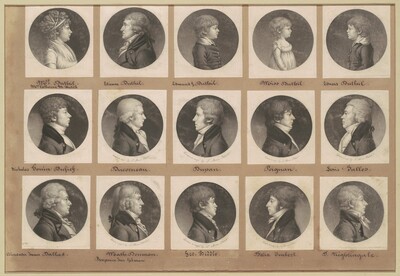
The image shows 12 engraved profiles displayed in a grid layout. Each profile depicts the upper body of a person, from head to shoulders, facing mostly to the side. The individuals wear late 18th to early 19th-century attire, with varying hairstyles and clothing styles. Men have a range of hairstyles, from short to tied back, without visible facial hair, wearing open jackets with high collars and cravats. Women have decorated hairstyles and some show their necks and upper garments, with one wearing a shoulderless dress. There is no jewelry or objects visible in the portraits. Each portrait is set in a circular vignette on a monochrome background, with handwritten names underneath. The grid layout has a historic aesthetic with sepia-toned coloration.

Saint-Mémin Collection of Portraits, Group 19

Saint-Mémin, Charles B. J. Févret de

This is a drawing of an abstract coastal cityscape. The drawing shows stylized cityscape with contrasts in black and white, likely done through a woodcut print technique. The image depicts abstract architectural forms: domes, arches, and steps spiraling upwards. Clouds or waves fill the sky. Beneath the drawing, text in German describes poetic imagery associated with the sea and city.

Die Meerstädte (The Sea Cities) (headpiece, page 20) from Georg Heym: Umbra Vitae (Georg Heym: The Shadow of Life)

Kirchner, Ernst Ludwig
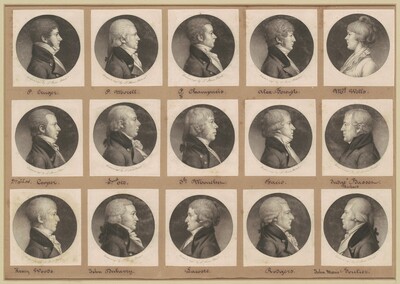
Fifteen portrait drawings are arranged in a grid, each showing the upper body of an individual in profile. The people are positioned facing either left or right within circular frames. Each portrait captures the side view of the person's face, highlighting their distinct facial features and hairstyles. The men have various hairstyles typical of an earlier era, some with short hair, some with curls, and others with powdered wigs. There is one woman portrayed in the top right with her hair styled in an updo. They all wear formal clothing; the men in high-collared coats and cravats, and the woman in a high-necked garment with a shawl. The background of each portrait is plain. The images are bordered by a brown matte, and each portrait has the individual's name handwritten beneath it.

Saint-Mémin Collection of Portraits, Group 21

Saint-Mémin, Charles B. J. Févret de
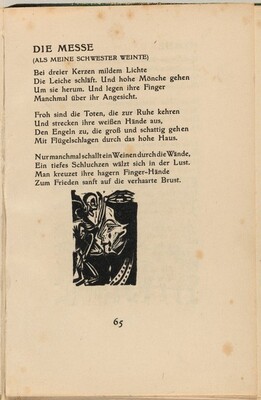
On the page, a bold abstract shape is positioned beneath a block of text. This dark, jagged shape consists of angular lines and contrasting areas of black and white, forming a pattern. The flowing, curved lines within the shape could be seen as stylized facial features or draped fabric. This form creates an organic contrast to the rectangular, orderly text above it.

Die Messe (The Mass) (in-text plate) from mock-up of Georg Heym: Umbra Vitae (Georg Heym: Shadow of Life)

Kirchner, Ernst Ludwig

The image shows a drawing of a man leaning over a table, engrossed in writing. He has a furrowed brow and his hands are on a piece of paper. The setting is a simple workspace with the man in focus and a dark background behind him.

Der Titularrat Akaki Akaki-jewitsch (The Titular Council Akaki Akakiyevich) (plate 2) from Der Mantel (The Coat)

Gramatté, Walter

The image depicts an abstract black and white illustration with dynamic lines and shapes. At the top, there is a block of solid, dark lines and angular forms. In the middle, abstracted human and animal forms can be seen. The overall composition evokes a woodland scene with elements that suggest intertwined flora and fauna. Below the illustration, there is text printed in German and the numbering 35 is noted at the bottom right corner.

Der Sterbende Faun (The Dying Faun) (headpiece, page 35) from Georg Heym: Umbra Vitae (Georg Heym: The Shadow of Life)

Kirchner, Ernst Ludwig

The image shows a design of jagged and curved lines forming abstract figures resembling human faces and bodies. The overlapping shapes create a sense of depth and complexity, with the figures appearing to emerge from one another. The composition evokes a chaotic unity, suggesting a bustling scene or crowded space.

Die Irren I (The Mad I) (in-text plate) from mock-up of Georg Heym: Umbra Vitae (Georg Heym: Shadow of Life)

Kirchner, Ernst Ludwig

This is a photograph of a closed album cover with French text. The album cover is made of a textured material with a dark green hue. It features embossed text in gold, stating "Dr Duche(enne de Boulogne)" and "MÉCANISME DE LA PHYSIONOMIE ALBUM" across the front. The text is centered, with varying sizes and styles to distinguish between titles and subtitles. Decorative horizontal lines are present above and below some of the text. The album is tied on the side with beige or light brown fabric ties. The overall appearance is formal.

Mécanisme de la Physionomie (The Mechanism of Human Facial Expression)

Duchenne (de Boulogne), Guillaume-Benjamin-Amant

The image depicts a man standing in a commanding pose. He is clothed in a tunic with decorative elements and holds a staff. The man has a beard, curly hair, and wears a crown-like headpiece. A ship with men aboard is visible in the background. Other figures and a person playing a musical instrument are present. The words "ΟYTIΣ. NEMO" are inscribed above the man.

OUTIS NEMO

Weiditz, II, Hans

The image shows four black-and-white etchings of elderly men. Each etching features the upper body of a seated man, highlighting the face and shoulders. The men have long, bushy beards, deeply set eyes, and aged facial features. They wear different styles of hats: simple floppy hats in two etchings, and more embellished headgear in the others. The men wear heavy, draped clothing, possibly robes or cloaks, with fur trims on one figure. Two men hold writing instruments and parchments. The background is plain with shading for depth.

Raccolta di teste (Parts I and II)

Tiepolo, Giovanni Domenico

The image is an illustration of a figure on the right page of an open book. The person is leaning forward slightly, appearing focused on a task. The facial features are not distinct, and the hair seems dark and possibly short. The individual is dressed in dark clothing blending into the shadows. There are no visible accessories or objects. The background is minimalistic and dark, with a highlighted area indicating a window at the upper right casting light into the room. The page is filled with German text and contains a handwritten marking at the bottom of the illustration.

Akaki zeigt dem Schneider die auszubessernden Stellen (Akaki Shows the Tailor the Areas to be Mended) (plate 3) from Der Mantel (The Coat)

Gramatté, Walter

Bluemner Sketchbook

Bluemner Sketchbook

Bluemner, Oscar F.

The image shows swirling lines and shapes creating an intricate pattern on the surface, resembling marbling. This pattern can be associated with natural forms, like water movement or cloud swirls. It features colors such as green, gray, and yellow, enhancing its organic appearance. The design conveys dynamic movement within the still image, echoing familiar elements.

Scelta di XXIV Vedute delle principali Contrade, Piazze, Chiese, e Palazzi della Città di Firenze

Zocchi, Giuseppe

Palazzi di Genova (vol. 2)

Palazzi di Genova (vol. 2)

Rubens, Peter Paul, Sir

The image is an architectural engraving divided into two sections. At the top, there is a frontal view of a temple with a classical façade, columns, and a domed roof. The bottom section shows ruins of a historical structure with a diagonal composition. The image features decorative elements and a small coin illustration of a Roman emperor. The engraving style emphasizes line work and shading for texture and dimension, with a monochromatic color palette of black, gray, and white.

Beschryuing van Oud en Niew Rome Verdeelt in Drie Deelen: In't Fransch beschreven door den heere Francois Desseine

Deseine, François

This is a drawing of abstract forms resembling rooftops and trees. Bold black lines and sharp angles create a dramatic and chaotic vision. There is German text above the drawing, and the page shows signs of aging with discolorations and light stains on the edges.

Spitzköpfig kommt er... (With a Pointed Head He Rises...) (in-text plate) from mock-up of Georg Heym: Umbra Vitae (Georg Heym: Shadow of Life)

Kirchner, Ernst Ludwig

The image displays curved and swirling lines in a bold, reddish hue against a yellowish background, creating an abstract pattern. The shapes resemble flowing water or the intricate design of tree roots. The repetition and fluidity of the lines suggest natural forms found in a landscape or organic growth.

Der Mantel (The Coat)

Gramatté, Walter

The image depicts a portrait of a person with only the upper body visible. The person is shown in a three-quarter view, with the head slightly tilted forward and to the side, eyes looking down. The facial features are stylized with angular lines and patterns, creating a sense of sharp cheekbones, a defined nose, and closed lips. The hair is portrayed as a solid, dark mass. The individual is wearing a simple garment with linear patterns on the neck and shoulder area. The background has abstract, irregular shapes.

Die Graphik Ernst Ludwig Kirchners bis 1924, von Gustav Schiefler Band I bis 1916 (The Graphic Art of Ernst Ludwig Kirchner to 1924 by Gustav Schiefler Volume 1 to 1916)

Kirchner, Ernst Ludwig

The image shows irregular and interconnected lines forming abstract human figures. Some figures are standing, some are sitting, and they appear to be interacting with each other. It resembles a group of people gathered together in a simple and sketchy style.

In-text plate from Kirchner Zeichnungen (Kirchner Drawings)

Kirchner, Ernst Ludwig
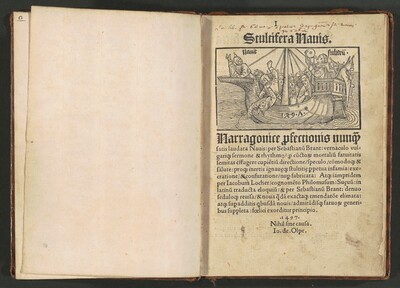
Stultifera navis (Ship of Fools)

Stultifera navis (Ship of Fools)

Dürer, Albrecht

This is a photograph of a page from a book. The page displays the title "ARABESQUES MYTHOLOGIQUES" in capital letters. The background is a creamy off-white color. There are no illustrations or additional text present. The edges of the page are slightly worn. Stains or marks are visible, particularly towards the bottom left and right corners.

Arabesques Mythologiques

Genlis, Stéphanie Félicité de Comtesse
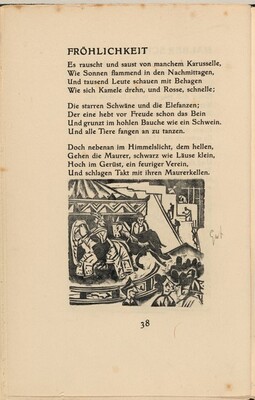
This is a drawing of a scene in a fairground or carousel setting. The image features an abstract, woodcut-style illustration, depicting figures riding on carousel animals. The animals appear to be elaborately designed, possibly elephants or similar creatures, with geometric patterns. The figures atop the animals seem to be engaged in various activities, with some positioned as if they are playing musical instruments. The composition includes dynamic lines that suggest movement and festivity. The text above the image contains a poem in German, titled "Fröhlichkeit," which translates to "Joy." The overall style and content indicate a lively and celebratory atmosphere, typical of a fairground scene.

Fröhlichkeit (Joyfulness) (in-text plate) from mock-up of Georg Heym: Umbra Vitae (Georg Heym: Shadow of Life)

Kirchner, Ernst Ludwig

The image shows a large rectangular shape in a green color. The surface has a texture resembling a rough fabric or canvas, with a subtle grid pattern.

Essais de gravure a l'eau-forte (Essays in Etching)

Calame, Alexandre

The image shows swirling lines and rounded shapes blending together in an abstract design. The lines and shapes overlap in a pattern with various colors including pale pink, muted green, soft yellow, and dark accents. The design resembles fluid movements found in nature, such as water currents or wind flow, portrayed in pastel tones.

One hundred and fifty new designs by Thos. Johnson carver, consisting of Ceilings, Chimmney Pieces, Slab, Glass and Picture Frames (etc.)...the Whole well Adapted for Decorating all kinds of Ornamental Furniture, in the Present Taste

Johnson, Thomas

The image shows sepia-toned portrait profiles encased in circular frames. The portraits depict individuals at various angles, focusing on their faces and upper shoulders without showing their full bodies. The subjects include men and women with different hairstyles and clothing styles typical of a historical period. Men have short, wavy, or curled hair, and some wear neckties or cravats. Women have voluminous hairstyles with ribbons or hats, and wear elaborate lace and ruffle collars or shawls. The facial features are detailed in a classical nineteenth-century style. Each portrait has a plain dark circle background and handwritten text below indicating the person's name. The image appears to document and commemorate the individuals in a formal and traditional portrait style.

Saint-Mémin Collection of Portraits, Group 2

Saint-Mémin, Charles B. J. Févret de

This is a drawing of an elephant with a column and statue on its back. The elephant carries a decorative cloth on its back with intricate patterns. A tall column rises from the elephant's back, supporting a statue of a standing figure. Next to the elephant is a torch-like structure emitting smoke. The ground has a pattern resembling cobblestones. The image is labeled "SCHEMA ELEPHANTI."

Descriptio publicae gratulationis...Ernesti Archiducis Austriae

Borcht, Peter van der

This is a photograph of the cover of a red leather-bound book. The image captures a close-up view of the book's exterior, showcasing its red leather cover. The cover appears worn and slightly scuffed, with visible creases and imperfections. The spine of the book, visible on the left, shows wear at the edges where it meets the cover's surface. The texture of the leather is noticeable, and the stitching around the edges is subtly highlighted.

Album of Engravings after Sir Peter Paul Rubens

Various Artists

This appears to be the front cover of an old leather-bound book. The book is covered with red leather with the word "IGNIS" embossed in gold in the center. The cover shows signs of wear and aging, with visible scuffs, scratches, and discoloration. There are four brass clasps on the edges of the book: one on the top and bottom edges, and two on the right side.

Animalia Rationalia et Insecta (Ignis)

Hoefnagel, Joris

This is a drawing of an abstract landscape and figure with accompanying text. The image features a stylized black and white depiction of a mountainous landscape with a central seated figure set within angular and sharp lines. Above the image is the title "PILATUS" in bold text. Below the drawing, there is German text. The artwork is rendered with a woodcut-like style that emphasizes contrast and texture, characteristic of expressionist prints. At the bottom of the page, the number 57 is printed.

Pilatus (Pilate) (headpiece, page 57) from Georg Heym: Umbra Vitae (Georg Heym: The Shadow of Life)

Kirchner, Ernst Ludwig

The image depicts architectural diagrams and cross-sections of wooden structures. The drawing displays detailed illustrations and cross-sections of roof construction, including various aspects, sections, and elements. Technical information about structural components like beams, columns, and trusses are provided through labels and measurements. The sections are neatly organized within boxes, potentially representing different perspectives or construction stages. The style is technical and precise, typical for architectural drawings used for educational or construction purposes.

Della Magnificenza ed Archittetura; Osservazioni; E Parere su l'Architettura

Piranesi, Giovanni Battista

The image displays swirling lines and circular shapes merging into a complex pattern, creating an abstract design reminiscent of marbled paper. The red and earthy tones combined with intricate patterns evoke the appearance of a swirling garden full of petals and leaves, mingling with bubbles or droplets.

Huit Études et compositions de fleurs (Eight Studies and Compositions of Flowers)

Jacquemart, Jules-Ferdinand
This is a photograph of a book cover. The cover features a textured fabric material in a neutral brownish tone, with reinforced corners and spine made of a smooth, slightly darker brown material resembling leather. The stitching pattern on the fabric gives it a subtle crosshatch design. The book cover does not contain any visible text, illustrations, or embellishments.

Album with engravings from John Leslie's "De Origine Scotorum"

British 17th Century

The image features fifteen oval framed bust portraits arranged in a grid of three rows and five columns. Each person is depicted in profile, showing the upper part of their bodies including their heads, shoulders, and upper chest. The individuals are primarily positioned facing either left or right, seated in an upright posture. 

The portraits mainly depict individuals with European facial features, short hairstyles consistent with the late 18th century, and some with powdered wigs or tied-back hair in short ponytails. One woman in the portraits has curly hair adorned with ribbons and flowers, wearing a high-collared dress with lace embellishments. 

The individuals are dressed in formal attire typical of the period, including high-collared coats with tall collars and cravats or neck scarves. There is no visible jewelry or objects being held by any of the figures. 

The background for each portrait is plain with a simple oval shape outlining each individual, contrasting with the textured clothing and hair details. The portraits are labeled with names written beneath each person. The entire collection is set on a light brown background serving as the mount for the grid of portraits.

Saint-Mémin Collection of Portraits, Group 6

Saint-Mémin, Charles B. J. Févret de

L'oeuvre d'Antoine Watteau (volume I)

L'oeuvre d'Antoine Watteau (volume I)

Various Artists

The image shows a landscape with a rocky river winding through trees. A castle or fort sits on a hill to the right of the river, above the tree line. Fluffy clouds are in the sky above. Fine lines and cross-hatching create texture in a monochromatic style, giving a detailed and structured feel to the scene.

Sammlung Radierter Blaetter von Nathe

Nathe, Christoph

The image shows a stylized artwork of a profile view of a person, with their head and part of the upper body visible. The person is facing to the left, with their hand touching their head. The facial features are abstract and angular, rendered in bold black lines. The hair is simplified and dark. The person appears to be wearing a garment, with contours extending from the neck downward. The background is textured with dark green and off-white tones, with text at the top reading "Georg Heym" and "UMBRAVITÆ."

Bucheinband (cover) from mock-up of Georg Heym: Umbra Vitae (Georg Heym: Shadow of Life)

Kirchner, Ernst Ludwig

This is a photograph of a decorative book cover. The cover is black with a gold border and lettering. The title of the book is "The Shakespeare Ballads Illuminated." In the center of the cover, there is a crest with a shield, a bird on top, and a ribbon with the motto "Hon Sanz Droict." Metal clasps are on the corners for closure.

The Songs and Ballads of Shakespeare

Mapleson, Thomas W. Gwilt

Excursions Daguerriennes / Vues et Monuments les plus Remarquables du Globe (Vol. 1)

Excursions Daguerriennes / Vues et Monuments les plus Remarquables du Globe (Vol. 1)

Lerebours, Noël Marie

This is a drawing of a cover page. The cover features a title in bold red and black text, promoting a collection of images of Rome. It names Giambattista Piranesi as the architect, with Giovanni Bouchard as the collector. Below the text, there is an illustration of an ancient Roman architectural ruin set amidst trees and natural surroundings, with detailed textures and grand columns. The drawing is detailed with a sense of depth, capturing the ambiance of Roman architecture.

Le Magnificenze di Roma Le Più Remarcabili Consistenti In Gran Numero di Stampe Nelle quali vengano rappresentate le più cospicue Fabbriche Di Roma Moderna, E Le Rimaste Dell' Antica, Anche Quelle, Che Sparse Sono Per L'Italia Con L'Aggiunta Ancora Di Molte Invenzioni Si Prospettiva Sulla Maniera Degl' Antichi Romani, Come Anche Di Molti Capricci Di Carceri Sotterranee. Il Tutto Com Singolar Gusto, E Studio Diligentemente Delineate, Inventate, Ed Incise Da Giambattista Piranesi Architetto Veneziano, E Raccolte Da Giovanni Bouchard Mercante Librajo Al Corso

Polanzani, Francesco

The image shows a large rectangular shape with two diagonal lines running from corner to corner, creating a triangular pattern. The overall composition resembles an abstract design resembling the cover of a book, with a textured surface and black borders.

Williamina Blackett's Album

Murray, Georgina

This tan-colored, fabric-covered sketchbook cover is marked with a few smudges of dark gray and white paint. The binding is to the left in this photograph. The cover is wide and has a cream-colored rope wrapped around the narrower end to our right. The weave of the fabric is visible. A few swipes of gray paint are spaced along the binding, to our left, and there are tiny touches of white, lavender purple, and brick red marking the cover.

Cezanne Sketchbook

Cezanne, Paul

This is a drawing of an elaborate baroque-style title page. The image features a highly ornate decorative border with swirling acanthus leaves and floral motifs around a central block of text. At the top, an opened book with Latin text is supported by a cherubic figure, with rays of light emanating from it. Additional cherubs on clouds enhance the composition. The text is inscribed in both Latin and German. This design showcases the detailed printmaking techniques of the period, emphasizing grandeur and formality.

Picturae Chalcographicae Historiam Veteris et Novi Testamenti

Kilian, Philipp Andreas

The image shows swirling patterns and spots on a textured surface. The abstract design consists of lines and shapes that resemble the branching of a tree or the veins of a leaf, with clusters resembling islands or clouds scattered across the surface. The pattern gives the impression of a natural landscape viewed from above, with organic formations.

Vida y Hechos del Ingenioso Hidalgo Don Quixote de la Mancha (volume 1)

Cervantes Saavedra, Miguel de

This is a drawing of a title page for an Italian text on the gates and walls of Rome. The page contains Italian text in various sizes and styles detailing the dedication and authorship of the text. The main dedication reads "Delle Magnificenze di Roma Antica e Moderna" and is dedicated to Carlo, Infante of Spain and King of the Two Sicilies. Below the text, there is a small engraved illustration of a classical figure surrounded by architectural elements, likely referencing ancient Roman structures. The page is dated MDCCXLVII (1747) and printed in Rome.

Delle Magnificenze di Roma Antica e Moderna (vol. 1)

Vasi, Giuseppe
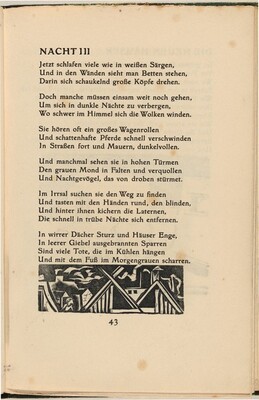
This is a photograph of a page from a book. The page contains a German text titled "NACHT III" with a small illustration of rooftops against a dark sky below. The text is neatly printed with occasional indents for new stanzas. The illustration uses high contrast black and white tones, resembling a woodcut style. The page has sepia tones and spots of discoloration, giving it an aged appearance. The page number "43" is centered at the bottom.

Nacht III (Night III) (in-text plate) from mock-up of Georg Heym: Umbra Vitae (Georg Heym: Shadow of Life)

Kirchner, Ernst Ludwig

This is a drawing of architectural designs for a building. The image showcases two elevations and two floor plans of a structure. One elevation depicts a building with columns supporting a triangular pediment. The other elevation shows an entrance with an arched doorway flanked by windows, topped with a pediment. The floor plans reveal the spatial arrangement and construction details. The drawing suggests an emphasis on balance, symmetry, and classical proportions.

A Book of Architecture containing Designs for Buildings and Ornaments

Gibbs, James

This is a photograph of a historical document's cover page. The document describes a collection of prints belonging to Jacopo Durazzo, a Genoese patrician, with a dissertation on the art of engraving. The cover is text-focused with Italian typography. It includes an engraved emblem or crest below the main text, and the bottom of the page indicates it was published in Parma by the Royal Printing House in 1784. The paper shows signs of aging with spots and discoloration.

Descrizione della raccolta di stampe di S.E. il sig. conte Jacopo Durazzo, patrizio genovese, ec. ec., esposta in una dissertazione sull'arte dell'intagio a stampa

Benincasa, Bartolommeo

The image features 15 circular portrait sketches of individuals from the shoulders up, facing towards the right or left. Each portrait is labeled with the respective person's name underneath. Men have various hairstyles and high collars or cravats, while women have styled hair with ribbons or caps, and wear dresses with ruffles or lace. The sketches are organized in five rows and three columns against a plain background, highlighting each profile.

Saint-Mémin Collection of Portraits, Group 36

Saint-Mémin, Charles B. J. Févret de

This is a drawing of a decorative title page featuring text surrounded by ornate borders. The page displays a central panel of text in Latin stating, "ICONES ILLVSTRIVM FEMINARVM VETERIS TESTAMENTI," by Philippo Gallaeo. The typography is set within an intricate border design of floral and geometric patterns. Additional Latin text at the bottom is dedicated to a notable figure. The words are neatly inscribed, combining both printed and handwritten elements, with further handwriting visible at the bottom of the page beyond the ornate border.

Icones Illustrium Feminarum Veteris Testamenti (The Celebrated Women of the Old Testament)

Collaert, Hans the Younger

The image displays jagged, angular lines and shapes forming an abstract composition. Some shapes resemble trees and rugged mountainous landscapes, suggesting a forested scene with light and shadow interplay. Bold black and white contrast enhances the abstract quality, and the dense, overlapping forms evoke a thicket or dense woods, with towering trees and uneven terrain.

In-text plate from Kirchner Zeichnungen (Kirchner Drawings)

Kirchner, Ernst Ludwig

The image shows a close-up of a worn and aged surface, possibly from an old book or manuscript. The surface is textured, with signs of wear, discoloration, and brownish stains resembling foxing. There are frayed edges and slightly bumped corners, indicating long-term handling. The photograph conveys historical value and age through the weathered material.

Ragguaglio della solenne comparsa, fatta in Roma gli otto di Gennaio MDCLXXXVII dall'Ill. Conte di Castelmaine ambasciadore straordinario della Sagra Real Maestà di Giacomo II, all'udienza di Papa Innocenzo XI

Westerhout, Arnold von

The image features a sculpture of three figures wearing crowns, standing on a pedestal. They wear flowing garments resembling Roman togas and hold a garland. The figures are large and grand, surrounded by architectural elements like columns with ornate designs. Above them is a medallion flanked by cherubs. The monochromatic sculpture appears to be made of stone, exuding a sense of classical elegance.

Descrizione delle feste celebrate in Parma l'anno MDCCLXIX per le auguste nozze di Sua Altezza Reale L'Infante Don Ferdinando colla Reale l'Archiduchessa Maria Amalia.

Various Artists

This is rectangular object that is predominantly brown, with some areas of slightly darker brown and mottled textures. There are thin, slightly recessed golden lines bordering the corners and edges of the rectangle.

Prints for "Collection complete des oeuvres de J.J. Rousseau"

Various Artists
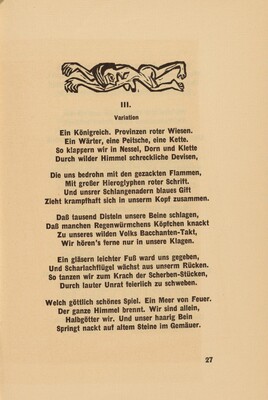
The image features an abstract drawing at the top with fluid, intertwining lines forming shapes. The shapes resemble a pair of symmetrical figures. Below the drawing, centered text in German is presented. The visual layout suggests a page from a book or collection of writings.

Liegende (Die Irren III) (Reclining Figure [The Mad III]) (headpiece, page 27) from Georg Heym: Umbra Vitae (Georg Heym: The Shadow of Life)

Kirchner, Ernst Ludwig

The image displays bold, angular lines and contrasting shapes, forming an abstract depiction of a face. The facial features, such as the eyes and mouth, have been exaggerated with sharp lines, which blend into rectangular forms resembling crosses. The elements combine to create a visually intricate and abstract style.

Judas (headpiece, page 59) from Georg Heym: Umbra Vitae (Georg Heym: The Shadow of Life)

Kirchner, Ernst Ludwig

The image showcases a contents list in German on the top portion, with various titles and page numbers. Below the text is a black and white illustration of a reclining figure surrounded by drapery, with the initials "EK" in the bottom right corner of the image.

Liegender Rückenakt (Reclining Nude) (tailpiece, table of contents) from Georg Heym: Umbra Vitae (Georg Heym: Shadow of Life)

Kirchner, Ernst Ludwig

This is a drawing of a group of people in motion. The image shows stylized line drawings of figures in a woodcut style, emphasizing outlines and forms without detailed facial features. Below the drawing, there is German text with the title "Die Blinden Frauen" followed by poetry. The page number 38 is present, suggesting this is a page from a book.

Die Blinden Frauen (The Blind Women) (headpiece, page 38) from Georg Heym: Umbra Vitae (Georg Heym: The Shadow of Life)

Kirchner, Ernst Ludwig

Palazzi di Genova (vol. 1)

Palazzi di Genova (vol. 1)

Rubens, Peter Paul, Sir

The image consists of fifteen individual portraits arranged in a grid of five rows and three columns. Each portrait shows a side profile of a man's head and shoulders within circular frames. The men vary in facial features, hairstyles, and clothing. Names are inscribed below each portrait, and the arrangement is on a flat, subtly varied background.

Saint-Mémin Collection of Portraits, Group 18

Saint-Mémin, Charles B. J. Févret de

The image displays swirling organic shapes with flowing lines resembling marbled patterns. Circular and oval forms akin to stones or bubbles move across the surface. The left side and corners have dark brown areas similar to aged leather. Vibrant colors like teal, green, and maroon blend in the central area to create a painterly wave or rippling water surface.

Fables (volume II)

Blake, William

This is a drawing of a book cover or page. The central text is a dedication on the magnificence of ancient and modern Rome, particularly its notable palaces and streets, addressed to Queen Elisabeth Farnese of Spain. The title indicates that this is the fourth book in a series. Below the text, there is a small illustration depicting a rustic hut with a banner bearing the word "DOMUS ROMULI." The scene suggests a portrayal of early Rome with a simple dwelling surrounded by natural elements including trees and vegetation. The entire piece is rendered in black and white with a detailed engraving underneath the main text.

Delle Magnificenze di Roma Antica e Moderna (vol. 2)

Vasi, Giuseppe
Officia M.T.C.

Officia M.T.C.

Cicero, Marcus Tullius

This is an image of mountainous landscapes with buildings and pathways. The image contains text printed in German, discussing artistic themes. In the lower right section, there is an illustration in black ink depicting a stylized mountain landscape with a winding path or road leading up the mountain, surrounded by trees. Small, simple figures are shown traversing the path, with simple buildings at the base amongst trees, creating a rustic, outdoor scene typical of mountainous or rural regions. The imagery is minimalist and stylistic, focusing on basic outlines and shapes to convey the scene.

In-text plate from Kirchner Zeichnungen (Kirchner Drawings)

Kirchner, Ernst Ludwig

Descrizione del Sacro Monte della Vernia

Descrizione del Sacro Monte della Vernia

Ligozzi, Jacopo

This is a photograph of a decorative book cover. The book cover has a golden-yellow background with a repeating pattern of floral motifs, resembling chrysanthemums. The text "BADAUDERIES PARISIENNES" is printed in a dark bold font in the upper portion, and "Les Rassemblements" is displayed centrally beneath it. The design suggests elegance and artistic flair with the patterned florals and typography contributing to a refined aesthetic.

Les Rassemblements

Vallotton, Félix

This is a photograph of an old book cover. The cover features a dark, textured spine on the left, with two thin gold vertical lines running along the edge. The spine is mostly black. The rest of the cover is a light brown fabric, which shows signs of wear and possible water or age stains, resulting in a mottled and discolored appearance. The overall feel of the image conveys a sense of antiquity and use.

On English Lagoons

Emerson, Peter Henry
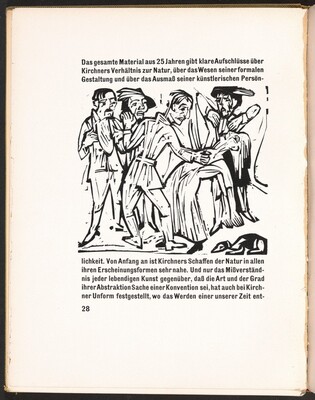
The image is a black and white illustration showing three people in a dynamic pose, with a partial view of their bodies from the waist up. The figures are leaning and reaching towards each other. Their features are stylized, with angular lines defining their faces and hair. They are wearing loose-fitting garments, with one figure in the center wearing a hat. The clothing is simple, focusing on shapes and lines. There is no visible jewelry or objects being held. The background is white. The image is surrounded by a block of text in German above and below and the page number "28" is visible at the bottom.

In-text plate from Kirchner Zeichnungen (Kirchner Drawings)

Kirchner, Ernst Ludwig

The image displays a brown leather-bound book cover. The cover shows signs of wear, including scuffs and discoloration, giving it a rustic and vintage appearance. The edges are stitched with a golden thread pattern. The leather's texture and markings contribute to the antique look of the book.

The Powers of the Pen

Mortimer, John Hamilton
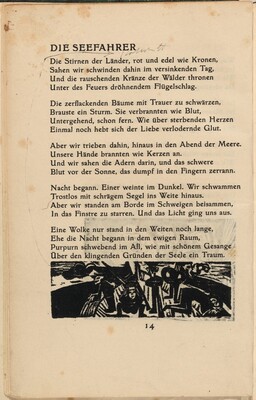
This is a drawing of a page featuring a poem titled "DIE SEEFARHER" in German printed in a serif font. The text occupies most of the upper portion of the page. Below the text is a small black and white abstract drawing of geometric shapes. The drawing contains a complex and slightly chaotic arrangement of figures or forms. The page number "14" is centered below the image.

Die Seefahrer (The Seafarer) (in-text plate) from mock-up of Georg Heym: Umbra Vitae (Georg Heym: Shadow of Life)

Kirchner, Ernst Ludwig

This is a book cover for "Narrative of a Five Years Expedition." The cover features the title and details of the book written in a decorative serif typeface. Below the main title, captioned "By CAPT. J. G. STEDMAN," there is an oval frame illustration depicting several ships at sea, surrounded by a bald eagle. The text provides context about the book's contents, promising descriptions of natural features and inhabitants of the depicted regions, including the Indians of Guiana and Negroes of Guinea. The book, published in London in 1796, claims to be illustrated with engravings made by the author. The text is accompanied by a Latin quote attributed to Valerius Flaccus.

Narrative, of a Five Years' Expedition, against the Revolted Negroes of Surinam, in Guiana, on the Wild Coast of South America (volume I)

Stedman, John Gabriel

This print features swirling lines and large, petal-like shapes that radiate outward. The petals seem to end in pointed, jagged edges. Those at the center are a pale-pink color with vibrant red shadows, while the leafy shapes in the background are blue-green and brownish-yellow. In the center there is also a cluster of black-and-white dots amid the petals.

The Golden Legend: the Golden Legend of Master William Caxton done anew (volume 1)

Morris, William

The image displays a series of head and shoulder profile portraits of 12 different individuals. Each portrait is presented within a circular frame, with the person facing to the viewer's left. The individuals have distinct facial features and hairstyles typical of the late 18th to early 19th century. They wear formal clothing and no visible accessories. Below each portrait are handwritten labels likely indicating their names. The background has a simple design, with each portrait contained within its own section against a tan or sepia-toned backdrop, giving a historical or vintage appearance to the series of portrait illustrations.

Saint-Mémin Collection of Portraits, Group 32

Saint-Mémin, Charles B. J. Févret de

This is a drawing of a mythological scene with figures and cherubs. It features a central figure surrounded by several cherubs and mythological creatures within a dynamic composition. The cherubs are depicted with wings, bows, and arrows, floating in the sky amidst clouds. Below, a central figure stands poised amidst a turbulent group of mythological beings that include mermen and sea creatures. The style of the drawing is reminiscent of classical or Renaissance art, with detailed line work and a sense of movement captured in the figures' poses and drapery.

Psyches et Amoris ...; Galeriae Farnesianae ...; Barberinae avlae fornix

Various Artists

This is a drawing of a dark, abstract composition with German text. The image features a woodcut-style illustration at the top with intricate shapes. Below the illustration, there is German text with the title "DIE MESSE" and a subtitle "(ALS MEINE SCHWESTER WEINTE)". The text consists of a poem or prose that evokes a somber and reflective mood. The text describes a scene involving candles, monks, and a sense of peace or tranquility amidst death or mourning.

Die Messe (The Mass) (headpiece, page 61) from Georg Heym: Umbra Vitae (Georg Heym: The Shadow of Life)

Kirchner, Ernst Ludwig

This is a drawing of a printed page consisting of text and an illustration. The page features a decorative title detailing an event relating to Henry II, King of France, in the year 1549. Below the title and main text, there is a small woodcut illustration depicting a figure carrying a staff or spear, navigating through a landscape with trees in the background, and water possibly flowing at their feet. The text beneath this illustration mentions Paris and a bookseller named Jehan Dallier. The overall composition of the page reflects the style of 16th-century printed documents, characterized by its typography and engravings.

[Entrée d'Henri II] C'est l'ordre qui a este tenu a la nouvelle et ioyeuse entrée que tres hault, tresexcellent et trespuissant Prince le Roy treschrestien Henry deuzieme de ce nom à faicte en sa bonne ville et cité de Paris...

Goujon, Jean