← All styles

Sculpture

163 works

The sculpture is an oval-shaped relief featuring a dynamic scene with two figures. On the left side of the relief, a centaur is depicted. The centaur is in motion, with horse legs shown mid-step, and the human torso slightly turned with one arm raised. On the right, a human figure, possibly a warrior, is walking briskly and pulling an object with a rope. The human is depicted in a muscular form with detail given to the musculature and limbs. The relief is made from a metal material, likely bronze, with a brown color and a patina finish that adds depth to the details. The material is a dark, burnished bronze, with some areas highlighting lighter shades that accentuate the outlines and contours of the figures.

A Warrior Fighting a Horseman

Roman 15th Century

The sculpture in the image is a circular, bronze-colored relief depicting a classical scene with several human figures. The figures are soldiers or warriors, with helmets and armor, some riding horses, walking in a procession. They carry long staffs adorned with symbols, such as an eagle. The sculpture appears to be made of bronze or a similar metal, giving it an antique appearance. In the foreground, a central figure stands near a column or pedestal with a decorative element that might be a flame or incense burner. Behind them, two figures observe the scene through an arcade.

Mucius Scaevola

Master IO.F.F.

The sculpture is an embossed circular metal medallion featuring the profile of a man in relief, facing left. The man is depicted with distinct facial features, wearing a hat with fringed edges. The medallion is bronze-like in color with the words "NICOLO" and "GANDER" engraved around the perimeter. The sculpture has a slightly weathered look, suggesting age, and exudes a sense of historical craftsmanship.

Nicolò Gander

Italian 19th Century

The sculpture depicts a central figure representing a woman with a halo, seated and surrounded by four smaller figures which appear to be cherubs or angels. The woman is holding a child who is reclined in her lap. The composition includes three cherubic heads with wings above, creating a stacked layer effect, and another cherubic figure on each side, flanking the central figures. The surface of the sculpture is a deep reddish-brown, suggesting it could be made from carved stone or cast metal with a patinated or aged finish. The relief is detailed, with defined lines and contours offering depth and texture, while the halo around the woman's head suggests religious iconography. The sculpture has a flat appearance, with a hole at the top indicating it could be hung or displayed.

The Virgin and Child

Paduan 15th Century

This is a photograph of a gold coin. The coin features a profile portrait of a figure wearing a hat adorned with a design or insignia. The figure has a determined, serious expression with detailed facial features including a sharp nose and distinct lips. The design on the coin also includes an elaborately patterned collar or clothing extending from the figure’s neck. An inscription in a stylized serif font wraps around the edge of the coin. The surface of the coin appears textured and worn in places, suggesting historical significance.

Lodovico II, 1438-1504, Marquess of Saluzzo 1475 [obverse]

Carmagnola 15th Century

The head and shoulders of a cleanshaven man are carved from white marble lightly streaked in gray in this freestanding sculpture. In this view, the shoulders are square to us, but he turns his head to our right. His left eyebrow, to our right, appears to cocked as he looks into the distance, and he has a sweeping nose with a rounded tip. His long upper lip overhangs the lower lip in a slight overbite. His hair is parted down the middle and ends in curls that angle from eye-level framing his forehead to ear-level at the back of his neck. He wears a high-collared breastplate over linked mail. The breastplate is ornamented with bands of flowers, dots, and other geometric designs. A strap and buckle hang from the neck area. The sculpture ends in a blunt, straight edge across the bottom, and it rests on a brown stone pedestal in front of a gray background.

Astorgio Manfredi

Mino da Fiesole

The sculpture depicts a lion overpowering a wild boar. The lion is pressing down the boar with its paw and biting into its body. The figures of both animals are intricately detailed, showing the powerful muscles and features of the lion and the rounded shape and limbs of the boar. The sculpture is made of dark brown bronze, giving it a smooth and polished finish. The stance and expression of the lion convey a sense of dominance as it stands over the boar. The sculpture captures the moment of the lion’s conquest, emphasizing the contrast between the lion’s mane and form against the boar.

Lion Devouring a Doe

Prieur, Barthélemy

The sculpture depicts a round medallion featuring a central figure with a human face surrounded by serpentine hair, possibly representing the mythological Medusa. Flanking this central figure are two smaller, naked human figures, likely cherubs, each positioned to the left and right with their arms extended towards the center. The medallion is made of dark brown material, likely bronze or a similar metal, giving it an antique and textured finish. The subject's expression is neutral, looking outward towards the viewer, and the intricate details of the hair and figures add depth. The piece has a small hole at the top, which suggests it may have been intended for hanging or attachment.

The Head of Medusa

North Italian 16th Century
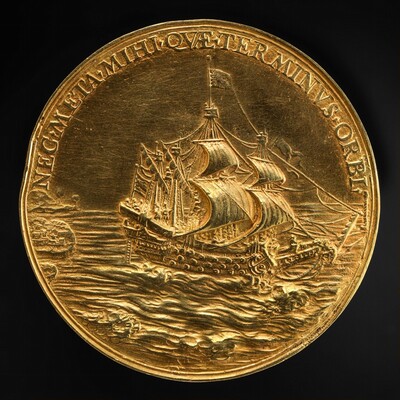
The sculpture on the circular object is a large sailing ship fully rigged with multiple sails billowing. Details of the ship, including the masts and rigging, are visible. In the foreground, there are wave-like engravings representing water. In the background, a faint coastline with structures is visible on the left side. An inscription at the top reads "NECQFETAMIFLQVETERMINVSORBI." The material is gold-colored metal, giving it a luxurious appearance. This image appears on a coin or medallion, with skilled engraving work bringing the ship to life through shadows.

The Juxon Medal: The Dominion of the Seas [reverse]

Briot, Nicolas
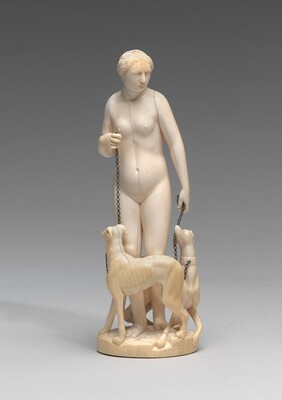
The sculpture depicts a standing nude female figure holding chains attached to two dogs. The woman is looking downwards towards one of the dogs. The sculpture is made from a smooth, ivory-colored material with a polished surface. Relative to us, the sculpture is small and detailed, capturing intricate elements such as the woman's facial features, hair, and the muscles and posture of the dogs around the woman's feet.

Diana with Her Hounds

Kern, Leonhard

The sculpture depicted in the image is a commemorative medal featuring two side portraits etched in relief. The subjects are a male and a female figure. Names and titles are inscribed around the edge. The male figure is dressed in historical attire and positioned slightly in the foreground with his profile facing left. The female figure, also in historical clothing, is positioned behind him. The medal is made of a metallic material, likely bronze or a similar alloy, with an aged patina. The inscription includes the names "FRIEDRICH WILHELM" and "KRONPRINZ VON PREUSSEN" along with other titles.

Marriage Medal of Crown Prince Frederick William of Prussia and Princess Louise Augusta of Mecklenburg-Strelitz [obverse]

Loos, Daniel Friedrich

The sculpture depicts a woman with a crown and detailed dress. The sculpture is in the form of a bronze medallion with embellished edges and raised lettering.

Christine de France, 1606-1663, Duchess of Savoy, Wife of Victor Amadeus I 1619, Regent 1637-1648

Dupré, Guillaume
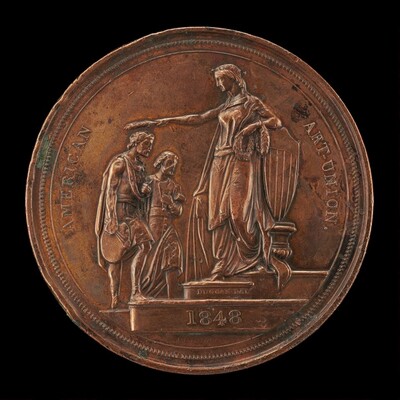
The image shows a round bronze medallion with a relief sculpture. The sculpture features a female figure standing on a platform, extending her hand towards two male figures in front of her. The female figure holds a laurel wreath and a shield. The two male figures stand in front of her, one muscular and draped in a cloth, the other smaller in stature. The medallion is inscribed with "AMERICAN ART-UNION" and "1848." The material is reddish-brown bronze with a metallic sheen and signs of aging. The scene is intricately detailed with the figures and their clothing carved in high relief.

Fame Crowning Painting and Sculpture [reverse]

Duggan, Paul Peter

The sculpture is a bust of a young man with distinct facial features, including a serene expression and short curly hair. It is crafted from a brown material with gold tones, suggesting it is bronze or terracotta with a patina finish. The subject wears a pleated garment, and the bust sits on a blue and gold base with a decorative border. The sculpture is life-sized, extending from the head to just below the shoulders. It conveys a poised and dignified presence, positioned at eye-height with a viewer.

Rinaldo della Luna

Anonymous Artist

The sculpture shows a dog lying down with its body slightly curled and its head on its front legs. The material of the sculpture appears to be bronze with a dark, greenish-brown patina. The details of the dog's muscular structure and fur texture are intricately captured. It is mounted on an oval base, with the dog's body stretched out horizontally.

Reclining Greyhound

Barye, Antoine-Louis

The image shows a circular sculpture depicting a figure riding a horse. The subject of the sculpture is a person dressed in historical or military attire, mounted on a horse captured mid-step, with its front leg raised. The material seems to be metal with a patina, likely bronze or a similar alloy. The sculpture is detailed with relief work showing the contours of the rider and horse. Embossed text encircles the figures, possibly indicating a commemorative name. Small holes can be seen on the surface, suggesting possible mounting or display purposes.

Ercole on Horseback [reverse]

Baldassare d'Este

The sculpture depicts a horse in profile. The body and head are clearly defined within the contours of the piece. The sculpture is predominantly dark in color, with shades of reddish-brown and black forming the body of the horse. The surface texture of the sculpture is rugged and uneven. The material appears to be a type of painted plaster or resin, providing a subdued matte finish. The horse is situated within a roughly rectangular form that frames its body. The base of the artwork is a slightly raised section that is lighter in color.

Ecorché: Relief of a Horse (Josephine)

Eakins, Thomas
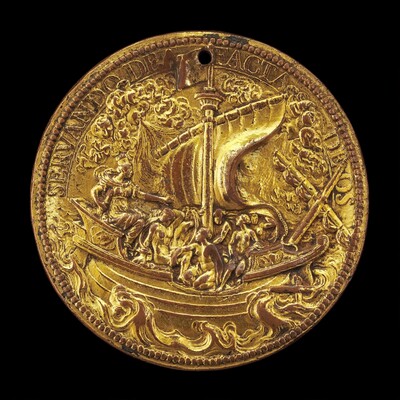
A photograph of a gold-colored medallion is shown. The medallion depicts a ship with a sail surrounded by waves and clouds. Figures on the ship are engaged in activities. The relief work is detailed, particularly in the figures and sail. An inscription in a classical style frames the scene on the edge of the medallion. The craftsmanship suggests a historical or commemorative purpose, highlighting fine artistry and detailed representation.

The Queen at the Helm of a Ship in Stormy Seas [reverse]

Dupré, Guillaume

The image depicts a coin with the profile of a man wearing traditional attire reminiscent of Renaissance armor. The man has a distinctive jawline and a prominent nose, with textured hair. Inscriptions surrounding the profile and the metallic material of the coin suggest historical importance. The sculpture is finely detailed, emphasizing the man's facial features and attire.

Galeazzo Maria Sforza, 1444-1476, 5th Duke of Milan 1466 [obverse]

Milanese 16th Century

A woman sitting on a throne with a child on her lap and two angels are carved from white marble and decorated with a few areas of gold in this freestanding sculpture. All four people face us in this photograph, and they have round cheeks, square jawlines, and closed lips. Black dots are painted for pupils but without irises or other paint on their faces, they all look startled or intense. The woman wears a gold crown over a cloth that drapes over her head, shoulders, and across her lap. Her knees are apart, and pointed shoes peek out under the rippling hem of her dress. She braces the child’s torso with her left hand, to our right, and touches his upper leg with the other hand. The child’s adult-like face is framed by gold hair. He holds up one hand, though the fingers have been broken off, and holds an open book facing out propped on his leg with his other hand. Writing on the pages has been painted. Two child-like, wingless angels stand on the arms of the throne behind the woman’s shoulders and hold a cloth up behind her head. On all four people, their hair and the necklines, hems, and cuffs of their garments have been painted with gold geometric designs. The Latin text on the book reads, "CONTINET IN GERMIO CELV TERRA Q REGENTE VIRGO DEI GENETRIX MCCCXXI.”

Madonna and Child with Two Angels

Verona 14th Century

The image shows a round, bronze medallion with a relief scene depicting multiple human figures and a centaur. On the left side, there is a centaur carrying a branch or staff. In the center, two human figures are embracing. To the right, two standing human figures are depicted; one is holding a staff, and the other is wrapped in a garment. A small dog and some foliage are visible on the ground. The medallion is predominantly bronze with variations in tone due to the relief work. There is a hole near the top of the medallion, possibly for hanging.

Achilles Taking Leave of Thetis and Chiron

Mantuan 16th Century

The sculpture is a medallion featuring a highly detailed coat of arms at its center. The circular design showcases heraldic symbols including shields and patterns enclosed by decorative drapery. Surrounding the coat of arms is a Latin inscription running along the edge of the medallion. The material of the sculpture appears to be metal, with a bronze or copper-like color. The textural details and raised relief of the symbols suggest careful craftsmanship in its creation, highlighting its historical or heraldic significance.

Shield of the Arms of Croy and Arschott [reverse]

German 17th Century

This is a round medal depicting the profile of a man wearing a distinctive hat and robe. The sculpture is crafted in a dark brown material, likely bronze. The man faces left with a calm expression, a prominent nose, a flat-topped hat with a band, and a simple collar on his robe. The edge of the medal is inscribed with the text “VICTORINVS FELTRENSIS SVM/MVS.” The front has a small hole near the top edge.

Vittorino de' Rambaldoni da Feltre, 1379-1446, Humanist [obverse]

Pisanello

The sculpture is an oval-shaped relief depicting a central figure emerging from a rectangular structure resembling a carved box or tomb. The central figure is draped in a garment, standing with an arm raised, and holding a staff with a flag. Two smaller figures, possibly angels or followers with halos, are on each side. The entire composition is within a raised border. The sculpture appears to be metal, likely bronze, with a dark brown color and subtle lighter highlights indicating wear or patina. The sculpture has detailed engravings on its surface for texture.

The Resurrection with Two Saints

Italian 15th Century

The sculpture is a bas-relief medallion featuring a profile view of a man identified as "ARMANVS IOAN CARD DE RICHELIEV." The man is depicted wearing a cap and an elaborate, high-collared garment with visible details in the fabric and folds, along with ornamental chains and a pendant. The material of the medallion appears to be a warm, bronze metal. The sculpting accurately captures facial features such as the man's wavy hair, beard, and prominent nose. The round medallion includes the artist's name, "J. WARIN," engraved along the bottom edge. It is designed to have a small hole at the top.

Armand-Jean du Plessis, 1585-1642, Cardinal de Richelieu 1622 [obverse]

Warin, Jean
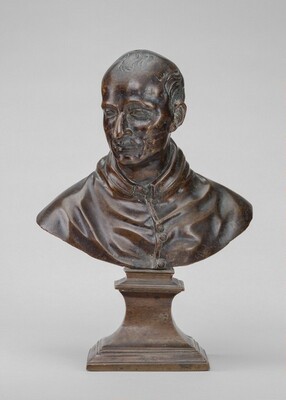
The sculpture is a bust of a mature man with a thoughtful expression and neatly combed hair. It is made from dark brown material, likely polished wood. The details of the man's face and clothing, such as buttons on his garment and folds around the neck area, are finely carved. The bust is mounted on a geometric base, evoking a sense of classical elegance.

Saint Charles Borromeo

Buonvicino, Ambrogio

The sculpture depicts a seated older man with a flowing beard. He is surrounded by two younger figures. One of them is placing a wreath on his head, while the other holds a drapery filled with fruit beside him. A small child is reclining at the man's feet next to a large urn. The sculpture is made of light terracotta material. Its detailed craftsmanship and dynamic composition allow the observer to closely observe the expressions and posture of each figure. The sculpture sits on a rounded base.

Silenus Crowned by Nymphs

Clodion

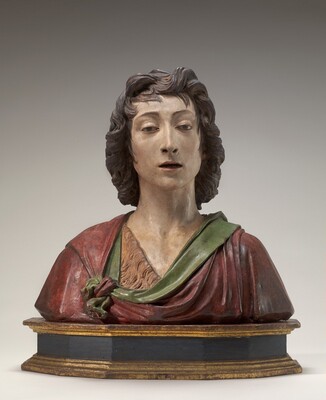
The sculpture is a detailed bust of a young man with pale skin and wavy brown hair that almost reaches to his shoulders, seen from the chest up. He has thin, arched eyebrows, a long, straight nose, and thin red lips that are partially open. A dark red and green cloth or cloak is draped over his shoulders and tied near his left arm, and it appears to cover a light brown garment with the texture of fur. The sculpture has no base.

Saint John the Baptist

Florentine 15th Century
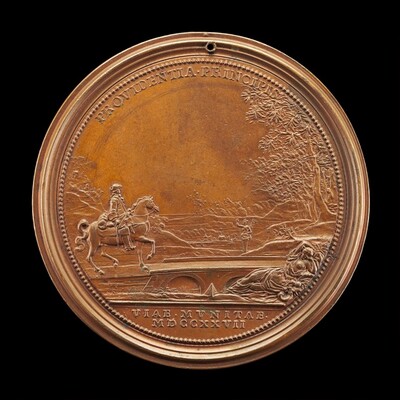
The image shows a round, flat medal with a relief sculpture on its front side. The sculpture features a person on horseback crossing a bridge in an outdoor setting with trees and distant landforms in the background. The scene is detailed with intricate lines depicting the scenery and is crafted from a bronze-colored material. An inscription in Latin surrounds the edge of the medal with "PROVIDENTIA PRINCIPIS" at the top and "VIAS MUNITAS MDCCXXVII" at the bottom. A small perforation near the top suggests it may have been used for display or worn on a chain.

Mounted Traveller [reverse]

Saint-Urbain, Ferdinand de

The sculpture is a detailed relief depicting two figures engaged in a handshake. Both figures are draped in classical attire. The figure on the left holds a staff topped with two entwined snakes and wings. The figure on the right holds a cornucopia filled with abundant produce. Between them, a small altar-like structure is adorned with fruit. The relief is crafted from bronze, giving it a metallic brown hue with areas of lighter patina. The rectangular plaque has two holes near its top corners. The overall appearance of the sculpture is flat, with the figures slightly raised against the background.

An Emperor and Concord

Cristoforo di Geremia

The sculpture depicts multiple human figures in a dynamic interaction against a backdrop of architectural elements. The figures have distinct facial features and clothing styles, and the setting suggests a scene from classical or ancient times. The sculpture is predominantly brown and has a relief appearance, with a textured background.

Augustus and the Sibyl

Briosco, called Riccio, Andrea

The sculpture is a rectangular bronze box with a relief carving on its front panel. The scene depicted on this panel includes several human figures dressed in long robes. The figures appear to be engaged in some form of interaction or narrative, with a central figure holding a staff and another figure kneeling before them. The bronze box has a dark brown patina, characteristic of aged metal, with areas of lighter highlights where the relief details are more pronounced. The box is set on four small feet.

Two Scenes from the Life of Saint Simeon of Polirone: The Miracle of the Stag (vignette) and The King of León (vignette)

Spani, Bartolomeo

This is a photograph of a bronze medallion. The medallion features a sculptural relief of a female figure holding a branch with leaves. The background showcases a landscape with structures resembling a castle or city. The perimeter of the medallion bears an inscription in Latin. The surface has a warm patina, highlighting the design details against the dark background.

Daphne Transformed into a Laurel Tree [reverse]

Galeotti, Pier Paolo

This is a photograph of an old coin. The image shows a circular metal coin with intricate detailing. The center of the coin features a shield divided into four quarters, with various symbols in each quarter. Above the shield is a crown and around it are decorative elements including foliage. The edge of the coin has inscribed text in an old-style font, encircling the shield and crowning design. The texture of the coin suggests it is made from a metal material.

Crowned Shield [reverse]

Milanese 15th Century

This is an image of an ancient coin. The coin features a detailed profile relief of a figure with curly hair and a regal or militaristic outfit adorned with a row of circular embellishments. The border of the coin contains inscribed text describing the figure. The surface of the coin shows signs of age with a patina giving it a brownish and reddish tint. The craftsmanship exhibits a high level of detail, particularly in the depiction of the figure's facial features and attire, indicating the coin's historical significance.

Federigo II Gonzaga, 1500-1540, 5th Marquess of Mantua 1519 and 1st Duke of Mantua 1530 [obverse]

Pomedelli, Giovanni Maria

The sculpture is a circular medal featuring a dragon-like creature breathing fire. The creature is centrally positioned and surrounded by decorative elements, including a crown above its head. The medal is crafted from a metallic material with a bronze or brass-like appearance. The surface is textured and the details of the dragon and surrounding elements are well-defined, enhancing the three-dimensional quality of the piece. The outer rim of the medal bears an inscription.

Salamander in Flames [reverse]

Neufahrer, Ludwig

The image depicts a bronze medallion featuring a profile of a sculpted figure. The figure wears ornate attire and a crown, showing intricate details in the hair, intricate garment patterns, and a circular necklace. The medallion has a warm, aged patina with varying brown and golden hues. An inscription encircles the edge, and a loop at the top suggests it may be used as a pendant.

Christine of France, 1606-1663, Duchess of Savoy 1619, Regent 1637-1648

Dupré, Abraham

This is a photograph of an ancient coin. The coin is circular with a finely serrated rim and features intricate engravings on its surface. In the center, there is a seated figure surrounded by ornate patterns. The figure holds a staff or scepter in one hand. Around the figure, there is an inscribed border containing possible words or letters in a historic script. The bottom part of the coin displays a series of squares with small figures or embellishments inside each one. The coin's surface shows signs of wear and age.

Saint Petronius Enthroned above Arms of Cardinal Alidosi [reverse]

Bolognese 16th Century

The sculpture depicts a hunting scene with armed hunters on horseback, holding spears, accompanied by dogs. There are additional horses in the background. The sculpture has an oval relief presentation with intricate details, such as flowing garments and textures reminiscent of ancient Roman or Greek warriors. The color of the sculpture is bronze-like, suggesting a metallic composition. The figures are highly detailed, showing the textures of the horses' manes and the musculature of the riders and dogs, creating a dynamic visual narrative.

A Panther Hunt

Bernardi, Giovanni

Amor Caritas

Amor Caritas

Saint-Gaudens, Augustus

The sculpture depicts a man in a dynamic pose, appearing as if caught mid-action. He is leaning back slightly and holding a long staff or spear across his shoulders. He is dressed in historical or outdoorsman clothing, including a feathered hat, a ruffled shirt, and fringed pants. The sculpture is made of dark bronze with an aged, greenish patina. The figure stands on a circular base and showcases realistic muscular definition and clothing folds. This bronze sculpture captures expressive motion and detail.

Peasant of the Middle Ages

Barye, Antoine-Louis

The sculpture is a bust of a man with a strong expression, prominent eyes, and defined facial features. He wears a high-collared coat and a neatly tied cravat. The material is smooth and light-colored, possibly marble or a similar stone. The craftsmanship depicts intricate details of the man's face, hair, and clothing realistically. The bust sits on a round pedestal, elevating it and enhancing its classical appearance.

Joel Barlow

Houdon, Jean-Antoine

The sculpture is a round medallion featuring the bust of a female figure. The subject is depicted in a frontal pose with her head slightly tilted, displaying long, flowing hair. The attire appears to be loosely draped around her shoulders, accentuating the form of her upper body. The sculpture is crafted from a material resembling aged bronze, evidenced by its dark, metallic color with patches of patina, giving it a rugged texture. The medallion includes inscriptions around the perimeter. The three-dimensional relief of the bust stands out against the flat surface of the medallion, lending it a sense of depth and realism.

Elvira, Daughter of Consalvo de Córdoba [obverse]

Italian 16th Century

Descent from the Cross

Descent from the Cross

Italian 16th Century

The sculpture is a bust depicting the head and shoulders of a man. His facial features are pronounced, with a prominent brow and nose, a large mustache, and a firm expression on his lips. The material appears to be bronze, exhibiting a dark, weathered patina with aging highlights. The surface is rough and rustic, adding to the impression of strength and solidity. The bust is life-sized.

Jacques-Antoine-Adrien, Baron Delort

Daumier, Honoré

The sculpture depicts a male figure with his hands tied behind his back. The material appears to be a dark, metallic substance, potentially bronze. The subject's head is turned slightly to the side, showing his defined facial features and curly hair. The figure's stance suggests tension, emphasized by the tightly pulled ropes around his wrists. The relief is set against a circular disc, creating subtle shadows.

Saint Sebastian

Francesco di Giorgio Martini

The image shows two central figures, one standing on a raised surface on the right with a staff and a vessel pouring water over the head of the other figure. The figure being baptized has long hair falling to their shoulders and serene facial features, with arms bent and hands clasped at the chest, wearing minimal clothing. The baptizing figure has a beard and detailed facial features, wearing a draped garment. Around them is a larger halo. On the left, a group of angels is present, with two angels kneeling, characterized by soft facial features and wings folded behind them, wearing draped robes. Above the central figure, a dove hovers with radiant lines spreading outward. The background has dark, crosshatched patterns for depth and an arched motif above, with the ground below resembling agitated waters. The image is framed, suggesting age or historical significance.

Baptism of Christ

Italian 16th Century

The sculpture is a medallion featuring a central figure of a putto playing a lute, surrounded by ornate designs including floral motifs, scroll work, and small figures. The sculpture is gold-colored and round, with a relief that provides texture and depth to the designs.

Cupid Playing on the Lute

German 16th Century

The sculpture depicts a small figure of a child seated with a posture suggesting relaxation or contemplation. The child appears to be holding an object that extends upwards near the head. The sculpture is made of metal with a golden hue, and some areas show wear with the underlying darker metal visible. It is mounted on a cylindrical base made of a polished stone material with a deep maroon color and white speckles throughout.

A Triton

Italian 16th Century

The sculpture is a coin depicting the profile of a man facing to the right. The figure has long hair and wears an elaborate garment with detailed collar. The coin is made of coppery material, giving it a reddish-brown hue with a slightly aged appearance. There is an inscription around the portrait in an older script, encircling the coin's border. "1471" is inscribed at the bottom. The coin is intricately detailed with raised lettering and a portrait, showing signs of wear consistent with age.

Lodovico Maria Sforza, called il Moro, 1451-1508, 7th Duke of Milan 1494-1500 [obverse]

Milanese 15th Century

The sculpture is a large, intricately designed urn with classical motifs. The focal point of the urn features a bas-relief depiction of a woman and a child, both seated and surrounded by a natural setting with trees and rocks. The scene is elegantly framed by ornate garland patterns and ribbon motifs. The urn has two large handles shaped like ram's heads, adding a distinctive and symmetrical feature to either side. It is crafted from white marble, giving it a smooth and pristine appearance, with finely polished surfaces that highlight the detailed artistry. The urn stands on a beautifully carved pedestal base, which is also adorned with patterns resembling leaves. Overall, this sculpture presents a harmonious blend of classical elements and exquisite craftsmanship, contributing to its aesthetic grandeur.

Monumental Urn

Clodion

The sculpture is a roundel featuring a figure of a bearded man holding a staff. The man is facing forward and is depicted in a carved design. The sculpture is made of a material that looks like a combination of dark wood or metal, with a golden hue accentuating the figure and rim. There are intricate carvings and crosshatching depicting the man's attire. The sculpture has a circular shape resembling a medallion or decorative plaque, giving it a historic or classical aesthetic.

Saint with Sword and Palm

Lombard 15th Century

The sculpture depicts three or four intertwined people on a rough base. The people are in a moment of interaction, with their limbs and torsos intertwined. One person appears seated in the center, while the others bend around them, their bodies contorted. None of their faces are visible. The people are smooth, while the base of the sculpture is roughly hewn. The material of the sculpture is white.

The Evil Spirits

Rodin, Auguste

The sculpture depicts a dragon-like creature with scales and a long, curving neck holding a set of scales. It is crafted in a round shape with a bronze color. The sculpture is a small, finely detailed relief, with the creature prominently raised against a flat background.

Winged Dragon with a Balance [reverse]

Antonio da Brescia, Fra

The sculpture is a circular medallion featuring the profile of a bearded man facing to the right. He has a detailed beard and hair texture, wearing what appears to be a tunic or armor with a visible collar and button. The medallion is crafted from a golden bronze material, giving it a rich, warm color and metallic sheen. The outer edge of the medallion is inscribed with the text "IVLIVS NOBILIVS PEO R," encircling the relief portrait.

Giulio Nobili, 1537-1612, Florentine Senator [obverse]

Poggini, Domenico

The sculpture is a profile portrait of a man depicted in relief, facing left. He wears traditional papal attire including a tiara or cap, and a robe with intricate details. The sculpture is dark bronze in color, giving it an aged appearance. The material appears to be metal, likely bronze. There are inscriptions in Latin encircling the figure, the top text reading "CLEM IX PONT MAX A I". The sculpture captures a detailed likeness from the profile view, with distinct facial features such as a bearded face, curls in the hair, and a serious expression.

Clement IX (Giulio Rospigliosi, 1600-1669), Pope 1667 [obverse]

Morone Mola, Gasparo

The sculpture depicts a figure in a robe with a halo around its head. The figure is holding up a hand with two fingers raised. The sculpture is circular and made of a dark metal material. Details are engraved into the metal, giving the figure an outlined appearance. Surrounding the figure is a sun with radiating lines and a building structure to the side.

Saint Bernardino of Siena

Italian 15th/16th Century
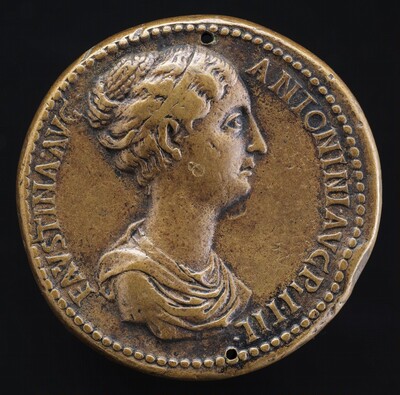
The image depicts a relief of a woman's profile facing right on an ancient Roman coin. The subject appears to be a classical figure, suggested by her attire and the style of the coin. The sculpture is made of a light brown material, possibly bronze. Text in Latin is inscribed along the border of the coin. The woman's hair is styled intricately and seems to be held up with a diadem or headband. There is a small hole near the edge of the coin, indicating it might have been used as a pendant or ornament. The texture of the coin shows signs of wear, suggesting its age and historical use.

Faustina the Younger, died A.D. 175, Wife of Marcus Aurelius [obverse]

Cavino, Giovanni da

The sculpture depicts a bull standing on a rectangular base. The bull is robustly built, with detailed musculature, a slightly lowered head, and prominent horns. The sculpture is made of bronze with a dark greenish-brown patina. It is small and detailed, showing the folds of the bull's skin and facial features.

Small Bull

Barye, Antoine-Louis

The sculpture portrays a human figure standing and draped in flowing robes, holding a serpent in one hand. It is set on a round, coin-like surface. The sculpture is made of metal with a dark patina of green and brown hues, giving it an aged appearance. The relief is low, with the figure gently raised against the background, outlining the figure's form and the serpent. The edges of the piece are slightly worn.

Wisdom Gazing at a Serpent [reverse]

Florentine 15th Century

The sculpture portrays the face of a cherubic figure with rounded cheeks and a subtle smile. The face is framed by a circular design featuring a leaf and flower pattern. The sculpture is primarily golden with darker patches underneath. The surface texture is uneven, emphasizing its three-dimensional quality. The proportions of the face are slightly exaggerated, giving it a mythical appearance.

A Child's Head

Italian 17th Century

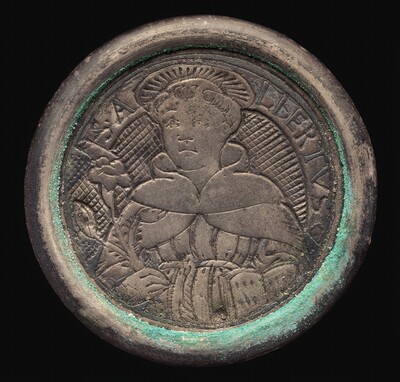
This is a photograph of a circular medallion or coin. The medallion features a raised relief depicting a robed figure with a halo holding a flower. The relief is set against a textured, diagonal crosshatch background. Surrounding the central figure are inscriptions that appear to form a name or title, including the letters "SA" and "LBERTVS." The item has a worn and weathered appearance, with a greenish patina along its rim.

Saint Albert of Trapani

Italian 15th/16th Century

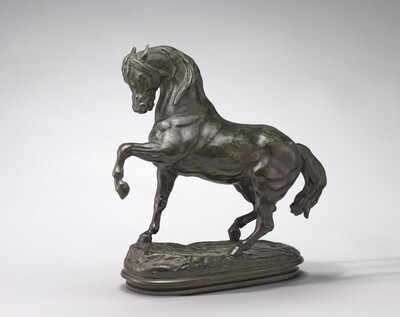
The sculpture depicts a horse in a rearing position with one front leg raised and bent. It is made of dark bronze with a smooth reflective surface and darker patina in some areas. The horse's nostrils are flared, and its mane appears flowing. The sculpture rests on an oval base, providing stability. The artwork is slightly larger than life, emphasizing the presence and vitality of the horse.

Turkish Horse, Right Foreleg Raised

Barye, Antoine-Louis

The sculpture displays a relief scene of a male figure standing bound beside a column. He is adorned in a cloth around his waist, revealing a muscular build. Surrounding elements include columns and smaller figures in dynamic poses, likely embodying scenes or characters of significance. The material is a bronze-like metal with a warm brown hue and a slightly reflective surface. The overall style is classical, reminiscent of ancient or mythological themes, with the main figure in the foreground and decorative elements framing the scene.

Saint Sebastian

Moderno

The sculpture is a round medallion featuring the profile of a man, identified as "Gilbert Stuart," as inscribed on the perimeter of the piece. The medallion depicts the man in a profile view, displaying detailed features including a prominent nose, lips, and textured, wavy hair. The sculpture is crafted from a dark brown metal that appears to be bronze or copper, with a weathered surface showing some areas of discoloration or patina typical of aged metallic materials. The carefully detailed contours and craftsmanship of the man's facial features and hairstyle give the medallion a realistic appearance when viewed closely.

Gilbert Stuart, 1755-1828, Painter [obverse]

Ellis, Salathiel

A man wearing a cloak tied around his body kneels with his hands together at the foot of a crucifix, set against a rocky outcropping on this stone panel. The scene is shallowly carved in low relief from pale, apricot-peach marble. Both the kneeling man, Saint Jerome, and the man hanging on the cross have raised, disk-like halos. Slightly right of center, the kneeling man looks up at the cross from under heavy brows. He has hollow cheekbones and short hair. His robe is tied over his shoulders and falls across his hips, but his feet and slender arms are bare. The man on the cross is smaller in scale, less than half the size of Saint Jerome. He hangs heavily from his hands, which are nailed into the cross, and his head falls forward. He is nude except for a loincloth across his hips. A rocky, hut-like form fills the space behind Saint Jerome. A few details are lightly carved so are visible only on closer inspection. These include a smaller cross along the left edge of the panel and a skull at the base of the crucifix. Between the crucifix and rocky structure, a male and female lion run toward Saint Jerome, mouths open. In the space between Saint Jerome and the right edge of the panel, another person is lightly carved into the background. He runs to our right while looking back over one shoulder, perhaps at the lions. One hand is flung high, his mouth wide open, and his hair stands on end. His voluminous robe flutters around his body. Beyond him, triangular trees recede into the distance under a cloud-streaked sky.

Saint Jerome in the Desert

Desiderio da Settignano
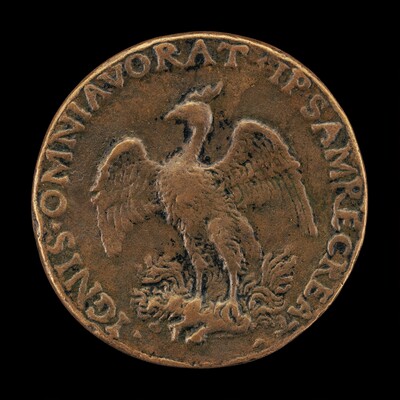
The sculpture depicted on the metal is of a bird. The bird is perched with its wings slightly spread and head elegantly turned. Flame-like patterns are visible beneath the bird. The sculpture is made of a bronze-colored metal and is surrounded by an inscription. The worn texture of the metal suggests age and endurance.

Phoenix on a Burning Pyre [reverse]

Romano, Giancristoforo

The sculpture depicts a horse in a dynamic pose, with one of its front legs raised. It is crafted from a dark material, likely bronze, giving it a rich, dark brown color with a slightly shiny surface. It is displayed on a rectangular base made from the same material. The surface of the horse is textured, showing details such as musculature, mane, and tail. The horse is proportionate and realistic in its depiction, evoking a sense of naturalism. The size of the sculpture is small, indicative that it is a model or a small-scale work rather than a life-sized representation.

Flayed Horse III

Gericault, Théodore

The sculpture depicts a horse in motion with its front left leg raised and its head turned to the side. It is crafted from a dark, metallic material with a green patina. The horse's muscles and contours are detailed, and it stands on a rocky base.

Turkish Horse, Left Foreleg Raised

Barye, Antoine-Louis

The sculpture depicts a pair of human hands, intricately intertwined and reaching upwards. The hands are sculpted from a material resembling bronze, with a dark brown color and subtle greenish patinas. The texture is smooth but detailed, highlighting finger joints and creases. The sculpture is mounted on a glossy black base bearing the artist's signature. It represents human hands, focusing on unity and connection.

Study for "The Secret"

Rodin, Auguste

The sculpture displays a religious scene with a central figure seated, holding a child. Surrounding them are additional figures, including two men in robes and headgear on the left, and others on the right. The sculpture is crafted in relief on an oval plaque, with intricate details, a warm brown color with gold highlights, and ornate edge decorations.

The Madonna of the Rosary

Anonymous Artist

The sculpture is a circular medallion featuring the relief of a male monarch in profile, facing the right. He is depicted wearing ornate robes adorned with detailed patterns and rich embellishments. He holds a scepter in one hand and a sphere in the other. The medallion is crafted from metal with a dark bronze or gold finish that highlights the raised features and textures, while the other areas are dark brown, perhaps from a patina. The edges of the medallion are inscribed with text.

Charles V, 1500-1558, King of Spain 1516-1556, Holy Roman Emperor 1519 [obverse]

Reinhart the Elder, Hans

This stylized, free-standing, wood sculpture shows a seated man with horns, creating a column-like shape. The statue is carved from polished, reddish-brown wood. The column is divided into three sections for the head, torso, and legs. In this photograph, the man faces us. He has gold-colored eyes under arched brows, a wide nose, thin lips, and a square jaw. The horns rise from over his temples. In the middle section, he holds his hands in front of his chest, nearly touching as if in prayer. The bottom section shows his shins, knees together. His feet, which are roughly carved, turn outward. The base along the bottom is carved with words painted in gold, reading, “PERE PAILLARO.”

Père Paillard

Gauguin, Paul

The sculpture depicts two figures holding a bearded head. The figures are wearing draped garments with intricate folds. The sculpture is made of bronze, with realistic proportions and textures, presented in a relief form.

Judith with the Head of Holofernes

Briosco, called Riccio, Andrea

The image shows a round, coin-like sculpture featuring a side profile of a human figure. The individual wears a hat, shoulder-length hair, and a garment with a visible collar. The sculpture appears to be made of metal, possibly bronze, based on its brown and gold tones. Intricate detailing is visible on both the figure's features and the surrounding text inscribed in a circular fashion around the edges, reading "BARTHOLOMEVS ZANGATIUS FLORENTI." The lettering is raised in relief against the background, showcasing precision and craftsmanship. The sculpture resembles a historical medallion or coin, providing a tangible, three-dimensional representation.

Bartolomeo Panciatichi, 1468-1533, Merchant [obverse]

Gauvain, Jacques

The sculpture is a bust depicting the head and upper torso of a man with wavy hair and a stern expression. It is crafted from a white material and has a polished appearance. The subject of the sculpture is portrayed in a formal manner, with a high collar, a knotted scarf around his neck, and a double-breasted outer garment with visible buttons. The sculpture is placed on a pedestal inscribed with the name "A. CÉRARD" and other text including "P.J. DAVID" and "1824." The sculpture presents detailed facial features, contributing to its realistic likeness.

François-Pascal-Simon, Baron Gérard

David d'Angers, Pierre-Jean

This is a photograph of a coin with an intricately designed classical scene in bas-relief. The coin features a standing male figure wrapped with ropes around a column or tree trunk. An inscription in Latin surrounds the central scene, while finely engraved text adorns the edge. The engraving showcases the craftsmanship involved in minting the coin.

John Huss Centenary Medal [reverse]

Austrian 16th Century

The sculpture is a small bust depicting the head of a person with distinctive features like deep-set eyes and textured hair. It varies in color from dark brown to a slightly lighter shade, indicating a metal material, possibly bronze. The head is proportionate, and the facial features are somewhat stylized. The sculpture appears antiquated with spots and patination typical of aged bronze artifacts. It is relatively small, standing freely on a flat base.

Head of a Faun

Briosco, called Riccio, Andrea

The sculpture is a profile portrait of a person facing left. The individual has a distinct hairstyle with short, wavy hair that is detailed with fine incisions. The person is wearing detailed armor or robe with intricate patterns visible on the shoulder and neckline. The sculpture is a circular medallion or relief made from a material resembling metal with a bronze or copper hue. There is an inscription along the circular edge of the medallion. The sculpture's form is flat and round, resembling a coin or medallion, with highly defined details.

Costanzo Sforza, 1447-1483, Lord of Pesaro 1473 [obverse]

Enzola, Gianfrancesco

The sculpture is a bas-relief image of a man's profile on a circular coin. The man has long hair flowing down his neck. The coin has inscriptions around its edge in a classical font, similar to "IOANNE STEFAN BENTIVOLVS." The coin is metallic, with a silver or gray color, and a shiny, reflective surface. The sculpture is relatively flat with detailed engravings of the man's profile and text. The craftsmanship emphasizes the contours of the man's face, including his nose, lips, and chin.

Giovanni II Bentivoglio, 1443-1509, Lord of Bologna 1462-1506 [obverse]

Bolognese 15th Century

The sculpture is a medallion with a portrait in profile of a bearded man facing to the right. The subject appears to be mature with detailed facial features, including a prominent nose, curly hair, and a thick beard. The medallion is circular and made of bronze with an aged, golden-brown patina. There is an inscription encircling the portrait along the edge of the medallion, partially obscured in the image. The raised relief of the portrait provides a three-dimensional quality, highlighting the subject's attire and facial features in relation to the flat background.

Pietro Lauro, born 1508, Modenese Poet and Scholar [obverse]

Master I.A.V.F.

The sculpture depicts two figures: a man and a creature with a human-like upper body and snake-like lower body. The man is nude, exhibiting a strong, muscular build, and is positioned in a dynamic stance, with one arm raised and holding the creature by its hair. The creature appears to be female, with intricate details in the long, serpentine curls of her hair that end in snake heads, and her tail is coiled on the ground. Both figures are crafted within a rectangular frame. The sculpture is composed of a dark, metallic material that gives it a glossy finish. The figures emerge in relief from the flat background.

Hercules and the Lernaean Hydra

Moderno

The sculpture is a round object resembling an old coin or medallion. The design features a central motif with a pointed, arrow-like figure surrounded by four circular patterns encased within a lobed border. The material appears to be metal, likely silver or a similar alloy, with a silver-gray color and areas of tarnish. Around the edges, there is an inscription or series of symbols. The sculpture is relatively flat with raised designs and inscriptions.

Four-wheeled Carro, Heraldic Symbol of the Carrara Family [reverse]

Paduan 14th Century

The sculpture depicts a scene with a central figure laying horizontally, supported by surrounding figures. The central figure is in a semi-reclined pose with an exposed torso and draped lower body. The surrounding figures have distinct expressions and gestures. The sculpture is made of a dark bronze or bronze-like material, giving it a rich hue with subtle highlights. The figures are densely packed in high relief, creating a dynamic three-dimensional quality.

The Entombment

Briosco, called Riccio, Andrea

The image shows a medallion featuring a side profile of a man's head and shoulders. The medallion is inscribed with "SIR JOSHUA REYNOLDS" around the edge and "KIRK.F" beneath the bust. The medallion is crafted from a brownish metal with distinct, sculpted features including curly hair and neck drapery. The relief work creates depth and texture.

Sir Joshua Reynolds, 1723-1792, Painter [obverse]

Kirk, John
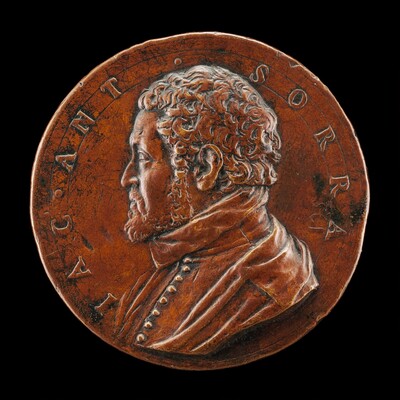
The image shows a medallion featuring a side profile of a man with curly hair and a short beard, wearing a buttoned-up garment with a high collar. The medallion is circular with text inscribed along the edge saying "IAC . ANT . SORRA." The material of the sculpture seems to be a reddish-brown metal, likely copper, giving it a distinct color and texture. The man's profile is presented in relief against the flat background of the medallion, providing clear visibility of his facial features and clothing details.

Jacopo Antonio Sorra [obverse]

Abondio, Antonio

This is a photograph of an ancient coin. The coin features a detailed engraving of two robed figures in profile, facing each other and reaching out their hands. Surrounding the figures is an inscription that includes the year "1532" and the text "CONCORDIA." The edges of the coin are slightly worn, and there is a raised, beaded border encircling the figures and inscriptions. The overall patina is a muted, aged bronze.

Antonio Da Mula and Marcantonio Trevisan [reverse]

Spinelli, Andrea

The image shows a sculpted relief featuring a central figure with long hair, a beard, and a crown of thorns, positioned in front of a cross. The central figure has eyes closed and hands crossed over its torso, displaying marks or wounds. Two smaller angelic figures with wings are on either side, kneeling and holding their hands together. The sculpture is made of a golden material, giving it a rich and luminous appearance. It is set within a rectangular frame, and the background features an arch pattern at the bottom.

The Dead Christ with Two Angels

Bellano, Bartolomeo

The sculpture is a circular medallion featuring the profile of a man. He has a beard and wears what appears to be armor with detailed engravings, including a cross-like design. The material of the medallion is metal with an aged, greenish-brown patina. The medallion is inscribed with text along its border, including the name "RICARDVS SCHELLEIVS PRIOR ANGLIE" in engraved capital letters. The sculpture's subject is depicted in a raised relief format against the flat background of the medallion. There is a small hole at the upper part, suggesting it may have been intended to be hung or worn.

Sir Richard Shelley, c. 1513-c. 1589, Prior of England in Malta and Turcopolier [obverse]

Rantwyck, Bernardo

The sculpture depicts a relief carving of a male figure standing in an elegant pose, holding a staff entwined with a serpent. The figure is shown in profile, facing left, with a defined muscular form. The staff, known as a caduceus, is held in the left hand resting on the ground. The sculpture is crafted from a material that appears weathered and earthy brown in color, suggesting it might be made of bronze or a similar metal that has aged over time. This small, oval-shaped relief has a detailed and textured surface, reflecting light to highlight its contours and enhance the three-dimensional quality of the figure. The edges of the oval frame the figure, adding a sense of completeness to the composition.

Aesculapius

Florentine 15th Century

The sculpture depicts a standing figure holding a staff in a slightly raised relief on a round medallion or disk. The figure is dressed in flowing robes and is positioned centrally on the disk. The sculpture is primarily brown with visible signs of aging, likely made of metal given its corroded surface with green patina. The figure appears to be carved in a style influenced by classical art. The word "CONSTANTIA" is inscribed below the figure. A small hole is visible at the top of the disk.

Constancy Holding a Staff and Resting on a Column [reverse]

Anonymous Artist

The sculpture is a round medal featuring the side profile of a man with long hair and a beard. The subject appears to be an older individual with pronounced facial features and a thoughtful expression. The sculpture is made of metal, likely bronze, as indicated by its rich brown and copper tones with hints of patina. The artwork is finely detailed, capturing the intricate lines of the man's hair and the texture of his beard. Surrounding his profile are inscriptions, including the name "Auguste Vacquerie" and other textual engravings.

Auguste Vacquerie, 1819-1895, Writer and Critic

Ringel d'Illzach, Jean Désiré

The relief depicts a group of figures engaged in hunting. There is a central archer aiming a bow at a target, with a dog by their side. Another figure is stepping back cautiously, while a third figure stands holding a staff. The sculpture is made of bronze or bronze-toned material, set on a rectangular plaque with a textured surface and framed by a border. It appears small in scale relative to human size.

Martyrdom of Saint Sebastian

Enzola, Gianfrancesco

The sculpture depicts a medallion featuring a side profile of a woman. She is wearing an elaborate headdress and a garment with rich folds and textures that suggest a high status. The medallion is crafted from a brown-toned material, likely bronze or a similar metal. Embedded around the edge of the medallion is a series of inscriptions in a refined, capitalized font. The woman's profile is detailed, with the headdress extending widely. The overall design and composition may suggest historical significance.

Anne of Hungary, died 1547, Wife of Ferdinand I of Austria 1521 [reverse]

German 16th Century

The sculpture is a bust depicting a person with an elaborate hairstyle characterized by voluminous curls. The figure has realistic facial features including eyes, nose, and lips, as well as a detailed representation of a draped garment over the shoulders. The sculpture is predominantly a light, weathered grey. The subject of the sculpture is positioned directly facing the viewer.

Linnaeus (Carl von Linn)

Rush, William

This is a photograph of an old coin. The coin features an engraving of a seated figure holding a branch with leaves or buds. Around the edge of the coin are inscriptions in a classical typeface, and the date "1552" is visible. The surface of the coin shows signs of age, with scratches and wear. The engraving is detailed, with emphasis on the flowing lines of the figure's draped clothing and the texture of the branch. The background is dark, highlighting the metallic sheen of the coin and drawing attention to its intricate design.

Victory [reverse]

Delaune, Etienne

This is a photograph of an ancient coin featuring an engraved portrait. The coin displays a detailed profile of a figure with elaborate headwear adorned with floral motifs. The design includes finely engraved details on both the headdress and attire. The coin's border is inscribed with lettering. The overall craftsmanship reflects a careful attention to detail characteristic of such coinage.

Maria of Burgundy, 1457-1482, First Wife of Maximilian I 1477 [reverse]

Austrian 16th Century

The sculpture in the image is of a bird with its wings partially spread. Surrounding the central bird are several smaller birds. The sculpture is crafted from a material that appears to be bronze, as indicated by its brownish metallic sheen. There is a circular composition. Engraved around the edge of the sculpture is a text, "LUATA PVDORE LAETA FOV CVNDITAS," and at the bottom, a small hole is present. The bird is shown in a relief style against a flat background.

Peahen with Six Chicks [reverse]

Poggini, Domenico

This is a photograph of an ancient coin. The coin features designs with heraldic symbols, such as a shield with crosses and a crest above it. The surrounding text is carved in a serif font following the contour of the coin's edge. The surface of the coin displays a patina, suggesting age and handling.

Shield of Savoy [reverse]

Turin 16th Century

The image is a bronze medallion with a side profile of a person's head and shoulders. The person appears to be wearing a headdress or cloak, with draped fabric covering the head and neck. The bronze material gives it a rich brown color with varied shades. The profile has a strong nose and a somewhat solemn expression, facing left. Inscriptions or lettering surround the profile, providing context to the subject. The medallion has a round shape and relief sculpting typical of historical art.

Possibly Diamante de' Medici, Wife of Giovanni Capponi [obverse]

Anonymous Artist

This is a photograph of a metallic plate. The image shows a rectangular copper or brass plate with a slightly aged and tarnished surface. The plate has engraved text, with the name "EMILE VERNIER" prominently displayed in the center. Towards the bottom, partially visible, is the word "SOCIETAIRE". The plate's surface is marked by scratches and blemishes, and the edges are softly rounded.

Inscription [reverse]

Charpentier, Alexandre
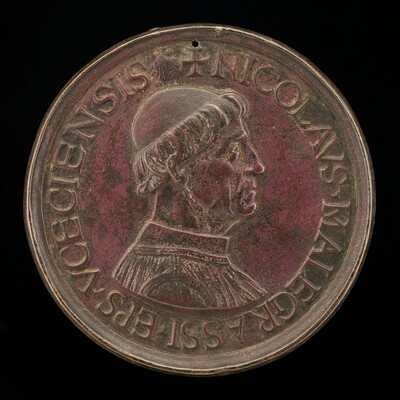
The sculpture is a round medallion depicting a profile portrait of a man inscribed with "NICOLAUS MALREGRESSIS VICECENSIS." The subject of the sculpture has distinct facial features, including a prominent nose and slightly open mouth, and is wearing a robe with a high collar. The figure has short hair that seems carefully styled. The color of the sculpture is predominantly a dark metallic brown with a hint of reddish patina.

Nicolas Maugras, Bishop of Uzes 1483-1503 [obverse]

Candida, Giovanni

The sculpture is a bust depicting an adult male with a mustache and wavy hair swept to the sides. The subject's expression is calm, with closed lips and slightly downcast eyes. He is draped in a robe that is intricately carved to capture the folds of the fabric. The sculpture is made of white marble, giving it a pristine appearance. It is set against a plain background.

William Wilson Corcoran

Rinehart, William Henry

The sculpture on this coin-like medallion is a profile portrait of a woman facing right. She has intricate, curly hair with a headpiece, a necklace, and detailed drapery over her shoulders. The metal medallion, likely bronze, has a dark, aged patina with a reddish-brown color, areas of oxidization, and wear. It features inscriptions around its perimeter, a small hole near the top, and is flat in relief with fine details.

Violante Brasavola, Wife of Giambattista Pigna

Cambio, called Bombarda, Giovanni Battista
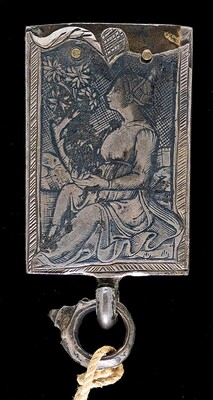
This is a photograph of an engraved metal object. The engraved image depicts a figure wearing a dress sitting on a chair, holding a bird, surrounded by floral elements. The figure is set against a patterned background with detailed engraving that enhances the texture of the garment and the foliage. The object's borders are adorned with a simple, repeating pattern, and there are metallic rivets visible at the top. This piece features an attachment component at the bottom. The photograph captures the intricate details and craftsmanship of the engraving, highlighting the contrast between the polished metal and the darkened etched lines.

Seated Woman Facing Left, Holding a Flowering Branch

Bolognese 15th Century

The sculpture depicts a woman riding side-saddle on a horse. The woman is adorned with a flowing dress, and a bonnet or headpiece covers her head. The horse is depicted in a dynamic pose, with one front leg raised. The sculpture is crafted from a dark material, likely bronze, giving it a deep, dark brown or black color with a slightly reflective surface. This dark finish accentuates the detailed textures of the clothing and the anatomy of the horse. The sculpture stands on a rectangular base.

Equestrienne in 1830 Dress

Barye, Antoine-Louis

The image shows a coin featuring the profile of a man with a beard and a laurel wreath on his head. The coin is made of bronze, with a dark brown color and green patina. The man's detailed face is facing right, wearing ornate attire with intricate patterns. An inscription on the edge reads "HENRICVS.II.GALLIARVM.REX.INVICTISS.PR."

Henri II, 1519-1559, King of France 1547 [obverse]

Delaune, Etienne

The sculpture is a circular relief medallion depicting a scene with multiple human figures and a chariot at the top. The figures are engaged in various activities, with some sitting and others standing. The sculpture is brown and likely made of bronze or a similar metal, giving it an aged patina. The figures are intricately carved, providing depth and movement, with attention to detail. The chariot at the top adds to the action-oriented narrative. The medallion has a small hole at the upper edge.

Mars and Venus

Master of the Orpheus Legend

The relief panel depicts various scenes, including a centaur in the center, surrounded by smaller panels of cherubic figures and circular scenes. The sculpture is made of a bronze-like material with detailed musculature and flowing lines, capturing a sense of movement and vitality. Craftsmanship is intricate, showcasing classical themes and storytelling elements.

Nessus and Deianira

Moderno

This is a round medallion or coin-shaped object made of reddish-brown material, which depicts the profile of an elephant walking towards the right, carved in relief. The elephant has large ears, a long trunk, and tusks that point upwards. The ground beneath the elephant is covered in faint vegetation, and beneath that is the inscription "M.CCCC.XLVI" in Roman numerals at the bottom. There is a hole near the top, possibly for hanging.

The Malatesta Elephant in a Meadow [reverse]

Pasti, Matteo de'

The sculpture on the coin features a figure riding a horse. The figure is clad in armor, holding a sword aloft. The horse is rearing up on its hind legs. The coin material appears to be bronze, with a warm, tarnished brown color. An inscription in raised letters surrounds the perimeter. The sculpture has intricate details in the armor and the horse's musculature.

Sigismund II Augustus on Horseback [reverse]

Herwijck, Steven van

The sculpture is a circular relief featuring four Roman soldiers engaged in an interaction around a pedestal with a flame. Two soldiers stand in the background, one holding a large spear or standard, while another soldier is seated in the foreground to the left. All soldiers are depicted wearing typical Roman military attire, including helmets and armor. The material of the sculpture has an aged bronze appearance, characterized by a dark brown color with some green patina in places. The sculpture is intricately detailed, capturing the scene as if preserved from a moment in ancient Roman military life.

Mucius Scaevola

Pseudo Melioli

The image contains a circular medallic sculpture with a relief featuring two cherubic figures with wings on opposite sides of an arch. One cherub is blowing a trumpet. Below them is a decorative arch framing a central rectangular section with the engraved text "PRINCE DE CONDÉ. M. 1637." Ornate foliage and scroll patterns decorate the sides, above two meticulously carved human faces in profile. The sculpture has a bronze hue, and the signature "I. DASSIER F." is at the bottom edge of the circle.

Memorial Tablet, with Geniuses of Death and Fame [reverse]

Dassier, Jean

Isabella di Capua, 1509-1559, Princess of Molfetta, Wife of Ferrante Gonzaga 1534 [obverse]

Isabella di Capua, 1509-1559, Princess of Molfetta, Wife of Ferrante Gonzaga 1534 [obverse]

Nizzola da Trezzo, Jacopo

The sculpture depicts a small child sitting with one knee raised and the other folded beneath, engaging with a bird perched nearby. The child is looking upwards with a serene expression, with styled short hair. The sculpture is made of bronze, with a shiny, smooth surface and dark brown color with hints of green patina. It has a rich, textured surface, particularly noticeable on the body and base. The sculpture is small enough to be a tabletop decorative piece, similar in size to a small figurine.

Child Clasping a Bird

North Italian 16th Century

The circular medallion depicts a Roman soldier riding a horse in a dynamic pose. The rider holds reins and the horse is mid-stride. The medallion is bronze with inscriptions reading “VICTORIAE AUGUSTE.” Fine details are captured in the armor and horse. There is a small hole near the top. The imagery is in relief against the flat surface.

Equestrian Figure of Marcus Croto [reverse]

Belferdino, Varrone

The image shows a profile portrait of a man on a circular medallion or coin. The man has a beard and curly hair, with facial features visible in profile view. The medallion is bronze with a rich, golden-brown color. There is an inscription in raised letters surrounding the profile. The sculpture resembles a classical portrait coin, similar to ancient or Renaissance medallions.

Marcantonio Flaminio, 1498-1550, poet [obverse]

Torre, Giulio della

The sculpture displays four human figures around a barrel. To the left, a child looks into the barrel. Next to them, a man in a uniform stands with one hand on his cap, engaged with two other figures. A woman stands to his right, wearing a long dress and looking down at a child clinging to her dress. The sculpture features detailed clothing and expressions, suggesting an activity related to taking an oath and drawing rations. The artwork is crafted from dark bronze with a polished finish, highlighting textures and creating a realistic appearance. The figures are detailed and lifelike, placed on a flat base with an inscription.

Taking the Oath and Drawing Rations

Rogers, John
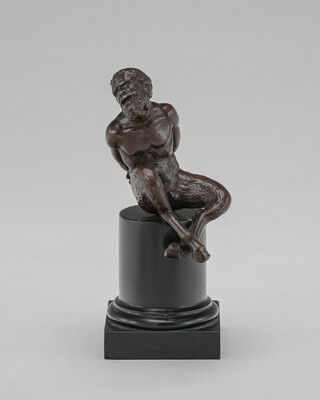
The sculpture portrays a satyr, a mythological creature with a human upper body and a goat-like lower body. The satyr is depicted seated with its arms bound behind its back, legs crossed, and head slightly tilted. The bronze sculpture showcases detailed musculature, facial features, and textured hair. It is placed on a black stone pedestal.

Bound Satyr

Anonymous Artist

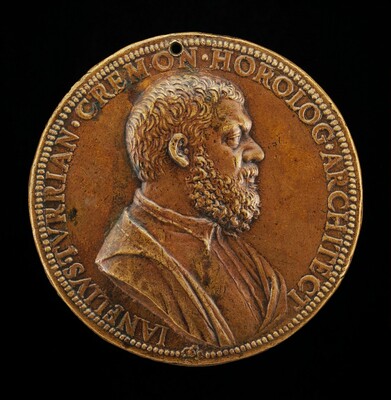
The image depicts a round bronze medallion with a relief sculpture of a man's profile looking to the right. The subject is a male figure with curly, short hair and a full beard. He is depicted wearing a garment with a collar visible at the neckline. The sculpture is rendered in bronze, giving it a warm, golden-brown color with some darker patina. Surrounding the profile is a border with an inscription that reads, "IAN.ELVSJ.VIRIAN.CREMON.HOROLOG.ARCHITECT." A small hole is present at the top of the medallion. The craftsmanship is detailed, providing a realistic portrayal of the subject.

Giannello della Torre of Cremona, 1500-1585, Engineer in the Service of Charles V (obverse)

Nizzola da Trezzo, Jacopo

This is a photograph of an old coin with a detailed profile embossment. The coin features a profile of a distinguished male figure with a beard and a hat, adorned in period clothing with detailed sleeves. The outer edge of the coin contains an inscription in a circular arrangement. The patina on the coin suggests age, giving it a rusted, brown coloration with smooth and worn areas highlighting the raised details. There are two small holes at the top and bottom of the coin.

Jean de Lorraine, 1498-1550, Cardinal 1518 [obverse]

Milanese 16th Century

The image shows a circular bronze medal featuring a scene with a dead tree, branches, a pelican feeding chicks on a mound, and an inscription in Latin "FIRME ET PERPETUE CARMST*" and the Roman numerals "M D XXIII" for the year 1523. The medal appears weathered and aged, with natural patina.

Pelican in Her Piety on a Tree Stump [reverse]

Olivieri, Maffeo

The sculpture features a profile of a man's head on a round object, potentially a medal or medallion. The man depicted has historical significance, shown in a classical style with inscriptions "IOANNES" and "FASTOLVUS." The material seems to be bronze based on its color and sheen. The sculpture represents the man's face in profile facing left, with detailed features like a nose, lips, and an eye. He wears headwear and clothing with a visible folded collar. The craftsmanship reveals intricate detailing common in historical portraiture in medal forms.

Giovanni Fasiol [obverse]

Venetian 16th Century

The sculpture is a circular relief depicting two male figures engaged in a handshake over an altar-like structure. One figure is dressed in classical attire, wearing a tunic and a cloak, while the other is similarly robed. In the background, there is a smaller figure or statue on a pedestal. The sculpture is crafted from a material that appears to be silver or a silver-like metal, giving it a shiny and reflective surface. The details are intricately carved, showing the folds in their garments and the expressions on their faces. The sculpture is designed to be viewed from the front, and the deeply carved elements create shadows that highlight the figures' outlines against the circular background.

Antique Sacrifice

Tommaso di Calisto

At first glance, this bronze sculpture resembles a lump of clay loosely formed into the head and shoulders of a man. In this photograph, his shoulders are squared toward us as he looks to our right. His hair is pushed forward in rope-like spikes over deep-set eye sockets. He has a sharp, thin nose, and his lips purse in an exaggerated scowl. He seems to wear a cravat nestled into the high lapels of his coat. The surface of the bronze is mostly brown except where the edges and ridges are gold, as if having been burnished through handling.

Dr. Clément-François-Victor-Gabriel Prunelle

Daumier, Honoré

The image shows a bronze medallion with a detailed design. The central subject is a shield-like motif with an emblem, possibly a cross, inside a circular crest. Surrounding the central motif are Latin inscriptions referencing the year 1517 and other design elements. The bronze material gives the sculpture a brown color with a weathered patina. The medallion features a three-dimensional relief with intricate craftsmanship.

Arms of Panciatichi [reverse]

Gauvain, Jacques

The round bronze medallion features a raised relief sculpture depicting a scene with human figures and horses in motion. There are three figures depicted - one central figure standing elevated with an outstretched arm, and two figures on horseback flanking the central figure. The surface has a textured appearance. Around the edge, there is a border of dots, and the word "TENEBRARVM" is inscribed across the top. The medallion has a rich, earthy brown color due to the bronze material. The overall appearance suggests age and intricacy in craftsmanship.

Aurora Stepping from a Car [reverse]

Italian 16th Century

The sculpture depicts a standing female figure with her arms behind her back and head slightly tilted downwards. The figure is leaning against a textured form, possibly representing drapery or a natural object. It is crafted from light brown or terracotta-colored material, likely clay, giving it an earthy appearance. The sculpture has a rough texture with visible marks and surface variations, suggesting a hand-modeled quality. The base is dark and polished, contrasting with the natural color of the sculpture. The proportions of the figure are naturalistic, emphasizing form and posture, conveying a sense of timelessness and human presence.

Statuette of a Woman

Rodin, Auguste

The image shows a round, flat sculpture resembling a medallion or coin with a raised Latin inscription. The sculpture appears to be made of a metal material with a warm, brownish coloration and hints of darker areas suggesting oxidation or patina. The surface is worn with blemishes and a small hole near the top. The letters are engraved into the metal, standing out by casting shadows, enhancing the visibility of the inscribed words. The texture suggests it is an antique piece, contributing to its historical appearance.

Inscription [reverse]

Hagenauer, Friedrich

The sculpture is of a human hand and wrist, depicted in a relaxed, natural position with fingers slightly bent. The sculpture's material appears to be a pale, white plaster, with a matte surface that shows subtle texture. The hand is life-sized, comparable to the size of an average human hand, and is oriented upright. The sculpture focuses on anatomical accuracy, with detailed contours and proportions that mimic the appearance of real human skin and bones. The material and color give the sculpture a minimalist and classical appearance.

Right Hand

Rodin, Auguste

This is a photograph of a coin. The coin features a central image of an eagle with its wings spread, standing atop a central emblem surrounded by detailed engravings. At the eagle's chest, there appears to be a shield or emblem. Beneath the eagle, there are additional sculpted figures or symbols flanked by columns and ribbon-like elements. The coin's edge is adorned with inscribed text and a textured, beaded border that encapsulates the design. The surface of the coin shows signs of wear.

Double-headed Crowned Eagle on the Pillars of Hercules [reverse]

Neufahrer, Ludwig

The sculpture is a medallion featuring the profile of a man looking to the left. The name "ANTONIVSDANDTEDECASITLION" is inscribed around the edge of the disc. The medallion is crafted from metal, likely bronze, with a brownish color and areas of lighter hue. The surface shows texture, suggesting age and wear, with a small hole at the top. The image is a detailed relief against a flat background.

Antonio di Dante Castiglione

Anonymous Artist

The sculpture is a round relief featuring two young girls facing each other. The girls are engaged in a gentle interaction, with one girl looking at the other girl as she points towards her chest area. Both girls are wearing long-sleeved attire, detailed with folds and textures. The medium of the sculpture is a dark bronze material. Surrounding the girls are engraved flowers. There are inscriptions around the sculpture's border stating "Daughters of Frederick and Elizabeth Shattuck" and the artist's initial "S. L. Pratt 1887."

Clara and Lizzie, Daughters of Frederick and Elizabeth Shattuck

Pratt, Bela Lyon

The sculpture is a round, medallion-like piece featuring a scene with two animals: a bull and a lion. The bull is facing left with its head lowered, standing on flat ground. The lion is on the right, shown in profile on a rocky incline, gazing at the bull. Above the animals, there is a panel with the inscription "CONSTANTIA" flanked by ribbon-like designs. The piece is made of a material resembling bronze, with a hole at the top for hanging. The intricate engravings and relief give a lifelike appearance to the animals and decorations.

Constantia

North Italian 16th Century

The sculpture is a round relief featuring several figures. In the foreground, there is a seated figure on the left holding an instrument while resting on a structure. To the right stands a female figure holding a torch in her right hand, with long hair falling over her shoulders. Between them stands a smaller figure, possibly a child. In the background, there is a tree and various textured and architectural elements. The sculpture appears to be made of bronze, exhibiting a dark, aged metallic color with highlights. The composition is intricate, with detailed figures and a textured background.

Vulcan, Cupid and Venus

Briosco, called Riccio, Andrea

The sculpture depicts a small group of cherubic figures. There are three child-like figures intertwined, all with distinctive curly hair. One figure is positioned centrally and slightly reclined, while the other two seem to be leaning over or supporting the central one. The sculpture is crafted from a dark material, likely bronze, giving it a rich, dark brown color with a shiny, polished surface that reveals the details of the figures’ hair, faces, and limbs. The texture of the material reflects light, highlighting the contours of the figures. The small size of the sculpture suggests it could easily fit within the palm of a hand, making it appear intimate and detailed when viewed up close.

Three Cupids

Flemish 16th Century

This is a golden medallion depicting a scene with armored people on the left and a columned structure on the right. The group on the left includes several armored individuals, three mounted on horseback, with some carrying tall flags or standards. The people are depicted in profile, walking towards a columned structure where two men are seated, looking towards the approaching group. The sculpture is a relief, and it shows intricate detailing on both the people and the architectural elements. However, some areas of the medallion have dark brown discoloration, obscuring these details. The medallion has a hole at the top.

Mucius Scaevola

Master IO.F.F.

The sculpture depicts a figure in a dynamic pose. One leg is lifted high with the foot pointed forward, the arms are bent at the elbows, and both hands are positioned differently - one pointed downwards and the other upwards. It portrays a dancer caught in mid-motion. The figure is sculpted in a dark brown color, and the material appears to be bronze, giving the subject a polished, metallic sheen. The sculpture is mounted on a simple rectangular base, providing a foundation to keep it upright. A metal rod provides additional support to the figure, attaching from the base to the torso. The detail in the sculpture captures the muscularity and movement of the dancer, highlighting the contours and tensions of the body's form.

Fourth Position Front, on the Left Leg

Degas, Edgar

The sculpture depicts a lion attacking a horse. The lion is positioned atop the horse, with its mane flowing around its face and its paws pressing down on the horse's body. The horse's legs are bent and its head is turned to the side. The sculpture is crafted from a dark material, likely bronze, with detailed textures on both animals. The composition conveys a dramatic interaction between the two animals.

Lion Attacking a Stallion

Susini, Antonio
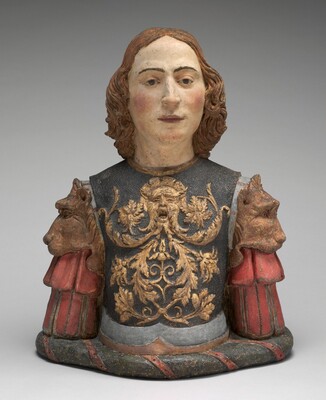
The sculpture depicts a bust of a person with a serene expression and shoulder-length wavy hair. The character is adorned with intricately detailed armor, which features a central motif of a grotesque face surrounded by floral patterns in gold. The armor is primarily a dark, muted hue, accented with red sleeves that resemble fabric folds, and two horse-like figures on the shoulders. The sculpture is created from what appears to be a painted, textured material, providing a realistic yet stylized representation of a historical or mythological figure. The face contrasts with the darker tones of the armor, enhancing the lifelike appearance of the sculpture.

A Man in Armor

Onofri, Vincenzo

The image is of a circular bronze medallion with a relief sculpture of a man showing a side profile. The sculpture depicts a mature man with distinct facial features, short hair, and draped cloth over his shoulders. The medallion features inscriptions reading "BENJAMIN WEST PRESIDENT OF THE ROYAL ACADEMY MDCCCXX". The surface of the medallion is smooth with signs of aging.

Benjamin West Medal Commemorating Those Who Subscribed to Purchase the Painting "Christ Healing the Sick in the Temple" [obverse]

Mills, George

The sculpture is a profile relief of a man with wavy hair, portrayed on a circular medallion. The man faces right with detailed facial features and prominent neck and hair contours. The bronze-colored medallion likely made of metal, possibly bronze, bears the name "WASHINGTON ALLSTON" around the upper half, with inscriptions crediting "F. Dougan Del. C. C. Wright Sc." The medallion is smooth and polished, contrasting with the intricate details of the profile.

Washington Allston, 1779-1843, Painter [obverse]

Duggan, Paul Peter
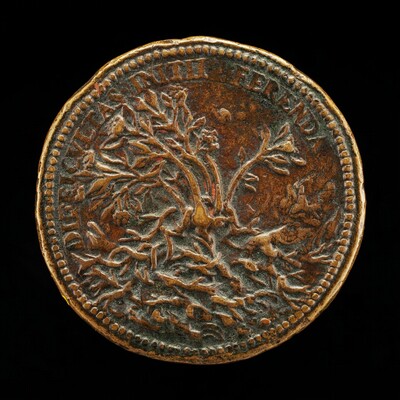
This is a photograph of an ancient coin. The coin displays intricate engravings featuring a detailed depiction of a tree with branching limbs and small buds or flowers against a textured background. The perimeter of the coin features a beaded edge and an inscription that wraps around the edge. The surface shows signs of aging, with a patina that suggests it has been handled or exposed to elements over time. The craftsmanship of the coin's details, particularly in the naturalistic representation of the tree, reflects a high level of skill in metalwork.

Flowering Shrub Growing through Thorns [reverse]

Galeotti, Pier Paolo

This is a photograph of an ancient coin. The image shows a coin with a detailed profile of a person's head in the center, surrounded by a circle of inscribed text along the circumference. The profile is intricately engraved, showcasing medium-length, wavy hair and the outline of a garment with a discernible collar. The text on the coin appears to be in a classical style, possibly Latin. The detailed craftsmanship suggests the coin is from a historical period when coins often featured prominent leaders or significant figures of the time. The lighting emphasizes the embossed features of the coin, highlighting the relief work against a darker background.

Giangaleazzo Maria Sforza, 1469-1494, 6th Duke of Milan 1476 [obverse]

Milanese 16th Century

Pax with the Crucifixion with Six Angels

Pax with the Crucifixion with Six Angels

Venetian 18th/19th Century

The sculpture is a rectangular relief panel with a detailed scene. Two Triton-like figures are on each side of the central part. They have human torsos and serpentine tails, facing the center and gesturing outward. At the top-center, there is a stylized frontal mask or head surrounded by floral or scroll-like elements. Flanking the central figures are ornate vases with floral designs, birds, and elaborate scrollwork. The material appears gilded, giving it a golden color. The composition shows harmony and balance, with fantastical figures and decorative elements arranged symmetrically.

One of Two Ornamental Friezes

Florentine 16th Century

The sculpture depicts a scene of crucifixion, with a central figure on a cross flanked by two other figures, also crucified in varying postures. Surrounding these central figures are numerous human figures, some soldiers with spears and shields, while others appear distressed or mourning. The figures are intricately detailed, with attention given to their expressions and the texture of their garments. The sculpture is crafted from bronze, lending it a dark, metallic brown color with a natural patina that highlights the relief work. All figures are positioned in high relief against the relatively flat background.

The Crucifixion

Moderno

The sculpture features a profile relief of a female figure on an oval medallion. Her hair is styled and adorned with a ribbon or headdress. The medallion is made of bronze with a green patina. The figure has classical features and looks to the left. The sculpture is small with a small hole at the top.

Diana

Italian 16th Century

The sculpture depicts a scene on a circular surface, featuring a figure at the top amidst clouds. Below, several people are shown in various poses, some holding objects or wearing distinct costumes. The color of the sculpture is a metallic gray, with rich textural details through incision and relief work. The surface includes intricate lines and etchings that create depth and pattern, capturing the scene compactly.

Possibly Martyrdom of Saint Stephen

Lombard 16th Century

The sculpture is a relief depicting a central figure standing on what seems to be an elevated platform, holding a staff or pole. Surrounding this central figure are smaller figures, including two seated or kneeling figures holding shields and staffs, and others in different poses that suggest motion. The sculpture, made of a material resembling bronze, has a dark metallic color with worn or polished areas highlighted. The relief features intricate detailing with figures in varying poses etched into a rectangular plaque, adding depth and movement. The top part includes cloud or smoke-like formations with smaller figures, possibly depicted in mid-air or within the clouds.

The Resurrection

Master I.F.P.

The sculpture features a relief depicting a woman seated and holding a child on her lap. Another small child stands slightly to the side, reaching up towards the woman. The figures are set within an ornate frame filled with intricate designs and patterns, including floral motifs and architectural elements in the background. The sculpture displays a rich, dark bronze color. The surface shows intricate detailing, highlighting the features of the figures' clothing and the ornate frame. The sculpture appears to be a small, decorative piece designed to be displayed flat against a surface.

Madonna and Child with Saint John

Venetian 16th Century

The sculpture is a circular medallion featuring a profile relief of a man wearing a traditional doge cap. The subject is an older man with prominent facial features including a pointed nose and a pronounced chin. The medallion is made of a metallic material with a bronze-like color and a slightly weathered texture. Surrounding the man's profile are embossed inscriptions, likely in Latin. There is a small hole near the top edge. The size of the medallion suggests it could be held in one's hand.

Marco Barbarigo, c. 1413-1486, Doge of Venice 1485 [obverse]

Anonymous Artist
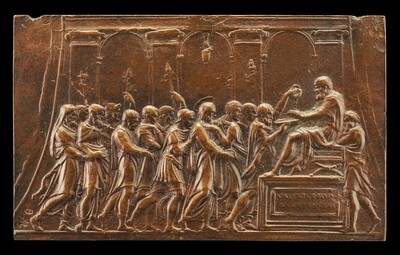
The sculpture depicts a bas-relief scene with multiple figures forming a procession or gathering. On the left, a line of individuals face towards a seated figure on the right. The prominent figure is elevated with one hand extended. The figures are draped in classical robes, giving it an ancient or historical setting. The sculpture is made of bronze, with a dark brown appearance and highlights where light catches on raised surfaces. The background features arches or columns, adding to the classical architectural context. The scene appears to be a formal or ceremonial gathering with a focus on the seated figure.

Christ Brought Before Pontius Pilate

Belli, Valerio

This is an image of an ancient coin featuring a central design of an ornate urn or vase with two handles, surrounded by partially visible inscriptions around the edge. The surface of the coin is worn with visible patina and signs of aging, giving it a rich, earthy color with hints of green. The inscriptions are in a classical style, possibly Latin, suggesting historical significance. The overall appearance of the coin suggests it has been buried or exposed to the elements for a significant period.

Vase in a Landscape [reverse]

Master IAC. URB.

The sculpture is a rectangular relief depicting a warrior in armor on top of a rearing horse. The warrior holds a weapon above their head while the horse opens its mouth and lifts its front legs off the ground. Below the horse, another armored figure is shown lying on the ground, partially hidden under the horse's hooves. The relief is carved from bronze-colored material. There are four small holes in the corners of the sculpture.

Horseman and Foot-Soldier

Briosco, called Riccio, Andrea

The sculpture is a relief profile of a man with long, wavy hair cascading down his shoulders. The material of the sculpture appears to be a metallic alloy, giving it a silvery or bronze patina. The artwork is a bas-relief with intricate detailing in the facial features, hair, and gown attire.

Louis II de Bourbon, 1621-1687, Prince de Condé [obverse]

Dassier, Jean

This is a painting of a nativity scene. The image features a baby lying on the ground with rays emanating from it, surrounded by figures dressed in robes. A cow and an ass are beside a wooden structure, possibly a stable. One of the figures is in a kneeling position with hands clasped. An angel hovers above with a banner, and there are multiple haloed figures. The style is reminiscent of an early Renaissance religious woodcut, known for biblical and Christian iconography.

The Nativity

Bolognese 15th Century

The image depicts a person standing upright, holding a staff in their right hand. Their facial features are distinct, with downward glancing eyes and a defined jawline. The person's hair is medium length and slightly wavy, framing their face. They are dressed in a classical or medieval-style tunic with a cloak draped over their shoulders. The tunic has a skirt-like bottom with textured horizontal lines, and they are wearing tall boots. The background shows bold lines and patterns indicating rocks or cliffs, with a structure resembling a church or castle tower partially visible to the right.

Saint Roche

Italian 16th Century

The sculpture is a bell-shaped mortarium made of dark bronze. It features intricate designs including reliefs of horses and chariots in motion, as well as ornate garlands and classical motifs. The sculpture is a small, open-topped vessel with a slightly outward sloping rim, resting on a narrow base. The craftsmanship is highly detailed, making it both functional and artistic.

Mortar with Putti and Griffins

Italian 16th Century
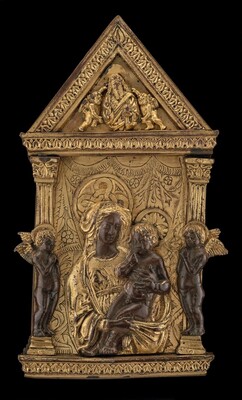
The sculpture shows a seated figure holding a child, surrounded by two smaller winged figures. The subject is central with a prominent position in the composition, flanked by columns. The sculpture is crafted in a gold color, possibly a metal like brass or gilded. The figure at the top of the triangular pediment appears to be holding a scroll, flanked by two small figures. The sculpture features detailed patterns etched into the background and framework, including repeated geometric designs and motifs. The expression and posture of the figures suggest a calm and composed arrangement.

Madonna and Child with Two Angels

Florentine 15th Century

The image shows a round bronze coin featuring a sculptural relief of a woman in profile, facing left. The woman is adorned with an intricately styled hairdo and wears a necklace with multiple strands. Her attire appears to be draped in classical fashion, with visible folds and texture depicted on the coin's surface. The sculpture is crafted from a material that gives a metallic sheen, typical of bronze, and the coin's surface shows variations in texture and patina. Around the edge of the coin, there is an inscription. The overall appearance of the coin reflects historical craftsmanship and artistry.

Faustina Romana [obverse]

Italian 16th Century
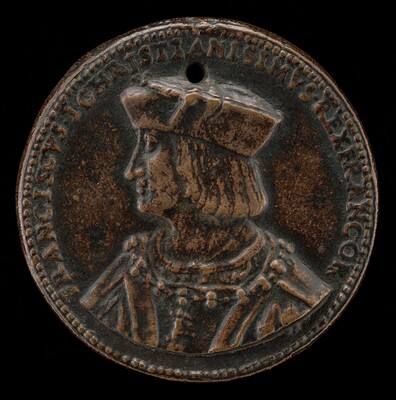
This is an image of an ancient coin or medallion. The object features a detailed profile relief of a regal figure facing left, wearing an elaborate crown or hat and a lavishly decorated robe adorned with patterns and possibly gemstones. Surrounding the figure is a border of text engraved along the edge of the coin. The surface of the medallion shows a patina, indicating age, and there is a small hole near the top. The craftsmanship and detail hint at its historical significance, likely commemorating a person of importance or serving as currency or a medallion during a specific period.

François I, 1494-1547, King of France 1515 [obverse]

Pomedelli, Giovanni Maria

The sculpture is a relief portrait on a medallion featuring a woman in profile facing left. She wears an elaborate headdress and the medallion appears to be made of a bronze or brass alloy. Surrounding the medallion is an inscription, “DIANA . DVX . VALENTINORVM . CLARISSIMA.” The craftsmanship shows intricate details in the headdress and the woman's facial features. The medallion appears slightly aged, with wear and patina consistent with its metallic composition.

Diane de Poitiers, 1499-1566, Wife of Louis de Breze, Duchess of Valentinois 1548 [obverse]

French 16th Century