← All styles

Painting

162 works

A garden with two fountains stretches back to a manor house in the distance in this horizontal landscape painting. The horizon comes about a third of the way up the composition, and gray clouds tower in the vivid blue sky above. A pine tree closer to us to the left of center rises high against the sky. There are a few more evergreens to the right among dark-green canopied trees. A yellowed pine tree has fallen on the grassy lawn in the lower left quadrant of the composition. Just beyond this, the fountain to the left has a tall, columnar base under a dish-like basin. Water fountains sprays up and out from the center of the dish and trickles down the sides. The fountain is topped with a statue, perhaps of a child. Three people stand at the base of this fountain, which is three times their height. The fountain to the right has a blocky base about the height of a person. Water streams out from the front and two sides in this view. On the base is an urn-like form that shoots water high into the air. Five more people stand, run, or walk across the garden between the fountains. The women’s long dresses have red, white, or black skirts and pale pink or black bodices. Two wear black head coverings, and the third wears a white head covering. One man wears brown and the other black, and both have wide-brimmed hats. Near the right edge of the painting, three more people wearing black stand around an arched opening that appears to be covered in moss and/or other plants. The people all appear to have light skin but not all faces or hands are visible. A broken column lies in the bushes in the lower right corner of the composition. The final person stands entirely in shadow in the distance between two rows of trees that flank an opening to the house. The structure appears to have two tall stories with four chimneys on the dark green-gray roof and light brown walls. Angular bays of windows are outlined with white trim on the symmetrical façade.

Country House in a Park

Ruisdael, Jacob van

Gentlemen's Still Life

Gentlemen's Still Life

Inman, John O'Brien

The head and pale face of a bearded man with a ring of interwoven branches of thorns over his chin-length, wavy, reddish-brown hair floats against a white cloth that has been hung over a wooden rod in this vertical painting. The cloth fills the composition. At its center, the man’s head faces us and he looks down with heavy-lidded, brown eyes. His lips are parted, and his cheeks are slightly sunken and shaded with pale lilac purple under high cheekbones. Blood drips down the man’s pallid forehead from the thorns. A brown spot high on his right cheek, on our left, might be a bruise or injury. A soft brown glow surrounds the head. The white cloth is frayed along its front edge, where it rests facing us on a wooden surface along the bottom edge of the painting. The cloth is bunched a little to each side where it drapes over the wooden rod above. The white cloth is painted with tones of pale coral pink, icy blue, silvery white, and dove gray. The background behind the cloth is black.

The Veil of Veronica

Fetti, Domenico

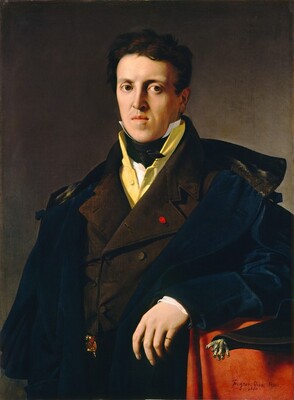
Shown from about the waist up, a man with pale, peachy skin, wearing a marine-blue greatcoat over several layers of clothing, looks out at us in this vertical portrait painting. The man’s body is angled to our left, and he looks at us from the corners of his dark brown, hooded eyes. He has an oval face with a slightly jutting chin, a long, straight nose, and his full-lipped mouth is lightly pursed. He is lit from our left, casting the right ear and side of his face in shadow. His chestnut-brown, wavy hair is short, and brushed forward over the ear we can see. Several shirts and coats are layered over his shoulders. Closest to his skin, a high-collared white shirt, with points reaching past his jawline, is tied with a wide, black neckcloth. Next is a custard-yellow garment, also with a high-neck, perhaps a vest. Over that he wears a brown coat with wide, pointed lapels. A bright, scarlet-red oval is fastened to one buttonhole on the lapel to our right, and a gold and rose-pink ornament peeks out from the bottom hem at his waist. Finally, the blue greatcoat has an elbow-length cape, and nearly falls off his shoulders. Fabric across the back of the collar is a hood lined with dark silver satin. He props his left elbow, to our right, on a table or ledge, and that wide cuff is rolled back over the white edge of this shirt. He wears a gold band on the pinky finger of that hand. The ledge is draped with a deep, marmalade-orange cloth. Gold tassels dangling from the end of a scrolled, bound document hangs off the edge of the ledge, near the man’s wrist. The background deepens from sage green along the lower left edge of the painting to fawn brown around the man’s head. The artist signed and dated the lower right corner, “Ingres. Pinx. Rom. 1810.”

Marcotte d'Argenteuil

Ingres, Jean-Auguste-Dominique

A mostly nude young woman with pale skin leans, half-sitting, back on one hand while she reaches for a silver vessel held by a second woman in this vertical painting. The woman who offers the vessel also has light skin, and both have auburn-brown hair bound up and interwoven with strands of pearls. The body of the woman at the center of the painting, Susanna, faces us and she turns her head to our left, to look at the vessel with shaded, dark eyes. She has a straight nose, and her ruby-red, full lips are closed. A glint on one earlobe suggests a jeweled earring behind curls that frame her face and brush her shoulders. She has small, firm breasts and wears a bronze-colored bracelet on each wrist. Crimson-red cloth hangs from the backs of her shoulders and drapes over her seat. Sheer white fabric covers her lap across her upper thighs. The toes of one foot rest on the ground while the other foot dips into the water of a pool. The other woman, holding the round vessel, faces away from us as she leans into the painting so only her head, shoulders, and arms are visible. Her dark pink sleeve wraps around the upper arm we can see, and she wears a gold-colored bracelet on that wrist. A swath of brick-red fabric hangs between the two women. A dark, shadowy bush dotted with deep pink roses fills the space behind Susanna and, in the distance to our left, two people stand under an arched trellis covered with vines. Wearing light-colored robes and hoods, the people in the distance are painted with silvery gray and cream white, and are translucent against the sky.

Susanna

Tintoretto, Domenico

Three Pears and an Apple

Three Pears and an Apple

Johnson, David

The image shows a landscape with three men in the foreground. One of the men is aiming a rifle, while the others are in the grass. In the background, a herd of bison is grazing in a sunlit meadow. The horizon is marked by hills with trees, and the sky has light brushstrokes suggesting a clear day. The color palette is dominated by greens and browns, with trees on the right side of the image.

Catlin and Two Companions Shooting Buffalo

Catlin, George
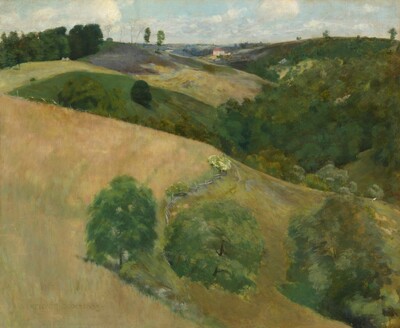
This painting depicts a landscape with rolling green hills viewed from an elevated perspective. Closest to us, the light green hills on the left are covered with yellowish grass. A dense forest of dark green trees is on the right at the bottom of the slopes. In the distance, towards the high horizon, the hills appear to flatten out, leading to a small white building with a red roof. The sky above is light blue with soft white clouds. The brushstrokes are soft.

Flying Shadows

Cox, Kenyon

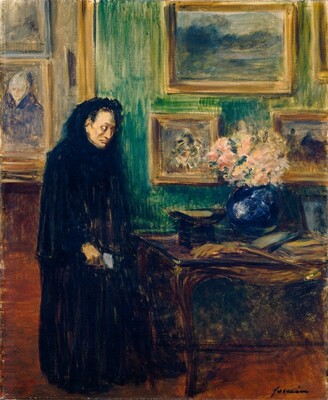
The Petitioner

The Petitioner

Forain, Jean-Louis

A pale, nearly nude young woman perches on a rock under a tree surrounded by small animals including dogs, deer, and birds, in this horizontal landscape painting. Her body faces us as, lips parted, she looks away to our left. She is covered only by an olive-green drape over her left thigh, on our right. She cradles what appears to be a tall stone tablet in her left arm and touches the inscribed surface with her right hand. White, buttercup-yellow, and crimson-red flowers crown her long blond hair. Her smooth pink skin stands out against the brown bark of the tree trunk behind her. By her right knee, a small brown doe stands looking at her. Closer to us, a white, wading bird dips its beak into a pool of water in the lower right corner of the painting. A large book of diagrams lies open next to the woman's foot, on the slate-gray ground. A small, white dog crouches next to the book on our right in front of a sleek, brown dog and a buck with antlers, and all face the woman in profile. In the trees above, a white hawk perches near the upper right corner of the canvas, and an owl sits on a branch over the woman’s head. Beyond the woman to our left, a steep bank is topped by wispy trees and shrubs. A sandy path meanders past the bank toward a wooden building in the distance. Delicate trees with rust-red and gold canopies frame the building, while a topaz-blue haze behind it suggests a forest beyond. Full, gray clouds fill the sky overhead above a band of pale light on the horizon.

Circe and Her Lovers in a Landscape

Dossi, Dosso

A tall silver vase with gold details holds a bouquet of white flowers with green leaves and red blossoms. The color palette includes metallic silver, gold, white, green, red, and teal. Positioned on the table, the vase stands centrally, with a blue box behind it to the left and a jewelry box with a pearl and flower ring design slightly to the right. There is also a piece of fabric with a tassel and small scissors lying flat behind the vase.

Still Life with Fan and Pendant

Brookes, Samuel Marsden

This painting depicts a body of water surrounded by mountains and dotted with small, tree-filled islands. At the bottom of the painting is a green area with several tall trees and a small dirt path. Beyond this area, a hill slopes down to the water below. The water is painted in light blue and gray tones, and the hazy mountains beyond the water are painted in light greens and blues. The blue sky above the scene is full of puffy white clouds.

Lake George

Casilear, John William

A long, rectangular dining table is surrounded by thirteen people in this horizontal painting. The skin of all the people, some of their clothing, and the tabletop are painted golden yellow. Touches of aquamarine blue, salmon pink, and rust red appear in some clothing, and the scene is set against a nearly black background. Across from us at the center of the table, a radiating, gold starburst surrounds the head and shoulders of a man, Jesus, with shoulder-length blond hair and beard. He looks at or toward us with dark eyes as he holds his hands up, palms facing out, at his chest. He wears a champagne-white robe and reclines with his legs extended to our left as he rests his opposite elbow on what could be a cushion or rolled-up blanket. To our right, a second person mirrors Jesus’s reclining position but with wrists crossed over the chest and turning to look toward Jesus. That person wears a long teal-blue garment and has smooth cheeks and long blond hair. Another bearded man to our left, near the back corner of the table, leans away from Jesus with hands held up as if in prayer. Three people lounge or sit on each of the short sides of the table to our left and right, and four recline on the side closest to us. Some have beards and others are cleanshaven, and some have short hair while others have long locks. Most of them look toward Jesus while two bend low to the table in prayer. One man, in the lower right, wears brick red and turns his back on the table as he counts or touches coins in a sack. The long table is set with goblets and plates of food. The artist signed the work with his initials in the lower left corner: “WB inv.”

The Last Supper

Blake, William

The image shows a wide expanse of land with a line of trees, rolling hills, tipis, figures in canoes on a river or lake, and people gathered around the tipis. The brushstrokes are smooth and meticulous, capturing details in the landscape and structures. The color palette is warm and tranquil, with shades of light yellow, green, and brown dominating the land, transitioning into the orange and pink tones of the sky. The sky features a few wispy clouds.

Sioux Village - Lac du Cygne

Catlin, George

Three pale-skinned men wearing long, dark robes stand in and near a dense cluster of vivid, mint-green buildings with arched openings and clay-red colored roofs that nearly fill this vertical painting. Near the lower center of the composition, two bearded men stand in an open doorway looking out at the younger, cleanshaven man who stands barefoot to our right, facing them. At the door, the man in front has a long, white beard, and he holds a red book, or manuscript, in his left hand while holding up his right hand with his first two fingers raised. The man behind him has a red beard and hair. The younger man to our right bows his head, encircled with a gold halo, toward the pair in the doorway. The younger man holds one hand over his heart, and in the other holds a long, gnarled walking stick. The skin of all three men has a greenish cast. The green buildings are tall and narrow. Beyond the buildings, near the top of the panel, a row of tall, dark green trees are silhouetted against the shiny gold sky. The gold background is punched with a decorative band of small circles and arches along the top edge of the panel.

Saint Anthony Leaving His Monastery

Master of the Osservanza
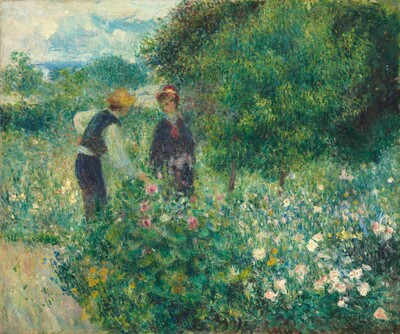
A light-skinned man and woman stand looking at each other, surrounded by blooming flowers and lush green trees in this square landscape painting. The palette is dominated by shades of vibrant green and blue, and is loosely painted with daubs and short strokes, making details indistinct. The people stand to our left of center and both are dressed in navy blue. The man stands facing our right, almost in profile, and bends forward slightly with one hand gesturing toward the flowers. He wears a vest and trousers, a white shirt, and a butterscotch-gold hat. The woman stands near him to our right, and faces us with her head turned to look at the man. She wears a long gown, a cherry-red hat, andwhat appears to be a denim-blue and cherry-red scarf around her neck. The trees fill right half of the painting, and the profusion of flowering bushes closest to us almost spans the width of the scene. Their blooms are suggested with touches of rose and petal pink, cream white, mustard yellow, and azure blue. More flowering bushes behind the man and woman are suggested by loosely painted areas of parchment white and laurel green, with scattered dots of poppy red. Pale pink clouds swirl through the topaz-blue sky in the upper left corner. The artist signed the painting in the lower right, “Renoir.”

Picking Flowers

Renoir, Auguste

A young woman with light skin stands in a garden, wearing a voluminous, full-length, silvery, shimmering gown in this vertical portrait painting. Her body faces us, as she looks into the distance to our left. She has rosy cheeks, gray-green eyes under gently arched, light brown brows, and her coral-pink, thin, closed lips curve in a slight smile. Her ash-brown hair is pulled back and adorned with tiny shell-pink and azure-blue flowers along the left side top of head, to our right. A pleated lace ruffle encircles her smooth neck. Her gown is parchment white where the light glints off the stiff fabric and is silvery gray in the shadows, creating a silk-like sheen. The dress is cut low across the chest, fits tightly around her narrow waist, and has puffy sleeves tied at the elbows with topaz-blue bows. Another blue bow is tied at her chest, and the ends wrap around her back along her waist. A corsage at her left shoulder, to our right, is a profusion of white flowers around a pale pink rose. In her other hand, to our left, she holds a straw hat with a shallow crown and a wide brim, trimmed with sky-blue ribbon. The arm holding the hat is nearly engulfed in the deep folds of her full skirt. She holds a pink rose in her other hand, which rests on the lip of a shiny, copper-colored urn filled with pink flowers and delicate green leaves. On that wrist she wears a bracelet with four strands of white pearls holding a cameo. She stands on a pale, dirt ground. A teal-blue bench in the lower left corner of the painting is tucked into sage-green shrubbery. Sprigs of pink roses are strewn across the seat and on the ground. The woman is framed to either side with olive and celery-green trees and vegetation, which blend into the hazy distance beyond her head.

Madame Bergeret

Boucher, François

We look out onto a sweeping, panoramic view with trees, their leaves fiery orange and red, framing a view of a distant body of water under a sun-streaked sky in this long, horizontal landscape painting. The horizon comes about halfway up the composition, and is lined with hazy mountains and clouds in the deep distance. Close examination slowly reveals minuscule birds tucked into the crimson-red, golden yellow, and deep, sage-green leaves of the trees to either side of the painting. Closest to us, vine-covered, fallen tree trunks and mossy gray boulders line the bottom edge of the canvas. Beyond a trickling waterfall and small pool near the lower left corner, and tiny within the scale of the landscape, a group of three men and their dogs sit and recline around a blanket and a picnic basket, their rifles leaning against a tree nearby. The land sweeps down to a grassy meadow crossed by a meandering stream that winds into the distance, at the center of the painting. Touches of white and gray represent a flock of grazing sheep in the meadow. A low wooden bridge spans the stream to our right, and a few cows drink from the riverbank. Smoke rises from chimneys in a town lining the riverbank and shoreline beyond, and tiny white sails and steamboats dot the waterway. Light pours onto the scene with rays like a starburst from behind a lavender-gray cloud covering the sun, low in the sky. The artist signed the painting as if he had inscribed the flat top of a rock at the lower center of the landscape with his name, the title of the painting, and date: “Autumn – on the Hudson River, J.F Cropsey, London 1860.”

Autumn - On the Hudson River

Cropsey, Jasper Francis

This painting depicts two people balancing on a running horse. The horse is mid-gallop, heading to the left, with a red cloth on its back and a silver halter on its face. It is a rich brown color, with a short mane. Standing on its back is a person with short, curly blond hair and pale skin, wearing a pale-yellow tunic or dress with puffy sleeves, silver embellishments, and white tights. They are standing with one arm extended to the side and the other raised, and one of their legs is slightly bent. On their shoulder stands a much smaller person with the same skin, hair, and pale-yellow costume. This person has one leg extended outward, and they are holding a blue fabric in both hands which twists through the air. The background shows an indoor setting, with teal fabric hung below red drapes, and on the left is the front of a building with peach walls. The floor is gray, and slopes slightly downward on the left and right.

The Mounted Acrobats

American 19th Century

Shown from the chest up, a light-skinned man with a wrinkled face and a silvery gray beard and hair gazes into the distance in this oval portrait painting. His chest is angled to our right but he turns his head to look off over his other shoulder, to our left. His slate-blue eyes are a little sunken and lined with wrinkles. Shading marks the hollows of the temple and cheek we can see. His thin lips are closed and framed by his curly mustache and beard. A dark, mahogany-brown cap is pushed back on his head, and his brown jacket has gold-colored buttons down the front. The collar of a cream-colored shirt shows through at the neckline. The background is dark olive green. The artist signed the work near the man’s shoulder, to our right: “GDOV.”

Bust of a Bearded Man

Dou, Gerrit

This painting shows three people sitting together. Two individuals on the left are women, likely nuns, with light skin, wearing black habits over tan head coverings and long-sleeved white robes. One of the women holds a book. The person on the right is an older man with light skin and a white beard, wearing a light red cloak over a long white robe. He holds a book and gestures towards the women. In the background on the left, there is a tan cityscape with buildings and a cloudy sky. On the right is a dark wall with a red hat hanging behind the man. The top of the painting is curved.

Saint Jerome with Saint Paula and Saint Eustochium

Zurbarán, Francisco de

This is a painting depicting an angel crowning a seated woman in a dark landscape. The angel has white wings with hints of pink and green, pale skin, and short, golden hair. They are draped in a flowing white robe, and have one hand extended upward and the other placing a golden crown on the woman's head. The woman sits below the angel, near the bottom left corner of the painting. Her eyes are closed, and she has one hand placed on her chest. She also has pale skin and golden hair, and she wears a draping white garment that hangs loosely off of her shoulders and is tied at the waist with what looks like white rope. Over her legs there appears to be a blanket in shades of coral pink and golden yellow. The background is dark, but seems to be a rocky terrain with sparse green grass and trees, under a dark sky with dramatic purple clouds and a hint of pink light emerging behind some rocky mountains on the right. The angel and woman are brightly illuminated against the dark background.

Mercy's Dream

Huntington, Daniel

This painting depicts a sandy beach under a vast, light blue sky. The horizon is in the center of the painting where the blue sky blends into the blue water. In the center of the painting, a group of women are on the beach, some standing and some seated. The women have light skin and wear clothing in shades of brown, dark blue, and red. They all wear headscarves covering their hair, mostly white except for one that is dark blue. Some of the women carry baskets, while others set them on the sandy ground. In the background, there are faint shapes near the shoreline created by small daubs of paint that suggest other people. The brushstrokes in the painting are thick and visible, especially those that create the shapes of the women. Small details are suggested with dashes and dots of paint instead of being shown clearly.

Women on the Beach at Berck

Boudin, Eugène

This painting shows a group of children in the woods. To the left of center, a boy plays the violin, standing on the edge of a gray path. He faces the right, where a group of children sit, looking at him. Three children sit on a pale log, while two sit on the green grass, which is dotted with small white flowers. The children mostly wear clothes in shades of tan and brown, although one child wears a pink dress and a blue jacket. All of the seated children wear straw hats. They all have pale skin. The trees fill the background with autumnal colors, including brown, orange, yellow ochre, and dark green. On the left, at the end of the path, a white cottage is visible in the distance behind a wooden gate.

His First Appearance in Public

Ward, Charles Caleb

A man and woman with pale, pink-colored skin hold hands and dance in this stylized, abstracted vertical painting. The woman’s breasts are exposed, and a single teal-green cloth edged in sapphire blue appears to encase both of their torsos. The man is behind the woman just to our left, and he looks down at her. Her shoulders face us, but she looks back at him, both in profile. Their faces are each painted with one or two strokes each for eyebrows, eyes, lips, and, for the man, a nose. Their hands are lifted and joined, blending into single forms, and the woman takes a wide step to our left. Their bodies are outlined with maroon red, black, or slate blue. The background is ice blue interspersed with angular, tent-like forms painted in royal blue, pale blue, and maroon. The frame is shown and reveals that the painting was done on the back of a stretched canvas. A label affixed to the top rail reads “Nachl. E.L. Kirchner TA/BH 19.”

Dancing Couple in the Snow [reverse]

Kirchner, Ernst Ludwig

A woman sits and supports a baby standing on her lap, both against a gold background in this arched, vertical painting. The woman and baby’s light skin is shaded with faint green, and they have pale pink cheeks. The woman’s body faces us. She tips her head toward the baby who stands on her knee, to our right. The woman looks at us with light brown eyes under curving brows. She has a long, straight nose, and her small pink lips are closed. Her blond hair is mostly covered by a midnight-blue robe that drapes over her shoulders, across her lap, and pools on the floor. The robe is lined with goldenrod yellow, edged with bright gold, and has gold starburst-like designs on the shoulder we can see and top of the head. The dress she wears underneath has more gold stars creating a pattern across the pearl-white fabric. A sky-blue scarf wraps over her head and loops across her shoulders. The baby holds one end of the scarf, and his other elbow rests on the woman’s shoulder. She props him up with both hands. He has a cap of blond curls and chubby cheeks with delicate features. His geranium-red garment falls over a pale blue skirt that reaches his bare feet. In the hand near the woman’s shoulder, he holds a scroll with the letters “EGO S.”  The floor beneath them is mint green and has gold writing across the front, reading, “AVE.G ANN O.D M.CCCC.XIII.” The woman and baby’s disc-like gold halos blend into the gold background, which is visibly cracked in some areas. The panel comes to a pointed arch at the top.

Madonna and Child

Lorenzo Monaco

We look down at a cluster of three farm buildings and across grassy fields that stretch into the distance in this horizontal landscape painting. A parchment-yellow road angles from the lower center of the composition into the upper right corner, where it meets the horizon line just below the upper edge of the painting. Closest to us, the buildings flank the road, with two barns to our left and a house to our right. The buildings all have burgundy-red roofs. The barns have brown siding, and the house has paler, tan siding. The buildings are surrounded by blue or red fences. The barns to our left have large doors and two windows are visible on one of the sides facing us. A two-story, turquoise-blue bird house is affixed to the side of the barn closer to us. To our right, the house has windows piercing both levels, and a porch facing the road, to our left. Birds gather on the roof of the house, and an American flag flies beyond the back corner of the house. A black horse and two red horses, four cows and bulls, two dogs, a dozen chickens, and two pigs occupy different areas of the fenced-in spaces around the buildings. A man stands near the dogs next to the house, and a person wearing a red-edged black garment and a red cap stands on the road between the structures. In the fields beyond, people ride horses or hunt, horses graze, and a cow frolics with a dog. More buildings dot the landscape, which is farther divided into plots of land by stone walls, black fences, and more roads. Rows of stylized trees grow in straight lines in a grove to our left. Birds and deer walk or stand among the trees, and two people stand nearby, holding rifles. The slopes of indigo-blue hills rise along the horizon, at the top of the painting.  The sky to the left of blue hills is mauve pink, streaked with black clouds. The rest of the sky is pale shell pink and ivory. Many of the animals and the architectural elements are outlined in black and filled in with flat areas of color. The weave of the window shade on which this is painted is visible in many areas.

Mahantango Valley Farm

American 19th Century

This is a painting of Native Americans participating in a ceremonial gathering. The painting depicts a group of people gathered outdoors on a grassy field, encircled by hills under a sky with scattered clouds. At the forefront stands a figure adorned in traditional attire, including a feathered headdress and garments with detailed patterning. The figure appears to be holding ceremonial objects and addressing or leading the assembly. Around this central figure, the people are positioned in various postures, seemingly listening or observing attentively. The scene is framed within an oval border, highlighting the central action while subtly incorporating a background structure that resembles an earthen or wooden lodge. The atmosphere is serene, with muted colors suggesting a peaceful observance. This is in the style of George Catlin, known for his portraits of Native American life.

A Mandan Medicine Man

Catlin, George

In this painting, two clusters of dark blue-black grapes hang from a thin brown branch against a beige background. The branch stretches horizontally across the top of the painting, and olive-green vines from the top of the grapes wrap around it. The grapes reflect light and cast dark shadows on the beige wall behind them.

Grapes

Decker, Joseph

A jumble of pewter plates and a pitcher, glass goblets, a gold chalice, a brass candlestick, and other vessels along with lemons, olives, and the remains of a mince pie are arranged on a cream-white tablecloth bunched on a dark green tabletop in this square still life painting. The scene is painted almost entirely in shades of cool grays, gold, brown, and white against a deep beige background. The objects span width of the canvas across its center. At the left edge of the painting, a vibrant yellow lemon has been cut so its rind curls in a spiral that hangs over the front edge of the table. Behind the lemon, a scissor-like candle snuffer is propped against the wide ledge of the tall brass candlestick, its white candle nearly burned down. A few glistening olives sit in a small pewter plate, and one olive sits on the tabletop near the lemon and candlestick. A glass goblet with a wide stem with textured knubs rests upended on an elaborately chased, gold, footed vessel that has been tipped over so its wide shallow bowl faces away from us. The tall pewter pitcher behind this is dented on its rounded body. The lidded gold chalice next to the jug is the tallest object in the painting. Next to the chalice, along the right half of the painting, is a glass oil cruet with a long, curving spout, a tall, cylindrical vessel holding a small pile of salt, and a straight-sided, low glass holding beer. In front of these objects, an untouched bread roll and knife sit on a pewter plate at the center of the composition. The remains of the mince pie with its pastry crust sit on a large pewter plate to our right. In front of it is a smaller plate holding a broken goblet and a piece of black and white paper rolled into a cone. A few empty oyster shells sit on the table to the left and right, near the lemons and mince pie. The artist signed and dated the painting along the edge of the white cloth near the lower right corner: “HEDA 1635.”

Banquet Piece with Mince Pie

Heda, Willem Claesz

In this horizontal painting, a crowd of more than two dozen men and women gathered shoulder to shoulder at the foot of three men hanging from wooden crosses nearly fill the scene. All the people have pale or ruddy skin. To our left of center, each of the crucified men is tied and nailed to a cross. Blood pours from their hands and feet, and from a gash over the central man’s right ribs. The men’s heads slump and their bodies sag. They are nude except for a red cloth across the central man’s hips and a small white loincloth on the man to our right. Two of the men wear crowns of thorns. The spear piercing the central man’s side is held by a man riding a white horse in the crowd below. At least three additional men in the crowd are on horseback. Many of the men are armed with spears, creating a bristle of vertical and diagonal lines over the group. The men and women wear robes and uniforms in shades of golden yellow, pine green, crimson and rust red, black, and cream white. A few men wear metal helmets, and one wears armor. Near the lower left corner, a woman wearing a navy-blue robe has fainted and is supported by two kneeling women while another woman and cleanshaven man look on, their fingers interlaced and held low. The smooth ground is grass green. A spindly tree with dark green leaves grows up the right side of the composition. Off in the distance beyond the tree, two buildings hint at a city. Blue clouds billow in the blue sky above.

The Crucifixion

Signorelli, Luca

A woman with light skin sits facing us across a marble-topped table in a café in this vertical painting. Her body is angled slightly to our right, and she rests her right elbow, on our left, on the table. She leans her right cheek onto the back of her right hand as she gazes into the distance. She holds a cigarette in her other hand, which rests on the tabletop. Her pale pink dress has long sleeves with ruffles at the cuffs, and buttons down the front of the skirt can be seen under the table. A lace bow or ruffles cascade down at her neck. Straw-colored hair peeks out under a black hat encircled with a wide band of lace. A short, stemmed glass sitting on the table in front of her holds a small, round piece of fruit surrounded by caramel-colored liquid. The white marble tabletop is streaked with gray. The burgundy, patterned banquette she sits on takes up the bottom half of the composition, and wood paneling around a slate-gray metal grate fills the top half. Loose brushstrokes are visible throughout. The artist signed the work as if he had written his name on the surface of the table, near the front edge to our left, "Manet."

Plum Brandy

Manet, Edouard

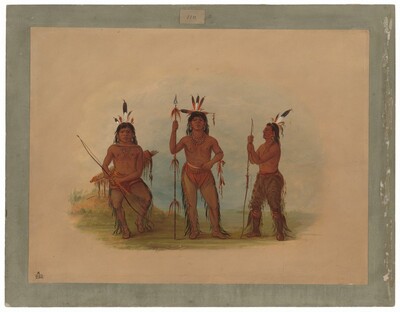
The image depicts four individuals against an abstract background. The first adult, on the left, is a woman with long, dark hair, wearing a shawl and holding a small unclothed child. In the center, a man stands with a raised arm holding a spear. The third adult, on the right, stands with a relaxed posture holding a bow. The background is soft-hued with a grassy ground underneath the individuals.

Four Mura Indians

Catlin, George

Three pale-skinned men wearing black garments and long, white aprons stand behind a table on which lies a nude corpse on a white sheet in this vertical painting. The corpse’s head is to our right and the face falls toward us. The eyes are sunken, and the rib cage and hip bones protrude sharply from the body. The men gathered behind the table are painted with fewer details so their faces are indistinct, though we can make out that the person to our left has gray hair, and he touches the corpse’s pelvis. The other two have dark beards and might wear black caps, and the middle person might take notes. The man to our right rests both hands on the table on either side of the corpse’s head and leans forward, looking down. The table is under the curve of a thick arched wall that separates two high, deep-set windows. Two unlit lamps hang above. The scene is painted with dabs and some visible brushstrokes, giving it a soft, shadowy, and hazy appearance. The artist signed the painting in red in the lower left, “H. Gervex.”

Study for "Autopsy at the Hôtel-Dieu"

Gervex, Henri

This is a tall, vertical painting. In the center, a woman in a pink-and-yellow gown sits on the ground, holding a limp child in her arms. She faces the left and is looking upward at a man in a brown robe who faces her and extends one arm towards the child, placing his finger on its forehead. Surrounding this group, many other people look at them with expressions of shock or amazement, leaning forward with their mouths open and hands raised. All the people in the painting have pale skin, although the child and another man in the bottom right corner have a greenish sheen to their skin. In the sky above this group, cherubs and angels fly, surrounded by clouds and looking down on the scene below. The sky is blue, with pink clouds and green trees, and a tall gray column on the left side.

A Miracle of Saint Francis of Paola

Ricci, Sebastiano

The image shows a person standing barefoot on a tiled surface, holding an open book. The person has a solemn facial expression, short hair, and is wearing a long brown robe with a hood. In the background, there is a golden archway with intricate patterns, leading to a landscape with trees and a clear blue sky.

Saint Bernardino of Siena

Foppa, Vincenzo

This painting depicts a seated woman looking off to the left, resting her head on her right hand, our left, with her elbow on an abstract green surface. She has a fair complexion, a long nose, pale eyebrows, pale lips in a neutral expression, and reddish-brown hair styled up with a blue clip. She is wearing a pale mauve dress and shawl with a deep neckline, blue-green ribbon details, and puffed sleeves. A thin black belt is tied around her waist and there is a silver bracelet on her forearm. The background is painted in soft shades of blue and green, with a few highlights of pale yellow. An inscription in gold lettering in the top left corner identifies her as "Annetta D. of Edward Coke, wife of Lewis Cage of Milgate Kent."

Annetta Coke

Reynolds, Joshua, Sir

Three tall sailing ships, each with three masts and full sails, float in calm, arctic waters, surrounded by fragments of icebergs and ice floes amid a smattering of arctic animals in this horizontal landscape painting. The horizon line comes about a quarter of the way up the composition so the sails and rigging of the ships are shown against the sky. The clouds have ivory tops and lavender-purple undersides, and they curve in a C-shaped bank to cover most of the left half of the painting and to span the horizon. The three ships closest to us are spaced evenly across the composition, with the left-most the closest, and therefore the largest. The ship to our right is set a bit farther back, and the center ship is the farthest away. A rowboat holding several men has pulled alongside the boat to our left, and more men haul massive slabs of whale blubber up the side of the ship. Others walk on an ice floe nearby. Close inspection reveals more rowboats around and beyond these ships, and several more ships fading into the hazy distance along the horizon. Jagged edged chunks of icebergs as tall as the ships float around them. Closer to us, a trio of seals sits on an ice floe near the lower center of the composition, and a polar bear stands nose to nose with a cub to our right. Two narwhal whales with long tusks break the surface of the water between us and the ships, as does a whale’s tail near the boat to our right. Two walruses with long tusks sit on a floe near the center ship. A couple dozen birds, many white with black wing tips, fly low over the surface of the water across the painting.

The Northern Whale Fishery: The "Swan" and "Isabella"

Ward of Hull, John

The image shows five individuals standing in a line on a flat terrain with a soft, neutral background. Starting from the left, there is a male figure with short dark hair holding a spear, another male figure with feathers in his hair holding a paddle or club, a male with a feathered headdress and a red band across his forehead, a female in a skirt with beaded accessories holding arrows, and a small child standing beside her.

Klatsop Indians

Catlin, George

Both dressed in white, a little boy leans onto the lap of a woman sitting in front of a smooth, sunlit boulder with a landscape to the right in this vertical portrait painting. Both people have pale skin with rosy cheeks. To our left, the woman sits with her body facing our right. Her round face also tips to our right, and she looks at us with gray eyes. She has an upturned nose and her full, pink lips are closed in a slight smile. Her long legs are crossed at the ankles, and dark gray slippers peek out from under the long hem. She wears a diaphanous, eggshell-white gown gathered under her bust. The short sleeves of the dress are puffy over sheer sleeves that extend to her wrists. A sheer veil is tied over her brown hair with a gray ribbon falls over her shoulders. She wears coral-red beaded necklace and drop earrings. Her hands rest in her lap and intertwine with the little boy’s hands. He stands behind her and leans onto her knees with both elbows. His round face is framed by a cap of honey-brown hair, and he looks at us with big, lapis-blue eyes. The boy has a small nose and bow-shaped lips. He wears a flax-yellow and mist-gray short sleeved garment with a bow in the back. Light falls on the pair from our left, and throws some of the foliage surrounding them into shadow. Burnt orange, gold, and white leaves and flowers surround the boulder behind the woman, and a view into a moss-green forest interior extends into the distance to our right.

Lady Mary Templetown and Her Eldest Son

Lawrence, Thomas, Sir

The image depicts a night scene in a dense and shadowy forest. A faintly illuminated path is visible running horizontally through the scene. Dark silhouettes of trees and foliage surround the path, leading to a strip of warm light shining through the trees. The horizon is obscured by the densely packed trees, creating a continuous dark mass. The artist uses blended brushstrokes to create subtle transitions between light and shadow, adding depth. The color palette consists of deep greens and blacks with touches of muted oranges and yellows where the light breaks through, creating contrast. Softly rendered brushstrokes blur the boundaries of form, enhancing the scene's depth and contrast.

Ignis Fatuus, Rio Uruguay

Catlin, George

This is a painting of a forest scene with dancers and a tent. Figures are dancing in the foreground on green grass, with each figure positioned expressively. More figures are gathered near a tent, and in the background, dense trees fill the scene. A serene body of water is visible through the clearing, surrounded by greenery.

Tapuya Encampment

Catlin, George

A naked man with ghostly white skin sits upright in a canopied bed set in a narrow room in this tall, vertical painting. Wearing a black cap, he looks to our left in profile toward a skeleton who comes through a door along the left edge of the composition. The man gestures at the skeleton with one hand and, with the other, toward a bag of money held up by a small demon next to the bed to our left. The skeleton wears a white shroud and holds an arrow. A winged angel kneels next to the man in the bed, one hand on the man’s shoulder and the other lifted to gesture at a crucifix hanging in the window over the door. A small devil on the canopy above looks down onto the bed. At the foot of the bed, a man wearing a green robe and headdress drops coins into a sack held by another demon. Three more demons crawl about and hide under the chest. Pieces of armor and weapons lie on the ground to the right in front of a stone ledge in the foreground. Two pieces of clothing drape over the ledge to our left.

Death and the Miser

Bosch, Hieronymus

A man and woman greet each other at the center of a group of about a dozen people set within a landscape in this horizontal painting. All the people have pale, peachy skin. In the middle of the crowd, a woman, Abigail, kneels to our left while a man to our right, David, reaches out to her. Abigail’s blond hair is tied back under a white veil that drapes over her shoulders, and she wears a slate-blue dress and a string of pearls around her neck. She holds her left hand, on our right, to her chest and her other hand gestures down to a basket of bread held by a man in the lower left corner of the painting. David stands and bends toward Abigail as he cups her bent elbow with his left hand. His other hand rests on a walking stick near her head, and his index finger is extended as if to brush her cheek. He has short, curly blond hair and beard, and he wears a thigh-length tunic under a breastplate. Crimson-red fabric drapes around his shoulders and over his armor, and a dagger or short sword hangs at his hip. Three women, three men, and a donkey gather to our left, behind Abigail. Two of the men hold large baskets of bread, and they all look toward Abigail and David. Six armored men, two younger people, and two horses make up the group to the right. Trees line a hill behind the people to our left and dark gray and amber-colored clouds fill the sky.

The Meeting of David and Abigail

Rubens, Peter Paul, Sir

People and a horse-drawn wagon move along a street lined with buildings on the left and trees on the right in this loosely painted horizontal landscape. The wide street angles from the bottom left of the composition to the middle right. The surface of the road is painted with strokes of apricot orange, light gray, rust red, and olive green, and it leads back to a slate-blue, blurred area suggesting trees in the distance. The two, three, or four-story buildings are close together or may be joined. They are painted in muted tones of parchment white, pale peach, and blue gray. Closest to us and to the left, a long brown roof and two bare trees sit beyond an ivy-covered stone wall. The people are indistinct and small in relation to the scene and are dressed in black, brown, olive-green, and slate-blue clothing. One of two carriages is across the road from us and the second one is farther back. On our side of the road, a man wearing a long black jacket and gray pants strolls away from us past a neat row of trees lining the peach-colored sidewalk. The overcast gray and pale pink sky is above. The artist signed and dated the lower left corner, “Sisley. 72.”

Boulevard Héloïse, Argenteuil

Sisley, Alfred
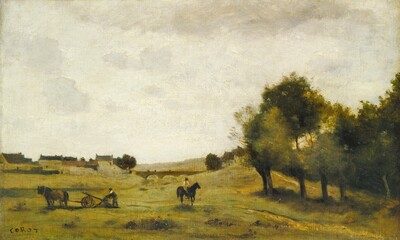
A person at the center of this loosely painted horizontal landscape rides a dark horse across a field as a man to the left works the field behind a horse-drawn plow. The field is carpeted with muted and gold-shaded green, and a grove of trees in the right third of the composition are painted in fern, olive, and dark green. A patch of darker green near us and to left of center is dotted with red and yellow to suggest flowers. The men and horses are small in relation to the composition. The people have brown skin and are painted with a few strokes in dark gray and muted green for the man behind the plow to the left and pale yellow and white and a red cap for the person on horseback. A band of houses with tan or light yellow walls and gray or terracotta red roofs line the far side of the field to the left, and an arched bridge crosses what appears to be a shallow, grassy ravine near the center. The horizon comes about a third of the way up this composition and a few smoke-gray clouds line the upper edge of the otherwise milk-white sky. The artist signed the lower left corner, “COROT.”

View near Epernon

Corot, Jean-Baptiste-Camille

Dozens of light-skinned men and women gather around clusters of columns and sandstone-colored buildings that line a crimson-red river to our right in this horizontal painting. The center of the painting is dominated by a structure made up of three rows of three columns each, which hold up a flat-topped roof. A similar structure angles into the distance along the left edge of the painting. The columns of these two structures are carved with bands showing people separated by rings of vertical lines. The capitals are carved with stylized leaves. Just beyond the columns to our left, a blocky, rose-pink structure is carved with more people, seated or standing singly or in pairs. More rectangular, parchment-brown buildings extend into the distance along the water’s edge. The people gathered along the riverbank wear robes and tunics in deep blue or black, bright white, or saturated tones of cobalt blue, ruby red, or shell pink. Standing within the columns of the central structure, a crowned, bearded man wearing an emerald-green robe under a scarlet-red cloak gestures to our right, toward the red river. A woman nearby, wearing lapis blue and also crowned, watches with hands flung up as a person pours red liquid from a bucket. Most of the other people look or gesture toward the river, which winds in deep S-curves from the horizon line, which comes about two-thirds of the way up the composition, through sage-green fields, to the town. A single, white lightning bolt zigzags down from a white cloud in an otherwise navy-blue sky above.

"He Turned Their Waters into Blood"

Field, Erastus Salisbury

The image shows three individuals standing in full length facing the viewer. On the left stands a woman with dark hair, wearing a brown fringed dress with red leggings. The middle figure, likely a man, wears a beaded garment and a headpiece with feathers. He holds a stick or staff. The figure on the right, also likely a man, wears a feathered headdress, a beaded necklace, and an arm band. He is bare-chested with a blue cloth covering his lower body, grey leggings, and holds a painted shield and a ceremonial club. The background features a softly painted horizon within an oval border.

Athapasca Chief, His Wife, and a Warrior

Catlin, George

A bird in flight with its hooked beak wide open, wings held high, holds a shimmering green and white fish in its talons in this vertical painting. The bird and fish fill the composition against a pale, hazy landscape. Both animals face our left in profile. The bird’s raised wings are dark brown, and the feathers on the underside of its left wing, closer to us, are cream white. Its tail is fanned and the feathers are striped with golden yellow against dark brown. The bird surges forward, to our left, its head low. The yellow eye we see is round and clear, and its dark beak curves to a sharp point over its protruding tongue. The head is striped with cream and brown, creating a mask-like effect. Powerful talons grip the fish, whose tail still dips in the water below. The fish’s mouth gapes and its eye, which is yellow around a black iris, is wide open in the gray and silver head. The top of the fish’s body is iridescent emerald green that fades to tan and parchment yellow along its belly. Light and dark speckles create a dotted pattern along the fish’s length. The body of water meets the horizon about a quarter of the way up the composition. The surface of the water is painted in sage green, golden tan, and pale pink. Cliffs in the distance are soft mauve purple under an aqua-blue sky filled with billowing clouds. White birds with black wingtips fly over the water in the distance.

Osprey and Weakfish

Audubon, John James

The painting depicts a landscape with rocky outcrops, trees, and distant mountains. A rocky brown hill that takes up the lower third of the image, and at the top there are white buildings with brown roofs. These buildings are surrounded by green trees, and on the other side of the hill we can see more dense trees and other structures. Above the distant mountains is a blue sky filled with a few white clouds.

View of La Cava

Lanoüe, Félix-Hippolyte

A sliver of land across the bottom of this composition gives way to a procession of puffy gray and white clouds sweeping up across a vivid blue, panoramic sky in this horizontal landscape painting. An area of darker gray beyond the brown land could be a valley, mountain, or shadows from the billowing clouds. About one-fifth of the way up the composition, the horizon glows the faintest peach. The clouds trundle from our left up and to our right. The view is loosely painted, especially in the land.

Study of Clouds over the Roman Campagna

Valenciennes, Pierre-Henri de

The image shows a portrait of a person from the upper half of their body. They are facing forward but their head is turned slightly to the side, suggesting a profile view. The person has sharp facial features, light-colored hair styled in a classic manner, and is wearing a black coat with a high collar and a white cravat. The background consists of a red drapery.

William Vans Murray

Brown, Mather

This painting shows a woman standing in front of a wooden dresser with a mirror, her back to us. We can see her face reflected in the mirror. She is gazing at her reflection with both of her hands lifted towards her slightly tilted face. The woman has pale skin and dark hair neatly styled away from her face, and she is wearing a dark gown with white ruffles around the neck. On the dresser, there is a floral arrangement, a pair of blue bottles, and a wooden box holding more containers. Behind the dresser, the background includes patterned wallpaper, a blue curtain on the left, and sunlight coming through a window on the right. The floor appears to be covered by a patterned rug.

The Toilet

Johnson, Eastman

The image displays a landscape with a high horizon line, showcasing a grassy plain under a soft sky. Figures on horseback are dispersed across the scene, with fluid brushstrokes depicting movement in the grass and sky. The color palette is mainly earth tones, greens, rust, and ochre, set against a pale blue sky.

Driving the Pampas for Wild Cattle - Connibo

Catlin, George

Portrait of a Man

Portrait of a Man

French 17th Century

This painting is a portrait of a seated woman looking off to the left with a composed expression. She has light skin with rosy cheeks, brown eyes, and slightly upturned pink lips. Her curly brown hair is styled on top of her head with a small floral clip or decoration. She is wearing a white dress with short sleeves and a low neckline with a wide collar. Around her waist is a thin belt with gold and light-blue designs, and a translucent cloth with a similar pattern is draped over her right forearm. Her other arm rests over the edge of the tan chair she sits in, and she brings her hand up slightly below her chin. A thin gold band is visible on one of her fingers. The background is a plain, muted brown color, with a curved tan section at the very top.

Eleanor Parke Custis Lewis (Mrs. Lawrence Lewis)

Stuart, Gilbert

Roiling, churning waves breaking against a patch of a sandy beach fill most of this wide, horizontal landscape painting. The water deepens from aquamarine blue to teal, slate, and midnight blue amid clouds of ivory-white crests and spray. A glassy, mirror-like sheen of water coats the sandy beach where it drops sharply from the lower left corner to the breaking waves. A few shells or other objects are suggested with touches of pumpkin orange and charcoal gray along the beach. Near the lower center, a battered wooden cage is pommeled by waves where the water meets the foot of the sloping beach. A strip of sky lightens from sable brown to our left to light tan to our right across the upper third of the composition. The artist signed and dated the work with red paint in the lower left corner, “T MORAN 1884,” with the T overlapping the M to make a monogram.

The Much Resounding Sea

Moran, Thomas

This painting depicts a landscape with several haystacks in the center, arranged in a line that cuts diagonally across a green field from left to right. The five large golden-brown haystacks are shaped like tall cones and are surrounded by more golden hay on the ground beneath them. The rest of the field is mostly green, with patches of yellow, purple, and light blue. The sky above the field is light blue, with long horizontal strips of white clouds. At the horizon is a line of purple and dark blue shapes, suggesting faraway trees, or perhaps low buildings. The brushstrokes are short and textured, making the landscape appear blurred.

Haystacks

Seurat, Georges

The image shows a portrait of a woman seated in a chair. She is facing slightly to the left and looking directly at the viewer. She has fair skin, light-colored eyes, and dark brown hair styled under a lace-edged cap. She wears a black dress with a lace collar and holds a small book titled "Sacred Songs" in one hand. She also wears a bracelet on her wrist. She is seated in a chair with a red upholstered back and an armrest draped with embroidered blue and green fabric. The background is a plain, muted brown color.

Sophia Mead

American 19th Century

Two large dogs approach a man lying unconscious and mostly buried in the snow in this horizontal painting. The head of the man comes toward us, at the lower center of the composition, and the dogs are close to us. In the center of the painting, a large tan and white dog has short, glossy fur and floppy ears, and its jowly mouth hangs open with the pink tongue visible. It paws at the snow partially covering most of the body of the man, who wears an olive-green coat with a fur collar and white shirt. The dog looks up to our right, and its body and white-tipped tail recede diagonally into the picture to the left. There is a red blanket with black edging over the dog’s back, and the hound wears a wide, fur-lined silver collar ornamented with metalwork lions and bells. The second dog, a dark brown brindle color, sits to the immediate left of the first dog. It gazes down at the prone person and bends its head down to lick a bare pale, pink hand that protrudes from under the snow. The brindle dog wears a small barrel around its neck on a brown buckled leather collar. The man’s dark brown hair falls over the snow. His pale gray face is upward, and his shoulders are visible while his arms splay out, and the rest of his body, extending into the picture, is covered with snow. The man’s eyes are closed. His right hand, in a tan leather glove, reaches toward us from the snow, while a green velvet cap with a red ribbon lies under the hand. The scene is enclosed by large, angular, steel and blue-gray boulders and rock formations, with two craggy pine trees above. Beyond lies a mountain landscape with a V-shaped pass at the center top framed by the steep ascent of jagged, snowy hillsides and a sliver of blue sky. A blocky stone building is nestled in among the crags to our right. On a path leading from the building, three bearded men wearing black caps and robes hurry toward the dogs. The nearest of them holds up a staff with a cross on the top and waves or signals to the men farther back along the path.

Alpine Mastiffs Reanimating a Distressed Traveler

Landseer, Edwin, Sir

Shown from the waist up, the profile of a pale-skinned woman wearing an ice-blue dress is loosely painted with visible brushstrokes in this vertical portrait. The woman’s body faces our right, and she looks slightly down with her pale pink lips parted. A floppy straw hat is tied over her copper-blond hair with a plum-purple ribbon and tied in a bow beneath her chin. The bow appears to be nearly as wide as her shoulders, and the ribbons hang down almost to her belly button. Her dress has a high, ruffled neckline along the back of the neck and long sleeves. A few flecks of lapis blue suggest polka dots, and a blue belt wraps around the waist. The background is especially loosely painted with strokes of aqua blue and bright, bottle green that suggest an outdoor setting and few touches of coral red in the lower corners could be flowers.

Young Woman with a Straw Hat

Morisot, Berthe

Dozens of men and women wander through a tall interior space lined with statues and columns and topped by a soaring domed roof in this vertical painting. The people are small in scale within the cavernous space. The women wear long, full dresses and the men wear knee-length waistcoats and stockings in shades of dark blue, crimson red, pine green, marigold orange, or brown. Three people wear clothing of the clergy: two of them, on our left, wear long, ginger-brown robes under white mantles, and a third person on our right wears a hip-length, diaphanous white cape over a long dark blue robe. The crowd strolls, kneels, converses, or leans back to look up at the high ceiling overhead, which has a round opening at its apex. A glimpse white of azure-blue sky with white clouds is visible through the opening. The interior is divided into three levels. The ground level has five niches lining the walls, each with a white stone statue of a man or woman standing inside. Each statue is at least three times the height of the people in the space below. The three niches closest to us on our left and right have semicircular pediments with garnet-red or moss-green columns flanking the statues. Two niches at the far end have triangular pediments and honey-gold columns. Each niche sits on a wide base, presumably an altar, and is surrounded by marbled gold and purple panels set against a sage-green background. Sets of three honey-gold columns line the wall between each niche. Oversized, copper-green double doors are swung inward at the far side of the space. More people, a sunlit obelisk, blue sky, and slivers of other buildings are visible through the doorway. The second level of the interior has windows spaced across walls otherwise covered with white, blue, and mauve-pink panels. An inscription running around the building between the first and second level reads, “DOMINVM IN SANCTIS EIVS LAVS EIVS IN ECCLE.” The third level is the domed pewter-gray ceiling with coffers, like inwardly stepped panels. The floor is patterned with alternating circles and rectangles in sage green or light brown.

Interior of the Pantheon, Rome

Panini, Giovanni Paolo

This painting shows the upper body of a woman seated in a chair. She is wearing a white bonnet with ruffled edges, covering her wavy, light brown hair. Her facial features include fair skin, thin lips, a long nose, and a pointed chin. She is dressed in a deep red gown with a high white collar. The chair has a blue cushion and wooden frame with curved armrests. The background is a gradient of brown at the top and tan at the bottom.

Sarah Homes Tappan (Mrs. Benjamin Tappan)

Stuart, Gilbert

A woman with peachy skin stands facing our left in profile ironing a pale blue shirt on a white surface, possibly a table, with a line of pastel-colored shirts hanging in front of curtained windows opposite us in this vertical painting. We seem to look slightly down onto the woman’s shoulders and onto the surface of the table. The white tabletop takes up most of the bottom half of the composition, and, seen from the knees up, the woman leans in from the lower right corner. The woman’s chestnut-brown hair is pulled up into a bun, and she wears a dark earring in her left ear. Her denim-blue dress is speckled with white dots and highlighted with strokes of blush pink. Her sleeves are rolled up to the elbow, and a dusty rose-pink apron covers her brown skirt. She presses down on the iron with her right hand, farther from us, and uses her left hand to straighten the fabric of the shirt collar. The iron has a thick handle and a flat, narrow, triangular surface used to press out wrinkles. A small, empty, bronze-colored bowl and crisply starched and folded porcelain-white shirt lie on the table to her left, closer to us. A row of hanging garments in pale crepe pink, flaxen gold, teal, and lavender purple soften the light coming into the room from three vertical windows, which are covered with sheer, ivory-white curtains. The artist’s feathery brushstrokes give the painting a hazy quality. The artist signed the work with olive-green letters near the lower left corner: “Degas.”

Woman Ironing

Degas, Edgar

The image shows a seated woman and a standing boy beside her. The woman is sitting on a wooden chair, with her right hand resting on a small table and her left hand holding a small book. She has dark hair styled in an updo and wears a long, dark dress with long sleeves and a pearl necklace. The boy is standing beside her, wearing a dark suit with shiny buttons and a bow tie. In front of them is a table covered with a white tablecloth, holding cakes, cups, a teapot, and a spoon. The background has a green wall with a window showing greenery and flowers outside, framed with a wooden frame. Red drapes with gold accents hang on either side of the window.

Interior Scene

American 19th Century

The image displays an upper-body portrait of a seated woman. She has fair skin, rosy cheeks, dark hair styled in tight curls, and is wearing a white lace bonnet with ribbons. She is dressed in a dark dress with white lace at the neckline and has a subtle smile on her face. The background is a plain, warm brown color with a lighter area on the left.

Portrait of a Lady

Neagle, John

The painting depicts a harbor scene with several large ships and smaller boats on a wide waterway. To the left and right of center, two large ships are visible, each with multiple tall masts and several sails. The boat on the left appears to fly a flag that has white and red stripes and a section of dark blue. A small rowboat is positioned in the water by this ship, and it appears to have several indistinct people on it. To the left, a plume of gray smoke rises from low gray buildings. On the right, more people in rowboats appear to head towards a line of tall buildings in the distance. The sky is painted with soft brushstrokes in shades of light blue and grey, with hints of pale yellow at the center of the painting by the horizon. Some gray clouds drift across the sky. The water reflects these colors as well as the gray ships. Overall, the color palette is mostly light blue and shades of gray. The brushstrokes are visible, and details in the distance are suggested with minimal lines of paint.

Entrance to the Harbor, Le Havre

Boudin, Eugène

Man of Science

Man of Science

American 19th Century

The image shows a scene with a weeping figure near a gravestone under a willow tree, a white horse attached to a cart on a path, and a distant townscape with a church steeple. The setting sun casts warm colors over the sky, with unique cloud formations and birds flying. The color palette consists of warm and cool tones.

Eaton Family Memorial

Jordan, Samuel

Four men and one woman gather around a dead man who is dressed in a bright honey-gold cape and pointed hat, his stone-gray face resting on a stump or column in this dark vertical painting. All the people have peachy skin or light skin tinged with green. Shown from the knees up, Saint Gennaro, the dead man, twists and slumps to our right. On the stump, his eyes are closed and his lips parted. His hands are crossed at his waist and bound with rope. He wears a tall hat rising to a peak in the center. His cloak drapes over a white tunic, and red seeps from around his neck. On our right, a brown-haired woman is shown from the waist up, bending down in front of Saint Gennaro’s face. The light falls across the scene from our right, so her profile is in shadow. She holds a silver chalice in one hand and squeezes something, perhaps a rag or sponge, over the chalice with her other hand. A clean-shaven man with dark curly hair stands behind the stump. That man’s body faces us as he leans to our right and tilts his head down over Saint Gennaro, his shadowed face obscured. His left hand is under the dead man’s head and his right hand clutches his own chest. Behind the dead man and to our left, a bald, gray bearded man bends over and spreads his arms wide over and across the saint’s back. His brow is furrowed, and he looks at Saint Gennaro with deep-set eyes. Along the left edge of the canvas, a bald man with a hooked nose and large ears stands and angles his body to our right, his face in profile. He leans back from the dead man, his right hand holding a knife or sword with a bird-shaped hilt. The fourth man close to Saint Gennaro looks on to our right, from behind the stooping woman. The people gathered around Saint Gennaro wear clothes in muted shades of gray, brown, and white. The edge of a building rises up along the left edge of the composition. In front of a distant mountain to our right, more people are gathered, some with swords raised and others looking on with mouths gaping. One faint head, the face painted in tones of ash gray, peeks over the shoulder of the fourth man. Yellow streaks near the horizon also illuminate the undersides of heavy, dark gray clouds above.

The Martyrdom of Saint Gennaro

Preti, Mattia

Madonna and Child

Madonna and Child

Zoppo, Marco

This painting depicts two people, an adult man and a young boy. The man is seen from the knees up, standing with one arm on a table and the other on his hip. He has light skin, light green eyes, a brown beard and mustache, and dark hair under a black cap. He is wearing a bright red jacket with several buttons down the front, which is open to reveal a white garment with several pleats and folds. The boy, who has short brown hair and fair skin, leans against the man's leg, tying a bow on the white garment and looking over his shoulder at us. He wears a yellow outfit with subtle white stripes. On the left is a table covered with dark green fabric which the man has his hand on; there are three books on it, and a letter on white paper propped up against the books. The background is a muted green-brown color.

Alessandro Alberti with a Page

North Italian 16th Century
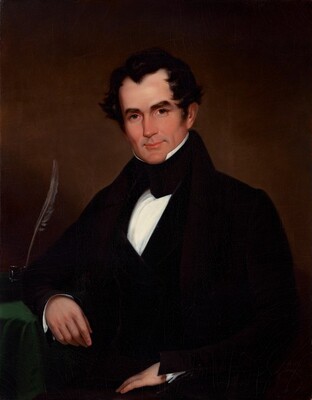
The image displays a man's upper body. He is seated at a slight angle to the left, with one arm resting on a surface covered by a green cloth. The man has a composed expression, with defined facial features, including dark arched eyebrows, a high forehead, and short, dark hair with a subtle wave. He is dressed in formal attire, consisting of a black coat, a white shirt, and a cravat. A quill is placed nearby. The background is a plain, muted brown color.

Samuel McKenney

Cooke, George

The image depicts a half-length portrait of a person shown from the waist up. The individual is standing with a confident posture, one hand positioned at their waist. Their facial features include a prominent mustache and pointed beard, with slightly arched eyebrows and a direct gaze. The person's hair is a dark shade, styled close to the head and visible beneath their hat. They are wearing a dark blue military uniform adorned with yellow buttons and shoulder insignia, along with a yellow and red belt. The hat is also dark blue with a yellow emblem that has the letters "US," circled by a decorative design. The person also wears yellow gloves on their hand. The background of the image is a muted, textured surface in shades of gray.

The Colonel

American 19th Century

A young blond person stands in the center of a dimly lit room facing dozens of men in this horizontal painting. The people all have pale skin, though many are in shadow. The central person, Joan of Arc, stands in profile facing our left. She clutches one hand at her chest and the other extends in front of her, fingers arcing up. She has chin-length hair and bangs. Her brow is furrowed and her lips parted. She wears a lapis-blue, high-necked tunic over smoke-gray stockings and pointed black shoes. A metal band encircles her waist and a chain and manacle hang from one of two rings there. The chamber is lined with two rows of seats that extend along the short side to our left and the long wall across from us. A man wearing a white robe and a burnished gold mitre hat and cloak sits in the corner, both arms resting on a high throne. The other men wear clergy’s brown or black and white robes or long garments in slate blue, olive green, tawny brown, charcoal gray, and silvery white. Most wear hats. Four more men sit around a table covered in a grass-green cloth behind Joan, to our right. One man looks down at and writes on a sheet of paper. About half a dozen soldiers wearing silvery helmets and holding spear-topped halberds cluster in the back right corner, beyond the table. A wood stepstool sits closer to us, in front of the table, in the lower right corner. The walls of the chamber are paneled in a rectangular grid of light brown planks over darker wood, and the floor is tiled with small pink rectangles. The artist has signed in the lower right, “M. Boutet de Monvel.”

The Trial of Joan of Arc (Joan of Arc series: VI)

Boutet de Monvel, Louis Maurice

The image shows a portrait of a woman in a side profile facing left. She has an elegant hairstyle, pearls in her hair, fair complexion, a delicate nose, and softly closed lips. She is dressed in a light pink gown with gathered fabric at the bodice, covered by a black lace shawl. She wears a necklace and the attire suggests an 18th-century fashion style. The background is a dark green shade, and the portrait is framed in an oval border.

Mrs. Thomas Horne

Cotes, Francis

The image depicts six people, all facing the viewer. On the left, a woman sits on the ground. A naked child is partially visible behind her on the left, and in front of her she holds a younger child in a decorated carrier with a square handle. On the right are three men, one sitting and the other two standing. The seated man is in the center of the painting, and he holds a bow and two arrows. The next man on the right holds an axe or similar weapon, and the third man on the right also holds a bow and two arrows. All of the people have light brown skin, and the woman and children have black hair. The men have no visible hair, but instead appear to wear headdresses of long, thin red fibers or feathers that radiate outward from the backs of their heads. The seated man also has long horizontal feathers or fibers extending on either side of his head. The men and woman are all adorned with jewelry, including layers of colorful necklaces, silver bracelets, and several earrings in each ear. The woman wears a long-sleeved tan dress, while the men have fur-lined tan garments draped around their torsos and tan pants with colorful beads and fringe. Their garments are painted with scenes of people on horseback or colorful geometric patterns. The men also have tattoos on their arms and torsos. The seated man has red handprints on his upper arms, and the dark outlines of a bull's head on his chest and face. He has a hooped ring in his nose. The background shows a blue sky and grassy ground. The painting is framed in a gray oval border with tan paper beyond it and a green outer frame.

Pawnee Indians

Catlin, George

This painting shows two halves of a pale-yellow lemon with visible seeds and a small hole in the center. Two green leaves and a short stem accompany the lemon halves. The lemon halves are placed side by side in the center of the painting, with one half slightly angled towards the right. The background is brown, and the lemon halves cast dark shadows.

Lemons

Hall, George Henry

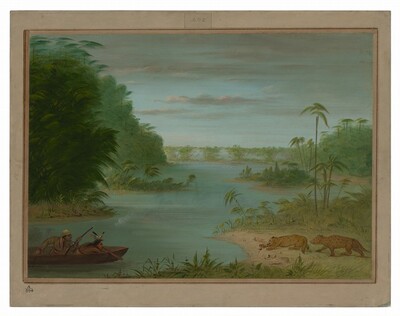
The image shows a serene river landscape from a slightly elevated angle. The horizon is near the upper third of the painting with a dense strip of forest lining the riverbanks in the distance. Two animals are scavenging for food on a sandy bank to the right, and to the left, near us, a small canoe with two figures is quietly paddling. The brushstrokes are smooth and detailed, capturing the lush foliage and gentle ripples on the water. The color palette is natural with rich greens of the vegetation contrasting with soft blues and earthy tones of the river and sky.

Pont de Palmiers and Tiger Shooting

Catlin, George

This painting shows a man from the waist up, his body turned slightly to the right. He stands upright, looking at the viewer, holding a golf club or cane horizontally with both hands. The man has a neutral facial expression and a light complexion, a blond mustache, and neatly combed blond hair. He wears a white shirt under a pale yellow sweater and a brown coat, along with a red bow tie. He also has a long, multi-colored scarf draped over his shoulders with red and green stripes visible. The background is gray and becomes slightly lighter around the man's head and darker around the edges.

Chester Dale

Bellows, George

A young girl with dark hair and pale skin, wearing a long white dress, kneels on the ground in a hilly, tree-lined landscape in this vertical portrait painting. The girl sits close to us, her body slightly angled to our left as she looks toward and reaches for a rose bush potted in a tall, brown urn along the left edge of the painting. She has pale gray eyes under faint brows and a delicate, pointed nose. Her round cheeks are flushed, and her pink bow lips are closed. Her chestnut-brown hair curls at the neck of her clothing, and bangs cover her forehead under a lacy white bonnet. Light glistens off her lace-edged black cape, which is tied at her throat. The full skirt of her white dress pillows like a cloud on the ground around her legs, and she has a wide, teal-blue sash around her waist. With her right arm, farther from us, she reaches out to touch a pink blossom with a gloved hand. The fingers of the butter-yellow gloves have been folded back. Her other hand rests with exposed fingers in a loose fist in near her knee. Behind her, gently rolling hills are dotted with leafy green trees silhouetted against a stretch of white sky just above the low horizon. Painted in smoky gray, ivory white, and pale, blush pink, the thin clouds against the topaz-blue sky fills the upper two-thirds of the picture. The painting is inscribed with gold paint in the lower right corner: “Lady Caroline Howard” and “Lady Cawdor.”

Lady Caroline Howard

Reynolds, Joshua, Sir

The painting depicts an elevated point of view of a broad landscape. The horizon is high in the image, showing distant mountains against a light blue sky with scattered clouds. The brushstrokes are smooth and blended, creating depth and atmosphere. The color palette includes earthy greens and browns in the landscape, and cooler blues and grays in the mountains and sky. Close to us, a group of horses stands near trees, with figures by a river and a waterfall in the background. The middle ground contains more trees and greenery leading to the distant horizon.

Falls of the Snake River

Catlin, George

This painting features a landscape with a winding dirt path surrounded by foliage. In the background, there are hills and mountains. On the left is row of buildings below tall brown cliffs, including a white church with a steeple. A body of water with sailboats can be seen in the distance on the right. The color palette is warm, with earthy tones including greens, browns, yellow, and oranges, with shades of pink and purple in the cloudy sky.

Lake George and the Village of Caldwell

Chambers, Thomas
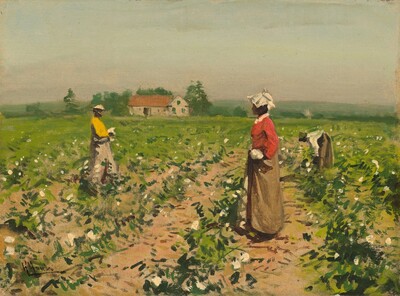
This painting depicts a green field of cotton plants with white blossoms. Three individuals are seen harvesting the cotton. They appear to be wearing skirts and bonnets and have dark skin, although their faces aren’t detailed. The background includes buildings on the left and green trees against a pale blue sky with hints of grey. The painting utilizes loose, visible brushstrokes. The color scheme is warm and natural, featuring shades of green, brown, and muted tones.

Picking Cotton

Gaul, William Gilbert

The image shows a rustic interior with large objects, including a collection of ceramic pots, bowls, and raw vegetables like cabbages, carrots, and onions in the foreground. The color palette is earthy and warm, with browns, beiges, and muted greens. A table is on the left side of the image where several people are seated, while in the center, a man with his arm around a woman stands in front of a stone archway, surrounded by pottery on a wooden table. In the background, another figure can be seen through a doorway.

Tavern Scene with Standing Couple

Buesem, Jan Jansz van

The painting depicts three adults and a child. The central adult, a woman, holds the child securely to her chest. The woman has pale skin and a white cloth covering her head, and she is wearing a dark cloak over a red robe. The child has curly light brown hair and is unclothed, looking towards the left. A bald man with a white beard, wearing a red garment and holding a key is on the left. On the right, another woman wears a white headscarf and a dark garment, holding a red cross. The background is dark, highlighting the people and their attire. All four of them have thin halos around their heads.

Madonna and Child with Saints

Anonymous Artist

The image depicts a night-time riverscape with a view from the bank of a river. The horizon is in the upper third of the painting, where the river meets a line of trees fading into the night. The brushstrokes give an impressionistic texture to the foliage and water, creating movement and depth. The color palette consists of deep blues and blacks, with a red-orange glow near a light source by the river bank illuminating nearby vegetation. A canoe with figures moves on the water near the light, heading towards the dim shorelines. Dark clouds loom in the upper portion, emphasizing the nocturnal setting.

Spearing by Torchlight

Catlin, George

William Henry Cavendish Bentinck, 3rd Duke of Portland

William Henry Cavendish Bentinck, 3rd Duke of Portland

Pratt, Matthew

This painting is a portrait of a man from his chest up. He is positioned slightly angled to the left and looks directly at us. His skin is pale, and he has rosy cheeks, deep-set, dark eyes, a long, straight nose, and thin lips set in a neutral expression. His hair is light gray, combed back from his face and curled above his ears. He is wearing a black coat over a white, high-collared shirt and a white lace cravat. The background is dark brown.

George Washington

Stuart, Gilbert

Two women and a baby, all with pale skin, sit together on a gray, stone throne with patterned fabric hanging behind them and a patterned rug below in this narrow, vertical painting. The woman sitting on the throne, Saint Anne, is the largest. A second woman, Mary, is smaller in scale, and she sits on Saint Anne’s lap. Mary, in turn, holds a nude baby boy on her lap. Both women have light brown eyes under faint, arched brows, smooth skin, long straight noses, and their shell-pink lips are closed. Saint Anne sits with her body facing us and she looks down with her head slightly tilted to our left. Her white head covering drapes over her shoulders and hangs down from her chin to cover her neck. She wears a marine-blue dress cinched at her waist with a black and gold belt, and a crimson-red robe that falls to and puddles around her feet. Her right arm, on our left, wraps around and holds Mary’s hip, and she supports a book with gold-edged pages with her other hand. Mary sits on Saint Anne’s right thigh, to our left, and leans toward the baby, who sits on her left knee, to our right. Her long, wavy, brown hair falls over her shoulders, and she wears a cobalt-blue robe over a lilac-purple dress. The baby has short, curly blond hair and reaches to turn the pages of the book. He has rounded cheeks and a pudgy torso. The stone throne is ornamented on the arms and at the top corners with ivory-white, nude children that are presumably also carved out of stone. The cloth hanging behind Saint Anne is decorated with glimmering gold, ornamental leaf designs against a pine-green background. The rug beneath her feet is a geometric pattern of red, tan, black, and white.

The Saint Anne Altarpiece: Saint Anne with the Virgin and Child [middle panel]

David, Gerard

This is a painting of a scene with a large cross at the center. The painting depicts a gathering around the cross, with angelic figures flying above amidst clouds. Some of these angels hold instruments, garlands, or tall staffs. On the ground, a group of individuals in colorful attire surround the bottom of the cross with a backdrop of a classical cityscape, including arches and stone buildings. In the bottom left, a man wearing a white cloth on his waist kneels down in front of the cross, his hands raised in prayer. To the right, two women in flowing clothes of gold and seafoam-green look at the cross, one resting her hand on it. At the very top of the painting, above the cross, is a pale-yellow arch.

The Exaltation of the True Cross

Ricci, Sebastiano

Shown from the thighs up, a woman holding a baby is surrounded by a man, woman, and two winged angels in this vertical painting. Mary, the central woman, the baby, Jesus, and the other woman, Saint Catherine of Alexandria, have pale, peach-toned skin. The man, Saint Jerome, and two angels have slightly darker peach-colored skin with faint gray shading. They all have gold halos, wide-set, hooded, light brown eyes, long, straight noses, delicate mouths, and pointed chins where we can see. Mary sits with her knees angled to our right, and she looks down at the baby held sitting upright near that shoulder. The crown of her head is covered by a white veil down to her forehead. A lapis-blue cloak drapes over the back of her head, her shoulders, and across her lap. There is a gold starburst on the right shoulder, to our left, and the cloak is edged in gold. The dress she wears is patterned ruby red on garnet red and decorated with shimmering, bright gold designs. She supports Jesus’s bottom with her left hand, to our right, and braces his chest with her other hand. He has small features with chubby cheeks, a high hairline with blond hair, and a chubby body. He grips the neckline of her dress with his right hand, to our left, and touches the hand that holds his chest with the other. He is nude except for a translucent white cloth around his chest and hips. To our left, Saint Jerome looks down at and writes in a book with a dark green cover using a feather quill. He is balding and has a long white beard. His forehead is lined, his cheeks hollow, and his lips parted. He wears a red robe over a white garment with a white collar. To our right, Saint Catherine looks at Jesus and holds a blue-covered book and black quill pen in one hand and a fragment of a wooden wheel lined with spikes with the other. Her blond hair is wrapped with and around a white cloth, and she wears a white-on-white patterned dress under a silver-gray cloak. One angel looks on from between Mary and the other looks up and to our right from behind Jesus. Both have their lips parted. The one to our right wears a pale pink garment and holds up one hand. The background is shiny, bright gold punched along the top and upper corners with a geometric design.

Madonna and Child with Saint Jerome, Saint Catherine of Alexandria, and Angels

Giovanni, Matteo di

Study for "Breton Women at a Pardon"

Study for "Breton Women at a Pardon"

Dagnan-Bouveret, Pascal-Adolphe-Jean

This painting is a portrait of a man. He is seated on a red cushioned chair, turned slightly to the left, facing us. He has a pale complexion and a neutral expression, with dark eyebrows, rosy cheeks, and thin lips. His hair is gray, with curls falling to the sides around his ears. He is dressed in formal attire, wearing a dark red, double-breasted coat with large golden button and a white cravat around his neck. The man holds a pair of tan gloves in his left hand, and in front of him is a piece of red furniture covered with a red cloth. The background is a muted brown gradient.

Stephen Van Rensselaer III

Stuart, Gilbert

We look across a lush landscape of olive-green forests lining a glimmering, silvery-blue lake with hills in the deep distance under a pale blue sky in this horizontal landscape painting. The scene is painted with some visible and some blended brushstrokes to give it a hazy, soft appearance. A man wearing a red cap and a white shirt sits in a long, low, narrow boat with a pointed bow in the grasses along the shore, near the bottom center of the composition. Gnarled tree trunks, one to each side, frame the view beyond. Towering, leafy trees nearly fill the right half of the painting. To our left, the still surface of the lake leads back to a city painted almost in silhouette with flint blue, which is reflected in the surface of the water. Hills and mountains are painted in bands of lightening blue as they recede into the deep distance to our left. The horizon comes about a third of the way up the composition, and the pale sky above is veiled with soft white clouds. The painting is signed in orange letters in the lower left corner, “COROT,” and dated in the lower right, “JANVIER 1866.”

The Moored Boatman: Souvenir of an Italian Lake

Corot, Jean-Baptiste-Camille

Apple Blossoms in a Vase

Apple Blossoms in a Vase

Heade, Martin Johnson

This painting shows a coastal scene with wooden rowboats on a sandy, rocky shore.  A white cloth and several ropes rest on the boat in the center, and two other boats are in a row behind it. On the left, brown stone structures are partially visible, with one in the background appearing to have been carved out of a rocky formation. A small figure is visible atop this structure, tending to what may be a clothesline. The rocks stretch across the painting, with some areas of bright, green-blue ocean visible around them. Small boats appear to sail on the water far in the distance. The light blue sky dominates the upper half of the painting, filled with puffy white clouds.

Marina Piccola, Capri

Haseltine, William Stanley

About two dozen men, women, children, and a baby sit in rows of wooden benches or on traveling trunks in this horizontal painting. Their skin is mostly pale with some ranging more toward pink and others toward tan. A woman nursing a baby sits in the center of the composition. Her blond hair is pulled back, and she wears a white blouse under a red vest and a long black skirt. Her shirt is pulled down to expose one breast, and the feeding baby wears a white bonnet and clothing, and is wrapped in a gray-patterned blanket. The woman sits on a wooden trunk in front of a young girl, who sits on a second chest just behind her and to our left. This girl has strawberry blond hair held back under a black headband, and she wears a blue shawl over a brick-red dress. Three silver pans, a silver jug, a glass bottle, and tin cup sit next to her trunk. She leans forward and looks intently off to our left. A man with a red beard wears glasses, a brown suit, and a flat-topped straw hat sits farther back in the room on the far side of bulging sacks and more trunks. He looks into the distance off to our right. Three men wearing black suits and two wearing black bowler hats sit facing each other just over this man’s shoulder. In the right two-thirds of the painting, more men wear fedoras, bowler hats, or brimless caps. Their clothing ranges from vests over button-down shirts to suits and ties. Some wear overcoats, and some are bearded. One man wears a military-style hat, a double-breasted black coat, and smokes a pipe with a white bowl. He looks toward the nursing woman, as does a standing man farther in the room. The men sit alone or chat in groups of two or three, and one sleeps, propped up against a fabric bag. A few more women are among the group, including one older woman who wears a yellow scarf tied over her head to the left. A sign hanging on a column behind the nursing woman begins with the text, “Emigrant Landing Depot” over columns of fine print. The walls of the room are mottled fog and cream white, and one visible window is small within the thick wall. The floor is wooden planks and there is a brown stain near the lower right corner.

In the Land of Promise, Castle Garden

Ulrich, Charles Frederic

Self-Portrait

Self-Portrait

Thayer, Abbott Handerson

The painting depicts a rocky coastline dotted with color. The horizon is high in the scene, and a strip of pale-yellow sky is visible at the very top of the painting. Along the rocky coast in the distance, the colorful land meets vivid turquoise and green ocean waters, with white lines indicating small waves. A red-striped umbrella in the top left corner appears to shelter a person in a long white dress; the umbrella obscures their face. The rocks have been painted with thick dots of black, white, yellow, orange, red, and green. The brushstrokes are expressive and the paint has been thickly applied in dots and dashes.

Flecks of Foam

Dearth, Henry Golden

This is a painting of a group of people gathered around a cave-like structure in a hilly landscape. The people have light skin and wear ornate and flowing robes in shades of pink, teal, and gold, and they are gathered closely together, some gesturing towards the cave. At the mouth of the cave, a man wrapped in strips of off-white cloth stands, looking out at the crowd. Two other men stand next to him, appearing to remove his cloth wrappings. To the right, in the center of the image, a man with long golden hair faces the cave and raises one arm. He wears blue and gold robes over a white garment, and his other hand holds a golden book. There is a halo behind his head. Behind him are ten other men of varying ages wearing colorful robes who also have halos. In the background are hills, greenery, and a sprawling city of white buildings with red roofs that extend towards the horizon. Tall palm trees punctuate the landscape, and the sky above is light blue with pink clouds.

The Raising of Lazarus

Gozzoli, Benozzo

The image shows three full-body figures of Native American individuals. To the left stands a woman wrapped in a light-colored shawl, holding a small child on her back. The woman's hair is parted down the middle, and she wears a long turquoise dress and red shoes. In the center stands a man wearing a headdress with feathers, earrings, and several necklaces. He is dressed in a dark green outfit with decorative trim and red accents, and he holds a long rifle in his right hand. This man's face is adorned with red paint around his eyes. To the right, another man sits cross-legged on the ground, wearing a feathered headdress similar to the standing man. His attire is grey with decorative elements, and he holds a tomahawk in his hands. The background is an open landscape with a predominantly light blue sky and clouds. The image is framed by an oval border set within a larger rectangular frame.

Three Micmac Indians

Catlin, George

The image depicts the upper body of a person seated upright. Their face is turned towards the viewer, showing fair skin, rounded facial features, light-colored eyes, fine eyebrows, full lips, and brown, curly hair styled back. The person is wearing a dark jacket, waistcoat, white shirt, and a black cravat. The background is a plain, muted brown color.

Husband

Prior-Hamblin School

The image shows three individuals depicted from head to toe. The central figure stands upright, with the figure on the left seated, and the figure on the right standing in a relaxed pose with a bent leg. Each individual has distinct facial features, black hair adorned with feathers, and dressed in traditional attire including decorative elements made of feathers, animal hide, or fur. The seated individual holds a bow, while the central figure holds a feather-decorated spear. All three individuals wear necklaces and have feathers in their hairstyles. The background features a subtle pastoral landscape of grass and open sky.

Alaeutian Chief and Two Warriors

Catlin, George

This painting depicts a long, horizontal landscape viewed from an elevated angle. On the left, by a group of green trees and bushes, several people stand around one person who is on the back of a white horse. They wear garments in shades of light red, dark green, and pale yellow. In the distance behind them, a gray castle is visible, and farther away boats sail across green water near tree-covered hills. In the center of the painting is a collection of massive gray rocks. A small yellow tent is at the bottom of the rocks, with a group of small people sitting or standing around it. To the right of them, two deer drink from a small blue pool while a person in a gray shirt rests nearby, wrapped in a green cloth. On the right side of the painting, people walk down a long path that ends in a large gray castle or city in the top right corner. Some of the people hold long poles or weapons. The color palette is mostly earthy browns and greens, with dark green trees filling much of the background. The sky is visible in the left and right sections of the painting; it is a greenish blue near the top that fades into a light pink when it meets the distant green hills.

Scenes from a Legend

Larciani (Master of the Kress Landscapes), Giovanni
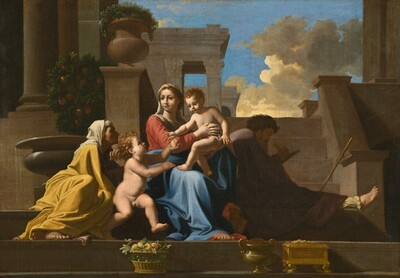
We look up at two women, two young boys, and a man, all with pale skin, sitting together on a wide landing, with stairs leading up to stone buildings behind the group and a patch of vivid blue sky in the upper right corner of this horizontal painting. At the center, a woman, Mary, sits holding a nearly nude child propped on one knee. Her body is angled to our right but she turns her head to look off into the distance to our left with large, dark eyes under faint brows. Her strawberry-blond hair is pulled back under a white veil that falls down the back of her neck and across her chest. Her smooth cheeks are lightly flushed in her round face. She has a straight nose and her pink, bow lips are closed. She wears a coral-red dress under a long, azure-blue robe that wraps around her waist and covers her legs. The sandaled toes of one foot peek from under the hems, and her other foot rests up on a gold-colored, rounded urn. Mary holds one child on her lap, and the second child sits by her right side, to our left. Both toddlers have blond, curly hair, dark eyes, rounded faces, and slightly pudgy bodies. Swaths of pale gray drapery mostly cover the genitals of both. The child on her lap half-sits, half-stands on the knee propped up on the urn. She supports his belly with one hand, the other wraps around his bottom. He leans forward, toward the second child, who faces him and holds up a yellow and blush-red fruit. Behind him, to our left, an older woman sits leaning forward and facing Mary in profile. Her wrinkled face is mostly lost in shadow, and she has a hooked nose and her forehead is lined, as if her eyebrows are raised. A white veil is wrapped around her head and drapes over the shoulders of her long, canary-yellow dress. One foot is crossed behind the other ankle, and the toes of both peep out from under her dress. To our right of Mary, a bearded man, Joseph, wears an eggplant-purple robe and sits almost entirely in shadow, facing our right in profile. The leg closer to us is extended and his foot stretches out of the shadow. He has short, curly brown hair and a long gray beard. He holds a carpenter’s compass to a panel in front of him. Closest to us, a step down runs along the bottom edge of the painting. On that step, a basket with leaves and yellow and peach-colored fruit sits in front of the standing child. Near Mary’s feet is a bronze-colored urn and a shiny gold box on raised feet. Behind the older woman to our left, water trickles from a round-bellied fountain on a pedestal in front of an orange tree. One building with round columns rises behind the tree. Behind Joseph, a long stick rests against the post of a short flight of four steps, which leads to another landing. The portico of a second temple-like building with squared columns and leafy capitals rises over Mary, presumably from the upper landing. A bright, topaz-blue sky with cream-white and steel-gray clouds fills the upper right corner of the composition.

The Holy Family on the Steps

Anonymous Artist

A woman and child sit on an ornate gold, curving throne in front of a shimmering gold background in this vertical painting. Two winged angels in roundels at the upper corners and the woman and child all have peach-colored skin with a gray cast. The woman tips her head toward the child, to our right. She has almond-shaped eyes, a long, straight nose, and her small lips are closed. She looks into the distance over the child’s head. She wears a scarlet-red mantle that covers her head and drapes over her shoulders and body. The azure-blue of her dress beneath is visible at her throat and over one knee. The child sitting on her knee is as tall as a toddler but has adult proportions in his face and body. He holds up his right hand, on our left, and raises the first two fingers. He holds a red scroll in his other hand. He wears a forest-green robe over a salmon-pink garment. The clothing of both the woman and child have geometric gold lines indicating folds in the drapery, and both have gold halos. The child’s halo is marked with three red arms to create a cross above and to the sides of his head. The woman rests her feet on a low stool in front of the opening of the elaborately carved, two-tier throne that nearly encircles the pair. The winged angels in the upper corners have gold halos, brown hair, jeweled, gold garments, and each holds an orb and scepter.

Madonna and Child on a Curved Throne

Byzantine 13th Century

Shown from the waist up behind a forest-green ledge or tabletop, a bearded man with a ruddy complexion strums a six-stringed lute between two, light-skinned people in this horizontal painting. The green ledge runs close to the bottom edge of the canvas, and the people nearly fill the composition. The musician’s body faces us but he looks up and off to our left with gray eyes under arched brows, with lips parted. His long brown hair is covered with a red hat wrapped with a pale, pink band. The ribbon meets in a bow-like form near the front center, and tassels hang to each side. His voluminous coat has wide, burnt-orange fur lapels and is lined with fur where it splits open over his shoulders. The garment below has dark sleeves. He lifts his right shoulder high over the lute as the instrument rests on the tabletop, with the neck to our right. The soundhole at the center is covered with rosette-like tracery. The man to our left has long, straight, dark brown hair and a cleft in his chin, which is darkened with a five o’clock shadow. He looks down and toward the musician with brown eyes over a long nose, and his lips are closed. He wears a black cloak with a fur collar over a white shirt, and holds a red book. To our right, a young person, possibly a man with delicate features, stands with his body angled toward the musician but he turns his face to look at us with gray eyes. He has flushed cheeks, a long, straight nose, and a rounded chin. He has shoulder-length, wavy brown hair parted down the middle, and he wears a red cloak also with a fur lapel, over a cream-white undershirt. A crumpled white cloth and a small, oval-shaped box with its lid askew sits on the green surface near the lute. The background behind the trio is elephant gray.

A Concert

Cariani

This painting shows a man facing the right. He has pale skin, a prominent nose, deep-set eyes, high cheekbones, a wrinkled brow, dark eyebrows, and a small mole near his mouth, which is set in a neutral expression. There is a hint of purple under his eye. The man has a thick beard and short, dark brown hair. He is dressed in formal attire, with a dark suit over a white collared shirt, and black bow tie. The background is black.

Abraham Lincoln

Volk, Douglas

The image includes two seated figures, both shown from the knees up. Each person is seated with their legs bent and feet resting on the ground. The individual on the left has dark hair with feathers and wears a long garment with a pattern across the chest and over the shoulders. Their garment reaches the knees, revealing moccasin-style footwear. This person holds an object in their hand, which appears to be a feather fan or similar item. The figure on the right also has dark hair with feathers and wears a long-sleeve top with a decorative sash, knee-length leggings, and moccasins. The background shows an open landscape with green plains, rocks, and a cloudy sky, suggesting an outdoor setting. The image is enclosed within an oval frame.

Two Choctaw Indians

Catlin, George

This is a painting of a group of people clustered together and facing different directions. Many of them have their knees bent. The group stands on light green grass under a blue sky, and the composition is framed in an oval. Almost all of the people are bare chested, their tan skin decorated with horizontal lines of bright red paint. They wear orange and yellow belts and long, white-and-black feathers around their waist. Some wear pants that appear to have tassels or string attached to the sides, while others have bare legs decorated with more red paint. They wear long strands of necklaces and multiple earrings featuring bright turquoise beads, and their hair is tied back in long, thin braids with more feathers and red spikes sticking up from headdresses they wear. Some of the people hold objects like spears, bows, and instruments. One person on the right is dressed differently, wearing a plain brown dress. This person has long black hair, and their body is turned to the left while their face is turned over their shoulder toward us, their eyes closed. In front of the group of people is a semi-circle of gray stones, within which are three large pots or vessels.

Dance to the Berdache - Saukie

Catlin, George

Two women with pale skin look out at us from the other side of a rectangular window opening with a shadowy interior behind them in this vertical painting. On our right, in the lower third of the composition, one young woman leans toward us over her left arm, which rests along the window ledge. She bends her right arm and props her chin on her fist. She looks at us with dark brown eyes under dark brows. She has shiny chestnut-brown hair with a strawberry-red bow on the right side of her head, to our left. She has a straight nose, and her full pink lips curve up in a smile. She wears a gossamer-white dress with a wide neckline trimmed in dark gray, with another red bow on the front of her chest. Her voluminous sleeves are pushed back to her elbows. To our left, a second woman peeks around a partially opened shutter. She is slightly older, and she stands next to the first woman with her body facing us. She tilts her head and also gazes at us with dark eyes under dark brown brows. She has dark brown hair covered by an oyster-white shawl. She holds the shawl up with her right hand to cover the bottom half of her face. Her mouth is hidden but her eyes crinkle as if in a smile. Her left arm bends at the elbow as she grasps the open shutter. She also wears a white shirt pushed back to her elbows, and a rose-pink skirt. The frame of the window runs parallel to the sides and bottom of the canvas. The room behind them is black in shadow.

Two Women at a Window

Murillo, Bartolomé Esteban

The image shows a wide expanse of land with a horizon featuring rolling hills or small mountains and sparse trees. In the foreground, a person in traditional indigenous attire is pulling on a rope tethered to a resisting horse. Several horses gallop energetically in the distance, while another horse stands alone to the right. The brushstrokes are detailed, capturing textures, and the color palette consists of earthy tones. The sky is light blue with occasional white clouds.

Catching Wild Horses - Pawnee

Catlin, George

Lady Wearing Spectacles

Lady Wearing Spectacles

American 19th Century

This painting shows a man in a yellow jacket standing on a small brown rowboat on a wide, pale green river. Behind him is a large mint-green sailboat, its tall mast bare, the sails folded on the deck. Behind that is a coastline covered in tan paths that cut through green grass. Another person stands on the shore, looking towards the boats. A yellow house with a weathered roof and two smaller, red-toned buildings can be seen on the shoreline. Behind them is more blue water, a grassy field, and dark green trees. The sky above is light gray with hints of blue. The brushstrokes of the painting are loose and visible, layering different colors on top of one another. The paint has been applied in thick, short strokes all facing the same direction, giving the impression of motion.

Oyster Sloop, Cos Cob

Hassam, Childe

This painting shows a rocky stream flowing through a green wooded area. Trees and rocky brown-and-gray terrain dominate the top of the composition, with the stream winding below around small gray rocks and boulders. A small white waterfall is depicted on the left side, leading into a flat pool of brown and gray water. The color palette is rich and earthy, with deep greens, golden yellows, and reddish-browns coloring almost all of the scene, as well as some lighter patches of white and beige in the water.

Woodland Stream

Huet, Paul

Tall, billowing, lavender-purple and shell-pink clouds line the distant horizon over a vast plain of flat grassy land in this horizontal landscape painting. Closest to us to the lower left, a tree with a gnarled trunk and round, sage-green canopy sits mostly in shadow. A river curves from near the tree to cut across most of the landscape in a tight S-shape. One plump haystack, shaped like a giant teardrop, sits near a curve of the river in the vivid, lemon-lime field, to our left of center. One brown and one white cow graze across the river, to our right. Above tawny-brown hills lining the horizon, sunlight from our left turns the tops of the band of clouds pale pink, and the undersides are grayish-purple. The sky above is turquoise. The artist signed the lower right corner, “M J Heade.”

Sunlight and Shadow: The Newbury Marshes

Heade, Martin Johnson

The image shows a landscape view of vast plains with small mounds of earth, a high horizon, greenish-yellow grassy land, light blue mountains, a sky with pale blue and soft gray clouds, meticulous brushwork with fine details illustrating texture, an earthy color palette with greens, yellows, and browns, and figures including a hunter and two riders on horseback.

Prairie Dog Village

Catlin, George

This painting shows four people standing by the edge of a body of water, with two of the people close to us and two farther away. They are all facing the left, towards the pale blue water that is framed by large gray rocks. In the pair closest to us, a person is standing with one leg forward, holding a large fish in both hands. They have long, dark hair, and they are wearing several earrings in their visible ear and a skirt made of thin strips of brown fringe or fibers with a colorful yellow-and-red belt. Hanging on their back is a child in cradle, swaddled in tan cloth decorated with colorful yellow bands. Behind them stands another adult who is wrapped in a light-colored blanket with a red stripe along the edges. Below the blanket, they wear tan pants and tan shoes with small dots of yellow, blue, and red. Beside these people, on the grassy ground, is a basket of gray fish. The pair that is farther away is painted with less detail, but one person appears to stand and fire an arrow into the water, while the other sits next to a basket of fish, holding one of the fish up. All of the people have light brown skin and long, dark hair. The setting appears to be outdoors, with a blurred background in shades of green and blue. The painting is surrounded by a border of off-white paper.

Flathead Indians

Catlin, George

A young girl stands next to and holds the hand of an elegantly dressed woman sitting in a wooden armchair near stone columns, in front of a crimson-red curtain pulled up to reveal a distant landscape view in this vertical portrait painting. The child and woman have smooth, light skin, and the fabric of their dresses has a silken sheen. To our right, the woman sits with her knees angled slightly to our left, and she looks at us with dark blue eyes under faint brows. Her brown hair is pulled back from her high forehead under a hair covering set with pearls. Her pointed chin is slightly pulled back, and her pale pink lips are closed. A teardrop-shaped pearl hangs from the ear we can see, and she wears two strands of pearls like a choker, above a thick, pleated lace ruff. The fabric of the long-sleeved bodice has a gold-on-gold pattern, and is lined with a row of buttons down the front. Filmy lace cuffs extend back over her forearms from her wrists. Her full, floor-length skirt is scarlet red with a gold, brocade-like pattern, and has silvery-gray stripes down the front and around the lower hem. The cloak she wears over the dress has a black-on-black floral pattern. Three thick gold chains hang across her bodice, and she wears a square-cut, gray stone set in a gold ring on the third finger of her left hand. To our left, the young girl stands next to the wooden arm of the chair and holds the woman’s hands with both of hers. The child looks at us with gray eyes, and her pale pink lips are parted in a slight smile. Her light brown hair is pulled back under a gray band, perhaps of fur, around her head, over an apricot-colored head covering that matches her dress. The tight-fitting, long-sleeved bodice is striped with bands of alternating gold and pink geometric designs against the apricot-peach background. A lace-edged collar lies across her shoulders. A red, oval pendant hangs from her three-standed pearl necklace, and she wears three pearl bracelets on one wrist. A thick gold chain falls across her chest and around one hip. The floor-length, full skirt has buttercup-yellow and shell-pink highlights on the coral-colored background. Behind the pair, the red curtain has been pulled up so it seems to flutter behind the woman’s head, in front of stone columns that frame a distant landscape view with trees. A blocky structure, presumably a building, sits on the far distant, hazy horizon. Light pours down in streaks from steel-gray clouds against a pale blue sky.

Susanna Fourment and Her Daughter

Dyck, Anthony van, Sir
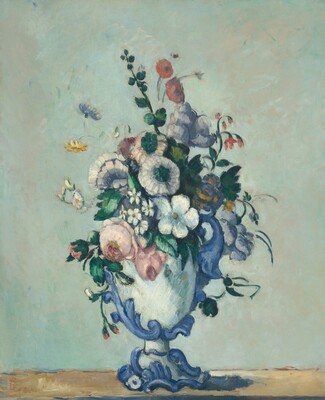
Rose and coral pink, vivid white, delphinium blue, and buttercup yellow flowers with deep green leaves are arranged in a blue and white vase in front of a pale sea-green background in this vertical still life painting. The vase has a white cup on a flaring foot. The vase is encircled with a twisting, decorative blue vine and scrolls. It sits on a band of peanut brown, suggesting a wooden tabletop. The still life is painted with blended strokes, giving the composition a soft, almost mottled appearance. The artist signed the painting in the lower left corner, “Cezanne.”

Flowers in a Rococo Vase

Cezanne, Paul

The image presents a landscape viewed from an elevated perspective, looking over a wide river winding into the distance. The horizon is positioned quite low, and the sky dominates the upper half of the scene, displaying a blend of blue with hints of pink and gray clouds. Distant trees frame the river on the horizon. Close to us, the left side features dense clusters of tall trees with green foliage, while the opposite riverbank to the right has a line of trees along the water's edge. The color palette is earthy, with shades of green for the vegetation and muted tones of brown and gray for the riverbanks and driftwood. The brushstrokes vary in intensity, softer in the sky and river, and more defined on the trees, contributing to an impressionistic effect.

Scene from the Lower Mississippi

Catlin, George

This painting shows a partial view of a dark wooden mantle. The mantle itself takes up the bottom right corner of the painting, and we see one side of it, but not the other. On its left corner, there is a vase of pink flowers, which stands at the center of the painting. Behind the vase, on top of the mantle, is a large silvery mirror in a golden frame. The mirror reflects gray walls and indistinct rectangles of black, gray, and brown.  In the bottom left corner, there is a patterned brown and white object, perhaps furniture or draped fabric. The wall on the left of the mantle and the mirror is a cream color. In some areas of the painting, the reddish-brown material beneath the paint is visible.

Vase of Flowers on a Mantelpiece

Vuillard, Edouard

Twelve people and one child stand, sit, or kneel along a riverbank in this horizontal painting. All the people have pale or tanned skin, and are muscular. They are in various stages of undress, wearing robes of golden yellow, ruby red, petal pink, azure blue, or cream white. To our right of center, a man, Jesus, stands facing us with his arms crossed over his chest. He wears a blue robe wrapped loosely across his shoulders and across his hips. He looks down, his blond hair falling alongside his face, as another man, wearing red, pours water from a shallow dish onto his head. A white dove flies with wings spread overhead. To our right of Jesus, one kneeling person wearing white holds up Jesus’s blue robes and another looks on, wearing a sage green robe and holding a voluminous rose-pink cloth. To our left, a group of five men react by throwing up hands, pointing upward, or looking up. One man with a gray beard and hair stands and bows his head over praying hands. A young boy wraps the arm we can see across the praying man's hips. Three more men to the left of this group pause as they undress to look toward Jesus. All the men stand or sit among puddles as a river spans the width of the painting behind the group and winds into the distance to our right. At the center of the composition, three men stand or recline on a grassy mound on the far side of the river. Tucked under trees at the peak of the mound, a smudge of white could be another kneeling person. Two more people walk along a path that crests the mound to our left. Mountains in the distance are slate blue beneath a vivid blue sky streaked with white clouds.

The Baptism of Christ

Poussin, Nicolas

A leafless, ash-white tree trunk has fallen from a broken stump into the wide V of a neighboring tree at the edge of a body of water near a verdant forest in this horizontal landscape painting. The fallen trunk creates a diagonal from near the lower left corner to the upper right. As it fell, it sheared off a substantial branch from a neighboring tree with a dark trunk. The bark where the damaged branch has pulled away is honey-orange, the same color as the leaves at the canopy, which has been pinned under the fallen trunk. Trees, vines, and other vegetation fill the space around and beyond this pair. In the lower right corner of the painting, vines grow over a broken stump, which deep in shadow. Between the stump and fallen tree, the peanut-brown surface of the water is smooth. Tiny in scale beneath the fallen tree and easily overlooked, there are two men and a dog in a boat. One man stands at the back of the boat and pushes it along with a long pole. He wears a tall, brown, cloth hat, a white shirt rolled up to the elbows under a blue vest, and loose-fitting pants. A second man wears a flat-topped, white hat with a black brim, a long, forest-green jacket, and tight-fitting slate-blue pants. He braces a rifle against one shoulder and shoots into the forest. The dog is white with brown spots, and it stands with its front paws on the edge of the boat, presumably ready to spring after the target. A patch of blue sky with puffy white clouds is seen above the trees in the upper left corner. The artist signed and dated the work in the lower right corner: “H. Vernet Rome 1833.”

Hunting in the Pontine Marshes

Vernet, Horace

The image displays two people from the waist up. The person on the left is seated in a green chair, facing slightly towards the viewer. They have short, light brown hair neatly combed to the side, a stern expression, noticeable cheeks, and a defined nose. They wear a tan coat with gold buttons over a black waistcoat and a white cravat. The person next to them, potentially a child, is slightly in front, facing the viewer, with hands clasped together or touching the object held by the other person. The child has very short light hair, a similar facial structure with bright eyes, and wears a dark garment with a white ruffled collar. The background features rich red drapery and a hint of a scenic landscape.

Father and Son

Budington, Jonathan

The image depicts a man and a woman indoors. The man is seated on a red-covered piece of furniture and holding a letter. He has curly blonde hair and is dressed in a yellow vest, white shirt, cravat, and gray breeches. The woman is kneeling beside him, holding a piece of paper. The scene also includes a stool with letters, a musical instrument, a chair with a cloak, a sword, a hat with plumes, and a decorated cabinet with a globe and vase on paneled walls.

I Reread Them with Pleasure

Gérard, Marguerite

Martha Tennent Rogers (Mrs. David Rogers) and Her Son, probably Samuel Henry Rogers

Martha Tennent Rogers (Mrs. David Rogers) and Her Son, probably Samuel Henry Rogers

Earl, Ralph

General Washington at Princeton

General Washington at Princeton

Polk, Charles Peale

In the center of this painting, a large animal carcass is hanging upside down from a wooden frame, with several people attending to it. The carcass is light pink and has been cut open to reveal white ribs, red muscles, and purple organs. On the far left, a young boy stands next to a barrel and a basket, holding several small knives. To the right, a man in a red cap and white apron observes the carcass while holding a drink. An older man in a furred cap and dark clothing looks towards him and holds one edge of the carcass. On the other side of the animal, a young boy blows up a round object. Two women peer out from the doorway of a wooden building in the background, one holding a basket full of what looks like meat. Behind this group of people are several brown structures and a bare tree against a light pink sky.

The Slaughtered Hog

Victors, Jan

Two pale-skinned women sit together surrounded by five sheep and a dog in a lush forest in this vertical painting. The woman to our right sits slightly above the other, with her arm draped around the shoulders of her companion. The woman to our right wears a low-cut, rose-pink dress with a full skirt and voluminous, gossamer sleeves. Blond curls are pulled back behind a headband, which is adorned over one ear with three large, pink flowers and smaller yellow and blue flowers. She tips her head to our right as she gazes down to her left at her friend. She has blue eyes, flushed cheeks, a delicate nose, and her grapefruit-pink lips curl in a gentle smile. She crosses one knee over the other and leans toward the other woman. Tucked into her side, the second woman looks up at the first in profile facing our right. Her low-cut, lavender-purple dress has a gold shimmer that suggests silk. Her ash-brown curls are pulled back and decorated with small sea-blue flowers. One toe peeks out from her long skirt, and both women are barefoot. The woman in purple holds a white dove on her friend’s lap, and the woman in pink holds a small envelope closed with a shell-pink seal next to the bird. The dove’s wings are slightly outspread, and a blue ribbon is tied around its neck. Just behind the pair, a towering tree with a silvery-gray trunk grows up and off the top edge of the painting. It angles to our left, and green branches hang down into the picture. To our right of the tree, a rectangular sand-brown stone structure is topped with a male lion carved from the same stone, near the upper right corner. The ground beneath the women is covered with moss-green growth and the space around them filled with verdant bushes and plants. A single, cream-colored sheep stands to our right, facing the women, next to a basket of flowers near the lower right corner. Four more sheep stand and lie together beyond the women to our left, while a black-bodied hound with a white muzzle sits watching the women. A pile of broken branches, perhaps forming a fence, lies behind the sheep. Grassy hills and trees become hazy in the distance beyond, and the sky above is slate blue with a few white and pale pink clouds. The upper and lower right corners and the lower left corner are deep in shade. The artist signed and dated the painting as if he had inscribed the stone in the shadow just below the lion, “f. Boucher 1750.”

The Love Letter

Boucher, François

Shown from the knees up, a pale-skinned woman in a voluminous rust-orange dress stands facing us in this vertical portrait painting. She looks toward us but slightly down with dark brown eyes under curved brows. She has a wide face, rounded cheeks, a broad nose, and closed, coral-pink lips over a deeply dimpled chin. Her chestnut-brown hair is pulled up and back. The orange dress has a band of charcoal gray across the shoulders and at the flaring cuffs. Wide, vertical pleats fall from under the band across her chest. White trim, perhaps lace or fur, is suggested by loosely painted cream white at the high neck. The poofy sleeves and cinched cuffs of her white shirt extend beyond the dress sleeves. Her right arm, to our left, hangs by her side and the other holds an indistinct, loosely painted light-colored object down in front of her. She seems to be in a corner with the wall behind thinly washed in muted brown and green and a sienna-brown wood panel wall to our right.

Girl in Red

Degas, Edgar

From a point of view over the water, we look across a bustling canal at a bridge, which is flanked by rows of buildings to each side in this horizontal painting. At the center of the composition, the pink stone bridge spanning the canal is edged with white stone along its three arches and the top of its stepped deck. At least fifteen people standing or walking along the bridge are painted with touches of dark red, brown, pale yellow, ice blue, white, and black. The canal is busy with gondolas and other small boats, each rowed by standing people with oars. Some boats have covered compartments while others are open with seated passengers. On either side of the canal, tightly packed buildings rise two to five stories high. The architecture includes arched windows, small balconies, and laundry hanging from lines. The colors of the buildings range from pale tan and ochre to darker reds and browns. The street-level areas are active with people walking, talking, or boarding boats. The horizon comes just under halfway up the composition. The sky above is blue with soft, streaked clouds, and sunlight illuminates parts of the scene, casting shadows along the buildings and water.

View on the Cannaregio Canal, Venice

Guardi, Francesco

A pale turquoise footbridge arching over a pond lined with tall grasses and filled with petal-pink and butter-yellow waterlilies spans this horizontal landscape painting. The scene is loosely painted with touches of vibrant color. In the top third of the composition, the shallowly arched bridge nearly touches the top edge of the canvas, and it extends off each side. The shadows on the bridge are painted with eggplant purple. Bands of waterlilies gently zigzag into the distance on the surface of the water. The spring and emerald-green grasses growing along the banks fill the space around and over the pond, and they blend into a screen of trees beyond that enclose the scene. The green of the grasses and trees is reflected in the surface of the water, as is the underside of the bridge. The artist signed and dated the work with dark paint in the lower right corner: “Claude Monet 99.”

The Japanese Footbridge

Monet, Claude

The image shows a tipi in a grassy field, with Native American figures nearby engaging in daily activities. The scene includes horses grazing in the background and a serene sky with wispy clouds. The color palette consists of earthy tones and gentle blues.

A Crow Chief at His Toilette

Catlin, George

In this painting, several people dressed in classical attire are gathered around a man on the right, who is wearing a laurel wreath. He appears to sit on an ornately carved throne or chair, and a small brown-and-white dog sits by his feet. His brow is furrowed, and he rests his head on his hand. He is wrapped in a rich yellow cloak lined with white fur. Several people are gathered around him, some in silver armor. Behind the group are two large white columns on the left, and on the right is a draped purple curtain. Behind the columns, blue sky and distant hills are visible.

Alexander Condemning False Praise

Mura, Francesco de

Shown from the waist up, a light-skinned woman sits angled slightly to our right in this vertical portrait painting. The woman has blue eyes, faint brows, and a sloping nose ending in a small bulb. Her upper lip is thin and her lower lip full over a slight double chin. Her blond hair is pulled back under a gold, cap-like headdress and a black, wide-brimmed hat with a shallow crown. She wears a high-necked white, black, and gold dress with intricate detailing, a gold chain necklace that falls to her waist, and a black belt with a gold clasp and medallions. She wears two gold rings set with gems on the pointer finger of her left hand, which is folded across her belly over the other hand. A scarlet-red wallcovering with pink floral designs fills two-thirds of the space behind her. The rightmost third of the background opens onto a landscape with a tall, spindly tree, a leaping animal, presumably a dog, and a bridge across a body of water leading to a town. Across another body of water, perhaps a lake, mountains are marine blue in the distance under a clear, celestial-blue sky.

Margarethe Vöhlin [obverse]

Strigel, Bernhard

The image shows a wide view over a grassy plain, with a high horizon line and groups of figures and horses in the distance. Close by, numerous people, most on horseback, engage in coordinated activities. They wear traditional clothing and appear to be involved in a hunt. The painting features fine, detailed brushstrokes and a color palette of green, brown, red, and earth tones, under a sky of soft blues and grays with scattered clouds.

Camanchees Moving

Catlin, George

The painting shows a woman and a man in a wood-paneled room. The woman is on the left, seated on a blue chaise lounge with carved wooden details. She is wearing a white blouse and a pink skirt, with one foot hovering above a basin of water. Her head is turned to the right. A small gray-and-brown dog is on the end of the chaise longue next to her. On the right, the man is entering the room, the pushing the wooden door open. He is holding a hat and is dressed in a blue tunic with white details, gray gloves, a red belt and red tights, and black shoes. They both have pale skin with rosy cheeks and red lips, and the woman has brown hair pulled back at the nape of her neck while the man has long gray curls. They are in a room with wood paneled walls and what looks like a heater on the far-left emitting steam.

Lady Undressing for a Bath

Duyckinck, Gerardus

The Despair of Cephalus

The Despair of Cephalus

Luini, Bernardino

Shown from the knees up, a young girl with pale skin, wearing a coral-peach dress, sits facing and looking at us in this loosely painted, vertical portrait. Her knees are angled slightly to our left, and her hands rest in her lap. She has a round face and smooth, lightly flushed cheeks. She has brown eyes under arched brows, a delicate, snub nose, and her rose-pink lips are closed. Her hair, which is painted with broad strokes of caramel brown and moss green, is parted on one side and pulled smoothly back, presumably tied behind her head. Tendrils fall over her shoulders. Her dress is gathered around her neck and tied with a bow at the back. The loose sleeves fall to just below her elbows, and the dress is belted around the waist. A curving swipe of canary-yellow paint could be a buckle at the front. The fabric of the dress is painted with long, visible strokes of shell and rose pink, butter yellow, and ivory white, and a few touches of sage green and periwinkle blue for shadows. She wears a ring on the middle finger of her right hand. The space around her is loosely painted with strokes of electric and cobalt blue, with unpainted canvas visible at some of the edges. To our left, over the girl's shoulder, a wooden bird cage holds an emerald-green parakeet. The bird is streaked with royal blue along its back, and the area around its hooked beak is apple red. The cage has a mint-green bow and ribbon along the top. The artist signed the painting in green on the lower right corner: “Berthe Morisot.”

The Artist's Daughter with a Parakeet

Morisot, Berthe

Singerie: The Painter

Singerie: The Painter

Huet, Christophe

Towering, pale, celery-green trees frame a view of a lush park with about a dozen elegantly dressed, light-skinned men and women in this vertical landscape painting. The color palette is dominated by moss and lemon-lime green, golden yellow, and spruce blue. The men all wear jackets with long tails over knee-breeches, and their long hair is pulled back at the napes of their necks. The women wear long dresses with full skirts and hints of lace at the sleeves and bust, and their brown or white hair is pulled up. Nine of the men and women gather to our right on a stone terrace along the bottom edge of the painting. A man in butter yellow kneels in front of a woman wearing rose pink. Around this pair, people stand, kneel, sit, or recline wearing aquamarine blue, light turquoise, or ivory white. A man and woman sit on a bench to our left, a little removed from the larger group. This woman wears ruby red and the man leaning toward her wears topaz blue. Two people in the park beyond these groups are painted with only a few strokes of pale blue and white paint, and they look over a low hedge row lining the walking path. Beds of red flowers fill the lower corners of the composition in front of a statue of a woman to our left and a person, perhaps on a fountain, to our right. The grassy walking path and trees become more blue as they fade into the hazy distance between the tall tress to either side. The sky fades from pale blue along the horizon to a silvery blue, almost white, at the top.

A Game of Hot Cockles

Fragonard, Jean Honoré

This vertical portrait painting shows the head and shoulders of a person with pale peach skin and an auburn, cheek-length bob hairstyle. The person has high cheek bones, deep pink lips, and an angular, pointed chin. The head is cocked to our left, and almond-shaped eyes are nearly blacked out. The black jacket has lapels over a white, collared, buttoned-up shirt with a crimson-red necktie. Shown against brick-red and black background, the portrait is painted with areas of relatively flat color but with loose brushstrokes that create a textured, mottled effect. The artist signed the work with black paint in the lower right corner: “modigliani.” 

Madame Kisling

Modigliani, Amedeo

In a landscape with chiseled, rocky mountains beyond a grassy meadow and stream, two men wearing dove-gray robes react to a flame-red cross in the sky in this nearly square painting. Both men have pale skin and their hair has been cut into a ring around each head. Their loose robes are cinched at the waist, and both have bare feet. The man to our left, with hands raised, kneels with his body angled to our right, facing the red cross in the sky, in the upper right corner of the painting. He has gray or blond hair and a flat gold halo edged with red. Five thin gold lines emanate from the red cross to touch the man’s hands, feet, and the right side of his chest. There is a red spot where one gold ray touches the palm of his right hand, closer to us. The second man, to our right, sits and leans back on one hand and holds his other hand to his brow as he looks up at the cross. He has dark hair. A small book with yellow pages and a red cover sits on the grass nearby. In the background, each of the three tall, pointed mountains nearly touch the top edge of the composition, and each is a different color, with icy, pale blue to our left, shell pink at the center, and light laurel green to our right. A stream running in front of the mountains turns a corner and comes our way in the lower right corner of the panel. The green meadow has a line of dark pine green trees and bushes behind the kneeling man and along the bottom left edge of the panel, near us. Wisps of white clouds float in the violet-purple sky above.

Saint Francis Receiving the Stigmata

Domenico Veneziano

Shown from the lap up and shaded entirely in tones of golden yellow, laurel green, and black, a pale-skinned woman cradles a small, furry dog in her arms in this vertical portrait. The woman’s body is squared toward us, and she looks directly out with slate-blue eyes. She has an oval face with a delicate nose, long chin, and her pale pink lips are closed in a slight smile. Her brown hair is pulled back under a tan-colored hat lined on the underside with translucent cloth and on the top with sage-green ribbons or ruffles. A choker of thumbnail-sized pearls encircles her neck. Her dress has a deep V in the front and the elbow-length sleeves end with layers of lacy ruffles. Curving black lines suggest a pattern on sheer black fabric that covers pale yellow and frosty green stripes of the bodice. The dog has long, light-colored fur and a dark, bead-like nose and eyes. Vines grow up and from the top of a stone column in the background to the right, and the rest of the shallow space is filled with shrubs and plants. A bright yellow spot near the top left corner suggests a strong light source coming from that area, which casts her face in a diffuse shadow under the hat’s brim.

Miss Nelly O'Brien

Anonymous Artist

This tall, vertical fresco depicts a person in a red garment extending their arm towards a white unicorn that is bowing down on grass. The person is on the left side of the image, and only partially visible. The unicorn's long horn almost touches the person’s outstretched hand. The unicorn's back legs are extended, but its front legs are kneeling. The person and unicorn are on a light green field with red flowers and small green ferns. Behind them are thin trees in front of distant, rocky mountains. The sky above is beige, blending into the earthy tones of the landscape.

Procris and the Unicorn

Luini, Bernardino

A woman cradling a baby boy sits on an arched throne, which is surrounded by twenty men, women, and winged angels against a glimmering gold background in this vertical painting. The panel on which it is painted comes to a pointed arch at the top, and a gold, carved, twisting column frames the scene to each side. Most the people have pale skin faintly tinged with green and all have bright gold, plate-like halos. The woman, Mary, wears a forest-green, gold-edged robe covering her head, shoulders, and body over a peach-colored dress, which is decorated with gold, geometric designs. She has wavy, strawberry-blond hair, a straight nose, wide, narrowed eyes, and her pink lips are closed. Her body faces us but she looks down and to our right, toward a pair of women on that side of the throne. The baby looks in the same direction, and has short, blond, curly hair, pudgy cheeks, a wide, bare chest, and scrawny arms. The fabric wrapped around his waist and legs shimmers from canary yellow to sky blue, and is crimson red on the underside. He reaches one arm across his body to our right, toward a small gray bird held by one of two women standing next to the throne. Those women and the others around the throne are smaller in scale than Mary. Their bodies face the throne, and most look up toward it. They all wear gold-trimmed robes in ultramarine blue, ruby red, emerald green, pale pink, fawn brown, ivory white, or golden yellow. Each person holds one object, including a palm frond, flute, ring, ointment jar, wooden cross, sword, lamb, or a book. One man, to our lower left, wears a furry garment under his robe and holds a red cross and a scroll. Another man, to our right, holds a book and a large, gold skeleton key. Even smaller in scale, two winged angels play instruments in the lower center, at the base of the throne. Finally, to each side of the throne, over the saints surrounding it, there are two pairs of two angels. In each of that final pair of angels, one is painted entirely in cobalt blue and the other entirely in scarlet red. Crimson-red fabric embellished with gold, stylized leaf patterns hangs behind Mary, on the throne.

Madonna and Child with Saints and Angels

Daddi, Bernardo

The painting depicts a rural landscape from a distance, showing a hill, houses, and trees. At the bottom of the painting is a body of water with two green banks on either side. The water reflects the green surroundings. On the right, a grassy path with rocks cuts across the landscape. Behind the water is a hill in the distance, with several small buildings on its top. At the base of the hill are several small figures on a grassy field, perhaps a mixture of humans and animals. The colors are predominately shades of green and brown, with some hints of rusty orange. The sky takes up the top half of the image and is a light blue color. Light brushstrokes are visible in the sky.

Landscape in Auvergne

Harpignies, Henri-Joseph

A dozen men and women approach or gather around a stone tomb in a church in this square painting. The people all have pale skin and wear robes in muted blue, sage green, apricot, dark pink, or vivid red. The rectangular tomb is supported on four columns, which are just taller than the people standing next to and under it. It sits in a curved apse, which is decorated with gold paintings or mosaics. In the quarter dome above, a person sits in an almond-shaped halo flanked by two people wearing royal blue and dark pink. Some of the scenes below and to the sides of the dome are hard to make out but one, to our left, shows a person wearing blue holding a baby, and another to our right is of a nearly nude person on a cross. Two people in front of the tomb raise hands to touch its bottom edge. Underneath the casket, one person supports another, who has swooned or fainted. A fifth person there peeks around the front, right column. Two women are on the six steps leading up to the tomb, and a man using a cane approaches from our right. His robes are pulled up over a red gash on his shin. At the bottom center of the picture, three men wearing knee-length tunics support each other, arms slung across each other’s shoulders. Another man carrying a crutch across one shoulder walks away from the tomb, to our left of this trio. Rows of tan stone columns topped by leafy capitals supporting vaulted arches comes toward us to either side of the tomb. One more person wearing monk’s robes is visible through the columns, near the right edge of the painting. The floor at the foot of the steps is petal pink.

The Crippled and Sick Cured at the Tomb of Saint Nicholas

Gentile da Fabriano
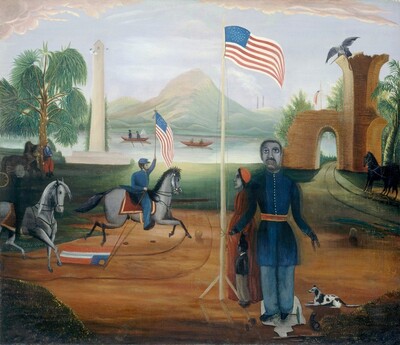
The painting shows a landscape including distant hills under a pale blue sky with clouds. Below the hills is a body of water with some small red rowboats on it. Closer to us, to the right of center, is an American flag on a flagpole. A child in a black suit and a woman in a red dress stand facing the flagpole, and a man stands in front of them, facing us. He is in a blue uniform with long buttons down the front and a red belt. The man is holding broken pieces of a chain in either hand and appears to be standing in a light gray puddle. All three of these people have blue-gray skin and black hair, and there is a small black-and-white dog by them near the bottom right corner. To the left of center, a man riding a horse holds up another American flag. This man is wearing a similar blue uniform and has slightly paler gray skin. He also holds another flag in his other hand, which he allows to drag on the ground, and this flag is red with a wide white stripe in the center and a blue and gold section in the top left. Behind him is another rider on horseback who is mostly in shadow, and behind that a man stands by a tree near two horses that appear to be hitched to a wagon. In the background on the left, there is a tall white monument, and on the right is an arched structure made of light brown stone with a large gray bird sitting on top of it and more horses standing below it.

Allegory of Freedom

American 19th Century

Seen through a wide, shallow, ornamental, stone arch, seventeen light-skinned people and a dog gather around or near a long banquet table set with plates of food in this horizontal painting. The table angles away from us so the short, right side is closest to us in the darkened room, which is lined along the far wall with shallow columns and capitals. To our left, an arched doorway in the room opens to a view of a stone structure and a sliver of blue sky. A gleaming, gold candelabra with curving arms hangs over the table from a coffered, possibly wooden ceiling. The table is covered with a white cloth. Men crowd around the short ends and the long side of the table opposite us. In pairs and trios, the men converse or look toward a man with light radiating from the top and sides of his head, at the center of the far side of the table. That bearded man, Jesus, has long brown hair and points his index finger upward with his right hand, on our left. The other men at the table wear robes and tunics in sage green, tan, brown, or slate blue. A portly man behind Jesus stands with a cloth draped over one forearm and his other hand on his hip, looking down at the table. Another cleanshaven man stands holding a large platter at the far corner of the table, and two people, perhaps a man and woman, appear to be walking away from the table but look back over their shoulders to our left. On the long side of the table, closer to us, a man to our left, balding with a long gray beard, sits on a narrow, bench-like seat and twists to pick up a jug from a large basin on the floor. The final man stands near an overturned seat as he turns his back on the table. He gestures forward, to our left, with one hand as he looks back over his other shoulder. A white dog with brown spots chews on a bone near the overturned seat. The highly decorated wide archway through which we see the scene seems to be carved from pale, fog-gray stone with scrolling moldings and capitals. The arch has a shield-like decoration at the top center, and is flanked by sculpted people in the upper corners. Two larger golden statues of robed women stand on floating plinths to either side of the arch. The woman to our left holds flaming orbs and the other holds a yoke across her shoulders. Though the painting seems rather illusionistic from afar, closer examination shows that it is sketchily painted throughout.

The Last Supper

Ricci, Sebastiano

More than a dozen light-skinned men, women, and children eat, drink, talk, and make music around a dancing couple under an arbor in this horizontal painting. Most of the people are dressed in muted tones of green, gray, and black. The patio-like space is enclosed by a railing along the back and a half wall to our right. Sage-green vines and leaves covering the roof-like trellis hang down. Ten men and women sit or stand closely around a long table along the left, next to the exterior wall of a red brick building. A woman sitting in a wooden chair at the end of the table closest to us wears a flax-yellow gown with a wide white collar and a starched white cap. She smiles up at the child she braces in her lap. The child stands and holds a toy in both hands and looks over one shoulder to our right. The child wears a carrot-orange gown with a white pinafore. Two men lean out of open windows at the far end of the brick building, and the people along the table drink, smile, or look on as a man in the center leads a woman by the hand to an open spot under the arbor. He wears a charcoal-gray suit, and a muted pink cap is pulled low over his eyes. He has a long, hooked nose, and light glints off teeth in his smiling mouth. The woman is pulled behind the man, so she stands flat-footed to our left of him. She faces our right but turns to looks at us from the corners of her dark eyes. Her light brown hair is gathered at the back of her head under a pearl-lined covering. She wears a dusty rose-pink gown with a sheer black shawl around her shoulders and white apron at her waist. Beyond the back rail, a man smiles widely as he balances a covered basket containing a gray chicken with one hand on his head. Nearby, a boy on our side of the rail talks with a little girl across the railing, who smiles back. Two men and a woman wearing a black head covering talk a short distance away. Close to us, a man, woman, and child in the lower right corner sit near two young men perched on the half wall, one playing a violin and the other a flute. A gleaming pewter ewer, a wooden barrel with a square opening, a white pipe, a terracotta bowl, broken eggs, a spoon, and an overturned pail of flowers lie scattered across the foreground of the patio. The artist signed and dated the lower left, “JSteen. 1663,” with the J and S overlapping.

The Dancing Couple

Steen, Jan

Against a distant, hazy, verdant forest, a petal-pink and amethyst-purple orchid grows from a mossy branch close to us, to our left, while three jewel-toned hummingbirds gather around a nest to our right in this horizontal painting. Two pale pink, ruffled petals of the orchid flare up and out from the hot-pink, furled center. The lip-like petal below is amethyst purple brushed with pale yellow along its top. Three narrow, pink petals create a triangle behind the center of the bloom. Some of the pale honeydew-green pods and leaves growing from the base of the plant are speckled with brown spots. The orchid grows on a gnarled brown branch painted with daubs of white, burnt orange, goldenrod yellow, and scarlet red along its length, which spans the width of the painting. Three hummingbirds with narrow, pointed beaks tend a nest built further along the branch to the right of the orchid. The largest is perched with its back to us. It has a vibrant green body and a two-pronged, crimson-red tail. Its head is turned up and to our left, looking at the second bird fluttering on a branch across the nest. The second bird’s avocado-green and dusty rose-pink body curves downward from outstretched wings. The third bird is perched on a nearby branch to our left, its head turned to the right to look at the others. Two white eggs are partially visible in the nest, which is shaped like an upside-down cone. The nest is woven with wavy, dangling strands of burnt-orange plant material. The orchid, birds, and nest fill the center of the composition. The scene is brightly lit from upper left. More leafy branches covered with hanging vines rise on either side of the painting. The background is filled with a dense growth of plants and trees, painted with blended shades of muted greens and pinks creating a diffuse, watery haze. The sky takes up the upper third of the composition and is filled with smoke-gray clouds except for a small circle of blue sky peeking through the branches of the tree in the upper right.

Cattleya Orchid and Three Hummingbirds

Heade, Martin Johnson

A rocky shoreline juts into a vivid, aquamarine-blue body of water in this loosely painted, nearly square landscape. The rocky beach and a few pieces of driftwood stretch in front of us in shades of ivory white, sand brown, gold, and mustard yellow to fill the bottom half of the painting. A few touches of shamrock green suggest plants growing in the near distance. A higher, almost flat-topped promontory reaches into the water beyond, nearly spanning the width of the composition. Areas of pine green suggest more growth in the distance near the left edge. A line of pale brown reaches across much of the horizon, which comes four-fifths of the way up the painting. The sky above is muted turquoise blue. The artist signed and dated the painting in the lower right corner, “Childe Hassam 1901.”

A North East Headland

Hassam, Childe

We look through shadowed trees at a river winding into the distance in this horizontal landscape painting. Close to us, a cluster of three thin trees and a larger central tree are deep in shadow, which contrasts with the light-filled scene beyond. The topaz-blue river curves from the lower right corner, across the canvas, and into the distance at the center. A few spindly trees grow along the riverbank in front of a hut with a thatched roof to our right. The bank to our left is lined with reeds and tall grasses. Behind the central shadowed tree, a long, low, narrow boat is occupied by four people with pale skin. To our left, a person with a dark garment and white collar reclines near a seated man wearing yellow and a feathered cap. To our right, another person reclines near the boatman who pushes the boat through the water using a long pole. The harvest yellow and sage green of the riverbanks and vegetation beyond the boats fades to hazy, pale blue mountains along the horizon line, which comes just over halfway up the composition. White clouds float across a blue sky above.

River Landscape

Carracci, Annibale

Shown from about the knees up, a young girl with pale skin and flushed cheeks stands in front of a landscape, looking at us in this vertical portrait painting. She stands with her body angled to our left, and she turns her face to us. Her chestnut-brown hair curls down the nape of her neck, and her bangs sweep across her forehead over slate-blue eyes. Her turned-up nose and pink bow mouth are set within in her round face. The girl’s smooth skin, her white dress, and her ivory-colored, wide-brimmed straw hat are brightly and evenly lit. Her flushed cheeks are echoed by the broad, petal-pink sash tied around her waist into a bow at her back and the matching ribbon of her hat, tied in a bow under her chin. A few streaks of pink also appear in the aquamarine-blue sky behind her. A hillside painted with tones of harvest gold and tawny brown slopes up from the lower left corner to the right edge of the canvas. The landscape is more loosely painted with lively brushstrokes.

Miss Juliana Willoughby

Romney, George

The image shows a Native American camp from an elevated viewpoint. The scene includes tipis with symbols and people engaged in various activities. The setting features distant hills under a cloudy sky, with soft transitions between land and sky. The brushstrokes are delicate and precise, creating a realistic landscape. The color palette is dominated by earthy tones, with greens for hills and browns for tipis and earth, while the sky is a blend of grays and blues. Figures on horseback in the distance add movement to the scene. The painting is bordered by an oval frame.

An Ojibbeway Village of Skin Tents

Catlin, George

Little Girl with Flower Basket

Little Girl with Flower Basket

American 19th Century

Shown from the chest up, a light-skinned, cleanshaven man looks down and to our left in this vertical portrait painting. His shoulders angle slightly to the right, but he turns to look in the other direction with dark eyes under gathered brows. He has a prominent nose, a pointed chin, and his full lips are parted. His dark blond hair is parted down the middle and falls to both shoulders. His right arm, to our left, crosses his chest, and he holds a staff with that hand along the right side of the painting. He wears a tawny-brown coat with buttons down the front over a high white collar. The background is painted with shades of fawn and peanut brown. The artist signed and dated the painting along the center of the left edge in faint brown paint: “P. Soutman F.A. 1640.”

A Young Man Holding a Staff

Soutman, Pieter Claesz
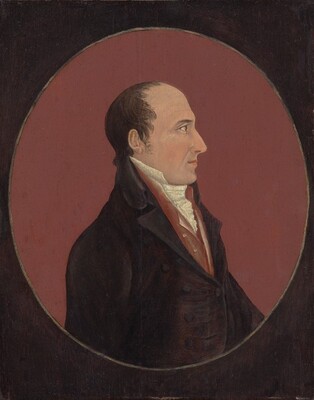
The image shows the upper half of a man's body in profile from the waist up. He has a prominent nose and slightly receding hairline, and his dark hair is combed back. He wears formal attire, including a dark coat, reddish-brown waistcoat, and white high-collared shirt. The background is a plain, muted reddish-brown color with an oval frame around the man, giving the image a classical portrait appearance with a simple, dark-colored border.

Wellington Van Reid

American 19th Century

An older woman wearing a long black dress sits reading a book in front of a younger woman wearing cream white, who sits on a couch just beyond, in this vertical portrait painting. The scene is loosely painted with some visible brushstrokes, especially in the furniture, clothing, and room. Both women have pale skin and wear dresses with long sleeves and skirts. To our right, the older woman sits in a chair with a curved back, which runs parallel to the right edge of the canvas. The full skirt of her black dress angles down across the picture, almost spanning the bottom edge of the composition. Her gray hair is pulled back and covered by a black cloth or veil, which falls to her shoulder and blends with her dress. The collar is lined with a white ruffle, and white lace cuffs encircle her wrists. Her face is painted with rosy tones. She looks down at her book with dark eyes, and her rose-pink lips are closed. She wears a gold ring with a light stone on her left ring finger, and the book she holds has a moss-green cover. Her skirt overlaps the younger woman sitting nearby on the couch, which runs along the back wall of the room. The young woman’s knees are angled to our left but she looks slightly back to our right, to gaze down and into the distance with brown eyes. Her skin is paler, but she has lightly flushed cheeks and her petal-pink lips are also closed. An azure-blue bow is tied in her chestnut-brown hair. A few tendrils fall down her back and over one shoulder. Her dress falls loosely over her torso and legs. She wears a gold ring on her left hand and a gold bracelet on that wrist. She fingers a piece of lapis-blue fabric in one hand. The couch behind her has a pattern with stylized flowers or leaves floating within rose-pink ribbons that hang in swags, against a white background. Pillows patterned with ruby red, sky blue, and fawn brown peek out from behind the young woman. A round or oval wooden table with curving legs to our left holds a glass vase with a violet-purple flower, perhaps a hydrangea. A slip of paper or envelope sits on the table next to the vase. The wall behind the couch is fog gray, and the bottom edge of a gold frame hangs behind the young woman.

The Mother and Sister of the Artist

Morisot, Berthe