← All styles

Decorative Art

162 works

The sculpture depicts a woman seated and nursing an infant who is wrapped in swaddling clothes. The woman wears a headscarf and a gown with a blue top and a grayish-blue skirt. The infant is positioned horizontally across her lap, with both hands cradling the baby securely. The sculpture is made from a material that has a glazed, smooth surface. The colors include a creamy tone for both the woman's skin and the baby's swaddling cloth, while the woman’s attire adds a touch of color with its blue and gray shades. The sculpture's life-like size and detail allow us to appreciate the realistic depiction of the maternal subject.

The Nurse

Fontainebleau Pottery

The image displays a ceramic bowl with a dragon motif. The dragon is intricately carved and painted on the bowl, showcasing scales and whiskers. The dragon's body is green, set against a yellow background. The bowl has a glossy finish, typical of glazed ceramic. The design suggests a fusion of artistry and functionality.

Bowl

Chinese Qing Dynasty

Rectangular Vase

Rectangular Vase

Chinese Qing Dynasty

The sculpture is a richly decorated lidded vase. It features a vibrant display of flowers and birds depicted in intricate detail on the body. The lid has a small sculpted figure of a stylized lion or mythical creature sitting on top. The color palette includes warm and soft colors - pinks, yellows, whites, and greens - against a complex pattern background. The material appears to be porcelain with a smooth, glossy finish. It presents itself as an ornate and elaborate piece of craftsmanship with decorative motifs indicative of traditional artistic techniques.

Large Covered Baluster Jar

Chinese Qing Dynasty

The sculpture depicts a figure with the upper body of a man and a fish-like lower body. The figure is adorned with decorative elements and is holding a small horn. The sculpture is intricate, combining gold metal with colored enamel and gemstones. The upper body is made of a lustrous material resembling pearl, while the lower tail-like portion is richly decorated with red and green enamel and embedded gemstones. The sculpture also features dangling pearls. Hanging from a gold chain, it resembles a luxury pendant or an ornamental piece. The elements create a visually captivating and intricate sculpture of a fantastical sea creature in a luxurious form.

Pendant with a Triton

André, Alfred

The sculpture is a ceramic vessel featuring a painted depiction of a cherubic, nude figure holding a vertical rod with a heart attached at the end. The background scene includes stylized mountains and grass. The vessel is painted in blue tones with yellow and hints of green. The figure has pale skin and brown, curly hair, and the material appears to be ceramic or pottery. The vessel is cylindrical with slightly curved sides, a wider base, and a narrow neck. Terracotta brown is visible at the rim and base, creating an aged and rustic appearance.

Albarello with Cupid spearing a heart

Faenza 16th Century

This is a photograph of a ceramic vase decorated with colorful patterns and motifs, predominantly in blue, yellow, and green hues. The center of the vase features a painted medallion with a profile portrait of a figure wearing headgear, and below it is a label with the inscription "dia-irrj" in a calligraphic style. The surface of the vase is covered with ornate designs including floral and geometric patterns.

Drug jar with the head of a warrior

Faenza 16th Century

Shallow bowl on low foot with the death of Laocoön and his two sons

Shallow bowl on low foot with the death of Laocoön and his two sons

Xanto Avelli, Francesco

This round plate features a central mustard-yellow design with a shield containing six circular shapes, five that are orange and one that is black with small yellow symbols inside it. The rim of the plate is decorated with floral and scroll patterns in the same yellow color, with thin blue outlines and small patches of white in between the large shapes. A motif of crossed keys below a crown is above the shield. The plate is set against a plain blue background.

Large dish with plant-pattern border; in the center, the arms of a Medici pope

Deruta 16th Century

The sculpture is a wooden chest with intricate carvings. The chest is a rich, dark brown color and features leaf motifs on the corners and circular designs along the top edge. The carvings are detailed and symmetrical. The chest is displayed on a white plinth, elevating it off the wooden floor.

Cassone Carved and Gilded

Florentine 15th Century

The sculpture depicts a wooden table with intricate designs, including human faces and scrollwork on the supports. The wood has a rich, polished brown color. The table has a rectangular tabletop, ornate balusters, and carved legs. The carvings show heads and decorative motifs, highlighting craftsmanship. The table has an opulent and elegant appearance suitable for a classic or traditional setting.

Walnut Table with Eagles on the Supports

Florentine 16th Century

This is a tapestry of a landscape with castles, trees, and various people and animals. It depicts an outdoor scene where people are dressed in elaborate clothing in shades of red, tan, and dark blue, including long dresses with draping sleeves, tunics with puffed sleeves, and feathered hats and caps. In the background, the landscape is dotted with green trees bearing fruit, and some people are engaging in what appears to be a harvest, using curved gray objects to slice the limbs from bare trees. To the right, a person on horseback looks on, watching them. Closer to us, near the bottom left corner, is a large table with dishes and plates, possibly signifying a feast, surrounded by more people. In the distance there are three buildings with spires and turrets typical of a castle.

The Return from the Hunt

Flemish 16th Century

Baluster Vase

Baluster Vase

Chinese Qing Dynasty

This sculpture is a large ceramic jar. It is made from brown, glazed material with a glossy finish. The jar is cylindrical with a wide opening at the top and two small, rounded handles near the rim. There are carved lines of text or markings around the upper portion of the jar near the rim.

Storage Jar

Drake, David

The image shows a tall vase with a smooth, rounded body that tapers towards an elongated neck, culminating in a flared rim. The vase has a soft pinkish-red color with speckles and a white accent at the rim and base. It is placed against a gray background.

Amphora Vase

Chinese Qing Dynasty

This is a vase with a rounded body and a long, narrow neck. The vase is a vibrant green color with a crackled finish. The crackle glaze covers the entire surface of the vase except for the rim of the opening, which is white. It seems that the interior of the vase is black or dark grey.

Bottle Vase

Chinese Qing Dynasty

The form of a woman standing inside an arched niche is created with vibrant painted and cut glass held in place by dark lines, probably lead, in this vertical stained-glass window. The woman’s body faces us but she turns her face to our left to look down in that direction. She wears a red dress under a blue robe lined with canary yellow. She holds a book in one hand, and her other hand, to our left, is down by her side. Her skin is a yellowish color, and she has long yellow hair with a darker yellow halo. In front of her and to our right is a lectern decorated with intricate scrollwork and floral carvings. The rounded arch behind her is filled with a coral-orange shell. A border with flowers is created with white, yellow, pale pink, red, and light blue glass.

The Virgin Annunciate

Giovanni di Domenico

This is a photograph of a decorative ceramic bowl made of porcelain. The bowl features intricate painting on its exterior, with a design of blue vines with green leaves winding around the bowl. Red, oval-shaped fruits decorated with small dots are interspersed among the foliage. The overall design is delicate and elegant, showcasing traditional ceramic art craftsmanship. The bowl is placed against a neutral background.

Cup

Chinese Qing Dynasty

This is a photograph of a decorative porcelain plate. The plate features a detailed and colorful design depicting a domestic scene with several figures engaged in leisurely activities. The central image is encompassed by a richly decorated border with floral patterns and ornamental motifs in colors such as greens, pinks, blues, and golds. The craftsmanship highlights traditional artistry found in fine porcelain, with an emphasis on harmony and elegance.

"Ruby-Back" Dish

Chinese Qing Dynasty

The sculpture is a cream-colored vase with a long, slender neck that gradually flares out towards the mouth and a bulbous body that rests on a narrow base. At first glance it appears smooth, but closer inspection reveals extremely subtle swirling patterns visible on the surface.

Vase

Chinese Qing Dynasty

A cup carved from stone is mounted in gold fittings to create a jeweled chalice with handles that curl up each side and a tall, flaring foot below. The stone of the cup is swirled with shell pink and rust brown, and carved to create vertical ridges. The gold rim around the lip flares outward and is set with a band of alternating pairs of small, white pearls and mostly garnet-red stones, though one stone to our right is a muted blue. In this photograph, the handles curve up each side from the base of the stone cup to the gold lip, where the handle divides into two scrolling tendrils on either side of a teardrop shaped center, like curling petals. The base and foot are as tall as the stone cup and gold lip. A knob-like form just below the stone cup is set with deep red and jade green stones around its center, and rows of small pearls around the narrow top and bottom of the knob. The knob is chased to create a pattern of scrolling vines, like tracery. The flaring foot below is also chased with the same pattern, surrounding gold, oval medallions set at regular intervals in the foot. In our view, the medallion to the left shows a bunch of grapes and the center is a portrait of a bearded man with a halo, holding his right hand up with his first two fingers raised. The details on the medallion to our right are difficult to make out but it could be a sheaf of wheat. Small, round jewels are set above and below each medallion, and between each one.

Chalice of the Abbot Suger of Saint-Denis

French 12th Century

The sculpture is a small, round container with a lid. It has a red color with areas of lighter patches. The material appears to be ceramic or porcelain, with a smooth, polished surface. It is similar in size and shape to a compact or trinket box and rests on a flat surface.

Covered Box for Seal Paste

Chinese Qing Dynasty

This is a photograph of a ceramic vessel. The vessel is a tall, pyramid-shaped object with a narrow neck and a wide base decorated with a colorful glaze featuring intricate, ornate designs. The surface of the vessel is adorned with highly detailed and decorative motifs including mythical figures, scrollwork, and creatures, with a central humanoid figure on one side. The vessel includes handles on each side, with a snake-like design coiled around them. The color palette consists of rich blues, yellows, and greens.

Quadrilateral flask with Saint John the Baptist and grotesques

Patanazzi Workshop

The sculpture depicts a figure with almond-shaped eyes and a closed mouth, adorned in a robe with colorful floral patterns. The hands are held together at the front, with a shawl draped over the shoulders. The head is topped with a dark headdress. Made from glossy ceramic material, the sculpture has a polished sheen, enhancing its design. The textures and colors create a decorative appearance, presenting the figure as elegant and traditionally crafted.

Guanyin, the Bodhisattva of Compassion

Chinese Qing Dynasty

This is a photograph of a vase with a dragon motif. The vase is ornately decorated with a dragon design that wraps around its body. The background has swirling cloud-like patterns in shades of green, yellow, black, and white. The dragon is detailed with scales rendered in gold and yellow. Its body weaves across the surface, and its head has a fierce expression with white protruding eyes and long tendrils. The vase has a wide mouth and a rounded base, showcasing an elegant silhouette.

Baluster Vase

Chinese Qing Dynasty

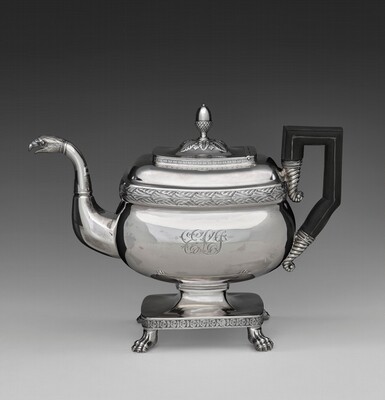
The image shows a large silver teapot with a unique spout shaped like an eagle's head, a dark handle, and intricate engravings. It has claw-footed legs, a finial on the lid, and an oval emblem on its side. The color scheme is mainly metallic silver with dark accents.

Five-Piece Tea/Coffee Service

Fletcher, Thomas

This is a photograph of a decorative ceramic jar. The ceramic jar is adorned with vibrant, intricate patterns. The central image is of a figure with a turban and beard, appearing to read or write on a scroll, against a bright yellow background encircled by blue and green foliage motifs. Below this portrait are ornate scrolling and a stylized, yellow mask-like face on a dark blue background. The top and bottom edges of the jar are banded with yellow and turquoise hues. The jar's shape is slightly tapered with a subtle flared top edge.

Albarello with white-bearded physician and trophies of arms

Faenza 16th Century

This is an ornate wooden table with multiple compartments and intricate gold detailing. The table is designed with a polished wood finish with decorative inlays and carvings indifferent shades of orange and reddish-brown wood. It is turned slightly to the left so that we get a view of the front and one of the sides. It features several drawers and compartments that are partially open, revealing felt-lined interiors. The central compartment has a lid that flips open, revealing a narrow compartment with a slanted bottom. The table has curved legs with decorative gold metal mounts at the joints and feet.

Combined Toilet and Writing Table (toilette à transformations)

Leleu, Jean-François

This free-standing bronze sculpture shows the rounded, stylized forms of a person with long limbs riding astride a horse with noticeably short legs. The horse and rider are angled to our right in this photograph. The dark brown bronze gleams white where the light catches the smooth surfaces, and some areas are a burnished gold color. The horse looks ahead with large eyes. It has short ears, and its mouth is parted. The person riding the horse holds the reins with the right hand, closer to us. The reins wrap halfway around the horse’s neck and are then broken off. The cleanshaven rider has a heavy brow ridge and a long, straight nose. He wears a flat-topped cap and a robe that reaches to his ankles. The pointed toes of his shoe pokes through the small stirrup we can see. A rounded handle connects the rider’s upper back to the back of the horse. The background is taupe-gray behind the sculpture and darkens at the upper corners.

Aquamanile in the Form of a Horseman

English 13th Century

The sculpture is a decorative vase with a wide flared top. The subject on the vase includes a black and yellow rooster, standing in a picturesque setting with delicate flowers and light greenery surrounding it, painted in vibrant colors such as red, blue, and green. The vase is made of a ceramic material with a glossy finish. The primary color of the vase is deep red, with an intricate design featuring alternating panels of white, where the painted images of the rooster, birds, landscape, and floral motifs are placed. The vase presents an elegant composition with traditional imagery that appears to be carefully arranged to achieve a harmonious and balanced visual effect.

Beaker Vase

Chinese Qing Dynasty

This is a painting of a pastoral scene with figures, animals, and a village. The tapestry depicts individuals engaged in various activities such as playing music, herding sheep, and conversing. The background features a castle with turrets and a bridge over water. Foliage and flower patches create a lush surrounding setting. A quaint hut can be seen on one side. Animals including dogs and sheep are present throughout. This is in the style of medieval European tapestries.

Hunting and Pastoral Scenes, with a shepherdess shearing

French 16th Century

This is a photograph of an ornate cabinet. The cabinet has a black lacquered surface with intricate gold detailing. The decorative elements include rococo-style gilded floral and scroll motifs surrounding the central panels. The central panels depict detailed and colorful scenes of traditional Asian architecture, surrounded by nature. The legs of the cabinet have intricate gold designs. The photograph showcases the fine craftsmanship and artistic details of the cabinet.

Corner-Cupboard (encoignure)

Desforges, Jean

The curving X-frame design of this wood chair creates an hourglass silhouette from the front, and creates a bucket-like seat for the sitter. The front face of the wooden frame is carved with curving vines and stylized bunches of grapes and leaves, and the frame ends with clawed lions’ feet at the bottom. The seat and legs are made up of alternating slats so the chair could fold up. Imagine interlacing your fingers and then moving your palms back and forth—that is how the pivot of this chair works. The arms of the chair, which have a rounded knob at each front end, rest along the top edges of the slats. The back rail connects at the back of the arms. A crest at the center of the back rail is flanked by the capital letters “A” to the left and “G” to the right. The crest and letters are contained within a medallion-like form, and the sides of the back rail dip down to meet the arms. A worn, pale blue velvet cushion rests on the seat, and has tassels at the front corners. The chair is shown against a pale gray background.

Walnut Savonarola Chair with Letters A.G.

Italian 16th Century

The sculpture is a shallow dish with two reclining figures at its center. The figures are human and intertwined, surrounded by small white seashell-shaped elements. The dish is made of ceramic with various colors. The material has a three-dimensional appearance and is detailed. The colors used are greens, blues, and flesh tones with a deep blue shade on the outer rim, giving it a lush and colorful look with naturalistic elements.

"Gondola" with Bacchus and Ceres

Fontainebleau Pottery

The sculpture depicts a hexagonal vase with floral motifs. The vase is adorned with blossoms in pink, white and green colors set against a yellow backdrop. It is made of glazed ceramic material with a white rim on top featuring a red crisscross pattern. The floral patterns are evenly spaced around the surface, creating a harmonious and balanced look.

Hexagonal Trumpet Beaker Vase

Chinese Qing Dynasty

This is a photograph of an ornate chair. The chair has an intricately designed, gilded wooden frame with detailed carvings in a Rococo style. The seat and armrests are upholstered with a floral tapestry in red, green, and beige. The chair features floral motifs, scrollwork, and stands on four cabriole legs. The design reflects a blend of artistry and opulence characteristic of the period associated with this style.

Armchair

Gobelins Tapestry Factory

Round Dish with the Wedding Feast of Cupid and Psyche

Round Dish with the Wedding Feast of Cupid and Psyche

Limousin, Leonard

This is a ceramic vase. The vase is colored magenta red with white sections showing designs of a rooster, flowers, and abstract floral patterns. The designs use colors like gold, green, and blue. The vase has a tall, cylindrical body with a flared top and a slightly rounded base.

Beaker Vase

Chinese Qing Dynasty

This is a ceramic vessel with a rounded, dome-like shape and a small, narrow opening at the top. The right half of the vessel is predominantly covered in red glaze, while the left side is a lighter cream color. The red glaze is patchy in some areas, showing the cream area underneath. The surface features an embossed design resembling swirling clouds or waves.

"Beehive" Water Pot

Chinese Qing Dynasty
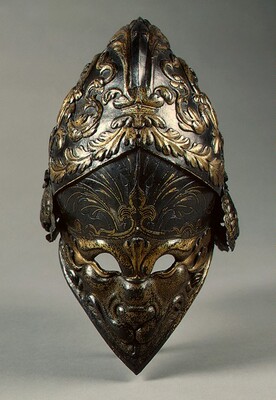
This is an ornate helmet made of dark metal with gold-colored details. It features intricate designs and patterns throughout, including symmetrical swirling and floral designs, as well as designs on the faceguard that look similar to an animal’s face, including a snarling mouth and eye holes. The lighting emphasizes the embossed and engraved elements of the helmet.

"The Morosini Helmet" (visored burgonet)

Milanese 16th Century

This is a painting on a circular plate depicting a battle scene. Warriors clad in medieval armor and helmets engage in combat. The scene includes figures in action poses with swords and shields. In the background, a fortified city with flames and smoke rising from its towers suggests a siege or invasion. Bright colors and detailed ornamentation enhance the drama of the scene. This is in the style of an Italian Renaissance artist like Francesco Xanto Avelli, known for detailed maiolica ceramics depicting historical and mythological scenes.

Charger with the Battle of Roncevaux

Xanto Avelli, Francesco

A free-standing, gold, enameled, rectangular box has a triangular top like the roof of a house, and the box rests on a short, square foot in each corner. In this photograph, we look onto one long side and the short side to our right is angled toward us, so we see the panel there, too. Along the long side, five people are shown from the waist up in the upper, roof-like panel and six more line up on the panel below. The skin of every person is gold, and all wear robes and garments in lapis or sky blue, spring green, yellow, and white. The area around the people is also gold, and each panel is encased by a royal-blue band dotted with stylized stars at regular intervals. Each panel is then lined with small, button-like rounded bosses around its edges. In the upper panel, all of the men except the second from the right have beards, and all have halos with wavy bands of blue, green, yellow, and white. The man to our left holds a book and his neighbor a skeleton key the length of his arm. The man at the center holds up a book with his left hand, on our right, and raises the index and middle fingers of his other hand, held up at shoulder height. The two men to our right also hold books. In the panel below, three horses’ heads peek in from the left edge, creating a vertical band, and three crowned men line up, holding gold vessels and looking toward a woman seated in a throne with a child on her lap. The woman has a halo made with a wavy pattern of blue, yellow, green, black, and white. Her throne is flanked by columns, and the area around it is edged with bands of white, light, and dark blue. The baby wears gold, has a halo, holds a book in his lap with his left hand, and raises the first two fingers of his other hand toward the three men. The final person in this panel wears a hat, holds a scepter topped with a fleur-de-lis, and gestures at the woman and baby. The head and shoulders of a haloed person is visible along the short side of the box, which is angled sharply away from us. The gold between all the people and bordering each panel is intricately carved with tiny flowing organic lines and swirls.

Reliquary Châsse

French 12th Century

This is a painting of a narrative scene on a circular ceramic plate. The plate is decorated with intricate and colorful imagery depicting various figures and animals engaged in different activities. In the foreground, there is a central pedestal with an inscription, surrounded by various characters and animals, including a bovine figure on the left and a variety of other figures interacting with each other, some appearing to be sleeping or in distress. The scene is bustling with activity, with architectural elements and lush greenery in the background.

Plate with the Plague of Phrygia

Urbino 16th Century
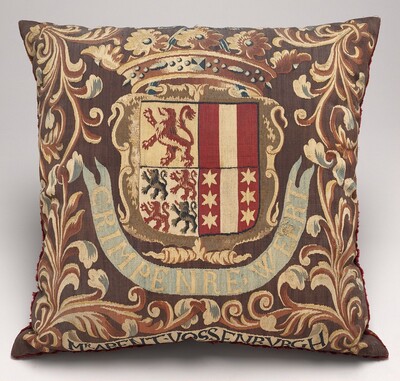
This is a photograph of a decorative embroidered cushion. The cushion features a detailed coat of arms in the center, showcasing a lion, stars, and various stripes and patterns within an ornate shield. The crest is surrounded by floral and scroll motifs in colors like gold, red, blue, and brown. The design includes a banner below the shield with text. The craftsmanship is intricate, highlighting woven patterns and textures.

Tapestry-covered Cushion

Netherlandish 17th Century

This is a photograph of an ornate necklace made from gold, pearls, and gemstones. The necklace features an intricate chain with repeating motifs of red and white gems encased in a gold setting. The central pendant shows a figure with a sculpted face and extended wings, with three pearls hanging beneath. The background is dark, emphasizing the craftsmanship and design of the jewelry.

Necklace and Pendant with a Sphinx

André, Alfred
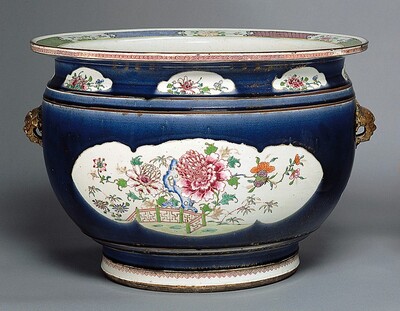
This is an ornate, decorative vessel resembling a large ceramic bowl or pot. Its surface features intricate floral designs painted in shades of pink, red, and orange, with hints of green leaves and a small brown fence around the flowers, all set against a white background. The main body of the vessel is a deep cobalt blue color and has a smooth, shiny surface. The vessel has small, golden-toned handles on each side.

Large Fish Bowl

Chinese Qing Dynasty

The sculpture is of a traditional ceramic vase featuring a bulging body with an elongated, narrow neck. The vase is primarily white and is adorned with an intricate pattern of blue swirling motifs covering the body and neck. The top of the vase has a band with blue calligraphic characters. Made from what appears to be porcelain, this vase displays a high level of craftsmanship typical of historical Asian pottery. Its glossy finish and classic blue-and-white color scheme give it an elegant and timeless look.

Bottle Vase

Chinese Qing Dynasty

This is a photograph of a white ceramic plate. The plate has a smooth, glossy finish with a subtle design along its surface that blends into the overall creamy white color. Its shape is slightly scalloped or lobed. The background is a simple, neutral tone. The lighting emphasizes the plate’s texture and shape.

Small Foliated Dish

Chinese Qing Dynasty

This painted plate shows three armored people and two horses in a dynamic scene set against a green and blue landscape. The people all have light skin and wear armor in shades of yellow and gold, with red fabric around their waists. They all wear different hats: one wears a yellow hat, one wears a blue hat, and one wears an orange hat with large blue feathers. Closest to us, a person jabs a spear towards a large white horse on the right. Another person is behind this horse, holding its reigns and looking over their shoulder. In the background on the left, a person riding a tan horse points a long sword down at the spear-wielder. In the background, blue water winds through light green grass and pale rock formations, with a few light blue trees. In the distance on the right is a large white castle with a golden roof under a blue sky that fades to yellow near the horizon. The rim of the plate is gold.

Flat plate with a battle scene

Italian 16th Century
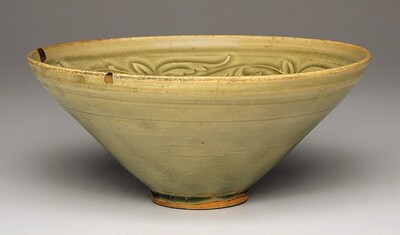
This is a photograph of a ceramic bowl. The bowl has a soft olive-green glaze with broad curving lines forming an abstract floral or vine-like pattern incised into the interior. The shape is wide at the top, tapering down to a small raised foot. The rim has small aged chips revealing a darker clay base. Subtle crackling is visible throughout the glazed surface, giving it an antiquated appearance. The lighting highlights the texture and color variations, accentuating the bowl's simple form.

Bowl

Chinese Jin Dynasty

This is a photograph of an ornately embroidered pillow. The pillow features an intricate design with a central heraldic emblem depicting a red lion in a standing pose enclosed within a woven-like fence, topped by a crown. Surrounding this central motif are floral embellishments with leaves and flowers in various colors, including red, pink, blue, and beige, set against a dark background.

Tapestry-covered Cushion

Netherlandish 18th Century

This is a painting of a scene featuring a young, winged figure reaching out to a robed woman. The round plate shows a colorful, intricate scene with a winged cherubic figure and a woman dressed in a flowing garment. The background displays a landscape with a twisted tree shape, rolling hills, and a detailed village under a sunset or dawn sky with hues of orange, blue, and pink. The style resembles the work of Renaissance artist Luca della Robbia, known for vibrant colors and intricate detailing typical of painted maiolica ware from that period.

Plate with the reconciliation of Cupid and Minerva

Italian 16th Century

This is a bowl with a rustic orange finish and a crackled glaze that gives it a textured pattern. The bowl is decorated with painted white designs, including a large floral motif in the center surrounded by curving lines and the outlines of birds. The rim of the bowl is undulating rather than flat, and it has some areas of black pigment. The wide bowl has a narrow, round base at the bottom.

Raku Tea Bowl

Japanese Edo Period

The Raising of Tabitha

The Raising of Tabitha

Netherlandish 15th Century

This is an ornate wooden side table. The table has slightly curved legs and a lower shelf for storage or display. The edges are trimmed with decorative silvery metallic elements. A small keyhole is visible at the front of the table. The legs appear to be darker wood, while the front and sides of the table are more red-toned wood. The top of the table has a floral design that uses multiple shades of wood.

Work and Writing Table (table en chiffonnière)

Vanrisamburgh II, Bernard

The image depicts a large, bulbous vase with a narrow neck and flared rim. It is turquoise blue with a crackled pattern. The vase is centered on a neutral background.

Bottle Vase

Chinese Qing Dynasty

The sculpture depicts a large decorative jar with a lid, showcasing ornate floral designs. The jar features predominantly green and red colors, with intricate floral patterns incorporating shades of orange, yellow, and white. It stands on an elaborate base made of what appears to be a gold-colored metal with scroll and leaf motifs. The jar seems to be made of glazed ceramic or porcelain, giving it a glossy appearance. The lid is adorned with a decorative knob resembling a pine cone. The overall impression is one of elegance and luxury.

Covered Jar in Gilt-Bronze Mount

Chinese Qing Dynasty

This is a photograph of a green ceramic pot. The pot is spherical with a wide opening at the top. Its surface is covered in a vibrant green glaze with a network of fine crackles creating a pattern across it. The top edge of the pot is unglazed. The background is a simple gradient. The lighting emphasizes the glossy finish of the glaze and highlights the form of the pot.

Bowl

Chinese Qing Dynasty

Vase

Vase

Chinese Qing Dynasty

This is a photograph of a decorative porcelain vase. The vase features intricate and colorful hand-painted designs typical of traditional East Asian craftsmanship. The central part of the vase showcases a scenic landscape with trees, rocks, and water, surrounded by Chinese characters. The top and bottom sections of the vase have decorative bands with a geometric pattern interspersed with floral motifs and circular medallions depicting mythical creatures. The color palette includes greens, blues, oranges, and earthy tones.

Lantern

Chinese Qing Dynasty

This sculpture is a decorative cup. The cup has a uniquely shaped form, with a scalloped rim and a yellow handle crafted in a flowing shape. The exterior is speckled mint green and decorated with various intricate patterns, including yellow flowers and stylized characters or symbols in tan and dark green. The interior is coated with a soft yellow glaze, while the rim is white.

Wine Cup

Chinese Qing Dynasty

This round sculpture contains several ornate designs and figures. In the center is a man with pale skin, long golden hair, and a golden beard, wearing red robes over a white garment. His hands are raised by his chest, and in them he holds a large cross with a smaller man attached to it. This man has his arms stretched out to each side, and his hands and feet have been nailed to the cross. He is shirtless, with a red cut on one side of his chest, white cloth wrapped around his waist, and a leafy crown on his head. He has pale skin with some areas of gold and long gold hair. At the top of the cross seems to be the shape of a white bird, its wings stretched to either side. Surrounding these two men are angelic figures with large brown wings, white skin, and golden hair. Circling them is a ring of thorns, and beyond that is a wreath of leaves with several large pearls in it. At the edge of the sculpture is an ornate golden frame. The piece is richly colored with gold, white, red, blue, and green tones.

Morse with the Trinity

French 15th Century

The sculpture is a vase with a simple form. It has a rounded body and a narrow neck that widens at the top. The vase is green with a glazed, crackled surface, giving it texture. It appears to be made of ceramic. The vase is visually appealing and likely used for holding flowers or as a decorative item.

Vase

Chinese Qing Dynasty

The sculpture is a rounded vase or vessel with a crackle glaze. It is a vibrant green color which is slightly lighter in some areas, highlighting the thin cracks running across it. The vase has a curved shape with a narrow neck and a flared white lip.

Jar

Chinese Qing Dynasty

Young Woman

Young Woman

Chinese Qing Dynasty

This is an ornately decorated plate. The rim is predominantly decorated with a light pink geometric pattern interspersed with blue, gold, and green accents along the border. At the center, within a yellow outline, is the design of a bouquet of flowers inside a decorative vase on a white background. The flowers are in shades of pink, purple, and yellow, and are inside a scalloped blue border. There is also the design of a blue platter with what appears to be a group of various fruits in yellow, green, and pink.

"Ruby-Back" Dish

Chinese Qing Dynasty
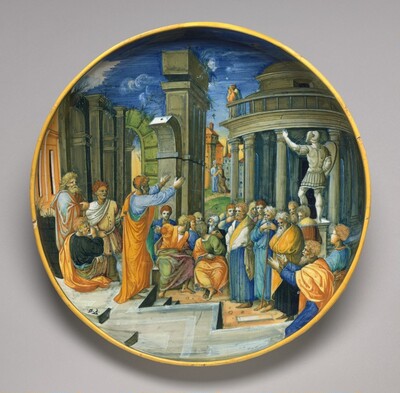
This is a painting of a gathering in an architectural setting. The composition features figures dressed in flowing robes around a temple or public square. One central figure is gesturing dynamically, possibly addressing the assembly or leading a discussion. The background shows classical architecture with columns, arches, and a statue of an armored figure. The scene is enclosed within a circular frame. The colors are vivid, with blues, oranges, and earth tones predominating the palette. This is in the style of Raphael, owing to the classical theme and details of the architecture and clothing.

Plate with Saint Paul preaching at Athens

Durantino of Urbino, Guido
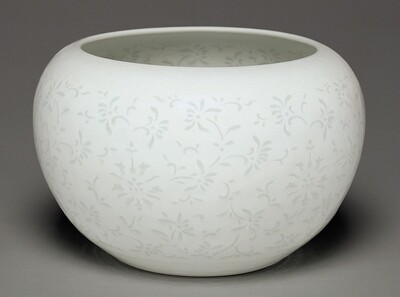
The sculpture is a large, rounded bowl with a delicate floral pattern covering its smooth surface. It is predominantly white, with the floral motifs painted in a light gray or off-white. The bowl has a wide, open top, and the same painted pattern appears to continue inside the bowl.

Bowl with "Rice Grain" Decoration

Chinese Qing Dynasty

The image shows a female figure standing upright. She is facing slightly to her left with her right arm raised, holding a sword, and her left hand on a balance scale. She has curly hair tied back, delicate eyes, and a slight smile. She wears an ornate garment with gold and red hues and is surrounded by a tapestry depicting a landscape with trees and mountains, framed by architectural elements.

The Four Cardinal Virtues: Justice

Netherlandish 16th Century

The sculpture is a detailed bust of a man’s head facing slightly to the left, with prominent, slightly furrowed brows and defined cheekbones. The man has a closely shaved hairstyle, a small beard or goatee on his chin, and large, deep-set eyes. It is crafted from a dark material, with some areas in a lighter yellow color creating highlights on the face.

Inkwell in the Form of a Grotesque Head

French 19th Century

The sculpture is a vase featuring a rounded body with a long, narrow neck. The vase is primarily made of a white material, and it is adorned with intricate designs. These designs include several black oval and leaf-shaped panels on the vase's body and neck, decorated with vibrant colors such as green, blue, yellow, and white. One of these panels on the body of the vase features a depiction of a snarling blue-and-white dragon with a yellow-and-green face set against a black background. The other visible panels have floral designs in white, yellow, blue, and green. Between these panels, the white body of the vase also appears to have been carved with white swirling floral designs. There are some small spots of brown discoloration on these designs at the bottom of the vase.

Bottle Vase

Chinese Qing Dynasty

The sculpture depicts a figure standing on a decorated pedestal, striking a dynamic pose with one arm raised and the other bent downward. The figure is adorned in a long, flowing garment with a variety of colors and patterns, including green, blue, yellow, and white, with floral motifs in different parts of the attire. The face of the figure is white with delicate features, and the hair is styled upward in a solid black form. The sculpture appears to be crafted from a glazed ceramic material, giving it a smooth and glossy finish, and it is detailed to convey a sense of movement and elegance. The pedestal below features a crisscross yellow and green pattern that complements the colors found in the figure's attire.

Dancing Woman

Chinese Qing Dynasty

This is a painting of a classical architectural scene with figures. The image depicts a woman seated in an architectural setting decorated with columns and arches, alongside a kneeling child and another figure holding a sphere. The painting is highly detailed, with the architectural setting resembling a palatial interior, complete with checkered flooring and intricate brickwork. The columns are painted in a vibrant blue hue, and the background features a view of a blue sky and distant buildings. The seated woman appears to be interacting with the kneeling child, possibly teaching or bestowing wisdom, as indicated by the open book and laurel wreath. The third figure, dressed in robes and holding the sphere, contributes to the scholarly or philosophical theme of the scene.

Plate with an allegorical scene of Calliope and a youth (from the Ladder Service)

Nicola da Urbino

Apollo and Daphne

Apollo and Daphne

La Fosse, Charles de

The sculpture depicts a white vase with a traditional bottle shape. It is made of porcelain and has intricate raised patterns of leafy motifs on the neck and swirling patterns on the body. The bottom of the vase features a repeated lotus petal pattern. It is set against a dark gray background.

Vase in the Shape of an Archaic Bronze Hu

Chinese Qing Dynasty

The sculpture is a lidded vase with a hexagonal shape and ornate decorations. It features a design of flowers, branches, and birds. The floral patterns are in white and green, and the branches are light brown. The birds are in matching colors. The vase is predominantly yellow with a detailed finial on top of the lid. It is made of glazed ceramic and has a glossy appearance. The body of the vase has intricate patterns, adding texture.

Hexagonal Covered Jar

Chinese Qing Dynasty

This is a painting on ornamental pottery. The artwork is on a decorative ceramic plate depicting a scene within an arched architectural setting. The detailed artwork includes elements of Renaissance-era attire and architectural forms. The background features a brick archway, buildings, and a blue sky with clouds. In the foreground, a group of figures is gathered in a dynamic arrangement. The figures are dressed in colorful period costumes, with one figure seated on an ornate chair. Rich drapery in blue and white stripes hangs on the right side. This style is reminiscent of Renaissance majolica ware, known for its vivid colors and narrative scenes.

Molded dish with Joseph's robe being presented to his father

Urbino 16th Century

Wine Cup

Wine Cup

Chinese Qing Dynasty

The sculpture is a blue vase with a tall, slender neck that widens into a bulbous body before tapering towards the bottom. The vase is made from smooth ceramic material and stands upright with a symmetrical shape, reflecting light.

Amphora Vase

Chinese Qing Dynasty

Roll-top Desk (Bureau à cylindre)

Roll-top Desk (Bureau à cylindre)

Riesener, Jean-Henri

This is a photograph of an ornate ceramic plate with intricate designs. The plate features a central circular motif with a black bird standing on stylized wheat or hay against an orange background. Surrounding the central motif are blue and gray decorations, including winged cherub-like faces and scrolls, with various words inscribed on them, such as "SPQR," "AMAS," "DIO," and "GADI." The plate has a richly detailed and symmetrical design, combining vibrant colors and classical elements.

Broad-rimmed bowl with border of urns and cherubs' heads; in the center, device of a bird standing on a bundle with the inscription VINCENZO

Urbino district 16th Century

This is a painting of a mythological scene on a decorative plate. The scene depicted involves several figures engaged in an active, dynamic composition. The central figure is supported or carried by several other figures along a landscape filled with vibrant colors, including greens, blues, and warm earth tones. The background features an idyllic landscape with trees and rocky formations under a sky exhibiting gradations of blue and orange hues. A figure to the left appears to be playing a musical instrument. This is in the style of Renaissance majolica pottery, encompassing mythological and classical themes painted with vivid colors on ceramic ware.

Plate with the Triumph of Bacchus

Italian 16th Century

This is a vase that features delicate white flowers with brown branches and a small gray bird. The vase is predominantly green. At the bottom of the vase there are some tall triangular shapes in lighter shades of green which may be representing the tops of mountains.

Baluster Vase

Chinese Qing Dynasty

This is a photograph of a decorative ceramic vase. The vase features intricate, colorful designs with a central motif of a mythical creature, with a human-like upper body seated atop it. The creature is set against a vibrant background of rolling hills and a sky. Surrounding the main scene are ornate leaf patterns and swirls in shades of deep blue, green, yellow, and orange. The neck of the vase is adorned with additional decorative patterns and motifs. A wide band at the base of the image contains a script in stylized lettering.

Tall drug bottle with two babies riding a griffin

Pompei, Orazio

This is a photograph of an ornate wooden table. The table features curved legs with gold accents, intricate floral marquetry, and a hinged decorative panel.

Writing and Toilet Table (table mécanique)

Oeben, Jean-François

The image shows a decorative ceramic bowl with a vibrant yellow glaze as its primary color. The bowl has intricate green patterns of stylized clouds interspersed with motifs in red and blue. The design forms a continuous band around the external surface of the bowl, and the rim is adorned with a green band featuring a repeating circular pattern. The bowl has a gently flared form and fine detailing, indicating artisanal quality.

Bowl

Chinese Qing Dynasty

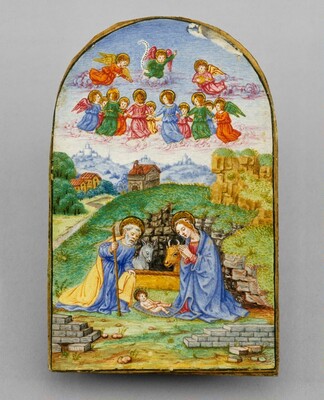
Pax with a Miniature of the Nativity

Pax with a Miniature of the Nativity

European 19th Century

This is a photograph of a hexagonal ceramic cup. The cup has a flat, hexagonal base and a wide opening at the top. The interior of the cup is yellow, contrasting with the exterior decoration. The exterior features intricate designs in muted greens, yellows, black, and white. The designs are floral and abstract patterns. The handle is curved and matches the cup's artistic theme. The style suggests a blend of traditional and artistic elements, focusing on symmetry and color harmony.

Wine Cup

Chinese Qing Dynasty

The image shows a person in a dynamic stance. The individual has a serene facial expression and styled hair with a ribbon or similar ornament. They wear ornate clothing, possibly a tunic, with draped fabric. The person holds a mirror with a decorative handle in one hand and extends the other hand upward. The background includes ornate pillars, an alcove, lush greenery, mountains, trees, and a cobbled path. Floral motifs adorn the tapestry surrounding the person.

The Four Cardinal Virtues: Prudence

Netherlandish 16th Century

This is a photograph of a decorative ceramic plate featuring an intricate design with concentric circles. The plate has a central motif of two hands shaking, surrounded by blue, orange, and white colors and various geometric patterns. The inner border has zigzag and triangular shapes, while the outer border alternates between blue and orange segments. The plate includes an inscription "FIL FEL" on a blue ribbon-like band. The design suggests a traditional or historical style of pottery.

Plate with clasped hands

Faenza 15th Century
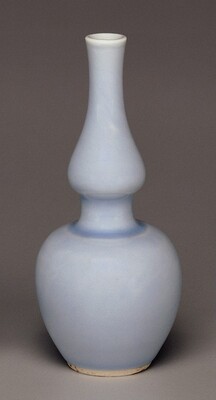
The sculpture depicts a vase with a bulbous lower body tapering into a slender neck. It is pale blue and made of ceramic. The vase has smooth curves and a glossy finish, exuding refinement and delicate craftsmanship. The neutral background accentuates its details and color.

Gourd-Shaped Vase

Chinese Qing Dynasty

This is a photograph of an intricately designed rug. The rug displays a classic Persian motif with a central medallion and a complex pattern of floral designs and arabesques set against a rich red background. The design is symmetrical, featuring ornate flourishes and scrolling patterns in muted tones of blue, gold, and cream, with hints of green. The border of the rug is decorated with larger floral patterns and vines, framing the central design. The craftsmanship reveals a detailed weaving technique that highlights the artistry and cultural heritage associated with handmade carpets. The aged appearance of the rug suggests it holds historical value and has been preserved over time.

Arabesque Band Carpet

Indian 17th Century
Dish

Dish

Chinese Jin Dynasty

The sculpture is a bowl-shaped piece with a small opening at the top. It is predominantly a muted reddish-pink color with areas of darker red speckles and is made from a ceramic material. The surface of the bowl features an embossed or carved design that incorporates a swirling pattern. The glossy finish gives the sculpture a refined appearance, and its compact size makes it appear similar in scale to a decorative tabletop item or pottery.

"Beehive" Water Pot

Chinese Qing Dynasty

The sculpture is a shallow bowl with a wide, gently flaring rim, made from ceramic material with a brown glaze transitioning from dark to light. The surface is smooth with dark speckles, and the base has an unglazed textured ring.

Bowl

Japanese 19th Century

This is a painting of people and animals in a rich green landscape under a blue sky with one bright star. On the right, under an arch, there is a seated woman with an infant on her lap, one man standing behind her and another kneeling in front of her, a crown on the ground next to him. There are two more men with crowns standing near the kneeling man, both pointing towards the child. The left side shows more people standing and looking at the woman and child, with some mounted on horses. More people are walking down a tall hill on the left, coming towards us. The people are clothed in tunics and cloaks in bright shades of green, blue, and orange-yellow. Most of them have pale yellow skin, although one of the crowned men in front of the woman has brown skin.

Panel with the Adoration of the Magi

Nicola da Urbino

The image shows a pastoral landscape with fantastical creatures depicted in a colorful and vibrant style. Two half-human, half-animal figures are engaged in various activities within the scene, which features a vividly painted sky, a flowing stream, and lush greenery. The central roundel of the dish shows a smaller scene with a figure interacting with a creature inside a circular frame surrounded by a golden rim. On the right side, a rocky formation is visible with another creature climbing or reaching. The style is reminiscent of Early Italian Renaissance art, particularly maiolica ware known for intricate and colorful narrative scenes with mythological or fantastical themes.

Plate with three Satyrs

Gubbio 16th Century

The sculpture is a circular gilded relief with a raised design featuring a profile portrait of a human head at its center. This central image is illustrated in vibrant shades of blue and green, depicting a person's head in profile with short hair, within a quatrefoil-shaped frame. The overall sculpture appears to be made of a metal that has been gilded, giving it a rich gold color. The background intricate pattern consists of geometric shapes, including crosses and lozenge forms, all embossed or engraved into the surface, creating a textured, three-dimensional appearance. The outer edge of the sculpture is bordered by a beaded pattern. It appears mounted on a dark background which enhances the golden hue of the metal.

Costume Ornament with Profile Portrait

North Italian 14th Century

The image shows a sculpture designed to resemble a teapot. The sculpture depicts a traditional teapot structure, complete with a spout, lid, and handle. The teapot is circular in shape, featuring a cylindrical body on a small, rounded base, and a circular lid with a knob at the top. The knob is intricately detailed, resembling a small sculpted rose or floral element. The sculpture is off-white or ivory in color, with a glossy sheen and smooth finish. Vertical inscriptions are embossed on the teapot's side, adding intricate detail to its design.

Teapot

Chinese Qing Dynasty

Square Vase

Square Vase

Chinese Qing Dynasty

The image shows a decorative vase adorned with intricate designs of birds, cherry blossoms, branches, leaves, and rocks. The vase is primarily black with colorful details including blue and white blossoms, white and light blue birds, green leaves, and rocks. The material seems to be ceramic with a glossy finish, and the vase has a wide mouth and a curved form. The contrast between the vibrant colors and the black background makes the design visually striking.

Baluster Vase

Chinese Qing Dynasty

The image depicts a decorative ceramic plate with an artistic portrayal of a woman in profile. The woman is facing left, showcasing her upper body. She has delicate and idealized facial features with a serene expression. Her hair is styled with an intricate headdress adorned with ornamental elements. She wears a garment with detailed embellishments, likely representing period clothing, in warm earth tones with lacing details. A necklace is depicted around her neck. The plate's surroundings feature elaborate designs with patterned motifs, contrasting blue and orange tones, and plant-like elements. The background is filled with intricate geometric and floral patterns, adding texture to the image.

Large dish with segmental border of plant sprays and scale pattern; in the center, a profile bust of a woman in a winged headdress

Deruta 16th Century

The sculpture depicts a tall black vase with a flared neck. The vase is decorated with the design of blooming flowers and small black birds perched among brown branches. The flowers are in shades of white and blue with pale yellow centers. The bottom of the vase features angular green and blue patterns resembling mossy rocks.

Baluster Vase

Chinese Qing Dynasty

The sculpture depicts a centaur, a mythical creature with the upper body of a human and the lower body of a horse. The human part is holding a bow. The sculpture is colorful and detailed. It has gold and enamel detailing. The centaur features a combination of enamel in rich hues, possibly including reds, blacks, and whites, while the horse body has a fur-like texture, with gilded highlights. The body is adorned with decorative jewels or stones. There are tear-shaped pearls dangling from the sculpture.

Pendant with a Centaur

André, Alfred

This is a photograph of a decorative ceramic bowl. The bowl has a floral design with yellow, blue, and white flowers on a red background. The interior is white. The design has flowers, stems, and leaves. The bowl is placed on a red circular foot.

Cup

Chinese Qing Dynasty

The sculpture is a rounded, bowl-like object with smooth, curved surfaces. It is a uniform, matte white color and looks like it is made of ceramic. Its form is slightly wider than its height, with a softly rounded body that tapers towards a narrow base. The top edge opens smoothly into a circular rim. The sculpture has a simple, minimalist design with gentle curves and a monochromatic finish.

Cup

Chinese Qing Dynasty

This horizontal tapestry is divided into three vertical sections by architectural columns and arches. The center column is a little wider than those to either side, but all three sections are packed with people, all with ivory-white skin. In the center column, a crowned Jesus is seated on a throne at the top center. His elaborately patterned robe falls in folds down past his feet. He hovers above a landscape view, which is flanked in the foreground by groups of men and women. About a dozen people are clustered on each side, many of them looking up at Jesus, and most of them wearing religious garments that range from monks and nuns to cardinals and bishops. Two crowned men kneel to our right in the center panel, their hands pressed together in prayer. Each column on either side of the central panel is divided so there is a smaller vignette above taller vignettes below. Large groups of people gather in each scene. Much of the tapestry’s surface is now brown, but it is punctuated throughout with patches of rust red, sky blue, and pale yellow.

The Triumph of Christ ("The Mazarin Tapestry")

Netherlandish 16th Century

The sculpture depicts a vase with an elongated neck opening into a flared rim, a smooth, rounded body, and a small base. It is made of ceramic material with a red and cream glaze and hints of green and blue. The surface has a glossy finish, and the vase stands upright with balanced proportions.

Petal-Decorated Vase

Chinese Qing Dynasty

This painting depicts a mythological scene with three central figures. One figure in a blue robe holds a sword, another figure in an orange garment appears distressed, and a third angelic figure with wings stands beside a tree. The background shows a lush landscape with architectural elements against a serene sky. The use of vibrant colors and intricate detailing creates a lively scene. This artwork is in the style of Renaissance majolica pottery.

Plate with Pyramus and Thisbe

Xanto Avelli, Francesco

Vase

Vase

Chinese Qing Dynasty

The sculpture is a globular-shaped ceramic jar with a narrow, slightly elevated neck. It has a smooth surface with an even, light blue color. The jar's shape is symmetrical, with a rounded lower body that tapers up to a smaller, circular opening. The material appears to be a glazed porcelain or similar ceramic, evident from its glossy finish that reflects light subtly across its surface. The overall look of the jar is simple and elegant, with a harmonious form that complements its monochromatic color.

Water Pot

Chinese Qing Dynasty

This is a colorful, decorative plate. The center of the plate features a coat of arms in vibrant tones of gold and deep blue, with the outline of a black bird. The shield is against a green and blue landscape, circled by a thick mustard-yellow border. The wide rim of the plate is adorned with green leaves, floral patterns, and curling scrollwork in blue, red, and yellow hues. There is the repeating image of the head of a creature with curled lips and fangs that tapers into a thin, intertwining body.

Plate with border of foliate scrollwork with dolphin heads and cornucopias; in the center, shield of arms of Vigerio of Savona

Italian 16th Century

This is a photograph of a decorative ceramic plate with intricate designs. The plate features a central emblem with a shield design, displaying five red roundels on a golden field, topped by a papal tiara and crossed keys. Surrounding the emblem is an ornate pattern with a blue background and white swirling motifs. The outer border of the plate is adorned with alternating green and yellow geometric designs. The craftsmanship suggests a detailed and meticulous approach to decoration, likely intended for ornamental use.

Footed dish with the arms of the Medici, reverse decorated "alla porcellana"

Tuscan 16th Century

The image shows a decorative table with a dark green rectangular top framed by a wooden border. The table is made of dark brown wood with intricate carvings of acanthus leaves and classical motifs. It has a single ornate pedestal support that leads to a four-footed base with matching carvings. The table is at a standard coffee table height.

Walnut Pedestal Table with Inlaid Marble Top

Italian 16th Century

The sculpture is a vase with intricate nature designs. It is predominantly black, with vibrant white, green, and yellow decorations. The vase features a pattern of blossoming flowers and yellow birds, with elements of nature such as rocks and trees at the base. It has a flared top, and is made of a smooth, glossy material. The craftsmanship is detailed, especially the floral and avian elements. The layering of imagery creates depth in the depiction.

Baluster Vase

Chinese Qing Dynasty

The image displays a wooden chair with an engraved backrest and a cushioned seat. The backrest has gold rivets and carved details, and the seat has a golden fringe. The chair is centered, with arms slightly extended, and ornate carvings are visible on the backrest and lower bar.

Leather-covered Walnut Armchair

Italian 16th Century
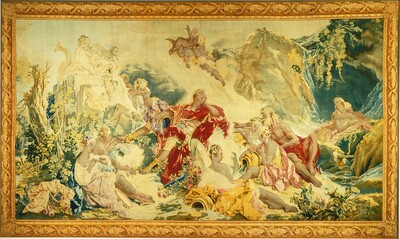
This is a tapestry of people in flowing garments in a pastoral landscape. At the center of the tapestry, a man in a red garment reclines, his eyes closed. He holds a plumed golden helmet on his knee and wears golden sandals. Around him, a crowd of people sitting or lounging on the ground turn to look at him, some pointing. All of the people have light skin and pale-yellow hair. The scene includes musical instruments, white sculptures, vessels spilling water, and many pink flowers among green leaves. Some sections of the tapestry, especially around the center, are bright white. The scene is surrounded by a golden border.

Dream of Rinaldo

Besnier, Nicolas

This is an ornate crucifix, with a man hanging from it in a traditional crucifixion pose, his arms outstretched and nailed to the crossbeam. The man has long hair and a cloth tied around his waist, and he is colored entirely in bright gold. Behind his head is a golden circle with gems in blue, red, and green. The cross itself is adorned with intricate designs in dark blue, red, teal, and green shapes, bordered by a gold-colored outline. The top of the cross features an inscription in gold lettering on a blue background. The sculpture stands upright against a neutral gray backdrop.

Crucifix

Rhenish 12th Century

This is a decorative ceramic vase. The vase features intricate designs that include large green lotus leaves, white lotus flowers, and a scene of a marsh or pond at the lower part of the vase. A white crane or heron is depicted standing in the water amongst the reeds. The background and top of the vase are dark gray, contrasting with the vibrant greens and whites of the vegetation and wildlife. The top of the vase is rounded, with a short, narrow neck.

Vase, Meiping Shape

Chinese Qing Dynasty
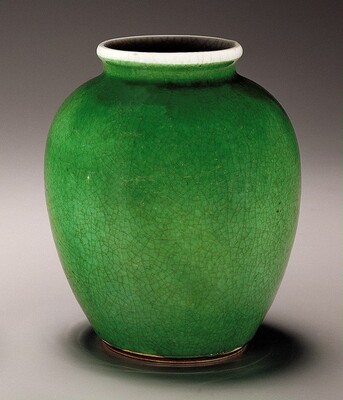
This is a vase with a rounded shape, a slightly narrowing neck, and a wide opening at the top. The vase is a vibrant green color, with crackle patterns and fine lines crisscrossing across its surface. The rim of the opening is white, and the base is a thin line of dark brown.

Jar

Chinese Qing Dynasty

The sculpture is a bowl-shaped vessel with a wide, slightly rounded body and a narrow opening. It is light blue with a smooth, glossy surface. The form is robust yet elegant. The sculpture is positioned on a flat surface. The light blue color and smooth texture give it a calm and understated appearance.

Brush Washer

Chinese Qing Dynasty

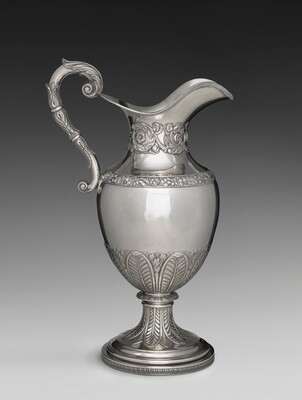
The sculpture is of a jug or pitcher made of a metallic material, likely silver. It has a curved handle embellished with leaf and scroll motifs. The body is polished, with a decorative band near the neck featuring floral designs and an ornamental base with foliage patterns. The jug is tall, standing on a sturdy, decorated pedestal base. The metallic sculpture is sophisticated and luxurious, appearing functional and artistic.

Monumental Ewer

Fletcher, Thomas

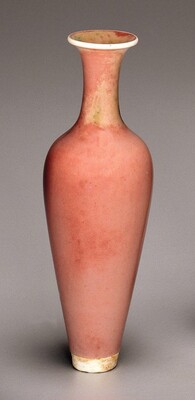
The sculpture is a vase with a long, slender neck and a rounded body that tapers towards the base. The vase is predominantly rose pink in color, with some slight variation on the neck, where there are patches of a peachy shade. There are also small dots of a light greenish color. The rim and base are both white.

Amphora Vase

Chinese Qing Dynasty

This is a painting of a circular plate with a central cherubic figure surrounded by various ornamental and mythological elements. The plate depicts a cherub-like figure carrying a shield, set within a pastoral scene with trees. Surrounding this central image, the plate is decorated with smaller cherubic figures and designs including scrolls, floral motifs, and musical instruments against a deep blue background. The design features a color palette of blues, yellows, and oranges, with a strong emphasis on symmetry and elaborate detail. This is in the style of Italian Renaissance Majolica pottery.

Plate with border of putti and trophies amid grotesques; in the center, a winged putto standing, armed, in a landscape

Urbino district 16th Century
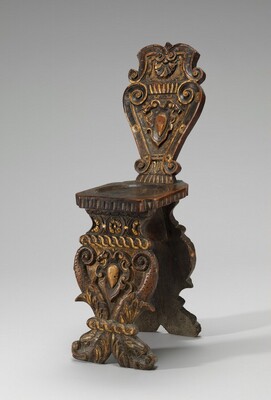
This is a photograph of an ornate wooden chair. The chair has intricate carvings and design elements throughout its structure. The backrest is detailed with scrollwork and central shields or cartouches framed by foliage designs. The seat is simple and flat, resting upon a similarly detailed base that continues the decorative motifs of scrolls and acanthus leaves. The chair appears to be made of dark wood, possibly enhanced with gold or gilded accents. The craftsmanship suggests it is an ornamental piece, possibly intended for decorative purposes as much as for utility.

Walnut Stool (Sgabello), Carved and Gilded

Italian 16th Century

This is a photograph of a decorative ceramic vase. The vase has painted scenes and motifs across its surface. The upper portion features a seated figure, peacock-like designs, foliage, and an orange color amidst green leaves. The middle section has an inscription reading "FILIONIO." The bottom section depicts cherubs or putti, one riding on a dolphin-like creature over waves. The composition suggests an ornate, historical style, possibly reminiscent of Italian Renaissance ceramics known for vivid colors and detailed storytelling in art.

Albarello with woman spinning and putti on sea monsters

Deruta 16th Century

Rectangular Vase

Rectangular Vase

Chinese Qing Dynasty

This is a photograph of a decorative ceramic jar with a mythological scene. The jar features a winged cherub, who is blindfolded and seated on a golden blanket. The background shows a natural scene, with green possibly representing grass or water, and distant hills or mountains. The rim of the jar has alternating color patterns with geometric designs. The artwork on the jar suggests a traditional aesthetic typical of European ceramics.

Albarello with blindfolded, bound Cupid

Faenza 16th Century
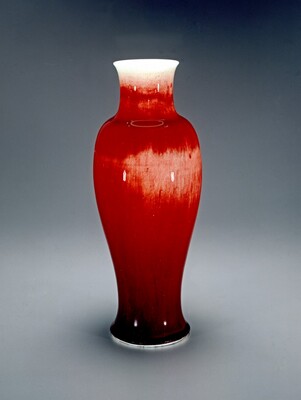
This large ceramic vase has a deep red glaze that fades to white at the top rim. The vase has a smooth, slightly elongated shape with a narrow neck and a round base. Around the middle section of the vase there is a lighter red section, and towards the bottom the red transitions into a dark, almost black shade.

Vase, called "The Flame"

Chinese Qing Dynasty

This is a photograph of an ornamental cushion with a heraldic emblem. The cushion features a richly embroidered coat of arms with two golden lions rampant on either side of a red shield adorned with three six-pointed stars arranged vertically. Above the shield is a crown-like adornment surrounded by circular patterns. The backdrop is a deep blue fabric draped to mimic curtains or banners. The top of the image reads "GOVDA" within an ornate scroll-like design, and the bottom bears the name "MR. REYER VANDER BVRCX."

Tapestry-covered Cushion

Netherlandish 18th Century

This is a vase with a bulbous body tapering towards a slightly flared rim. It is coated in a vivid green glaze with a crackle pattern. In some areas, the green is lighter, accentuating the fine lines on the surface of the vase. The rim of the vase is white.

Vase

Chinese Qing Dynasty

The sculpture is a cylindrical jar with an illustrated profile of a human head. The depiction includes stylized black hair and a finely detailed facial profile painted in a light blue or gray tone. The jar is made from ceramic material, predominantly gray with decorative elements and the head in shades of blue and rust-orange. The word "MITRIANO" is inscribed vertically beside the profile in dark blue letters. The form of the jar is slightly waisted, with a flared rim and base, suggesting it is designed as an apothecary or storage container. Decorative bands at the top and bottom emphasize its design, combining functionality with artistry.

Albarello with a portrait of a youth (Mitriano)

Neapolitan 15th Century

The image shows a tall, elegant vase with a wide, flaring mouth and a narrow neck, which expands into a rounded bulbous body with a slightly ribbed pattern at the base. The vase has a soft, pale green color. Positioned centrally within the image, the vase stands upright and occupies the majority of the frame, set against a neutral gray background.

Petal-Decorated Vase

Chinese Qing Dynasty

The sculpture is a decorative pitcher or ewer with an ornate handle. The handle resembles a flowing figure integrated into the design. The body of the pitcher is smooth pale green with subtle white floral designs. The pitcher features intricate gold details on its neck, base, and handle, combining porcelain and gold-toned metal elements. The gold sections include leaf motifs and decorative elements contrasting with the soft green porcelain, giving the sculpture a detailed and luxurious appearance.

Vase Mounted as an Ewer

Chinese Qing Dynasty

This is a round plate with colorful designs. In the center of the plate is a portrait of a person in profile. They have white skin and long, yellow hair, and they wear orange armor and an orange-and-green helmet. The figure is surrounded by yellow plants against a blue and white sky. The central image is bordered by a geometric and floral pattern in earth tones of terracotta, cream, and green. The rim is adorned with a repeated floral design, red diamonds, and green dots.

Plate with running plant border and geometric panels on well; in the center, profile bust of a man in armor

Deruta 16th Century

The sculpture is an ornate goblet with a lid. The goblet is made primarily of clear glass, although the top, the base, and a line down the side are adorned with gold-colored metal bands featuring enamel work in green, yellow, brown, and blue. The designs on the metal include flowers, fruit, weapons, and musical instruments. There is a section of text at the top of the goblet, below the lid. At the top of the lid is a white knob.

Covered Cup with Shield of Arms of the Countess of Gleichen

Freiburg-im-Breisgau 16th Century

The sculpture depicts a bottle or vase with a rounded, bulbous body that tapers into a narrow neck and small opening at the top. It has a predominantly white surface with deep red patches blending into the white. The material seems to be ceramic or porcelain with a crackle texture on the surface. The sculpture is displayed on a neutral gray background.

Vase, Meiping Shape

Chinese Qing Dynasty

The sculpture is a vase with a long, narrow neck that gradually widens towards the base. It is a vibrant green color with a crackled glaze which creates small lines across the surface. The rim of the vase is white. The vase is standing upright and casting a slight shadow below it.

Vase

Chinese Qing Dynasty

The sculpture is an oval platter featuring detailed elements of creatures and foliage from a natural environment. At its center, there is a coiled snake made of a shiny material, possibly ceramic or glazed pottery. The color palette includes greens, browns, and yellows with accents of blue and white. The snake is surrounded by animals like a frog and fish, as well as plants and leaves. The textures and raised elements create a rich and three-dimensional effect.

Rustic Plate with Snakes, Lizards, and Frog

Palissy, Bernard

An armored knight and the rectangular trough he lies next to are both on a slightly larger pedestal base in this freestanding, vibrantly colored maiolica inkstand.  The earthenware object was covered with tin-oxide glaze, which, when fired, results in royal blue, grass green, pale orange, and brown hues. The knight’s skin is the white of the earthenware, and his armor is blue and orange. He lies down, using his helmet as a pillow to our left. Both knees are bent, and his hands are by his sides. A staff or lance lies at his feet to our right.  The base has a coat of arms on the center front, and two animals, perhaps deer, lie to either side. The base is outlined in green or blue, and it rests on four brown, paw-shaped feet.

Inkstand with sleeping knight

Faenza 15th Century

The sculpture is a chair-like piece with a tall, ornate backrest and intricately carved details. It features swirling patterns and symmetrical floral motifs in dark brown and golden hues. The material seems to be wood, with visible natural grain. The chair appears more like an artistic or ceremonial object rather than a practical piece of furniture, with a historical or ornate decorative style.

Walnut Stool (Sgabello), Carved and Gilded

Italian 16th Century

This is a photograph of a decorative ceramic bowl. The bowl features intricate floral patterns with large blue and yellow flowers and green leaves set against a vibrant red background. The designs showcase a variety of flower types interspersed with smaller floral accents and stems. The color palette is bold and vibrant. The interior of the bowl is stark white, creating a contrast with the detailed exterior.

Cup

Chinese Qing Dynasty

This is a cushion with a coat of arms that includes a crowned shield displaying a lion. The shield is red with a golden lion, and it is topped by a golden crown. The lion is raised up on its back paws, holding a group of arrows in one front paw and a sword in the other. There appear to be two crossing anchors behind the shield, and a brown fence circling the bottom of the shield, inside of which is a patch of green grass. The background is deep green. The letter "A" is embroidered in the top corners of the cushion.

Tapestry-covered Cushion

Netherlandish 18th Century

The sculpture is a ceramic pot decorated with floral motifs. The pot is blue with gold detailing and features an oval panel displaying colorful flowers against a white background. Surrounding the panel is a geometric pattern in gold. Animal head-shaped handles are on either side of the pot. The rim is white with a pink and orange pattern, and smaller floral motifs are repeated around the upper part of the pot.

Large Fish Bowl

Chinese Qing Dynasty

The image shows a round decorative plate with a mythological scene. It features an aerial view of a landscape with a fort-like structure, greenery, water, and ships with one flag reading "SELEUCO." The style is reminiscent of Renaissance painting, with intricate brushstrokes capturing figures and scenery. The color palette includes blues, greens, and earth tones with accents of orange and yellow. Muscular figures are engaged in activity, and an emblem or coat of arms is displayed above against a richly toned sky with clouds.

Plate with the sinking of the fleet of Seleucus (from the Pucci Service)

Xanto Avelli, Francesco

Shou Lao, the God of Longevity

Shou Lao, the God of Longevity

Chinese Qing Dynasty

The image shows a large, round porcelain vase with a long, narrow neck. The vase is predominantly a pale green color with a crackle glaze effect. It is centered in the frame, positioned upright on a plain surface, with a neutral grey background.

Bottle Vase

Chinese Qing Dynasty

The sculpture is a large ceramic vessel with a green surface featuring intricate designs, dense foliage, and patterns. Throughout the green background, there are stylized representations of objects and symbols in vibrant colors like red, blue, and yellow. The upper rim has an ornate border pattern in red and gold designs, and the opening is white with subtle traces of age. The sculpture likely is made of porcelain or glazed ceramic. The overall shape is broad and rounded, conveying a sense of stability and elegance.

Large Fish Bowl

Chinese Qing Dynasty

This is a photograph of a decorative lidded porcelain vase with blue and white patterns. The vase has an intricate floral design painted in shades of blue against a white background. The body of the vase tapers down to a narrow base and is topped with a fitted lid that has a small finial at the top. The patterns consist of floral motifs interspersed with small dotted designs. The blue used is a deep cobalt shade commonly associated with traditional Chinese porcelain.

Blue and White Jar with Cover

Chinese Qing Dynasty

The spout of this silver teapot faces our left and the black handle our right in this photograph. The body of the teapot would be oval shaped if viewed from above. The sides of the teapot are straight and fluted to create vertical columns that curve inward. The shallowly domed lid has a flat, black, disk-like knob. The long, straight, narrow spout tapers from the base of the teapot to the opening, which is level with the top of the teapot. The handle to the right curves like the right half of a heart and flares upward where the thumb would rest at the top of the curve. The handle is affixed to the body of the teapot with short silver sleeves. The body is engraved along the top and bottom with decorative bands of garlands and vegetal scrolls. A rose-like flower and leaves are incised near the base on the side facing us.

Teapot

Revere, Paul

The sculpture is a round, lidded box with a smooth surface. It has a muted red and beige color palette. The top is primarily red, blending into a creamier beige near the edges. The lid fits snugly over the base, which has red patterning along the upper edge. The sculpture is made of ceramic material. The form is simple and streamlined, without intricate details, emphasizing the color gradient on its surface.

Covered Box for Seal Paste

Chinese Qing Dynasty

This is an image of a decorative ceramic plate with a heraldic design. The plate is circular and adorned with a central coat of arms or shield. The shield is divided diagonally by a gold band with two heraldic animals, likely greyhounds, depicted in a running posture with gold stripes. The upper part of the shield contains three gold fleur-de-lis symbols on a blue field. Surrounding the shield is an intricate design of green laurel branches with acorns and yellow floral elements on a blue background. The date "1532" is inscribed on the plate. The ceramic plate combines craftsmanship with rich symbolic imagery, indicative of heraldry. The design reflects a family or regional coat of arms and emphasizes tradition and artistry common in European decorative arts.

Circular plaque with fruited wreath enclosing a shield of arms

Faenza 16th Century

Oval dish with Allegory of Autumn

Oval dish with Allegory of Autumn

Palissy, Bernard

This is an image of a wooden armchair with leather upholstery. The chair has a high back, dark-stained wood, embossed leather with decorative patterns, metallic studs, a leather-upholstered seat with studs, simple arms, and intricately carved stretchers connecting the legs. The stretchers have a looped design.

Leather-covered Walnut Armchair

Italian 16th Century
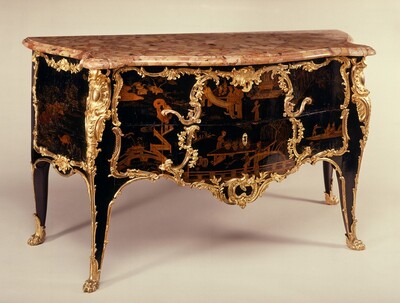
Chest of Drawers (commode)

Chest of Drawers (commode)

Desforges, Jean

This is a tapestry showing a crucifixion scene. At the top of the tapestry are three men hanging from large wooden crosses, one in the center and the other two near the upper right and left corners. The men on the sides have agonized expressions, and their bodies are contorted, limbs bent and curved. The central man is still, his arms stretched outward, hands and feet nailed to the wood. He has a bleeding cut on his side and wears a tanged thorny circlet on his reddish-brown hair. The men all have cloths of various shades of gray and blue tied around their waists. Below, numerous other men and women are gathered, wearing colorful dresses and robes in shades of blue, red, orange, green, and purple. Near the bottom left corner, a woman in a blue dress and a white head covering appears to have fainted, and two other women grab her arms. Another woman stands at the base of the central cross, looking down at the fainted woman. All four of these women have halos, as does a man on the left who looks upward, his folded hands raised. In the bottom right corner, another man kneels down next to several tools, reaching for a loop of rope. The background features a pale green landscape with hills, trees, and gray buildings under a sky swirling with blue and white clouds. A red sun and a pale moon appear in the sky on either side of the central crucified man. The central scene of the tapestry is contained in an intricately decorated red border which features designs of flowers, fruit, and curling vines.

The Crucifixion

Pannemaker I, Pieter

The sculpture depicts a wooden chair with an intricate design. It features a rich brown hue and carved circular designs on the backrest. The arms extend horizontally with rounded edges. The base forms an X shape to support the seat, and the legs have detailed carvings along the edges.

Walnut Savonarola Chair with Incised Ornament

Italian 16th Century

This is a painting of a group of figures gathered around a long table with various dishes and food items. The figures are depicted in intricate detail, with the central figures showing emotional expressions. The setting is a richly decorated interior with ornate architectural elements, including columns, arches, and a large window. The clothing of the figures is rendered with rich colors and patterns, emphasizing the formal and historical significance of the scene. The artwork exhibits rich texture and vibrant colors, consistent with the style associated with the artist, reflecting a scene of historical or religious importance.

Plaque with the Last Supper

Penicaud, Jean I
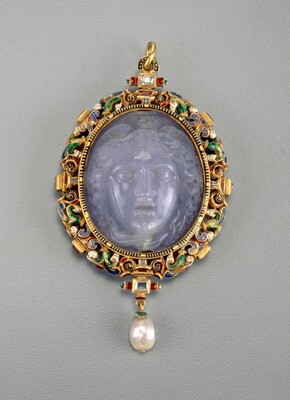
This is an ornate pendant with a carved face. The pendant features a central cameo with a face carved from a semi-transparent, milky blue stone. The face is of a woman, with an open mouth, wide eyes, and curling hair surrounding her face. The carved face is encased in a golden frame with colorful enamel work in blue, green, red, and gold. The pendant has a loop for hanging at the top and a pearl drop hanging from the bottom.

Pendant with the Head of Medusa

André, Alfred

This is a photograph of a circular metallic object. The object features a golden circular medallion with a textured pattern of raised geometric and floral motifs. In the center, there is a small, circular inset with a stylized profile in shades of blue and turquoise against a deep blue background. The object's design suggests a blend of historical and artistic elements. The gold sections have an embossed look reminiscent of decorative craftsmanship, hinting at a ceremonial or symbolic purpose. The medallion's edge is finely scalloped and the background of the photograph is a deep, velvety shade of maroon.

Costume Ornament with Profile Portrait

North Italian 14th Century

The sculpture is a ceramic dish featuring raised figures from the animal kingdom. At the center is a brown crocodile. Other figures include a coiled snake on the left and a moth on the right. Smaller figures like snails, shells, and leaves are scattered around the dish. The dish is predominantly blue with various colored figures that contrast against the blue background. The piece appears three-dimensional with vividly carved and colored creatures.

Rustic Plate with Crocodile, Snake, and Lizard

Palissy, Bernard

This is a painting of a decorative ceramic plate. The plate features intricate designs with a central scene depicting three figures in traditional attire surrounded by floral and cloud motifs. The figures are colors such as blue, red, and green, set against a background of pine trees and swirling cloud patterns. The rim of the plate has a pattern of floral and scroll designs in red, green, and blue. The artwork blends traditional elements and decorative motifs.

Dish

Japanese 19th Century