← All periods

1726 to 1750

71 works

The sculpture is a richly decorated lidded vase. It features a vibrant display of flowers and birds depicted in intricate detail on the body. The lid has a small sculpted figure of a stylized lion or mythical creature sitting on top. The color palette includes warm and soft colors - pinks, yellows, whites, and greens - against a complex pattern background. The material appears to be porcelain with a smooth, glossy finish. It presents itself as an ornate and elaborate piece of craftsmanship with decorative motifs indicative of traditional artistic techniques.

Large Covered Baluster Jar

Chinese Qing Dynasty

The image displays a title page with the title "RECUEIL DE DIVERSES FABLES" and the name "GEORGE FOSSATI" written in large, centered text. Below, there is a small engraved illustration featuring a wolfish creature along with plants and rocks. The color scheme is monochromatic, consisting of black and white shades. The text is centrally aligned on the top half of the page, with the illustration placed closer to the lower half. Publication information is located at the bottom center of the page.

Raccolta di Varie Favole delineate ed incise in rame (Tome 4-6)

Fossati, Giorgio
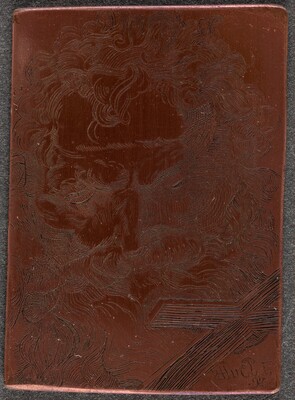
The image shows an engraving of a bearded man's face, likely from the chest up. The man's head is slightly tilted, with facial features such as the brow and nose depicted through etched lines. His hair is voluminous and curly, flowing outward in swirling patterns. There is no clothing detail visible. The engraving includes a crosshatched pattern in the bottom right corner and a signature, possibly "Ritter A.L." The background is a polished metal surface.

Head of Saint John the Baptist [verso]

Butts, Jr., Thomas

The image depicts two figures, a woman and a young girl, next to a spinning wheel. The woman is seated on a chair, sewing, while the girl stands beside her. A small dog rests nearby on a wooden surface. Other household items, like a teapot and a candelabra, are visible.

La Mere laborieuse

Lépicié, Bernard

This print shows several people on a cobblestone street in a variety of dramatic poses, their arms outstretched in different directions. There is a woman in the center dressed in an elaborate gown, looking upward. She has pale skin and light hair, and she wears a necklace that looks like a strand of pearls. Behind her, people appear shocked, with a woman bending down and holding a cloth to her face, a man with one head on his hand and the other stretched forward, and another person kneeling on some stairs, their head on the ground. On the left, a man with medium-toned skin and a dark beard bows down towards the woman, his arms outstretched, holding a cloth. More shocked people are on the left, one of them wearing a mask over the top of their head. On the far right, someone stands on a ladder, posting a large sign on the wall. A person below looks toward them, their right arm raised up as if directing. In the bottom right corner, a child appears to carry a thin drum or similar object on a strap hung around their neck. The background includes more buildings on the cobblestone street under a light gray sky. People look out from second story windows in a building on the left, staring down at the scene on the street. Below the print are several lines of text.

L'oeuvre d'Antoine Watteau (volume II)

Various Artists

The sculpture is a cream-colored vase with a long, slender neck that gradually flares out towards the mouth and a bulbous body that rests on a narrow base. At first glance it appears smooth, but closer inspection reveals extremely subtle swirling patterns visible on the surface.

Vase

Chinese Qing Dynasty

The image shows an intricately detailed stone plaque or monument off-center to the left, with inscribed text reading "Landschaften und Köpfe von LD." The scene includes dense foliage, stones, two figures near the monument, a winding path disappearing into trees, an ornate stone urn on a pedestal covered by leaves, and twisted trees on the left side. Brushstrokes are detailed, and the color palette is monochrome. Wispy clouds stretch across a clear sky in the background.

Landscapes and Heads

Hagedorn, Christian Ludwig von
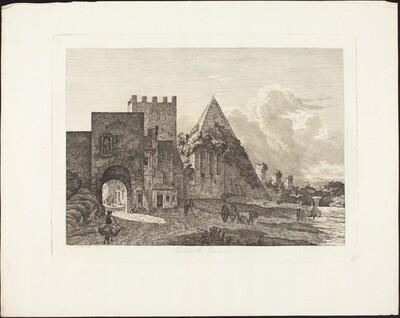
The image shows an architectural structure with a large arched gateway, a castle-like wall, and a triangular, pyramid-like structure. The perspective is slightly elevated, with the horizon high in the image, partially obscured by structures, trees, and clouds. The monochromatic artwork consists of fine, detailed brushstrokes depicting textures of stone and foliage. The color palette is limited to sepia tones. A person on horseback is close by, and the road leads through the archway to a populated area with smaller figures and buildings. A cart, animals, trees, and ruins are visible to the right.

Porta di San Paolo

Mechau, Jacob Wilhelm
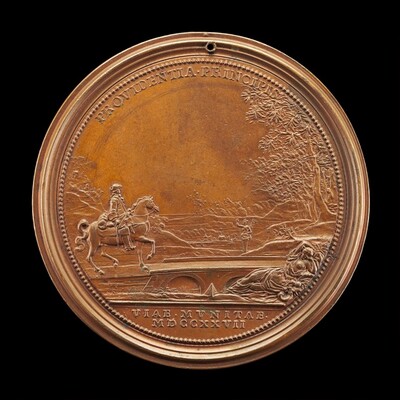
The image shows a round, flat medal with a relief sculpture on its front side. The sculpture features a person on horseback crossing a bridge in an outdoor setting with trees and distant landforms in the background. The scene is detailed with intricate lines depicting the scenery and is crafted from a bronze-colored material. An inscription in Latin surrounds the edge of the medal with "PROVIDENTIA PRINCIPIS" at the top and "VIAS MUNITAS MDCCXXVII" at the bottom. A small perforation near the top suggests it may have been used for display or worn on a chain.

Mounted Traveller [reverse]

Saint-Urbain, Ferdinand de
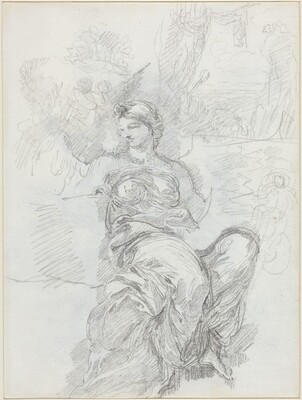
The drawing shows a full-body sketch of a person seated, with their upper body slightly turned to the side and their head tilted downward. The individual's facial features are delicately outlined, with an emphasis on closed eyes and a serene expression. The hair is styled in an updo, with a small decorative element or bow near the top. They are draped in flowing garments that fall smoothly over the contours of their body, while their right hand holds an object close to them, and their left hand rests on their lap. The background features faint sketch lines suggesting an outdoor setting, with trees and clouds. There are no visible jewelry or detailed objects held by the person.

Seated Angel in a Landscape [recto]

Lemonnier, Anicet-Charles-Gabriel

This is a photograph of an ornate cabinet. The cabinet has a black lacquered surface with intricate gold detailing. The decorative elements include rococo-style gilded floral and scroll motifs surrounding the central panels. The central panels depict detailed and colorful scenes of traditional Asian architecture, surrounded by nature. The legs of the cabinet have intricate gold designs. The photograph showcases the fine craftsmanship and artistic details of the cabinet.

Corner-Cupboard (encoignure)

Desforges, Jean

The image displays a cityscape view with classical architecture. The scene includes a street, buildings, Castel Sant'Angelo, a bridge over a river, and a basilica dome in the distance. The low horizon shows rooftops and structures fading into the background. The style uses pen and ink with a light wash, creating a sepia-toned look. The color palette consists of earthy browns and soft grays. The sky is left mostly blank, adding to the sense of openness.

View of Rome with the Dome of Saint Peter's and the Castel Sant' Angelo

Zocchi, Giuseppe

The image is a sketch of a full-length figure standing. The person has one arm resting on a surface and the other hand on their hip. The facial features are basic outlines, and the hair is also sketched loosely. The clothing is a long, flowing garment, possibly a robe or cloak, with a hood. There is no visible jewelry. The background is plain with a slightly textured appearance.

Portrait of a Procurator [verso]

Longhi, Alessandro

This is a drawing of a title page. The title is written in large, bold font across the top of the page, focusing on the city of Venice and its views in the works of Antoni Canal. Red and black inks emphasize different sections of the text, most of which is in Latin. Below the text, there is an ornamental embellishment with an elaborate illustration. The illustration includes a central figure, possibly an allegorical or classical figure, surrounded by a richly adorned frame with intricate scrollwork, shields, and symbolic elements. At the bottom, there are publication details and a red seal, indicating it is a publication from Venice dated MDCCXLII (1742).

Urbis Venetiarum Prospectus Celebriores, Ex Antonii Canal Tabulis XXXVIII. Aere Expressi ab Antonio Visentini in Partes Tres Distributi. Pars Prima [-Pars Tertia]

Visentini, Antonio

This is a tall, vertical painting. In the center, a woman in a pink-and-yellow gown sits on the ground, holding a limp child in her arms. She faces the left and is looking upward at a man in a brown robe who faces her and extends one arm towards the child, placing his finger on its forehead. Surrounding this group, many other people look at them with expressions of shock or amazement, leaning forward with their mouths open and hands raised. All the people in the painting have pale skin, although the child and another man in the bottom right corner have a greenish sheen to their skin. In the sky above this group, cherubs and angels fly, surrounded by clouds and looking down on the scene below. The sky is blue, with pink clouds and green trees, and a tall gray column on the left side.

A Miracle of Saint Francis of Paola

Ricci, Sebastiano

The image displays a landscape with various elements. On the left, there is a grand structure with columns, potentially a temple, partly covered with ivy. A stone bridge crosses a stream in the middle, while trees frame the right side. The top of the image shows a horizon with clouds blending into the tree line. In the scene, figures are seen engaged in various activities, such as leading a horse, reclining on the grass, and interacting near the water. The brushstrokes are loose and fluid, emphasizing movement and texture. The color scheme includes blues, greens, and earthy tones, creating a serene atmosphere.

The Seesaw

Anonymous Artist

This is a drawing of a neoclassical building facade with columns and a clock tower. The drawing presents a symmetrical architectural design with detailed elements. The central part of the building features a prominent entrance flanked by four large columns in the Corinthian order, which support an entablature adorned with classic friezes. Above the entablature rests a clock tower with a dome. The lower portions include arched openings and niches containing sculptures or reliefs. The left side of the drawing shows additional segmentations, suggesting window placements, while the right side is faded. The meticulous linework and use of shadows enhance the depth and dimensionality, emphasizing the structure's grandeur and classical inspiration.

Architectural Study

Valeriani, Giuseppe

This is a drawing of an outdoor gathering with a nature theme. It depicts a lush, wooded landscape with trees forming a canopy. In the center and towards the top, cloud-born figures float above. On the ground, various figures are gathered, dressed in flowing garments, engaging in a festive or social occasion. Some hold musical instruments and others wear floral wreaths. The scene includes decorative elements, a pedestal on the right, and peacefully integrated animals. The composition conveys a tranquil and celebratory atmosphere, capturing leisure and nature's splendor.

La simple Nature

Martinet, Francois-Nicolas
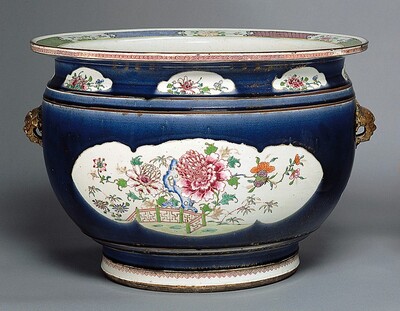
This is an ornate, decorative vessel resembling a large ceramic bowl or pot. Its surface features intricate floral designs painted in shades of pink, red, and orange, with hints of green leaves and a small brown fence around the flowers, all set against a white background. The main body of the vessel is a deep cobalt blue color and has a smooth, shiny surface. The vessel has small, golden-toned handles on each side.

Large Fish Bowl

Chinese Qing Dynasty

The image is a pencil sketch showcasing a rural scene from a slightly elevated viewpoint. The landscape features several structures among lush vegetation. The horizon blends with the building roofs, while trees rise behind them. The pencil strokes show detail in foliage and buildings, with cross-hatching for shadows. The color palette is monochromatic, emphasizing gray tones. The sketch depicts a grassy hill leading to trees and buildings in the distance, creating a countryside vista.

Italian Farm Buildings by a Stream

Vien, Joseph-Marie

This is a photograph of a white ceramic plate. The plate has a smooth, glossy finish with a subtle design along its surface that blends into the overall creamy white color. Its shape is slightly scalloped or lobed. The background is a simple, neutral tone. The lighting emphasizes the plate’s texture and shape.

Small Foliated Dish

Chinese Qing Dynasty

The image depicts a dense forest with an old stone structure among the trees, viewed from ground level. The canopy obscures the horizon, creating an intimate and enclosed atmosphere. The foliage and branches are intricately detailed, with the ruins shaded to show age and texture. Delicate brushstrokes capture the play of light and shadow on the trunks and leaves precisely. The color palette is monochromatic, in shades of gray, creating a tranquil setting. Soft light filters through the trees, illuminating parts of the ruins and forest floor. Figures are engaged in quiet activity in the background.

Ruins by a Woodland Stream

Liender, Paulus van

This is a photograph of an antique leather-bound book. The cover features a worn brown leather exterior with an embossed rectangle and diamond pattern in lighter brown hues. The design includes delicate decorative dots and filigree at the corners of the rectangular border. The spine of the book is visible on the left, exhibiting slightly raised bands. The overall condition suggests age, with visible scratches and wear.

Kupfer-Bibel, volume I

Scheuchzer, Johann Jacob

This is a drawing of a group of angelic figures surrounding a central figure. The drawing features angelic figures depicted in a classical style with flowing robes and feathered wings, gathered around a central, reclining figure. The scene depicts a moment of care or protection, with the figures intertwined and creating a sense of movement. The drawing is rendered with a subtle use of sepia tones, primarily browns and grays that provide a sense of depth and contour. The strokes are fluid and sketchy, with a dynamic and expressive quality that captures the emotional essence of the scene. The background is left largely unmarked, keeping the focus on the figures and their interactions.

Saint Mary Magdalene Lifted by Angels

Tiepolo, Giovanni Battista

The image is a title page from a book, consisting of text at the top and bottom. In the center, there is an illustration within a rectangle, showing a scene from a slightly elevated side view. The horizon is depicted above the middle of the rectangle, featuring a cityscape with towers and domes. A tall tower stands prominently on the horizon. The illustration includes a wolf or dog-like animal facing left, with its head slightly turned towards the right. The style of the brushstrokes is reminiscent of classic etching, with fine lines detailing the animal's fur and surrounding foliage. The color palette is monochrome, with different intensities of black and white creating contrast and detail, giving the image a vintage appearance.

Bertoldo con Bertoldino e Cacasenno

Mattioli, Ludovico

This is an ornate wooden side table. The table has slightly curved legs and a lower shelf for storage or display. The edges are trimmed with decorative silvery metallic elements. A small keyhole is visible at the front of the table. The legs appear to be darker wood, while the front and sides of the table are more red-toned wood. The top of the table has a floral design that uses multiple shades of wood.

Work and Writing Table (table en chiffonnière)

Vanrisamburgh II, Bernard

This is a photograph of a green ceramic pot. The pot is spherical with a wide opening at the top. Its surface is covered in a vibrant green glaze with a network of fine crackles creating a pattern across it. The top edge of the pot is unglazed. The background is a simple gradient. The lighting emphasizes the glossy finish of the glaze and highlights the form of the pot.

Bowl

Chinese Qing Dynasty

The image is an etching of a classic architectural scene with an elevated perspective, offering a broad view of the structures. The horizon is visible along the distant architectural lines and beyond the archway. The etching features precise linework detailing the textures and forms of ancient stone structures. The color palette is monochromatic, using black and white for depth and detail. The grand arch of Settimio Severo is prominent in the foreground, with intricate carvings and deteriorating stones. Various ancient buildings with Roman architectural features like columns and arched windows are visible in the distance. The sky has a few clouds, creating a sense of openness, and people are scattered throughout the scene for scale.

Arco di Settimio Severo

Piranesi, Giovanni Battista

This is a drawing of an ornate title page. The image features a detailed and elaborately designed title page with a classic font, announcing the seventh book in a series about the magnificence of ancient and modern Rome, focusing on convents and the houses of clerics. The piece is dedicated to Carlo Vittorio Amadeo delle Lanze and created by Giuseppe Vasi. At the bottom of the page, there is a small illustration depicting an outdoor scene with people among architectural ruins, featuring large columns surrounded by trees and greenery. The text indicates the book was printed in Rome in 1756.

Delle Magnificenze di Roma Antica e Moderna (vol. 3)

Vasi, Giuseppe

Dozens of men and women wander through a tall interior space lined with statues and columns and topped by a soaring domed roof in this vertical painting. The people are small in scale within the cavernous space. The women wear long, full dresses and the men wear knee-length waistcoats and stockings in shades of dark blue, crimson red, pine green, marigold orange, or brown. Three people wear clothing of the clergy: two of them, on our left, wear long, ginger-brown robes under white mantles, and a third person on our right wears a hip-length, diaphanous white cape over a long dark blue robe. The crowd strolls, kneels, converses, or leans back to look up at the high ceiling overhead, which has a round opening at its apex. A glimpse white of azure-blue sky with white clouds is visible through the opening. The interior is divided into three levels. The ground level has five niches lining the walls, each with a white stone statue of a man or woman standing inside. Each statue is at least three times the height of the people in the space below. The three niches closest to us on our left and right have semicircular pediments with garnet-red or moss-green columns flanking the statues. Two niches at the far end have triangular pediments and honey-gold columns. Each niche sits on a wide base, presumably an altar, and is surrounded by marbled gold and purple panels set against a sage-green background. Sets of three honey-gold columns line the wall between each niche. Oversized, copper-green double doors are swung inward at the far side of the space. More people, a sunlit obelisk, blue sky, and slivers of other buildings are visible through the doorway. The second level of the interior has windows spaced across walls otherwise covered with white, blue, and mauve-pink panels. An inscription running around the building between the first and second level reads, “DOMINVM IN SANCTIS EIVS LAVS EIVS IN ECCLE.” The third level is the domed pewter-gray ceiling with coffers, like inwardly stepped panels. The floor is patterned with alternating circles and rectangles in sage green or light brown.

Interior of the Pantheon, Rome

Panini, Giovanni Paolo

The sculpture is a vase with a simple form. It has a rounded body and a narrow neck that widens at the top. The vase is green with a glazed, crackled surface, giving it texture. It appears to be made of ceramic. The vase is visually appealing and likely used for holding flowers or as a decorative item.

Vase

Chinese Qing Dynasty

The sculpture is a rounded vase or vessel with a crackle glaze. It is a vibrant green color which is slightly lighter in some areas, highlighting the thin cracks running across it. The vase has a curved shape with a narrow neck and a flared white lip.

Jar

Chinese Qing Dynasty

This is a drawing of a rustic interior scene. The image depicts a room within an old structure. Inside, the space is filled with various household items and exposed wooden beams line the ceiling. An open hearth is on the left side and a cat is resting nearby. Wooden stairs are on the right. Barrels and containers are stacked against the walls. The composition features a subdued palette of browns and grays.

Interior of a Farmhouse with Figures

Robert, Hubert
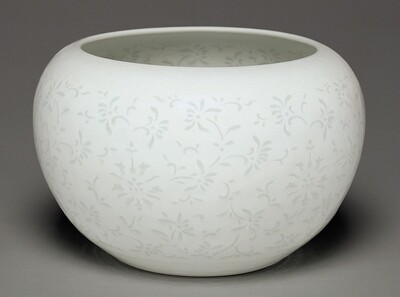
The sculpture is a large, rounded bowl with a delicate floral pattern covering its smooth surface. It is predominantly white, with the floral motifs painted in a light gray or off-white. The bowl has a wide, open top, and the same painted pattern appears to continue inside the bowl.

Bowl with "Rice Grain" Decoration

Chinese Qing Dynasty

The image displays swirling circular patterns on the surface, intertwined with organic shapes. The design resembles a marbled effect or grainy patterns in polished wood. The spirals and shapes resemble whirlpools or eddies in water. Warm brown tones with touches of deep blue and ochre enhance the natural feel of the composition.

Atlas des Environs de Paris

Delagrive, Jean

The image depicts a terraced structure with a row of arches on the left side. The top of the stone structure is adorned with small decorative sculptures. The drawing shows detailed textures, including leafy trees and stone surfaces, created through fine pencil strokes. The color palette is monochromatic with shades of grey. The trees appear to recede into the distance, while the stone steps and walls closer to us provide a sturdy appearance.

The Fishpond at Villa Madama

Vien, Joseph-Marie
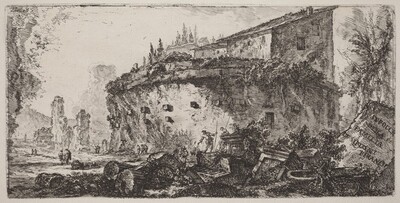
The image shows a bird's-eye view of a rural scene with ruins and distant landscape. The intricate 18th-century style with black and white color palette emphasizes textural detail and contrast. Remnants of architectural elements and figures can be seen among scattered ruins. A wall with foliage is in the foreground, while the background shows a rugged terrain with more ruins and vegetation.

Sepulcro de famiglia de' Scipioni

Piranesi, Giovanni Battista

This is a photograph of an ornate wooden table. The table features curved legs with gold accents, intricate floral marquetry, and a hinged decorative panel.

Writing and Toilet Table (table mécanique)

Oeben, Jean-François

The image shows a portrait of a person displayed from the mid-torso up. The individual faces slightly to the left, with their gaze forward. They have a pale complexion, delicate facial features, and powdered hair styled pulled back. The person wears a garment with a red fur-trimmed collar and a light blue bow at the neckline. No jewelry is visible. The background features an oval frame with decorative leaf motifs on a dark, textured backdrop. An inscription below the oval states the name and title of the person depicted.

Marie-Antoinette, Dauphine

Bonnet, Louis-Marin

The image is an etching of an ancient ruin, showing grand columns from a low perspective. The horizon is low, emphasizing the tall columns which break the line, with remnants of foliage or sculptural decoration on top. The lines are intricate, creating texture and depth on the stone surfaces. The color scheme is monochromatic, enhancing the classic feel. Beyond the columns, buildings and ruins fade into the distance. Small figures and livestock give a sense of scale. The sky has delicate clouds, creating a serene ambiance.

Vestigi del tempio del Giove Statore

Piranesi, Giovanni Battista

This is a painting of a scene with a large cross at the center. The painting depicts a gathering around the cross, with angelic figures flying above amidst clouds. Some of these angels hold instruments, garlands, or tall staffs. On the ground, a group of individuals in colorful attire surround the bottom of the cross with a backdrop of a classical cityscape, including arches and stone buildings. In the bottom left, a man wearing a white cloth on his waist kneels down in front of the cross, his hands raised in prayer. To the right, two women in flowing clothes of gold and seafoam-green look at the cross, one resting her hand on it. At the very top of the painting, above the cross, is a pale-yellow arch.

The Exaltation of the True Cross

Ricci, Sebastiano

The image is an etching of a ruinous arch, slightly off-center, with intricate line work to depict its structure. The horizon is above the arch, showing vegetation and rugged terrain in the distance. The etching displays textures representing flora and stone, with shadows and depth created by dense hatching. The sky is light with airy cross-hatching. The color palette is black on off-white paper. Foliage and rough ground are detailed near the arch, and ancient stonework and rocky formations extend into the landscape beyond.

Arco di Pola in Istria

Piranesi, Giovanni Battista

The image shows a standing male leaning against a rectangular slab inscribed with text. He has a classical facial features, dark curly hair, and is nude with a cloth around his waist. He stands on a textured surface with a plain background. The scene is depicted in fine linework.

Title Page

Van Loo, Carle

The image shows a sculpture designed to resemble a teapot. The sculpture depicts a traditional teapot structure, complete with a spout, lid, and handle. The teapot is circular in shape, featuring a cylindrical body on a small, rounded base, and a circular lid with a knob at the top. The knob is intricately detailed, resembling a small sculpted rose or floral element. The sculpture is off-white or ivory in color, with a glossy sheen and smooth finish. Vertical inscriptions are embossed on the teapot's side, adding intricate detail to its design.

Teapot

Chinese Qing Dynasty

The Prima Macchina for the Chinea of 1738: Allegory of Regal Providence

The Prima Macchina for the Chinea of 1738: Allegory of Regal Providence

Parrocel, Pierre

The sketch shows multiple figures' upper bodies, centered around a standing person and two cherubic children. The central figure is an adult standing and presented in profile, gazing downward, with a serene expression. This figure has curly hair falling to the shoulders, classical features, a prominent nose, and a gentle smile. The clothing suggests classical drapery covering the torso loosely. Next to the central figure are two cherubic figures, mostly nude, with playful, rounded features and small wings. One cherub leans against the standing figure, while another lies across the lap of a seated figure. The background consists of simple, curved lines creating an arched frame, matching the page's shape, with no distinct setting depicted.

Charity

West, Benjamin

This is a painting of a purple bird perched on a rock. The image depicts a bird with dark plumage standing on a small, rocky mound scattered with patches of greenery. The bird's beak is open, and its eye is highlighted. The brushstrokes illustrate the texture of its feathers, while the rock beneath is shaded in warm earth tones, accentuated by small areas of plant life sprouting around it. The background is a plain, light color, allowing focus on the detailed rendering of the bird itself.

The Purple Jack Daw (Gracula Quiscula)

Catesby, Mark

The image shows multiple individuals in a scene. In the foreground, a man and a woman are on a bed. The woman is uncovered, reclining on her back with her arms raised. The man is leaning over her, wearing rich clothing and a headpiece with a plume. Another person with similar attire stands behind them. The background features heavy curtains, a luxurious bed, and ornate furniture.

Le roi d'Ethiopie

Vidal, Gérard

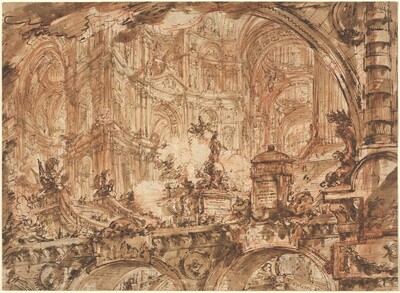
The image shows intricate lines and shapes creating elaborate arches and architectural structures. The drawing has a swirling and overlapping design that suggests chaotic motion within a grand structure. The abstract assembly resembles a grand cathedral or a palatial hall, with arches and columns akin to classical architecture. Figures and decorative flourishes are interspersed throughout, resembling statues or ornate carvings typical of an embellished building.

A Magnificent Palatial Interior

Piranesi, Giovanni Battista

The image shows a landscape with buildings, trees, and a small bridge in the distance. The viewpoint is slightly elevated, with a rustic setting. The horizon has hills and clouds in the sky. Birds are seen flying above the horizon. There are buildings made of stone or brick with intricate details, surrounded by lush trees. In the foreground, there is a shaded area with a small, thatched structure near water. The artwork features light pencil sketching, varied brushstrokes, and a monochromatic color palette.

The Ponte Sant'Angelo and Houses on the East Bank of the Tiber

Vien, Joseph-Marie

The image is an illustration of a forest scene with trees of varying heights. A gnarled tree is slightly off-center to the right. Human figures and a dog are seen on a path winding through the trees, providing scale. The detailed brushstrokes show the foliage and tree textures accurately. The color palette is grayscale, resembling an etching. The sky is partly cloudy with soft cloud formations in the distance.

Entrata nel bosco di Marino

Mechau, Jacob Wilhelm
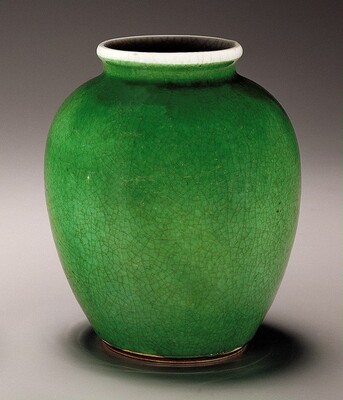
This is a vase with a rounded shape, a slightly narrowing neck, and a wide opening at the top. The vase is a vibrant green color, with crackle patterns and fine lines crisscrossing across its surface. The rim of the opening is white, and the base is a thin line of dark brown.

Jar

Chinese Qing Dynasty

The image depicts a portrait of a person from the waist up. The person is slightly facing left, with their head tilted downwards, eyes looking down, and lips closed. They have delicate facial features, including softly arched brows, long eyelashes, and a faint blush on the cheeks. Their hair is styled in loose curls with small flower adornments. The person is wearing a light-colored garment with a draped neckline and a darker overcoat with a rose flower pinned to it on the left side. The background is a simple, textured gray pattern, framed with a decorative border.

Bust of a Young Woman Looking Down

Bonnet, Louis-Marin

L'oeuvre d'Antoine Watteau (volume I)

L'oeuvre d'Antoine Watteau (volume I)

Various Artists

The image shows an aerial view of an arched bridge and surrounding architectural structures. The horizon is not clearly defined, with the bridge spanning the middle of the composition. Buildings with slanted roofs reach upwards towards the top of the scene. The sketch features expressive pencil strokes with heavy shading to denote texture and depth in the stonework and surrounding terrain. The artwork is in shades of grey, emphasizing shadow and light. The cliffs are detailed, emphasizing the central archway against the sky above.

A High Bridge in Tivoli

Vien, Joseph-Marie

The image shows a group of figures, both human and a cow, in a rural setting. One person is seated, holding a child, with most of their body shown. Another figure is leaning on a staff, facing downward, with short wavy hair and simple clothing. A third figure stands behind them. A cow with horns is on the left. The scene is sketched in brown ink wash, depicting a barn-like environment with few details.

The Adoration of the Shepherds

Tiepolo, Giovanni Battista

The image shows swirling patterns and spots on a textured surface. The abstract design consists of lines and shapes that resemble the branching of a tree or the veins of a leaf, with clusters resembling islands or clouds scattered across the surface. The pattern gives the impression of a natural landscape viewed from above, with organic formations.

Vida y Hechos del Ingenioso Hidalgo Don Quixote de la Mancha (volume 1)

Cervantes Saavedra, Miguel de

Two pale-skinned women sit together surrounded by five sheep and a dog in a lush forest in this vertical painting. The woman to our right sits slightly above the other, with her arm draped around the shoulders of her companion. The woman to our right wears a low-cut, rose-pink dress with a full skirt and voluminous, gossamer sleeves. Blond curls are pulled back behind a headband, which is adorned over one ear with three large, pink flowers and smaller yellow and blue flowers. She tips her head to our right as she gazes down to her left at her friend. She has blue eyes, flushed cheeks, a delicate nose, and her grapefruit-pink lips curl in a gentle smile. She crosses one knee over the other and leans toward the other woman. Tucked into her side, the second woman looks up at the first in profile facing our right. Her low-cut, lavender-purple dress has a gold shimmer that suggests silk. Her ash-brown curls are pulled back and decorated with small sea-blue flowers. One toe peeks out from her long skirt, and both women are barefoot. The woman in purple holds a white dove on her friend’s lap, and the woman in pink holds a small envelope closed with a shell-pink seal next to the bird. The dove’s wings are slightly outspread, and a blue ribbon is tied around its neck. Just behind the pair, a towering tree with a silvery-gray trunk grows up and off the top edge of the painting. It angles to our left, and green branches hang down into the picture. To our right of the tree, a rectangular sand-brown stone structure is topped with a male lion carved from the same stone, near the upper right corner. The ground beneath the women is covered with moss-green growth and the space around them filled with verdant bushes and plants. A single, cream-colored sheep stands to our right, facing the women, next to a basket of flowers near the lower right corner. Four more sheep stand and lie together beyond the women to our left, while a black-bodied hound with a white muzzle sits watching the women. A pile of broken branches, perhaps forming a fence, lies behind the sheep. Grassy hills and trees become hazy in the distance beyond, and the sky above is slate blue with a few white and pale pink clouds. The upper and lower right corners and the lower left corner are deep in shade. The artist signed and dated the painting as if he had inscribed the stone in the shadow just below the lion, “f. Boucher 1750.”

The Love Letter

Boucher, François

This is a drawing of a title page for an Italian text on the gates and walls of Rome. The page contains Italian text in various sizes and styles detailing the dedication and authorship of the text. The main dedication reads "Delle Magnificenze di Roma Antica e Moderna" and is dedicated to Carlo, Infante of Spain and King of the Two Sicilies. Below the text, there is a small engraved illustration of a classical figure surrounded by architectural elements, likely referencing ancient Roman structures. The page is dated MDCCXLVII (1747) and printed in Rome.

Delle Magnificenze di Roma Antica e Moderna (vol. 1)

Vasi, Giuseppe

The image shows a sketch from an elevated point of view. Various elements suggest depth, including faint outlines of structures, a small human figure with a staff in the distance, and a prominent tree closest to the viewer. The artwork uses dynamic pencil strokes to depict foliage with varying textures and contrasts. The color palette is primarily gray, capturing forms and details in a natural setting. Details become lighter towards the sky, showcasing open spaces with minimal distant sketches.

A Towering Tree with Travelers

Vien, Joseph-Marie

This is a drawing of architectural designs for a building. The image showcases two elevations and two floor plans of a structure. One elevation depicts a building with columns supporting a triangular pediment. The other elevation shows an entrance with an arched doorway flanked by windows, topped with a pediment. The floor plans reveal the spatial arrangement and construction details. The drawing suggests an emphasis on balance, symmetry, and classical proportions.

A Book of Architecture containing Designs for Buildings and Ornaments

Gibbs, James

The image shows an expansive scene of ancient ruins and natural surroundings, viewed from a slightly elevated perspective. The horizon is in the upper third of the image, featuring distant structures and a line of trees outlining the skyline. The etching style is defined by intricate lines and hatching that detail the architecture and foliage. The color palette consists of shades of black and gray to create contrast and depth. Closest to us are ancient ruins and a landscape leading to a winding path, with more ruins and vegetation extending into the distance. In the background, more ruins are partially obscured by trees, blending into the sky.

Parte dell'antica Via Appia fuori de Porta S. Sebastiano

Piranesi, Giovanni Battista

The painting shows a woman and a man in a wood-paneled room. The woman is on the left, seated on a blue chaise lounge with carved wooden details. She is wearing a white blouse and a pink skirt, with one foot hovering above a basin of water. Her head is turned to the right. A small gray-and-brown dog is on the end of the chaise longue next to her. On the right, the man is entering the room, the pushing the wooden door open. He is holding a hat and is dressed in a blue tunic with white details, gray gloves, a red belt and red tights, and black shoes. They both have pale skin with rosy cheeks and red lips, and the woman has brown hair pulled back at the nape of her neck while the man has long gray curls. They are in a room with wood paneled walls and what looks like a heater on the far-left emitting steam.

Lady Undressing for a Bath

Duyckinck, Gerardus

Singerie: The Painter

Singerie: The Painter

Huet, Christophe

The sculpture is a ceramic pot decorated with floral motifs. The pot is blue with gold detailing and features an oval panel displaying colorful flowers against a white background. Surrounding the panel is a geometric pattern in gold. Animal head-shaped handles are on either side of the pot. The rim is white with a pink and orange pattern, and smaller floral motifs are repeated around the upper part of the pot.

Large Fish Bowl

Chinese Qing Dynasty

The image shows the interior of a grand cathedral or similar structure from an observational perspective. The arches rise above with gothic vaults, while massive pillars define the open central area. Figures in long garments can be seen in the distance, adding scale to the space. The image is in a monochromatic sepia tone, likely ink or wash, giving an antique feel. The shadows and light detail the structure, enhancing its depth and grandeur. The color palette is warm and earthy.

Monks in a Cathedral

Le Brun, Jean-Baptiste-Pierre

The sculpture is a large ceramic vessel with a green surface featuring intricate designs, dense foliage, and patterns. Throughout the green background, there are stylized representations of objects and symbols in vibrant colors like red, blue, and yellow. The upper rim has an ornate border pattern in red and gold designs, and the opening is white with subtle traces of age. The sculpture likely is made of porcelain or glazed ceramic. The overall shape is broad and rounded, conveying a sense of stability and elegance.

Large Fish Bowl

Chinese Qing Dynasty

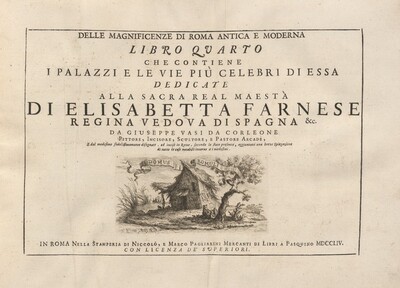
This is a drawing of a book cover or page. The central text is a dedication on the magnificence of ancient and modern Rome, particularly its notable palaces and streets, addressed to Queen Elisabeth Farnese of Spain. The title indicates that this is the fourth book in a series. Below the text, there is a small illustration depicting a rustic hut with a banner bearing the word "DOMUS ROMULI." The scene suggests a portrayal of early Rome with a simple dwelling surrounded by natural elements including trees and vegetation. The entire piece is rendered in black and white with a detailed engraving underneath the main text.

Delle Magnificenze di Roma Antica e Moderna (vol. 2)

Vasi, Giuseppe
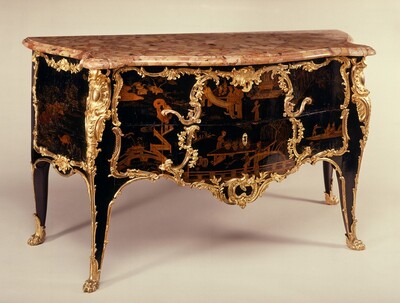
Chest of Drawers (commode)

Chest of Drawers (commode)

Desforges, Jean

The image is a landscape seen from a slightly elevated perspective, showing a valley with a distant mountain range under a pale sky. To the right, a rocky cliff face is depicted with soft brushstrokes. The color palette is subdued, with light grays, beiges, and browns. Mountains in the distance are outlined with minimal detailing. A river winds through the valley, indicated by simple lines that merge into the background.

Swiss Landscape with a Village in the Distance

Lushington, Sarah Grace

The image is an engraving. It features a portrait of a person viewed from the torso upwards, set within an ornate oval frame. The individual is positioned slightly angled to the left while facing the viewer. They have facial features including a mustache and wavy hair that reaches just below the ears. The person wears a dark garment with a high collar and may be draped with a robe or cloak. Surrounding the oval frame are elaborate carved embellishments, and a cherubic figure sits at the bottom right, looking upwards and holding decorative foliage. Beneath this figure, sailing ships are etched into the lower section of the carved frame. In the background, detailed engraving work embellishes the image with intricate patterns and shapes.

Algernon Percy, Earl of Northumberland

Houbraken, Jacobus