← All periods

before 1300

7 works

A cup carved from stone is mounted in gold fittings to create a jeweled chalice with handles that curl up each side and a tall, flaring foot below. The stone of the cup is swirled with shell pink and rust brown, and carved to create vertical ridges. The gold rim around the lip flares outward and is set with a band of alternating pairs of small, white pearls and mostly garnet-red stones, though one stone to our right is a muted blue. In this photograph, the handles curve up each side from the base of the stone cup to the gold lip, where the handle divides into two scrolling tendrils on either side of a teardrop shaped center, like curling petals. The base and foot are as tall as the stone cup and gold lip. A knob-like form just below the stone cup is set with deep red and jade green stones around its center, and rows of small pearls around the narrow top and bottom of the knob. The knob is chased to create a pattern of scrolling vines, like tracery. The flaring foot below is also chased with the same pattern, surrounding gold, oval medallions set at regular intervals in the foot. In our view, the medallion to the left shows a bunch of grapes and the center is a portrait of a bearded man with a halo, holding his right hand up with his first two fingers raised. The details on the medallion to our right are difficult to make out but it could be a sheaf of wheat. Small, round jewels are set above and below each medallion, and between each one.

Chalice of the Abbot Suger of Saint-Denis

French 12th Century

This free-standing bronze sculpture shows the rounded, stylized forms of a person with long limbs riding astride a horse with noticeably short legs. The horse and rider are angled to our right in this photograph. The dark brown bronze gleams white where the light catches the smooth surfaces, and some areas are a burnished gold color. The horse looks ahead with large eyes. It has short ears, and its mouth is parted. The person riding the horse holds the reins with the right hand, closer to us. The reins wrap halfway around the horse’s neck and are then broken off. The cleanshaven rider has a heavy brow ridge and a long, straight nose. He wears a flat-topped cap and a robe that reaches to his ankles. The pointed toes of his shoe pokes through the small stirrup we can see. A rounded handle connects the rider’s upper back to the back of the horse. The background is taupe-gray behind the sculpture and darkens at the upper corners.

Aquamanile in the Form of a Horseman

English 13th Century

A free-standing, gold, enameled, rectangular box has a triangular top like the roof of a house, and the box rests on a short, square foot in each corner. In this photograph, we look onto one long side and the short side to our right is angled toward us, so we see the panel there, too. Along the long side, five people are shown from the waist up in the upper, roof-like panel and six more line up on the panel below. The skin of every person is gold, and all wear robes and garments in lapis or sky blue, spring green, yellow, and white. The area around the people is also gold, and each panel is encased by a royal-blue band dotted with stylized stars at regular intervals. Each panel is then lined with small, button-like rounded bosses around its edges. In the upper panel, all of the men except the second from the right have beards, and all have halos with wavy bands of blue, green, yellow, and white. The man to our left holds a book and his neighbor a skeleton key the length of his arm. The man at the center holds up a book with his left hand, on our right, and raises the index and middle fingers of his other hand, held up at shoulder height. The two men to our right also hold books. In the panel below, three horses’ heads peek in from the left edge, creating a vertical band, and three crowned men line up, holding gold vessels and looking toward a woman seated in a throne with a child on her lap. The woman has a halo made with a wavy pattern of blue, yellow, green, black, and white. Her throne is flanked by columns, and the area around it is edged with bands of white, light, and dark blue. The baby wears gold, has a halo, holds a book in his lap with his left hand, and raises the first two fingers of his other hand toward the three men. The final person in this panel wears a hat, holds a scepter topped with a fleur-de-lis, and gestures at the woman and baby. The head and shoulders of a haloed person is visible along the short side of the box, which is angled sharply away from us. The gold between all the people and bordering each panel is intricately carved with tiny flowing organic lines and swirls.

Reliquary Châsse

French 12th Century

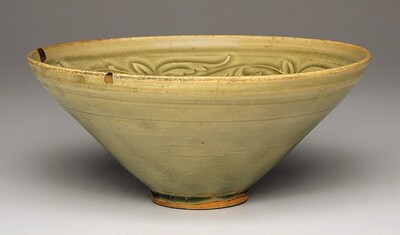
This is a photograph of a ceramic bowl. The bowl has a soft olive-green glaze with broad curving lines forming an abstract floral or vine-like pattern incised into the interior. The shape is wide at the top, tapering down to a small raised foot. The rim has small aged chips revealing a darker clay base. Subtle crackling is visible throughout the glazed surface, giving it an antiquated appearance. The lighting highlights the texture and color variations, accentuating the bowl's simple form.

Bowl

Chinese Jin Dynasty

Dish

Dish

Chinese Jin Dynasty

A woman and child sit on an ornate gold, curving throne in front of a shimmering gold background in this vertical painting. Two winged angels in roundels at the upper corners and the woman and child all have peach-colored skin with a gray cast. The woman tips her head toward the child, to our right. She has almond-shaped eyes, a long, straight nose, and her small lips are closed. She looks into the distance over the child’s head. She wears a scarlet-red mantle that covers her head and drapes over her shoulders and body. The azure-blue of her dress beneath is visible at her throat and over one knee. The child sitting on her knee is as tall as a toddler but has adult proportions in his face and body. He holds up his right hand, on our left, and raises the first two fingers. He holds a red scroll in his other hand. He wears a forest-green robe over a salmon-pink garment. The clothing of both the woman and child have geometric gold lines indicating folds in the drapery, and both have gold halos. The child’s halo is marked with three red arms to create a cross above and to the sides of his head. The woman rests her feet on a low stool in front of the opening of the elaborately carved, two-tier throne that nearly encircles the pair. The winged angels in the upper corners have gold halos, brown hair, jeweled, gold garments, and each holds an orb and scepter.

Madonna and Child on a Curved Throne

Byzantine 13th Century

This is an ornate crucifix, with a man hanging from it in a traditional crucifixion pose, his arms outstretched and nailed to the crossbeam. The man has long hair and a cloth tied around his waist, and he is colored entirely in bright gold. Behind his head is a golden circle with gems in blue, red, and green. The cross itself is adorned with intricate designs in dark blue, red, teal, and green shapes, bordered by a gold-colored outline. The top of the cross features an inscription in gold lettering on a blue background. The sculpture stands upright against a neutral gray backdrop.

Crucifix

Rhenish 12th Century