← All periods

1901 to 1925

98 works

This is a photograph of the surface of the Moon. The image shows the lunar surface with numerous craters of varying sizes. Some craters are more prominent than others, casting shadows that highlight their depth. The landscape looks rugged and desolate, with a rocky texture. The top part of the image is illuminated by a light source, creating contrast and showcasing the uneven terrain. The photograph is bordered with labels and text in French, referencing a specific photographic map of the Moon and providing observation details.

Carte photographique de la lune, planche X (Photographic Chart of the Moon, plate X)

Le Morvan, Charles
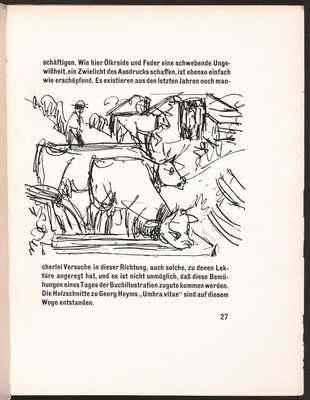
The image shows two cows and a man surrounded by rough sketch lines. There are two cows in the foreground, depicted with fluid lines suggesting movement. Above the cows are sketchy lines resembling barns or rural buildings, with a figure resembling a man nearby. The drawing is placed on a page with text above and below, creating an illustrative connection between the art and text.

In-text plate from Kirchner Zeichnungen (Kirchner Drawings)

Kirchner, Ernst Ludwig
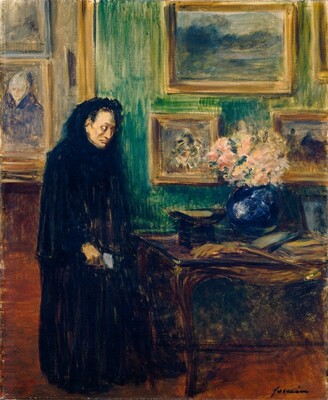
The Petitioner

The Petitioner

Forain, Jean-Louis

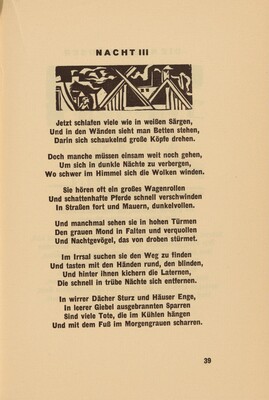
There is a rectangular abstract illustration at the top of the page. The image has bold, dark lines and shapes against a light background. The illustration depicts a cityscape with buildings and a sky filled with swirling cloud-like forms. Below the illustration, there is a block of centered text on the page. The title "NACHT III" is in bold capital letters, followed by a poem in German. The text is printed in a clear serif typeface, with the page number "39" at the bottom right corner.

Nacht III (Night III) (headpiece, page 39) from Georg Heym: Umbra Vitae (Georg Heym: The Shadow of Life)

Kirchner, Ernst Ludwig

This is a photograph of a circus performance featuring an acrobat in mid-air performing a daring feat high above the ground. The acrobat is upside down, balancing on a wire and holding various objects, such as a ring and a disc. Flowing fabrics add movement and grace to the scene. The perspective is dramatic, emphasizing the acrobat's poise and control against a light sky backdrop, giving a sense of weightlessness. The image is in sepia tones. There is a handwritten inscription in French in the lower right corner.

Acrobat

Stone, Sasha

The image features a series of jagged, angular lines and geometric shapes forming a complex pattern. The arrangement resembles human figures, with bold outlines hinting at heads, limbs, and torsos. The foreground includes a central figure with exaggerated facial features and wild hair, surrounded by other figures. The composition conveys a crowded scene with a sense of motion and interaction, similar to people gathered in a limited space.

Die Irren I (The Mad I) (headpiece, page 24) from Georg Heym: Umbra Vitae (Georg Heym: The Shadow of Life)

Kirchner, Ernst Ludwig

The image displays a black-and-white illustration on the right page of an open book. It shows a person standing in profile facing to the left. The individual's facial features are lightly sketched, and their hair is covered by a large hat. The person wears a long, dark coat and stands on a path with abstract shapes in the background resembling trees or foliage edges. The scene has stark contrasts between light and dark areas and an atmospheric quality. The left page contains German text organized into paragraphs relating to the illustration.

Akaki trägt den Mantel das erstemal auf der Straße (Akaki Wears the Coat on the Street for the First Time) (plate 6) from Der Mantel (The Coat)

Gramatté, Walter

This is a drawing of a book cover for "Umbria Vitae" by Georg Heym. The cover features bold typography and a central woodcut illustration depicting two abstract figures with mountainous or cliff-like forms in the background. The lines are sharp and angular, typical of expressionist art. The illustration is attributed to Ernst Ludwig Kirchner. The drawing is bordered by simple lines and has handwritten inscriptions at the bottom, detailing information about the publication, including the publisher and year.

Titelvignette (title vignette) from mock-up of Georg Heym: Umbra Vitae (Georg Heym: Shadow of Life)

Kirchner, Ernst Ludwig

This is a drawing depicting figures in a contemplative scene. The drawing uses simple lines and shading to depict a set of figures within an undefined space. One figure stands with hands clasped, head tilted upward. The use of charcoal or pencil gives the piece a raw and expressive touch, emphasizing emotions rather than detailed realism. The surrounding figures and scenery are delineated with minimalistic lines. The strokes give the piece an open-ended narrative.

During the Armistice

Forain, Jean-Louis

The image shows a series of abstract, thick black lines outlining human figures. On the left side, two figures are depicted in motion, with one figure raising their hands and the other stretching out an arm. On the right, two figures are seated with angular and abstracted limbs tucked closely around their bodies. The design features bold black lines framing the figures against a pink background, with a structure resembling a linked chain of stylized squares.

Vorsatz (back endpapers) from mock-up of Georg Heym: Umbra Vitae (Georg Heym: Shadow of Life)

Kirchner, Ernst Ludwig

The image shows two nude figures in an open natural setting. Both individuals have short, dark hair. One figure is seated with their knees bent, while the other figure stands with one arm reaching towards their head. The figures lack detailed facial features and are surrounded by vibrant green foliage, a body of water, and a blue sky.

Two Bathers

Mueller, Otto

The image at the top of the page shows abstract interlocking geometric shapes and lines that resemble human faces. The shapes suggest a group of people with various expressions, arranged in a structured yet chaotic manner. The design is reminiscent of tribal masks or ancient carvings. Below the artwork, there is German text formatted in a structured layout, similar to a poem or song lyrics. The combination of the abstract image and text creates a juxtaposition of visual and literary elements.

Die Irren II (The Mad II) (headpiece, page 26) from Georg Heym: Umbra Vitae (Georg Heym: The Shadow of Life)

Kirchner, Ernst Ludwig

This is a black and white drawing featuring abstract figures surrounding geometric structures. The drawing is on a page with German text titled "DIE NEUEN HÄUSER." The abstract illustration on the page shows angular forms suggesting architectural elements and elongated figures interacting with each other. The drawing style uses heavy black lines and shapes to create contrast. The figures are in dynamic poses, implying movement or action in a simplified and distorted environment.

Die Neuen Häuser (The New Houses) (in-text plate) from mock-up of Georg Heym: Umbra Vitae (Georg Heym: Shadow of Life)

Kirchner, Ernst Ludwig

Chad Gadya (The Tale of the Goat)

Chad Gadya (The Tale of the Goat)

Lissitzky, El

This is a black and white drawing of an expressionistic scene with a group of individuals and a piece of text. The illustration shows figures in a style similar to woodcut prints, with strong angular lines and sharp contrasts. The scene features abstracted figures, some with raised hands, depicted in a dramatic and stylized manner. The text "DIE TAUBEN II" is present above the image, and below the artwork, there is an excerpt of German text. The composition conveys an introspective or solemn tone typical of expressionist art, emphasizing emotion and the human condition.

Die Tauben II (The Deaf II) (headpiece, page 46) from Georg Heym: Umbra Vitae (Georg Heym: The Shadow of Life)

Kirchner, Ernst Ludwig

This is a photograph of a star chart. The image shows a grid layout with small black dots spread across the background, representing stars in the celestial coordinate system. The chart, titled "Photographische Sternkarten," was created by Joh. Palisa and Max Wolf and includes annotations detailing its production date, location, and contributors. The chart features references to celestial latitude and longitude, presented on an organized grid with numbered divisions running vertically and horizontally along the edges. These coordinates assist in identifying star positions within the mapped sky section. The information provided emphasizes cartographical efforts to document the night sky in 1901.

Photographische Sternkarten (October 15, 1901)

Wolf and Palisa

The image shows a group of children and a few adults gathered outdoors. The children, dressed in formal attire typical of the early 1900s, are positioned with their backs to the viewer. They wear long socks, dark suits, and dresses. One girl in the foreground stands out with a light-colored dress and puffed sleeves. The children are standing closely together facing forward. Among the adults is a man elevated above the children, wearing a tall top hat and dark suit. The setting is outdoors, with tall trees and sparse bushes in the background, suggesting a park or forest area. The photograph is in sepia tone.

Singing for President Roosevelt, Pinehurst Tea Farm, Summerville, South Carolina

Underwood & Underwood

Notre-Dame

Notre-Dame

Atget, Eugène

The image contains bold, angular lines and shapes creating an abstract winter landscape. A fragmented face appears on the left within undulating forms resembling trees or branches. The right side displays structures with slanting rooflines, possibly representing houses or sheds adorned with snow-like textures. The abstract elements evoke a winter scene, with the face suggesting indoor observation.

Der Winter (The Winter) (headpiece, page 37) from Georg Heym: Umbra Vitae (Georg Heym: The Shadow of Life)

Kirchner, Ernst Ludwig

This is a drawing of an abstract scene along with text. The image contains a black and white illustration above a poem or text titled "Der Krieg." The drawing features an abstract arrangement of figures and forms blending into one another, with dynamic elements suggesting movement. Below the illustration, the text is laid out in stanzas and is in German. The composition likely aims to evoke themes related to conflict, upheaval, or internal struggles. The use of black and white enhances the stark nature of the themes presented.

Der Krieg (The War) (headpiece, page 3) from Georg Heym: Umbra Vitae (Georg Heym: Shadow of Life)

Kirchner, Ernst Ludwig

This is a photograph of a historical document titled "CARTE PHOTOGRAPHIQUE ET SYSTÉMATIQUE DE LA LUNE." The document cover is aged and has finely textured paper with a black binding on the left edge. It includes the author's name, "C. LE MORVAN," and the description "ASTRONOME ADJOINT A L'OBSERVATOIRE DE PARIS." The title describes a photographic and systematic map of the moon. Below the author's name, the document mentions "IMAGES DIRECTES" and "SIX PLANCHES EN HÉLIOGRAVURE." It also includes the year "MDCDXXVI" (1926) and the location "PARIS" at the bottom. The document shows signs of wear with paper deterioration on the edges and a tear in the bottom region.

Carte photographique et systématique de la lune (Photographic and Systematic Chart of the Moon)

Le Morvan, Charles

The image shows an open book with an artwork on the right page and faint text on the left page. The artwork is a black and white print depicting a group of figures walking down a tunnel-like structure with curved walls. One figure in the foreground has large eyes and a cap. The figures are mostly in silhouette, with minimal details. The clothing is dark, blending with the scene's shadowy atmosphere. The background suggests depth with lighter tones continuing the tunnel. The signature "Kollwitz" is seen at the bottom of the artwork. The setting conveys a solemn procession.

Der Morgenweg zum Amt (The Morning Route to the Agency) (plate 1) from Der Mantel (The Coat)

Gramatté, Walter

The image shows abstract shapes and lines forming two distinct clusters against a monochromatic background. On the left, there are angular, abstract faces resembling caricature-like facial expressions. On the right, there are elongated, linear figures suggesting human forms in motion. Both clusters are enclosed within rounded edges and separated by a horizontal division. Handwritten text is present at the top and bottom of the page.

Vorsatz (front endpapers) from mock-up of Georg Heym: Umbra Vitae (Georg Heym: Shadow of Life)

Kirchner, Ernst Ludwig

The drawing depicts a full-length view of a person standing with their upper body slightly bent forward and looking to their left. The figure's head is turned to the side, revealing their facial features, including a prominent nose and a defined brow. The person's hair is styled back and appears to be in a loose, short ponytail. The individual is shown in an expressive pose with one arm crossing their body and the other resting near their abdomen. The background consists of plain brown paper, contrasting with the white highlights and black contours used to render the figure, emphasizing the form and musculature of the body. There are no visible details of jewelry or objects being held by the figure.

Study for "Stars and Dews and Dreams of Night"

Davies, Arthur B.

Men's Fashions

Men's Fashions

Atget, Eugène

This is a drawing of a village scene with houses and foliage. The artwork is executed in a bold, woodcut style and features several small, peaked-roof houses nestled among abstracted trees and foliage. There is a figure with a pointed head and intricate patterns in the surroundings. The drawing is surrounded by text in German. The monochromatic, high-contrast technique is typical of woodblock prints.

Spitzköpfig Kommt Er... (With a Pointed Head He Rises) (headpiece, page 13) from Georg Heym: Umbra Vitae (Georg Heym: The Shadow of Life)

Kirchner, Ernst Ludwig

The image displays abstract bold angular shapes and intersecting lines in black at the bottom of a text-filled page. The forms suggest movement and overlap, resembling silhouettes of people and flames. Within the design, figures engaged in action can be recognized, suggesting a scene of activity or commotion. The solid black and sharp contrasts lend depth and complexity to the composition.

Der Krieg (The War) (in-text plate) from mock-up of Georg Heym: Umbra Vitae (Georg Heym: Shadow of Life)

Kirchner, Ernst Ludwig

The image displays bold, expressive lines and sharp contrasts in black and white, forming an abstract composition. Three figures are depicted, each suggesting a regal figure with crowns on their heads. The figures hold objects resembling gifts or containers. The background consists of swirling lines.

The Magi

Rohlfs, Christian

The image shows an open book with an illustration on the right page and text in German on the left page. The left page has a block of printed text in German. The right page features a monochromatic illustration of two claw-like hands reaching out against a dark, textured background. The hands are detailed with sharp edges and exaggerated features, set against abstract forms creating a shadowy atmosphere. The book has a red spine with the page number 24 visible at the bottom of the left page.

Zwei gespenstische Hände greifen nach etwas (Two Ghostly Hands Grasp for Something) (plate 8) from Der Mantel (The Coat)

Gramatté, Walter

The image shows a figure sitting in an angled chair. Their body is partially visible from the chest down to the knees, with hands on their lap. The person has abstract facial features with sharp, angular lines, and short hair. They wear a dark outfit with a collar or scarf around the neck. Around them are abstracted elements of a room, including a wall with a framed picture and three plant-like forms on a shelf. There is a table nearby with an unknown object. The background features a linear style with dark lines and shadows.

plate 1 in Alfred Döblin: Das Stiftsfräulein und der Tod (Alfred Döblin: The Canoness and Death)

Kirchner, Ernst Ludwig
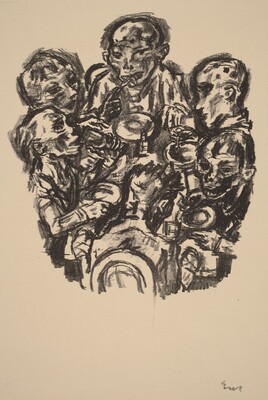
The image is a charcoal drawing depicting the upper bodies of five individuals closely gathered together. They are positioned to form a compact group, possibly interacting. Each person has distinct facial features portrayed with expressive, bold strokes. The individuals have diverse hair and facial structures in an intense, somewhat abstract style. Their clothing details are difficult to discern, but they seem to be wearing long-sleeved garments. Some individuals are holding bowls and utensils, suggesting a possible food or dining scenario. No discernible jewelry is present, as the focus is on their interactions with the objects. The background is plain, highlighting the figures and their central activity.

Six Diners at Table

Beeh, René

This stylized, free-standing, wood sculpture shows a seated man with horns, creating a column-like shape. The statue is carved from polished, reddish-brown wood. The column is divided into three sections for the head, torso, and legs. In this photograph, the man faces us. He has gold-colored eyes under arched brows, a wide nose, thin lips, and a square jaw. The horns rise from over his temples. In the middle section, he holds his hands in front of his chest, nearly touching as if in prayer. The bottom section shows his shins, knees together. His feet, which are roughly carved, turn outward. The base along the bottom is carved with words painted in gold, reading, “PERE PAILLARO.”

Père Paillard

Gauguin, Paul

A young blond person stands in the center of a dimly lit room facing dozens of men in this horizontal painting. The people all have pale skin, though many are in shadow. The central person, Joan of Arc, stands in profile facing our left. She clutches one hand at her chest and the other extends in front of her, fingers arcing up. She has chin-length hair and bangs. Her brow is furrowed and her lips parted. She wears a lapis-blue, high-necked tunic over smoke-gray stockings and pointed black shoes. A metal band encircles her waist and a chain and manacle hang from one of two rings there. The chamber is lined with two rows of seats that extend along the short side to our left and the long wall across from us. A man wearing a white robe and a burnished gold mitre hat and cloak sits in the corner, both arms resting on a high throne. The other men wear clergy’s brown or black and white robes or long garments in slate blue, olive green, tawny brown, charcoal gray, and silvery white. Most wear hats. Four more men sit around a table covered in a grass-green cloth behind Joan, to our right. One man looks down at and writes on a sheet of paper. About half a dozen soldiers wearing silvery helmets and holding spear-topped halberds cluster in the back right corner, beyond the table. A wood stepstool sits closer to us, in front of the table, in the lower right corner. The walls of the chamber are paneled in a rectangular grid of light brown planks over darker wood, and the floor is tiled with small pink rectangles. The artist has signed in the lower right, “M. Boutet de Monvel.”

The Trial of Joan of Arc (Joan of Arc series: VI)

Boutet de Monvel, Louis Maurice

The image shows a sketch of two half-body figures. One figure, on the left, is standing upright wearing a long-sleeved garment with an emblem over the chest. He has a mustache, short hair, and a stern expression, with one hand on his hip. The second figure, on the right, is less detailed, leaning forward with an obscured face and short hair. The sketch is set on a plain, light-colored background with scribbles and the phrase "En 1871" and a signature in the bottom right corner.

En 1871

Forain, Jean-Louis

The image displays a block of text in a serif typeface, with evenly spaced lines and justified alignment. Below the text is an abstract black and white illustration portraying a cluster of angular shapes and lines that suggest human faces and figures. The abstract forms resemble a crowd or a group of people, with some elements hinting at eyes, noses, and mouths amidst swirling lines. The figures appear intertwined, conveying a sense of movement or congregation.

Die Morgue (The Morgue) (in-text plate) from mock-up of Georg Heym: Umbra Vitae (Georg Heym: Shadow of Life)

Kirchner, Ernst Ludwig

This painting shows a man from the waist up, his body turned slightly to the right. He stands upright, looking at the viewer, holding a golf club or cane horizontally with both hands. The man has a neutral facial expression and a light complexion, a blond mustache, and neatly combed blond hair. He wears a white shirt under a pale yellow sweater and a brown coat, along with a red bow tie. He also has a long, multi-colored scarf draped over his shoulders with red and green stripes visible. The background is gray and becomes slightly lighter around the man's head and darker around the edges.

Chester Dale

Bellows, George

The image depicts complex shapes and lines on a red background. The shapes resemble human figures in different poses - two standing and two sitting, enclosed in rectangular outlines. The figures appear stylized with emphasis on form. Black shapes interconnect, creating a puzzle-like composition where the figures interact within outlined spaces.

Vorsatz (back endpapers) from Georg Heym: Umbra Vitae (Georg Heym: The Shadow of Life)

Kirchner, Ernst Ludwig

The image features angular lines and bold black shapes forming an abstract design. On the left side, there is a block of text with a striking font amidst fluid shapes on the right. The abstract lines on the right suggest elongated figures or flowing fabric. The design merges text with fluid forms, combining the appearance of a book cover or a poster with abstract expression.

title page for Alfred Döblin: Das Stiftsfräulein und der Tod (Alfred Döblin: The Canoness and Death)

Kirchner, Ernst Ludwig

The image shows a page from a book with text in German above a black and white illustration. The illustration is located towards the bottom of the page, just above the page number 18. It depicts a stylized landscape or scene with arched structures resembling domes or arches at the center, surrounded by foliage or trees. The bold and rough brushstrokes or carving technique create contrasts and a sense of movement. The color palette is monochromatic, with black ink on a cream-colored page. The horizon is not defined, but the composition directs the focus towards the central arch formations, emphasizing depth and structure. There are no visible elements in the distance or background, as the composition concentrates on the central elements.

Mond (Moon) (in-text plate) from mock-up of Georg Heym: Umbra Vitae (Georg Heym: Shadow of Life)

Kirchner, Ernst Ludwig

This is a drawing of a figure with an animal-like mask in a dark outfit holding objects. The image is on the right page of an open book, with German text on the left page. The drawing is done in a monochromatic style, primarily using dark shades against a lighter background, suggesting a chaotic or urban environment with rough textures and a sense of movement. The figure's stance and the composition contribute to an unsettling atmosphere.

Akaki geht ratlos auf der Straße (Akaki Walks Helplessly on the Street) (plate 4) from Der Mantel (The Coat)

Gramatté, Walter

This is a drawing of an abstract coastal cityscape. The drawing shows stylized cityscape with contrasts in black and white, likely done through a woodcut print technique. The image depicts abstract architectural forms: domes, arches, and steps spiraling upwards. Clouds or waves fill the sky. Beneath the drawing, text in German describes poetic imagery associated with the sea and city.

Die Meerstädte (The Sea Cities) (headpiece, page 20) from Georg Heym: Umbra Vitae (Georg Heym: The Shadow of Life)

Kirchner, Ernst Ludwig
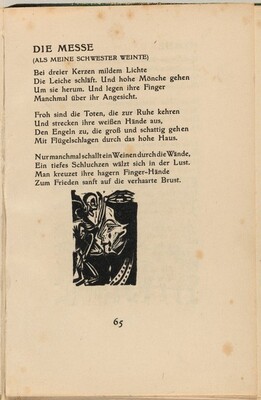
On the page, a bold abstract shape is positioned beneath a block of text. This dark, jagged shape consists of angular lines and contrasting areas of black and white, forming a pattern. The flowing, curved lines within the shape could be seen as stylized facial features or draped fabric. This form creates an organic contrast to the rectangular, orderly text above it.

Die Messe (The Mass) (in-text plate) from mock-up of Georg Heym: Umbra Vitae (Georg Heym: Shadow of Life)

Kirchner, Ernst Ludwig

This is a sepia-toned photograph of a group of people riding horses that stand on a grassy field with mountain peaks in the background. The people and horses are in a horizontal line across the photograph, all facing the left. The people have dark skin and black hair tied in two braids, many of which are adorned with long black-and-white feathers. They wear long pants, some with tassels or fringe, and many of them appear to have bare chests. The person on the far left has several strands of white beads around their neck and down their chest, and the person behind them holds a long spear. The backdrop consists of light gray mountains with snow caps against a pale sky.

The Pass Finders, Piegan, Montana

Reed, Roland W.

The image shows a drawing of a man leaning over a table, engrossed in writing. He has a furrowed brow and his hands are on a piece of paper. The setting is a simple workspace with the man in focus and a dark background behind him.

Der Titularrat Akaki Akaki-jewitsch (The Titular Council Akaki Akakiyevich) (plate 2) from Der Mantel (The Coat)

Gramatté, Walter

The image displays an abstract wave-like line on the left, with tendrils curving upwards. On the right, there is a figure with a round head and simple body sitting on an abstract formation. In the center, there are abstract forms implying the movement of a fish-like creature. The artwork blends organic and abstract elements, creating a dreamlike landscape with a whimsical twist.

Der Baum der Sehnsucht (The Tree of Longing)

Hoerle, Heinrich

The image depicts an abstract black and white illustration with dynamic lines and shapes. At the top, there is a block of solid, dark lines and angular forms. In the middle, abstracted human and animal forms can be seen. The overall composition evokes a woodland scene with elements that suggest intertwined flora and fauna. Below the illustration, there is text printed in German and the numbering 35 is noted at the bottom right corner.

Der Sterbende Faun (The Dying Faun) (headpiece, page 35) from Georg Heym: Umbra Vitae (Georg Heym: The Shadow of Life)

Kirchner, Ernst Ludwig

The image shows a design of jagged and curved lines forming abstract figures resembling human faces and bodies. The overlapping shapes create a sense of depth and complexity, with the figures appearing to emerge from one another. The composition evokes a chaotic unity, suggesting a bustling scene or crowded space.

Die Irren I (The Mad I) (in-text plate) from mock-up of Georg Heym: Umbra Vitae (Georg Heym: Shadow of Life)

Kirchner, Ernst Ludwig

The image is a bird's-eye view sketch depicting a village scene. The main structures are surrounded by human figures and animals. The sketch shows fine lines and detailed strokes capturing movement and activity. It is monochrome with shades of gray and black. Close to the viewer, various figures and animals are engaged in interactions, including villagers managing two horses. The village setting is rural with people engaging in daily activities, with visible roofs and chimneys in the distance.

Einzug

Palukst, Abraham

The image shows a portrait of a person with a focus on the head and neck, particularly the face. The individual is facing slightly left with their gaze turned to the side. The face is detailed, showing features like a mustache, facial hair, and expressive eyes. The dark hair is slightly parted and falls around the head. The person wears a light-colored garment with a high collar close to the neck. The background is simple with subtle textures. The inscription "Rome" and the date "1917" are on the left side of the image.

Jules Destrée

Besnard, Albert

The image shows a sculpture of a figure in robes on an ornate pedestal. The figure is standing upright with hands delicately positioned. The sculpture appears to be made of light-colored stone, possibly marble or limestone. It is located outdoors near leafless tree branches. In the background, there is a large, ornate building with multiple windows. The scale of the sculpture and pedestal makes it appear tall compared to the trees and the viewer's point of view.

Luxembourg, Anne of Brittany

Atget, Eugène

The image is an illustration of a figure on the right page of an open book. The person is leaning forward slightly, appearing focused on a task. The facial features are not distinct, and the hair seems dark and possibly short. The individual is dressed in dark clothing blending into the shadows. There are no visible accessories or objects. The background is minimalistic and dark, with a highlighted area indicating a window at the upper right casting light into the room. The page is filled with German text and contains a handwritten marking at the bottom of the illustration.

Akaki zeigt dem Schneider die auszubessernden Stellen (Akaki Shows the Tailor the Areas to be Mended) (plate 3) from Der Mantel (The Coat)

Gramatté, Walter

Self-Portrait

Self-Portrait

Thayer, Abbott Handerson

Bluemner Sketchbook

Bluemner Sketchbook

Bluemner, Oscar F.

The painting depicts a rocky coastline dotted with color. The horizon is high in the scene, and a strip of pale-yellow sky is visible at the very top of the painting. Along the rocky coast in the distance, the colorful land meets vivid turquoise and green ocean waters, with white lines indicating small waves. A red-striped umbrella in the top left corner appears to shelter a person in a long white dress; the umbrella obscures their face. The rocks have been painted with thick dots of black, white, yellow, orange, red, and green. The brushstrokes are expressive and the paint has been thickly applied in dots and dashes.

Flecks of Foam

Dearth, Henry Golden

The image is a sketch of the upper body of a person in profile view. The figure is facing left, with their face turned towards another obscured figure in the background. The person has distinct facial features with a beard and short hair. The drawing is abstract with heavy lines and shading. There are no detailed clothing patterns. The background has bold, dark strokes, implying depth and complexity. The composition suggests an interaction between the foreground figure and the obscured figure in the background.

Death Visits the Strucks (Death and the Couple) (Tod bei Strucks [Tod und Paar]) from Dance of Death (Totentanz)

Corinth, Lovis

This is a photograph of a parade marching through a city street lined with spectators. It captures a group of uniformed individuals marching in rows through an urban environment, flanked by an audience along the sidewalk. The background features tall buildings with American flags. Street lamps and architecture contribute to the historical feel of the image, suggesting an early 20th-century setting. The perspective and sepia tone enhance the historical atmosphere, capturing a moment of order, attention, and public interest.

"Colored Veterans of the 15th Regiment, 369th Infantry, Marching up Fifth Avenue, New York City"

Keystone View Company

The image is an artistic etching showing an abstract representation of a person with a full torso. The individual's head is tilted back and turned slightly to the side, with one hand raised to their forehead. The detail is focused on the torso and arms, with facial features being indistinct. The person's hair appears dark and loosely rendered. The figure is nude, and there are no visible accessories or objects. The background consists of dark, textured shading that contrasts with the light-colored paper.

Der Kuss (The Kiss)

Corinth, Lovis

This is a drawing of abstract forms resembling rooftops and trees. Bold black lines and sharp angles create a dramatic and chaotic vision. There is German text above the drawing, and the page shows signs of aging with discolorations and light stains on the edges.

Spitzköpfig kommt er... (With a Pointed Head He Rises...) (in-text plate) from mock-up of Georg Heym: Umbra Vitae (Georg Heym: Shadow of Life)

Kirchner, Ernst Ludwig

The image displays curved and swirling lines in a bold, reddish hue against a yellowish background, creating an abstract pattern. The shapes resemble flowing water or the intricate design of tree roots. The repetition and fluidity of the lines suggest natural forms found in a landscape or organic growth.

Der Mantel (The Coat)

Gramatté, Walter

The image depicts a portrait of a person with only the upper body visible. The person is shown in a three-quarter view, with the head slightly tilted forward and to the side, eyes looking down. The facial features are stylized with angular lines and patterns, creating a sense of sharp cheekbones, a defined nose, and closed lips. The hair is portrayed as a solid, dark mass. The individual is wearing a simple garment with linear patterns on the neck and shoulder area. The background has abstract, irregular shapes.

Die Graphik Ernst Ludwig Kirchners bis 1924, von Gustav Schiefler Band I bis 1916 (The Graphic Art of Ernst Ludwig Kirchner to 1924 by Gustav Schiefler Volume 1 to 1916)

Kirchner, Ernst Ludwig

The image shows irregular and interconnected lines forming abstract human figures. Some figures are standing, some are sitting, and they appear to be interacting with each other. It resembles a group of people gathered together in a simple and sketchy style.

In-text plate from Kirchner Zeichnungen (Kirchner Drawings)

Kirchner, Ernst Ludwig

This painting shows a man facing the right. He has pale skin, a prominent nose, deep-set eyes, high cheekbones, a wrinkled brow, dark eyebrows, and a small mole near his mouth, which is set in a neutral expression. There is a hint of purple under his eye. The man has a thick beard and short, dark brown hair. He is dressed in formal attire, with a dark suit over a white collared shirt, and black bow tie. The background is black.

Abraham Lincoln

Volk, Douglas

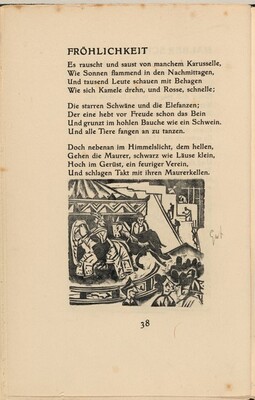
This is a drawing of a scene in a fairground or carousel setting. The image features an abstract, woodcut-style illustration, depicting figures riding on carousel animals. The animals appear to be elaborately designed, possibly elephants or similar creatures, with geometric patterns. The figures atop the animals seem to be engaged in various activities, with some positioned as if they are playing musical instruments. The composition includes dynamic lines that suggest movement and festivity. The text above the image contains a poem in German, titled "Fröhlichkeit," which translates to "Joy." The overall style and content indicate a lively and celebratory atmosphere, typical of a fairground scene.

Fröhlichkeit (Joyfulness) (in-text plate) from mock-up of Georg Heym: Umbra Vitae (Georg Heym: Shadow of Life)

Kirchner, Ernst Ludwig

This painting shows a man in a yellow jacket standing on a small brown rowboat on a wide, pale green river. Behind him is a large mint-green sailboat, its tall mast bare, the sails folded on the deck. Behind that is a coastline covered in tan paths that cut through green grass. Another person stands on the shore, looking towards the boats. A yellow house with a weathered roof and two smaller, red-toned buildings can be seen on the shoreline. Behind them is more blue water, a grassy field, and dark green trees. The sky above is light gray with hints of blue. The brushstrokes of the painting are loose and visible, layering different colors on top of one another. The paint has been applied in thick, short strokes all facing the same direction, giving the impression of motion.

Oyster Sloop, Cos Cob

Hassam, Childe

The image shows a curving, elongated shape forming the outline of a chair. On it sits a figure with exaggerated, distorted features. Several arms and hands rise from small pots on the left of the seated figure, resembling plants growing from soil.

Hällucinationen (Hallucinations)

Hoerle, Heinrich

This is a minimalist drawing of a cloaked figure standing on a rocky cliff. The scene is rendered in soft black and gray tones on paper. The figure, draped in flowing garments, appears to gaze out into a vast landscape dominated by the sky. The drawing uses brushstrokes to convey texture and an atmospheric effect suggesting contemplation or solitude. The surroundings are sketch-like with few details, emphasizing the silhouette and mood. Light and shadow create depth and a sense of vastness beyond the figure's sight.

France Watching

Forain, Jean-Louis

This is a drawing of an abstract landscape and figure with accompanying text. The image features a stylized black and white depiction of a mountainous landscape with a central seated figure set within angular and sharp lines. Above the image is the title "PILATUS" in bold text. Below the drawing, there is German text. The artwork is rendered with a woodcut-like style that emphasizes contrast and texture, characteristic of expressionist prints. At the bottom of the page, the number 57 is printed.

Pilatus (Pilate) (headpiece, page 57) from Georg Heym: Umbra Vitae (Georg Heym: The Shadow of Life)

Kirchner, Ernst Ludwig

The image shows a group of people. Most individuals are in a seated or crouched position, with the focus being on an older man with a cap holding a child in his lap. There is an older woman beside him and a young girl holding a baby on the other side. Another child is crouched in front, holding flowers. They are all dressed in simple clothing, and there are scattered items in the background. The backdrop is minimal, with sketched lines indicating space. There is no visible jewelry, and the image is monochromatic.

Poor People (Les pauvres gens)

Steinlen, Théophile Alexandre

This is a photograph of the surface of the Moon. The image shows a detailed view of the Moon’s surface, capturing craters and variations in terrain. The craters vary in size and depth, some appearing as small indentations while others are large and prominent. The lighting creates shadows across the surface, emphasizing the rugged and uneven texture of the lunar landscape. The photograph is marked with various labels and coordinates, indicating details about the location and orientation of this lunar capture.

Carte photographique de la lune, planche XVIII (Photographic Chart of the Moon, plate XVIII)

Le Morvan, Charles
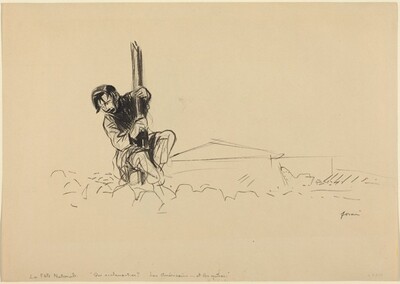
This is a drawing of a person next to a large wooden pole in abstract surroundings. The drawing features minimalistic and expressive linework. The person is crouched next to a tall, jagged structure that appears to be a pole or beam. Abstract lines suggest a rocky terrain or rubble around the figure. The background is mostly empty, highlighting the central interaction between the figure and the structure.

a) La fête nationale (The National Holiday) (recto); b) Woman Holding Child (verso)

Forain, Jean-Louis

This is a drawing of an architectural column capital. The drawing shows the top view of the capital with a round, circular top featuring six radial lines. The capital displays intricate carvings including volutes and vertical grooves suggesting fluting. The shading and line work emphasize the three-dimensional form of the object.

Study for "The Fall of Gog and Magog"

Sargent, John Singer

The image shows a stylized artwork of a profile view of a person, with their head and part of the upper body visible. The person is facing to the left, with their hand touching their head. The facial features are abstract and angular, rendered in bold black lines. The hair is simplified and dark. The person appears to be wearing a garment, with contours extending from the neck downward. The background is textured with dark green and off-white tones, with text at the top reading "Georg Heym" and "UMBRAVITÆ."

Bucheinband (cover) from mock-up of Georg Heym: Umbra Vitae (Georg Heym: Shadow of Life)

Kirchner, Ernst Ludwig

The image features two figures shown from the waist up. The individual on the left is an older, balding man with deep-set eyes, pronounced cheekbones, and a frown line above pursed lips. He is wearing a collared shirt and is holding a small child facing him. The child has curled hair and is shown in profile. The older individual's hands are supporting the child. The background is a plain, light-colored surface.

Der Vater (The Father)

Hoerle, Heinrich

There are four individuals in the image: a woman and three children. The woman is slightly bent over, holding a baby close to her chest. One child is seen with a ball, another has curly hair and a doll-like expression, and the baby is swaddled. The background shows a tree, a wooden fence, and a structure resembling a house.

Springtime

Myers, Jerome

The image is a sketch of a person's bust, focusing on the head and shoulders. The person is facing slightly to the side with their gaze directed upward. Their facial features, including large eyes and a prominent nose, are depicted with strong shadowing and lines. The dark, textured hair appears almost unruly. Light sketching suggests loose clothing draped over the shoulders. In the background, there is a skull rendered in a similar sketch style above and behind the person's head. Heavy shading and cross-hatching blend the background into the person's form, creating depth and intensity in the artwork.

Death and the Old Man (Tod und Greis) from Dance of Death (Totentanz)

Corinth, Lovis

This is a drawing featuring abstract forms that suggest human caricatures with exaggerated features and dynamic poses. On the left is a whimsical face with a mischievous expression, crafted with bold, angular lines. In the center, a figure appears to be in motion, with limbs extended in a dance-like posture. To the right, two more ambiguous figures are depicted. One has a rounder form and robe-like garment, while the other has an oversized head and large eyes, seemingly observing from the background. The drawing style is loose and expressive, with quick, gestural marks giving a sense of lively interaction among the figures.

Das Gastmahl des Trimalchio: pl. XI (The Banquet of Trimalchio: pl. XI)

Corinth, Lovis
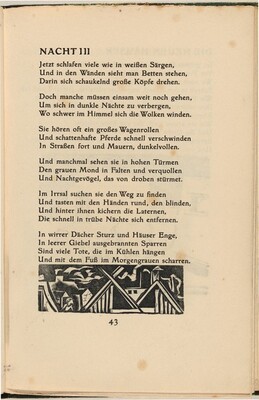
This is a photograph of a page from a book. The page contains a German text titled "NACHT III" with a small illustration of rooftops against a dark sky below. The text is neatly printed with occasional indents for new stanzas. The illustration uses high contrast black and white tones, resembling a woodcut style. The page has sepia tones and spots of discoloration, giving it an aged appearance. The page number "43" is centered at the bottom.

Nacht III (Night III) (in-text plate) from mock-up of Georg Heym: Umbra Vitae (Georg Heym: Shadow of Life)

Kirchner, Ernst Ludwig
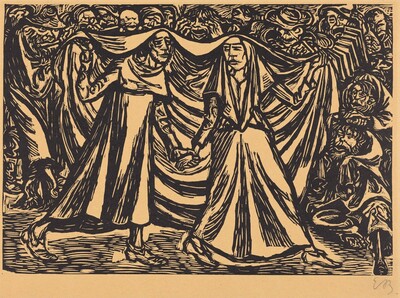
The artwork features figures holding hands. Rendered in a bold, graphic style with stark black lines against a plain background. Two central figures are draped in flowing robes, creating a dramatic effect with dynamic lines. They appear to be moving in synchrony, possibly a dance or ritual. The expressions are solemn and elongated, emphasizing a sense of gravity or mysticism. Surrounding them are abstract forms or faces crowding in from all sides, mainly from above and behind. The area is densely packed with swirling shapes, adding depth and tension. This is in the style of Ernst Barlach.

The Dance of Death II

Barlach, Ernst

The image shows a pastoral scene with a building featuring distinct architecture as the central focus. The style is impressionistic with soft, sketch-like brushstrokes and a color palette of muted earthy tones. A tree with budding greenery leans slightly in the foreground, and other rooftops and shrubbery are visible in the distance.

In a French Village

Griffin, Walter

The image displays jagged, angular lines and shapes forming an abstract composition. Some shapes resemble trees and rugged mountainous landscapes, suggesting a forested scene with light and shadow interplay. Bold black and white contrast enhances the abstract quality, and the dense, overlapping forms evoke a thicket or dense woods, with towering trees and uneven terrain.

In-text plate from Kirchner Zeichnungen (Kirchner Drawings)

Kirchner, Ernst Ludwig

This is a drawing of a prone figure among foliage and a directional marker. The image features a figure lying face down, partially obscured by dense vegetation. Beside the figure is a column-like object with the words "VERDUN 11 K" inscribed on it. The drawing is rendered in black and white, using expressive lines to create texture and movement. The composition contrasts the solid form of the milestone with the softer, flowing lines of the natural elements around it. The title "La Borne" is handwritten at the bottom of the drawing.

a) La Borne, Verdun (recto); b) Wounded Soldier and First-Aid Man (verso)

Forain, Jean-Louis
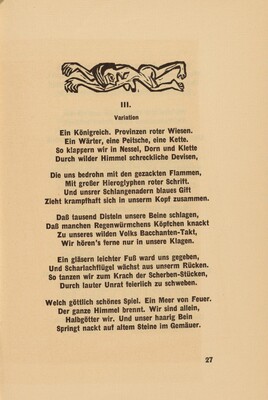
The image features an abstract drawing at the top with fluid, intertwining lines forming shapes. The shapes resemble a pair of symmetrical figures. Below the drawing, centered text in German is presented. The visual layout suggests a page from a book or collection of writings.

Liegende (Die Irren III) (Reclining Figure [The Mad III]) (headpiece, page 27) from Georg Heym: Umbra Vitae (Georg Heym: The Shadow of Life)

Kirchner, Ernst Ludwig

The image displays bold, angular lines and contrasting shapes, forming an abstract depiction of a face. The facial features, such as the eyes and mouth, have been exaggerated with sharp lines, which blend into rectangular forms resembling crosses. The elements combine to create a visually intricate and abstract style.

Judas (headpiece, page 59) from Georg Heym: Umbra Vitae (Georg Heym: The Shadow of Life)

Kirchner, Ernst Ludwig

The image showcases a contents list in German on the top portion, with various titles and page numbers. Below the text is a black and white illustration of a reclining figure surrounded by drapery, with the initials "EK" in the bottom right corner of the image.

Liegender Rückenakt (Reclining Nude) (tailpiece, table of contents) from Georg Heym: Umbra Vitae (Georg Heym: Shadow of Life)

Kirchner, Ernst Ludwig

This vertical portrait painting shows the head and shoulders of a person with pale peach skin and an auburn, cheek-length bob hairstyle. The person has high cheek bones, deep pink lips, and an angular, pointed chin. The head is cocked to our left, and almond-shaped eyes are nearly blacked out. The black jacket has lapels over a white, collared, buttoned-up shirt with a crimson-red necktie. Shown against brick-red and black background, the portrait is painted with areas of relatively flat color but with loose brushstrokes that create a textured, mottled effect. The artist signed the work with black paint in the lower right corner: “modigliani.” 

Madame Kisling

Modigliani, Amedeo

This is a drawing of a group of people in motion. The image shows stylized line drawings of figures in a woodcut style, emphasizing outlines and forms without detailed facial features. Below the drawing, there is German text with the title "Die Blinden Frauen" followed by poetry. The page number 38 is present, suggesting this is a page from a book.

Die Blinden Frauen (The Blind Women) (headpiece, page 38) from Georg Heym: Umbra Vitae (Georg Heym: The Shadow of Life)

Kirchner, Ernst Ludwig

The image shows a kitten inside a circular metal structure. The kitten is positioned near the edge of the opening, looking upwards. Its fur is primarily white with some darker patches, particularly on one ear and part of its face. The metal structure is cylindrical with a smooth finish. The background is blurred, emphasizing the kitten. The photograph is mounted on a decorative backing and labeled "Yung Fong, Shanghai."

Portrait of a Kitten

Fong, Yung

The image shows a drawing of a person standing with their hands on a book on a table. The person seems to be speaking or addressing a group. They have a bald head, a mustache, and a serious expression, wearing a dark-colored garment. On the table in front of them is a helmet with a spike. In the background, there is a crowd of people. The setting appears formal, possibly a public event. The image includes the text "Versailles, 28 Juin."

Versailles, 28 Juin

Forain, Jean-Louis
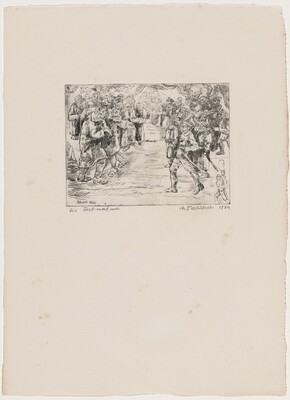
This is a drawing of a group of people gathered in a festive or ceremonial setting. It shows detailed line work of individuals in traditional clothing in an outdoor area. The figures are closely packed, suggesting unity. The scene portrays movement and interaction, with two figures in the foreground. Trees in the background indicate an outdoor setting. Various figures show different expressions and postures, creating a dynamic scene. The drawing captures a group celebration or procession with intricate line work and shading.

Die Festnahme

Palukst, Abraham

This is an image of mountainous landscapes with buildings and pathways. The image contains text printed in German, discussing artistic themes. In the lower right section, there is an illustration in black ink depicting a stylized mountain landscape with a winding path or road leading up the mountain, surrounded by trees. Small, simple figures are shown traversing the path, with simple buildings at the base amongst trees, creating a rustic, outdoor scene typical of mountainous or rural regions. The imagery is minimalist and stylistic, focusing on basic outlines and shapes to convey the scene.

In-text plate from Kirchner Zeichnungen (Kirchner Drawings)

Kirchner, Ernst Ludwig
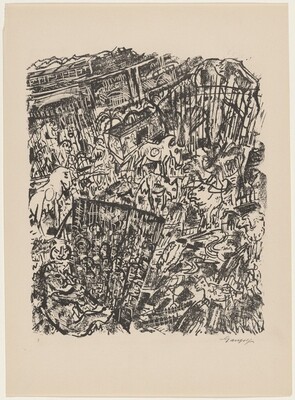
The image contains a variety of jagged and swirling lines, creating an abstract composition. Amongst these lines, there are patterns that resemble shapes such as animals and structures. The overlapping figures and lines create a sense of complexity within the image, challenging viewers to identify recognizable forms.

Zoo

Gangolf, Paul

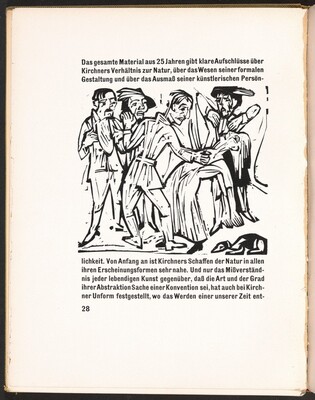
The image is a black and white illustration showing three people in a dynamic pose, with a partial view of their bodies from the waist up. The figures are leaning and reaching towards each other. Their features are stylized, with angular lines defining their faces and hair. They are wearing loose-fitting garments, with one figure in the center wearing a hat. The clothing is simple, focusing on shapes and lines. There is no visible jewelry or objects being held. The background is white. The image is surrounded by a block of text in German above and below and the page number "28" is visible at the bottom.

In-text plate from Kirchner Zeichnungen (Kirchner Drawings)

Kirchner, Ernst Ludwig

A rocky shoreline juts into a vivid, aquamarine-blue body of water in this loosely painted, nearly square landscape. The rocky beach and a few pieces of driftwood stretch in front of us in shades of ivory white, sand brown, gold, and mustard yellow to fill the bottom half of the painting. A few touches of shamrock green suggest plants growing in the near distance. A higher, almost flat-topped promontory reaches into the water beyond, nearly spanning the width of the composition. Areas of pine green suggest more growth in the distance near the left edge. A line of pale brown reaches across much of the horizon, which comes four-fifths of the way up the painting. The sky above is muted turquoise blue. The artist signed and dated the painting in the lower right corner, “Childe Hassam 1901.”

A North East Headland

Hassam, Childe

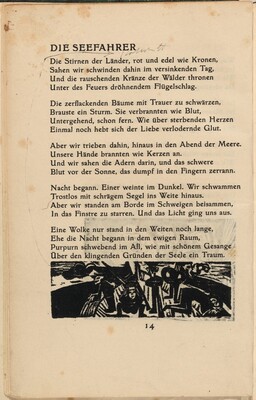
This is a drawing of a page featuring a poem titled "DIE SEEFARHER" in German printed in a serif font. The text occupies most of the upper portion of the page. Below the text is a small black and white abstract drawing of geometric shapes. The drawing contains a complex and slightly chaotic arrangement of figures or forms. The page number "14" is centered below the image.

Die Seefahrer (The Seafarer) (in-text plate) from mock-up of Georg Heym: Umbra Vitae (Georg Heym: Shadow of Life)

Kirchner, Ernst Ludwig
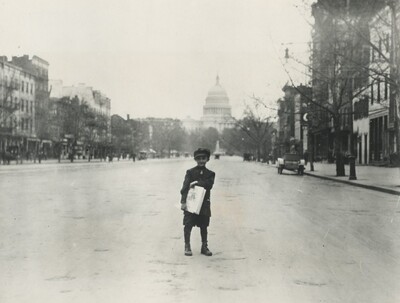
Title from caption on object: "Read All About It!"

Title from caption on object: "Read All About It!"

Hine, Lewis Wickes

The image features an ancient temple captured from a low vantage point, highlighting its towering columns. The temple dominates the composition, obscuring most of the horizon. The artwork utilizes sketch-like brushstrokes with dark shading and lighter textured areas. The color scheme is monochrome, with various shades of black and grey. A path leading to the temple is illuminated, contrasting with the darker surroundings. Subtly shaded foliage in the background adds depth to the scene without excessive detail.

Sunrise Behind Temple of Concord, Girgenti

Pennell, Joseph

This is a drawing of a dark, abstract composition with German text. The image features a woodcut-style illustration at the top with intricate shapes. Below the illustration, there is German text with the title "DIE MESSE" and a subtitle "(ALS MEINE SCHWESTER WEINTE)". The text consists of a poem or prose that evokes a somber and reflective mood. The text describes a scene involving candles, monks, and a sense of peace or tranquility amidst death or mourning.

Die Messe (The Mass) (headpiece, page 61) from Georg Heym: Umbra Vitae (Georg Heym: The Shadow of Life)

Kirchner, Ernst Ludwig

The image displays multiple curving and interwoven lines, depicting an abstract composition reminiscent of human figures in motion. The central figures are elongated and posed dynamically, suggesting movement and fluidity. The lines create a scene that could evoke a group performing a coordinated dance or ritual. The figures emerge from a textured background, adding depth and complexity. Overlapping dark and light areas could be perceived as trees or a forest setting, providing context for the activity depicted.

By the Caliban

Davies, Arthur B.