← All periods

1776 to 1800

72 works

The sculpture is an embossed circular metal medallion featuring the profile of a man in relief, facing left. The man is depicted with distinct facial features, wearing a hat with fringed edges. The medallion is bronze-like in color with the words "NICOLO" and "GANDER" engraved around the perimeter. The sculpture has a slightly weathered look, suggesting age, and exudes a sense of historical craftsmanship.

Nicolò Gander

Italian 19th Century

This image shows fifteen round cameo-style portraits of individuals in profile from the side, focusing on their heads and shoulders. Each person appears to be seated and displaying distinct facial features and hairstyles typical of the late 18th or early 19th century. Most individuals are men wearing formal attire, including high collars, cravats, and in some cases, military uniform elements such as epaulettes. One woman is depicted wearing a headwrap with curly hair. The portraits are monochromatic and presented in a grid over a cardboard backing. The backgrounds in the portraits are plain or softly shaded, emphasizing the individuals depicted. The cardboard backing contains text, presumably identifying some of the individuals by names like "Comeagues" and "Tarleton Bates."

Saint-Mémin Collection of Portraits, Group 53

Saint-Mémin, Charles B. J. Févret de

The image features a sketch of various full-body figures drawn with minimalistic lines. The figures are standing and include both men and women. The facial features are simple and not detailed, with only some outlines hinting at eyes, noses, or mouths. Various hairstyles are shown, with some women having their hair styled in buns or veils, while men are wearing hats. The clothing appears to be historical or formal, with men in coats, breeches, and wide-brimmed hats, and women in long, flowing dresses or cloaks, some with head coverings. One figure is depicted on horseback, showing more dynamic movement. The background is a plain sheet of paper with no additional details or context provided, aside from some lines indicating ground or shadow under the figures.

Historical Costumes

Paret y Alcázar, Luis

The sculpture depicted in the image is a commemorative medal featuring two side portraits etched in relief. The subjects are a male and a female figure. Names and titles are inscribed around the edge. The male figure is dressed in historical attire and positioned slightly in the foreground with his profile facing left. The female figure, also in historical clothing, is positioned behind him. The medal is made of a metallic material, likely bronze or a similar alloy, with an aged patina. The inscription includes the names "FRIEDRICH WILHELM" and "KRONPRINZ VON PREUSSEN" along with other titles.

Marriage Medal of Crown Prince Frederick William of Prussia and Princess Louise Augusta of Mecklenburg-Strelitz [obverse]

Loos, Daniel Friedrich

This is a painting depicting a scene inside a rustic interior. The painting shows a group of individuals interacting in a lively manner within what seems to be a tavern or domestic setting. One figure is being embraced by another in colorful attire at the center, with other figures observing. The room features wooden beams, a large fireplace with pots and vessels, and a door leading to another space. Dynamic postures suggest movement and drama, with a dog sitting in the foreground. The style resembles Jean-Honoré Fragonard, showcasing baroque exuberance and detailed elements.

Histoire de Manon Lescaut (volume I)

Various Artists

A long, rectangular dining table is surrounded by thirteen people in this horizontal painting. The skin of all the people, some of their clothing, and the tabletop are painted golden yellow. Touches of aquamarine blue, salmon pink, and rust red appear in some clothing, and the scene is set against a nearly black background. Across from us at the center of the table, a radiating, gold starburst surrounds the head and shoulders of a man, Jesus, with shoulder-length blond hair and beard. He looks at or toward us with dark eyes as he holds his hands up, palms facing out, at his chest. He wears a champagne-white robe and reclines with his legs extended to our left as he rests his opposite elbow on what could be a cushion or rolled-up blanket. To our right, a second person mirrors Jesus’s reclining position but with wrists crossed over the chest and turning to look toward Jesus. That person wears a long teal-blue garment and has smooth cheeks and long blond hair. Another bearded man to our left, near the back corner of the table, leans away from Jesus with hands held up as if in prayer. Three people lounge or sit on each of the short sides of the table to our left and right, and four recline on the side closest to us. Some have beards and others are cleanshaven, and some have short hair while others have long locks. Most of them look toward Jesus while two bend low to the table in prayer. One man, in the lower right, wears brick red and turns his back on the table as he counts or touches coins in a sack. The long table is set with goblets and plates of food. The artist signed the work with his initials in the lower left corner: “WB inv.”

The Last Supper

Blake, William

This is a photograph of a copper printing plate. The plate displays reverse-engraved text with letters indented into the metal surface. The writing is in an elegant font and is surrounded by ornamental designs. A small illustration of a bird in flight is at the top left corner. The copper's patina gives the plate a brownish tone, contrasting with the polished surface and engraved lines.

Fragment of cancelled plate for "A Prophecy" [recto]

Blake, William

The image shows a profile view of a person facing left, from the shoulders up. Their facial features include a prominent nose with detailed shading. The person has short, combed-back hair and is wearing a high-collared garment with a jacket. The collar appears stiff and there is a dark circular background framing the head and shoulders. No jewelry or objects are visible in the image.

Morris

Saint-Mémin, Charles B. J. Févret de

The sculpture includes two women standing on rectangular bases, both dressed in classical attire. They have one arm extended toward the center, interacting with decorative elements. These elements consist of two griffins facing each other on each side of an ornamental swirl at the top of the piece. The relief is displayed on a lintel or mantlepiece. The color scheme is monochromatic in shades of gray, resembling stone such as marble. The composition is symmetrical and balanced, with the figures mirroring each other for a sense of harmony and order.

A New Collection of Chimney Pieces, Ornamented to the Style of the Etruscan, Greek and Roman Architecture; Containing Thirty Six Designs suitable to the most Elegant Range of Apartments

Richardson, George

The image displays eight individual engravings arranged symmetrically on a single page. The top left engraving shows a City Tavern, a large two-story building with classical architectural features. To the right is a central vignette of a landscape with intricate foliage framing an empty center and a small stone bridge below. The top right engraving depicts a market scene with several buildings and a prominent arched structure in the center. In the middle left is an engraving labeled "Court-house" featuring a grand building with a detailed cupola set in a pastoral scene. The central engraving is a circular portrait of a woman and child. The middle right displays an architectural image labeled "Church" with a neoclassical building, columns, and surrounding structures under a cloudy sky. The bottom left engraving shows a smaller building with high boundary walls. Below, a colored landscape, labeled "Vue de Ticonderoga sur le Lac Champlain," illustrates a serene scene of a lake and hills with vibrant foliage. At the bottom right is a landscape with trees on the horizon and gently sloping hills in black and white with fine linework. The engravings are primarily monochromatic, except for the colored landscape which features greens, blues, and earth tones.

Saint-Mémin Collection, Group 57

Saint-Mémin, Charles B. J. Févret de

The image depicts a valley surrounded by cliffs and waterfalls, viewed from an elevated perspective. The cliffs, waterfalls, greenery, trees, river, and sky are detailed with fine brushstrokes using earthy tones. Figures and wooden structures are visible in the foreground.

Chute de Staubbach, dans la Vallée de Lauterbrunnen (Falls at Staubbach in the Lauterbrunnen Valley)

Janinet, Jean-François
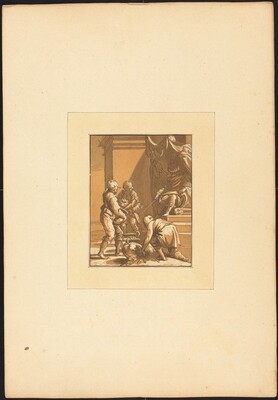
This is a drawing of a group of figures engaged in an activity in a classical setting. The scene is set within a formal interior space defined by architectural elements such as a column and a draped curtain. The composition features figures dressed in historical attire, with one seated figure elevated. The gathered figures are depicted in dynamic poses, and one seems to be attending to an overturned pot or urn on the ground. The gestures and diagonals formed by the figures and their garments lead the viewer's eye around the scene. The use of line and shading in the drawing adds depth and drama to the scene, creating a contrast between the figures and their environment.

Roman Sacrifice

Prestel, Maria Catharina

This is a drawing of a hunting scene with a dog and two figures. The drawing depicts two individuals engaged in a conversation or instruction session in a natural setting. One figure is holding a large stick or pole, while the other is bending down by a small dog. The background features rolling clouds in the sky and distant trees, adding depth to the landscape. The ground is detailed with foliage and grass, indicative of a rural or wild environment with various plants depicted in the foreground. The artwork includes a caption in French.

Un violent exercice étouffe les sentimens tendres

Le Mire, Noël

A sliver of land across the bottom of this composition gives way to a procession of puffy gray and white clouds sweeping up across a vivid blue, panoramic sky in this horizontal landscape painting. An area of darker gray beyond the brown land could be a valley, mountain, or shadows from the billowing clouds. About one-fifth of the way up the composition, the horizon glows the faintest peach. The clouds trundle from our left up and to our right. The view is loosely painted, especially in the land.

Study of Clouds over the Roman Campagna

Valenciennes, Pierre-Henri de

The image shows a portrait of a person from the upper half of their body. They are facing forward but their head is turned slightly to the side, suggesting a profile view. The person has sharp facial features, light-colored hair styled in a classic manner, and is wearing a black coat with a high collar and a white cravat. The background consists of a red drapery.

William Vans Murray

Brown, Mather

This is a bowl with a rustic orange finish and a crackled glaze that gives it a textured pattern. The bowl is decorated with painted white designs, including a large floral motif in the center surrounded by curving lines and the outlines of birds. The rim of the bowl is undulating rather than flat, and it has some areas of black pigment. The wide bowl has a narrow, round base at the bottom.

Raku Tea Bowl

Japanese Edo Period

This is a drawing of two separate scenes on a single sheet. On the left side, there is an abstract scene with swirling clouds or waves and indistinct figures. On the right side, there is a more structured scene with figures gathered in an architectural space, possibly a ballroom or hall. Figures are shown in a way that suggests a social or ceremonial occasion. Both sketches are outlined delicately with pencil.

Study of Moses Striking the Rock and a Procession [verso]

West, Benjamin

The image depicts a large, bulbous vase with a narrow neck and flared rim. It is turquoise blue with a crackled pattern. The vase is centered on a neutral background.

Bottle Vase

Chinese Qing Dynasty

The image depicts sixteen circular portraits of historical figures arranged in rows and columns. Each portrait shows a head-and-shoulders view of the subjects in profile, facing left or right. The subjects are depicted with detailed facial features, expressions, and hairstyles indicative of different historical periods. The men typically have styled, powdered wigs or tied back hair, while the women have coiffed hairstyles, some adorned with hats or ribbons. They are dressed in period-appropriate clothing like high-collared jackets and elaborate dresses. The portraits have plain backgrounds, and names are written underneath each image for identification. The overall presentation is organized and harmonious.

Saint-Mémin Collection of Portraits, Group 1

Saint-Mémin, Charles B. J. Févret de

This is a painting of a medieval illuminated manuscript page. The artwork depicts a central figure seated on a throne under a grand arch, holding a book and gesturing towards a group of standing figures. The background is decorated with floral patterns and roundels, showcasing colors including blue, red, yellow, and green. Surrounding the scene are architectural elements, such as arches and columns. The attire of the figures and decoration reflect the artistic style associated with illuminated manuscripts. This is in the style of an anonymous medieval illuminator.

Saint Augustine

British 19th Century

This is a drawing of a bird called Larvivora ruficeps. The illustration shows a bird with a red-brown head, a black mask around its eyes, and a white throat. It has a dark upper body blending into grayish tones on the underparts. The bird is standing on the ground among grasses and fallen leaves in a naturalistic habitat.

Bird (Larvivora Ruficeps)

British 19th Century

The image shows several figures in a group. One central male figure is standing with his arms outstretched. A female figure is near him, slightly behind and to his left. On the far right, there is a smaller figure, likely a child. The central figure has distinctive facial features, is wearing a hat, loose-fitting clothes, and boots. Other figures around him also have visible facial lines, hats, and casual or rustic attire. The figures are on a simple background, enclosed within a border, against a beige matting background.

Old Man Pointing to the Left

Prestel, Maria Catharina

In the image, there are two central figures. One is an older man seated, shown from the chest up with one hand resting on a rolled scroll. He has a beard and disheveled hair, and his expression is focused as he gazes upward. The man's body is muscular and mostly uncovered, with a cloth draped over his lap. An elegant woman stands beside him, gesturing towards him, with styled hair and flowing garments. The background features architectural elements like columns and arches.

Homer and Calliope

Conca, Tommaso

The image is an architectural drawing of a grand temple-like structure viewed from the front at a slightly elevated angle. The temple has a prominent central entrance with steps and tall columns on each side. Statues decorate the top of the structure, including a figure at the peak. The horizon is low, emphasizing the building's height. Trees can be seen in the background, adding depth to the scene. The drawing is detailed with cross-hatching for shadows and textures, typical of engravings. The color scheme is mainly brown and sepia tones. Closest to the temple, figures are engaged in various activities, adding scale and human presence to the scene.

The Prima Macchina for the Chinea of 1782: The Temple of Janus Built by Numa Pompilius

Barbazza, Francesco

The image features a landscape viewed from a slightly elevated perspective. The horizon is subtly suggested by pencil outlines, with elements such as tree outlines and a distant structure visible. Loose and fluid brushwork in sepia tones creates a soft and ethereal quality. Darker strokes at the forefront indicate trees and shrubs, with a predominantly earthy brown color palette.

Hillside and Trees

Cox, David

This is a richly textured reddish-brown book cover with gold embossed text. The title "DANTE" is displayed prominently in the center, with "FLAXMAN" below it. The border of the cover includes a simple gold outline. The spine of the book, visible on the left edge, has ornate ridges and shows signs of wear. The other edges appear similarly worn.

Album of Drawings for Dante's "Divine Comedy"

Flaxman, John

The image depicts a landscape seen from above. The horizon is positioned above the center, where the land meets a cloudy sky. Buildings are visible in the distance. The brushwork is detailed, defining trees, landforms, and water in monochrome. A river flows through the scene with figures and rocky terrain in the foreground, flanked by tall trees. The composition balances nature and human presence.

Landscape with River and Town

Prestel, Maria Catharina

The image depicts a landscape viewed from a slightly elevated position. The horizon is above the center, showing an expansive scene dominated by rolling hills in the distance. Trees are scattered across the terrain. In the foreground, small figures are seen by boats along a curving path beside a rocky outcrop. The brushstrokes are subtle and controlled, emphasizing details without overwhelming the serene ambiance. The scene is depicted in a monochromatic palette of warm sepia tones, creating a timeless and historic atmosphere. Lighter tones are used for the sky and distant hills to suggest depth and vastness.

Landscape with Fishing Boats

Prestel, Maria Catharina
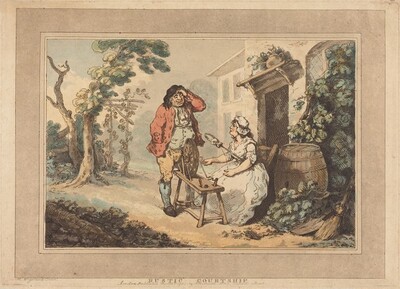
The image shows two people in a rustic outdoor setting. The man is standing with one hand on his head, facing the woman. He has a broad smile, shoulder-length dark hair, and is dressed in an earthy red coat, light blue waistcoat, yellow breeches, blue stockings, and black shoes. The woman is seated on a chair, spinning using a wheel in front of her. She has dark hair, wears a white bonnet, and a white dress with long sleeves. Surrounding them are a barrel, a broom against the wall, a tree with green foliage, a simple wooden house with a thatched roof, and an earthy ground with grassy patches.

Rustic Courtship

Rowlandson, Thomas

This is a drawing of a book cover for "La Derniere Héloïse." The cover features decorative typography and an illustrated oval scene framed with ornate detailing. The scene shows two figures in an interior space with tall columns and arched architecture. One figure is seated and the other standing, engaged in an interaction. The seated figure appears relaxed, leaning against the back of a chair or couch. The illustration reflects 18th-century style with detailed and elegant features, including clothing and architecture. Text on the cover includes the title, author, and publication details, showing it was published in Paris in 1784. The color scheme consists of sepia tones.

La Dernière Héloïse: ou, Lettres de Junie (Part I and Part II)

Dauphin, de Verdun

The image depicts a page with an illustration of an ancient-style profile portrait medallion, featuring the bust and head of a person with defined facial features facing left. The person has a nose, cheekbones, and chin, with hair styled in a classical Greek fashion, tied with a band. Above the portrait, the text "Le Avventure di SAFFO" is inscribed in a decorative font. Below the medallion, there are lines of smaller text in Italian. The background has an aged paper texture with scattered spots. The location is listed as "ROMA," and the date is in Roman numerals "MDCCLXXVIII," which translates to 1784.

Le Avventure di Saffo (The Adventures of Sappho)

Tresham, Henry

The image consists of monochromatic portrait engravings showing the head and shoulders of various individuals. The individuals are in profile, facing either left or right. Their faces have prominent noses, chins, and facial hair typical of the 18th or early 19th century. The portraits display distinct hairstyles or wigs common for the period, often powdered or tied into queues. The subjects wear formal attire with high-collared coats and cravats or neckties. No additional jewelry or objects are present. The portraits have a dark circle background against a plain archival paper backdrop. Some portraits have handwritten names like "Elias Boudinot" and "Aaron Burr" below them.

Saint-Mémin Collection of Portraits, Group 54

Saint-Mémin, Charles B. J. Févret de

This is a drawing of a group of armored figures. The individuals are depicted wearing classical and elaborate armor. They appear to be focusing on something central. The scene is detailed, with intricate designs on their helms and clothes. The setting suggests a natural environment, possibly under a tree or tent. The color palette consists mainly of shades of brown.

Dying Epaminondas

Prestel, Johann Gottlieb

A young girl with dark hair and pale skin, wearing a long white dress, kneels on the ground in a hilly, tree-lined landscape in this vertical portrait painting. The girl sits close to us, her body slightly angled to our left as she looks toward and reaches for a rose bush potted in a tall, brown urn along the left edge of the painting. She has pale gray eyes under faint brows and a delicate, pointed nose. Her round cheeks are flushed, and her pink bow lips are closed. Her chestnut-brown hair curls at the neck of her clothing, and bangs cover her forehead under a lacy white bonnet. Light glistens off her lace-edged black cape, which is tied at her throat. The full skirt of her white dress pillows like a cloud on the ground around her legs, and she has a wide, teal-blue sash around her waist. With her right arm, farther from us, she reaches out to touch a pink blossom with a gloved hand. The fingers of the butter-yellow gloves have been folded back. Her other hand rests with exposed fingers in a loose fist in near her knee. Behind her, gently rolling hills are dotted with leafy green trees silhouetted against a stretch of white sky just above the low horizon. Painted in smoky gray, ivory white, and pale, blush pink, the thin clouds against the topaz-blue sky fills the upper two-thirds of the picture. The painting is inscribed with gold paint in the lower right corner: “Lady Caroline Howard” and “Lady Cawdor.”

Lady Caroline Howard

Reynolds, Joshua, Sir

The remains of a rectangular porch-like portico are photographed in tones of ash-brown and black in this horizontal albumen print. The roof of the portico is held up by six marble columns carved into the shape of women wearing robes that fall in long, vertical folds. The women all face forward, and some of their features are weathered. All are missing their arms. The portico and structure behind it are constructed with massive, squared blocks. A man wearing a suit and a bowler hat sits drawing in the corner where the portico meets the bulk of the building, near the lower right corner of the photograph. Fragments of reliefs and other architectural ornaments are lined up behind and next to him. A few scrubby plants grow on the dirt ground, and the sky above is a washed out white. White text angled up across the lower right corner reads, “D. CONSTANTIN.”

The Caryatides

Constantine, Dimetrius

The image shows a decorative ceramic bowl with a vibrant yellow glaze as its primary color. The bowl has intricate green patterns of stylized clouds interspersed with motifs in red and blue. The design forms a continuous band around the external surface of the bowl, and the rim is adorned with a green band featuring a repeating circular pattern. The bowl has a gently flared form and fine detailing, indicating artisanal quality.

Bowl

Chinese Qing Dynasty

The image shows a woman in profile, standing with her left arm on a railing. She has delicate facial features, soft lines, and curly hair under a wide-brimmed hat with ribbons or feathers. She wears a long gown with puffy sleeves and a fitted waist, along with a necklace featuring a circular pendant. The background displays faint, unfinished sketches and intricate line work around the woman, possibly hinting at a setting or other figures. The artwork conveys grace and poise in pencil and watercolor.

Maria Cosway with Her Daughter Louisa

Cosway, Richard
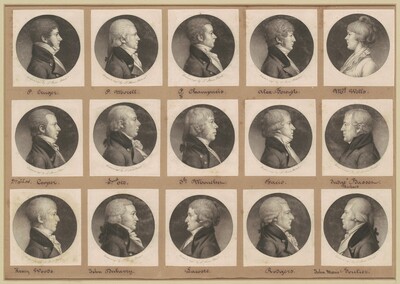
Fifteen portrait drawings are arranged in a grid, each showing the upper body of an individual in profile. The people are positioned facing either left or right within circular frames. Each portrait captures the side view of the person's face, highlighting their distinct facial features and hairstyles. The men have various hairstyles typical of an earlier era, some with short hair, some with curls, and others with powdered wigs. There is one woman portrayed in the top right with her hair styled in an updo. They all wear formal clothing; the men in high-collared coats and cravats, and the woman in a high-necked garment with a shawl. The background of each portrait is plain. The images are bordered by a brown matte, and each portrait has the individual's name handwritten beneath it.

Saint-Mémin Collection of Portraits, Group 21

Saint-Mémin, Charles B. J. Févret de

The image shows three outlined figures in varying levels of completion. The first figure on the left has its torso sketched with an outline of a cap. The middle figure appears more detailed, in a profile view with head down, gesturing hands, possibly leaning. This figure wears a coat and a hat. The smaller figure at the bottom left is sketched in a few simple lines, suggesting an abstract form or posture. The figures are drawn in pencil strokes on a blank background, with no additional details or scenery.

Figure Studies

Linnell, John

The image shows three figures standing together. They wear elaborate headdresses with feathers or decorations and voluminous clothing. The figures appear to be in a loosely gathered group, with two closer together on the right side and one standing slightly apart on the left. The figures have indistinct facial features and the background is plain and neutral.

Two Elegant Couples [verso]

Guardi, Francesco

This painting is a portrait of a man. He is seated on a red cushioned chair, turned slightly to the left, facing us. He has a pale complexion and a neutral expression, with dark eyebrows, rosy cheeks, and thin lips. His hair is gray, with curls falling to the sides around his ears. He is dressed in formal attire, wearing a dark red, double-breasted coat with large golden button and a white cravat around his neck. The man holds a pair of tan gloves in his left hand, and in front of him is a piece of red furniture covered with a red cloth. The background is a muted brown gradient.

Stephen Van Rensselaer III

Stuart, Gilbert

The sculpture is a shallow bowl with a wide, gently flaring rim, made from ceramic material with a brown glaze transitioning from dark to light. The surface is smooth with dark speckles, and the base has an unglazed textured ring.

Bowl

Japanese 19th Century

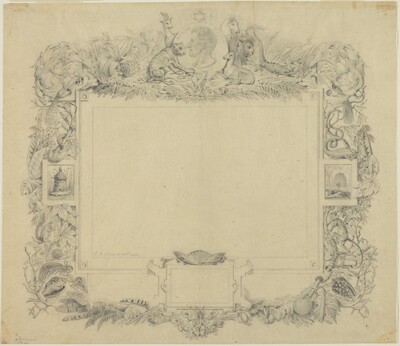
This is a drawing of an ornate decorative border featuring a variety of natural elements. The rectangular blank space is framed with intricate pencil drawings depicting flora and fauna. The border includes tropical plants, a leopard, a fox, a snake, various birds, a person, an animal, plants, flowers, animals such as frogs, fish, and reptiles, insects like butterflies and dragonflies, fruits, foliage, and additional natural elements. Two small drawings are included within the vertical borders, and the bottom center features a prominent butterfly image.

Design for a Border with a Portrait of Baron Cuvier

Arnout, Jean-Baptiste

The image portrays an engraved portrait of a man with distinct facial features. He is posed in a slightly turned angle to the right, with curly hair flowing down to his shoulders. He wears a richly detailed garment with a large ruffled collar. The portrait's ornate frame features classical motifs and French text.

Charles I

Unknown 19th Century

This is a drawing of a small dog resting on a cushioned surface. The image captures a small dog lying down with its head resting on its paws. The texture of the dog's fur is illustrated with detail, emphasizing the curls and volume. The surrounding environment appears simple, with hints of texture above the dog's back and behind it. The drawing uses a monochromatic palette and shading to create depth and define the form of the dog.

Lying Dog

Ploos van Amstel, Cornelis

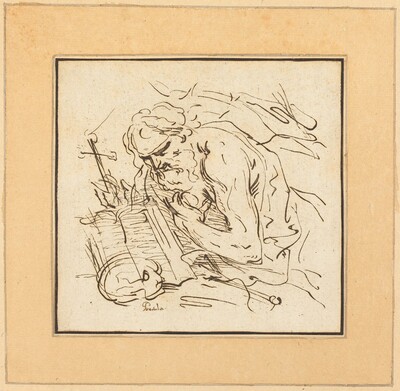
The image shows a sketch of a seated person reading a book. The person is depicted from head to waist, with detailed facial features and a beard. He has curly hair and is wearing simple drapery. There is a large open book with visible text and a wooden object nearby. A cross is shown on the side of the book. The background consists of simple sketched lines framing the figure.

Saint Jerome

Prestel, Johann Gottlieb

The image shows sepia-toned portrait profiles encased in circular frames. The portraits depict individuals at various angles, focusing on their faces and upper shoulders without showing their full bodies. The subjects include men and women with different hairstyles and clothing styles typical of a historical period. Men have short, wavy, or curled hair, and some wear neckties or cravats. Women have voluminous hairstyles with ribbons or hats, and wear elaborate lace and ruffle collars or shawls. The facial features are detailed in a classical nineteenth-century style. Each portrait has a plain dark circle background and handwritten text below indicating the person's name. The image appears to document and commemorate the individuals in a formal and traditional portrait style.

Saint-Mémin Collection of Portraits, Group 2

Saint-Mémin, Charles B. J. Févret de

The image features fifteen oval framed bust portraits arranged in a grid of three rows and five columns. Each person is depicted in profile, showing the upper part of their bodies including their heads, shoulders, and upper chest. The individuals are primarily positioned facing either left or right, seated in an upright posture. 

The portraits mainly depict individuals with European facial features, short hairstyles consistent with the late 18th century, and some with powdered wigs or tied-back hair in short ponytails. One woman in the portraits has curly hair adorned with ribbons and flowers, wearing a high-collared dress with lace embellishments. 

The individuals are dressed in formal attire typical of the period, including high-collared coats with tall collars and cravats or neck scarves. There is no visible jewelry or objects being held by any of the figures. 

The background for each portrait is plain with a simple oval shape outlining each individual, contrasting with the textured clothing and hair details. The portraits are labeled with names written beneath each person. The entire collection is set on a light brown background serving as the mount for the grid of portraits.

Saint-Mémin Collection of Portraits, Group 6

Saint-Mémin, Charles B. J. Févret de

The image shows three figures seated. In the center, a woman sits with a baby in her arms. To the left, a child is seated on an elevated surface, holding a hat. In the background, there is a decorative pulpit or architectural structure.

Figures at a Church Service

Bellangé, Hippolyte

The image shows a cottage on fire, with a group of figures trying to fetch water nearby. The brushstrokes are dynamic, emphasizing the fire's movement. The color palette contrasts dark blues and blacks with vibrant oranges and reds. Other structures in the distance hint at a perilous situation.

A Cottage on Fire

Turner, Charles

The image displays two people from the waist up. The person on the left is seated in a green chair, facing slightly towards the viewer. They have short, light brown hair neatly combed to the side, a stern expression, noticeable cheeks, and a defined nose. They wear a tan coat with gold buttons over a black waistcoat and a white cravat. The person next to them, potentially a child, is slightly in front, facing the viewer, with hands clasped together or touching the object held by the other person. The child has very short light hair, a similar facial structure with bright eyes, and wears a dark garment with a white ruffled collar. The background features rich red drapery and a hint of a scenic landscape.

Father and Son

Budington, Jonathan

The image depicts a man and a woman indoors. The man is seated on a red-covered piece of furniture and holding a letter. He has curly blonde hair and is dressed in a yellow vest, white shirt, cravat, and gray breeches. The woman is kneeling beside him, holding a piece of paper. The scene also includes a stool with letters, a musical instrument, a chair with a cloak, a sword, a hat with plumes, and a decorated cabinet with a globe and vase on paneled walls.

I Reread Them with Pleasure

Gérard, Marguerite

Martha Tennent Rogers (Mrs. David Rogers) and Her Son, probably Samuel Henry Rogers

Martha Tennent Rogers (Mrs. David Rogers) and Her Son, probably Samuel Henry Rogers

Earl, Ralph

General Washington at Princeton

General Washington at Princeton

Polk, Charles Peale
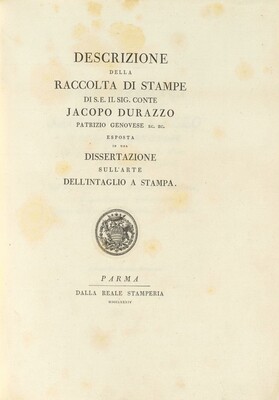
This is a photograph of a historical document's cover page. The document describes a collection of prints belonging to Jacopo Durazzo, a Genoese patrician, with a dissertation on the art of engraving. The cover is text-focused with Italian typography. It includes an engraved emblem or crest below the main text, and the bottom of the page indicates it was published in Parma by the Royal Printing House in 1784. The paper shows signs of aging with spots and discoloration.

Descrizione della raccolta di stampe di S.E. il sig. conte Jacopo Durazzo, patrizio genovese, ec. ec., esposta in una dissertazione sull'arte dell'intagio a stampa

Benincasa, Bartolommeo

The sculpture depicts a bottle or vase with a rounded, bulbous body that tapers into a narrow neck and small opening at the top. It has a predominantly white surface with deep red patches blending into the white. The material seems to be ceramic or porcelain with a crackle texture on the surface. The sculpture is displayed on a neutral gray background.

Vase, Meiping Shape

Chinese Qing Dynasty

The image shows a landscape with a dirt path curving in the foreground. A wooden cart is being pulled by a horse on the left, and a person walks near a small bridge on the right. Large trees with dense foliage line the background, framing the scene. The horizon is in the middle distance, with a vague hint of a castle or large structure. Clouds and light mist soften the distant view. The painting is done in watercolor with smooth brushstrokes capturing a tranquil countryside. Earthy tones dominate the color palette, with soft greens for trees and muted blues for the sky.

Landscape

De Wint, Peter

There is a drawing of an interior scene. The scene features a group of chairs and a framed image. The room is dimly lit, with tall-backed chairs on a tiled floor and framed pictures on the walls. There is a rectangular table or pedestal in the center. Light from an unseen source illuminates part of the room, possibly from a window. Fine lines and crosshatching are used for shading and texture, creating depth and perspective in the drawing.

The Voyage to Paris

Chodowiecki, Daniel Nikolaus
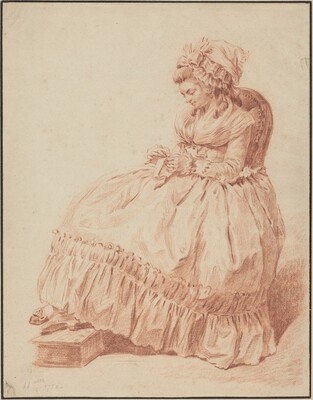
The image shows a woman sitting in a chair, holding a small piece of fabric or paper. She has a serene expression and curly hair. She wears an elegant dress and a decorative headpiece. In the background are a book and a piece of cloth.

Seated Woman Sewing

Trinquesse, Louis Rolland

Shown from the lap up and shaded entirely in tones of golden yellow, laurel green, and black, a pale-skinned woman cradles a small, furry dog in her arms in this vertical portrait. The woman’s body is squared toward us, and she looks directly out with slate-blue eyes. She has an oval face with a delicate nose, long chin, and her pale pink lips are closed in a slight smile. Her brown hair is pulled back under a tan-colored hat lined on the underside with translucent cloth and on the top with sage-green ribbons or ruffles. A choker of thumbnail-sized pearls encircles her neck. Her dress has a deep V in the front and the elbow-length sleeves end with layers of lacy ruffles. Curving black lines suggest a pattern on sheer black fabric that covers pale yellow and frosty green stripes of the bodice. The dog has long, light-colored fur and a dark, bead-like nose and eyes. Vines grow up and from the top of a stone column in the background to the right, and the rest of the shallow space is filled with shrubs and plants. A bright yellow spot near the top left corner suggests a strong light source coming from that area, which casts her face in a diffuse shadow under the hat’s brim.

Miss Nelly O'Brien

Anonymous Artist

The image consists of fifteen individual portraits arranged in a grid of five rows and three columns. Each portrait shows a side profile of a man's head and shoulders within circular frames. The men vary in facial features, hairstyles, and clothing. Names are inscribed below each portrait, and the arrangement is on a flat, subtly varied background.

Saint-Mémin Collection of Portraits, Group 18

Saint-Mémin, Charles B. J. Févret de

Multiple sketches of human figures are depicted in the artwork. On the left, a full-body sketch shows a figure in loose-fitting clothing with a hood, detailed facial features, and short hair. Below, another sketch shows a figure from the thighs up, with minimal facial features and hair pulled back. To the right, more lightly sketched figures are shown, with one reclining figure and another standing figure in the background. The background is plain with aging marks, emphasizing the human form and posture through a mix of complete and partial contour lines.

Studies for Christopher Columbus

Delacroix, Eugène

The spout of this silver teapot faces our left and the black handle our right in this photograph. The body of the teapot would be oval shaped if viewed from above. The sides of the teapot are straight and fluted to create vertical columns that curve inward. The shallowly domed lid has a flat, black, disk-like knob. The long, straight, narrow spout tapers from the base of the teapot to the opening, which is level with the top of the teapot. The handle to the right curves like the right half of a heart and flares upward where the thumb would rest at the top of the curve. The handle is affixed to the body of the teapot with short silver sleeves. The body is engraved along the top and bottom with decorative bands of garlands and vegetal scrolls. A rose-like flower and leaves are incised near the base on the side facing us.

Teapot

Revere, Paul

The image shows an upper body portrait of a woman positioned in profile, facing to the left. She has delicate facial features with a soft complexion and slightly pink cheeks. Her hair is light-colored, curly, voluminous, and styled elegantly. The woman is dressed in a white garment with ruffled detailing and a light pink sash around her waist. The background is a muted dark color.

Mary Wood

Russell, John

Oval dish with Allegory of Autumn

Oval dish with Allegory of Autumn

Palissy, Bernard

The image shows a sketch of a serene landscape. The horizon is depicted higher in the sketch with outlines of structures, potentially a bridge and buildings. The sketch is done in pencil with soft strokes, creating an impressionistic sense. Different shades of grey define the objects, while the paper is left bare for the sky and lighter areas. Close to us, there are indistinct shapes, potentially rocks or foliage. In the distance, there is a suggestion of trees or dense vegetation, framing the buildings in the sketch.

Landscape Sketch with Bridge and Castle

Cotman, John Sell

Shown from about the knees up, a young girl with pale skin and flushed cheeks stands in front of a landscape, looking at us in this vertical portrait painting. She stands with her body angled to our left, and she turns her face to us. Her chestnut-brown hair curls down the nape of her neck, and her bangs sweep across her forehead over slate-blue eyes. Her turned-up nose and pink bow mouth are set within in her round face. The girl’s smooth skin, her white dress, and her ivory-colored, wide-brimmed straw hat are brightly and evenly lit. Her flushed cheeks are echoed by the broad, petal-pink sash tied around her waist into a bow at her back and the matching ribbon of her hat, tied in a bow under her chin. A few streaks of pink also appear in the aquamarine-blue sky behind her. A hillside painted with tones of harvest gold and tawny brown slopes up from the lower left corner to the right edge of the canvas. The landscape is more loosely painted with lively brushstrokes.

Miss Juliana Willoughby

Romney, George

This is a book cover for "Narrative of a Five Years Expedition." The cover features the title and details of the book written in a decorative serif typeface. Below the main title, captioned "By CAPT. J. G. STEDMAN," there is an oval frame illustration depicting several ships at sea, surrounded by a bald eagle. The text provides context about the book's contents, promising descriptions of natural features and inhabitants of the depicted regions, including the Indians of Guiana and Negroes of Guinea. The book, published in London in 1796, claims to be illustrated with engravings made by the author. The text is accompanied by a Latin quote attributed to Valerius Flaccus.

Narrative, of a Five Years' Expedition, against the Revolted Negroes of Surinam, in Guiana, on the Wild Coast of South America (volume I)

Stedman, John Gabriel

The Triumph of Truth Over Envy

The Triumph of Truth Over Envy

Prestel, Maria Catharina

This is a drawing of seated figures in an abstract scene. The central figure is seated, surrounded by other figures. The drawing uses pencil and light washes of red and brown. The main figure in the center is detailed, with a muscular torso and wearing a draped garment. There are at least four other figures with varying degrees of detail around the central figure. The drawing is enclosed in a roughly sketched oval boundary and contains swirling lines and shading.

Study of Jove and Three Goddesses

Bartolini, Lorenzo

The sculpture is a ceramic dish featuring raised figures from the animal kingdom. At the center is a brown crocodile. Other figures include a coiled snake on the left and a moth on the right. Smaller figures like snails, shells, and leaves are scattered around the dish. The dish is predominantly blue with various colored figures that contrast against the blue background. The piece appears three-dimensional with vividly carved and colored creatures.

Rustic Plate with Crocodile, Snake, and Lizard

Palissy, Bernard

This is a painting of a decorative ceramic plate. The plate features intricate designs with a central scene depicting three figures in traditional attire surrounded by floral and cloud motifs. The figures are colors such as blue, red, and green, set against a background of pine trees and swirling cloud patterns. The rim of the plate has a pattern of floral and scroll designs in red, green, and blue. The artwork blends traditional elements and decorative motifs.

Dish

Japanese 19th Century