← All periods

1701 to 1725

23 works
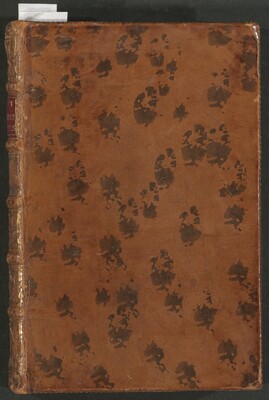
This is a photograph of a weathered leather book cover with a mottled pattern. The surface is rich, brown leather with dark, irregular spots scattered across it, giving it a worn, antique appearance. The spine of the book is visible on the left, showing faint vertical creases and a smaller section at the top with an embossed or pressed design. The book cover appears to have been well-used or designed to look aged, with distinctive leather grain and signs of wear. There is a small, white paper sticking out slightly from the top.

Les Cent Nouvelles Nouvelles

Hooghe, Romeyn de

This is a photograph of a decorative ceramic bowl made of porcelain. The bowl features intricate painting on its exterior, with a design of blue vines with green leaves winding around the bowl. Red, oval-shaped fruits decorated with small dots are interspersed among the foliage. The overall design is delicate and elegant, showcasing traditional ceramic art craftsmanship. The bowl is placed against a neutral background.

Cup

Chinese Qing Dynasty

This is a photograph of a decorative porcelain plate. The plate features a detailed and colorful design depicting a domestic scene with several figures engaged in leisurely activities. The central image is encompassed by a richly decorated border with floral patterns and ornamental motifs in colors such as greens, pinks, blues, and golds. The craftsmanship highlights traditional artistry found in fine porcelain, with an emphasis on harmony and elegance.

"Ruby-Back" Dish

Chinese Qing Dynasty

The sculpture is a decorative vase with a wide flared top. The subject on the vase includes a black and yellow rooster, standing in a picturesque setting with delicate flowers and light greenery surrounding it, painted in vibrant colors such as red, blue, and green. The vase is made of a ceramic material with a glossy finish. The primary color of the vase is deep red, with an intricate design featuring alternating panels of white, where the painted images of the rooster, birds, landscape, and floral motifs are placed. The vase presents an elegant composition with traditional imagery that appears to be carefully arranged to achieve a harmonious and balanced visual effect.

Beaker Vase

Chinese Qing Dynasty

The image shows a landscape with rocky terrain leading to a body of water in the distance. The horizon line is visible midway, with sailboats on the water and hills or mountains beyond. Tree branches arch overhead and to the right, framing the scene. The rocks close to the viewer exhibit varying textures, with caves and boulders in brownish sepia tones. The color palette is earthy, emphasizing details and depth in the scene.

Veue de quelques Grottes solitaires de la Thebaide

Chedel, Quentin-Pierre

This is a ceramic vase. The vase is colored magenta red with white sections showing designs of a rooster, flowers, and abstract floral patterns. The designs use colors like gold, green, and blue. The vase has a tall, cylindrical body with a flared top and a slightly rounded base.

Beaker Vase

Chinese Qing Dynasty

The sculpture depicts a large decorative jar with a lid, showcasing ornate floral designs. The jar features predominantly green and red colors, with intricate floral patterns incorporating shades of orange, yellow, and white. It stands on an elaborate base made of what appears to be a gold-colored metal with scroll and leaf motifs. The jar seems to be made of glazed ceramic or porcelain, giving it a glossy appearance. The lid is adorned with a decorative knob resembling a pine cone. The overall impression is one of elegance and luxury.

Covered Jar in Gilt-Bronze Mount

Chinese Qing Dynasty

The image is an illustration of the Church and Hospital of the Mendicanti with a canal scene. The perspective is slightly elevated, showing the architecture and canal activity below. Various structures and buildings are visible, creating depth. The building on the right has columns and statues. The lines are detailed, capturing textures. The color palette is sepia, typical of a pen and ink drawing. Gondolas are on the canal, with human figures nearby. In the background, there are more buildings and a bridge over the canal.

Chiesa et Hospitale de Mendicanti (plate 35)

Carlevariis, Luca

An Album of Prints of the Roman Festival of the Chinea

An Album of Prints of the Roman Festival of the Chinea

Various Artists

This is an ornately decorated plate. The rim is predominantly decorated with a light pink geometric pattern interspersed with blue, gold, and green accents along the border. At the center, within a yellow outline, is the design of a bouquet of flowers inside a decorative vase on a white background. The flowers are in shades of pink, purple, and yellow, and are inside a scalloped blue border. There is also the design of a blue platter with what appears to be a group of various fruits in yellow, green, and pink.

"Ruby-Back" Dish

Chinese Qing Dynasty

The image is a portrait drawing of a woman's upper body. She is turned slightly to the side with her head tilted down and eyes closed. Her facial features are delicately drawn, emphasizing her closed eyes and subtle smile. Her hair is styled elegantly with floral elements. She wears a textured garment with decorations and a bow, along with earrings and a necklace. The background is plain.

Seated Woman Looking Down

Watteau, Antoine

Apollo and Daphne

Apollo and Daphne

La Fosse, Charles de

The sculpture depicts a white vase with a traditional bottle shape. It is made of porcelain and has intricate raised patterns of leafy motifs on the neck and swirling patterns on the body. The bottom of the vase features a repeated lotus petal pattern. It is set against a dark gray background.

Vase in the Shape of an Archaic Bronze Hu

Chinese Qing Dynasty

The image shows a pastoral scene with figures and a landscape. It is viewed from a slightly elevated perspective, showing the horizon towards the upper part, with a structure in the distance. A group of figures, including a seated man, woman, and child, are depicted in the foreground. The sunlight illuminates them. The brushstrokes are expressive and fluid, with a textured style. The color palette includes earthy browns and whites. A donkey is grazing in the distance, contributing to the rural atmosphere. The artwork presents a balance between figures and nature, capturing a tranquil moment.

The Rest on the Flight into Egypt

Tavella, Carlo Antonio

The image is an architectural engraving divided into two sections. At the top, there is a frontal view of a temple with a classical façade, columns, and a domed roof. The bottom section shows ruins of a historical structure with a diagonal composition. The image features decorative elements and a small coin illustration of a Roman emperor. The engraving style emphasizes line work and shading for texture and dimension, with a monochromatic color palette of black, gray, and white.

Beschryuing van Oud en Niew Rome Verdeelt in Drie Deelen: In't Fransch beschreven door den heere Francois Desseine

Deseine, François

There is a sepia-toned drawing of a group of individuals in a natural setting. The scene features people interacting joyously, some playing musical instruments or holding festive objects. Trees frame the gathering, with a figure overlooking the scene from a raised platform. The drawing is detailed, with flowing garments and foliage creating a lively atmosphere. The precise lines and shading add depth and motion to the image, capturing a moment in what could be a narrative or celebratory event.

Children Parodying a Triumph of Bacchus

Watteau, Antoine

This is a photograph of a decorative ceramic bowl. The bowl has a floral design with yellow, blue, and white flowers on a red background. The interior is white. The design has flowers, stems, and leaves. The bowl is placed on a red circular foot.

Cup

Chinese Qing Dynasty

This is a drawing of two sketchy figures on horseback. The drawing features two simplistic, linear sketches depicting figures on horseback. The left side displays a horse and rider seen from behind, positioned near some roughly indicated foliage. The right side shows another horse and rider, depicted in profile with the rider raising an arm. The horses are outlined with minimal lines. The bottom right section contains a hand-written note.

Mounted Horsemen [verso]

Seymour, James

The sculpture is a decorative pitcher or ewer with an ornate handle. The handle resembles a flowing figure integrated into the design. The body of the pitcher is smooth pale green with subtle white floral designs. The pitcher features intricate gold details on its neck, base, and handle, combining porcelain and gold-toned metal elements. The gold sections include leaf motifs and decorative elements contrasting with the soft green porcelain, giving the sculpture a detailed and luxurious appearance.

Vase Mounted as an Ewer

Chinese Qing Dynasty

This is a photograph of a decorative ceramic bowl. The bowl features intricate floral patterns with large blue and yellow flowers and green leaves set against a vibrant red background. The designs showcase a variety of flower types interspersed with smaller floral accents and stems. The color palette is bold and vibrant. The interior of the bowl is stark white, creating a contrast with the detailed exterior.

Cup

Chinese Qing Dynasty

The image depicts two sketches of a man playing the violin. In both sketches, the man is shown in a slightly bent posture, focusing on the violin. The man's facial features are rough but expressive, with prominent cheekbones and a subtle smile in one of the images. He wears a wide-brimmed hat and a loose-fitting jacket. The man holds a violin and bow, with the violin under his chin. The background is plain with the texture of the paper visible.

Two Studies of a Violinist Tuning His Instrument

Watteau, Antoine

The image features a pastoral landscape viewed from an elevated vantage point. The terrain is rugged, with hills, clay cliffs, trees, and small architectural ruins. A group of figures is seen on a rocky path leading towards a circular structure surrounded by trees in the distance. The etching style employs fine lines for details and textures. The palette is monochromatic, with black ink on a light background creating depth. The sky has cloud patterns, adding to the sense of depth in the image.

Landscape with Two Ruined Towers

Dietzsch, Johann Christoph

Seen through a wide, shallow, ornamental, stone arch, seventeen light-skinned people and a dog gather around or near a long banquet table set with plates of food in this horizontal painting. The table angles away from us so the short, right side is closest to us in the darkened room, which is lined along the far wall with shallow columns and capitals. To our left, an arched doorway in the room opens to a view of a stone structure and a sliver of blue sky. A gleaming, gold candelabra with curving arms hangs over the table from a coffered, possibly wooden ceiling. The table is covered with a white cloth. Men crowd around the short ends and the long side of the table opposite us. In pairs and trios, the men converse or look toward a man with light radiating from the top and sides of his head, at the center of the far side of the table. That bearded man, Jesus, has long brown hair and points his index finger upward with his right hand, on our left. The other men at the table wear robes and tunics in sage green, tan, brown, or slate blue. A portly man behind Jesus stands with a cloth draped over one forearm and his other hand on his hip, looking down at the table. Another cleanshaven man stands holding a large platter at the far corner of the table, and two people, perhaps a man and woman, appear to be walking away from the table but look back over their shoulders to our left. On the long side of the table, closer to us, a man to our left, balding with a long gray beard, sits on a narrow, bench-like seat and twists to pick up a jug from a large basin on the floor. The final man stands near an overturned seat as he turns his back on the table. He gestures forward, to our left, with one hand as he looks back over his other shoulder. A white dog with brown spots chews on a bone near the overturned seat. The highly decorated wide archway through which we see the scene seems to be carved from pale, fog-gray stone with scrolling moldings and capitals. The arch has a shield-like decoration at the top center, and is flanked by sculpted people in the upper corners. Two larger golden statues of robed women stand on floating plinths to either side of the arch. The woman to our left holds flaming orbs and the other holds a yoke across her shoulders. Though the painting seems rather illusionistic from afar, closer examination shows that it is sketchily painted throughout.

The Last Supper

Ricci, Sebastiano