← All periods

1601 to 1650

69 works

This is an illustration of a figure drawn in ink, depicting a person standing. The person is facing slightly to the side with a gaze directed upwards. The facial features are rendered in fine lines, giving the face a serene expression, framed by hair styled in a bun with a decorative element. The figure is dressed in flowing robes and holding a shield or tablet with inscriptions with both hands. The background is plain.

Eritrean Sibyl

Spanish 17th Century

The sculpture depicts a woman seated and nursing an infant who is wrapped in swaddling clothes. The woman wears a headscarf and a gown with a blue top and a grayish-blue skirt. The infant is positioned horizontally across her lap, with both hands cradling the baby securely. The sculpture is made from a material that has a glazed, smooth surface. The colors include a creamy tone for both the woman's skin and the baby's swaddling cloth, while the woman’s attire adds a touch of color with its blue and gray shades. The sculpture's life-like size and detail allow us to appreciate the realistic depiction of the maternal subject.

The Nurse

Fontainebleau Pottery

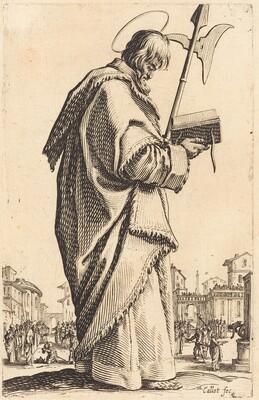
The image features a full-body illustration of a person standing in profile, facing right. The person has a halo around their head, long wavy hair covering the forehead and part of the face, a serious expression, a long nose, and a prominent brow. They wear flowing robes with intricate patterns, hold a book in their right hand, and a staff in their left. The background shows architectural structures, arches, and several smaller figures engaged in different activities, creating a busy city scene. The drawing style is detailed with emphasized texture and depth.

Saint Matthias

Callot, Jacques

The head and pale face of a bearded man with a ring of interwoven branches of thorns over his chin-length, wavy, reddish-brown hair floats against a white cloth that has been hung over a wooden rod in this vertical painting. The cloth fills the composition. At its center, the man’s head faces us and he looks down with heavy-lidded, brown eyes. His lips are parted, and his cheeks are slightly sunken and shaded with pale lilac purple under high cheekbones. Blood drips down the man’s pallid forehead from the thorns. A brown spot high on his right cheek, on our left, might be a bruise or injury. A soft brown glow surrounds the head. The white cloth is frayed along its front edge, where it rests facing us on a wooden surface along the bottom edge of the painting. The cloth is bunched a little to each side where it drapes over the wooden rod above. The white cloth is painted with tones of pale coral pink, icy blue, silvery white, and dove gray. The background behind the cloth is black.

The Veil of Veronica

Fetti, Domenico

The image shows five women sitting in a semi-circle around a fireplace. They have distinct facial features and varied hairstyles, and wear formal dresses. There is a table with lit candles, and some of the women appear to be holding books or documents. In the background, there is an ornate fireplace and a window with closed shutters showing a crescent moon. The room is elegantly decorated with wood paneling and textile wall hangings.

The Wise Virgins before the Fire

Bosse, Abraham
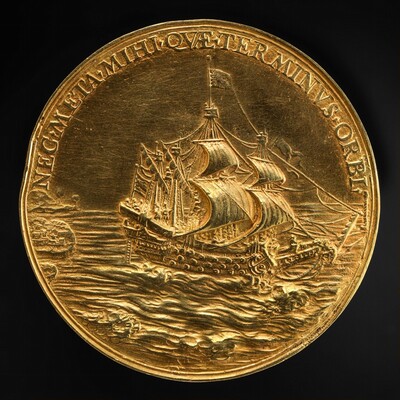
The sculpture on the circular object is a large sailing ship fully rigged with multiple sails billowing. Details of the ship, including the masts and rigging, are visible. In the foreground, there are wave-like engravings representing water. In the background, a faint coastline with structures is visible on the left side. An inscription at the top reads "NECQFETAMIFLQVETERMINVSORBI." The material is gold-colored metal, giving it a luxurious appearance. This image appears on a coin or medallion, with skilled engraving work bringing the ship to life through shadows.

The Juxon Medal: The Dominion of the Seas [reverse]

Briot, Nicolas

This is a drawing of mythological figures in a mountainous landscape. The image shows muscular figures engaging in a struggle among jagged rock formations. Clouds fill the sky above, adding a dramatic sense, while the figures carry or interact with rocks. The artwork is circular with shadows and highlights used to create depth and emphasize the figures' musculature. The detailed line work suggests a classical style, possibly inspired by mythological tales of ancient giants. Below the circular scene are inscriptions or text.

Giants Repelled by Jove

Wolfgang the Elder, Georg Andreas

The image shows a full-length profile of a woman standing, facing to the right. She is depicted with delicate lines, showing a composed expression. She wears a large, wide-brimmed hat with a decorative band and bow. She is dressed in a richly detailed jacket with a high, pleated ruff around her neck and long sleeves. Her voluminous skirt extends to the floor in pleats, and she wears shoes. The background is simple with no other objects, and the illustration is labeled "Mulier Augustana" at the bottom.

Mulier Augustana

Hollar, Wenceslaus

The image shows an arched stone and wooden building to the left and a large, leafless tree to the right. Characters are engaged in various activities around the structure, including standing, sitting, and one figure on horseback facing towards the right. Closest to the building's entrance, a group of people gather, while others interact with objects or animals to the left of the structure. In the distance, more people and buildings are visible, adding depth to the scene. The etching technique is detailed with precise lines, presented in monochrome shades of black and white depicting depth through shadows and textures.

The Stopping Place

Callot, Jacques

A drawing of a figure transforming into a tree is depicted in a circular frame. One figure on the left is transforming into a tree, with arms extending upward and morphing into branches with foliage. Another figure on the right is dynamic in posture, holding a curved object resembling a bow. The background shows a landscape with trees and hills. The detailed etching technique highlights the expressiveness of the figures and the natural setting. Latin text is included in the image.

Daphne Turning to a Laurel

Wolfgang the Elder, Georg Andreas
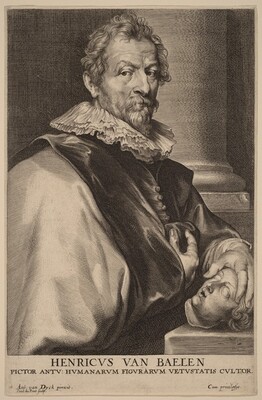
The image depicts the upper half of a man facing slightly to his right. He has a thoughtful expression, a prominent nose, close-set eyes, wavy medium-length hair, and a full beard. He wears a detailed garment with a ruffled collar under a dark velvety coat. His left hand rests on a sculpted head on a plinth table. In the background, there is a vertical element resembling a column. The artwork includes an inscription identifying the subject as Henricus van Baelen and additional text in Latin.

Hendrick van Balen

Pontius, Paulus

The sculpture depicts a woman with a crown and detailed dress. The sculpture is in the form of a bronze medallion with embellished edges and raised lettering.

Christine de France, 1606-1663, Duchess of Savoy, Wife of Victor Amadeus I 1619, Regent 1637-1648

Dupré, Guillaume

The drawing depicts cherubic figures in a pastoral setting with a large tub. The figures interact joyfully around the tub in the wilderness. Winged cherubs are in trees and seated on the edges of the tub. The figures hold grapes and vines. One figure pours liquid into a bowl. Grapes and foliage are woven into garlands. The drawing is detailed and intricate, highlighting textures of hair, foliage, and wood grain. The scene conveys enjoyment and natural beauty.

Putti with Grapes and a Seated Bacchante

Dorigny, Michel

This is a vase with a rounded body and a long, narrow neck. The vase is a vibrant green color with a crackled finish. The crackle glaze covers the entire surface of the vase except for the rim of the opening, which is white. It seems that the interior of the vase is black or dark grey.

Bottle Vase

Chinese Qing Dynasty

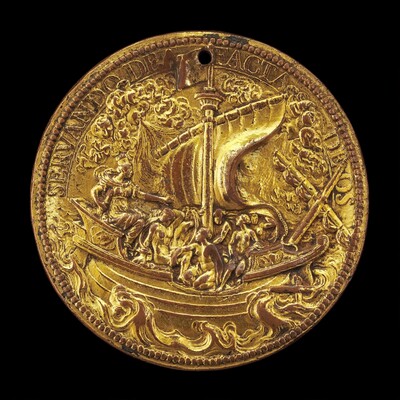
A photograph of a gold-colored medallion is shown. The medallion depicts a ship with a sail surrounded by waves and clouds. Figures on the ship are engaged in activities. The relief work is detailed, particularly in the figures and sail. An inscription in a classical style frames the scene on the edge of the medallion. The craftsmanship suggests a historical or commemorative purpose, highlighting fine artistry and detailed representation.

The Queen at the Helm of a Ship in Stormy Seas [reverse]

Dupré, Guillaume

Shown from the chest up, a light-skinned man with a wrinkled face and a silvery gray beard and hair gazes into the distance in this oval portrait painting. His chest is angled to our right but he turns his head to look off over his other shoulder, to our left. His slate-blue eyes are a little sunken and lined with wrinkles. Shading marks the hollows of the temple and cheek we can see. His thin lips are closed and framed by his curly mustache and beard. A dark, mahogany-brown cap is pushed back on his head, and his brown jacket has gold-colored buttons down the front. The collar of a cream-colored shirt shows through at the neckline. The background is dark olive green. The artist signed the work near the man’s shoulder, to our right: “GDOV.”

Bust of a Bearded Man

Dou, Gerrit

This painting shows three people sitting together. Two individuals on the left are women, likely nuns, with light skin, wearing black habits over tan head coverings and long-sleeved white robes. One of the women holds a book. The person on the right is an older man with light skin and a white beard, wearing a light red cloak over a long white robe. He holds a book and gestures towards the women. In the background on the left, there is a tan cityscape with buildings and a cloudy sky. On the right is a dark wall with a red hat hanging behind the man. The top of the painting is curved.

Saint Jerome with Saint Paula and Saint Eustochium

Zurbarán, Francisco de

The sculpture is a bas-relief medallion featuring a profile view of a man identified as "ARMANVS IOAN CARD DE RICHELIEV." The man is depicted wearing a cap and an elaborate, high-collared garment with visible details in the fabric and folds, along with ornamental chains and a pendant. The material of the medallion appears to be a warm, bronze metal. The sculpting accurately captures facial features such as the man's wavy hair, beard, and prominent nose. The round medallion includes the artist's name, "J. WARIN," engraved along the bottom edge. It is designed to have a small hole at the top.

Armand-Jean du Plessis, 1585-1642, Cardinal de Richelieu 1622 [obverse]

Warin, Jean
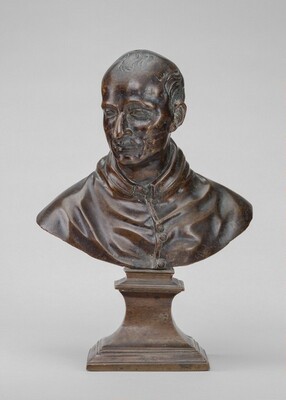
The sculpture is a bust of a mature man with a thoughtful expression and neatly combed hair. It is made from dark brown material, likely polished wood. The details of the man's face and clothing, such as buttons on his garment and folds around the neck area, are finely carved. The bust is mounted on a geometric base, evoking a sense of classical elegance.

Saint Charles Borromeo

Buonvicino, Ambrogio

The image shows a landscape with a low horizon line, featuring hills and mountains in the distance. The scene includes a winding path with travelers and donkeys, as well as additional travelers farther away. The etching technique used provides intricate detailing, giving the foliage and trees a textured appearance. The color palette is monochromatic, mainly utilizing shades of gray and black.

The Large Tree

Both, Jan

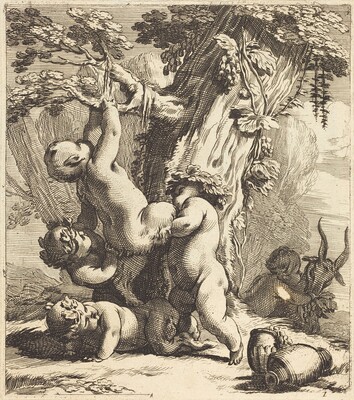
This is a drawing of three cherub-like figures in a natural setting with a tree. The scene depicts these figures engaging with their surroundings, with one cherub reaching up towards the branches of a tree. The tree has detailed bark and the ground is scattered with vessels, including an amphora. In the background, there are elements of nature such as foliage and faint hills. The style of line work and cross-hatching enhances the depth and shadow, emphasizing the contours of the figures and the natural environment.

Putti and Fauns Climbing a Grapevine

Dorigny, Michel

A jumble of pewter plates and a pitcher, glass goblets, a gold chalice, a brass candlestick, and other vessels along with lemons, olives, and the remains of a mince pie are arranged on a cream-white tablecloth bunched on a dark green tabletop in this square still life painting. The scene is painted almost entirely in shades of cool grays, gold, brown, and white against a deep beige background. The objects span width of the canvas across its center. At the left edge of the painting, a vibrant yellow lemon has been cut so its rind curls in a spiral that hangs over the front edge of the table. Behind the lemon, a scissor-like candle snuffer is propped against the wide ledge of the tall brass candlestick, its white candle nearly burned down. A few glistening olives sit in a small pewter plate, and one olive sits on the tabletop near the lemon and candlestick. A glass goblet with a wide stem with textured knubs rests upended on an elaborately chased, gold, footed vessel that has been tipped over so its wide shallow bowl faces away from us. The tall pewter pitcher behind this is dented on its rounded body. The lidded gold chalice next to the jug is the tallest object in the painting. Next to the chalice, along the right half of the painting, is a glass oil cruet with a long, curving spout, a tall, cylindrical vessel holding a small pile of salt, and a straight-sided, low glass holding beer. In front of these objects, an untouched bread roll and knife sit on a pewter plate at the center of the composition. The remains of the mince pie with its pastry crust sit on a large pewter plate to our right. In front of it is a smaller plate holding a broken goblet and a piece of black and white paper rolled into a cone. A few empty oyster shells sit on the table to the left and right, near the lemons and mince pie. The artist signed and dated the painting along the edge of the white cloth near the lower right corner: “HEDA 1635.”

Banquet Piece with Mince Pie

Heda, Willem Claesz

The image shows several figures gathered outdoors near the entrance of a building. The central figure is an elderly man standing at an open door, gesturing towards two approaching men. Both men are using walking sticks and wearing cloaks. Other figures are visible in the scene, with a person peeking out from the doorway. In the background, there is a large, leafy tree and a distant town or village with buildings and people moving along a path.

Lodging of the Travelers

Meyer, Conrad

The image depicts a bronze medallion featuring a profile of a sculpted figure. The figure wears ornate attire and a crown, showing intricate details in the hair, intricate garment patterns, and a circular necklace. The medallion has a warm, aged patina with varying brown and golden hues. An inscription encircles the edge, and a loop at the top suggests it may be used as a pendant.

Christine of France, 1606-1663, Duchess of Savoy 1619, Regent 1637-1648

Dupré, Abraham

This is a drawing of multiple figures in an architectural setting. The figures are arranged in a classical architectural environment with arches and columns. They appear to be interacting, some seated and others standing, dressed in draped garments. In the background, there is an alcove with a statue. The use of hatching and cross-hatching techniques provide texture and shading.

Confirmation

Dughet, Jean

This is a drawing of horses with mounted riders. The drawing shows several horses and riders in different poses and perspectives, depicted with delicate lines and shading. The background is plain.

Study of Four Horsemen

Callot, Jacques

A man and woman greet each other at the center of a group of about a dozen people set within a landscape in this horizontal painting. All the people have pale, peachy skin. In the middle of the crowd, a woman, Abigail, kneels to our left while a man to our right, David, reaches out to her. Abigail’s blond hair is tied back under a white veil that drapes over her shoulders, and she wears a slate-blue dress and a string of pearls around her neck. She holds her left hand, on our right, to her chest and her other hand gestures down to a basket of bread held by a man in the lower left corner of the painting. David stands and bends toward Abigail as he cups her bent elbow with his left hand. His other hand rests on a walking stick near her head, and his index finger is extended as if to brush her cheek. He has short, curly blond hair and beard, and he wears a thigh-length tunic under a breastplate. Crimson-red fabric drapes around his shoulders and over his armor, and a dagger or short sword hangs at his hip. Three women, three men, and a donkey gather to our left, behind Abigail. Two of the men hold large baskets of bread, and they all look toward Abigail and David. Six armored men, two younger people, and two horses make up the group to the right. Trees line a hill behind the people to our left and dark gray and amber-colored clouds fill the sky.

The Meeting of David and Abigail

Rubens, Peter Paul, Sir

The image is a detailed engraving viewed from an elevated vantage point. The scene features a dramatic sky dominating the upper portion with dynamic cloud formations and a mythological figure. The sun is in the top left, radiating lines. Below the sky is a landscape with rugged mountains, plains, and intricate detailing in hatching and cross-hatching lines. The image is monochromatic, creating a stark contrast and highlighting details within the scene.

God Creating Order from Chaos

Wolfgang the Elder, Georg Andreas

This is a drawing of an architectural frontispiece with decorative elements. The image shows an intricately detailed architectural frame with columns, arches, a banner in the center with an inscription, and a coat of arms featuring an eagle's head and angelic figures. The architectural details include columns with decorative embellishments and drapery revealing the central banner. The focus is on architectural ornamentation and heraldic symbols.

Freggi Dell'Architettura

Mitelli, Agostino

This is a drawing of a mythological scene with Apollo and the Python. The circular frame contains a wooded landscape. On the left, a figure with a decorated robe holds a bow, aiming towards a serpent or dragon on the right. The creature lies slain with its sinuous body and large head near a tree. In the background, a group of figures observes from a distance. The artwork is detailed, especially in the foliage and serpent's scales. The scene conveys tension, capturing a moment of triumph in a classical mythological context.

Apollo Killing the Python

Wolfgang the Elder, Georg Andreas
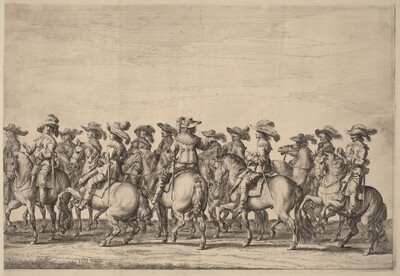
This is a drawing of a group of horse riders in elaborate attire. The riders are mounted on horses and are dressed in detailed embellishments. The horses are depicted with precision, appearing to be trotting or standing elegantly. The background is minimal, allowing the focus to remain on the intricate portrayal of the horses and riders. Lines and shading emphasize the movement and posture of both riders and horses.

Entry of Marie de Medici into Amsterdam [plate 3 of 6]

Nolpe, Pieter

This is a drawing of an ornate emblem featuring two cherubs holding a cartouche. The image includes a shield-like structure with inscriptions "PRIMA PARS" and other text. Above the cartouche is a trumpet with ribbon-like scrolls, surrounded by decorative elements like leafy motifs and swirling patterns. The design is enclosed within a circular frame with fabric drapery at the sides.

Title Page

Wolfgang the Elder, Georg Andreas

Portrait of a Man

Portrait of a Man

French 17th Century

The image depicts a scene from an elevated position, showing a figure standing on steps overlooking a busy square. The background includes architectural structures and a gathering of people, horses, and carriages. A figure in ornate attire points toward the plaza, while the buildings and a tower in the distance frame the bustling activity within the square. The brushstrokes are detailed and linear, creating a complex scene with a color palette dominated by sepia tones.

Piazza della Signoria, Florence

Callot, Jacques

Vase

Vase

Chinese Qing Dynasty

The image shows an engraved portrait of a man in elaborate armor within an ornate oval frame. He has short, curly hair, a moustache, and a pointed goatee. The background features classical elements and the frame includes inscriptions and decorative motifs. The style indicates a baroque influence.

Ernest of Holstein, Schawenburg and Sternberg, Prince of Holy Roman Empire

Kilian, Lucas

The image shows a landscape with a low horizon line. The area is gently rolling with vegetation, a windmill on the horizon, a large detailed tree on the right, and a building with steep roofs and chimneys partially hidden by the tree. The style is precise etching with attention to texture and contour. The color palette is black and white with strong contrast for depth and detail.

A Village on a Hill

Waterloo, Anthonie

The image shows a seated woman holding a child on her lap. The woman is in a relaxed position, with her head tilted downward to the child who is standing on her lap. The woman has closed eyes and shoulder-length hair. She is wearing a long robe. The child is unclothed with curly hair and one arm around the woman's neck. Both the woman and the child have a halo around their heads, depicted by radiant lines. There are several cherubic figures with curly hair on the left and in the clouds below. The background is filled with clouds.

The Virgin and Child

Cantarini, Simone

Printed in black on now-darkened paper, lines of text are above and below an illustration showing three winged, nude children gesturing toward a balding older, bearded man near the center. The older man sits on a throne to the right and leans forward, one hand braced on the sphinx-shaped arm of the chair and the other pointing toward a stick one of the children holds. One of the man’s eyes is open wide, and the other appears to be closed. The man is barefoot and wears voluminous, flowing robes. The children all have short, curly hair and muscular bodies. Drapery flits to cross the groin of the child closest to us and the back side of another. They all reach at least one hand forward toward the man. The front child holds up the stick and looks over his shoulder at us. The room behind them has a door opening into a cavernous space with arched vaults. The corner of the paneled room beyond the older man has shelves and a ledge with books and globes. The page is numbered 151 in the top right corner. Text above the image reads, in all caps: “Francisci Agvilonii e Societate Iesv Opticorvm Liber Tertivs de Commvnivm Obiectorvm Cognitione.” The block of text under the image is titled “Argvmentvm” in all caps. Text continues, in italics mixed case: “Natvræ simul ac doctrinæ ordo exposcit, vt definite visus essential, præcipua’que eius affectione, quæ ad visionis modum opticorum’que radiorum traductionem pertinent, explicate, ad communium visibilium cognitionem veniamus. Hæc enim per se quidem, at non primò, vt et quæ propria dicuntur, sub aspectum cadunt. Nam lux et color simplici obtutu; hæc verò aut collatione, aut distinction, aut antecedente notione, aut syllogism, aut alia demum ratione, quam internus sensus variam ac multiplicem administrat, cognoscuntur. Quod sane ex eo prouenire videtur, quòd hæc non propriè ad visus facultatem attineant, sed aliis quoque sensibus sese ingerant: vnde N4 non”

Opticorum Libri Sex

Galle, Theodor

The image features a group of people depicted in an etching style. Various figures are shown in full body view, with some standing and others seated. Two men on the left are conversing, one holding a cane. Their faces are expressive with lined features, beards, and they wear long robes and distinctive hats. Another man in the background sits on a stone ledge, also dressed in flowing garments and a turban. To the right, two men are in discussion, one wearing a tall hat. The background shows architecture with large stone columns and high arched openings that create shadow and light contrasts.

Jews in the Synagogue

Rembrandt van Rijn

There is an open book in the image, with text on both pages. The left page has "TABLE DES MATIERES" as a heading, with a floral illustration at the bottom. The color palette is mainly beige and cream, with the text and illustration in dark tones. The text is organized in columns on the left page, with "FIN" and a floral basket illustration at the bottom. The right page continues the text in a similar layout.

Les Quatre Livres De l'Architecture D'André Palladio. Mis en François. Dans lesquels, aprés un petit Traitté des cing Ordres, avec quelques- vues des plus necéssaires observations pour bien bastir, Il parle de la contructions des maisons particulieres, des grands chemins, des Ponts, des Places publiques, des Xystes, des Basiliques, & des Temples

Fréart, Sieur de Chambray, Roland

The image shows a sketch of a human figure in a side-profile view from the upper thigh down, including one leg. The figure appears to be standing. Facial features, hair, clothing, or specific objects are not detailed. Surrounding the figure are additional light sketches of an animal head and abstract shapes. The background has a lightly speckled paper texture, indicating this may be from a sketchbook or similar document.

A Leg and a Pig's Head

Callot, Jacques

The Fantastic Rocks and Castle at Bomarzo [verso]

The Fantastic Rocks and Castle at Bomarzo [verso]

Breenbergh, Bartholomeus
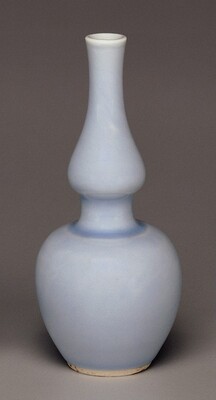
The sculpture depicts a vase with a bulbous lower body tapering into a slender neck. It is pale blue and made of ceramic. The vase has smooth curves and a glossy finish, exuding refinement and delicate craftsmanship. The neutral background accentuates its details and color.

Gourd-Shaped Vase

Chinese Qing Dynasty

This is a photograph of an intricately designed rug. The rug displays a classic Persian motif with a central medallion and a complex pattern of floral designs and arabesques set against a rich red background. The design is symmetrical, featuring ornate flourishes and scrolling patterns in muted tones of blue, gold, and cream, with hints of green. The border of the rug is decorated with larger floral patterns and vines, framing the central design. The craftsmanship reveals a detailed weaving technique that highlights the artistry and cultural heritage associated with handmade carpets. The aged appearance of the rug suggests it holds historical value and has been preserved over time.

Arabesque Band Carpet

Indian 17th Century
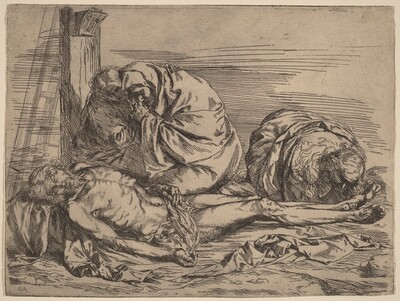
This is a drawing of three figures. In the center, one figure is reclining, supported by two robed figures who appear to be mourning. The background is depicted with simple, fine lines, and the use of shading and line work adds depth to the scene.

The Lamentation

Spanish 17th Century

Palazzi di Genova (vol. 2)

Palazzi di Genova (vol. 2)

Rubens, Peter Paul, Sir
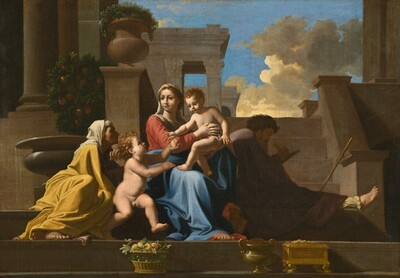
We look up at two women, two young boys, and a man, all with pale skin, sitting together on a wide landing, with stairs leading up to stone buildings behind the group and a patch of vivid blue sky in the upper right corner of this horizontal painting. At the center, a woman, Mary, sits holding a nearly nude child propped on one knee. Her body is angled to our right but she turns her head to look off into the distance to our left with large, dark eyes under faint brows. Her strawberry-blond hair is pulled back under a white veil that falls down the back of her neck and across her chest. Her smooth cheeks are lightly flushed in her round face. She has a straight nose and her pink, bow lips are closed. She wears a coral-red dress under a long, azure-blue robe that wraps around her waist and covers her legs. The sandaled toes of one foot peek from under the hems, and her other foot rests up on a gold-colored, rounded urn. Mary holds one child on her lap, and the second child sits by her right side, to our left. Both toddlers have blond, curly hair, dark eyes, rounded faces, and slightly pudgy bodies. Swaths of pale gray drapery mostly cover the genitals of both. The child on her lap half-sits, half-stands on the knee propped up on the urn. She supports his belly with one hand, the other wraps around his bottom. He leans forward, toward the second child, who faces him and holds up a yellow and blush-red fruit. Behind him, to our left, an older woman sits leaning forward and facing Mary in profile. Her wrinkled face is mostly lost in shadow, and she has a hooked nose and her forehead is lined, as if her eyebrows are raised. A white veil is wrapped around her head and drapes over the shoulders of her long, canary-yellow dress. One foot is crossed behind the other ankle, and the toes of both peep out from under her dress. To our right of Mary, a bearded man, Joseph, wears an eggplant-purple robe and sits almost entirely in shadow, facing our right in profile. The leg closer to us is extended and his foot stretches out of the shadow. He has short, curly brown hair and a long gray beard. He holds a carpenter’s compass to a panel in front of him. Closest to us, a step down runs along the bottom edge of the painting. On that step, a basket with leaves and yellow and peach-colored fruit sits in front of the standing child. Near Mary’s feet is a bronze-colored urn and a shiny gold box on raised feet. Behind the older woman to our left, water trickles from a round-bellied fountain on a pedestal in front of an orange tree. One building with round columns rises behind the tree. Behind Joseph, a long stick rests against the post of a short flight of four steps, which leads to another landing. The portico of a second temple-like building with squared columns and leafy capitals rises over Mary, presumably from the upper landing. A bright, topaz-blue sky with cream-white and steel-gray clouds fills the upper right corner of the composition.

The Holy Family on the Steps

Anonymous Artist

The image displays the interior of an ancient stone structure. Arched openings with heavy stone blocks frame the scene, leading to more arches and columns in the distance. The horizon is obscured by the architecture. The work features detailed line work, with cross-hatching and parallel lines providing shading and texture for the stone. The color palette is monochromatic, using shades of black and white to emphasize contrast and detail. The ground is rocky and uneven, leading towards a brighter area in the distance.

The Ruins of the Colosseum

Mercati, Giovanni Battista

This is a photograph of the cover of a red leather-bound book. The image captures a close-up view of the book's exterior, showcasing its red leather cover. The cover appears worn and slightly scuffed, with visible creases and imperfections. The spine of the book, visible on the left, shows wear at the edges where it meets the cover's surface. The texture of the leather is noticeable, and the stitching around the edges is subtly highlighted.

Album of Engravings after Sir Peter Paul Rubens

Various Artists

The image is a portrait showing the upper half of a person's body. The individual is positioned facing slightly to the left, with their head turned to look directly at the viewer. The person's facial features include a solemn expression with deep-set eyes and a beard. They have a hood over their head, with their hair not visible beneath it. The person is wearing a robe, typical of monastic attire, which covers their shoulders and chest. In their right hand, they hold a closed book, and their left hand is raised, fingers extended in a gesture. The background is filled with radiating lines, and ornate decorative scrolling borders surround the image. The text below reads "Vera SS. Francisci Effigies."

The True Effigy of Saint Francis

Callot, Jacques

This is a drawing of an old printing press in action. It shows a detailed interior view of a print workshop with three individuals working with a large press. One person operates the press by turning a handle, another applies ink to a plate, and the third oversees or prepares paper. The workshop has a timber ceiling with exposed beams, shelves with bottles and containers, and framed artworks hanging on the walls. The caption at the bottom describes the printing process. The scene reflects the craftsmanship and labor of traditional printmaking.

The Intaglio Printers

Bosse, Abraham

This is a drawing of a pastoral scene with mythical figures and a bountiful harvest. The image is filled with intricate details, highlighting a lush natural landscape framed by elegant trees. In the foreground, fruits and grains are abundant, symbolizing fertility and nature's richness. The center of the image features figures, including a being carrying a bounty of fruits over his shoulders, and a seated figure engaging with another. An urn is placed prominently on the right, while to the left, a ram's head is also present. Above and to the right, a cherub-like figure peeks from behind a tree. The overall composition is ornate, showcasing the pastoral abundance intertwined with mythological elements.

Faun Embracing a Bacchante

Dorigny, Michel

A young girl stands next to and holds the hand of an elegantly dressed woman sitting in a wooden armchair near stone columns, in front of a crimson-red curtain pulled up to reveal a distant landscape view in this vertical portrait painting. The child and woman have smooth, light skin, and the fabric of their dresses has a silken sheen. To our right, the woman sits with her knees angled slightly to our left, and she looks at us with dark blue eyes under faint brows. Her brown hair is pulled back from her high forehead under a hair covering set with pearls. Her pointed chin is slightly pulled back, and her pale pink lips are closed. A teardrop-shaped pearl hangs from the ear we can see, and she wears two strands of pearls like a choker, above a thick, pleated lace ruff. The fabric of the long-sleeved bodice has a gold-on-gold pattern, and is lined with a row of buttons down the front. Filmy lace cuffs extend back over her forearms from her wrists. Her full, floor-length skirt is scarlet red with a gold, brocade-like pattern, and has silvery-gray stripes down the front and around the lower hem. The cloak she wears over the dress has a black-on-black floral pattern. Three thick gold chains hang across her bodice, and she wears a square-cut, gray stone set in a gold ring on the third finger of her left hand. To our left, the young girl stands next to the wooden arm of the chair and holds the woman’s hands with both of hers. The child looks at us with gray eyes, and her pale pink lips are parted in a slight smile. Her light brown hair is pulled back under a gray band, perhaps of fur, around her head, over an apricot-colored head covering that matches her dress. The tight-fitting, long-sleeved bodice is striped with bands of alternating gold and pink geometric designs against the apricot-peach background. A lace-edged collar lies across her shoulders. A red, oval pendant hangs from her three-standed pearl necklace, and she wears three pearl bracelets on one wrist. A thick gold chain falls across her chest and around one hip. The floor-length, full skirt has buttercup-yellow and shell-pink highlights on the coral-colored background. Behind the pair, the red curtain has been pulled up so it seems to flutter behind the woman’s head, in front of stone columns that frame a distant landscape view with trees. A blocky structure, presumably a building, sits on the far distant, hazy horizon. Light pours down in streaks from steel-gray clouds against a pale blue sky.

Susanna Fourment and Her Daughter

Dyck, Anthony van, Sir

Twelve people and one child stand, sit, or kneel along a riverbank in this horizontal painting. All the people have pale or tanned skin, and are muscular. They are in various stages of undress, wearing robes of golden yellow, ruby red, petal pink, azure blue, or cream white. To our right of center, a man, Jesus, stands facing us with his arms crossed over his chest. He wears a blue robe wrapped loosely across his shoulders and across his hips. He looks down, his blond hair falling alongside his face, as another man, wearing red, pours water from a shallow dish onto his head. A white dove flies with wings spread overhead. To our right of Jesus, one kneeling person wearing white holds up Jesus’s blue robes and another looks on, wearing a sage green robe and holding a voluminous rose-pink cloth. To our left, a group of five men react by throwing up hands, pointing upward, or looking up. One man with a gray beard and hair stands and bows his head over praying hands. A young boy wraps the arm we can see across the praying man's hips. Three more men to the left of this group pause as they undress to look toward Jesus. All the men stand or sit among puddles as a river spans the width of the painting behind the group and winds into the distance to our right. At the center of the composition, three men stand or recline on a grassy mound on the far side of the river. Tucked under trees at the peak of the mound, a smudge of white could be another kneeling person. Two more people walk along a path that crests the mound to our left. Mountains in the distance are slate blue beneath a vivid blue sky streaked with white clouds.

The Baptism of Christ

Poussin, Nicolas

This is a drawing of an interior scene depicting a group of individuals interacting in a structured environment. The image displays an interior with large block stones forming walls and arches, along with a hanging chain. In the center, a group of figures is gathered. Among them, three figures are seated; two are draped in cloth and appear to be barefoot. Another figure stands, gesturing towards one of the seated individuals. Additionally, there is a figure leaning over a wall observing the interaction. The scene extends into the background with more figures. The detailed lines and shading techniques emphasize the depth and texture of the architectural elements and figures.

Consolation of the Imprisoned

Meyer, Conrad

The image shows a figure standing on a sphere. The person is in a poised position with one arm extended to the side. Their facial features are classical, with a calm expression and short, wavy hair. The person's body is partially draped in light fabric and they hold a small open bag from which coins are spilling. A winged cherub-like child is closely positioned beside them. The background consists of stylized clouds.

Fortune

Cantarini, Simone

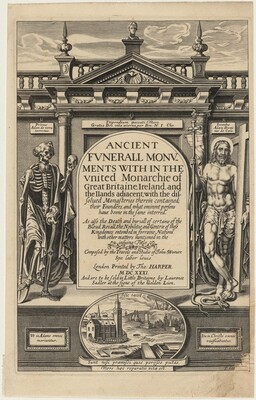
This is an image of an ornate title page from an old book. The central part shows an intricate, framed frontispiece with the title "Ancient Funerall Monuments within the United Monarchie of Great Britaine, Ireland, and the Ilands adjacent." The frame features classic columns, a pediment with sculptural busts and finials. On the left side is a skeletal figure, possibly representing death, and on the right, a draped human figure representing life or resurrection. Below the text block is an illustrated vignette of a church and cemetery, with the phrase "Hic jacet" (Here lies) written in Latin. Latin inscriptions surround the visual elements, adding to the scholarly atmosphere of the book.

Title Page to John Weever, Ancient Funeral Monuments

Cecil, Thomas

The image shows a group of five women in a richly decorated interior. Each woman wears historical clothing with lace collars, voluminous skirts, and tight bodices. One standing woman holds a book, gesturing, while another sitting woman holds an open book. A third woman looks at a reflection or portrait. The hairstyles are styled in curls with ribbons or flowers. Some women wear earrings. The room has intricate woodwork, paintings, wallpaper or tapestries, a fireplace, and a small dog. Large windows reveal a landscape.

The Foolish Virgins Wasting Time

Bosse, Abraham
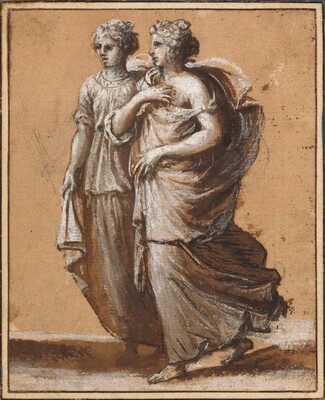
The image depicts two individuals standing side by side. The person on the left has short curly hair and is wearing a loose, flowing garment. The person on the right has longer curly hair pulled back and is dressed in a draped garment with one shoulder exposed. Both individuals are shown from head to toe. The background is a simple, monochromatic surface primarily in shades of brown.

Two Women in Classical Dress

Lorrain, Claude

This is a drawing featuring a complex scene with elements of the divine and mortal realms. The image is filled with various figures and actions across celestial beings above and human figures below, depicted in a linear style suggestive of a narrative composition. In the upper section, angelic figures and ethereal beings are seen amidst clouds. They appear poised in postures that convey communication, exaltation, or proclamation. Below, there is a dynamic portrayal of human figures engaged in interactions or expressive gestures. The architecture suggests a grand temple or cityscape with archways and a bridge. Detailed figures in dramatic poses are also visible in the lower part of the image. Intricate lines and shading create movement and depth, and the monochrome palette emphasizes contrast and detail.

The Last Judgment

Rovere, Giovanni Mauro della

Palazzi di Genova (vol. 1)

Palazzi di Genova (vol. 1)

Rubens, Peter Paul, Sir

The image shows a large, round porcelain vase with a long, narrow neck. The vase is predominantly a pale green color with a crackle glaze effect. It is centered in the frame, positioned upright on a plain surface, with a neutral grey background.

Bottle Vase

Chinese Qing Dynasty

Descrizione del Sacro Monte della Vernia

Descrizione del Sacro Monte della Vernia

Ligozzi, Jacopo

This is a drawing featuring four circular panels depicting different religious scenes. The top-left panel shows a standing figure with an aura above a seated figure and two others nearby. The top-right panel shows a central figure in clerical garments with two others. The lower-left panel shows monks and a cleric in a church-like setting. The lower-right panel shows a reclining figure in a natural setting with beams of light from the sky. The style is reminiscent of classic religious iconography with detailed line work.

St. Remigius; St. Leodegarius; St. Gerard, Abbot; St. Francis of Assisi

Callot, Jacques

This is a drawing of intricate decorative motifs with mythical creatures and floral designs. The drawing features a symmetrical arrangement with an oval shape in the center, containing letters "CR" above "F.A." and the date "1616" underneath. Surrounding the central medallion are elegant, swirling floral designs and fantastical creatures reminiscent of satyrs, adorned with leaves and flowers. Above the central oval is a drum with arms and flags protruding, while in the corners, there are two birds in motion. Below the medallion is a skull design, adding a macabre element to the composition, which is balanced by the ornamental extravagance of the whole artwork.

Ornament with Grotesque

Master CR

The image displays a full-body drawing of a person in a sitting position. The individual is reclining slightly backward, with the head tilted upwards and the gaze directed above. The facial features suggest a firm expression with a slightly open mouth, while the hairstyle is short and close to the scalp. The person is wearing a draped garment, possibly resembling a toga or a robe, loosely covering the body and falling in soft folds. They hold a large round shield with a floral or medallion-like pattern in one hand, and the other hand is partially obscured but appears to grasp a long stick or weapon, potentially a spear. The background is plain, lacking any discernable environmental elements, which emphasizes the subject.

Seated Warrior Holding a Sword and Shield [recto]

Cavedone, Giacomo

The image shows a detailed drawing of a fish skeleton in a monochromatic color palette. The fish skeleton extends from the head to the tail, positioned diagonally across the image. Below the fish, there is text in Latin, and the artist's inscription "Pesce Cappone" is near the lower right of the fish's head.

Skeleton of a Gurnard

Liagno, Teodoro Filippo di

Shown from the chest up, a light-skinned, cleanshaven man looks down and to our left in this vertical portrait painting. His shoulders angle slightly to the right, but he turns to look in the other direction with dark eyes under gathered brows. He has a prominent nose, a pointed chin, and his full lips are parted. His dark blond hair is parted down the middle and falls to both shoulders. His right arm, to our left, crosses his chest, and he holds a staff with that hand along the right side of the painting. He wears a tawny-brown coat with buttons down the front over a high white collar. The background is painted with shades of fawn and peanut brown. The artist signed and dated the painting along the center of the left edge in faint brown paint: “P. Soutman F.A. 1640.”

A Young Man Holding a Staff

Soutman, Pieter Claesz