← All periods

1501 to 1550

105 works

The image shows a group of armored figures in front of a fortress. The figures are gathered around a large arched doorway with spiked and barred gates. Some of the figures are in dynamic poses, holding swords or staffs. The background includes a brick structure, adding to the fortress setting. The drawing is in black and white with detailed line work.

Christ Carrying the Cross

Altdorfer, Albrecht

The image displays a rural scene from a slightly elevated perspective. A figure sits under a large tree observing the surroundings. A road leads into the distance where two horses and a cart loaded with hay approach a rustic structure. Near the structure, there are barrels and smoke coming from a chimney. In the fields beyond, several small figures are engaged in harvesting activities. The horizon is lined with small buildings or trees. The illustration uses delicate lines with light blue washes for shadows. The color scheme is mainly sepia tones with hints of blue. The sky has wispy clouds and faint birds in the background.

Summer Harvest in an Extensive Landscape

Toeput, Lodewyk

Three German Soldiers Armed with Halberds

Three German Soldiers Armed with Halberds

Hopfer, Daniel

This image shows a group of serene figures and cherubs gathered around a grand tree. A central figure is holding a child, both with halos above their heads. The scene is filled with cherubic figures interacting around the main characters, with some hovering in the air. The tree is lush with foliage, extending upwards with cherubic figures among its branches. In the background, there are detailed architectural structures, contributing to the tranquil and natural atmosphere of the scene. The drawing is created with fine linework and subtle shading, resulting in a harmonious and intricate depiction.

Madonna and Child with Saints John and Luke

Cousin the Younger, Jean

The sculpture depicts a lion overpowering a wild boar. The lion is pressing down the boar with its paw and biting into its body. The figures of both animals are intricately detailed, showing the powerful muscles and features of the lion and the rounded shape and limbs of the boar. The sculpture is made of dark brown bronze, giving it a smooth and polished finish. The stance and expression of the lion convey a sense of dominance as it stands over the boar. The sculpture captures the moment of the lion’s conquest, emphasizing the contrast between the lion’s mane and form against the boar.

Lion Devouring a Doe

Prieur, Barthélemy

This is a photograph of a ceramic vase decorated with colorful patterns and motifs, predominantly in blue, yellow, and green hues. The center of the vase features a painted medallion with a profile portrait of a figure wearing headgear, and below it is a label with the inscription "dia-irrj" in a calligraphic style. The surface of the vase is covered with ornate designs including floral and geometric patterns.

Drug jar with the head of a warrior

Faenza 16th Century

Shallow bowl on low foot with the death of Laocoön and his two sons

Shallow bowl on low foot with the death of Laocoön and his two sons

Xanto Avelli, Francesco

This round plate features a central mustard-yellow design with a shield containing six circular shapes, five that are orange and one that is black with small yellow symbols inside it. The rim of the plate is decorated with floral and scroll patterns in the same yellow color, with thin blue outlines and small patches of white in between the large shapes. A motif of crossed keys below a crown is above the shield. The plate is set against a plain blue background.

Large dish with plant-pattern border; in the center, the arms of a Medici pope

Deruta 16th Century

A pale, nearly nude young woman perches on a rock under a tree surrounded by small animals including dogs, deer, and birds, in this horizontal landscape painting. Her body faces us as, lips parted, she looks away to our left. She is covered only by an olive-green drape over her left thigh, on our right. She cradles what appears to be a tall stone tablet in her left arm and touches the inscribed surface with her right hand. White, buttercup-yellow, and crimson-red flowers crown her long blond hair. Her smooth pink skin stands out against the brown bark of the tree trunk behind her. By her right knee, a small brown doe stands looking at her. Closer to us, a white, wading bird dips its beak into a pool of water in the lower right corner of the painting. A large book of diagrams lies open next to the woman's foot, on the slate-gray ground. A small, white dog crouches next to the book on our right in front of a sleek, brown dog and a buck with antlers, and all face the woman in profile. In the trees above, a white hawk perches near the upper right corner of the canvas, and an owl sits on a branch over the woman’s head. Beyond the woman to our left, a steep bank is topped by wispy trees and shrubs. A sandy path meanders past the bank toward a wooden building in the distance. Delicate trees with rust-red and gold canopies frame the building, while a topaz-blue haze behind it suggests a forest beyond. Full, gray clouds fill the sky overhead above a band of pale light on the horizon.

Circe and Her Lovers in a Landscape

Dossi, Dosso

The image shows a depiction of Christ on the cross, with his full body prominently displayed. He is nailed to the wooden cross with his arms outstretched, his head slightly tilted to one side, crowned with thorns. His facial features are solemn, with a beard and mustache, and his hair appears to be of medium length, dark in color. Christ is draped with a white cloth around his waist. Flanking him on either side are two individuals; on the left, a figure standing, clothed in a long robe with a hood, hands clasped together, and a subtle expression on her face. She has a halo around her head. On the right, another figure is wearing a green garment layered with a red cloak, holding a book, with one hand raised, gazing upwards. This person also has a halo and features long, curly hair. Both of these individuals stand on green grass, with the blue sky and the cross as the background, and there is Latin text beneath them.

Missal for Passau

Burgkmair I, Hans

The sculpture depicts a wooden table with intricate designs, including human faces and scrollwork on the supports. The wood has a rich, polished brown color. The table has a rectangular tabletop, ornate balusters, and carved legs. The carvings show heads and decorative motifs, highlighting craftsmanship. The table has an opulent and elegant appearance suitable for a classic or traditional setting.

Walnut Table with Eagles on the Supports

Florentine 16th Century

This is a tapestry of a landscape with castles, trees, and various people and animals. It depicts an outdoor scene where people are dressed in elaborate clothing in shades of red, tan, and dark blue, including long dresses with draping sleeves, tunics with puffed sleeves, and feathered hats and caps. In the background, the landscape is dotted with green trees bearing fruit, and some people are engaging in what appears to be a harvest, using curved gray objects to slice the limbs from bare trees. To the right, a person on horseback looks on, watching them. Closer to us, near the bottom left corner, is a large table with dishes and plates, possibly signifying a feast, surrounded by more people. In the distance there are three buildings with spires and turrets typical of a castle.

The Return from the Hunt

Flemish 16th Century

The figure stands behind a rectangular pedestal, extending from head to mid-thigh. The person has a bearded face, curly hair, and a serious expression. They wear loose garments, with a hand-woven lion pelt draped over one shoulder. The lion's head rests on their chest, and they hold a large club-like object with one hand. The background includes tall grass, a small stream, and a leafless tree on the right. Above the figure, ornate designs frame the scene, with leafy garlands, tassels, and ornamental faces with wings.

Hercules with His Club

Mignon, Jean

This is a drawing of a jousting scene. It features an armored rider on horseback with a long lance, engaged in a jousting match. The rider is leaning towards the ground, indicating motion of the lance as if striking a target. Another figure lies on the ground, seemingly dislodged from their horse. The horses are adorned in decorative caparisons with green and yellow patterns. The artwork portrays the movement and drama of a jousting scene, showcasing the elaborate armor and attire characteristic of medieval tournaments, offering insight into the pageantry and competitiveness of the era.

German Joust of Peace

German 16th Century

This is a photograph of a decorative ceramic jar. The ceramic jar is adorned with vibrant, intricate patterns. The central image is of a figure with a turban and beard, appearing to read or write on a scroll, against a bright yellow background encircled by blue and green foliage motifs. Below this portrait are ornate scrolling and a stylized, yellow mask-like face on a dark blue background. The top and bottom edges of the jar are banded with yellow and turquoise hues. The jar's shape is slightly tapered with a subtle flared top edge.

Albarello with white-bearded physician and trophies of arms

Faenza 16th Century

This is a drawing depicting three cherubs holding ornate staffs that support a circular platform, on which a bear is resting. The cherubs have wings and one of them is looking upwards. The bear is reclined with its head on its paws. Intricate foliage and decorative details surround the scene. Below the bear, there is a plaque inscribed with the date "1529." The drawing features detailed line work and fine hatching typical of the early 16th century.

Three Cupids and a Bear

Aldegrever, Heinrich

In this horizontal painting, a crowd of more than two dozen men and women gathered shoulder to shoulder at the foot of three men hanging from wooden crosses nearly fill the scene. All the people have pale or ruddy skin. To our left of center, each of the crucified men is tied and nailed to a cross. Blood pours from their hands and feet, and from a gash over the central man’s right ribs. The men’s heads slump and their bodies sag. They are nude except for a red cloth across the central man’s hips and a small white loincloth on the man to our right. Two of the men wear crowns of thorns. The spear piercing the central man’s side is held by a man riding a white horse in the crowd below. At least three additional men in the crowd are on horseback. Many of the men are armed with spears, creating a bristle of vertical and diagonal lines over the group. The men and women wear robes and uniforms in shades of golden yellow, pine green, crimson and rust red, black, and cream white. A few men wear metal helmets, and one wears armor. Near the lower left corner, a woman wearing a navy-blue robe has fainted and is supported by two kneeling women while another woman and cleanshaven man look on, their fingers interlaced and held low. The smooth ground is grass green. A spindly tree with dark green leaves grows up the right side of the composition. Off in the distance beyond the tree, two buildings hint at a city. Blue clouds billow in the blue sky above.

The Crucifixion

Signorelli, Luca

This is a painting of a pastoral scene with figures, animals, and a village. The tapestry depicts individuals engaged in various activities such as playing music, herding sheep, and conversing. The background features a castle with turrets and a bridge over water. Foliage and flower patches create a lush surrounding setting. A quaint hut can be seen on one side. Animals including dogs and sheep are present throughout. This is in the style of medieval European tapestries.

Hunting and Pastoral Scenes, with a shepherdess shearing

French 16th Century

The image depicts two full-length figures inside a room with a vaulted, wooden ceiling. The first figure, a standing woman, is depicted in profile and is elegantly dressed in a long, flowing gown with voluminous sleeves and a bodice. Her hair is styled elaborately on top of her head. Opposite her, a second figure, dressed in a cloak and elaborate head covering, is kneeling on the ground with hands clasped in front of her chest. Both figures appear to be concentrating on a distant point, with the standing woman pointing toward the horizon outside, visible through arched windows. In the background, beyond the room's arched windows, a picturesque landscape unfolds, consisting of a castle nestled amongst trees and rolling hills. The image is detailed with light and shading, adding depth and texture to the figures and the architectural details that frame them. On the right side, there is a small sculpted figure holding a snake wrapped around what appears to be a staff, standing on a pedestal.

Solomon Worshipping False Gods

Master MZ

The sculpture is a rectangular bronze box with a relief carving on its front panel. The scene depicted on this panel includes several human figures dressed in long robes. The figures appear to be engaged in some form of interaction or narrative, with a central figure holding a staff and another figure kneeling before them. The bronze box has a dark brown patina, characteristic of aged metal, with areas of lighter highlights where the relief details are more pronounced. The box is set on four small feet.

Two Scenes from the Life of Saint Simeon of Polirone: The Miracle of the Stag (vignette) and The King of León (vignette)

Spani, Bartolomeo

The curving X-frame design of this wood chair creates an hourglass silhouette from the front, and creates a bucket-like seat for the sitter. The front face of the wooden frame is carved with curving vines and stylized bunches of grapes and leaves, and the frame ends with clawed lions’ feet at the bottom. The seat and legs are made up of alternating slats so the chair could fold up. Imagine interlacing your fingers and then moving your palms back and forth—that is how the pivot of this chair works. The arms of the chair, which have a rounded knob at each front end, rest along the top edges of the slats. The back rail connects at the back of the arms. A crest at the center of the back rail is flanked by the capital letters “A” to the left and “G” to the right. The crest and letters are contained within a medallion-like form, and the sides of the back rail dip down to meet the arms. A worn, pale blue velvet cushion rests on the seat, and has tassels at the front corners. The chair is shown against a pale gray background.

Walnut Savonarola Chair with Letters A.G.

Italian 16th Century

The sculpture is a shallow dish with two reclining figures at its center. The figures are human and intertwined, surrounded by small white seashell-shaped elements. The dish is made of ceramic with various colors. The material has a three-dimensional appearance and is detailed. The colors used are greens, blues, and flesh tones with a deep blue shade on the outer rim, giving it a lush and colorful look with naturalistic elements.

"Gondola" with Bacchus and Ceres

Fontainebleau Pottery

This is a drawing of sea creatures riding waves. The image shows two human-like figures with serpent bodies on horses, one holding a staff and the other blowing a horn. A cherubic figure floats above them. Sea creatures and cherubic forms blend with the waves below. Intricate lines detail scales, waves, and hair, emphasizing the lively and fantastical nature of the scene.

Sirens, Naiads, and Tritons

Falconetto, Angelo

This is an image of an ancient coin. The coin features a detailed profile relief of a figure with curly hair and a regal or militaristic outfit adorned with a row of circular embellishments. The border of the coin contains inscribed text describing the figure. The surface of the coin shows signs of age with a patina giving it a brownish and reddish tint. The craftsmanship exhibits a high level of detail, particularly in the depiction of the figure's facial features and attire, indicating the coin's historical significance.

Federigo II Gonzaga, 1500-1540, 5th Marquess of Mantua 1519 and 1st Duke of Mantua 1530 [obverse]

Pomedelli, Giovanni Maria

The sculpture is a circular medal featuring a dragon-like creature breathing fire. The creature is centrally positioned and surrounded by decorative elements, including a crown above its head. The medal is crafted from a metallic material with a bronze or brass-like appearance. The surface is textured and the details of the dragon and surrounding elements are well-defined, enhancing the three-dimensional quality of the piece. The outer rim of the medal bears an inscription.

Salamander in Flames [reverse]

Neufahrer, Ludwig

The image is a sketch of several figures, likely male, seated around a central figure on a table or platform. The central figure has long hair and a beard, seated facing forward. The surrounding individuals have indistinct faces and are oriented towards the central figure. Their clothing is suggested by flowing lines indicating loose garments or robes. The sketch is on a textured, aged background.

The Last Supper

Italian 16th Century

This is a drawing of an angel and a woman in a religious scene. The drawing shows an angel with large wings and a flowing robe gesturing towards a kneeling woman. The angel holds a staff and appears to be delivering a message. The woman is near a structure that resembles an altar, and there is a potted plant or flowers nearby. Above them, there is a divine figure in the clouds and a dove emitting rays of light. The drawing uses fine lines and delicate shading, suggesting a classical or Renaissance style, with carefully detailed drapery and architecture.

The Annunciation

Anonymous Artist

This is a drawing of an ornate decorative page. Detailed illustrations with a central coat of arms featuring an eagle in a heraldic pose under a wide-brimmed clerical hat are included. Latin text is at the top in a serif typeface. The borders are decorated with intricate patterns of vine-like motifs, stylized floral designs, and baroque faces surrounding the central content. Ink annotations are visible within the illustration. The design is likely from a historical manuscript or book, showcasing craftsmanship and elegance typical of religious or formal publications from previous centuries.

Decachordum Christianum

Vigerius, Marcus
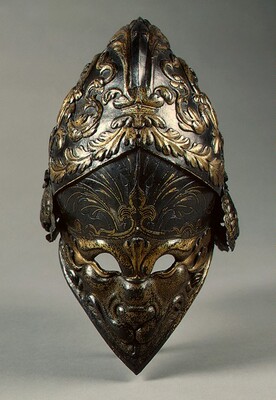
This is an ornate helmet made of dark metal with gold-colored details. It features intricate designs and patterns throughout, including symmetrical swirling and floral designs, as well as designs on the faceguard that look similar to an animal’s face, including a snarling mouth and eye holes. The lighting emphasizes the embossed and engraved elements of the helmet.

"The Morosini Helmet" (visored burgonet)

Milanese 16th Century

This is a painting on a circular plate depicting a battle scene. Warriors clad in medieval armor and helmets engage in combat. The scene includes figures in action poses with swords and shields. In the background, a fortified city with flames and smoke rising from its towers suggests a siege or invasion. Bright colors and detailed ornamentation enhance the drama of the scene. This is in the style of an Italian Renaissance artist like Francesco Xanto Avelli, known for detailed maiolica ceramics depicting historical and mythological scenes.

Charger with the Battle of Roncevaux

Xanto Avelli, Francesco

This is a black and white drawing of a forest scene with a man aiming a rifle towards another figure. Above them is a celestial figure holding a child, surrounded by clouds. The style is reminiscent of woodcut illustrations with detailed lines. Text at the bottom of the image appears to be in a German-like language.

Ain Man ward mit ainer Puren ...

Master of the Miracles of Mariazell

This is a painting of a narrative scene on a circular ceramic plate. The plate is decorated with intricate and colorful imagery depicting various figures and animals engaged in different activities. In the foreground, there is a central pedestal with an inscription, surrounded by various characters and animals, including a bovine figure on the left and a variety of other figures interacting with each other, some appearing to be sleeping or in distress. The scene is bustling with activity, with architectural elements and lush greenery in the background.

Plate with the Plague of Phrygia

Urbino 16th Century

Descent from the Cross

Descent from the Cross

Italian 16th Century

The sculpture is a medallion featuring a central figure of a putto playing a lute, surrounded by ornate designs including floral motifs, scroll work, and small figures. The sculpture is gold-colored and round, with a relief that provides texture and depth to the designs.

Cupid Playing on the Lute

German 16th Century

This painted plate shows three armored people and two horses in a dynamic scene set against a green and blue landscape. The people all have light skin and wear armor in shades of yellow and gold, with red fabric around their waists. They all wear different hats: one wears a yellow hat, one wears a blue hat, and one wears an orange hat with large blue feathers. Closest to us, a person jabs a spear towards a large white horse on the right. Another person is behind this horse, holding its reigns and looking over their shoulder. In the background on the left, a person riding a tan horse points a long sword down at the spear-wielder. In the background, blue water winds through light green grass and pale rock formations, with a few light blue trees. In the distance on the right is a large white castle with a golden roof under a blue sky that fades to yellow near the horizon. The rim of the plate is gold.

Flat plate with a battle scene

Italian 16th Century
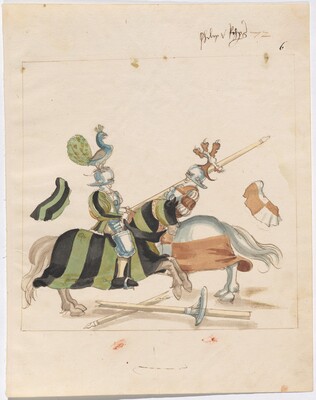
This is a drawing of two jousting knights on horseback. The drawing depicts two armored knights engaged in a joust, each riding a horse and carrying a lance. Both knights are wearing helmets adorned with elaborate crests; one with a bird-like creature and the other with antler decorations. The armor and horses are decorated with colorful patterns. The background appears plain. Below the horses, a lance is broken. The drawing skillfully combines line work with watercolor to give a sense of movement and historical context.

Mock Joust of War with Flying Shields

German 16th Century

This is a painting of a scene featuring a young, winged figure reaching out to a robed woman. The round plate shows a colorful, intricate scene with a winged cherubic figure and a woman dressed in a flowing garment. The background displays a landscape with a twisted tree shape, rolling hills, and a detailed village under a sunset or dawn sky with hues of orange, blue, and pink. The style resembles the work of Renaissance artist Luca della Robbia, known for vibrant colors and intricate detailing typical of painted maiolica ware from that period.

Plate with the reconciliation of Cupid and Minerva

Italian 16th Century

The image is an ink drawing of a person standing in a relaxed posture. The figure faces forward with one arm resting on the side and the other raised, lightly touching their head. The face has classical proportions, with a straight nose and full lips, and the hair is depicted in curls. The body is mostly uncovered, with only hints of draped clothing around the shoulders. The person holds a cluster of foliage or a garland in one hand. The background includes architectural elements like a pillar and archway, with the area around the figure outlined with hatching for shadow and depth.

Allegorical Figure with a Cat and a Pig

Jacopo di Giovanni di Francesco
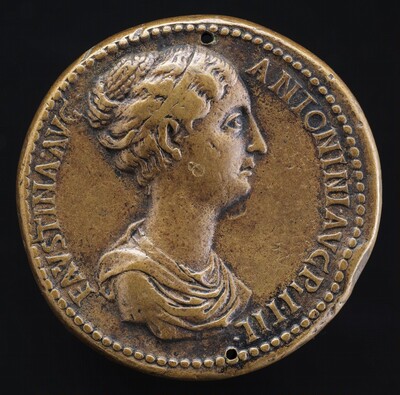
The image depicts a relief of a woman's profile facing right on an ancient Roman coin. The subject appears to be a classical figure, suggested by her attire and the style of the coin. The sculpture is made of a light brown material, possibly bronze. Text in Latin is inscribed along the border of the coin. The woman's hair is styled intricately and seems to be held up with a diadem or headband. There is a small hole near the edge of the coin, indicating it might have been used as a pendant or ornament. The texture of the coin shows signs of wear, suggesting its age and historical use.

Faustina the Younger, died A.D. 175, Wife of Marcus Aurelius [obverse]

Cavino, Giovanni da

The image depicts an elaborate interior scene with intricate architectural details and figures. It features a vaulted ceiling adorned with arches and a carving of a dove at the center. Two figures are seated on either side, with a playful toddler-like figure reaching up between them. In the background, there is a colonnade and figures peering through windows. The drawing suggests a narrative or thematic element with symbolic references.

The Virgin and Child with Saint Anne by a Portal

Hopfer, Daniel

Six men and women stand or kneel in front of a sixth person, a man, holding the limp corpse of another, Jesus, in this vertical drawing on cream-white paper. Jesus and the man supporting him are in the lower right corner of the page, and a woman with long, loose hair bends low to kiss Jesus’s feet in the lower left corner. These three people are the mostly simply drawn of the group, sketched in with outlines and contours without shading. The other woman kneels with her hands together, facing Jesus in profile. A young, cleanshaven man stands at her far side and rests his hand on her other shoulder. A trio of three men stand closely behind this pair. All three wear elaborate hats, two may converse, and one holds a drum-like object and another a hammer. A rectangular stone tomb stretches behind Jesus at the foot of a rocky cliff face. Across the paper, three crosses rise from a hill in the top left corner of the composition. A ladder leans against the central cross, and men hang heavily from the other two. The artist signed and dated the work as if he had inscribed the top middle of the tomb cover. A capital letter D is tucked between the wide legs of a capital A, both under the date, 1504.

The Entombment

Dürer, Albrecht

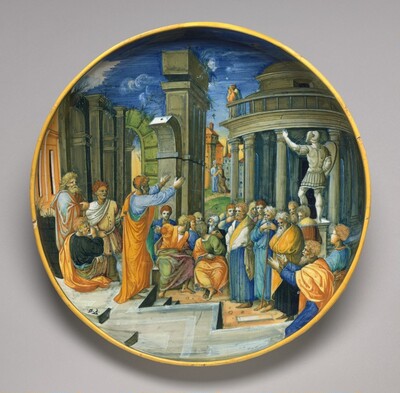
This is a painting of a gathering in an architectural setting. The composition features figures dressed in flowing robes around a temple or public square. One central figure is gesturing dynamically, possibly addressing the assembly or leading a discussion. The background shows classical architecture with columns, arches, and a statue of an armored figure. The scene is enclosed within a circular frame. The colors are vivid, with blues, oranges, and earth tones predominating the palette. This is in the style of Raphael, owing to the classical theme and details of the architecture and clothing.

Plate with Saint Paul preaching at Athens

Durantino of Urbino, Guido

The drawing shows a figure resembling a satyr, with a child in one arm and holding a goat's horn in the other. A goat sits at their feet. In the background, another figure leans over a jug. The style features fine lines and detailed cross-hatching for texture and depth, with careful attention to shading and contours. The image is labeled "SATVRNVS" and has the initials "ISB" in the corner. The composition is balanced, with the figures in the foreground and minimal background elements.

Saturn

Beham, Sebald

The image shows a female figure standing upright. She is facing slightly to her left with her right arm raised, holding a sword, and her left hand on a balance scale. She has curly hair tied back, delicate eyes, and a slight smile. She wears an ornate garment with gold and red hues and is surrounded by a tapestry depicting a landscape with trees and mountains, framed by architectural elements.

The Four Cardinal Virtues: Justice

Netherlandish 16th Century

This is a drawing of a group of figures in an architectural setting. The drawing depicts multiple figures in an intricate scene. The setting is indoors or within a walled enclosure, with walls and an architectural structure at the top of the image. The figures are dressed in historical clothing, including robes and hats, and are engaged in an exchange or discussion. The use of lines and shading provides texture and depth to the illustration, typical of the woodcut or engraving style used in historical illustrations.

Ecce Homo

Altdorfer, Albrecht

The sculpture displays a religious scene with a central figure seated, holding a child. Surrounding them are additional figures, including two men in robes and headgear on the left, and others on the right. The sculpture is crafted in relief on an oval plaque, with intricate details, a warm brown color with gold highlights, and ornate edge decorations.

The Madonna of the Rosary

Anonymous Artist

The sculpture is a circular medallion featuring the relief of a male monarch in profile, facing the right. He is depicted wearing ornate robes adorned with detailed patterns and rich embellishments. He holds a scepter in one hand and a sphere in the other. The medallion is crafted from metal with a dark bronze or gold finish that highlights the raised features and textures, while the other areas are dark brown, perhaps from a patina. The edges of the medallion are inscribed with text.

Charles V, 1500-1558, King of Spain 1516-1556, Holy Roman Emperor 1519 [obverse]

Reinhart the Elder, Hans

This painting depicts two people, an adult man and a young boy. The man is seen from the knees up, standing with one arm on a table and the other on his hip. He has light skin, light green eyes, a brown beard and mustache, and dark hair under a black cap. He is wearing a bright red jacket with several buttons down the front, which is open to reveal a white garment with several pleats and folds. The boy, who has short brown hair and fair skin, leans against the man's leg, tying a bow on the white garment and looking over his shoulder at us. He wears a yellow outfit with subtle white stripes. On the left is a table covered with dark green fabric which the man has his hand on; there are three books on it, and a letter on white paper propped up against the books. The background is a muted green-brown color.

Alessandro Alberti with a Page

North Italian 16th Century

This is a painting of a classical architectural scene with figures. The image depicts a woman seated in an architectural setting decorated with columns and arches, alongside a kneeling child and another figure holding a sphere. The painting is highly detailed, with the architectural setting resembling a palatial interior, complete with checkered flooring and intricate brickwork. The columns are painted in a vibrant blue hue, and the background features a view of a blue sky and distant buildings. The seated woman appears to be interacting with the kneeling child, possibly teaching or bestowing wisdom, as indicated by the open book and laurel wreath. The third figure, dressed in robes and holding the sphere, contributes to the scholarly or philosophical theme of the scene.

Plate with an allegorical scene of Calliope and a youth (from the Ladder Service)

Nicola da Urbino

The image shows a round, coin-like sculpture featuring a side profile of a human figure. The individual wears a hat, shoulder-length hair, and a garment with a visible collar. The sculpture appears to be made of metal, possibly bronze, based on its brown and gold tones. Intricate detailing is visible on both the figure's features and the surrounding text inscribed in a circular fashion around the edges, reading "BARTHOLOMEVS ZANGATIUS FLORENTI." The lettering is raised in relief against the background, showcasing precision and craftsmanship. The sculpture resembles a historical medallion or coin, providing a tangible, three-dimensional representation.

Bartolomeo Panciatichi, 1468-1533, Merchant [obverse]

Gauvain, Jacques

This is a photograph of a coin with an intricately designed classical scene in bas-relief. The coin features a standing male figure wrapped with ropes around a column or tree trunk. An inscription in Latin surrounds the central scene, while finely engraved text adorns the edge. The engraving showcases the craftsmanship involved in minting the coin.

John Huss Centenary Medal [reverse]

Austrian 16th Century

This is a photograph of an ornate ceramic plate with intricate designs. The plate features a central circular motif with a black bird standing on stylized wheat or hay against an orange background. Surrounding the central motif are blue and gray decorations, including winged cherub-like faces and scrolls, with various words inscribed on them, such as "SPQR," "AMAS," "DIO," and "GADI." The plate has a richly detailed and symmetrical design, combining vibrant colors and classical elements.

Broad-rimmed bowl with border of urns and cherubs' heads; in the center, device of a bird standing on a bundle with the inscription VINCENZO

Urbino district 16th Century

This is a drawing of a scene in a forest featuring intertwined figures and various animals. The intricate line work depicts two central figures, one giving an apple to the other, with a snake entwined around a tree nearby. There are also depictions of a badger and a goat at their feet, and the scene is filled with dense foliage and branches. The composition is carefully balanced with detailed textures in the bark of the trees and the fur of the animals. The strong contrast created by the black and white ink work adds depth and drama to the scene.

The Fall of Man

Dürer, Albrecht

This is a photograph of a decorative ceramic vase. The vase features intricate, colorful designs with a central motif of a mythical creature, with a human-like upper body seated atop it. The creature is set against a vibrant background of rolling hills and a sky. Surrounding the main scene are ornate leaf patterns and swirls in shades of deep blue, green, yellow, and orange. The neck of the vase is adorned with additional decorative patterns and motifs. A wide band at the base of the image contains a script in stylized lettering.

Tall drug bottle with two babies riding a griffin

Pompei, Orazio

This is a photograph of an ancient coin. The coin features a detailed engraving of two robed figures in profile, facing each other and reaching out their hands. Surrounding the figures is an inscription that includes the year "1532" and the text "CONCORDIA." The edges of the coin are slightly worn, and there is a raised, beaded border encircling the figures and inscriptions. The overall patina is a muted, aged bronze.

Antonio Da Mula and Marcantonio Trevisan [reverse]

Spinelli, Andrea

The image shows a person in a dynamic stance. The individual has a serene facial expression and styled hair with a ribbon or similar ornament. They wear ornate clothing, possibly a tunic, with draped fabric. The person holds a mirror with a decorative handle in one hand and extends the other hand upward. The background includes ornate pillars, an alcove, lush greenery, mountains, trees, and a cobbled path. Floral motifs adorn the tapestry surrounding the person.

The Four Cardinal Virtues: Prudence

Netherlandish 16th Century
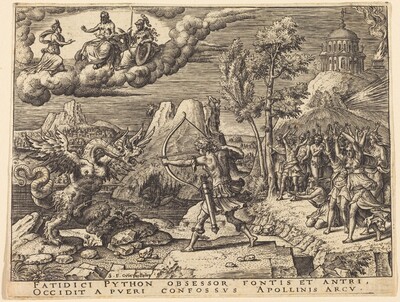
This is a painting of a battle scene. The image depicts a confrontation between a winged serpent-like creature and an archer at the center. Surrounding them are onlookers with various emotional reactions. In the sky above, three figures are seated on clouds. The background includes architectural structures and natural elements.

Apollo Killing Python

Delaune, Etienne

The sculpture depicts a medallion featuring a side profile of a woman. She is wearing an elaborate headdress and a garment with rich folds and textures that suggest a high status. The medallion is crafted from a brown-toned material, likely bronze or a similar metal. Embedded around the edge of the medallion is a series of inscriptions in a refined, capitalized font. The woman's profile is detailed, with the headdress extending widely. The overall design and composition may suggest historical significance.

Anne of Hungary, died 1547, Wife of Ferdinand I of Austria 1521 [reverse]

German 16th Century

This is a painting of people and animals in a rich green landscape under a blue sky with one bright star. On the right, under an arch, there is a seated woman with an infant on her lap, one man standing behind her and another kneeling in front of her, a crown on the ground next to him. There are two more men with crowns standing near the kneeling man, both pointing towards the child. The left side shows more people standing and looking at the woman and child, with some mounted on horses. More people are walking down a tall hill on the left, coming towards us. The people are clothed in tunics and cloaks in bright shades of green, blue, and orange-yellow. Most of them have pale yellow skin, although one of the crowned men in front of the woman has brown skin.

Panel with the Adoration of the Magi

Nicola da Urbino

The image depicts a man standing in a commanding pose. He is clothed in a tunic with decorative elements and holds a staff. The man has a beard, curly hair, and wears a crown-like headpiece. A ship with men aboard is visible in the background. Other figures and a person playing a musical instrument are present. The words "ΟYTIΣ. NEMO" are inscribed above the man.

OUTIS NEMO

Weiditz, II, Hans

The image depicts three individuals in full-length view, each with distinct poses. The person on the left has curly hair, a winged helmet, and holds a torch. The central figure wears elaborate armor, a plumed helmet, and a detailed cape. The third individual on the right wears a crown of flowers and puffed clothing. The characters are dressed in historical or allegorical apparel with intricate designs. The background is plain, highlighting the detailed attire and symbolic elements.

A Blindfolded Cupid Holding a Torch Before a Couple

Dolendo, Zacharias

The image shows a pastoral landscape with fantastical creatures depicted in a colorful and vibrant style. Two half-human, half-animal figures are engaged in various activities within the scene, which features a vividly painted sky, a flowing stream, and lush greenery. The central roundel of the dish shows a smaller scene with a figure interacting with a creature inside a circular frame surrounded by a golden rim. On the right side, a rocky formation is visible with another creature climbing or reaching. The style is reminiscent of Early Italian Renaissance art, particularly maiolica ware known for intricate and colorful narrative scenes with mythological or fantastical themes.

Plate with three Satyrs

Gubbio 16th Century

The image depicts a decorative ceramic plate with an artistic portrayal of a woman in profile. The woman is facing left, showcasing her upper body. She has delicate and idealized facial features with a serene expression. Her hair is styled with an intricate headdress adorned with ornamental elements. She wears a garment with detailed embellishments, likely representing period clothing, in warm earth tones with lacing details. A necklace is depicted around her neck. The plate's surroundings feature elaborate designs with patterned motifs, contrasting blue and orange tones, and plant-like elements. The background is filled with intricate geometric and floral patterns, adding texture to the image.

Large dish with segmental border of plant sprays and scale pattern; in the center, a profile bust of a woman in a winged headdress

Deruta 16th Century

This is a drawing of two armored knights jousting on horseback. The drawing depicts a scene where two knights clad in armor and feathered helmets are jousting. They are seated on horses decorated in red and green trappings. Each knight holds a lance and their armor includes chainmail and steel plates. The illustration captures the moment of impact, with fragments of a lance visible at the center of the composition. The style of the drawing is reminiscent of historical illustrations, with delicate lines and intricate designs on the armor and horses' coverings. There is a handwritten note on the bottom of the page.

Mock Joust of War with Flying Shields

German 16th Century

The sculpture on this coin-like medallion is a profile portrait of a woman facing right. She has intricate, curly hair with a headpiece, a necklace, and detailed drapery over her shoulders. The metal medallion, likely bronze, has a dark, aged patina with a reddish-brown color, areas of oxidization, and wear. It features inscriptions around its perimeter, a small hole near the top, and is flat in relief with fine details.

Violante Brasavola, Wife of Giambattista Pigna

Cambio, called Bombarda, Giovanni Battista

Three full-body figures are depicted. On the left, a man is stepping forward with his left foot, holding a sword at his waist and an instrument resembling a small xylophone. He wears a mask with sharp facial features, a mustache, and a feathered hat. In the center stands another man holding a lute-like instrument, with an elongated nose and chin, wearing a cap with a feather, a collared shirt, and trousers. To the right, a woman stands holding the folds of an elaborate gown with floral designs. She wears a veil covering her head and shoulders. The background is minimal.

A Veiled Woman with Two Musicians Playing a Gridiron and a Bellows

Dolendo, Zacharias

This painting depicts a long, horizontal landscape viewed from an elevated angle. On the left, by a group of green trees and bushes, several people stand around one person who is on the back of a white horse. They wear garments in shades of light red, dark green, and pale yellow. In the distance behind them, a gray castle is visible, and farther away boats sail across green water near tree-covered hills. In the center of the painting is a collection of massive gray rocks. A small yellow tent is at the bottom of the rocks, with a group of small people sitting or standing around it. To the right of them, two deer drink from a small blue pool while a person in a gray shirt rests nearby, wrapped in a green cloth. On the right side of the painting, people walk down a long path that ends in a large gray castle or city in the top right corner. Some of the people hold long poles or weapons. The color palette is mostly earthy browns and greens, with dark green trees filling much of the background. The sky is visible in the left and right sections of the painting; it is a greenish blue near the top that fades into a light pink when it meets the distant green hills.

Scenes from a Legend

Larciani (Master of the Kress Landscapes), Giovanni

The image shows a man with both arms raised at shoulder height, facing slightly off to his right. He appears to be interacting with a skeletal figure. The man has a full face with a mustache and short beard, and his hair is medium length. He is wearing elaborate clothing typical of a nobleman including a large cloak with detailed trimming. An hourglass sits on a table beside him. The skeletal figure beside him is partially draped in fabric. The background features mountains and clouds and the composition is framed with the title "Der Edelmann" at the top.

Der Edelmann (The Nobleman)

Lützelburger, Hans

This drawing is a sketch of several people facing the left, depicted from the chest up. The individuals are standing together in a group. Their hair is in a variety of styles, and they are dressed in draped garments. The person at the front of the group has their hands clasped together in front of their chest. The background is plain beige paper, and the lines of the drawing have been done in red.

Eight Apostles

Raphael

Shown from the waist up behind a forest-green ledge or tabletop, a bearded man with a ruddy complexion strums a six-stringed lute between two, light-skinned people in this horizontal painting. The green ledge runs close to the bottom edge of the canvas, and the people nearly fill the composition. The musician’s body faces us but he looks up and off to our left with gray eyes under arched brows, with lips parted. His long brown hair is covered with a red hat wrapped with a pale, pink band. The ribbon meets in a bow-like form near the front center, and tassels hang to each side. His voluminous coat has wide, burnt-orange fur lapels and is lined with fur where it splits open over his shoulders. The garment below has dark sleeves. He lifts his right shoulder high over the lute as the instrument rests on the tabletop, with the neck to our right. The soundhole at the center is covered with rosette-like tracery. The man to our left has long, straight, dark brown hair and a cleft in his chin, which is darkened with a five o’clock shadow. He looks down and toward the musician with brown eyes over a long nose, and his lips are closed. He wears a black cloak with a fur collar over a white shirt, and holds a red book. To our right, a young person, possibly a man with delicate features, stands with his body angled toward the musician but he turns his face to look at us with gray eyes. He has flushed cheeks, a long, straight nose, and a rounded chin. He has shoulder-length, wavy brown hair parted down the middle, and he wears a red cloak also with a fur lapel, over a cream-white undershirt. A crumpled white cloth and a small, oval-shaped box with its lid askew sits on the green surface near the lute. The background behind the trio is elephant gray.

A Concert

Cariani

The image features a sketch of three faces shown in close-up from the neck upwards. The leftmost face is oriented slightly towards the viewer with a direct gaze, the central face looks downward with closed eyes, and the rightmost face is in profile with an upward tilt. All three faces have sculptural, classical features with prominent eyelids, smooth contours, and slightly parted lips. The hair is styled with soft curls. The medium used is red chalk on paper, giving the artwork a warm, monochromatic tone. There are no visible clothing or jewelry. The background of the sketch is simple and unadorned.

Three Feminine Heads

Parmigianino

This painting depicts a mythological scene with three central figures. One figure in a blue robe holds a sword, another figure in an orange garment appears distressed, and a third angelic figure with wings stands beside a tree. The background shows a lush landscape with architectural elements against a serene sky. The use of vibrant colors and intricate detailing creates a lively scene. This artwork is in the style of Renaissance majolica pottery.

Plate with Pyramus and Thisbe

Xanto Avelli, Francesco

This is a colorful, decorative plate. The center of the plate features a coat of arms in vibrant tones of gold and deep blue, with the outline of a black bird. The shield is against a green and blue landscape, circled by a thick mustard-yellow border. The wide rim of the plate is adorned with green leaves, floral patterns, and curling scrollwork in blue, red, and yellow hues. There is the repeating image of the head of a creature with curled lips and fangs that tapers into a thin, intertwining body.

Plate with border of foliate scrollwork with dolphin heads and cornucopias; in the center, shield of arms of Vigerio of Savona

Italian 16th Century

This is a drawing of a group of figures gathered around an object. The drawing features several individuals wearing hats and flowing garments. The figures appear to be focused on a central action or object that involves a long, staff-like item being handled. The background includes a simple architectural structure. The lines and use of shading add depth and texture to the composition, and the monochromatic palette suggests it may be a preparatory sketch or study for a more detailed work in another medium.

The Founding of Santa Maria Maggiore

Ricci, Giovanni Battista

This is a photograph of a decorative ceramic plate with intricate designs. The plate features a central emblem with a shield design, displaying five red roundels on a golden field, topped by a papal tiara and crossed keys. Surrounding the emblem is an ornate pattern with a blue background and white swirling motifs. The outer border of the plate is adorned with alternating green and yellow geometric designs. The craftsmanship suggests a detailed and meticulous approach to decoration, likely intended for ornamental use.

Footed dish with the arms of the Medici, reverse decorated "alla porcellana"

Tuscan 16th Century

Isabella di Capua, 1509-1559, Princess of Molfetta, Wife of Ferrante Gonzaga 1534 [obverse]

Isabella di Capua, 1509-1559, Princess of Molfetta, Wife of Ferrante Gonzaga 1534 [obverse]

Nizzola da Trezzo, Jacopo

The image shows a profile portrait of a man on a circular medallion or coin. The man has a beard and curly hair, with facial features visible in profile view. The medallion is bronze with a rich, golden-brown color. There is an inscription in raised letters surrounding the profile. The sculpture resembles a classical portrait coin, similar to ancient or Renaissance medallions.

Marcantonio Flaminio, 1498-1550, poet [obverse]

Torre, Giulio della
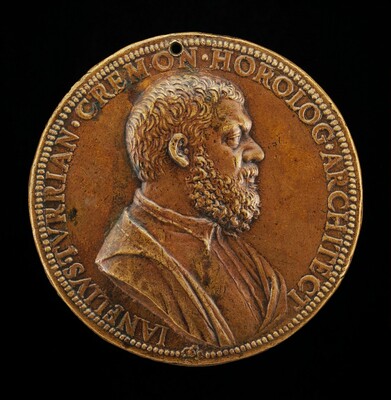
The image depicts a round bronze medallion with a relief sculpture of a man's profile looking to the right. The subject is a male figure with curly, short hair and a full beard. He is depicted wearing a garment with a collar visible at the neckline. The sculpture is rendered in bronze, giving it a warm, golden-brown color with some darker patina. Surrounding the profile is a border with an inscription that reads, "IAN.ELVSJ.VIRIAN.CREMON.HOROLOG.ARCHITECT." A small hole is present at the top of the medallion. The craftsmanship is detailed, providing a realistic portrayal of the subject.

Giannello della Torre of Cremona, 1500-1585, Engineer in the Service of Charles V (obverse)

Nizzola da Trezzo, Jacopo

This is a photograph of an old coin with a detailed profile embossment. The coin features a profile of a distinguished male figure with a beard and a hat, adorned in period clothing with detailed sleeves. The outer edge of the coin contains an inscription in a circular arrangement. The patina on the coin suggests age, giving it a rusted, brown coloration with smooth and worn areas highlighting the raised details. There are two small holes at the top and bottom of the coin.

Jean de Lorraine, 1498-1550, Cardinal 1518 [obverse]

Milanese 16th Century

The image shows a circular bronze medal featuring a scene with a dead tree, branches, a pelican feeding chicks on a mound, and an inscription in Latin "FIRME ET PERPETUE CARMST*" and the Roman numerals "M D XXIII" for the year 1523. The medal appears weathered and aged, with natural patina.

Pelican in Her Piety on a Tree Stump [reverse]

Olivieri, Maffeo

This is a painting of a circular plate with a central cherubic figure surrounded by various ornamental and mythological elements. The plate depicts a cherub-like figure carrying a shield, set within a pastoral scene with trees. Surrounding this central image, the plate is decorated with smaller cherubic figures and designs including scrolls, floral motifs, and musical instruments against a deep blue background. The design features a color palette of blues, yellows, and oranges, with a strong emphasis on symmetry and elaborate detail. This is in the style of Italian Renaissance Majolica pottery.

Plate with border of putti and trophies amid grotesques; in the center, a winged putto standing, armed, in a landscape

Urbino district 16th Century
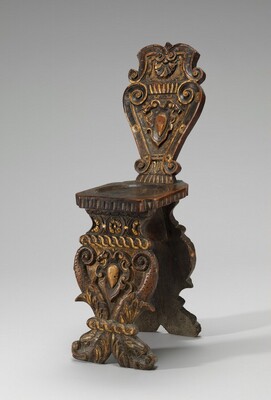
This is a photograph of an ornate wooden chair. The chair has intricate carvings and design elements throughout its structure. The backrest is detailed with scrollwork and central shields or cartouches framed by foliage designs. The seat is simple and flat, resting upon a similarly detailed base that continues the decorative motifs of scrolls and acanthus leaves. The chair appears to be made of dark wood, possibly enhanced with gold or gilded accents. The craftsmanship suggests it is an ornamental piece, possibly intended for decorative purposes as much as for utility.

Walnut Stool (Sgabello), Carved and Gilded

Italian 16th Century

The image shows a bronze medallion with a detailed design. The central subject is a shield-like motif with an emblem, possibly a cross, inside a circular crest. Surrounding the central motif are Latin inscriptions referencing the year 1517 and other design elements. The bronze material gives the sculpture a brown color with a weathered patina. The medallion features a three-dimensional relief with intricate craftsmanship.

Arms of Panciatichi [reverse]

Gauvain, Jacques

The round bronze medallion features a raised relief sculpture depicting a scene with human figures and horses in motion. There are three figures depicted - one central figure standing elevated with an outstretched arm, and two figures on horseback flanking the central figure. The surface has a textured appearance. Around the edge, there is a border of dots, and the word "TENEBRARVM" is inscribed across the top. The medallion has a rich, earthy brown color due to the bronze material. The overall appearance suggests age and intricacy in craftsmanship.

Aurora Stepping from a Car [reverse]

Italian 16th Century

The image shows a round, flat sculpture resembling a medallion or coin with a raised Latin inscription. The sculpture appears to be made of a metal material with a warm, brownish coloration and hints of darker areas suggesting oxidation or patina. The surface is worn with blemishes and a small hole near the top. The letters are engraved into the metal, standing out by casting shadows, enhancing the visibility of the inscribed words. The texture suggests it is an antique piece, contributing to its historical appearance.

Inscription [reverse]

Hagenauer, Friedrich

This is a photograph of a coin. The coin features a central image of an eagle with its wings spread, standing atop a central emblem surrounded by detailed engravings. At the eagle's chest, there appears to be a shield or emblem. Beneath the eagle, there are additional sculpted figures or symbols flanked by columns and ribbon-like elements. The coin's edge is adorned with inscribed text and a textured, beaded border that encapsulates the design. The surface of the coin shows signs of wear.

Double-headed Crowned Eagle on the Pillars of Hercules [reverse]

Neufahrer, Ludwig

The image shows a man standing with his hands on his hips. He has a strong expression with thick, slightly curled hair under a decorated cap. He wears a quilted garment with a thorn-like pattern, patterned pants, and a belt holding a sword or dagger. The background features an engraved cloudy sky.

Kunz von der Rosen

Hopfer, Daniel

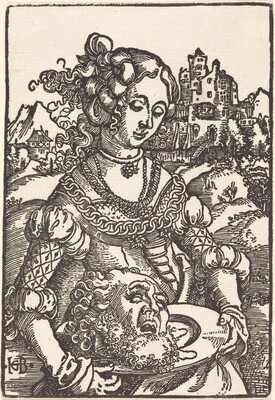
The image features a woman holding a platter with a man's head on it, set in a landscape with trees, architectural structures, and mountains.

Salome

Baldung Grien, Hans

Shown from the waist up, a light-skinned woman sits angled slightly to our right in this vertical portrait painting. The woman has blue eyes, faint brows, and a sloping nose ending in a small bulb. Her upper lip is thin and her lower lip full over a slight double chin. Her blond hair is pulled back under a gold, cap-like headdress and a black, wide-brimmed hat with a shallow crown. She wears a high-necked white, black, and gold dress with intricate detailing, a gold chain necklace that falls to her waist, and a black belt with a gold clasp and medallions. She wears two gold rings set with gems on the pointer finger of her left hand, which is folded across her belly over the other hand. A scarlet-red wallcovering with pink floral designs fills two-thirds of the space behind her. The rightmost third of the background opens onto a landscape with a tall, spindly tree, a leaping animal, presumably a dog, and a bridge across a body of water leading to a town. Across another body of water, perhaps a lake, mountains are marine blue in the distance under a clear, celestial-blue sky.

Margarethe Vöhlin [obverse]

Strigel, Bernhard

The sculpture depicts a lion attacking a horse. The lion is positioned atop the horse, with its mane flowing around its face and its paws pressing down on the horse's body. The horse's legs are bent and its head is turned to the side. The sculpture is crafted from a dark material, likely bronze, with detailed textures on both animals. The composition conveys a dramatic interaction between the two animals.

Lion Attacking a Stallion

Susini, Antonio

The Despair of Cephalus

The Despair of Cephalus

Luini, Bernardino

The sculpture is a chair-like piece with a tall, ornate backrest and intricately carved details. It features swirling patterns and symmetrical floral motifs in dark brown and golden hues. The material seems to be wood, with visible natural grain. The chair appears more like an artistic or ceremonial object rather than a practical piece of furniture, with a historical or ornate decorative style.

Walnut Stool (Sgabello), Carved and Gilded

Italian 16th Century

The image shows a round decorative plate with a mythological scene. It features an aerial view of a landscape with a fort-like structure, greenery, water, and ships with one flag reading "SELEUCO." The style is reminiscent of Renaissance painting, with intricate brushstrokes capturing figures and scenery. The color palette includes blues, greens, and earth tones with accents of orange and yellow. Muscular figures are engaged in activity, and an emblem or coat of arms is displayed above against a richly toned sky with clouds.

Plate with the sinking of the fleet of Seleucus (from the Pucci Service)

Xanto Avelli, Francesco

This image shows a sketch of a person from the chest upwards, positioned in a three-quarter view facing slightly to the left. The person has a well-defined jawline and large eyes, with high cheekbones and a straight nose. Their hair is short and combed back, with a slight receding hairline. The person is depicted wearing a robe with a high, wide collar that covers part of their neck. The robe appears to be plain, with no visible patterns or accessories. There are no visible jewelry or objects being held. The background is simple and unadorned, providing a neutral setting for the figure. Below the portrait, there is an inscription in Latin, which accompanies the drawing and includes the date "M.D.XX" (1520).

Luther as an Augustinian Friar

Cranach the Elder, Lucas
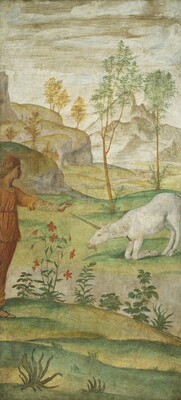
This tall, vertical fresco depicts a person in a red garment extending their arm towards a white unicorn that is bowing down on grass. The person is on the left side of the image, and only partially visible. The unicorn's long horn almost touches the person’s outstretched hand. The unicorn's back legs are extended, but its front legs are kneeling. The person and unicorn are on a light green field with red flowers and small green ferns. Behind them are thin trees in front of distant, rocky mountains. The sky above is beige, blending into the earthy tones of the landscape.

Procris and the Unicorn

Luini, Bernardino
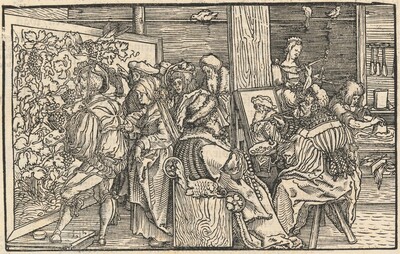
Officia M.T.C.

Officia M.T.C.

Cicero, Marcus Tullius

The sculpture features a relief depicting a woman seated and holding a child on her lap. Another small child stands slightly to the side, reaching up towards the woman. The figures are set within an ornate frame filled with intricate designs and patterns, including floral motifs and architectural elements in the background. The sculpture displays a rich, dark bronze color. The surface shows intricate detailing, highlighting the features of the figures' clothing and the ornate frame. The sculpture appears to be a small, decorative piece designed to be displayed flat against a surface.

Madonna and Child with Saint John

Venetian 16th Century

This is an image of a decorative ceramic plate with a heraldic design. The plate is circular and adorned with a central coat of arms or shield. The shield is divided diagonally by a gold band with two heraldic animals, likely greyhounds, depicted in a running posture with gold stripes. The upper part of the shield contains three gold fleur-de-lis symbols on a blue field. Surrounding the shield is an intricate design of green laurel branches with acorns and yellow floral elements on a blue background. The date "1532" is inscribed on the plate. The ceramic plate combines craftsmanship with rich symbolic imagery, indicative of heraldry. The design reflects a family or regional coat of arms and emphasizes tradition and artistry common in European decorative arts.

Circular plaque with fruited wreath enclosing a shield of arms

Faenza 16th Century

This is a tapestry showing a crucifixion scene. At the top of the tapestry are three men hanging from large wooden crosses, one in the center and the other two near the upper right and left corners. The men on the sides have agonized expressions, and their bodies are contorted, limbs bent and curved. The central man is still, his arms stretched outward, hands and feet nailed to the wood. He has a bleeding cut on his side and wears a tanged thorny circlet on his reddish-brown hair. The men all have cloths of various shades of gray and blue tied around their waists. Below, numerous other men and women are gathered, wearing colorful dresses and robes in shades of blue, red, orange, green, and purple. Near the bottom left corner, a woman in a blue dress and a white head covering appears to have fainted, and two other women grab her arms. Another woman stands at the base of the central cross, looking down at the fainted woman. All four of these women have halos, as does a man on the left who looks upward, his folded hands raised. In the bottom right corner, another man kneels down next to several tools, reaching for a loop of rope. The background features a pale green landscape with hills, trees, and gray buildings under a sky swirling with blue and white clouds. A red sun and a pale moon appear in the sky on either side of the central crucified man. The central scene of the tapestry is contained in an intricately decorated red border which features designs of flowers, fruit, and curling vines.

The Crucifixion

Pannemaker I, Pieter

This is a drawing of a heraldic coat of arms with two angels and a large bishop's mitre. The coat of arms is quartered, featuring lions in red sections and frog-like creatures in black sections, with a smaller inescutcheon in the center showing a lion. Two angels support the coat of arms and hold a bishop's mitre above it. The colors include reds, greens, black, and gold. The composition is framed with intricate black linework.

The Coat of Arms of Wigeleus von Fröschel, Bishop of Passau

Burgkmair I, Hans

This is a painting of a group of figures gathered around a long table with various dishes and food items. The figures are depicted in intricate detail, with the central figures showing emotional expressions. The setting is a richly decorated interior with ornate architectural elements, including columns, arches, and a large window. The clothing of the figures is rendered with rich colors and patterns, emphasizing the formal and historical significance of the scene. The artwork exhibits rich texture and vibrant colors, consistent with the style associated with the artist, reflecting a scene of historical or religious importance.

Plaque with the Last Supper

Penicaud, Jean I

The image shows two figures in full view. The person on the left is standing upright, holding a child in their arms. The person on the right is bent over slightly, facing the person on the left. Both individuals have halos around their heads. The figure on the left has a covered head, with mature facial features, a beard, and the child they are holding has curly hair. The figure on the right is wearing a hat, and their facial features are less discernible due to the position. The person on the left is draped in robes, and the child is also wrapped in cloth, while the person on the right appears to be wearing a garment with a checkered texture and decorative elements. The object next to the leaning figure resembles a crib or type of container with a radiating design above it. The background consists of a simple lined texture, implying an interior setting with no distinct features beyond the figures.

The Virgin and Child and Saint Anne

Altdorfer, Albrecht
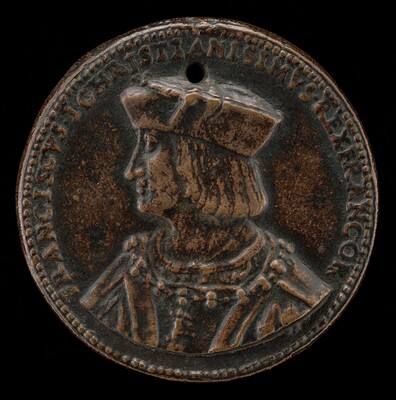
This is an image of an ancient coin or medallion. The object features a detailed profile relief of a regal figure facing left, wearing an elaborate crown or hat and a lavishly decorated robe adorned with patterns and possibly gemstones. Surrounding the figure is a border of text engraved along the edge of the coin. The surface of the medallion shows a patina, indicating age, and there is a small hole near the top. The craftsmanship and detail hint at its historical significance, likely commemorating a person of importance or serving as currency or a medallion during a specific period.

François I, 1494-1547, King of France 1515 [obverse]

Pomedelli, Giovanni Maria

The sculpture is a relief portrait on a medallion featuring a woman in profile facing left. She wears an elaborate headdress and the medallion appears to be made of a bronze or brass alloy. Surrounding the medallion is an inscription, “DIANA . DVX . VALENTINORVM . CLARISSIMA.” The craftsmanship shows intricate details in the headdress and the woman's facial features. The medallion appears slightly aged, with wear and patina consistent with its metallic composition.

Diane de Poitiers, 1499-1566, Wife of Louis de Breze, Duchess of Valentinois 1548 [obverse]

French 16th Century

This is a drawing of a printed page consisting of text and an illustration. The page features a decorative title detailing an event relating to Henry II, King of France, in the year 1549. Below the title and main text, there is a small woodcut illustration depicting a figure carrying a staff or spear, navigating through a landscape with trees in the background, and water possibly flowing at their feet. The text beneath this illustration mentions Paris and a bookseller named Jehan Dallier. The overall composition of the page reflects the style of 16th-century printed documents, characterized by its typography and engravings.

[Entrée d'Henri II] C'est l'ordre qui a este tenu a la nouvelle et ioyeuse entrée que tres hault, tresexcellent et trespuissant Prince le Roy treschrestien Henry deuzieme de ce nom à faicte en sa bonne ville et cité de Paris...

Goujon, Jean