← All artists

Piranesi, Giovanni Battista

10 works

Lapides Capitolini; Le Rovine dell Castello dell'Acqua Giula; Antichità di Cora

Lapides Capitolini; Le Rovine dell Castello dell'Acqua Giula; Antichità di Cora

Piranesi, Giovanni Battista

The image features two illustrations. The top illustration shows a detailed architectural drawing of a stone block with labeled sections and parts marked with letters. The perspective is from a slight angle, emphasizing the three-dimensional aspect and showcasing architectural elements like channels and holes. The drawing style is technical and precise, with clean, deliberate lines defining the structure. The bottom illustration depicts an ancient ruin, potentially part of a coliseum or amphitheater. The perspective is from a low vantage point, looking up towards the structure. A series of arches guide the eye towards a tall tower in the middle, with additional buildings and vegetation in the background. The brushstrokes are expressive, creating a textured, cross-hatching effect to indicate the aged and overgrown nature of the ruins. The color palette is monochromatic, using contrasts of light and dark to convey depth and detail, similar to etchings or engravings.

Le Antichità Romane (volume I)

Piranesi, Giovanni Battista
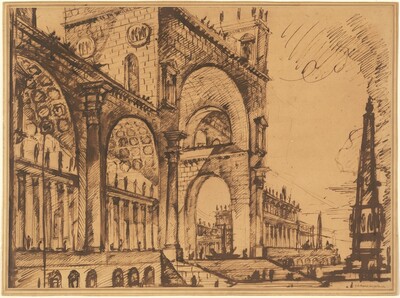
This is a drawing of an elaborate architectural structure featuring grand arches, columns, and detailed stonework. The design includes large arches, columns, circular medallions, arched windows, and a colonnade leading into the depth of the structure. In the distance, an obelisk-like structure is visible. The drawing uses cross-hatching and bold lines to define depth and form.

Fantasy on a Magnificent Triumphal Artch

Piranesi, Giovanni Battista

The image is an etching of a classic architectural scene with an elevated perspective, offering a broad view of the structures. The horizon is visible along the distant architectural lines and beyond the archway. The etching features precise linework detailing the textures and forms of ancient stone structures. The color palette is monochromatic, using black and white for depth and detail. The grand arch of Settimio Severo is prominent in the foreground, with intricate carvings and deteriorating stones. Various ancient buildings with Roman architectural features like columns and arched windows are visible in the distance. The sky has a few clouds, creating a sense of openness, and people are scattered throughout the scene for scale.

Arco di Settimio Severo

Piranesi, Giovanni Battista
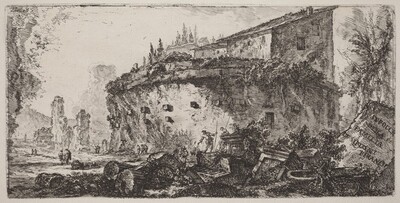
The image shows a bird's-eye view of a rural scene with ruins and distant landscape. The intricate 18th-century style with black and white color palette emphasizes textural detail and contrast. Remnants of architectural elements and figures can be seen among scattered ruins. A wall with foliage is in the foreground, while the background shows a rugged terrain with more ruins and vegetation.

Sepulcro de famiglia de' Scipioni

Piranesi, Giovanni Battista

The image is an etching of an ancient ruin, showing grand columns from a low perspective. The horizon is low, emphasizing the tall columns which break the line, with remnants of foliage or sculptural decoration on top. The lines are intricate, creating texture and depth on the stone surfaces. The color scheme is monochromatic, enhancing the classic feel. Beyond the columns, buildings and ruins fade into the distance. Small figures and livestock give a sense of scale. The sky has delicate clouds, creating a serene ambiance.

Vestigi del tempio del Giove Statore

Piranesi, Giovanni Battista

The image is an etching of a ruinous arch, slightly off-center, with intricate line work to depict its structure. The horizon is above the arch, showing vegetation and rugged terrain in the distance. The etching displays textures representing flora and stone, with shadows and depth created by dense hatching. The sky is light with airy cross-hatching. The color palette is black on off-white paper. Foliage and rough ground are detailed near the arch, and ancient stonework and rocky formations extend into the landscape beyond.

Arco di Pola in Istria

Piranesi, Giovanni Battista
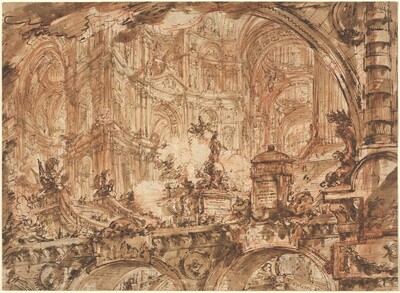
The image shows intricate lines and shapes creating elaborate arches and architectural structures. The drawing has a swirling and overlapping design that suggests chaotic motion within a grand structure. The abstract assembly resembles a grand cathedral or a palatial hall, with arches and columns akin to classical architecture. Figures and decorative flourishes are interspersed throughout, resembling statues or ornate carvings typical of an embellished building.

A Magnificent Palatial Interior

Piranesi, Giovanni Battista

The image depicts architectural diagrams and cross-sections of wooden structures. The drawing displays detailed illustrations and cross-sections of roof construction, including various aspects, sections, and elements. Technical information about structural components like beams, columns, and trusses are provided through labels and measurements. The sections are neatly organized within boxes, potentially representing different perspectives or construction stages. The style is technical and precise, typical for architectural drawings used for educational or construction purposes.

Della Magnificenza ed Archittetura; Osservazioni; E Parere su l'Architettura

Piranesi, Giovanni Battista

The image shows an expansive scene of ancient ruins and natural surroundings, viewed from a slightly elevated perspective. The horizon is in the upper third of the image, featuring distant structures and a line of trees outlining the skyline. The etching style is defined by intricate lines and hatching that detail the architecture and foliage. The color palette consists of shades of black and gray to create contrast and depth. Closest to us are ancient ruins and a landscape leading to a winding path, with more ruins and vegetation extending into the distance. In the background, more ruins are partially obscured by trees, blending into the sky.

Parte dell'antica Via Appia fuori de Porta S. Sebastiano

Piranesi, Giovanni Battista