← All artists

Kirchner, Ernst Ludwig

40 works
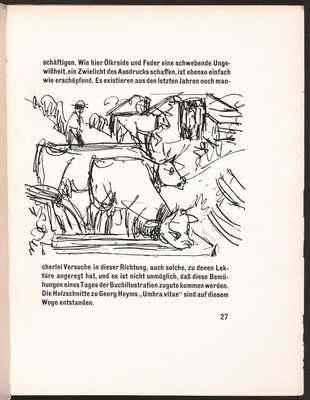
The image shows two cows and a man surrounded by rough sketch lines. There are two cows in the foreground, depicted with fluid lines suggesting movement. Above the cows are sketchy lines resembling barns or rural buildings, with a figure resembling a man nearby. The drawing is placed on a page with text above and below, creating an illustrative connection between the art and text.

In-text plate from Kirchner Zeichnungen (Kirchner Drawings)

Kirchner, Ernst Ludwig
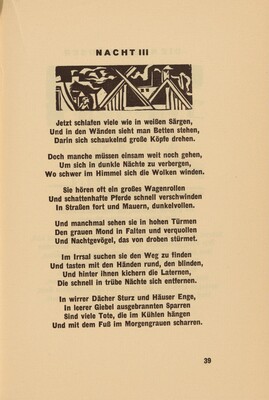
There is a rectangular abstract illustration at the top of the page. The image has bold, dark lines and shapes against a light background. The illustration depicts a cityscape with buildings and a sky filled with swirling cloud-like forms. Below the illustration, there is a block of centered text on the page. The title "NACHT III" is in bold capital letters, followed by a poem in German. The text is printed in a clear serif typeface, with the page number "39" at the bottom right corner.

Nacht III (Night III) (headpiece, page 39) from Georg Heym: Umbra Vitae (Georg Heym: The Shadow of Life)

Kirchner, Ernst Ludwig

The image features a series of jagged, angular lines and geometric shapes forming a complex pattern. The arrangement resembles human figures, with bold outlines hinting at heads, limbs, and torsos. The foreground includes a central figure with exaggerated facial features and wild hair, surrounded by other figures. The composition conveys a crowded scene with a sense of motion and interaction, similar to people gathered in a limited space.

Die Irren I (The Mad I) (headpiece, page 24) from Georg Heym: Umbra Vitae (Georg Heym: The Shadow of Life)

Kirchner, Ernst Ludwig

This is a drawing of a book cover for "Umbria Vitae" by Georg Heym. The cover features bold typography and a central woodcut illustration depicting two abstract figures with mountainous or cliff-like forms in the background. The lines are sharp and angular, typical of expressionist art. The illustration is attributed to Ernst Ludwig Kirchner. The drawing is bordered by simple lines and has handwritten inscriptions at the bottom, detailing information about the publication, including the publisher and year.

Titelvignette (title vignette) from mock-up of Georg Heym: Umbra Vitae (Georg Heym: Shadow of Life)

Kirchner, Ernst Ludwig

A man and woman with pale, pink-colored skin hold hands and dance in this stylized, abstracted vertical painting. The woman’s breasts are exposed, and a single teal-green cloth edged in sapphire blue appears to encase both of their torsos. The man is behind the woman just to our left, and he looks down at her. Her shoulders face us, but she looks back at him, both in profile. Their faces are each painted with one or two strokes each for eyebrows, eyes, lips, and, for the man, a nose. Their hands are lifted and joined, blending into single forms, and the woman takes a wide step to our left. Their bodies are outlined with maroon red, black, or slate blue. The background is ice blue interspersed with angular, tent-like forms painted in royal blue, pale blue, and maroon. The frame is shown and reveals that the painting was done on the back of a stretched canvas. A label affixed to the top rail reads “Nachl. E.L. Kirchner TA/BH 19.”

Dancing Couple in the Snow [reverse]

Kirchner, Ernst Ludwig

The image shows a series of abstract, thick black lines outlining human figures. On the left side, two figures are depicted in motion, with one figure raising their hands and the other stretching out an arm. On the right, two figures are seated with angular and abstracted limbs tucked closely around their bodies. The design features bold black lines framing the figures against a pink background, with a structure resembling a linked chain of stylized squares.

Vorsatz (back endpapers) from mock-up of Georg Heym: Umbra Vitae (Georg Heym: Shadow of Life)

Kirchner, Ernst Ludwig

The image at the top of the page shows abstract interlocking geometric shapes and lines that resemble human faces. The shapes suggest a group of people with various expressions, arranged in a structured yet chaotic manner. The design is reminiscent of tribal masks or ancient carvings. Below the artwork, there is German text formatted in a structured layout, similar to a poem or song lyrics. The combination of the abstract image and text creates a juxtaposition of visual and literary elements.

Die Irren II (The Mad II) (headpiece, page 26) from Georg Heym: Umbra Vitae (Georg Heym: The Shadow of Life)

Kirchner, Ernst Ludwig

This is a black and white drawing featuring abstract figures surrounding geometric structures. The drawing is on a page with German text titled "DIE NEUEN HÄUSER." The abstract illustration on the page shows angular forms suggesting architectural elements and elongated figures interacting with each other. The drawing style uses heavy black lines and shapes to create contrast. The figures are in dynamic poses, implying movement or action in a simplified and distorted environment.

Die Neuen Häuser (The New Houses) (in-text plate) from mock-up of Georg Heym: Umbra Vitae (Georg Heym: Shadow of Life)

Kirchner, Ernst Ludwig

This is a black and white drawing of an expressionistic scene with a group of individuals and a piece of text. The illustration shows figures in a style similar to woodcut prints, with strong angular lines and sharp contrasts. The scene features abstracted figures, some with raised hands, depicted in a dramatic and stylized manner. The text "DIE TAUBEN II" is present above the image, and below the artwork, there is an excerpt of German text. The composition conveys an introspective or solemn tone typical of expressionist art, emphasizing emotion and the human condition.

Die Tauben II (The Deaf II) (headpiece, page 46) from Georg Heym: Umbra Vitae (Georg Heym: The Shadow of Life)

Kirchner, Ernst Ludwig

The image contains bold, angular lines and shapes creating an abstract winter landscape. A fragmented face appears on the left within undulating forms resembling trees or branches. The right side displays structures with slanting rooflines, possibly representing houses or sheds adorned with snow-like textures. The abstract elements evoke a winter scene, with the face suggesting indoor observation.

Der Winter (The Winter) (headpiece, page 37) from Georg Heym: Umbra Vitae (Georg Heym: The Shadow of Life)

Kirchner, Ernst Ludwig

This is a drawing of an abstract scene along with text. The image contains a black and white illustration above a poem or text titled "Der Krieg." The drawing features an abstract arrangement of figures and forms blending into one another, with dynamic elements suggesting movement. Below the illustration, the text is laid out in stanzas and is in German. The composition likely aims to evoke themes related to conflict, upheaval, or internal struggles. The use of black and white enhances the stark nature of the themes presented.

Der Krieg (The War) (headpiece, page 3) from Georg Heym: Umbra Vitae (Georg Heym: Shadow of Life)

Kirchner, Ernst Ludwig

The image shows abstract shapes and lines forming two distinct clusters against a monochromatic background. On the left, there are angular, abstract faces resembling caricature-like facial expressions. On the right, there are elongated, linear figures suggesting human forms in motion. Both clusters are enclosed within rounded edges and separated by a horizontal division. Handwritten text is present at the top and bottom of the page.

Vorsatz (front endpapers) from mock-up of Georg Heym: Umbra Vitae (Georg Heym: Shadow of Life)

Kirchner, Ernst Ludwig

This is a drawing of a village scene with houses and foliage. The artwork is executed in a bold, woodcut style and features several small, peaked-roof houses nestled among abstracted trees and foliage. There is a figure with a pointed head and intricate patterns in the surroundings. The drawing is surrounded by text in German. The monochromatic, high-contrast technique is typical of woodblock prints.

Spitzköpfig Kommt Er... (With a Pointed Head He Rises) (headpiece, page 13) from Georg Heym: Umbra Vitae (Georg Heym: The Shadow of Life)

Kirchner, Ernst Ludwig

The image displays abstract bold angular shapes and intersecting lines in black at the bottom of a text-filled page. The forms suggest movement and overlap, resembling silhouettes of people and flames. Within the design, figures engaged in action can be recognized, suggesting a scene of activity or commotion. The solid black and sharp contrasts lend depth and complexity to the composition.

Der Krieg (The War) (in-text plate) from mock-up of Georg Heym: Umbra Vitae (Georg Heym: Shadow of Life)

Kirchner, Ernst Ludwig

The image shows a figure sitting in an angled chair. Their body is partially visible from the chest down to the knees, with hands on their lap. The person has abstract facial features with sharp, angular lines, and short hair. They wear a dark outfit with a collar or scarf around the neck. Around them are abstracted elements of a room, including a wall with a framed picture and three plant-like forms on a shelf. There is a table nearby with an unknown object. The background features a linear style with dark lines and shadows.

plate 1 in Alfred Döblin: Das Stiftsfräulein und der Tod (Alfred Döblin: The Canoness and Death)

Kirchner, Ernst Ludwig

The image displays a block of text in a serif typeface, with evenly spaced lines and justified alignment. Below the text is an abstract black and white illustration portraying a cluster of angular shapes and lines that suggest human faces and figures. The abstract forms resemble a crowd or a group of people, with some elements hinting at eyes, noses, and mouths amidst swirling lines. The figures appear intertwined, conveying a sense of movement or congregation.

Die Morgue (The Morgue) (in-text plate) from mock-up of Georg Heym: Umbra Vitae (Georg Heym: Shadow of Life)

Kirchner, Ernst Ludwig

The image depicts complex shapes and lines on a red background. The shapes resemble human figures in different poses - two standing and two sitting, enclosed in rectangular outlines. The figures appear stylized with emphasis on form. Black shapes interconnect, creating a puzzle-like composition where the figures interact within outlined spaces.

Vorsatz (back endpapers) from Georg Heym: Umbra Vitae (Georg Heym: The Shadow of Life)

Kirchner, Ernst Ludwig

The image features angular lines and bold black shapes forming an abstract design. On the left side, there is a block of text with a striking font amidst fluid shapes on the right. The abstract lines on the right suggest elongated figures or flowing fabric. The design merges text with fluid forms, combining the appearance of a book cover or a poster with abstract expression.

title page for Alfred Döblin: Das Stiftsfräulein und der Tod (Alfred Döblin: The Canoness and Death)

Kirchner, Ernst Ludwig

Self-Portrait

Self-Portrait

Kirchner, Ernst Ludwig

The image shows a page from a book with text in German above a black and white illustration. The illustration is located towards the bottom of the page, just above the page number 18. It depicts a stylized landscape or scene with arched structures resembling domes or arches at the center, surrounded by foliage or trees. The bold and rough brushstrokes or carving technique create contrasts and a sense of movement. The color palette is monochromatic, with black ink on a cream-colored page. The horizon is not defined, but the composition directs the focus towards the central arch formations, emphasizing depth and structure. There are no visible elements in the distance or background, as the composition concentrates on the central elements.

Mond (Moon) (in-text plate) from mock-up of Georg Heym: Umbra Vitae (Georg Heym: Shadow of Life)

Kirchner, Ernst Ludwig

This is a drawing of an abstract coastal cityscape. The drawing shows stylized cityscape with contrasts in black and white, likely done through a woodcut print technique. The image depicts abstract architectural forms: domes, arches, and steps spiraling upwards. Clouds or waves fill the sky. Beneath the drawing, text in German describes poetic imagery associated with the sea and city.

Die Meerstädte (The Sea Cities) (headpiece, page 20) from Georg Heym: Umbra Vitae (Georg Heym: The Shadow of Life)

Kirchner, Ernst Ludwig
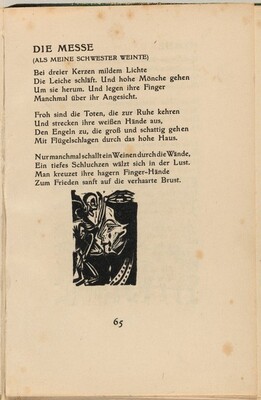
On the page, a bold abstract shape is positioned beneath a block of text. This dark, jagged shape consists of angular lines and contrasting areas of black and white, forming a pattern. The flowing, curved lines within the shape could be seen as stylized facial features or draped fabric. This form creates an organic contrast to the rectangular, orderly text above it.

Die Messe (The Mass) (in-text plate) from mock-up of Georg Heym: Umbra Vitae (Georg Heym: Shadow of Life)

Kirchner, Ernst Ludwig

The image depicts an abstract black and white illustration with dynamic lines and shapes. At the top, there is a block of solid, dark lines and angular forms. In the middle, abstracted human and animal forms can be seen. The overall composition evokes a woodland scene with elements that suggest intertwined flora and fauna. Below the illustration, there is text printed in German and the numbering 35 is noted at the bottom right corner.

Der Sterbende Faun (The Dying Faun) (headpiece, page 35) from Georg Heym: Umbra Vitae (Georg Heym: The Shadow of Life)

Kirchner, Ernst Ludwig

The image shows a design of jagged and curved lines forming abstract figures resembling human faces and bodies. The overlapping shapes create a sense of depth and complexity, with the figures appearing to emerge from one another. The composition evokes a chaotic unity, suggesting a bustling scene or crowded space.

Die Irren I (The Mad I) (in-text plate) from mock-up of Georg Heym: Umbra Vitae (Georg Heym: Shadow of Life)

Kirchner, Ernst Ludwig

This is a drawing of abstract forms resembling rooftops and trees. Bold black lines and sharp angles create a dramatic and chaotic vision. There is German text above the drawing, and the page shows signs of aging with discolorations and light stains on the edges.

Spitzköpfig kommt er... (With a Pointed Head He Rises...) (in-text plate) from mock-up of Georg Heym: Umbra Vitae (Georg Heym: Shadow of Life)

Kirchner, Ernst Ludwig

The image depicts a portrait of a person with only the upper body visible. The person is shown in a three-quarter view, with the head slightly tilted forward and to the side, eyes looking down. The facial features are stylized with angular lines and patterns, creating a sense of sharp cheekbones, a defined nose, and closed lips. The hair is portrayed as a solid, dark mass. The individual is wearing a simple garment with linear patterns on the neck and shoulder area. The background has abstract, irregular shapes.

Die Graphik Ernst Ludwig Kirchners bis 1924, von Gustav Schiefler Band I bis 1916 (The Graphic Art of Ernst Ludwig Kirchner to 1924 by Gustav Schiefler Volume 1 to 1916)

Kirchner, Ernst Ludwig

The image shows irregular and interconnected lines forming abstract human figures. Some figures are standing, some are sitting, and they appear to be interacting with each other. It resembles a group of people gathered together in a simple and sketchy style.

In-text plate from Kirchner Zeichnungen (Kirchner Drawings)

Kirchner, Ernst Ludwig
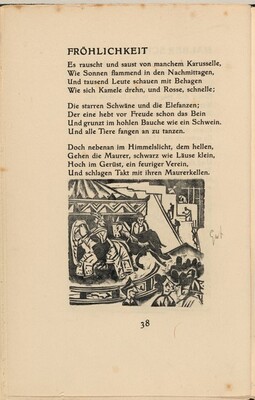
This is a drawing of a scene in a fairground or carousel setting. The image features an abstract, woodcut-style illustration, depicting figures riding on carousel animals. The animals appear to be elaborately designed, possibly elephants or similar creatures, with geometric patterns. The figures atop the animals seem to be engaged in various activities, with some positioned as if they are playing musical instruments. The composition includes dynamic lines that suggest movement and festivity. The text above the image contains a poem in German, titled "Fröhlichkeit," which translates to "Joy." The overall style and content indicate a lively and celebratory atmosphere, typical of a fairground scene.

Fröhlichkeit (Joyfulness) (in-text plate) from mock-up of Georg Heym: Umbra Vitae (Georg Heym: Shadow of Life)

Kirchner, Ernst Ludwig

This is a drawing of an abstract landscape and figure with accompanying text. The image features a stylized black and white depiction of a mountainous landscape with a central seated figure set within angular and sharp lines. Above the image is the title "PILATUS" in bold text. Below the drawing, there is German text. The artwork is rendered with a woodcut-like style that emphasizes contrast and texture, characteristic of expressionist prints. At the bottom of the page, the number 57 is printed.

Pilatus (Pilate) (headpiece, page 57) from Georg Heym: Umbra Vitae (Georg Heym: The Shadow of Life)

Kirchner, Ernst Ludwig

The image shows a stylized artwork of a profile view of a person, with their head and part of the upper body visible. The person is facing to the left, with their hand touching their head. The facial features are abstract and angular, rendered in bold black lines. The hair is simplified and dark. The person appears to be wearing a garment, with contours extending from the neck downward. The background is textured with dark green and off-white tones, with text at the top reading "Georg Heym" and "UMBRAVITÆ."

Bucheinband (cover) from mock-up of Georg Heym: Umbra Vitae (Georg Heym: Shadow of Life)

Kirchner, Ernst Ludwig
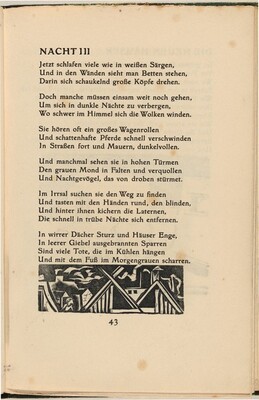
This is a photograph of a page from a book. The page contains a German text titled "NACHT III" with a small illustration of rooftops against a dark sky below. The text is neatly printed with occasional indents for new stanzas. The illustration uses high contrast black and white tones, resembling a woodcut style. The page has sepia tones and spots of discoloration, giving it an aged appearance. The page number "43" is centered at the bottom.

Nacht III (Night III) (in-text plate) from mock-up of Georg Heym: Umbra Vitae (Georg Heym: Shadow of Life)

Kirchner, Ernst Ludwig

The image displays jagged, angular lines and shapes forming an abstract composition. Some shapes resemble trees and rugged mountainous landscapes, suggesting a forested scene with light and shadow interplay. Bold black and white contrast enhances the abstract quality, and the dense, overlapping forms evoke a thicket or dense woods, with towering trees and uneven terrain.

In-text plate from Kirchner Zeichnungen (Kirchner Drawings)

Kirchner, Ernst Ludwig
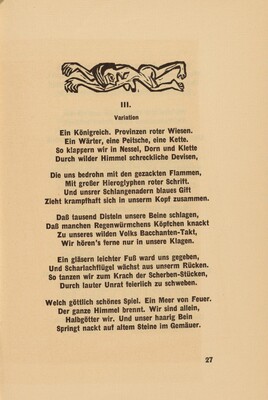
The image features an abstract drawing at the top with fluid, intertwining lines forming shapes. The shapes resemble a pair of symmetrical figures. Below the drawing, centered text in German is presented. The visual layout suggests a page from a book or collection of writings.

Liegende (Die Irren III) (Reclining Figure [The Mad III]) (headpiece, page 27) from Georg Heym: Umbra Vitae (Georg Heym: The Shadow of Life)

Kirchner, Ernst Ludwig

The image displays bold, angular lines and contrasting shapes, forming an abstract depiction of a face. The facial features, such as the eyes and mouth, have been exaggerated with sharp lines, which blend into rectangular forms resembling crosses. The elements combine to create a visually intricate and abstract style.

Judas (headpiece, page 59) from Georg Heym: Umbra Vitae (Georg Heym: The Shadow of Life)

Kirchner, Ernst Ludwig

The image showcases a contents list in German on the top portion, with various titles and page numbers. Below the text is a black and white illustration of a reclining figure surrounded by drapery, with the initials "EK" in the bottom right corner of the image.

Liegender Rückenakt (Reclining Nude) (tailpiece, table of contents) from Georg Heym: Umbra Vitae (Georg Heym: Shadow of Life)

Kirchner, Ernst Ludwig

This is a drawing of a group of people in motion. The image shows stylized line drawings of figures in a woodcut style, emphasizing outlines and forms without detailed facial features. Below the drawing, there is German text with the title "Die Blinden Frauen" followed by poetry. The page number 38 is present, suggesting this is a page from a book.

Die Blinden Frauen (The Blind Women) (headpiece, page 38) from Georg Heym: Umbra Vitae (Georg Heym: The Shadow of Life)

Kirchner, Ernst Ludwig

This is an image of mountainous landscapes with buildings and pathways. The image contains text printed in German, discussing artistic themes. In the lower right section, there is an illustration in black ink depicting a stylized mountain landscape with a winding path or road leading up the mountain, surrounded by trees. Small, simple figures are shown traversing the path, with simple buildings at the base amongst trees, creating a rustic, outdoor scene typical of mountainous or rural regions. The imagery is minimalist and stylistic, focusing on basic outlines and shapes to convey the scene.

In-text plate from Kirchner Zeichnungen (Kirchner Drawings)

Kirchner, Ernst Ludwig
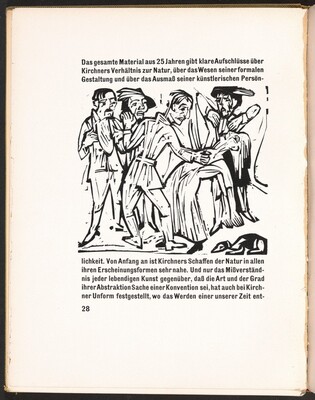
The image is a black and white illustration showing three people in a dynamic pose, with a partial view of their bodies from the waist up. The figures are leaning and reaching towards each other. Their features are stylized, with angular lines defining their faces and hair. They are wearing loose-fitting garments, with one figure in the center wearing a hat. The clothing is simple, focusing on shapes and lines. There is no visible jewelry or objects being held. The background is white. The image is surrounded by a block of text in German above and below and the page number "28" is visible at the bottom.

In-text plate from Kirchner Zeichnungen (Kirchner Drawings)

Kirchner, Ernst Ludwig
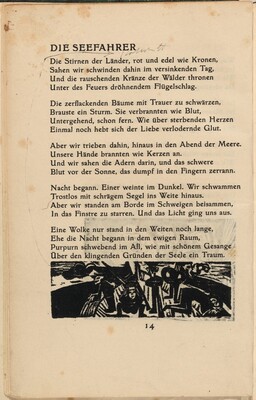
This is a drawing of a page featuring a poem titled "DIE SEEFARHER" in German printed in a serif font. The text occupies most of the upper portion of the page. Below the text is a small black and white abstract drawing of geometric shapes. The drawing contains a complex and slightly chaotic arrangement of figures or forms. The page number "14" is centered below the image.

Die Seefahrer (The Seafarer) (in-text plate) from mock-up of Georg Heym: Umbra Vitae (Georg Heym: Shadow of Life)

Kirchner, Ernst Ludwig

This is a drawing of a dark, abstract composition with German text. The image features a woodcut-style illustration at the top with intricate shapes. Below the illustration, there is German text with the title "DIE MESSE" and a subtitle "(ALS MEINE SCHWESTER WEINTE)". The text consists of a poem or prose that evokes a somber and reflective mood. The text describes a scene involving candles, monks, and a sense of peace or tranquility amidst death or mourning.

Die Messe (The Mass) (headpiece, page 61) from Georg Heym: Umbra Vitae (Georg Heym: The Shadow of Life)

Kirchner, Ernst Ludwig