← All artists

Italian 16th Century

21 works

The curving X-frame design of this wood chair creates an hourglass silhouette from the front, and creates a bucket-like seat for the sitter. The front face of the wooden frame is carved with curving vines and stylized bunches of grapes and leaves, and the frame ends with clawed lions’ feet at the bottom. The seat and legs are made up of alternating slats so the chair could fold up. Imagine interlacing your fingers and then moving your palms back and forth—that is how the pivot of this chair works. The arms of the chair, which have a rounded knob at each front end, rest along the top edges of the slats. The back rail connects at the back of the arms. A crest at the center of the back rail is flanked by the capital letters “A” to the left and “G” to the right. The crest and letters are contained within a medallion-like form, and the sides of the back rail dip down to meet the arms. A worn, pale blue velvet cushion rests on the seat, and has tassels at the front corners. The chair is shown against a pale gray background.

Walnut Savonarola Chair with Letters A.G.

Italian 16th Century

The image is a sketch of several figures, likely male, seated around a central figure on a table or platform. The central figure has long hair and a beard, seated facing forward. The surrounding individuals have indistinct faces and are oriented towards the central figure. Their clothing is suggested by flowing lines indicating loose garments or robes. The sketch is on a textured, aged background.

The Last Supper

Italian 16th Century

The sculpture is a round medallion featuring the bust of a female figure. The subject is depicted in a frontal pose with her head slightly tilted, displaying long, flowing hair. The attire appears to be loosely draped around her shoulders, accentuating the form of her upper body. The sculpture is crafted from a material resembling aged bronze, evidenced by its dark, metallic color with patches of patina, giving it a rugged texture. The medallion includes inscriptions around the perimeter. The three-dimensional relief of the bust stands out against the flat surface of the medallion, lending it a sense of depth and realism.

Elvira, Daughter of Consalvo de Córdoba [obverse]

Italian 16th Century

Descent from the Cross

Descent from the Cross

Italian 16th Century

The image shows two central figures, one standing on a raised surface on the right with a staff and a vessel pouring water over the head of the other figure. The figure being baptized has long hair falling to their shoulders and serene facial features, with arms bent and hands clasped at the chest, wearing minimal clothing. The baptizing figure has a beard and detailed facial features, wearing a draped garment. Around them is a larger halo. On the left, a group of angels is present, with two angels kneeling, characterized by soft facial features and wings folded behind them, wearing draped robes. Above the central figure, a dove hovers with radiant lines spreading outward. The background has dark, crosshatched patterns for depth and an arched motif above, with the ground below resembling agitated waters. The image is framed, suggesting age or historical significance.

Baptism of Christ

Italian 16th Century

The sculpture depicts a small figure of a child seated with a posture suggesting relaxation or contemplation. The child appears to be holding an object that extends upwards near the head. The sculpture is made of metal with a golden hue, and some areas show wear with the underlying darker metal visible. It is mounted on a cylindrical base made of a polished stone material with a deep maroon color and white speckles throughout.

A Triton

Italian 16th Century

This painted plate shows three armored people and two horses in a dynamic scene set against a green and blue landscape. The people all have light skin and wear armor in shades of yellow and gold, with red fabric around their waists. They all wear different hats: one wears a yellow hat, one wears a blue hat, and one wears an orange hat with large blue feathers. Closest to us, a person jabs a spear towards a large white horse on the right. Another person is behind this horse, holding its reigns and looking over their shoulder. In the background on the left, a person riding a tan horse points a long sword down at the spear-wielder. In the background, blue water winds through light green grass and pale rock formations, with a few light blue trees. In the distance on the right is a large white castle with a golden roof under a blue sky that fades to yellow near the horizon. The rim of the plate is gold.

Flat plate with a battle scene

Italian 16th Century

This is a painting of a scene featuring a young, winged figure reaching out to a robed woman. The round plate shows a colorful, intricate scene with a winged cherubic figure and a woman dressed in a flowing garment. The background displays a landscape with a twisted tree shape, rolling hills, and a detailed village under a sunset or dawn sky with hues of orange, blue, and pink. The style resembles the work of Renaissance artist Luca della Robbia, known for vibrant colors and intricate detailing typical of painted maiolica ware from that period.

Plate with the reconciliation of Cupid and Minerva

Italian 16th Century

This is a painting of a mythological scene on a decorative plate. The scene depicted involves several figures engaged in an active, dynamic composition. The central figure is supported or carried by several other figures along a landscape filled with vibrant colors, including greens, blues, and warm earth tones. The background features an idyllic landscape with trees and rocky formations under a sky exhibiting gradations of blue and orange hues. A figure to the left appears to be playing a musical instrument. This is in the style of Renaissance majolica pottery, encompassing mythological and classical themes painted with vivid colors on ceramic ware.

Plate with the Triumph of Bacchus

Italian 16th Century

This is a colorful, decorative plate. The center of the plate features a coat of arms in vibrant tones of gold and deep blue, with the outline of a black bird. The shield is against a green and blue landscape, circled by a thick mustard-yellow border. The wide rim of the plate is adorned with green leaves, floral patterns, and curling scrollwork in blue, red, and yellow hues. There is the repeating image of the head of a creature with curled lips and fangs that tapers into a thin, intertwining body.

Plate with border of foliate scrollwork with dolphin heads and cornucopias; in the center, shield of arms of Vigerio of Savona

Italian 16th Century

The image shows a decorative table with a dark green rectangular top framed by a wooden border. The table is made of dark brown wood with intricate carvings of acanthus leaves and classical motifs. It has a single ornate pedestal support that leads to a four-footed base with matching carvings. The table is at a standard coffee table height.

Walnut Pedestal Table with Inlaid Marble Top

Italian 16th Century

The image displays a wooden chair with an engraved backrest and a cushioned seat. The backrest has gold rivets and carved details, and the seat has a golden fringe. The chair is centered, with arms slightly extended, and ornate carvings are visible on the backrest and lower bar.

Leather-covered Walnut Armchair

Italian 16th Century
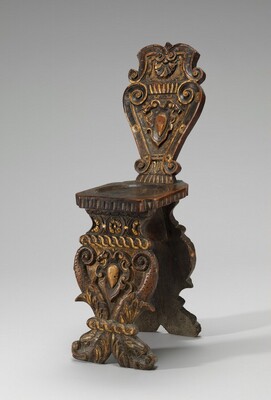
This is a photograph of an ornate wooden chair. The chair has intricate carvings and design elements throughout its structure. The backrest is detailed with scrollwork and central shields or cartouches framed by foliage designs. The seat is simple and flat, resting upon a similarly detailed base that continues the decorative motifs of scrolls and acanthus leaves. The chair appears to be made of dark wood, possibly enhanced with gold or gilded accents. The craftsmanship suggests it is an ornamental piece, possibly intended for decorative purposes as much as for utility.

Walnut Stool (Sgabello), Carved and Gilded

Italian 16th Century

The round bronze medallion features a raised relief sculpture depicting a scene with human figures and horses in motion. There are three figures depicted - one central figure standing elevated with an outstretched arm, and two figures on horseback flanking the central figure. The surface has a textured appearance. Around the edge, there is a border of dots, and the word "TENEBRARVM" is inscribed across the top. The medallion has a rich, earthy brown color due to the bronze material. The overall appearance suggests age and intricacy in craftsmanship.

Aurora Stepping from a Car [reverse]

Italian 16th Century

The sculpture is a chair-like piece with a tall, ornate backrest and intricately carved details. It features swirling patterns and symmetrical floral motifs in dark brown and golden hues. The material seems to be wood, with visible natural grain. The chair appears more like an artistic or ceremonial object rather than a practical piece of furniture, with a historical or ornate decorative style.

Walnut Stool (Sgabello), Carved and Gilded

Italian 16th Century

The sculpture features a profile relief of a female figure on an oval medallion. Her hair is styled and adorned with a ribbon or headdress. The medallion is made of bronze with a green patina. The figure has classical features and looks to the left. The sculpture is small with a small hole at the top.

Diana

Italian 16th Century

This is an image of a wooden armchair with leather upholstery. The chair has a high back, dark-stained wood, embossed leather with decorative patterns, metallic studs, a leather-upholstered seat with studs, simple arms, and intricately carved stretchers connecting the legs. The stretchers have a looped design.

Leather-covered Walnut Armchair

Italian 16th Century

The sculpture depicts a wooden chair with an intricate design. It features a rich brown hue and carved circular designs on the backrest. The arms extend horizontally with rounded edges. The base forms an X shape to support the seat, and the legs have detailed carvings along the edges.

Walnut Savonarola Chair with Incised Ornament

Italian 16th Century

The image depicts a person standing upright, holding a staff in their right hand. Their facial features are distinct, with downward glancing eyes and a defined jawline. The person's hair is medium length and slightly wavy, framing their face. They are dressed in a classical or medieval-style tunic with a cloak draped over their shoulders. The tunic has a skirt-like bottom with textured horizontal lines, and they are wearing tall boots. The background shows bold lines and patterns indicating rocks or cliffs, with a structure resembling a church or castle tower partially visible to the right.

Saint Roche

Italian 16th Century

The sculpture is a bell-shaped mortarium made of dark bronze. It features intricate designs including reliefs of horses and chariots in motion, as well as ornate garlands and classical motifs. The sculpture is a small, open-topped vessel with a slightly outward sloping rim, resting on a narrow base. The craftsmanship is highly detailed, making it both functional and artistic.

Mortar with Putti and Griffins

Italian 16th Century

The image shows a round bronze coin featuring a sculptural relief of a woman in profile, facing left. The woman is adorned with an intricately styled hairdo and wears a necklace with multiple strands. Her attire appears to be draped in classical fashion, with visible folds and texture depicted on the coin's surface. The sculpture is crafted from a material that gives a metallic sheen, typical of bronze, and the coin's surface shows variations in texture and patina. Around the edge of the coin, there is an inscription. The overall appearance of the coin reflects historical craftsmanship and artistry.

Faustina Romana [obverse]

Italian 16th Century